
Gig Economy Taxes
Instacart Didn't Pay Quarterly Taxes? What to Do Now (2026)
The short answer: if you earned Instacart income and didn't pay quarterly taxes, you owe the tax plus an underpayment penalty that accrues from each missed deadline — an interest-style charge, not a criminal problem. File on time, pay what you can now, and use a payment plan or other IRS program for the rest.
The deposits hit your account every week all year — batch pay, tips, peak boosts — and not one dollar was ever held back. Now you've searched "Instacart didn't pay quarterly taxes" because someone mentioned estimated payments and your stomach dropped. Here's the honest news: this is one of the most fixable tax problems there is, and the penalty is smaller than you're imagining. The map is below.
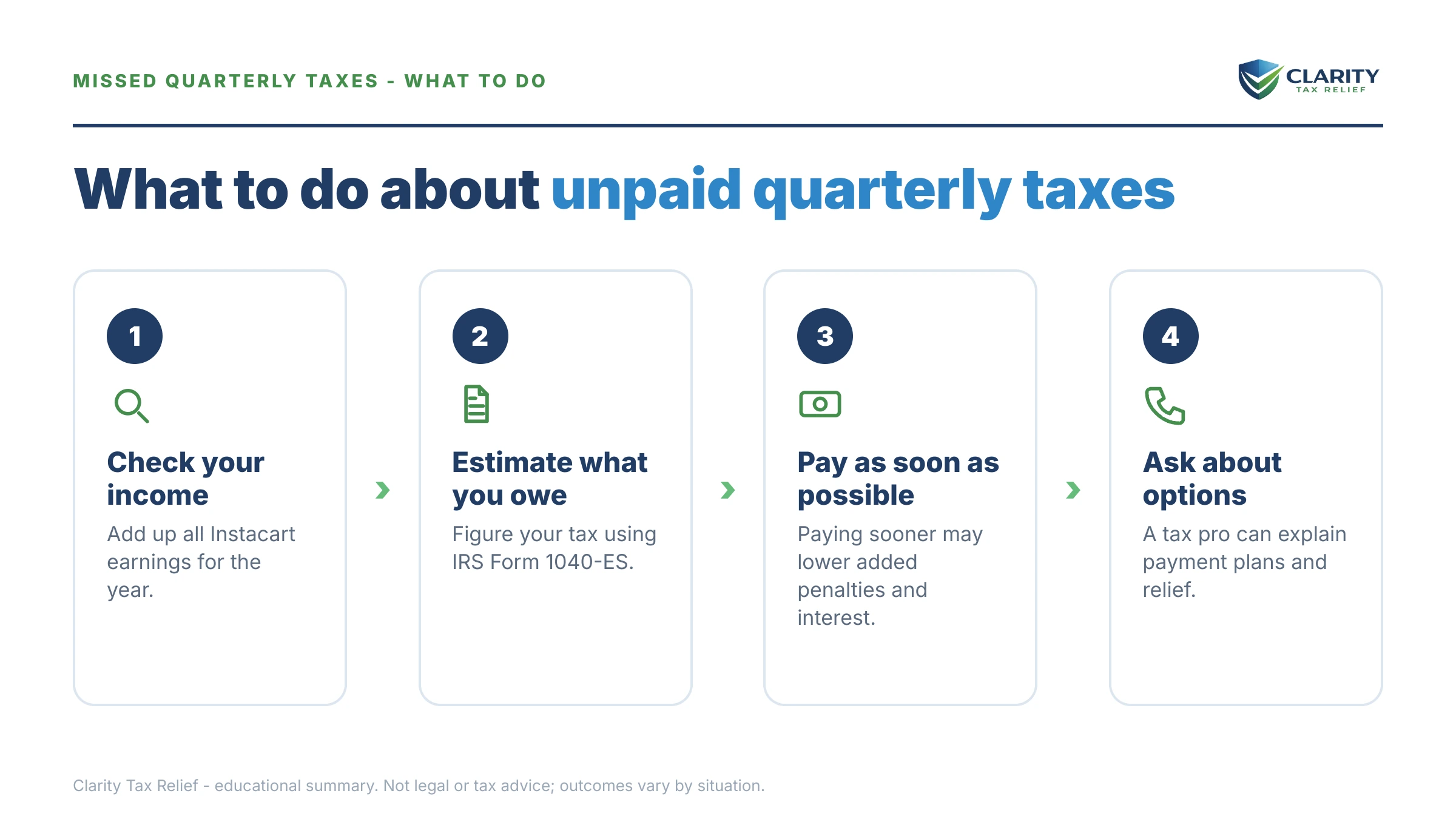
Two numbers decide everything from here: your net profit after mileage, and how many quarterly deadlines have already passed. The image below lays out the full path from a missed quarterly payment to an actual IRS bill, so you can see exactly where you stand on that timeline right now.
⏱ The real clock: the underpayment penalty accrues every day, counted separately from each quarterly deadline you missed, until the day you pay. There's no warning letter to wait for — the next Form 1040-ES due date is the only date the IRS gives you, and every payment you make stops the meter on that amount.
Why Instacart income blindsides shoppers at tax time
Instacart withholds nothing from full-service shopper pay — every batch payment and in-app tip lands in your account with zero tax taken out. In the IRS's eyes you are a self-employed sole proprietor running a delivery business, even if it never felt like a business.
That status carries two tax bills, not one. You owe regular income tax on your profit, plus 15.3% self-employment tax covering Social Security and Medicare — the piece a W-2 employer normally splits with you and pays behind the scenes. That self-employment tax is what shocks most first-year shoppers.
Because no one is withholding, the tax system expects you to pay as you go — four estimated payments a year. That's the whole point of quarterlies; the mechanics are covered in our guide to how quarterly estimated taxes work. Skip them, and the IRS charges you for the delay.
Three Instacart-specific details matter here:
- Your earnings are reported. Instacart issues Form 1099-NEC, typically through Stripe Express, and the IRS gets a copy. The computers will match it to your return whether or not you ever open the form.
- App tips count. Tips paid through the app flow into your reported earnings, and cash tips are taxable too — the tip line is often a third or more of a shopper's income.
- In-store shoppers are different. If you're an Instacart in-store shopper, you're a part-time W-2 employee with withholding, and the estimated-tax rules generally don't apply to that income. This article is for full-service (1099) shoppers.
If this was a side gig on top of a W-2 job, note one quirk that helps later: paycheck withholding is treated as paid evenly across the year, so raising it can retroactively cure missed quarterlies. Our guide on how much to set aside from a side hustle covers the prevention side for next year.
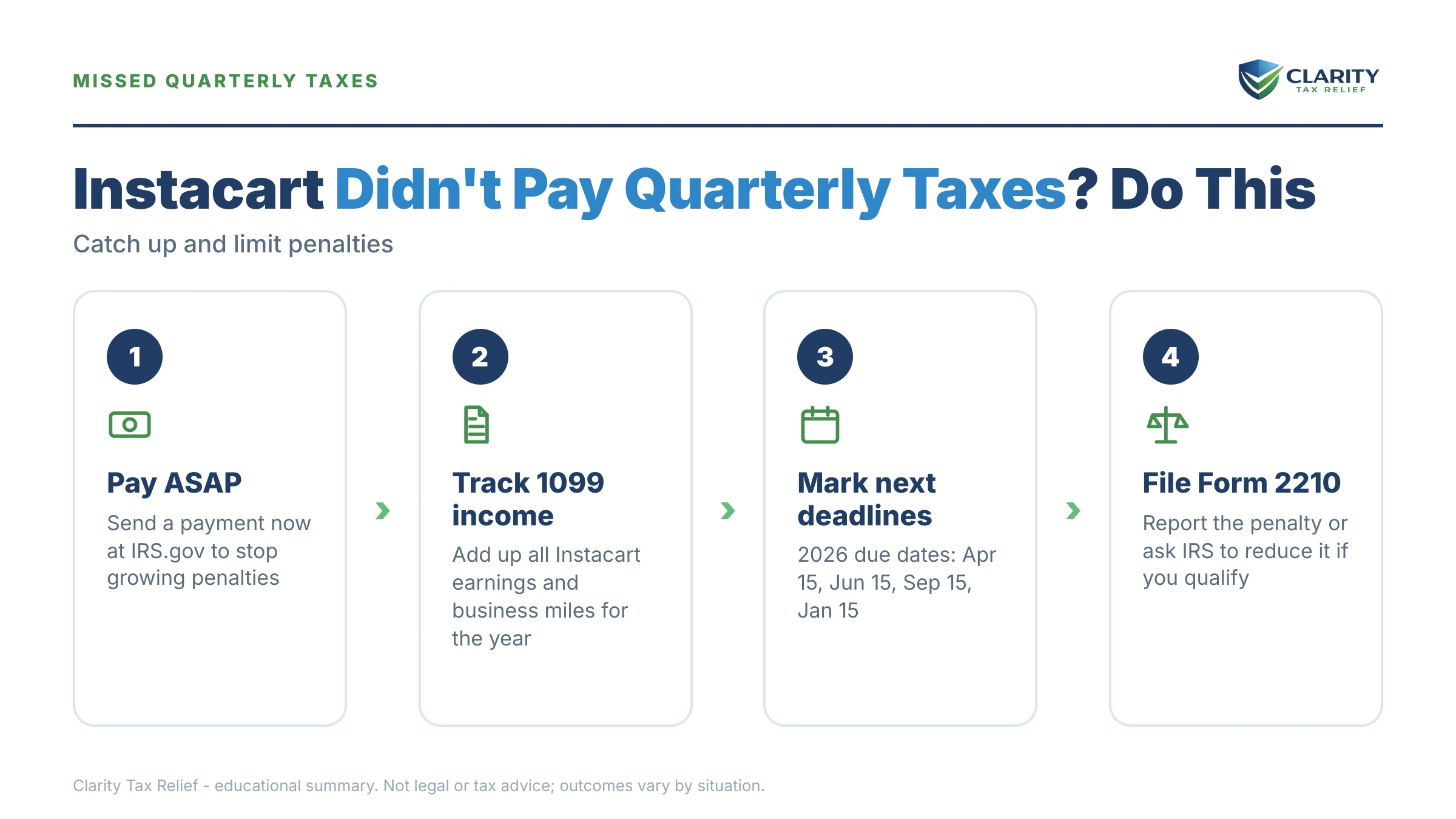
Didn't pay quarterly taxes on Instacart income? Here's what it actually costs
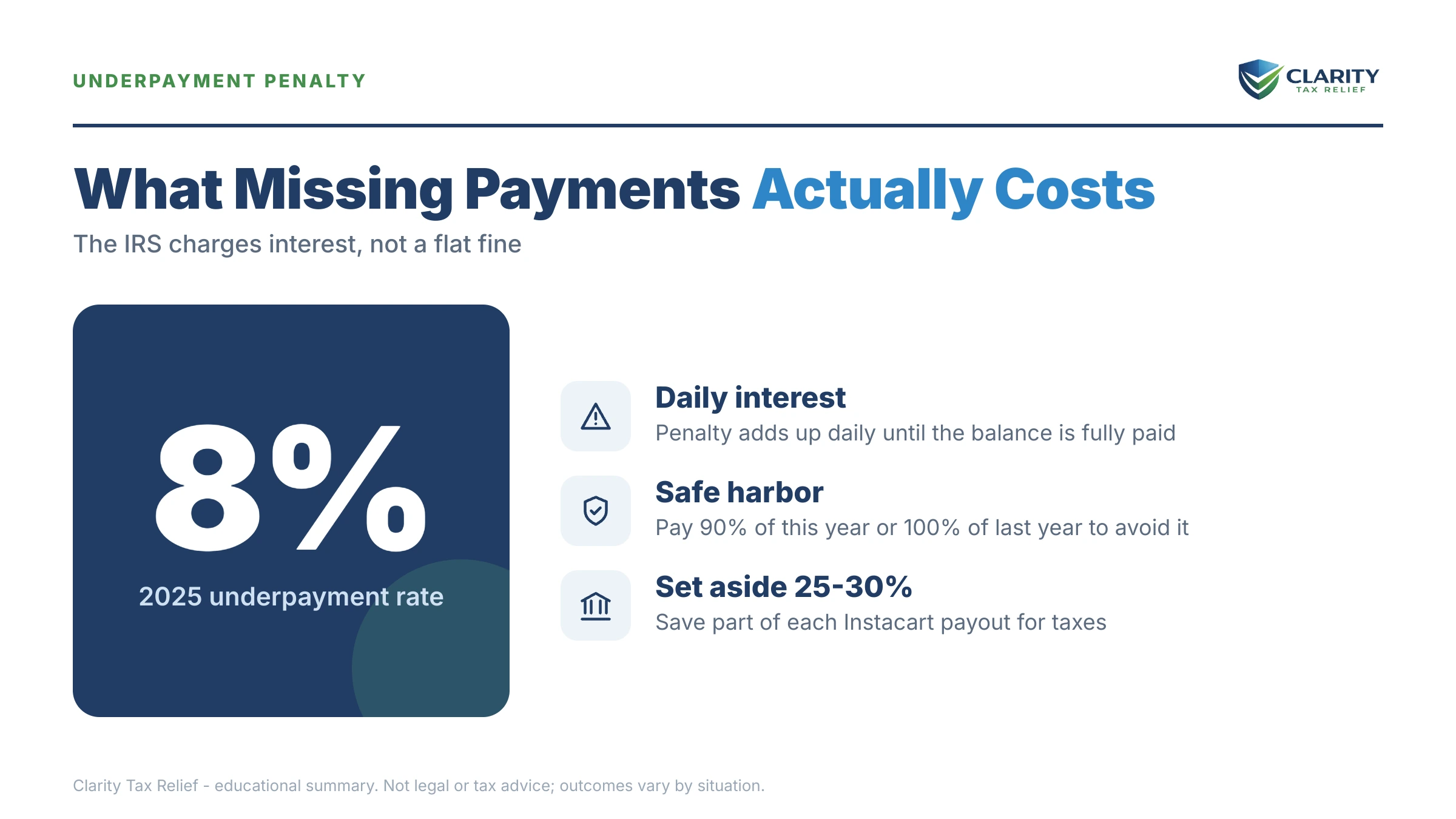
The estimated-tax penalty is an interest-style charge — recently in the range of 7–8% a year, prorated by the day — not the 5%-per-month penalty that punishes unfiled returns. That distinction is why panic is the wrong response and delay is the wrong strategy: it grows slowly, but it never stops on its own.
Here's the math on a realistic full-time year. Say you grossed $76,400 in batch pay and tips as a full-service shopper and paid nothing in during the year:
- Mileage deduction: 22,000 business miles at the standard mileage rate (70 cents per mile for 2025 — check the 2026 mileage rate for this year) = $15,400.
- Other expenses (insulated bags, phone portion, supplies): about $1,000.
- Net profit on Schedule C: $76,400 − $15,400 − $1,000 = $60,000.
- Self-employment tax: $60,000 × 92.35% = $55,410 × 15.3% ≈ $8,478.
- Income tax: after the half-of-SE-tax deduction (about $4,239) and the standard deduction, roughly $4,650 for a single filer.
- Total tax: about $13,100 — which should have gone in as four payments of roughly $3,275 each.
The underpayment penalty on that miss, at recent rates, typically lands somewhere around $450–$550 by the time the return is filed — real money, but a rounding error next to the $13,100 itself. You can estimate your own figure with our Penalty & Interest Calculator; the full formula lives in our guide to the penalty for not paying estimated taxes.
Notice what did the heavy lifting in that example: the 22,000 miles cut the taxable profit by over $15,000. If you didn't keep a log, don't concede the deduction — our guide for shoppers and drivers who didn't track miles shows how to reconstruct a defensible record from app history, odometer photos, and bank statements.
And after April 15, the problem changes shape. Any unpaid balance starts accruing the 0.5%-per-month failure-to-pay penalty (about $65/month on $13,100) plus daily compounding interest — a second, faster meter on top of the first.
The quarterly deadlines you missed — and the next one
Estimated taxes are due in four unequal installments: April 15, June 15, September 15, and January 15 of the following year. Each missed date starts its own penalty clock, which is why catching up on the next deadline still helps even when earlier ones are gone.
| Income earned | Payment due | If you haven't paid it |
|---|---|---|
| Jan 1 – Mar 31, 2026 | April 15, 2026 | Penalty accrues daily on that installment until paid |
| Apr 1 – May 31, 2026 | June 15, 2026 | Its own separate penalty clock starts on June 16 |
| Jun 1 – Aug 31, 2026 | September 15, 2026 | Still payable — paying stops future accrual on it |
| Sep 1 – Dec 31, 2026 | January 15, 2027 | Not missed yet — hit this one even if others are gone |
Full dates and edge cases (weekends, disaster extensions) are in our quarterly estimated tax deadlines 2026 guide. Three catch-up moves still work mid-year:
- Pay now, in any amount. The penalty stops on every dollar the day it posts. A late quarterly is dramatically cheaper than a skipped one.
- Use withholding if you have any. If you or a spouse has a W-2 job, withholding is treated as paid evenly all year — raising it before December 31 can erase underpayments from quarters you already missed.
- Know your safe harbors. No penalty applies if you owe under $1,000 at filing, or if you paid in at least 90% of this year's tax or 100% of last year's total tax (110% if your AGI was over $150,000). If last year's tax was small — say, your first year shopping — the prior-year safe harbor can be surprisingly cheap to hit.
What happens if you ignore missed quarterly taxes
A missed quarterly never triggers an immediate IRS letter — the bill only becomes visible when you file, or when the IRS notices you didn't. From there, the sequence is automated and runs in a fixed order:
- During the year — the penalty quietly accrues from each missed due date. No mail, no login alert. This is the silent stage you're in now.
- At filing — Form 2210 adds the underpayment penalty to your return. If you can't pay the balance, the 0.5%-per-month failure-to-pay penalty and daily interest begin. If the IRS recalculates your penalty afterward, a CP30 notice explains the change.
- CP14 notice — the first bill for the unpaid balance, with roughly 21 days to respond before the next notice queues up.
- CP501 / CP503 — reminder bills. Still no enforcement, but the balance compounds monthly.
- CP504 — intent to levy your state tax refund under IRC §6331(d). A federal tax lien becomes a live possibility.
- LT11 / Letter 1058 — final notice of intent to levy, starting a 30-day clock and your Collection Due Process rights (Form 12153).
- Levy — after that window, the IRS can freeze a bank account (funds held 21 days before they're taken) or send a levy directly to Instacart and intercept your contractor payments at the source, though a contractor levy generally captures only what Instacart owes you on the day it is served — the IRS has to issue new levies to reach future payouts, which it can and does.
- If you never file at all — the failure-to-file penalty (5% per month) stacks on, and the IRS can eventually file a substitute return using the 1099-NEC alone: no mileage, no expenses, maximum tax.
One 2026 reality worth knowing: the IRS workforce shrank roughly 27% in 2025, but this notice stream is fully automated. Humans are harder to reach; the machine that escalates your file never stopped.
Behind on a year of Instacart quarterlies?
Penalties and interest are accruing on the balance every day it sits. An experienced tax professional will run your real numbers — mileage included — and map the cheapest way out, free and confidential.
Your options if you can't pay the Instacart tax bill
The IRS offers a short-term payment plan of up to 180 days with no setup fee, and online installment agreements of up to 72 months for balances of $50,000 or less. Which option fits depends almost entirely on the size of the balance and what your finances can honestly support — the full DIY playbook is our guide on how to settle tax debt yourself.
| Option | Who typically qualifies | Setup cost | Timeline & what keeps accruing |
|---|---|---|---|
| Pay in full | Anyone with the cash or credit | $0 | Immediate; all penalty and interest accrual stops |
| Short-term payment plan | Can clear the balance within 180 days | $0 | Interest + late-pay penalty accrue until paid off |
| Long-term installment agreement | Total balance ≤ $50,000 — set up online, up to 72 months (≤ $10,000 may fit the guaranteed installment agreement) | Modest setup fee; lower with direct debit, reduced or waived for low-income taxpayers | Interest continues; the late-pay penalty rate is cut in half while the plan is current |
| Currently Not Collectible | Paying anything would leave you unable to cover basic living expenses (shown on Form 433-F) | $0 | Collection pauses; the balance still grows and the IRS reviews your income periodically |
| Offer in Compromise | Assets plus future income genuinely can't cover the debt — the IRS runs the math | $205 fee + 20% down on lump-sum offers (both waived with low-income certification) | Months to over a year; the IRS accepted roughly 1 in 5 offers in FY2024 |
| Penalty relief (Form 2210) | Casualty, disaster, recent retirement/disability, or income that arrived unevenly (annualized method) | $0 | Reduces or removes the estimated-tax penalty — never the tax itself |
Two notes specific to shoppers. First, the annualized income method is built for gig income — if your earnings spiked around holidays and slumped in summer, recomputing the penalty quarter by quarter often shrinks it; the paths are in our estimated tax penalty waiver guide. Second, if you're reading this in early spring with the return not yet filed, the priority order in can't pay taxes by April 15 applies: file first, resolve the balance second. Official plan terms are on the IRS payment plans page.
How to respond, step by step
- Pull your real Instacart numbers. Download your year-to-date earnings from the Instacart app and your 1099-NEC from Stripe Express so you're working from actual figures, not guesses.
- Reconstruct your mileage and expenses. Rebuild your business miles and costs before you calculate anything — every deductible dollar shrinks the tax, the penalty, and the interest at the same time.
- File on time, even if you can't pay. Filing stops the 5%-per-month failure-to-file penalty from ever starting; the unpaid balance can be resolved separately.
- Pay whatever you can now. Send it through IRS.gov/payments — the underpayment penalty and interest stop accruing on every dollar the moment it posts, so partial payments are never wasted.
- Set up a plan for the remainder. Choose a short-term plan, an installment agreement, or hardship status — or get a free professional review if the balance is large or covers multiple years.
When you can handle this yourself — and when help changes the outcome
Most shoppers with one year of missed quarterlies and a balance under about $10,000 can fix this alone. At that level you're in guaranteed installment agreement territory: the return gets filed, the plan gets set up online in an evening, and the penalty is a manageable line item. Why pay for help you don't need? The math on filing even if you can't pay is the same whether a professional files it or you do.
Experienced help earns its cost in specific situations: multiple unfiled years (the order you file and resolve them changes the total), a balance over $50,000 (financial disclosure required, negotiation matters), mileage records that are thin enough to invite scrutiny, a levy notice already in hand, or genuine hardship where CNC or an Offer in Compromise is on the table — self-employment income makes that math easy to get wrong in both directions.
Terms on your tax forms, decoded
- 1099-NEC — the form Instacart uses to tell the IRS what it paid you; "NEC" means nonemployee compensation, i.e., contractor income with nothing withheld.
- Self-employment tax — the 15.3% Social Security and Medicare tax you pay on net profit because there's no employer paying half of it for you.
- Form 1040-ES — the worksheet-and-voucher package for making quarterly estimated payments (official page: About Form 1040-ES).
- Safe harbor — the payment level that shields you from the penalty entirely: 90% of this year's tax, or 100% of last year's (110% for higher incomes).
- Form 2210 — the form that calculates the underpayment penalty on your return, and the only place its waivers and the annualized income method live.
- Failure-to-pay penalty — the separate 0.5%-per-month charge that starts only after April 15 on any balance you didn't pay with the return.
Instacart quarterly tax questions, answered
What happens if you don't pay quarterly taxes on Instacart income?
You owe an underpayment penalty on top of the tax itself, calculated separately from each missed quarterly deadline until you pay. It works like interest — at recent rates, roughly 7–8% annualized — not like the harsh 5%-per-month failure-to-file penalty. The bigger risk is arriving at April 15 with a five-figure bill and no plan, which is where the IRS collection sequence begins.
Does Instacart take taxes out of your pay?
No — full-service Instacart shoppers are independent contractors, so nothing is withheld from batch pay or tips. You're responsible for both income tax and 15.3% self-employment tax on your net profit. The exception is in-store shoppers, who are part-time W-2 employees with normal withholding; if you're paid on a W-2, the estimated-tax rules generally don't apply to that income.
How much should I set aside from Instacart earnings for taxes?
Most full-time shoppers should set aside 25–30% of net earnings — what's left after mileage and expenses — and send it in four quarterly payments. Your exact number depends on total household income, filing status, and your state. If Instacart is a side gig on top of a W-2 job, you can often skip quarterlies entirely by raising the withholding at your main job instead.
Can the IRS waive the estimated tax penalty?
Sometimes — but not through first-time penalty abatement, which does not cover the estimated-tax penalty. Form 2210 has its own relief: a waiver for casualty, disaster, or unusual circumstances, an exception for recent retirement or disability, and the annualized income method, which recalculates the penalty when income arrived unevenly through the year. Because Instacart earnings often spike seasonally, the annualized method alone can cut the penalty meaningfully.
Do I still owe the penalty if I pay everything by April 15?
Usually yes. The underpayment penalty runs from each missed quarterly due date to the date you actually pay, so paying in full with your return stops future accrual but doesn't erase what already built up. Two safe harbors avoid it entirely: owing under $1,000 when you file, or having paid in at least 100% of last year's total tax (110% if your AGI topped $150,000).
What if I never got a 1099 from Instacart?
You still owe tax on every dollar. Instacart issues Form 1099-NEC — typically through Stripe Express — to shoppers who cross the reporting threshold, and the IRS gets a copy, which its computers match against your return. If no form arrived, pull your earnings history from the app and report the actual total; a missing form is never a defense for unreported income.
What if I haven't filed my tax return at all?
File now, even if you can't pay a cent. The failure-to-file penalty runs 5% per month — ten times the 0.5% failure-to-pay penalty — so an unfiled return is the most expensive version of this problem. Filing also starts the clock on your payment options; the IRS won't approve a payment plan or other resolution while required returns are missing.
Your next 24 hours
- Open the Instacart app and Stripe Express and write down two numbers: your year-to-date (or full-year) gross earnings, and the total on your 1099-NEC if one was issued.
- Gather last year's tax return and any mileage evidence — app trip history, odometer photos, maintenance receipts, bank statements. Even partial records rebuild a deduction worth thousands.
- Get your numbers reviewed free — the 2-minute form at the top of this page or (888) 825-7779. Penalties and interest accrue on this balance every day it goes unaddressed; a 15-minute call tells you exactly which option fits and what it will cost.
This guide is general information, not tax or legal advice for your specific situation. Eligibility for IRS programs depends on individual facts and circumstances; no outcome is guaranteed.