
Self-Employed Taxes
2026 Mileage Rate: How Self-Employed Contractors Owe Less on Taxes
The short answer: the 2026 mileage rate lets self-employed workers deduct every business mile, cutting both income tax and the 15.3% self-employment tax at the same time. The IRS sets the rate each December — the 2025 rate was 70 cents per mile — so 18,000 business miles can trim a tax bill by thousands.
You finished your Schedule C, saw the number at the bottom, and did the math twice because it couldn't be right. Nobody withheld a dime from your 1099 checks, and now the IRS wants a bill you don't have sitting in checking. Here's what most contractors in that exact spot miss: the miles you drove to earn that income are the single fastest legal way to shrink the bill — this year's quarterlies, and possibly the last three years' balances too. The image below shows how a business mile actually flows through your return and cuts your bill in two separate places — worth a look before you run your own numbers.
⏱ Your next real deadline: September 15, 2026 — the third-quarter estimated tax payment. Miss it and the underpayment penalty starts accruing from that date, even if you pay everything by next April. And if you already owe for a past year, interest on that balance compounds daily while you decide.

Why 1099 contractors owe so much in the first place
A self-employed contractor pays 15.3% self-employment tax on top of regular income tax — with no employer withholding any of it. That 15.3% covers both halves of Social Security and Medicare, applied to 92.35% of your net Schedule C profit. The 12.4% Social Security portion applies only to net earnings up to the 2026 wage base of $184,500 — above that, only the 2.9% Medicare portion (plus the 0.9% Additional Medicare Tax over $200,000) continues to apply. It's why a first tax bill on 1099 income feels roughly double what a W-2 job at the same pay ever produced — the mechanics are covered in our guide to self employment tax owe irs.
The flip side of that math is the opportunity. Every dollar of legitimate business expense reduces the profit that both taxes are computed on. And for anyone who drives for their income — couriers, rideshare drivers, tradespeople, mobile service providers, sales reps on 1099s — vehicle miles are almost always the largest expense on the return.
One more 2026 wrinkle: the 1099-k 20000 threshold 2026 reversion means many platforms won't send a 1099-K unless you cross $20,000 and 200 transactions. The income is still fully taxable either way — but so are the miles fully deductible either way. Don't let a missing form talk you out of reporting, and don't let it talk you out of deducting. If this is your first year on contractor income, our first year self employed owe taxes guide covers the whole shock in one place.
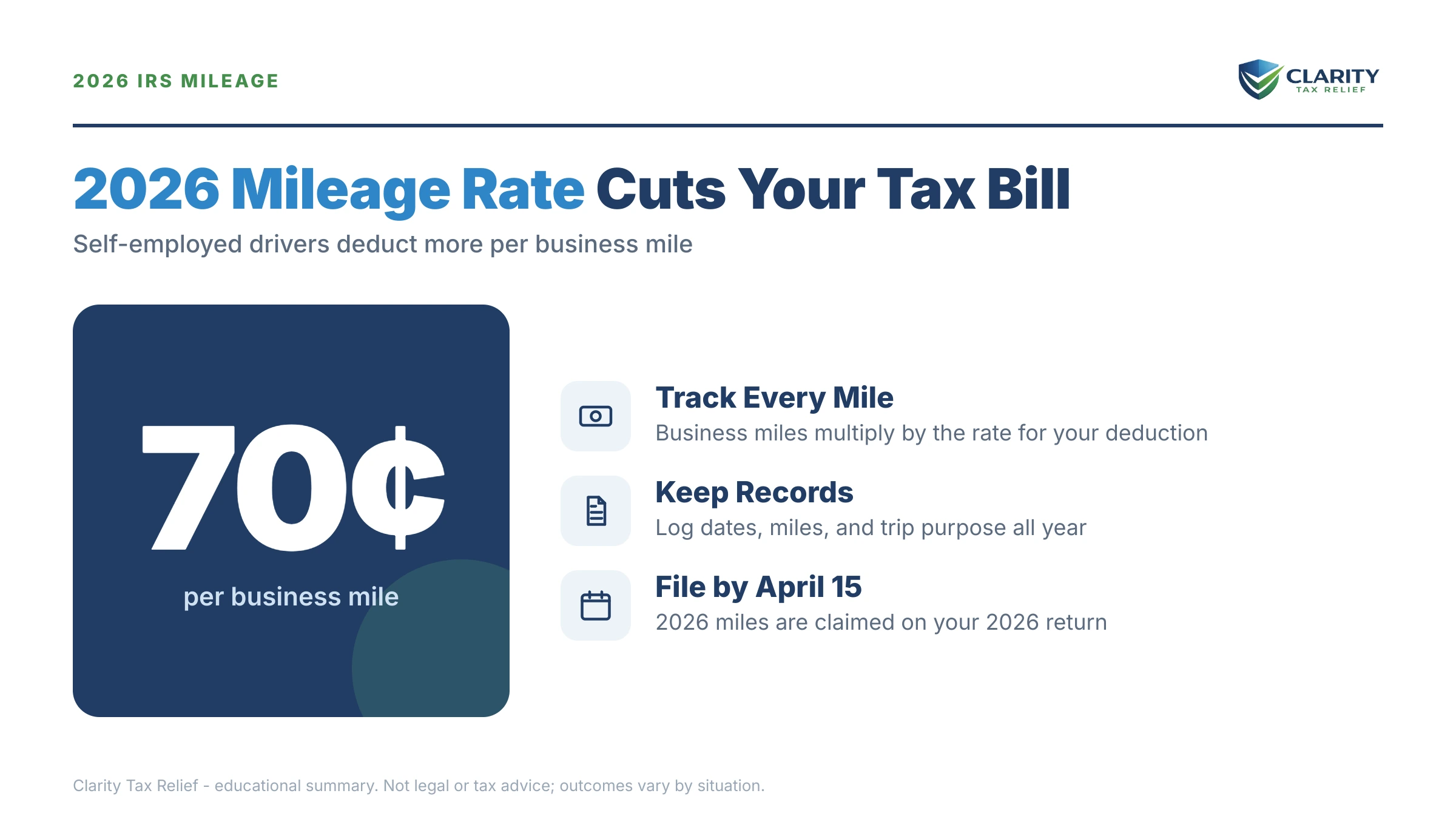
How the 2026 mileage rate helps self-employed contractors owe less
The standard mileage rate turns every business mile into a deduction that cuts income tax and the 15.3% self-employment tax simultaneously. The IRS publishes each year's rate in a notice the preceding December; the 2025 business rate was 70 cents per mile, and you should confirm the current 2026 figure on the IRS standard mileage rates page (linked below) before you file. The examples in this article use the most recent published 70-cent rate for illustration.
What counts as a business mile:
- Driving between job sites, gigs, or deliveries during the day
- Trips to clients, suppliers, the bank for business, or to pick up materials
- Miles driven while a gig app has you on an active trip or heading to one
- Trips from a qualifying home office to any work location
What doesn't: ordinary commuting from home to a regular workplace, personal errands folded into a work day, and miles you can't tie to a business purpose. The line matters because the IRS requires you to substantiate business miles with records — date, mileage, destination, and purpose — and a vehicle deduction is one of the first things examined on a Schedule C.
Here's the arithmetic that makes each mile worth more than it looks. At an illustrative 70 cents, 1,000 business miles is a $700 deduction. That $700 saves roughly $99 in self-employment tax ($700 × 92.35% × 15.3%) plus about $154 in income tax for someone in the 22% bracket — call it roughly $250 back per 1,000 miles. A contractor logging 20,000 business miles a year is leaving around $5,000 on the table by not claiming them.
Worked example: an $83,100 contractor with 18,000 business miles
Say you're a 1099 contractor who nets $83,100 on Schedule C in 2026 before counting your vehicle, and your records show 18,000 business miles. Here's the math, using the illustrative 70-cent rate:
- Mileage deduction: 18,000 × $0.70 = $12,600
- Self-employment tax without it: $83,100 × 92.35% × 15.3% ≈ $11,742
- Self-employment tax with it: $70,500 × 92.35% × 15.3% ≈ $9,961 — a saving of about $1,781
- Income tax saved at a 22% marginal rate: $12,600 × 22% ≈ $2,772
- Combined reduction: roughly $4,550 — before the smaller ripple effects, like the larger deduction for half your self-employment tax
Spread across four estimated payments, that's about $1,138 less due each quarter. This is a hypothetical illustration, not a promise — your bracket, state, and actual rate will move the figures — but the structure holds for every driving contractor: the deduction hits two taxes, not one.
Standard mileage vs. actual expenses: pick the right method
You can deduct your vehicle one of two ways, and the choice you make in a car's first business year controls which methods stay available for that car later.
| Factor | Standard mileage rate | Actual expenses |
|---|---|---|
| What it covers | Gas, oil, repairs, tires, insurance, registration, and depreciation — all bundled into one per-mile figure | Every real vehicle cost, prorated by your business-use percentage |
| Records required | A mileage log: date, miles, destination, business purpose | The same mileage log plus every receipt — fuel, repairs, insurance, lease or depreciation schedules |
| Usually wins when | High miles on an economical or paid-off car | Lower miles on an expensive, new, or heavily financed vehicle |
| First-year rule | Claiming standard mileage in the car's first business year preserves your right to switch methods later | Claiming accelerated depreciation in year one locks that car out of the standard rate permanently |
| Deductible either way | Parking fees and tolls | Parking fees and tolls |
Two traps worth flagging. If you lease and choose the standard rate, you must stick with it for the entire lease term. And whichever method you use, you still need the mileage log — actual expenses are prorated by business-use percentage, and only a log proves the percentage.
Cut your 2026 quarterlies with the deduction built in
Self-employed taxpayers owe tax four times a year, and the underpayment penalty runs separately from each quarterly date you miss. Most contractors who owe every April got there by estimating quarterlies off gross income — without subtracting the mileage they were entitled to. Build the deduction into your quarterly estimated tax deadlines 2026 math and each payment shrinks immediately.
| Income period | Payment due | If you miss it |
|---|---|---|
| January 1 – March 31, 2026 | April 15, 2026 | Underpayment penalty (Form 2210) accrues from this date on the shortfall |
| April 1 – May 31, 2026 | June 15, 2026 | A second, separate penalty clock starts on this quarter's shortfall |
| June 1 – August 31, 2026 | September 15, 2026 | Third clock starts — this is the next deadline as of this writing |
| September 1 – December 31, 2026 | January 15, 2027 | Fourth clock starts; all four run until each shortfall is paid |
A safety valve if your income swings: paying in 100% of last year's total tax (110% if your adjusted gross income topped $150,000) generally protects you from the penalty regardless of what you end up owing. Already missed a quarter or two? The penalty math and your fix options are in didn't pay estimated taxes penalty.
What happens if you file, owe, and do nothing
An unpaid self-employment tax balance rides the same automated notice ladder as every IRS debt — and it ends at a levy that isn't limited by paycheck exemption tables. The sequence, in order:
- Balance assessed — interest starts immediately, and the failure-to-pay penalty adds 0.5% of the balance every month.
- CP14 notice — the first bill, with roughly 21 days before the system queues the next letter (only 10 business days when the balance is $100,000 or more).
- CP501 / CP503 — reminder notices while the balance compounds. How fast it compounds is laid out in irs interest rate on back taxes 2026.
- CP504 — intent to levy your state tax refund, with a federal tax lien now a live possibility.
- LT11 / Letter 1058 — the final notice. A 30-day clock starts on your Collection Due Process rights; after it runs, the IRS can levy bank accounts and reach your contractor pay.
- Levy on 1099 income — unlike a W-2 garnishment, a levy served on your client or platform isn't capped by wage exemption tables. It can capture an entire invoice or payout owed to you at that moment.
Every stage of that ladder is automated — the 2026 IRS workforce cuts made a human harder to reach, but the notices and levies never needed one. You can estimate what your balance is adding each month with our Penalty & Interest Calculator.
Owe the IRS on 1099 income right now?
Whether you under-claimed miles, missed quarterlies, or both — interest and the monthly late-payment penalty are accruing while you decide. Get a free review of your Schedule C years and your resolution options from an experienced tax professional. No pressure, no obligation.
If you still owe after every deduction: your options
The mileage deduction shrinks the bill; these programs handle whatever is left. Which one fits depends on the size of the balance and your real ability to pay:
| Option | Typical eligibility | Cost & key terms |
|---|---|---|
| Pay in full | Any balance | Stops the failure-to-pay penalty and interest immediately; always the cheapest total |
| Short-term payment plan | Can clear the balance within 180 days | $0 setup fee; interest and the 0.5%/month penalty continue until paid |
| Guaranteed installment agreement | Owe $10,000 or less in tax, with a compliant filing history | Approval is set by statute if you pay within 3 years and stay current |
| Online installment agreement | Combined balance up to $50,000 | Up to 72 monthly payments; setup fee is lower with direct debit; interest continues |
| Currently Not Collectible | Income doesn't cover IRS allowable living expenses | Collection pauses; the balance still accrues interest and the IRS reviews your finances periodically |
| Offer in Compromise | Assets plus future income genuinely fall below the balance | $205 fee plus 20% down on lump-sum offers — both waived with low-income certification; the IRS accepted roughly 1 in 5 offers in FY2024 |
Note the sequencing: file (or amend) first, then resolve. An installment agreement or offer built on an inflated balance — one that never got the mileage deduction — means paying down debt you never actually owed. Fix the number, then finance what's real. The full do-it-yourself playbook for these programs lives in our guide on how to settle tax debt yourself.
How to use the mileage deduction to owe less, step by step
- Pull every mileage record you have — export trip histories from gig apps, mileage apps, and GPS, gather calendars and job invoices, and photograph your current odometer today so you have a fixed reference point.
- Separate business miles from commuting and personal miles — only miles driven for business count: trips between jobs, to clients, and for supplies. Home-to-regular-workplace commuting does not, unless a qualifying home office changes the analysis.
- Run the math both ways for your vehicle — compare the standard mileage total against actual expenses before choosing; the method you claim in a car's first business year controls which methods stay available later.
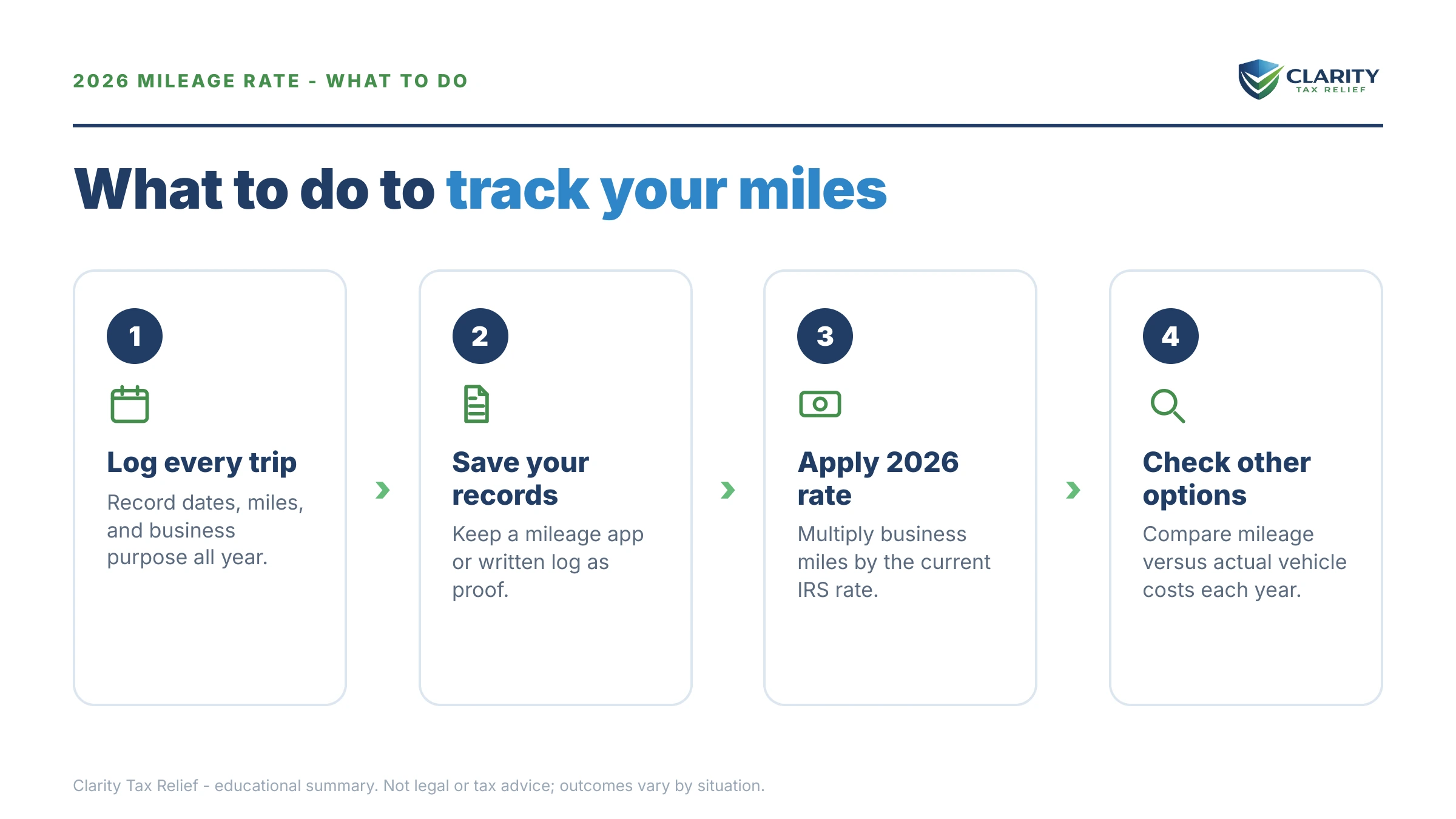
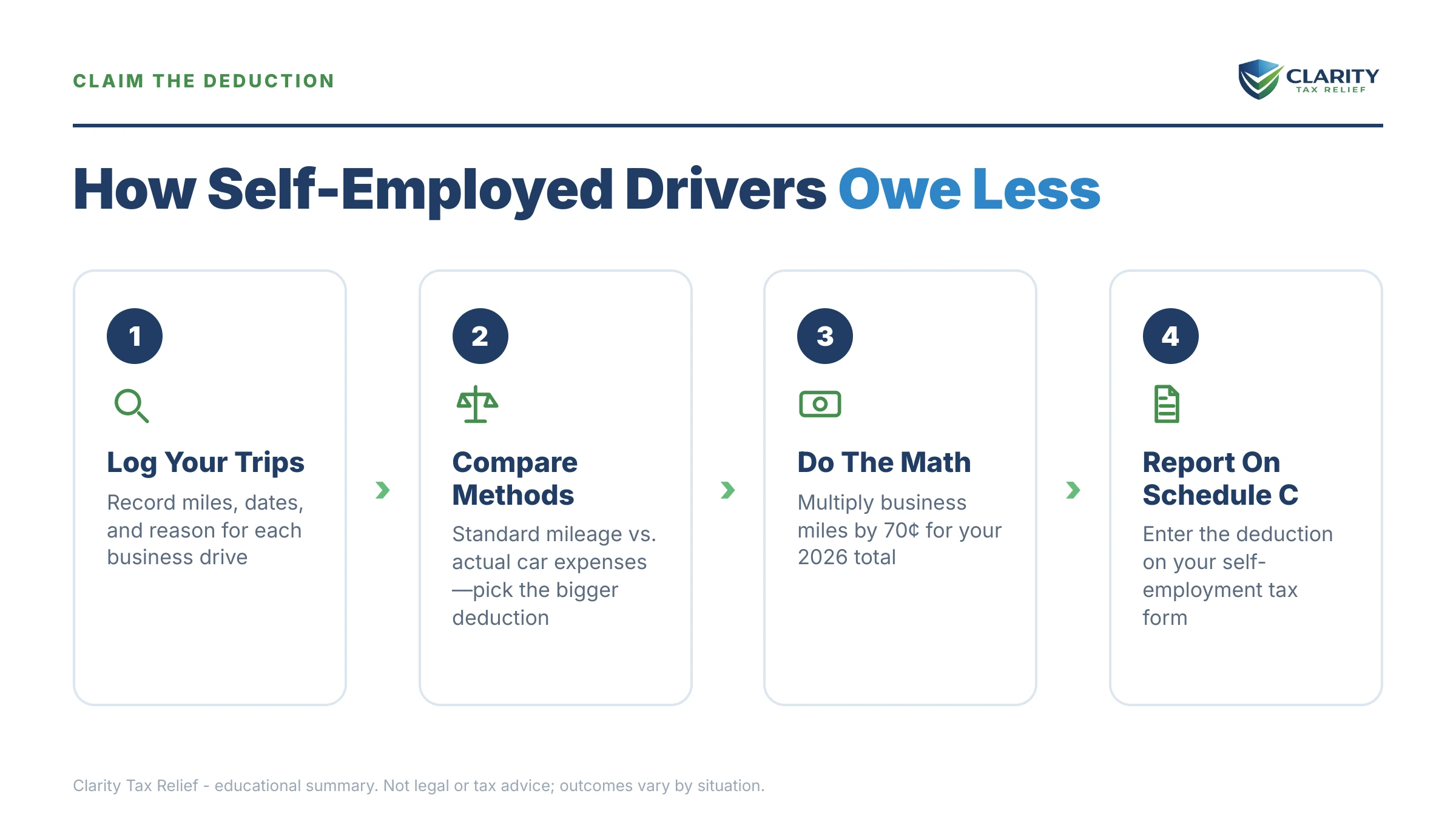
- Enter the deduction on Schedule C — report your vehicle details in Part IV and the deduction on Line 9. For a past year you under-claimed, file Form 1040-X with a corrected Schedule C instead.
- Rebuild your 2026 quarterly estimates — recalculate your Form 1040-ES payments with the deduction built in, so each remaining quarter reflects what you will actually owe.
- Set up a resolution for any balance that remains — pick the payment option that fits your leftover balance now, before the automated notice sequence escalates and adds enforcement power.
Didn't track your miles? You can still fix this year — and the last three
The IRS accepts reconstructed mileage logs built from credible third-party records — it does not accept round-number guesses. Platform trip summaries, GPS history, calendar entries, job invoices, oil-change receipts showing odometer readings, and toll records can rebuild a defensible log month by month. The full reconstruction method is in didn't track miles doordash taxes, and if an examiner has already asked for your records, start with irs wants mileage log instead — the stakes and sequencing change once an exam is open.
For past years, the fix is Form 1040-X with a corrected Schedule C. Refund claims generally must be filed within three years of the original return's due date — so a 2023 return filed on time in April 2024 has a window running into 2027. If you owe for that year instead of expecting a refund, the amendment reduces the assessed balance directly, and the penalties and interest computed on it shrink with it. The strategy and its limits are covered in amend return to reduce tax debt.
When you can handle this yourself
Plenty of contractors don't need professional help for this. Handle it yourself if you kept an app-based mileage log, you're fixing a single year, your Schedule C is straightforward, and any balance left is something you can pay within 180 days or on a simple online plan. The IRS's own tools cover that path end to end.
Experienced help tends to change the outcome when the picture is messier: multiple years unfiled or under-claimed at once, a reconstruction the IRS is actively examining, a CP504 or LT11 already in hand with a levy clock running, a combined balance over $50,000 that requires financial disclosure, or an Offer in Compromise where the asset-and-income math decides everything. In those cases the order of operations — returns first, penalties second, balance last — routinely changes what you pay, and getting it wrong is expensive to undo.
Terms on your Schedule C, decoded
- Standard mileage rate — the IRS's all-in per-mile figure covering gas, repairs, insurance, and depreciation, set each December for the following year.
- Commuting miles — trips between home and a regular workplace; never deductible, no matter how far.
- Contemporaneous log — a mileage record kept at or near the time of each trip; the gold standard of proof if the IRS ever asks.
- Self-employment tax — the 15.3% Social Security and Medicare tax on 92.35% of net Schedule C profit, paid on top of income tax.
- Safe harbor — paying 100% of last year's tax (110% for higher incomes) through the year to avoid the underpayment penalty entirely.
- Underpayment penalty — the Form 2210 charge that accrues from each quarterly deadline you underpay, computed at the IRS interest rate.
Primary sources worth bookmarking: the IRS's official standard mileage rates page (always the authoritative current-year figure), the Schedule C instructions and form, and IRS.gov/payments for estimates and balances.
2026 mileage rate questions, answered
What is the standard mileage rate for 2026?
The IRS announces each year's standard mileage rate in a notice published the preceding December — the 2025 business rate was 70 cents per mile, and the current 2026 figure is posted on the IRS standard mileage rates page. Whatever the current number, the mechanics are the same: multiply your business miles by the rate and deduct the total on Schedule C. Always use the rate for the year you drove the miles, not the year you file.
Does the mileage deduction reduce self-employment tax?
Yes — and that is what makes it more valuable than most deductions. Because mileage is a Schedule C business expense, it lowers your net profit before the 15.3% self-employment tax is calculated, and it lowers your income tax at the same time. A W-2 employee's deductions only touch income tax; a contractor's mileage deduction cuts both layers.
Can I claim mileage if I didn't keep a log?
You can reconstruct one, but you cannot simply guess. The IRS accepts logs rebuilt from credible records — rideshare and delivery app trip summaries, calendar appointments, job invoices, GPS history, and odometer readings — as long as the result is specific and consistent. A round number with no support behind it is exactly what gets a vehicle deduction disallowed in an exam.
Can I deduct gas on top of the standard mileage rate?
No. The standard mileage rate already bundles gas, oil, repairs, insurance, registration, and vehicle depreciation into one per-mile figure, so claiming fuel receipts on top of it double-counts the expense. You can, however, separately deduct parking fees, tolls, and the business-use share of car loan interest and personal property tax — those sit outside the rate.
Do miles from home to my first job site count?
Usually not — driving from home to a regular place of work is commuting, which is never deductible. Miles between job sites, to client meetings, to pick up supplies, or between gig platform trips do count. The big exception: if your home qualifies as your principal place of business under the home office rules, trips from home to work locations generally become deductible business miles.
Can I amend past returns to claim mileage I missed?
Yes. File Form 1040-X with a corrected Schedule C for each year you under-claimed. If the amendment produces a refund, you generally must file within three years of the original return's due date to collect it. If you owe back taxes for that year, the amendment reduces the assessed balance instead — which also shrinks the penalties and interest calculated on it.
Will a large mileage deduction trigger an audit?
High vehicle deductions on Schedule C do draw scrutiny, especially when the miles look implausible against the income reported. That is a reason to keep records, not a reason to skip a deduction you legally earned. If the IRS ever asks, a contemporaneous or well-reconstructed log showing dates, destinations, miles, and business purpose resolves the question quickly.
What if I still owe after claiming every mile?
You have structured options: up to 180 days to pay in full with no setup fee, a monthly installment agreement of up to 72 months for combined balances under $50,000, hardship status that pauses collection, or — where your finances genuinely support it — an Offer in Compromise. Interest keeps accruing under most options, so the cheapest path is the shortest one you can realistically afford.
Your next 24 hours
- Photograph your odometer and export your trip data. Tonight's odometer photo plus your app and GPS histories are the raw material for every mile you'll ever claim — capture them before anything else gets deleted or overwritten.
- Gather last year's return, your 1099s, and any IRS notices. Line 9 of your last Schedule C tells you in one glance whether you've been leaving the vehicle deduction on the table — and by roughly how much.
- Get a free case review. If you owe on 1099 income, an experienced tax professional can tell you whether amending, adjusting your quarterlies, or a payment arrangement — or all three — cuts your total cost most, while interest and penalties are still accruing on the current number. Use the 2-minute form or call (888) 825-7779.
This guide is general information, not tax or legal advice for your specific situation. Eligibility for IRS programs depends on individual facts and circumstances; no outcome is guaranteed.