
Self-Employed Tax Debt
First Year Self-Employed and Owe Taxes? What to Do in 2026
The short answer: if your first year self employed left you owing taxes, the cause is almost always self-employment tax — 15.3% on most of your net profit — with zero withholding to cover it. File the return immediately even if you can't pay; balances under $50,000 usually qualify for an online IRS payment plan of up to 72 months.
All year you ran payroll for your crew — withholding came out of their checks like clockwork. Then your preparer finished your first Schedule C, and the number at the bottom wasn't a refund. It was a five-figure balance due, because nobody was withholding for you.
That number isn't a software glitch, and it isn't a sign you did something wrong. It's how year one ends for most new owners — and every path out of it is mapped below, in order of cost.
⏱ The clock that's running: there's no notice deadline yet, but your balance grows every month. The failure-to-pay penalty adds 0.5% per month plus interest — and if the return isn't filed, the failure-to-file penalty adds 5% per month, ten times faster. Filing today is the single cheapest move available.
Why you owe taxes your first year self-employed
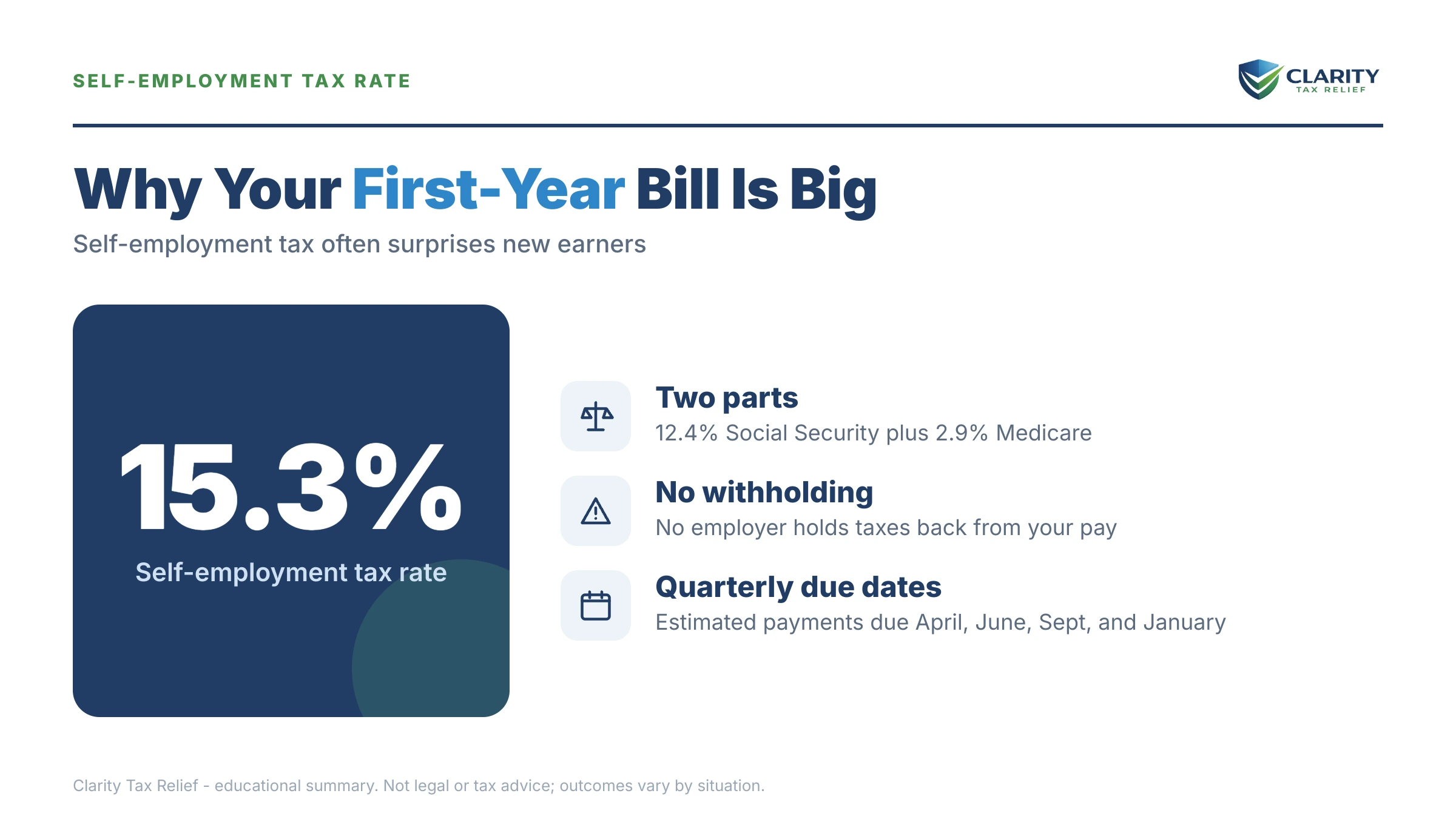
First-year self-employed tax bills happen because you now pay both halves of Social Security and Medicare — 15.3% self-employment tax — with no employer withholding a cent along the way.
In your W-2 years, your employer paid half of that payroll tax and quietly withheld the other half, plus income tax, from every paycheck. April was a settling-up, and usually a refund.
As an owner, both jobs became yours. The self-employment tax shock hits hardest in year one because nothing in your old paycheck life prepared you for it.
Here's the trap that catches business owners with payroll specifically: your owner draws are not wages. Money you moved from the business account to your personal account had no withholding on it — even while you were correctly withholding for your employees every pay period.
The IRS expected you to replace withholding yourself, four times a year, through quarterly estimated taxes. Nobody sends a new business owner a memo about that. The first "memo" is the balance due on your first return.
How big is the bill? The math on $61,200 of first-year profit
On $61,200 of net profit, a first-year sole proprietor owes about $8,647 in self-employment tax before a single dollar of income tax is counted.
Say your landscaping business cleared $61,200 in profit its first year — after paying your two part-time employees, equipment, fuel, everything. This example is hypothetical, but the arithmetic is real:
- $61,200 × 92.35% = $56,518 subject to self-employment tax
- $56,518 × 15.3% = $8,647 self-employment tax
- Half of that ($4,324) is deductible, then federal income tax applies to what's left. For a single filer taking the standard deduction, that's roughly $4,800 — your figure shifts with filing status, dependents, and credits.
- Total federal bill: roughly $13,400 — with $0 withheld against it all year, before any state income tax.
Because no quarterlies were paid, an underpayment penalty gets added on Form 2210 — the exact damage depends on how income arrived through the year, and the estimated-tax penalty math has exceptions worth checking. Once the return is filed and unpaid, the failure-to-pay penalty adds about $67 a month on that balance, plus interest that compounds daily. You can estimate what's already stacked up with our IRS penalty & interest calculator.
For scale: on a 72-month installment agreement, roughly $13,400 works out to a minimum around $186 a month — though because interest and the monthly penalty keep accruing on a plan, paying faster than the minimum always costs less overall.
What happens if you ignore the balance
An unpaid first-year balance enters the same automated collection sequence as any tax debt: a bill, reminders, then levy notices with real seizure power behind them.
- CP14 — the first bill, showing tax, penalty, and interest. You typically have about 21 days before the sequence advances.
- CP501 / CP503 — reminder notices. Still just bills, but the penalty and interest are compounding every month they sit.
- CP504 — Notice of Intent to Levy. The IRS can now take your state tax refund, and a federal tax lien becomes a realistic next move.
- LT11 / Letter 1058 — the final notice. You get 30 days to request a Collection Due Process hearing (Form 12153); after that, the IRS can levy bank accounts, garnish income, and — for business owners — levy your customer receivables.
Two cautions specific to your situation. First, in 2026 the IRS workforce is down roughly 27%, but these notices are generated by automated systems that never stopped — a thin IRS is harder to reach, not slower to escalate.
Second, and more important: never "borrow" from your 941 payroll deposits to cover this personal balance. Taxes withheld from your employees are trust fund money, and falling behind on them creates a far more dangerous category of debt with personal liability attached — see what happens with 941 back taxes before you're ever tempted.
First-year tax bill sitting unpaid?
It's cheapest to fix before the notice sequence starts — every month adds another 0.5% penalty plus interest. Get your balance and payment options reviewed free by an experienced tax professional: call (888) 825-7779 or use the 2-minute form.
Your options when you can't pay the full first-year bill
Balances under $50,000 — where most first-year self-employed bills land — qualify for an online IRS installment agreement of up to 72 months.
| Option | Typical eligibility | Cost & notes |
|---|---|---|
| Pay in full | Anyone | Stops penalties and interest immediately; cheapest by far |
| Short-term payment plan | Can pay within 180 days | $0 setup fee; interest and 0.5%/month penalty continue |
| Guaranteed installment agreement | Owe $10,000 or less; clean filing history | Approval essentially assured by statute; pay within 3 years |
| Long-term installment agreement | Owe $50,000 or less (tax + penalties + interest) | Up to 72 months, set up online; setup fee applies (lower with direct debit) |
| Currently Not Collectible | Paying would leave you unable to cover basic living expenses | Collection pauses; debt and interest remain; refunds get kept |
| Offer in Compromise | IRS math shows you can't full-pay before the 10-year statute runs | $205 fee + 20% down on lump-sum offers (both waived with low-income certification); roughly 1 in 5 offers accepted in FY2024 |
| Penalty abatement | Clean compliance for the prior 3 years, or reasonable cause | Removes failure-to-file/failure-to-pay penalties; free to request |
Two honest notes on that table. An Offer in Compromise rarely fits a first-year owner whose business is growing — the IRS looks at what it could collect from your future income, and a profitable operating business usually means you can pay over time instead. Don't spend money chasing one before someone runs the math.
Penalty relief, on the other hand, fits new owners unusually well. First-time penalty abatement requires three clean prior years — which your W-2 history probably provides — and starting in summer 2026 the IRS is replacing it with an Automatic Exemption from Penalty that applies without a request. The estimated-tax penalty isn't covered by either, but Form 2210 has its own waiver and exceptions.
The mechanics of setting all this up yourself — which forms, which order, what to say — are in our guide to how to settle tax debt yourself.
First-year deadlines that keep mattering
Your first year as an owner sets four recurring clocks: the filing date, the quarterly estimate dates, your payroll deposit schedule, and the 10-year collection statute on anything left unpaid.
| Deadline | What's due | What missing it costs |
|---|---|---|
| April 15 (typically) | File Form 1040 with Schedules C and SE; pay the balance | Failure-to-file: 5%/month up to 25%; failure-to-pay: 0.5%/month up to 25%, plus interest |
| Apr 15 / Jun 15 / Sep 15 / Jan 15 (typically) | Quarterly estimated payments (Form 1040-ES) | Underpayment penalty computed on Form 2210 at next filing |
| Your deposit schedule (monthly or semiweekly) | 941 payroll tax deposits for your employees | Failure-to-deposit penalties that step up the later the deposit gets — and personal-liability exposure |
| Before the LT11 final notice | Any payment arrangement, even a minimal one | After LT11's 30-day window, bank levies and income garnishment become legal |
| 10 years from assessment (CSED) | Nothing — this is the IRS's own deadline | Collection generally ends here, but appeals, offers, and bankruptcy pause the clock |
How to respond, step by step
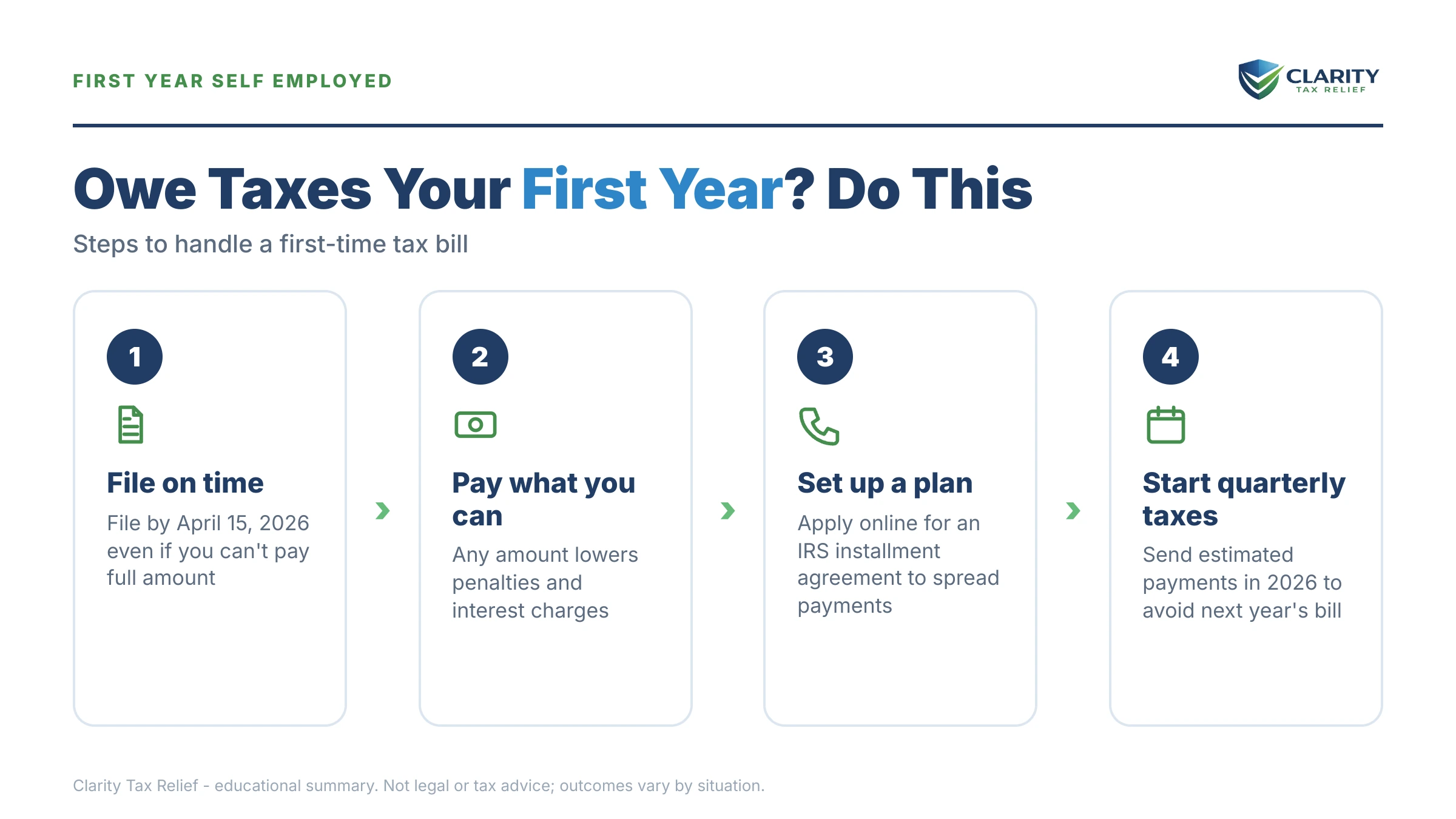
- File the return now — even if you can't send a dollar with it, filing stops the 5%-per-month failure-to-file penalty and leaves only the 0.5%-per-month failure-to-pay penalty running.
- Confirm the balance — log into your IRS online account and verify the assessed amount matches your return before you commit to any payment path.
- Choose a payment path — full payment, a 180-day short-term plan, or a monthly installment agreement, set up before the CP14 notice sequence starts escalating.
- Request penalty relief — ask about first-time abatement on the failure-to-file and failure-to-pay penalties, and check the Form 2210 exceptions on the estimated-tax penalty.
- Start this year's quarterlies — an installment agreement defaults if you fall behind on current-year estimated taxes, so the next Form 1040-ES payment is part of fixing the old debt.
If the return isn't filed yet, read why you should file even if you can't pay before anything else — the math is not close.
How to not owe again next year: quarterlies, safe harbor, deductions
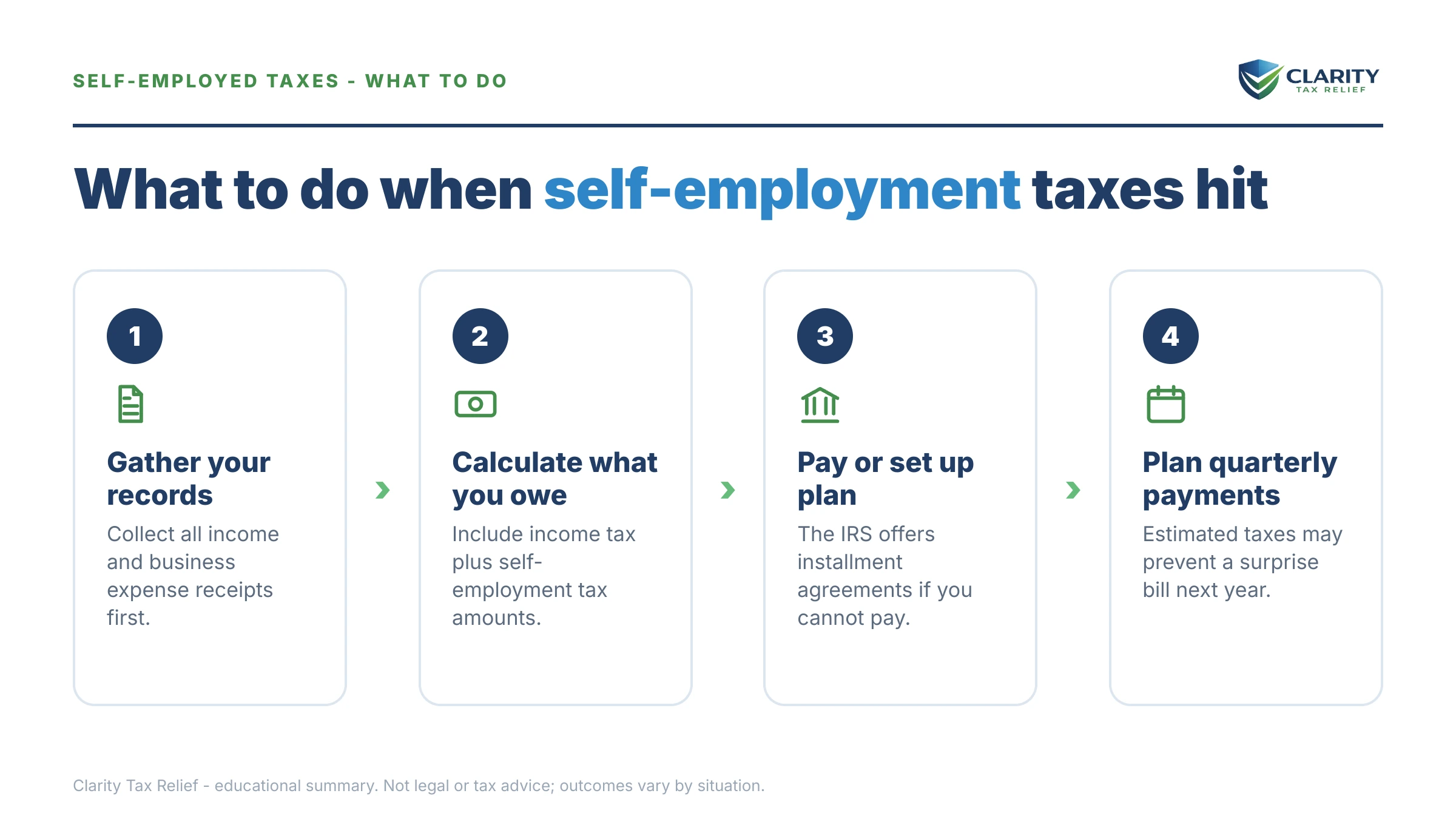
Setting aside 25% to 30% of net profit and paying quarterly estimates is what keeps year two from repeating year one.
The cleanest target is the safe harbor: pay in at least 100% of this year's total tax through quarterlies (110% if your AGI tops $150,000), and next April carries no underpayment penalty regardless of how much you grew. Our guide on how much to set aside for taxes walks through the percentage by income level.
Move the tax money to a separate account every time a customer pays — treat it like you treat your employees' withholding, which you already never touch. The owners who owe every year are almost never the ones who can't afford the tax; they're the ones whose tax money sat in the operating account and got spent on the business.
Deductions matter too: vehicle mileage is usually a new owner's largest missed write-off, and the 2026 mileage rate for the self-employed can meaningfully shrink next year's profit on paper. And once profits are steady, an S-corporation election — which changes how you pay yourself, not whether you owe — is worth a conversation with an experienced tax professional.
When you can handle this yourself
Most first-year balances are genuinely a do-it-yourself fix. If your return is filed, you agree with the number, and the balance is under $50,000, you can set up a plan in about 15 minutes at the IRS's payment plans page — our walkthrough of the IRS payment plan online setup shows every screen. If you can pay in full, do it directly at IRS.gov/payments and this is over.
Experienced help changes the outcome in specific situations: you're behind on 941 deposits or payroll returns for your employees; the notice sequence has already reached CP504 or LT11; the balance is over $50,000 or spans multiple years; you're weighing an Offer in Compromise; or paying anything would genuinely break the household budget. In those cases, the order you fix things in — returns, payroll compliance, penalties, then the balance — changes what you end up paying. If you get stuck between the IRS's own departments, the Taxpayer Advocate Service is a free, independent escalation path.
Terms on your first-year tax bill, decoded
- Self-employment tax — the 15.3% Social Security and Medicare tax you pay on net profit, covering both the employee and employer halves.
- Estimated taxes (Form 1040-ES) — the four payments a year that replace paycheck withholding for the self-employed.
- Safe harbor — the pay-in level (generally 100% of last year's tax, 110% for higher incomes) that shields you from the underpayment penalty no matter what you end up owing.
- Underpayment penalty (Form 2210) — the charge for paying too little during the year, calculated quarter by quarter when you file.
- Failure-to-file vs. failure-to-pay — two separate penalties: 5% per month for an unfiled return versus 0.5% per month for an unpaid balance. Filing is always the first move.
- Trust fund taxes — the money withheld from your employees' paychecks. It's never yours, and unpaid trust fund taxes can be assessed against you personally.
First-year self-employed tax questions, answered
Why do I owe so much in taxes my first year self-employed?
Because nothing was withheld all year and you now pay both halves of Social Security and Medicare. Self-employment tax alone is 15.3% of about 92.35% of your net profit, and federal income tax stacks on top of it. A W-2 employer used to cover half of that payroll tax and withhold the rest from every check — as an owner, both jobs became yours.
What happens if I can't pay my first-year tax bill in full?
File the return anyway, then set up a payment arrangement. The failure-to-file penalty runs 5% per month while the failure-to-pay penalty is 0.5% per month — filing without payment cuts the monthly damage by roughly 90%. Balances under $50,000 typically qualify for an online installment agreement of up to 72 months, and short-term plans give you up to 180 days with no setup fee.
Is there a penalty for not paying quarterly estimated taxes in my first year?
Usually yes — the IRS computes an underpayment penalty on Form 2210 when you pay too little during the year. But there is a first-year exception worth checking: if your total tax liability last year was zero and you were a U.S. citizen or resident for the whole year, the estimated-tax penalty generally does not apply. If you had a W-2 job last year, withholding from that job may also have partly covered you under the prior-year safe harbor.
Can I set up a payment plan for self-employment taxes?
Yes — self-employment tax balances are treated like any other personal income tax debt. Under $50,000 combined (tax, penalties, and interest), you can typically set up a plan online for up to 72 months; under $10,000, a guaranteed installment agreement is available if you have filed and paid on time historically. One catch owners miss: the plan defaults if you fall behind on this year's estimated payments, so the quarterlies have to start now.
Does my LLC protect me from personally owing the taxes?
No. A single-member LLC is a disregarded entity for federal income tax — the profit flows to your personal return, and the self-employment tax and income tax are personally yours. Even with a multi-member LLC or corporation, payroll trust fund taxes withheld from employees can be assessed against you personally through the Trust Fund Recovery Penalty if they go unpaid.
How much should I set aside for taxes now that I'm self-employed?
A working rule is 25% to 30% of net profit for federal taxes, more if you live in a state with income tax or land in a higher bracket. To avoid next year's underpayment penalty, aim for the safe harbor: pay in at least 100% of this year's total tax through quarterly estimates (110% if your adjusted gross income tops $150,000). Move the money to a separate account every time you're paid so it can't be spent.
Will the IRS levy my business bank account over a first-year balance?
Not immediately — levies come only after a mailed notice sequence that ends with a final notice of intent to levy (LT11 or Letter 1058) and a 30-day window to respond. If a bank levy does happen, the bank holds the funds for 21 days before sending them to the IRS, which is your window to negotiate a release. Setting up any payment arrangement before the final notice keeps enforcement off the table.
Can first-time penalty abatement help a new business owner?
Often, yes — and new owners are unusually good candidates. First-time abatement requires a clean compliance history for the prior three years, which most first-year owners have from their W-2 days, and it can remove the failure-to-file and failure-to-pay penalties. It does not remove the estimated-tax underpayment penalty, and starting in summer 2026 the IRS is replacing FTA with an Automatic Exemption from Penalty that applies without a request.
Your next 24 hours
- Pull your exact number. Log into your IRS online account (or find the "amount you owe" line on your return) and write down the total balance and the tax year it belongs to.
- Gather three documents: your first-year profit-and-loss or Schedule C, last year's tax return, and a rough picture of what the business is bringing in monthly right now.
- Get the free case review. An experienced tax professional will map your payment options, check your penalty-relief eligibility, and make sure your payroll side stays clean while you fix the personal balance — the form at /#consult takes 2 minutes, or call (888) 825-7779. Every month you wait, another 0.5% penalty plus interest posts to the balance.
This guide is general information, not tax or legal advice for your specific situation. Eligibility for IRS programs depends on individual facts and circumstances; no outcome is guaranteed.