
IRS Audits
IRS Correspondence Audit: How to Respond and Protect Yourself (2026)
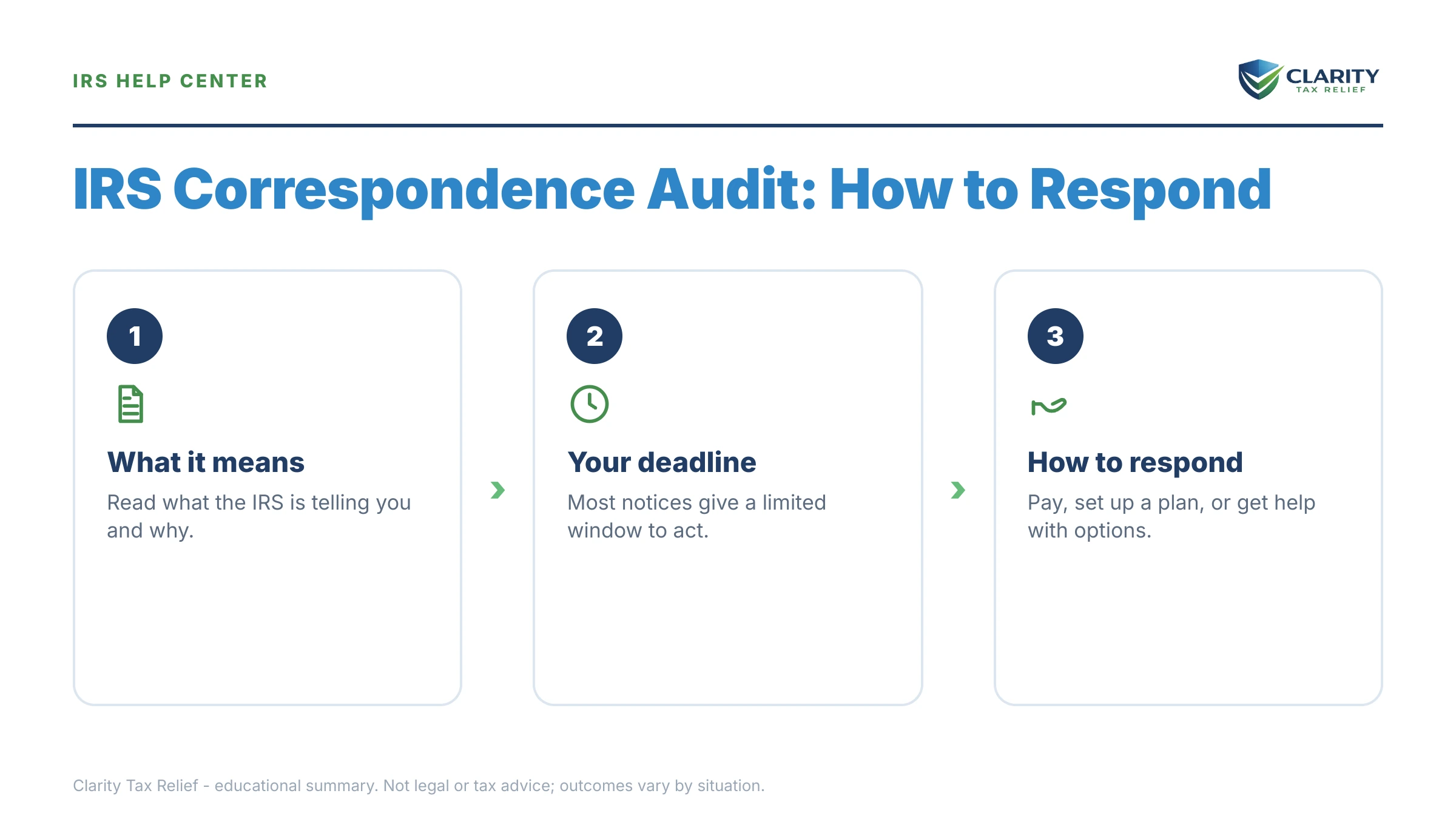
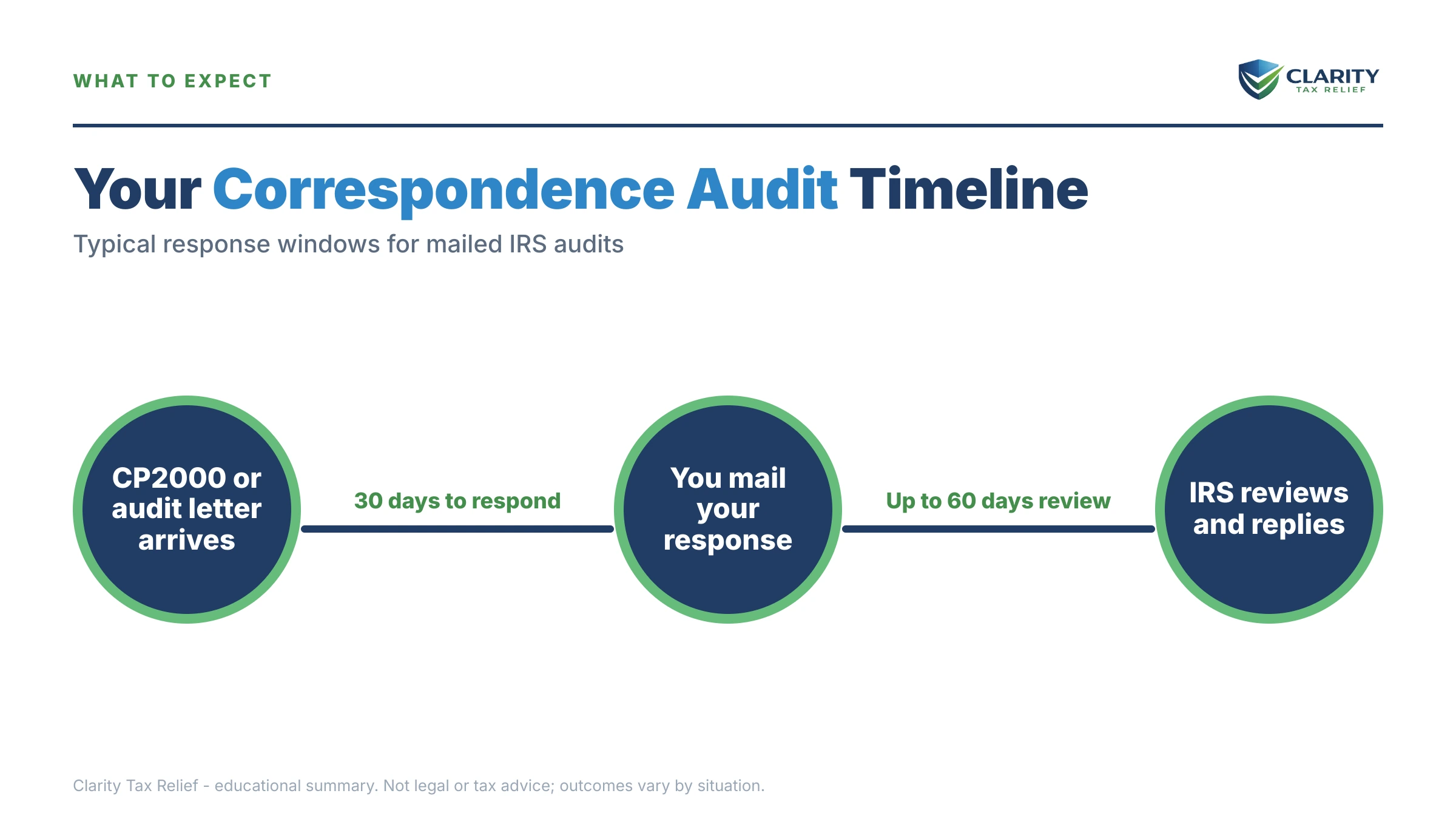
The short answer: an IRS correspondence audit is an examination conducted entirely by mail. The letter questions specific items on one return and gives you — typically 30 days from the letter date — to send proof. Respond completely and on time; if you send nothing, the IRS disallows every questioned item automatically.
The envelope is thin — no agent's business card, no appointment time, just a letter with your name, one tax year, and a list of items the IRS wants you to prove. That is the entire audit. It runs on paper and deadlines, and the person who sends the better-organized stack of documents usually wins.
Two things on that letter control everything that follows: the response date on page one and the list of questioned items on the Form 886-A attachment. The image below shows you exactly what a real correspondence audit letter looks like and where to look for both.
⏱ Your deadline: the response date printed on your audit letter — typically 30 days from the letter date. Miss it and the IRS disallows every questioned item by default, then moves your case toward an exam report and a Notice of Deficiency while interest keeps accruing.
What an IRS correspondence audit is — and what it isn't
A correspondence audit is the IRS's default form of examination: the large majority of all IRS audits are conducted entirely by mail, worked by campus service-center units rather than a single assigned examiner. No one is coming to your house. There is no meeting to attend. Your case is a file in a queue, and your response is the only version of your side that anyone will ever read.
It usually opens with a Letter 566 (general items — deductions, credits, filing status) or a CP75 notice (refundable credits like the Earned Income Credit, with your refund frozen while the exam runs). It is not a CP2000 — that's the automated underreporter program matching third-party forms against your return, a different process with different response rules. And it is not the same as an office or field audit; in-person exams are generally reserved for complex returns and cash-intensive businesses, a defense covered in our cash business audit guide.
Compare the sample image on this page against your own letter, then use this table to place yours in the sequence:
| Letter | What it means | Your window |
|---|---|---|
| Letter 566 | Audit opened by mail; Form 886-A lists the items under exam | The printed response date, typically 30 days |
| CP75 / CP75A | Credit audit (EIC, Child Tax Credit, filing status); refund held until it closes | The printed response date, typically 30 days |
| Letter 525 | The "30-day letter" — exam report (Form 4549) with proposed changes | 30 days to agree or protest to Appeals |
| CP3219A | Notice of Deficiency — the last stop before the tax is assessed | 90 days to petition U.S. Tax Court |
| CP22E | Audit changes assessed; the exam is now a balance due | Pay or arrange payment before collection notices begin |
Why you got a correspondence audit in 2026
Correspondence audits are selected by computer scoring, not by a person reading your return. No human examiner is assigned to your case until you respond — the selection systems flag returns where a claimed number looks out of line with the data the IRS already holds: 1099s and W-2s that don't reconcile, Schedule C expenses that are high relative to gross receipts, refundable-credit claims that trip eligibility filters, or deduction ratios far outside the norm for your income band. The IRS is leaning harder on algorithmic case selection every year; our guide to irs ai audits covers how that scoring works — and here's the correction to that path: see irs ai audits for how 2026 exam selection actually picks returns.
For gig and 1099 workers, the usual trigger is the gap between platform-reported income and what the Schedule C shows — or estimated deductions (especially mileage) with no contemporaneous log behind them. A Schedule C audit by mail almost always centers on two or three expense categories, not the whole return.
How far back the IRS can reach is its own topic — normally three years from filing, six when income is substantially understated, and unlimited for unfiled or fraudulent returns. The full rules live in our guide to how far back can the IRS audit; for this letter, what matters is the single year and the specific items printed on it.
What happens if you ignore an IRS correspondence audit
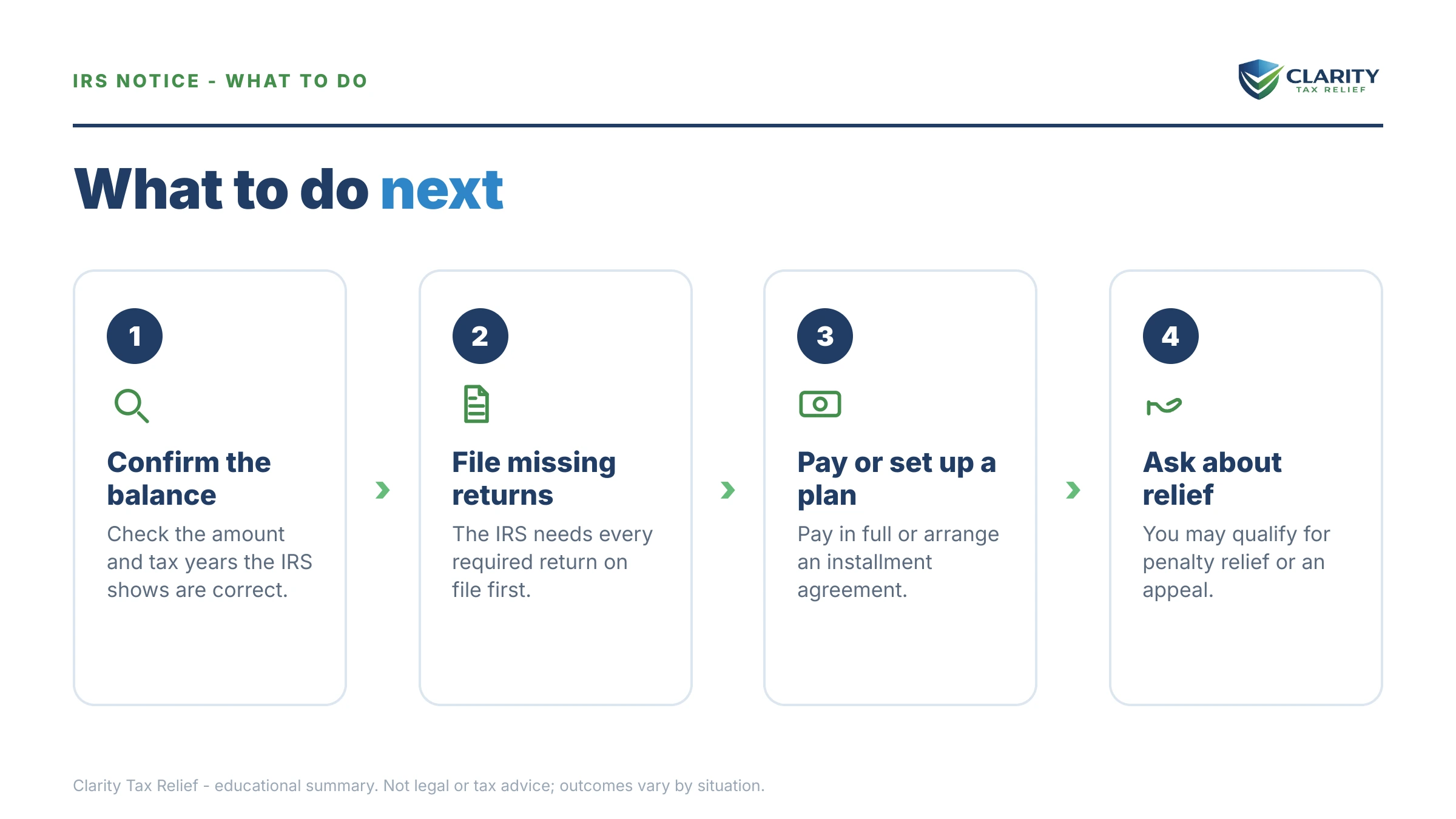
In a mail audit, silence is treated as agreement — the IRS doesn't need your permission to finish the exam without you. The sequence that follows is largely automated, and each stage removes an option you have today:
- Response date passes — the questioned items are disallowed by default. The campus unit drafts proposed changes using only its side of the story.
- Letter 525 with the Form 4549 exam report — the proposed additional tax, penalties, and interest, with 30 days to agree or protest to the IRS Independent Office of Appeals. Your irs audit appeal rights are strongest here.
- CP3219A Notice of Deficiency — the statutory "90-day letter." You have 90 days to petition U.S. Tax Court; after that, the proposed tax is assessed whether you agree or not.
- Assessment — the audit result becomes a legal debt. A CP22E-style balance-due notice arrives with penalties and interest already baked in.
- Collection — the balance enters the standard IRS notice stream that ends in lien filings and levy authority. What began as a request for receipts is now a collection case.
Even after assessment, the door isn't fully shut — irs audit reconsideration can reopen a closed mail audit if you produce documentation the examiner never saw. But reconsideration is a plea to revisit a decided case; a response before the deadline is a case decided with your evidence in it. The first is uphill. The second is just paperwork.
Holding a correspondence audit letter right now?
Get it reviewed free before the response date on your letter passes. An experienced tax professional will decode exactly which items are under exam, what proof will satisfy the unit reviewing it, and what your response should say — no pressure, no obligation.
Your options: agree, disagree, or something in between
Every correspondence audit ends in one of three postures, and you get to choose which one — as long as you choose before the deadlines run.
If the IRS is right — you claimed a credit you didn't qualify for, or deducted expenses you can't support — agreeing early is usually cheapest. Sign the exam report, and the case closes without Appeals or Tax Court. You can still contest penalties separately even when you concede the tax.
If the IRS is wrong, your documents are the argument. Respond in full before the printed date, and if the exam report still disagrees, protest to Appeals within its 30-day window — Appeals settles cases based on litigating risk, which a well-documented file creates.
If it's partly right — the most common outcome — concede the weak items in writing and substantiate the strong ones. A response that says "we agree with $4,000 of the adjustment and here is proof for the rest" reads as credible and tends to close fast.
And if the audit ends with tax you can't pay, the exam result becomes an ordinary balance with ordinary resolution paths:
| Option | Who it fits | Cost & key facts |
|---|---|---|
| Short-term payment plan | Can pay in full within 180 days | $0 setup; interest and late-payment penalty continue until paid |
| Long-term installment agreement | Assessed balance of $50,000 or less can be set up online | Up to 72 months; setup fee applies; interest continues |
| Audit reconsideration | You have documentation the exam never reviewed and the balance isn't fully paid | Free to request; collection can continue while it's reviewed |
| Offer in Compromise | Means-tested — assets plus future income genuinely can't cover the debt | $205 fee plus 20% down on lump-sum offers (both waived with low-income certification); the IRS accepted roughly 1 in 5 offers in FY2024 |
| Currently Not Collectible | Paying anything would leave you unable to cover basic living expenses | $0; collection pauses but the debt and interest remain |
| Penalty abatement | Clean compliance the prior 3 years (First-Time Abate) or reasonable cause; the automatic AEP program begins summer 2026 | Free to request; removes penalties, not tax or interest |
What a winning response package looks like
A correspondence audit is won on paper, so build the response like the reviewer has five minutes: send proof for only the items listed on the Form 886-A, organized in the same order the IRS listed them. Volunteering documents about items nobody questioned is the classic self-inflicted wound — it invites the exam to expand.
Good substantiation is boring and specific: bank and card statements tied to specific expenses, platform earnings summaries, invoices, canceled checks, school and medical records for dependency and residency questions, and — for vehicle expenses — trip-level data from the apps you drove for. If your records are gone, reconstruction is legitimate and often successful; our guide to being audited with no receipts walks through exactly what the IRS accepts in place of originals.
One caution: if the letter questions your income rather than your deductions, the IRS may total your deposits to reconstruct receipts — the bank deposit method audit. Loan proceeds, transfers between your own accounts, and gifts are not income, but they will be counted as income unless you label them. That's a situation where a mistake in the response creates tax that never existed.
Worked example: a $68,500 gig year under mail audit
Say you drove for delivery apps and grossed $68,500 in 1099 income in 2024. You filed that year claiming $31,500 in Schedule C expenses — including $24,600 of car and truck costs based on estimated, unlogged mileage — but 2021, 2022, and 2023 are still unfiled. A correspondence audit letter questions the vehicle expenses. This is hypothetical, but the math is how the exam unit will actually run it.
If you don't respond: the full $24,600 is disallowed. That adds roughly $3,500 in self-employment tax (about 15.3% on 92.35% of the disallowed amount) and, at a 22% income-tax rate, roughly $5,000 more in income tax — about $8,500 in added tax. A 20% accuracy related penalty irs examiners routinely propose adds roughly $1,700 more, for about $10,200 before interest. You can estimate how penalties and interest stack on your own numbers with our IRS Penalty & Interest Calculator.
If you respond with a reconstruction: your platform trip histories, delivery logs, and repair receipts substantiate roughly $19,000 of the $24,600. The disallowance shrinks to $5,600 — roughly $1,900 in added tax — and the documented good-faith effort gives you a real argument against the accuracy penalty. In this example, one organized response is worth roughly $8,300.
The unfiled years change the stakes. An open exam puts eyes on your account, and unfiled years have no audit statute of limitations at all — the IRS can eventually file substitute returns for them with zero deductions. Filing those years yourself, on your terms, before the audit closes is almost always the cheaper path; see haven't filed taxes in 3 years for the exact catch-up sequence.
How to respond to an IRS correspondence audit, step by step
- Calendar the response date. Find the reply-by date on page one of your letter and work backward — your package should be in the mail at least a week early.
- Pull your transcripts. Download your account and wage-and-income transcripts from IRS.gov to see exactly what the IRS already has for the year under exam.
- Gather proof for only the questioned items. Match every item on the Form 886-A list to a document — and send nothing about items the IRS didn't ask about.
- Write a one-page cover letter. List each questioned item, the dollar amount you're substantiating, and which attached document proves it.
- Send it trackably. Use certified mail with return receipt or the Documentation Upload Tool on your letter, and keep a complete copy of the package.
- Answer the follow-up in writing. When the exam report arrives, sign only if you fully agree — otherwise dispute in writing within the report's stated window.
What your transcript shows during a mail audit
Your IRS account transcript tracks a correspondence audit in code, often before or between letters — and code 420 means an examination is open on the year shown. Here's how to read the trail:
| Code | What it means | What to do |
|---|---|---|
| 424 | Exam request — the return was referred for possible examination | Nothing to send yet; watch the mail and verify your address is current |
| 420 | Audit indicator — an examination is open for that year | Match it to the letter you received and calendar the response date |
| 971 | Notice issued — a letter was mailed on the date shown | If nothing arrives within two weeks, check your IRS online account for a copy |
| 1242 | Refund frozen and routed to examination | Expect a CP75-type credit audit; the refund is held until it closes |
| 290 | Additional tax assessed — the audit closed with a balance | Move to resolution: pay, arrange payments, or pursue reconsideration or appeal |
When you can handle a mail audit yourself
Be honest about your own case, because plenty of correspondence audits don't need professional help: one questioned item on one filed year, with organized proof, is a do-it-yourself project. If the IRS asks for your child's school records to support the EIC and you have them, send them. If it questions a charitable deduction and you have the acknowledgment letters, send those. Follow the step-by-step above, keep copies, and you'll likely close it yourself.
Experienced help changes outcomes in specific situations: unfiled years sitting underneath the audited one, income questioned through bank-deposit reconstruction, multiple expense categories across a business return, an exam report already issued with the Appeals clock running, or a proposed balance large enough that penalty positioning and payment strategy matter as much as the documents. In those cases, the order you fix things in — missing returns first, then the exam response, then penalties, then the balance — determines what you ultimately pay. If cost is a barrier, Low Income Taxpayer Clinics and the Taxpayer Advocate Service exist for exactly these cases.
If your letter questions more than one item — or you have unfiled years underneath it — have an experienced tax professional review your response before it goes in the mail: call (888) 825-7779 or use the 2-minute form.
Terms on your audit letter, decoded
- Form 886-A — the attachment listing exactly which items are under exam and what proof the IRS wants for each.
- Form 4549 — the examination report showing the proposed change to your tax; signing it means you agree.
- 30-day letter — Letter 525, which gives you 30 days to protest the proposed changes to the IRS Independent Office of Appeals.
- Notice of Deficiency — CP3219A, the "90-day letter"; your final window to contest the tax in U.S. Tax Court before it's assessed.
- Form 872 — a consent extending the audit statute of limitations; signing or refusing is a strategic decision, not a formality.
- Audit reconsideration — the process for reopening a closed audit with documentation the examiner never saw.
The IRS's own overview of how examinations work — selection, your rights, and how cases close — is at IRS audits, and any balance that results can be paid or arranged at IRS.gov/payments.
IRS correspondence audit questions, answered
Is an IRS correspondence audit a real audit?
Yes — a correspondence audit carries the same legal weight as an office or field exam, and it ends the same way: with a report that changes your tax or a letter closing the case with no change. The only difference is the format. Everything happens by mail, which means your documents and cover letter do all the talking for you.
How long does an IRS correspondence audit take?
Most correspondence audits run several months from the first letter to a closing report, and in 2026 they often run longer because IRS campus staffing was cut roughly 27% in 2025. Each round of mail can sit weeks before a reviewer reads it. Respond once, completely, and trackably — piecemeal responses are the single biggest cause of year-long mail audits.
What happens if I miss the deadline on my audit letter?
The IRS treats silence as agreement and disallows the questioned items, then sends an exam report and eventually a Notice of Deficiency. Missing the first date is not fatal: you can still respond until the case closes, petition Tax Court within the 90-day deficiency window, or request audit reconsideration with new documentation after assessment. Every stage you wait costs leverage and adds interest.
Can a correspondence audit turn into an in-person audit?
It can, though most mail audits stay by mail. If your responses raise bigger questions — unreported income, multiple years, business records too complex to review remotely — the case can be transferred to an office or field examination. A complete, organized first response is your best protection against expansion, because it answers the question before a human examiner goes looking for more.
What if I don't have receipts for the items being audited?
You can reconstruct records, and the IRS routinely accepts reasonable reconstructions: bank and card statements, app trip histories, calendars, invoices, and third-party records. Vehicle, travel, and meal expenses have stricter substantiation rules, so a rebuilt mileage log needs supporting evidence like platform trip data. Never invent documents — a weak-but-honest reconstruction beats a fabricated one every time.
Can I call the IRS about a correspondence audit?
Yes, the letter lists a phone number, but expect long holds — IRS staffing dropped sharply in 2025 and correspondence exam lines are among the hardest to reach. Calls also leave no paper trail. Send your response in writing by certified mail or the IRS Documentation Upload Tool listed on your letter, and use the phone only to confirm receipt or request more time.
Will a correspondence audit delay my refund?
If the audit involves refundable credits — a CP75 examining the Earned Income Credit or Child Tax Credit — the IRS holds the refund until the audit closes. The faster and more complete your proof of income, residency, and relationship, the sooner the freeze lifts. Audits of a return with no refund pending don't hold money, but they can end with a new balance.
Do I need a professional for a correspondence audit?
Not always. One questioned item, clean records, and a single filed year is a manageable do-it-yourself project. Experienced help changes outcomes when the audit spans multiple issues or years, when you have unfiled returns the exam could surface, when income must be reconstructed from bank deposits, or when the proposed tax is large enough that appeal strategy matters.
Can the IRS audit years I never filed?
Yes — the audit statute of limitations never starts running on a year you didn't file, so unfiled years stay open indefinitely. An active correspondence audit also puts eyes on your account, which is how non-filing gets noticed and substitute returns get filed without your deductions. Filing your missing years yourself, before the IRS does it for you, almost always produces a smaller bill.
Your next 24 hours
- Find two things on your letter: the response date on page one and the Form 886-A list of questioned items. Those two lines define the entire audit — write the date somewhere you'll see it daily.
- Gather your file: a copy of the audited return, every 1099 and earnings summary for that year, bank and card statements, and any mileage or trip records — even partial ones can anchor a reconstruction.
- Get the letter reviewed free before the response date passes: use the 2-minute form or call (888) 825-7779. If you also have unfiled years, say so up front — the order you fix things in changes what you pay.
This guide is general information, not tax or legal advice for your specific situation. Eligibility for IRS programs depends on individual facts and circumstances; no outcome is guaranteed.