
IRS Audits
IRS Audit Appeal: How to Disagree With Your Audit Results (2026)
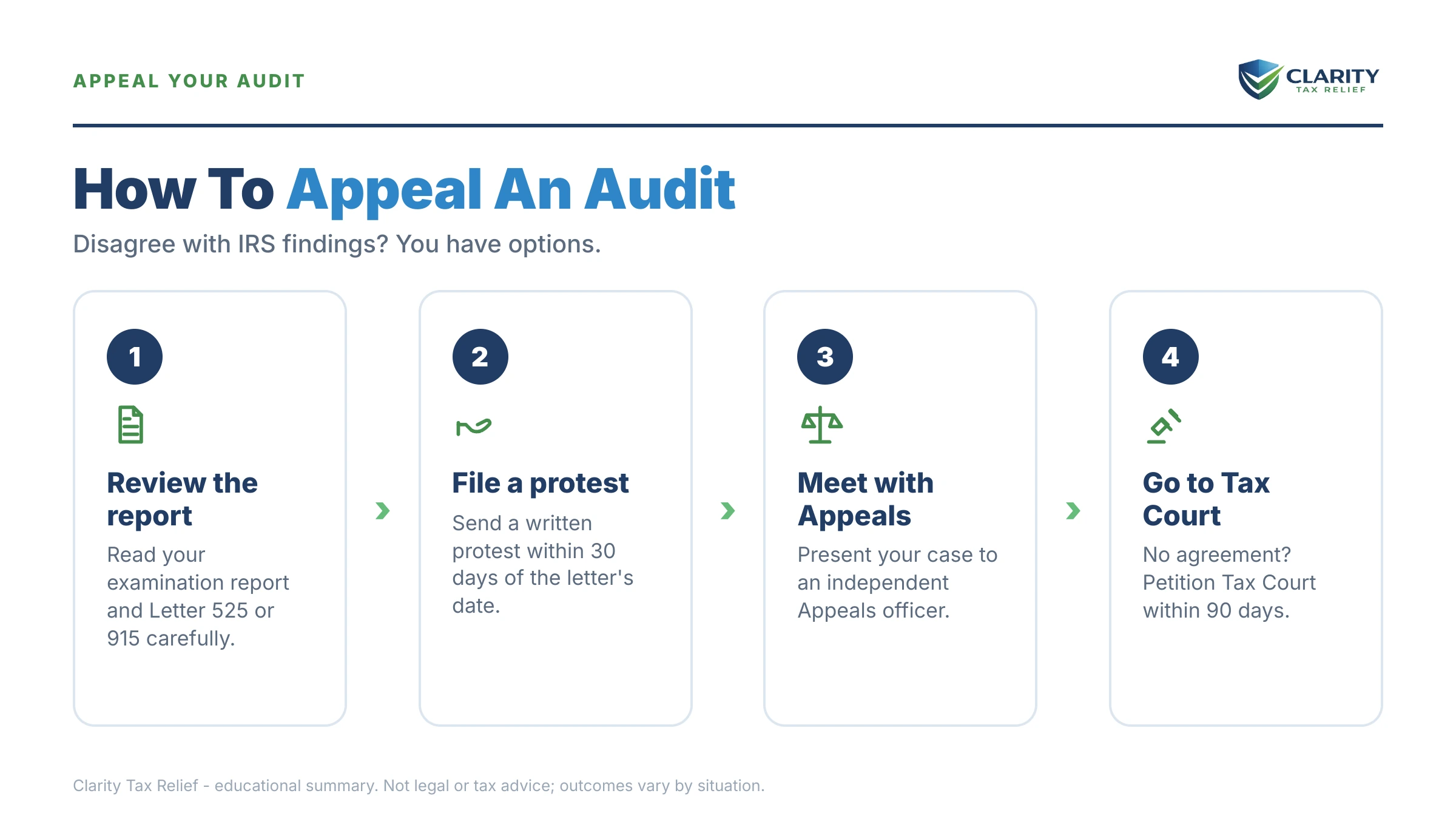
The short answer: an IRS audit appeal asks the IRS Independent Office of Appeals to review exam results you disagree with. You have 30 days from the date on your audit report letter to request it. Disputes of $25,000 or less per tax period use Form 12203; anything larger requires a formal written protest.
The examination is over, and the examiner's report says you owe a number that doesn't match reality — deductions you actually paid, marked "disallowed for lack of substantiation," with a signature line inviting you to agree. You don't have to sign. The auditor's conclusion is a proposal, not a verdict, and a separate office exists specifically to second-guess it.
The packet you're holding usually contains two documents: a cover letter with a response deadline and Form 4549, the examination report itself. The image below shows exactly what this package looks like and where the date that controls your appeal window sits — it's not labeled "deadline," which is why so many people miss it.
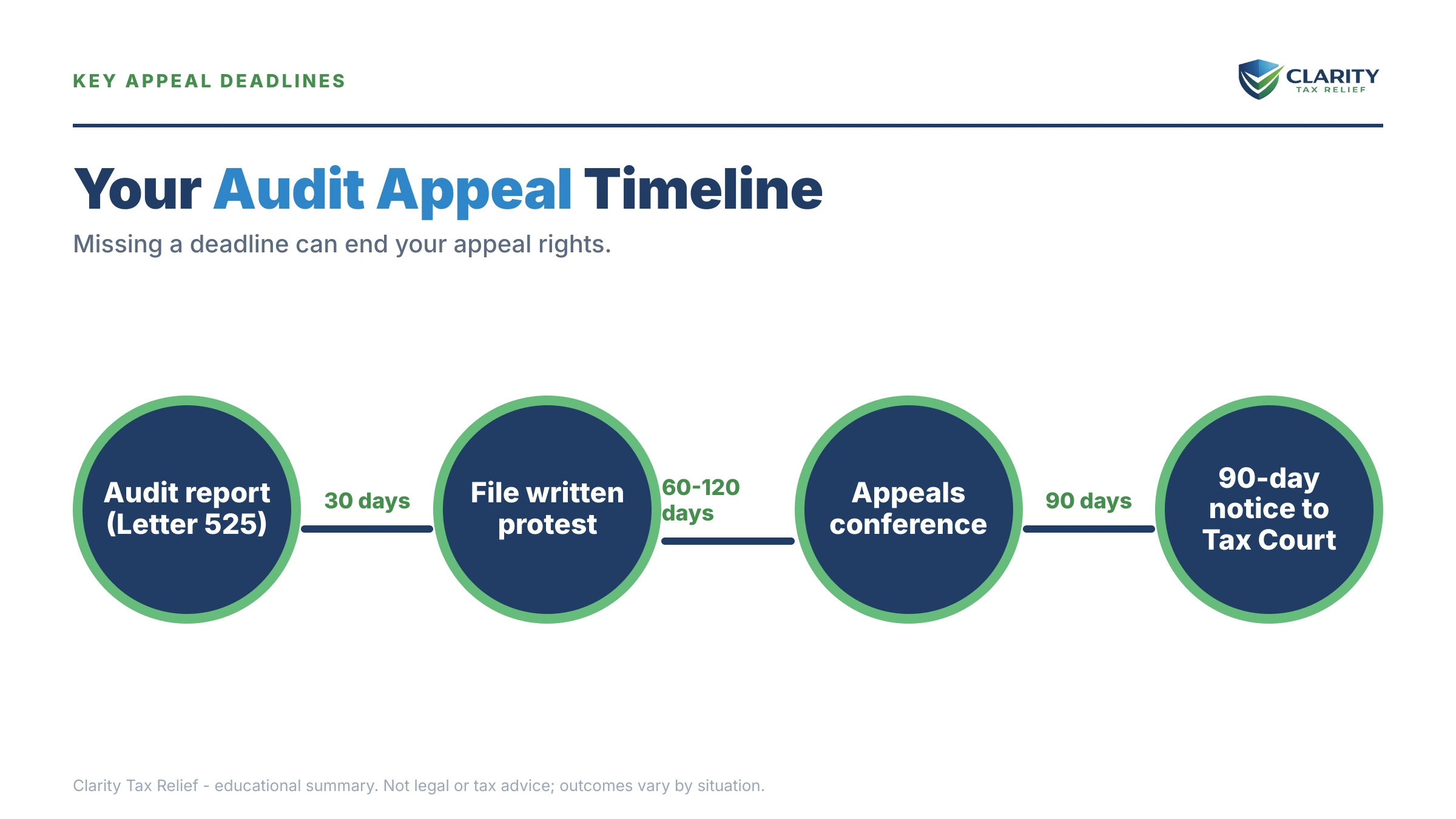
⏱ Your deadline: you have 30 days from the date printed on your 30-day letter — Letter 525, Letter 915, or Letter 950 — to request an IRS audit appeal. Miss it and the case moves to a notice of deficiency, where the only pre-payment forum left is the U.S. Tax Court.
Why the examiner's report says you owe money you don't think you owe
An audit ends with Form 4549, a report of proposed changes — and the examiner who wrote it is graded on closing cases, not on being right. For small-business owners with payroll, the same handful of adjustments drive most disputed reports: contract labor disallowed because 1099s weren't issued, vehicle and travel deductions cut for missing logs, and business bank deposits recharacterized as unreported income under a bank deposit method audit.
Two 2026 realities make disputed reports more common, not less. Exam selection increasingly runs through scoring models — see how IRS AI audits pick returns — which routes more borderline returns into examination. And with the IRS workforce down roughly 27% since 2025, examiners under pressure to close inventory lean harder on "insufficient substantiation" findings rather than working through partial records.
None of that changes your rights. The Taxpayer First Act made the Office of Appeals statutorily independent of the exam function. Its officers are barred from one-sided substantive conversations with the examiner about your case, and their job is to settle disputes based on how the issues would fare in court — not to defend the auditor's report. For background on which years the IRS could even reach, see how far back can the IRS audit; this page assumes the exam already happened and focuses on fighting its results.
What happens if you ignore the 30-day letter
Ignoring a 30-day letter converts your right to an independent review into a 90-day countdown toward assessment. Nothing pauses while you decide — the sequence is automated, and each stage closes a door the previous one held open:
- The 30-day window closes. Your right to a non-docketed Appeals conference — the cheapest, most flexible forum — lapses. You are here, with the door still open.
- Notice of deficiency arrives. A CP3219A notice of deficiency (or Letter 531) starts a statutory 90-day clock to file a Tax Court petition. This deadline cannot be extended for any reason.
- Assessment posts. If no petition is filed, the proposed tax, penalties, and accrued interest become a legal debt. From this point the failure-to-pay penalty of 0.5% per month stacks on top of everything else.
- Billing and collection begin. A balance-due notice arrives with a pay-by date, followed by reminder notices, then CP504, then an LT11 final notice — after which the IRS can levy bank accounts and wages, subject to a 30-day Collection Due Process window.
- Your remaining remedies become discretionary. Audit reconsideration and a doubt-as-to-liability offer still exist after assessment, but the IRS decides whether to entertain them — nobody is required to reopen your case.
| Stage | What arrives | Your window | Right at stake |
|---|---|---|---|
| Exam closes, you disagree | Letter 525 / 915 / 950 + Form 4549 | 30 days from the letter date | Independent Appeals review before any assessment |
| Appeal missed or unresolved | CP3219A / Letter 531 notice of deficiency | 90 days (150 if outside the U.S.) | U.S. Tax Court review before paying a dollar |
| No petition filed | Assessment + audit balance-due bill | The pay-by date printed on the bill | Stopping failure-to-pay penalties and collection notices |
| Bills ignored | CP504, then LT11 final notice | 30 days on the LT11 | Collection Due Process hearing before levy |
Holding an audit report you disagree with?
Send us the letter and Form 4549 before your 30-day window closes. An experienced tax professional will tell you — free and confidentially — whether your dispute belongs on Form 12203 or in a formal written protest, and which adjustments are actually worth fighting.
Your IRS audit appeal options in 2026
Every dollar of a proposed audit assessment can be contested in at least one forum — which forum depends on the amount in dispute and how far the case has already moved. The routes below run from cheapest and fastest to slowest and most formal:
- Group manager conference. Before the exam formally closes, you can ask to discuss the findings with the examiner's manager. Free, fast, and occasionally enough when the dispute is a document the examiner overlooked. It costs you nothing and preserves every later right.
- Fast Track Settlement. A mediation-style program (requested on Form 14017) where an Appeals mediator works the dispute while the case is still in Examination. Both you and the exam team must agree to use it. If it fails, you keep your full appeal rights.
- Small case request — Form 12203. If the total proposed change is $25,000 or less per tax period, the one-page Form 12203 appeal request gets you to Appeals without drafting a legal document. List each disputed item and why you disagree. No fee.
- Formal written protest. Required above $25,000 for any period. It must include your contact information, a statement that you want to appeal to the Office of Appeals, the letter and tax periods involved, each disputed adjustment, the facts supporting your position on each, the law or authority you rely on, and a signed penalties-of-perjury declaration. If your protest follows a Letter 692 after a follow-up report, the same requirements apply. No filing fee — the cost is in doing it well.
- Tax Court petition. If Appeals doesn't resolve the case, or you missed the 30-day window, the notice of deficiency lets you petition the U.S. Tax Court within 90 days for a $60 filing fee — before paying anything. Disputes of $50,000 or less per year can elect the simplified "S case" procedure. Even docketed cases are usually routed back to Appeals for settlement talks first.
- Post-assessment paths. After assessment, IRS audit reconsideration and an offer in compromise doubt as to liability (Form 656-L, no application fee) remain — both discretionary, both slower than appealing on time.
One decision often arrives alongside the appeal itself: the examiner may ask you to sign Form 872, extending the IRS's assessment deadline. Refusing usually triggers an immediate notice of deficiency — skipping the Appeals conference entirely — so the choice deserves advice, not reflex.
| Route | When it's available | Threshold / eligibility | How you start |
|---|---|---|---|
| Manager conference | Before the exam closes | Any amount | Ask the examiner for the group manager |
| Fast Track Settlement | During the exam, both sides agree | Any amount | Form 14017, jointly with the exam team |
| Small case request | Within 30 days of the 30-day letter | ≤ $25,000 per tax period | Form 12203 to the address on your letter |
| Formal written protest | Within 30 days of the 30-day letter | > $25,000 for any period | Written protest with penalties-of-perjury declaration |
| Tax Court petition | Within 90 days of the notice of deficiency | Any amount (S case election ≤ $50,000/year) | Petition + $60 filing fee |
| Audit reconsideration | After assessment | New information the exam didn't consider | Written request with documents to the exam office |
| OIC — doubt as to liability | After assessment | Genuine dispute over the amount's correctness | Form 656-L (no application fee) |
What a $92,700 audit appeal looks like in dollars
Say you run a business with payroll and the examiner's Form 4549 proposes $92,700 in additional tax — driven by disallowed contract-labor deductions and business deposits treated as income. This is a hypothetical, but the arithmetic is how every case like it works.
First, the exposure if you sign or do nothing. A 20% accuracy related penalty almost always rides along with adjustments this size: 20% × $92,700 = $18,540. That's $111,240 before interest — and interest runs from the original due date of the audited return, so a two-year-old exam already carries a meaningful interest layer. You can estimate how that layer grows with our Penalty & Interest Calculator.
Because $92,700 is well over the $25,000-per-period line, Form 12203 is off the table — this case requires a formal written protest. Now suppose your records show that most of the "unexplained" deposits were loan proceeds and owner transfers, and canceled checks substantiate the bulk of the contract labor. If Appeals, weighing the hazards of litigation, ultimately sustained only $28,000 of the proposed tax, the penalty recomputes on the smaller base: 20% × $28,000 = $5,600, for $33,600 plus interest on that amount.
The swing between those two hypothetical endpoints is $77,640 before interest. Whether your case lands near the top, the bottom, or anywhere in between depends entirely on the evidence behind each adjustment — not on how forcefully anyone argues. That is why the protest and the document file, not the conference, are where an audit appeal is won or lost.
How Appeals actually decides: hazards of litigation
Appeals settles cases by estimating the government's chance of winning each issue in court — the "hazards of litigation" — and pricing the settlement accordingly. An issue the IRS would likely win gets sustained. An issue where your documentation and the case law give you a real shot gets conceded in part or in whole. This is why an appeal that simply re-argues the audit fails, while one that reframes each adjustment as "here is what a judge would see" succeeds.
Two practical consequences follow. First, concede your weak items early — it buys credibility on the ones that matter. Second, remember that interest never pauses during an appeal: contesting a position you'll ultimately lose costs you every month it takes to lose it. If part of the report is clearly right, paying that portion now stops interest on it while you fight the rest.
If your dispute is fundamentally about missing documentation rather than legal interpretation — the classic IRS audit no receipts problem, common in every cash business audit — the appeal is still winnable, but it becomes a reconstruction project: bank records, vendor statements, affidavits, and reasonable industry benchmarks assembled issue by issue.
How to appeal your IRS audit results, step by step
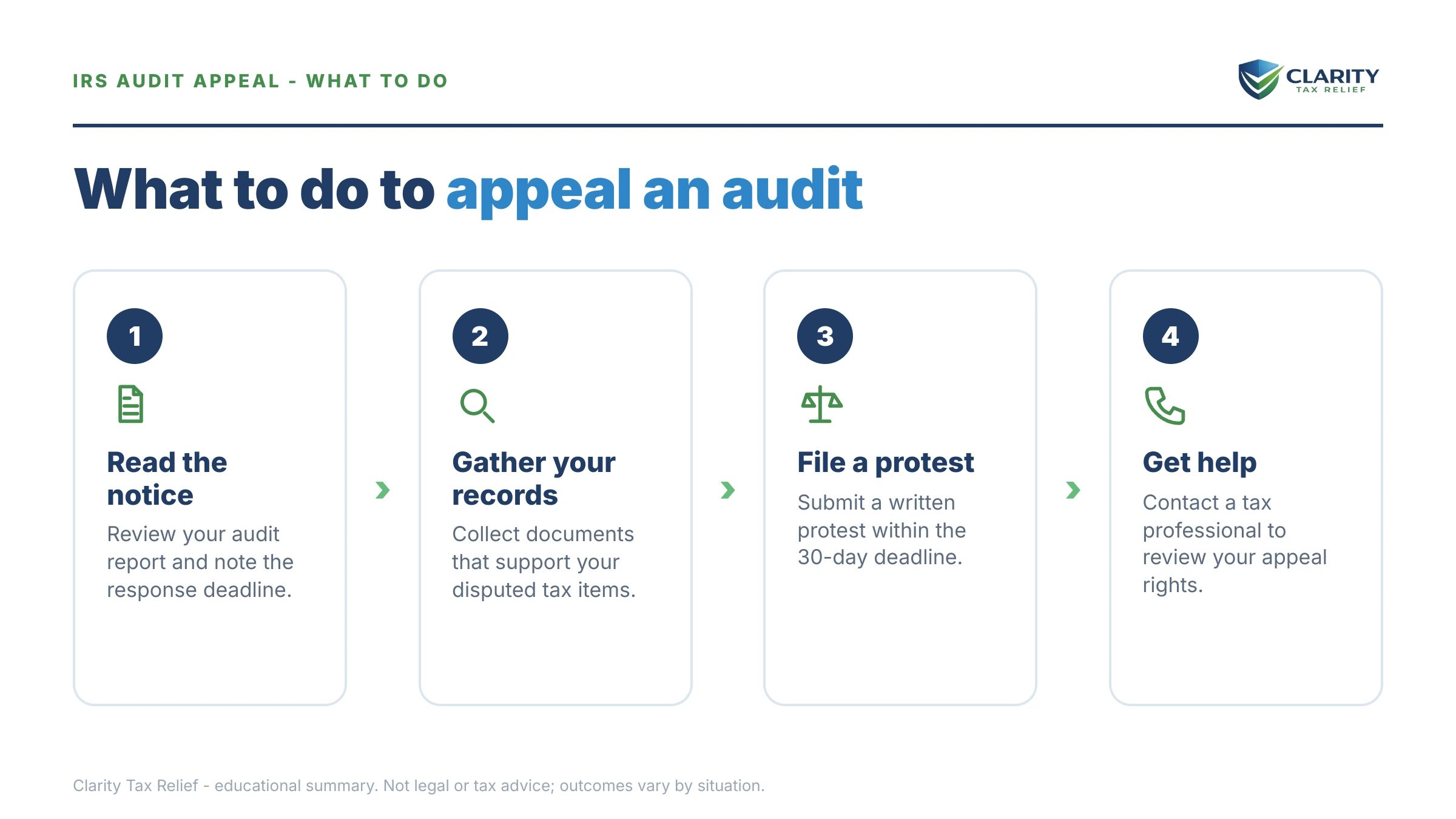
- Confirm your real deadline. Find the date at the top of your Letter 525, 915, or 950 — your response is due 30 days from that date, not from the day you opened the envelope.
- Pick the correct route. Total the proposed tax and penalties for each tax period: $25,000 or less means Form 12203; more means a formal written protest.
- Build the file issue by issue. Match every adjustment on Form 4549 to the records that answer it — invoices, bank statements, payroll reports, mileage reconstructions — and note which items you concede.
- File before the deadline. Send the protest or Form 12203 to the address on your letter by certified mail, return receipt requested, and keep a complete copy of everything.
- Prepare for the Appeals conference. Know your best number, your worst number, and the evidence behind each disputed item — Appeals settles on the strength of your file, not sympathy.
- Protect the Tax Court backstop. If a notice of deficiency arrives at any point, calendar the 90-day petition deadline immediately — it cannot be extended.
Already assessed? Two paths still exist
Missing both the 30-day and 90-day windows does not end the fight — it just moves it to forums where the IRS holds the discretion. Audit reconsideration asks Examination to reopen the case based on information it never considered: records you found later, a corrected third-party form, or a return you filed after the IRS assessed without one. There's no fee and no fixed deadline, but collection doesn't automatically stop while it's pending, so pair the request with a collection hold or payment arrangement.
The second path is an offer in compromise based on doubt as to liability — Form 656-L, which disputes the debt's correctness rather than your ability to pay. If collection pressure is already causing hardship while a legitimate dispute sits unresolved, the Taxpayer Advocate Service can intervene when normal channels stall.
When you can handle an audit appeal yourself
You genuinely don't need professional help when the dispute is small, factual, and documented. If the proposed change is under $25,000, hinges on one or two items, and you hold the canceled checks or statements that answer them, Form 12203 plus a clean document package is a reasonable DIY project. The same is true if you actually agree with the report — signing and setting up a payment arrangement is simpler than any appeal.
Experienced help changes outcomes in four situations: a proposed assessment at the scale of the $92,700 example, where the formal protest must frame facts and law correctly the first time; business and payroll issues, where one exam year's findings can spill into other years and employment-tax exposure; a Form 872 statute-extension decision, where the wrong signature costs leverage; and any exam with potential fraud undertones, where what you volunteer matters as much as what you prove. Professional fees are real — see what IRS audit representation cost typically runs — but on a five-figure swing they are usually the smaller number.
Terms on your audit letter, decoded
- 30-day letter: the cover letter (525, 915, or 950) transmitting the exam report and giving you 30 days to request Appeals review.
- Form 4549 / RAR: the Revenue Agent's Report — the line-by-line list of proposed changes, penalties, and the new balance.
- Protest: the written document that moves your case to Appeals; formal above $25,000 per period, Form 12203 at or below it.
- Notice of deficiency: the "90-day letter" (CP3219A or Letter 531) — your ticket to Tax Court and the last stop before assessment.
- Hazards of litigation: Appeals' estimate of the chance the IRS would lose each issue in court — the basis for every settlement it offers.
- Statute date / Form 872: the deadline by which the IRS must assess, and the consent form that extends it — sign only with advice.
If your 30-day window is inside the next two weeks and your numbers look anything like the example above, have the report reviewed free before you file — call (888) 825-7779 or use the 2-minute form.
IRS audit appeal questions, answered
How long do I have to appeal an IRS audit?
You have 30 days from the date printed on your audit report letter — Letter 525, 915, or 950 — to request an appeal. The clock runs from the letter's date, not the day you opened it, so check the top of page one immediately. If the window has already closed, the notice of deficiency that follows gives you 90 days to petition the U.S. Tax Court instead.
How successful are IRS audit appeals?
The IRS Independent Office of Appeals resolves most of the cases it hears without anyone going to trial, because it must weigh the hazards of litigation — the chance the IRS would lose in court. Your result depends entirely on the strength of your documentation and legal position, not on negotiation tricks. Weak positions get sustained; well-supported positions get conceded or settled somewhere in between.
Do I need a formal written protest or Form 12203?
The dividing line is $25,000 per tax period. If the total proposed change — tax and penalties combined — is $25,000 or less for each period, you can file the one-page Form 12203 small case request. Above that, you must file a formal written protest that identifies each disputed adjustment, states the facts and the law you rely on, and carries a signed penalties-of-perjury declaration.
Does an IRS audit appeal stop penalties and interest?
No. Interest keeps running on any amount ultimately sustained, from the original due date of the return until you pay. That is the real cost of appealing a weak position. If you agree with part of the adjustment, you can pay that portion up front to stop interest on it while contesting the rest.
Can the Appeals officer raise new issues against me?
As a matter of policy, the Office of Appeals does not raise new issues; its job is to settle the ones in dispute. The examiner, however, can expand the audit before the case leaves Examination — one reason to route your fight through a written protest rather than reopening arguments with the auditor. Appeals can still adjust penalty determinations connected to the existing issues.
What happens if I lose my IRS audit appeal?
Appeals issues a notice of deficiency, which gives you 90 days to petition the U.S. Tax Court before the tax is assessed. If you do not petition, the balance is assessed and moves to collection, where payment plans and other resolution options still apply. You can also pay the tax and pursue a refund claim, though that path runs through federal district court or the Court of Federal Claims.
Can I appeal an audit after the tax has already been assessed?
Yes, through audit reconsideration — you ask Examination to reopen the case based on information it has not considered, such as records you located after the exam closed. There is no fee and no fixed deadline, but it is discretionary, and collection does not automatically stop while it is pending. An Offer in Compromise based on doubt as to liability, filed on Form 656-L, is a second post-assessment path.
Should I sign Form 872 to extend the audit statute?
It depends on what refusing buys you. If you refuse, the IRS typically protects its deadline by issuing a notice of deficiency immediately — which skips the Appeals conference and forces the Tax Court route. Signing a restricted-scope or fixed-date extension often preserves your chance at an Appeals settlement; get advice from an experienced tax professional before signing an open-ended one.
Do I need a tax attorney to appeal an IRS audit?
No — an enrolled agent, CPA, or attorney can represent you before the Office of Appeals under a Form 2848 power of attorney, and you can also represent yourself. An attorney matters most when there is potential fraud exposure or the case is clearly headed to litigation. For a documentation-driven dispute, experienced representation of any of the three types is what moves the number.
Your next 24 hours
- Find the letter date. It's at the top of your Letter 525, 915, or 950. Count 30 days forward and write that date somewhere you'll see it — it controls every option you have.
- Gather three things: the full audit package including Form 4549, your filed return for the audited year(s), and whatever records exist behind each disallowed item — even partial ones.
- Get the report reviewed free before you respond. Use the 2-minute form or call (888) 825-7779 — an experienced tax professional will tell you which route fits your numbers and which adjustments are worth contesting, while your 30-day window is still open.
Primary sources: the IRS's overview of the Independent Office of Appeals, the United States Tax Court for petition procedures, and the Taxpayer Advocate Service when normal channels stall.
This guide is general information, not tax or legal advice for your specific situation. Eligibility for IRS programs depends on individual facts and circumstances; no outcome is guaranteed.