
Audits & Exams
IRS Audit Representation Cost in 2026: What Professional Audit Defense Really Runs
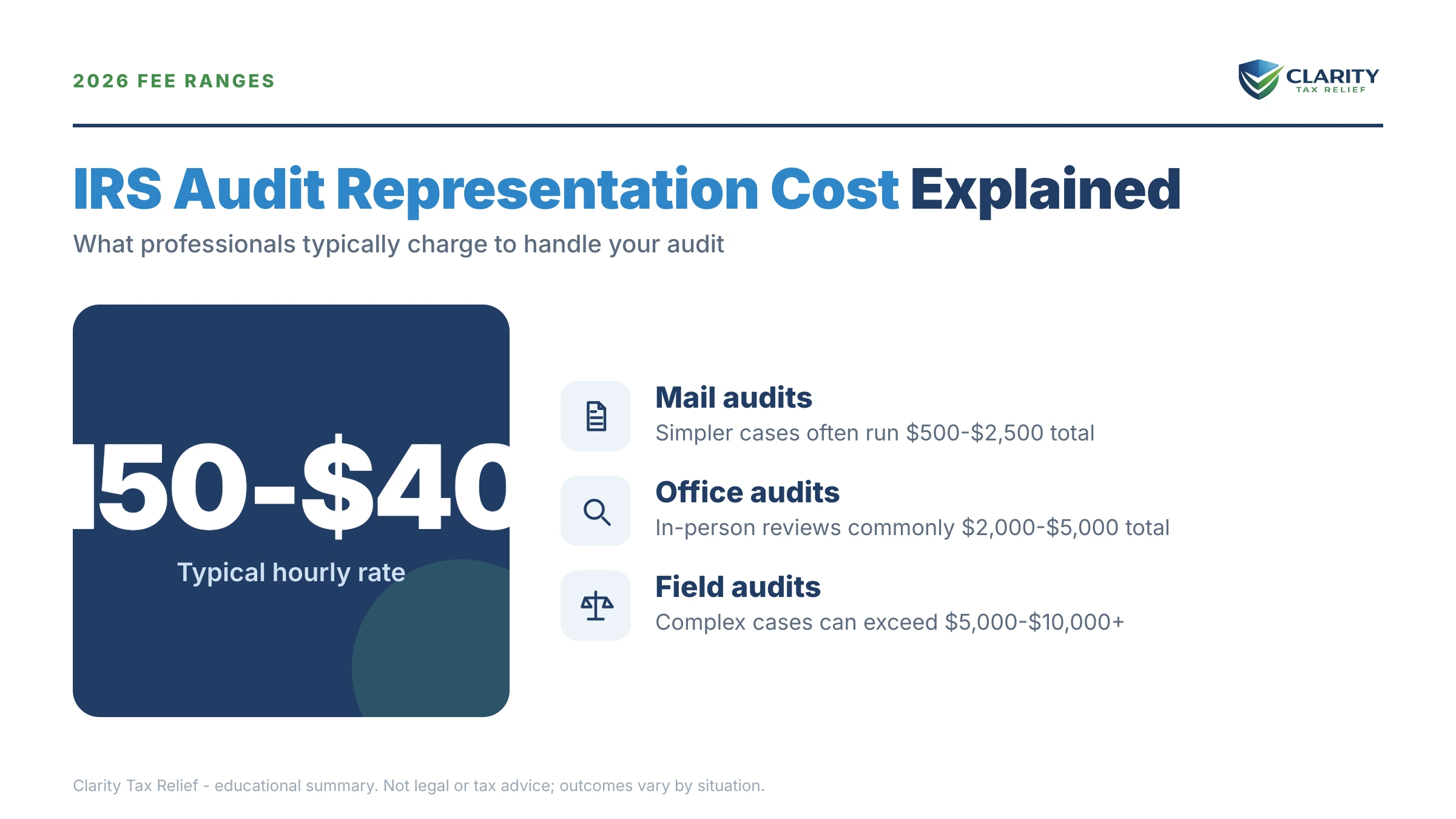
The short answer: IRS audit representation cost typically runs $1,000–$3,000 for a mail audit, $2,500–$7,500 for an office audit, and $5,000–$15,000 or more for a field audit. Enrolled agents and CPAs bill roughly $150–$400 per hour; tax attorneys $300–$550. Flat fees are common — and usually safer — for defined-scope audits.
You've got two documents in front of you: an IRS audit letter with a reply-by date, and a fee quote from a tax firm that made your stomach drop a second time. Now you're doing the grim math — does defending the audit cost more than just losing it? That's exactly the right question, and this page gives you the actual numbers to answer it: what IRS audit representation cost looks like in 2026 by audit type, by credential, and by stage — plus the free options nobody quotes you.
Farther down, the image below shows exactly what the one-page form that puts a representative between you and the auditor looks like and where to look — because that form, not the fee, is what changes who the IRS is allowed to talk to.
⏱ Your deadline: the reply-by date printed on your audit letter. An exam report (Letter 525 or 915) typically gives you 30 days to protest; a CP3219A Notice of Deficiency gives exactly 90 days to petition Tax Court. Hiring representation does not pause these windows — a representative has to work inside them.
What does IRS audit representation cost in 2026?
Professional IRS audit representation typically costs between $1,000 and $15,000, and the single biggest driver is which of the three audit types you're facing. A correspondence audit is a mail exchange about one or two line items; an office audit is an appointment at an IRS office covering several issues; a field audit puts a revenue agent inside your business records for months.
Each step up multiplies the professional hours involved — more documents to assemble, more meetings, more issues to argue — which is why the fee bands below are wide but the ordering never changes.
| Audit type or stage | Typical flat-fee range | What the fee usually covers |
|---|---|---|
| Correspondence (mail) audit | $1,000–$3,000 | Reviewing the letter, assembling proof, one or two written responses |
| Office audit | $2,500–$7,500 | Document prep, attending the appointment for you, negotiating the exam report |
| Field audit | $5,000–$15,000+ | Managing the agent's information requests, defending books and records over months |
| IRS Appeals after the audit | $2,500–$10,000 | Written protest, Appeals conference, settlement negotiation |
| Tax Court petition & pre-trial settlement | $5,000–$25,000+ | Petition, Appeals/counsel negotiation — most cases settle before trial |
| Audit reconsideration (after the audit closed) | $2,500–$7,500 | Reopening a closed exam with documentation the auditor never saw |
These are typical market ranges, not promises — a one-issue mail audit with clean receipts can come in under $1,000, and a multi-year business field audit can run past $20,000. What matters is that the quote you're holding sits inside the band for your audit type, and that you know exactly which stages it covers.
Why your quote is what it is: the six fee drivers
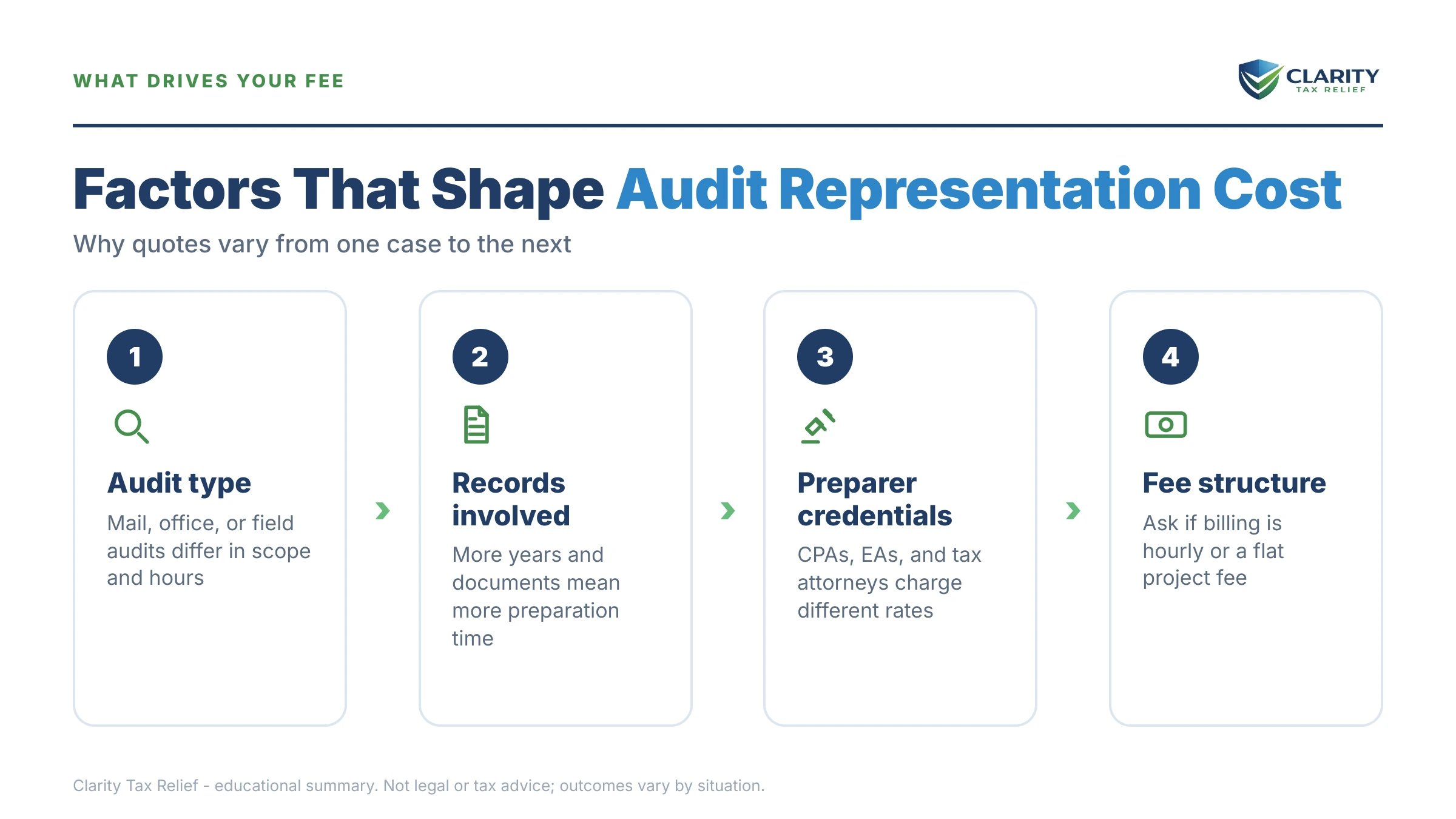
Two people with the same letter number can be quoted fees that differ by 5x, because the price follows the work, not the letter. Six factors move it:
- Number of years under exam. Each added year roughly adds a full document cycle. If the auditor wants to expand backward, read how far back the IRS can audit — scope is negotiable more often than people think.
- Business vs. wage income. A Schedule C audit means reconstructing income and expenses, not just mailing a 1098. Business returns anchor the top of every fee band.
- The condition of your records. A shoebox costs more than a spreadsheet. If you're audited with no receipts, expect reconstruction work — and budget for it, because reconstruction is usually what saves the deductions.
- Unreported-income methods. If the auditor is running a bank deposit method audit, every deposit in every account has to be explained. That's hours, and it's also where representation moves the most dollars.
- Cash-intensive operations. A cash business audit draws indirect-method scrutiny that demands a defense strategy, not just paperwork.
- Criminal exposure underneath. If there's anything on the return you'd hesitate to explain under oath, you're in eggshell audit territory — that's attorney work, at attorney rates, because attorney-client privilege exists and accountant privilege mostly doesn't.
One 2026-specific driver: the IRS workforce shrank about 27% in 2025, so audits stall in ways that burn hourly time — unanswered faxes, re-sent documents, months of silence. That reality is a strong argument for flat-fee engagements, covered below. It also means audit selection itself is increasingly automated; see how IRS AI audits pick returns now.
What happens if you go in alone — or ignore the audit entirely
An ignored audit doesn't stall — it concludes without you, and every proposed number becomes final. The sequence is automated and each stage closes a door:
- Opening letter (Letter 566 or 2205-A) — the exam begins with a reply-by date printed on the letter. Respond late and the auditor works from IRS data alone.
- Document requests — items you don't substantiate by the printed date get disallowed by default. Silence reads as concession.
- Exam report (Letter 525 / 915) — the proposed changes, penalties included, with a 30-day window to protest to IRS Appeals. Miss it and your cheapest negotiation forum is gone.
- CP3219A Notice of Deficiency — 90 days to petition Tax Court before paying. This is a statutory clock; nothing extends it except the date printed on the notice.
- Assessment and the collection ladder — the balance posts, the first bill arrives, and the notices escalate toward a final notice of intent to levy with 30 days to request a Collection Due Process hearing.
- Levy — a bank levy freezes funds with a 21-day hold before they leave; a wage levy is continuous until released. If you rent, there's no home equity for a lien to sit against quietly — collection pressure lands directly on your paycheck and bank account.
| Letter | Response window | The right you lose if it passes |
|---|---|---|
| Letter 566 / 2205-A (audit opening) | Date printed on the letter | The chance to shape scope early; the IRS proceeds on its data alone |
| Document request (IDR) | Date printed on the request | Unsubstantiated items are disallowed by default |
| Letter 525 / 915 (exam report) | 30 days | Your IRS audit appeal to the Independent Office of Appeals |
| CP3219A (Notice of Deficiency) | 90 days (150 if abroad) | Tax Court review before paying — after this, it's pay first, fight later |
| LT11 / Letter 1058 (final levy notice) | 30 days | Your Collection Due Process hearing before wages or accounts are levied |
Notice the pattern in the fee table above: every stage you let pass makes the fix more expensive. Defending items live in the exam is the cheapest work; Appeals costs more; reopening a closed audit costs more still, with collection defense stacked on top.
Holding an audit letter and a fee quote right now?
Send us both. An experienced tax professional will tell you — free — whether the quote is fair for your audit type, what's actually at stake in dollars, and whether you even need paid help, before the response window printed on your letter closes.
Who can represent you — and what each credential charges
Only three credentials can represent you at every stage of an IRS audit: enrolled agents, CPAs, and attorneys. All three hold identical, unlimited practice rights before the IRS under Circular 230 — the auditor treats a $175-an-hour EA and a $500-an-hour attorney with the same procedural authority. What differs is cost, and what each is best at.
| Representative | Typical hourly rate | Best for |
|---|---|---|
| Enrolled agent (EA) | $150–$300 | Most mail and office audits; best value with full IRS practice rights |
| CPA | $200–$400 | Audits tangled in complex books — depreciation, inventory, multi-entity returns |
| Tax attorney | $300–$550+ | Fraud indicators, privilege needs, and cases genuinely headed to Tax Court |
| Low Income Taxpayer Clinic | Free / nominal | Income-qualified taxpayers (generally ≤ 250% of the federal poverty level) |
| Unenrolled preparer (AFSP) | Varies | Limited: only returns they prepared, only at exam level — not Appeals or collection |
| Yourself | $0 | Single-issue mail audits where you have clean documentation (see below) |
If you're weighing credentials, the full breakdown is in tax attorney vs CPA vs enrolled agent. The short version: pay for the attorney when the risk is legal, not arithmetic. For everything else, the cheaper credential with audit-defense experience beats the pricier one without it.
Flat fee vs. hourly for audit defense
A flat fee shifts the risk of IRS slowness onto the firm — and in 2026, the IRS is slow. Under hourly billing, every hold-time hour, every re-sent document, every "we have no record of your response" letter lands on your invoice. Under a flat fee, it doesn't.
Hourly makes sense only when scope is genuinely unknowable — a field audit that might expand to more years, for example. Even then, insist on a written estimate, a not-to-exceed cap, and itemized monthly invoices. Get in writing whether the fee includes negotiating the exam report and whether an appeal is extra — the appeal is where many audits are actually won, and discovering it costs another $5,000 is a bad surprise. The pricing-model tradeoffs are covered in depth in our tax relief flat fee guide, and the broader market pricing in how much does tax relief cost.
How to hire IRS audit representation, step by step
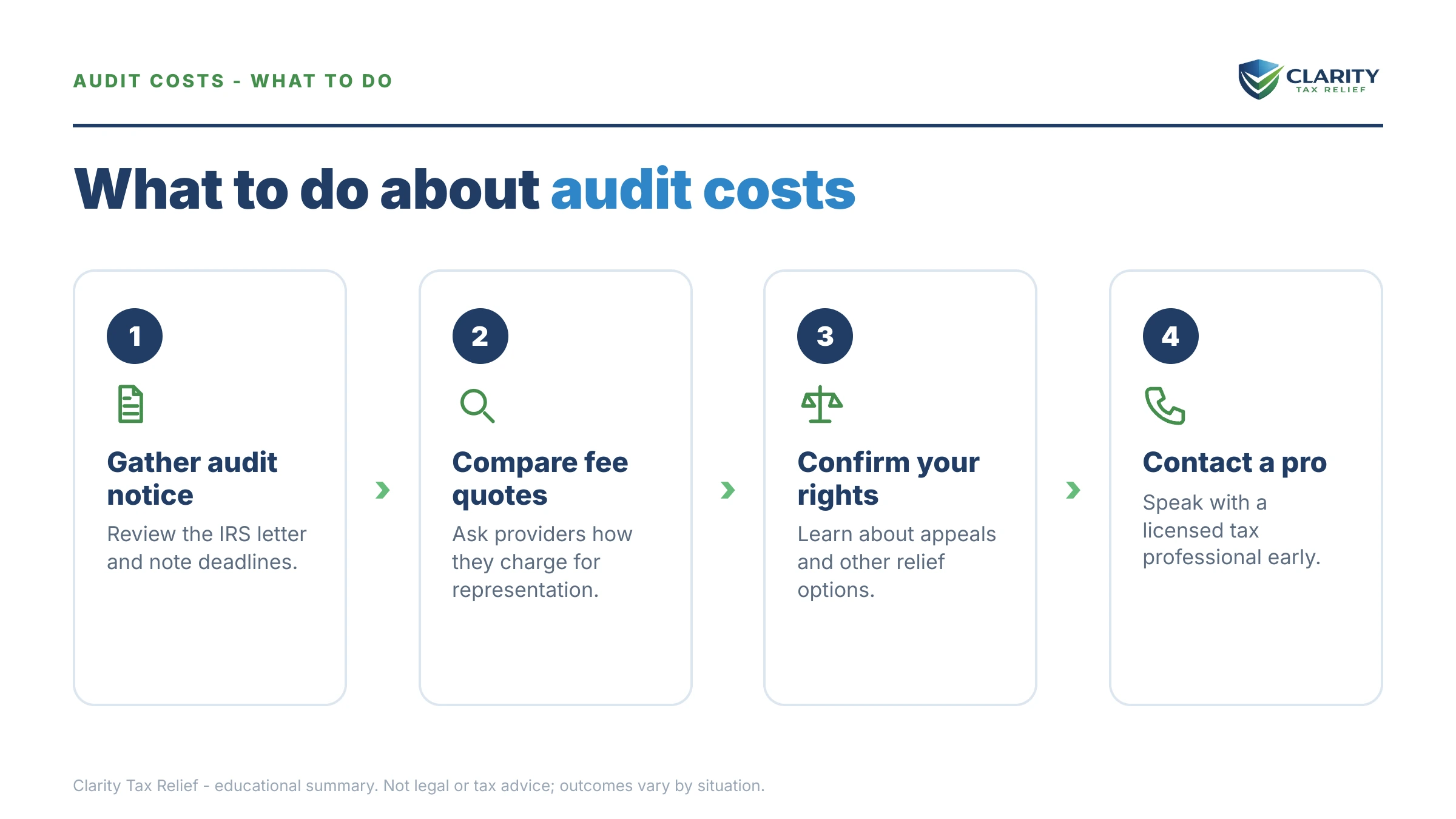
- Find your letter number and response date. Look at the top right of your IRS letter for the letter number (566, 525, 915, CP3219A) and the printed reply-by date — together they tell any professional the audit's stage and how much time is left.
- Match the professional to the audit. Use an enrolled agent or CPA for correspondence and office audits; interview a tax attorney if there are unreported-income or fraud issues on the table.
- Get two or three written quotes. Ask each for a flat fee, exactly what it covers, and whether an appeal after the audit costs extra — then compare scope, not just price.
- Verify the credential before you pay. Confirm the person signing your Form 2848 is an enrolled agent, CPA, or attorney — only those three can represent you at every stage of the audit and beyond.
- Sign Form 2848 and go quiet. Once the power of attorney is filed, the IRS must work through your representative — stop calling or writing the auditor yourself.
- Deliver organized records immediately. Labeled, year-sorted documents cut hourly time and give a flat-fee representative the best shot at narrowing the audit early.
Is audit representation worth the cost? The $68,500 math
Representation earns its fee when the dollars it can move dwarf the dollars it costs — so run the comparison before you sign anything. Here's a clearly hypothetical example built on real fee bands.
Say your exam report proposes $68,500 — a self-employed renter, one Schedule C year, where a bank deposit analysis treated unexplained deposits as income. The breakdown: $54,000 in additional tax, a 20% accuracy-related penalty of $10,800 (0.20 × $54,000), and roughly $3,700 of interest accrued so far. You can rough out your own penalty and interest exposure with our Penalty & Interest Calculator.
Path A — represented at the 30-day-letter stage. A flat fee of, say, $6,500 buys a written protest and an Appeals conference. Suppose — outcomes vary and nothing is promised — the deposit analysis gets corrected because half those deposits were loan proceeds and transfers between your own accounts, and the penalty falls away with the adjustment. The tax drops to $27,000 and interest to roughly $1,850: a total near $28,850 instead of $68,500. The $6,500 fee bought a swing of nearly $40,000 — about 16 cents per dollar moved. Even if Appeals sustained most of the adjustment, removing the $10,800 penalty alone would cover the fee.
Path B — unrepresented and unanswered. The full $68,500 is assessed. Because you rent, there's no property for a lien to quietly attach to — enforcement comes straight at your income. The collection ladder runs to a final notice of intent to levy, then a bank levy (21-day hold) and a continuous wage levy. Fixing it now means audit reconsideration at $2,500–$7,500 plus levy-release work, all while the paycheck is being taken. The same defense, bought later, costs more and starts from a worse position.
The honest rule of thumb: if the proposed change is less than about three times the fee quote, think hard about handling it yourself. Above five times, representation is usually the cheaper option even in a mediocre outcome.
When you can handle the audit yourself
Plenty of audits don't justify a professional fee — and a firm that quotes you $3,000 to mail in a mortgage statement is telling you something about itself. You can reasonably self-represent when:
- It's a mail audit on one simple issue — a credit, a filing status, a single deduction — and you hold clean documentation. Copy, label, mail by the printed date, keep proof of mailing.
- You agree with the proposed change. Sign the report and go set up payment; your money is better spent on the balance than on defense of a position you don't hold.
- The dollars are small. If the proposed adjustment is $2,000 and quotes start at $1,500, the math answers itself.
Experienced help genuinely changes outcomes in the opposite situations: a field audit at your business, a bank-deposit or cash-business income reconstruction, multiple years or missing records, a request to sign a statute extension (see Form 872 before you sign anything), any hint of fraud exposure — or an audit that already closed and turned into a levy. Those are the cases where the fee is small next to what's moving.
Not sure which side of that line you're on? A free case review will tell you honestly — including "handle this one yourself" when that's the right answer.
Free and low-cost IRS audit representation
Free audit representation exists, and it's real representation — not a helpline. Low Income Taxpayer Clinics represent income-qualified taxpayers (generally at or below 250% of the federal poverty level) in exams, appeals, and Tax Court for free or a nominal fee; find one through the Taxpayer Advocate Service. TAS itself can also intervene free of charge when an audit or the collection that follows is causing genuine hardship — it advocates within the IRS rather than representing you, but it can unstick a stalled case.
A middle path also works: self-represent the simple document exchange, then hire a professional only if the exam report comes back wrong. You keep the cheap stage cheap and buy expertise exactly where it pays — at Appeals.
Terms on your audit paperwork, decoded
- Form 2848 — the power of attorney that authorizes an EA, CPA, or attorney to deal with the IRS for you; the official form lives at IRS.gov's Form 2848 page, and our Form 2848 instructions walk through every box.
- CAF number — the IRS file number tracking who holds authorization on your account; your representative has one, you don't need one.
- Form 4549 / exam report — the auditor's proposed changes, penalties, and interest; signing it agrees to everything on it.
- 30-day letter — the cover letter (525/915) on the exam report giving you 30 days to protest to IRS Appeals.
- 90-day letter — the CP3219A Notice of Deficiency, your last pre-payment stop: 90 days to petition Tax Court.
- Form 872 — a consent extending the IRS's time to assess; it buys the auditor time, which is why the decision to sign deserves advice.
IRS audit representation cost: your questions, answered
How much does IRS audit representation cost on average?
Most people pay between $1,000 and $7,500 for professional audit representation, with mail audits at the low end and office audits at the high end. Field audits typically run $5,000–$15,000 or more, and taking a case to IRS Appeals adds roughly $2,500–$10,000. Hourly work bills at about $150–$550 per hour depending on the credential.
Is hiring IRS audit representation worth the money?
It usually makes financial sense when the proposed adjustment is at least three to five times the fee quote. A $2,000 fee against a $30,000 proposed assessment is cheap insurance; the same fee against a $1,500 adjustment is not. The exception is any audit with fraud indicators or unreported income, where what's at risk is bigger than the dollars on the exam report.
Who is cheapest to hire for an IRS audit — an EA, CPA, or attorney?
Enrolled agents are usually the least expensive credentialed option, billing roughly $150–$300 per hour versus $200–$400 for CPAs and $300–$550 or more for tax attorneys. All three have unlimited practice rights before the IRS, so for most correspondence and office audits an EA delivers the same representation authority at the lowest rate. Attorneys earn their premium when there are fraud indicators or a real chance of Tax Court.
Can I get free IRS audit representation?
Yes, if your income qualifies. Low Income Taxpayer Clinics represent taxpayers in audits and appeals for free or a nominal fee, generally when income is at or below 250% of the federal poverty level. The Taxpayer Advocate Service can also intervene for free when an audit or collection action is causing hardship, though it advocates rather than represents.
Does hiring a representative make the IRS think I'm guilty?
No. The right to retain representation is one of the ten rights in the Taxpayer Bill of Rights, and auditors work with representatives on Form 2848 every day. In practice, an organized representative often shortens an audit because responses arrive complete and on time. What raises scrutiny is missed deadlines and inconsistent answers, not a power of attorney.
Can the person who prepared my return represent me in the audit?
Only if they are an enrolled agent, CPA, or attorney. An unenrolled preparer who holds an Annual Filing Season Program record of completion has limited practice rights: they can represent you only for returns they prepared and signed, only before examination-level IRS employees, and not at Appeals or in collection. If your preparer lacks a credential, you'll need someone else the moment the audit escalates.
Should I pay a flat fee or hourly for audit defense?
Flat fees are generally safer for a defined-scope audit because the 2026 IRS is slow — its workforce shrank about 27% in 2025 — and hourly bills grow every time your representative waits on hold or re-sends documents the IRS lost. Choose hourly only when the scope is genuinely unknowable. Either way, get the fee and exactly what it covers, including whether Appeals is extra, in writing.
Are IRS audit representation fees tax deductible?
Sometimes. Fees to defend business income — a Schedule C, corporate, or partnership audit — are generally deductible as an ordinary business expense. Fees to defend the personal side of a Form 1040 are generally not deductible for most individuals under current law. Ask the professional to split the invoice between business and personal issues so the deductible portion is documented.
What does it cost to fix an audit that's already over?
More than defending it live. Audit reconsideration — reopening a closed exam with new documentation — typically runs $2,500–$7,500 in professional fees, and if collection has started you may also need levy-defense work on top of that. That's why the cheapest moment to hire help is while the response window printed on your audit letter is still open.
Your next 24 hours
- Find the letter number and reply-by date on your audit letter — top right corner. Those two facts set your stage, your rights, and every quote you'll get.
- Gather three things: the return under exam, the audit letter itself, and whatever records back the questioned items — even partial. Organized records lower every fee band on this page. If you owe when it's over, payment options live at IRS.gov/payments.
- Get a free case review before the window closes. Use the 2-minute form or call (888) 825-7779 — an experienced tax professional will price the real exposure against the real fee, while the reply-by date on your letter still leaves room to act.
Fee figures on this page are typical market ranges, not quotes or promises. This guide is general information, not tax or legal advice for your specific situation. Eligibility for IRS programs depends on individual facts and circumstances; no outcome is guaranteed.