
IRS Audits
IRS Office Audit: What to Expect, How to Prepare, and What Happens After (2026)
The short answer: an IRS office audit is an in-person examination held by appointment at a local IRS office and run by a Tax Compliance Officer. Your letter lists the tax year, the specific items under exam, and the records to bring. Show up prepared — or send a representative — and most office audits close after one meeting.
The letter on your desk isn't a bill and it isn't a form to mail back — it's an appointment. The IRS wants you, your records, and two to four hours in a government conference room, and it has already told you exactly which lines of your return it plans to test. For a business owner juggling payroll and receivables, that specificity is actually the good news: unlike a levy or a surprise assessment, an office audit hands you the exam questions in advance.
The letter is also more readable than it first appears — the image below shows you exactly what an office audit appointment letter looks like and where to find the items list and the appointment instructions that define the entire exam. Everything on this page keys off those two pieces of the letter.
⏱ Your deadline: the appointment date — or the contact-by date — printed on your audit letter. Miss it without calling to reschedule and the examiner can close the audit using only the records the IRS already has, which almost always means disallowed deductions and a larger proposed bill.
Why you got an IRS office audit
An office audit means the IRS decided your return needs an interview, not just mailed-in documents. Returns are scored and screened — increasingly by the algorithmic selection systems covered in our guide to IRS AI audits — and the ones with issues that require explanation get routed to a Tax Compliance Officer instead of the mail-audit unit.
The issues that typically land a return in an office audit are the ones a document alone can't resolve: Schedule C income that looks low against the deductions claimed, vehicle and travel expenses, contract labor, home office claims, dependents and filing status, and cash-heavy income sources. If you run a small business — especially one with payroll, subcontractors, or meaningful cash receipts — you're squarely in the population office audits were built for.
One thing your letter is not: an accusation of fraud. Office audits are civil examinations, and a large share of them end in modest adjustments or none at all. How many years are exposed depends on the lookback rules — three years from filing as the standard, six when income is understated by more than 25% — which we cover in full in our guide to how far back can the IRS audit.
Office audit vs. correspondence vs. field audit
An office audit sits in the middle of the IRS's three exam tiers: broader than a mail audit, narrower than a field audit. Knowing which tier you're in tells you how much is genuinely at stake — and each tier has its own playbook.
| What to compare | Correspondence audit | Office audit | Field audit |
|---|---|---|---|
| Where it happens | Entirely by mail | By appointment at an IRS office | At your home, business, or representative's office |
| Who conducts it | Campus exam unit (often no single examiner) | Tax Compliance Officer (TCO) | Revenue Agent |
| Typical scope | One or two document-verifiable items | Several return items plus an income probe | The whole return — and often related business returns |
| Typical target | Credits, single deductions, mismatches | Self-employed filers, Schedule C, itemized deductions | Higher-income filers, businesses, complex entities |
If your letter says to mail documents rather than appear, you're in a mail exam — see our guide to the IRS correspondence audit. If an examiner wants to come to your business, that's the top tier, covered in our IRS field audit guide. Everything below is specific to the appointment exam in the middle.
What your office audit appointment letter tells you
The appointment letter defines the entire audit: the year under exam, the specific line items being questioned, and the documents to bring. For individual returns, the exam typically opens with Letter 2205-A or a similar appointment letter, usually paired with a document checklist or a Form 4564 Information Document Request.
Read the items list like a map. The examiner is generally limited to the issues and year on the letter unless something at the meeting justifies expanding — which means your preparation has a defined perimeter. If the letter lists vehicle expenses, contract labor, and gross receipts, those three issues are the audit. You don't need to defend your whole financial life; you need to document three things well.
The letter also tells you how to confirm, reschedule, or move the appointment. In 2026 that call takes patience — the IRS cut roughly 27% of its workforce in 2025, and exam lines are slower than the deadlines they enforce — so make the call early, not the week of the appointment.
Inside the appointment: what the auditor will actually do
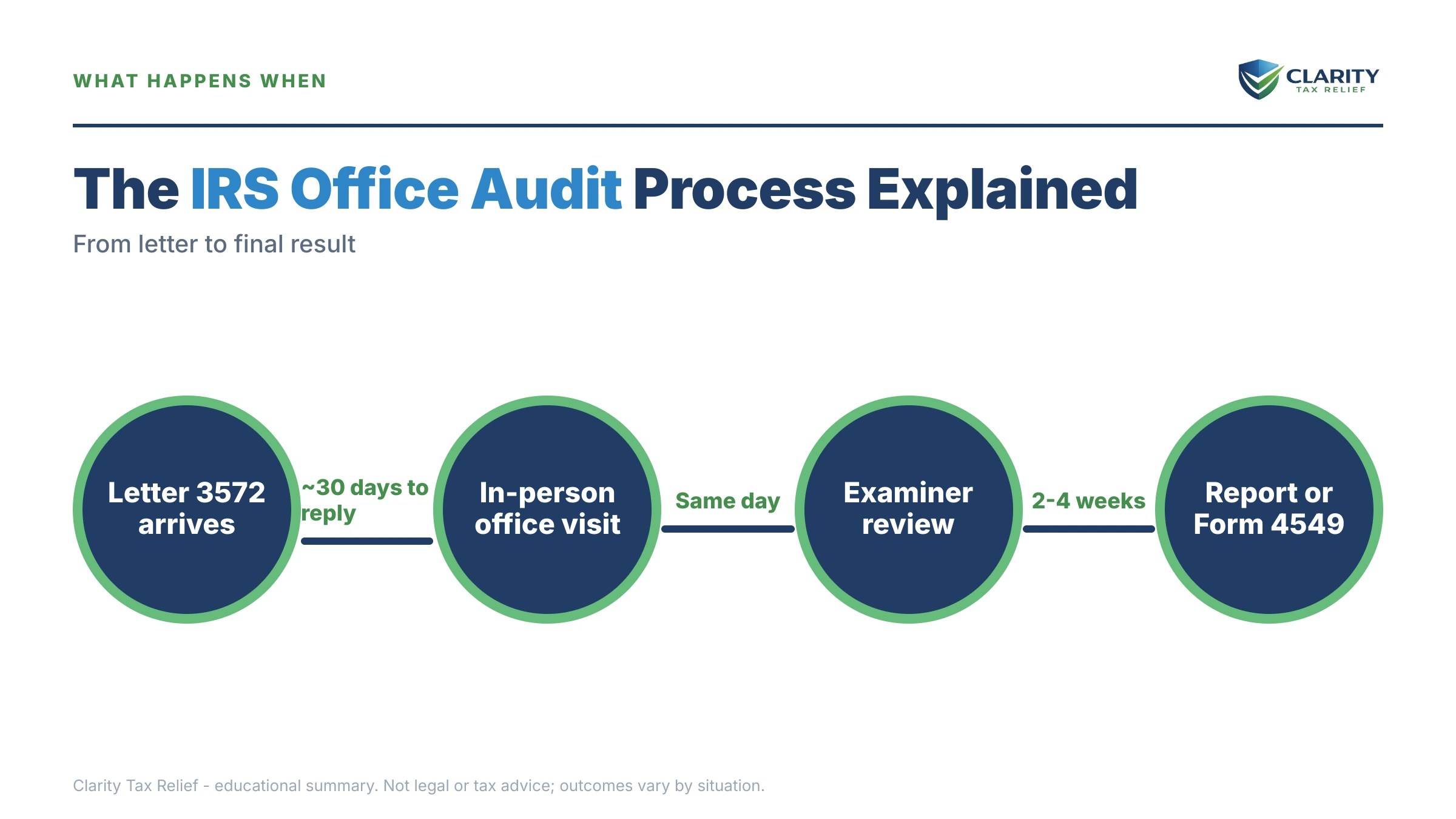
An office audit interview typically runs two to four hours and follows a script. The TCO will ask background questions (how the business operates, who keeps the books, how you're paid), walk the listed issues one by one against your records, and — for almost every self-employed taxpayer — run an income probe.
The income probe is where unprepared owners get hurt. The examiner totals deposits into your business and personal accounts and compares them to the receipts on your return; unexplained deposits are treated as unreported income. This is the bank deposit method audit, and the defense is simple but front-loaded: before the meeting, trace every significant deposit to its source — sales, transfers between accounts, loan proceeds, owner contributions — so nothing on the schedule is a mystery.
Three ground rules protect you in the room:
- Bring only what the letter asks for. Extra boxes of records invite extra questions. Organize by issue and by year.
- Answer the question asked, then stop. Volunteered detail is the most common way office audits expand to new issues or the adjacent year.
- You don't have to go at all. An enrolled agent, CPA, or attorney holding your signed Form 2848 can attend in your place — and in most office audits the taxpayer never appears. That removes the risk of an off-hand answer becoming an adjustment.
If your records are thin, don't skip the appointment — reconstruction is a recognized, legitimate defense. Bank statements, vendor histories, calendars, and job logs can rebuild support for real expenses; our guide to an IRS audit no receipts situation walks through what examiners accept and what they won't.
What happens if you ignore an IRS office audit
Ignoring an office audit doesn't stall it — it forfeits it, because the examiner simply decides the audit without your side of the file. The sequence runs on its own:
- Missed appointment. The examiner may attempt one contact to reschedule; after that, the exam proceeds on the IRS's records alone.
- Default audit findings. Deductions you didn't verify are disallowed, and income is set from third-party reports and deposit data — the most expensive version of your return the facts allow.
- Form 4549 exam report with a 30-day letter. The proposed changes arrive in writing, with typically 30 days to protest to IRS Appeals.
- CP3219A Notice of Deficiency. No response to the report triggers the statutory 90-day letter — your last chance to contest the tax in Tax Court before it's assessed.
- Assessment and collections. The balance posts to your account, penalties and interest attach, and the collection notice stream begins — ending, if still ignored, in lien filings and levy authority.
Every stage in that list is worse than the one before it, and the first stage — the appointment — is the only one where you're negotiating facts instead of procedure. Even after a missed appointment, calling immediately can often reopen the exam before the report issues.
Office audit appointment on the calendar?
Send us a photo of your appointment letter before the date on it. An experienced tax professional will decode exactly which issues are in play, what your records need to show, and whether you should attend at all — free, confidential, no pressure.
How an office audit ends — and the clocks each outcome starts
Every office audit closes one of three ways: a no-change letter, an agreed report, or a disagreed report — and the disagreed path runs on strict deadlines. If the examiner proposes changes, you'll receive Form 4549 with a cover letter (often Letter 525, the "30-day letter") laying out the adjustments, the 20% accuracy-related penalty where asserted, and interest.
Signing Form 4549 ends the audit but also ends your appeal rights — never sign at the table if you disagree with any number on it. Disagreeing costs nothing: IRS Appeals is a free, separate office that settles most protested exams based on the hazards of litigation, and the process is covered in our guide to an IRS audit appeal.
| Stage / document | Your window | What you lose if it passes |
|---|---|---|
| Appointment letter | The appointment or contact-by date printed on it | The chance to present your records before the examiner decides without them |
| Form 4549 exam report (30-day letter) | Typically 30 days from the letter date | The free IRS Appeals review before any tax is assessed |
| CP3219A Notice of Deficiency | 90 days (statutory) from the notice date | The right to contest the tax in Tax Court without paying first |
| After assessment | Collection notices begin on their own cycle | The pre-assessment forums entirely — you're now negotiating payment, not the audit |
If the deficiency notice window closes too, the fight isn't strictly over — Tax Court requires the 90-day letter and Tax Court petition path, but a missed one leaves audit reconsideration and refund-claim routes, both slower and weaker. One more document deserves a mention: if the examiner asks you to sign a statute extension because time is running out on the assessment window, that's Form 872, and whether to sign it is a genuine strategic decision, not a formality.
If the audit ends with a balance you can't pay: your options
An audit bill is collected exactly like any other IRS balance — which means every payment program is available, each with its own eligibility line. Here's the field, keyed to where an audit assessment typically lands:
| Option | Who it fits | Cost & terms |
|---|---|---|
| Appeal before assessment | You disagree with any part of the exam report | Free — but only inside the 30-day letter window; often reduces the balance before payment is even discussed |
| Pay in full | You can raise the cash without crippling the business | No fee; stops the 0.5%/month failure-to-pay penalty and interest accrual immediately |
| Short-term payment plan | Balance payable within 180 days | $0 setup; interest and penalties continue until paid |
| Streamlined installment agreement | Assessed balance of $50,000 or less | Up to 72 months, set up online without financial disclosure; setup fee is lower with direct debit |
| Non-streamlined installment agreement | Balances over $50,000 | Requires Form 433 financial disclosure; payment set by ability to pay |
| Offer in Compromise | Assets plus future income genuinely can't cover the debt | $205 fee and 20% down on lump-sum offers (both waived with low-income certification); the IRS accepted roughly 1 in 5 offers in FY2024 |
| Currently Not Collectible | Any payment would prevent basic living expenses | Collection pauses; the debt remains and interest keeps accruing |
A worked example (hypothetical). Say you own a small business with four employees, and your office audit closes with $54,600 proposed across two Schedule C years — disallowed vehicle and contract-labor deductions, the 20% accuracy-related penalty, and interest. Run the decision in order:
- First, the appeal math. If even part of the contract labor is documentable, protesting within the 30-day window can shrink the number before it's ever assessed — Appeals settlements routinely land between the examiner's figure and yours.
- If the number stands, mind the $50,000 line. At $54,600 you're above the streamlined online cap, so the default path is Form 433 financial disclosure. But paying $4,600 up front drops the assessed balance to $50,000 — unlocking a streamlined installment agreement of about $695/month over 72 months on principal alone (the actual required payment runs somewhat higher because interest keeps accruing). Compare that with $54,600 over the same 72 months at roughly $758/month — except that route also hands the IRS your full financial statement.
- Protect the payroll account. Any agreement you sign requires staying current on new obligations — for an employer, that means every 941 deposit, on time, or the agreement defaults and collections restart.
Penalties and interest are their own line items in that $54,600, and they're moving targets — you can estimate what the layers add on your own numbers with our IRS Penalty & Interest Calculator.
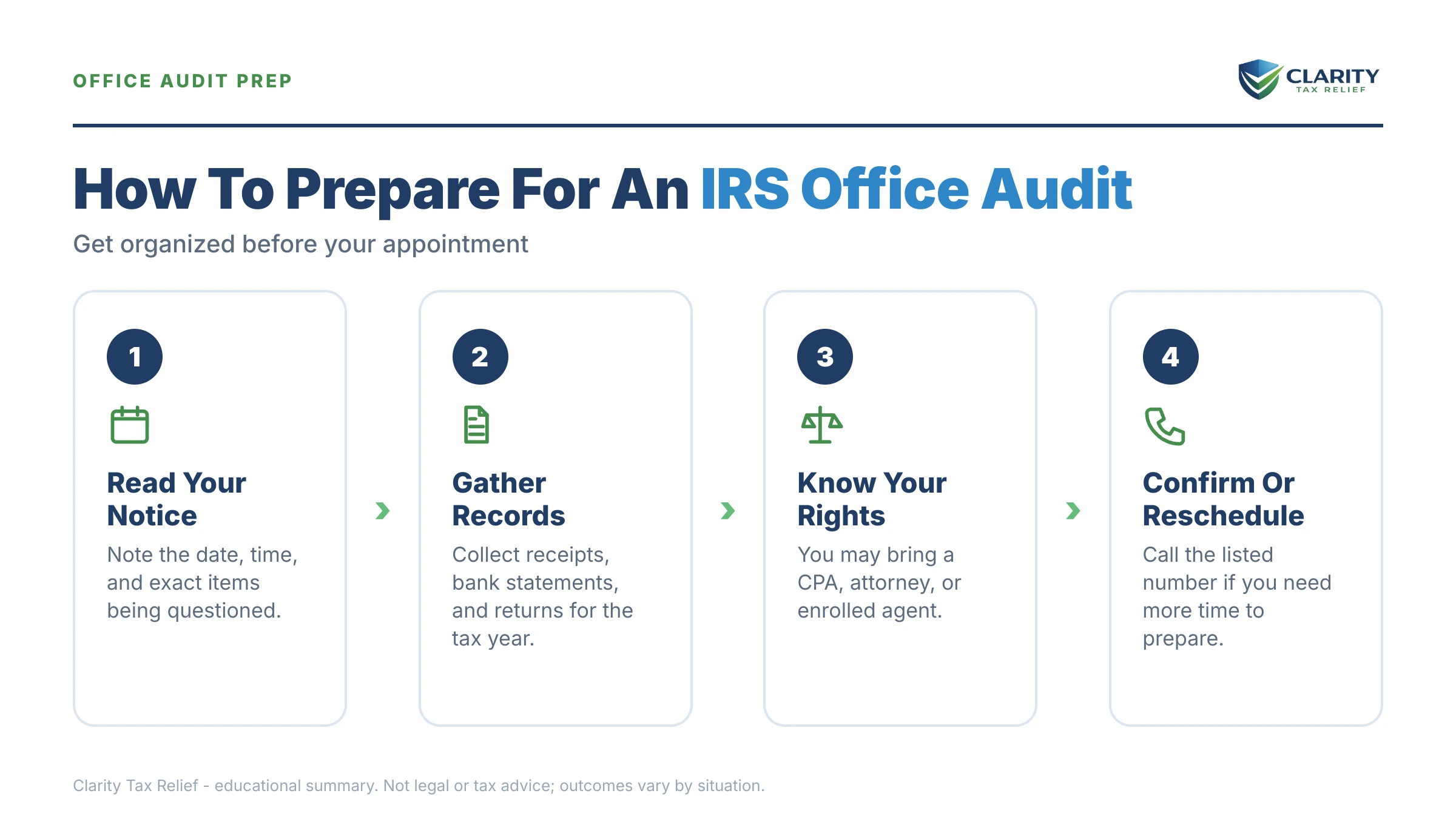
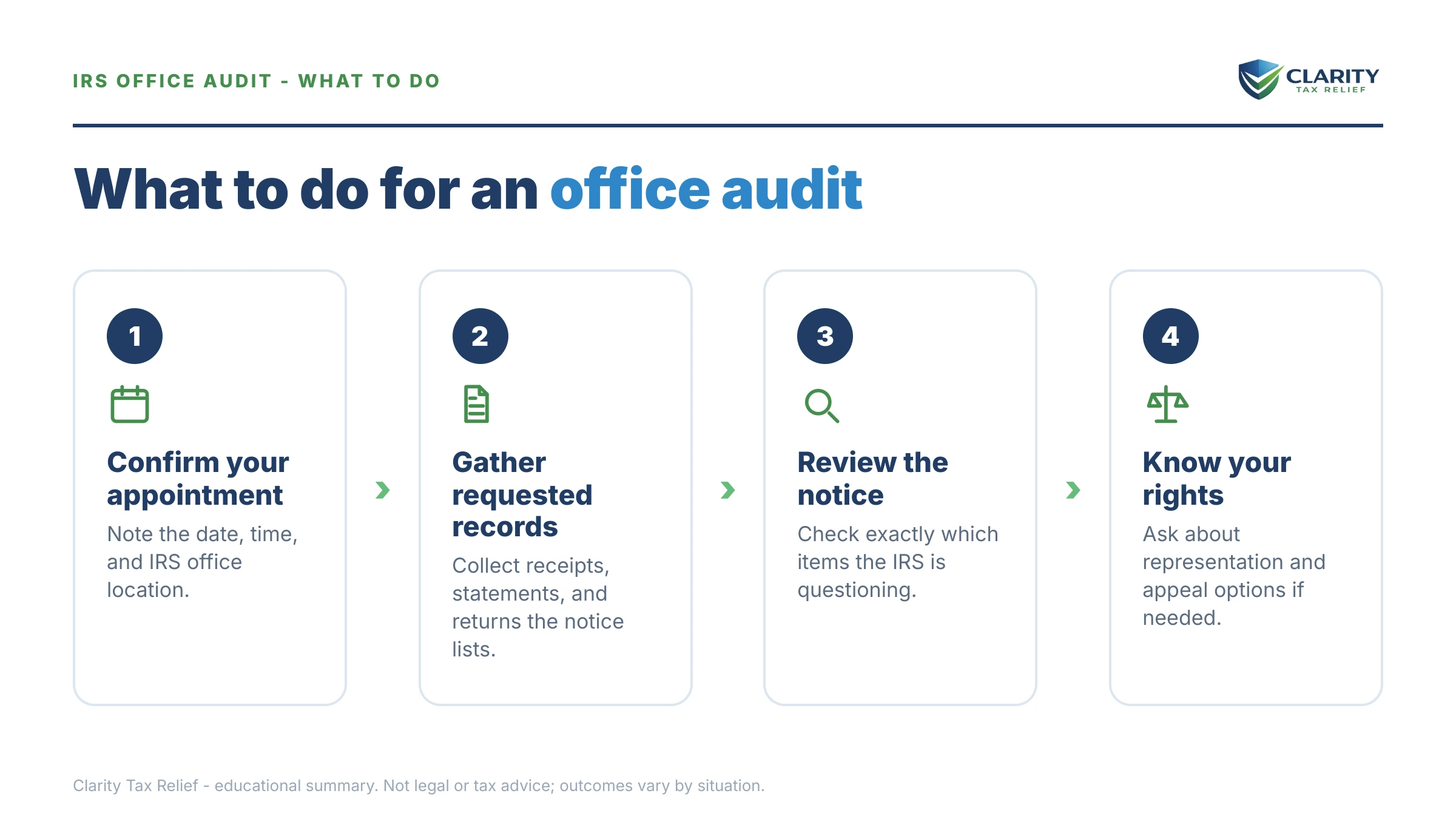
How to respond to an IRS office audit, step by step
- Verify the letter. Real exam appointment letters arrive by postal mail with a letter number, a scheduled or contact-by date, and a list of the documents to bring — the IRS never opens an audit by phone, text, or email.
- Call before the date on the letter. Confirm the appointment, or reschedule it if you need more time to gather records — silence is the only response that hurts you.
- Pull the records for the listed items only. Organize receipts, bank statements, and logs by issue and by year, and trace every large deposit before the meeting.
- Decide who attends. You can go yourself, or send an enrolled agent, CPA, or attorney under Form 2848 — in most office audits, your representative can appear without you.
- Answer what's asked and nothing more. Provide the documents on the list, respond to direct questions, and offer to follow up in writing on anything you're unsure of.
- Get everything in writing. Leave with — or wait for — the examiner's written report, and calendar the appeal windows it starts the moment it arrives.
When you can handle an office audit yourself
Plenty of office audits don't need professional representation. You can reasonably go alone when the letter lists one or two issues, your records for those issues are complete and organized, your income is fully third-party reported, and you'd genuinely agree with a small adjustment if the examiner found one. In that situation, preparation matters more than credentials — show up organized and the exam tends to close quickly.
Experienced help changes outcomes in specific, predictable situations: a self-employed return facing a deposit-analysis income probe, cash-heavy receipts, significant reconstructed records, more than one year under exam, unfiled returns lurking behind the audited year, or any hint the examiner is interested in intent rather than arithmetic. In those cases the representative's real value isn't the meeting — it's keeping the scope contained, choosing what gets said, and working the Appeals math if the report comes back wrong. And a hard line: if the questions turn to why income was omitted rather than whether it was, stop volunteering and get counsel before the next conversation.
If your appointment is inside two weeks and you're staring at a records gap, a free case review can tell you in one call whether to go alone or send representation — (888) 825-7779 or the 2-minute form.
Terms on your audit letter, decoded
- Tax Compliance Officer (TCO): the IRS examiner who conducts office audits — trained for interview-based exams of individual and small-business returns.
- Information Document Request (Form 4564): the formal list of records the examiner wants; it defines what you must bring and, by omission, what you don't.
- Form 4549: the Income Tax Examination Changes report — the audit's proposed bottom line; signing it accepts the changes and waives your appeal.
- 30-day letter (Letter 525): the cover letter on the exam report giving you a window — typically 30 days — to protest to IRS Appeals.
- Notice of Deficiency (CP3219A): the statutory "90-day letter" — your final pre-assessment chance to contest the tax, in Tax Court, without paying first.
- No-change letter: the best possible ending — the examiner accepted the return as filed and the audit is closed.
- Statute extension (Form 872): a consent form extending the IRS's time to assess; sometimes worth signing to allow Appeals time, sometimes not.
The IRS's own overview of the exam process lives at IRS.gov's audit page, and the appeal process is described at the IRS Independent Office of Appeals. If the exam is causing genuine hardship or the process breaks down procedurally, the Taxpayer Advocate Service is an independent channel inside the IRS built for exactly that.
IRS office audit questions, answered
How serious is an IRS office audit?
An office audit is the middle tier of IRS exams — more serious than a mail audit, less invasive than a field audit. The IRS believes the issues on your return need a face-to-face interview, not just documents, which usually means deductions or self-employment income it expects to adjust. Prepared taxpayers regularly walk out with no change or a small one; unprepared ones fund most of the adjustments office audits produce.
Can someone go to my IRS office audit for me?
Yes. An enrolled agent, CPA, or attorney holding your signed Form 2848 power of attorney can attend the appointment in your place, and in most office audits you never have to appear at all. That matters because a representative can answer only the questions asked, promise follow-up documents instead of guessing, and can't be drawn into casual conversation that expands the exam.
Why did I get an office audit instead of a mail audit?
The IRS routes a return to an office audit when the issues need explanation, not just paperwork — typically Schedule C income and expenses, vehicle and travel deductions, or dependents and filing status. Mail audits handle single, document-verifiable items; your letter means an examiner wants to ask questions. It is not evidence the IRS suspects fraud.
How long does an IRS office audit take?
The appointment itself typically runs two to four hours. The full audit — from the first letter to a closing report — usually takes several months, longer if you send follow-up documents or the auditor opens another year. Delivering organized, complete records at the first meeting is the single biggest thing you control in shortening it.
What if I don't have receipts for the deductions being audited?
You can often reconstruct support — bank and card statements, vendor records, mileage built from calendars and job logs, and reasonable estimates courts have accepted for some expense types under the Cohan rule. Strict substantiation rules still apply to vehicle, travel, and meal expenses, so those need contemporaneous-style records. Never invent documents; a reconstructed record labeled as such is credible, a fake one is dangerous.
Can an office audit expand to other years or my business returns?
Yes — if the auditor finds the same issue produced a similar error in the adjacent year, they can open it, and large unexplained bank deposits can widen the exam's scope. The standard window is three years from filing, stretching to six when income is understated by more than 25%. Tight, responsive answers at the first meeting are the best way to keep the exam contained to what the letter lists.
Can I reschedule my office audit appointment?
Generally yes — call the number on your letter before the appointment date and request a new time; auditors routinely grant reasonable requests, especially a first one made early. What hurts you is silence: a missed appointment with no call lets the auditor close the exam on the IRS's own records. If you've just hired representation, your representative can request the reschedule and handle scheduling going forward.
Will the auditor look at my bank accounts?
In a self-employed office audit, almost certainly. The examiner typically totals the deposits into your business and personal accounts and compares them with the income on your return — any unexplained gap is treated as unreported income unless you document it as loans, transfers, or nontaxable amounts. Trace every large deposit before the appointment, not while sitting across the desk.
What happens if I miss my IRS office audit appointment?
The audit doesn't go away — the auditor closes it using the information the IRS already has, disallowing unverified deductions and adjusting income from third-party reports. You'll then receive an exam report proposing the changes and, if you don't respond, a Notice of Deficiency giving you 90 days to petition Tax Court before the balance is assessed. Even after a missed appointment, calling immediately can often reopen the exam.
Your next 24 hours
- Find two things on your letter: the appointment (or contact-by) date, and the list of items under exam. Those two boxes define your entire audit — photograph the letter so you have it everywhere.
- Start the records pile: the audited year's return, bank statements for every account (business and personal), and whatever supports the listed items — receipts, mileage logs, contractor invoices, payroll records.
- Get the letter reviewed free before the appointment date: call (888) 825-7779 or use the 2-minute form, and an experienced tax professional will map the issues, the records gaps, and whether you should attend in person at all.
This guide is general information, not tax or legal advice for your specific situation. Eligibility for IRS programs depends on individual facts and circumstances; no outcome is guaranteed.