
IRS Letters
IRS Letter 2205-A: Your Return Was Selected for Examination — What to Do in 2026
The short answer: IRS Letter 2205-A means your individual tax return has been selected for examination — an audit handled by an assigned examiner, not by mail. The letter asks you to call the examiner to schedule an appointment, typically within 10 business days. Nothing has been assessed yet; how you respond shapes the outcome.
Maybe this is the first return you filed on your own after the divorce — new filing status, the kids claimed for the first time solo — and now a letter says the IRS wants to "examine" it, with a stranger's name and phone number at the top. Take a breath: an examination is a document contest, not a verdict. The final number tracks the records you bring, not how nervous the letter makes you.
Letter 2205-A is different from most IRS mail in one crucial way: it gives you a person, not a payment coupon. The image below shows exactly what Letter 2205-A looks like and where to find the examiner's name, the tax year under exam, and your contact-by date.
⏱ Your deadline: the contact-by date printed on your Letter 2205-A — the letter typically asks you to call the examiner within 10 business days of the letter date. Missing it does not pause the audit. The examiner can proceed without you and propose changes using only IRS records and third-party data.
Why you got Letter 2205-A
Letter 2205-A is the IRS's opening letter for an in-person examination of an individual return — it names your assigned examiner, the tax year under review, and asks you to call to schedule an appointment. It usually arrives with Form 4564, an Information Document Request listing the specific items and records the examiner wants, plus Publication 1 (Your Rights as a Taxpayer).
Selection rarely means anyone suspects wrongdoing. Individual returns land in examination for a few predictable reasons: statistical scoring that flags returns whose deductions sit far outside the norm for their income, mismatches between your return and third-party documents, or a related exam — for example, your ex-spouse's return is under review and yours reports the same dependents, the same support payments, or the mirror image of the same divorce-year income split. (If you're still not sure why the IRS is writing you at all, our decoder on why did I get a letter from the IRS covers the whole landscape.)
The "A" matters: 2205-A is the individual version, while Letter 2205-B is its business counterpart. And it differs from a Letter 566 correspondence audit in scope — 566 exams run entirely by mail through a central campus, while a 2205-A exam has an assigned examiner and a scheduled meeting, either an office audit at an IRS location or a field audit at your home, business, or representative's office. That structure usually signals more complex issues: self-employment income, filing status, several questioned items at once. When your copy arrives, check it against the sample image on this page so you know which box holds which date.
What happens if you ignore Letter 2205-A
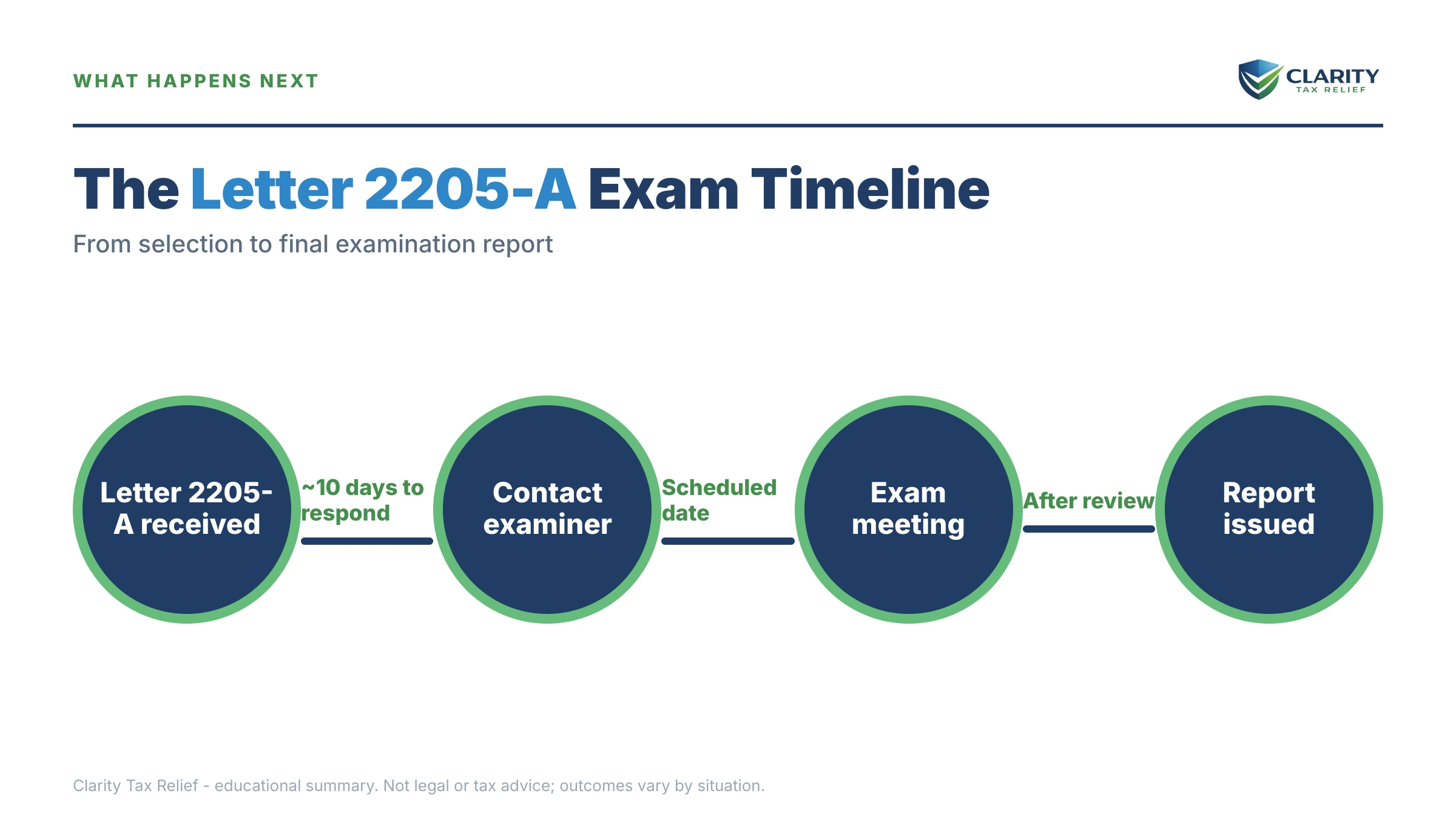
Ignoring Letter 2205-A doesn't stall the audit — the examiner can complete it without you and disallow every item you didn't substantiate. From there, the process moves through a fixed sequence of letters, and at each stage you hold fewer rights than the stage before:
- Letter 2205-A — the exam opens. You still control the narrative: you can schedule, organize records, and bring representation.
- Exam conducted by default — if you never call, the examiner works from IRS records and third-party data alone. Deductions without documentation get removed; income the IRS sees gets added.
- Examination report — the proposed changes arrive, typically with Letter 915 and Form 4549. You get 30 days to agree or protest to the IRS Independent Office of Appeals.
- Notice of Deficiency — if the 30 days pass without agreement, the 90-day letter gives you one last window to petition the U.S. Tax Court before assessment.
- Assessment and collection — the balance posts to your account and the collection notice stream begins, ending at a final notice of intent to levy such as Letter 1058, which starts a 30-day clock before the IRS can levy wages and bank accounts.
One 2026 reality worth naming: IRS staffing fell roughly 27% in 2025, so reaching a human is harder than ever — but examination default assessments and the collection notices that follow are generated by automated systems that never slowed down. Silence doesn't buy time; it buys a worse number.
| Stage | What happens | Your window and rights |
|---|---|---|
| Letter 2205-A | Exam opens; examiner assigned; Form 4564 lists requested records | Contact-by date on the letter (typically 10 business days to call) |
| Exam without you | Unverified deductions disallowed; third-party income added | You can still engage at any point before the report is final |
| Letter 915 / exam report | Form 4549 proposes the changes and the new balance | 30 days to agree or file a protest with Appeals |
| Notice of Deficiency | The proposed tax becomes final unless you act | 90 days to petition the U.S. Tax Court |
| Assessment & collection | Balance posts; bills begin; levy notices eventually follow | Payment options, then Collection Due Process rights via Form 12153 at the final notice |
Holding a Letter 2205-A right now?
Send us a photo of it before your contact-by date passes. An experienced tax professional will review the year under exam, the items listed on the document request, and what should — and shouldn't — be said when the examiner is called. Free, confidential, no pressure.
Your options after Letter 2205-A: costs and timelines
Every Letter 2205-A exam ends one of four ways: you substantiate the items, you agree to changes, you appeal, or you take it to Tax Court. What you choose at the front end mostly determines which ending you get:
| Option | Typical cost | Timeline | Best when |
|---|---|---|---|
| Handle the exam yourself | Your time plus record-gathering | One or more appointments over weeks to a few months | One simple issue, complete records, and you're confident answering questions |
| Hire representation (Form 2848) | Professional fees vary with issues and years in scope | Same exam timeline; your representative attends in your place | Multiple issues or years, missing records, divorce-year disputes, cash or self-employment income |
| Agree and resolve the balance | Tax + penalties + interest; short-term IRS plans (up to 180 days) have $0 setup | Assessment posts within weeks of signing Form 4549 | The examiner's changes are correct and the amount is manageable |
| Protest to Appeals (30-day letter) | No IRS filing fee; representation fees if you use help | Typically several months to a conference and settlement | You disagree on facts or law and have documentation or a reasonable position |
| Petition Tax Court (90-day letter) | Small court filing fee; higher professional fees if represented | Longest path — many cases still settle before trial | Appeals failed or was skipped, and you want a ruling before paying anything |
Two option-specific notes. First, representation isn't just comfort: once Form 2848 is on file, the examiner generally must communicate through your representative, which prevents the casual phone answer that expands an exam from one item to four. Second, if the examiner asks you to sign Form 872 extending the assessment statute, don't sign reflexively — an extension has strategic costs and benefits that depend on your specific case.
What a Letter 2205-A exam can cost: a $54,600 worked example
Say you divorced in 2024, filed head of household, claimed both kids, and deducted heavy self-employment expenses — and Letter 2205-A arrives, but you never call. This is what a default result could look like (hypothetical numbers, shown for the arithmetic):
- Disallowed items: unsubstantiated Schedule C deductions, head-of-household status recomputed to single, and one child's credits removed because your ex held the signed Form 8332 → additional tax of $42,000
- Accuracy-related penalty at 20%: $42,000 × 0.20 = $8,400 (see how the accuracy related penalty attaches to exam changes)
- Interest accrued to date (illustrative): roughly $4,200, compounding from the return's original due date at the IRS's quarterly rate
- Total proposed: $42,000 + $8,400 + $4,200 = $54,600
Now run the same exam with a response: mileage logs reconstructed from calendars and bank records, the household-cost worksheet proving head of household, receipts matched to the deductions on Form 4564. An exam assessment only sticks to what you can't substantiate — which is why the single most expensive decision in this hypothetical wasn't any deduction; it was not calling. You can estimate how penalties and interest stack on a proposed exam balance with our IRS Penalty & Interest Calculator.
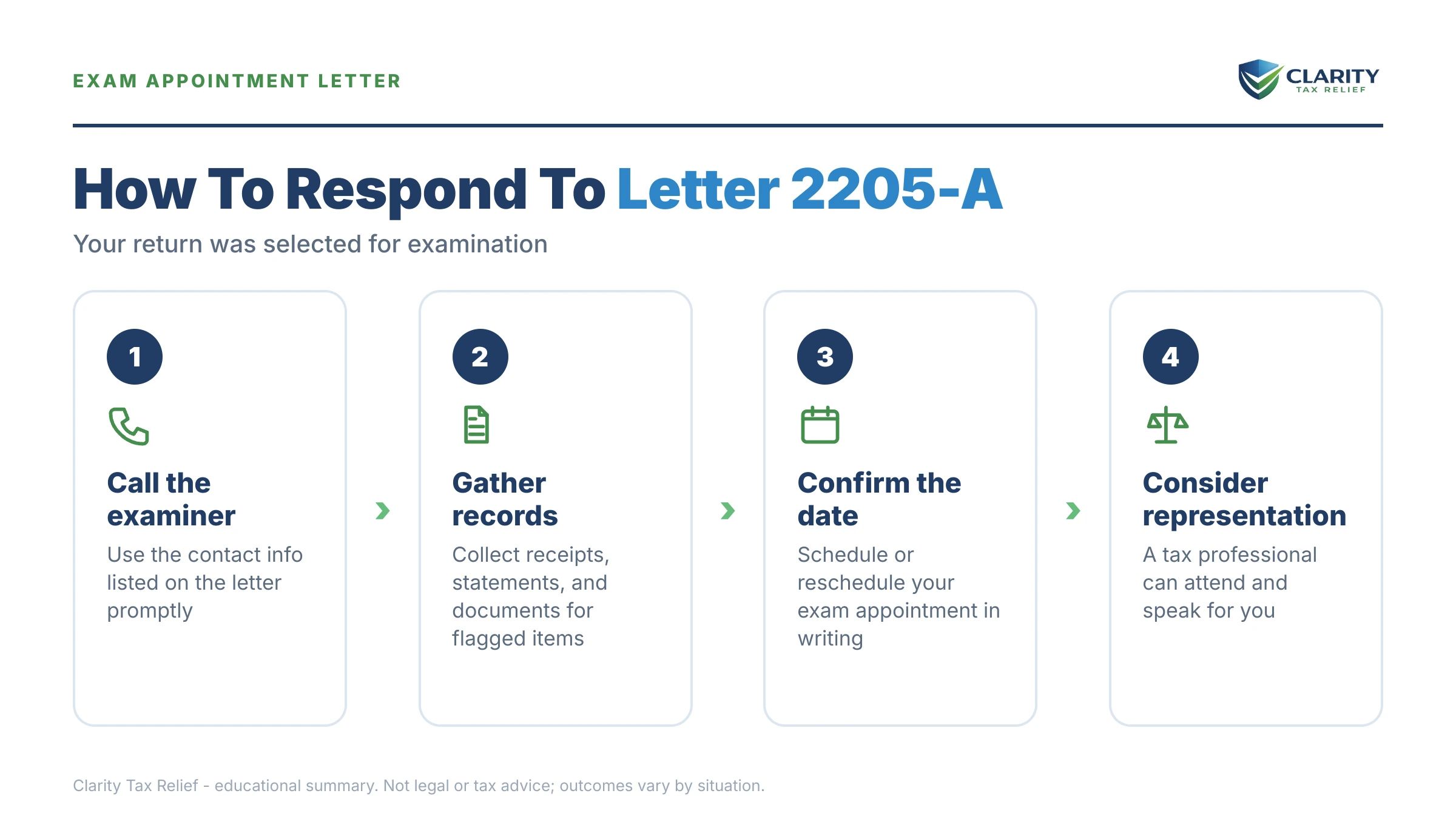
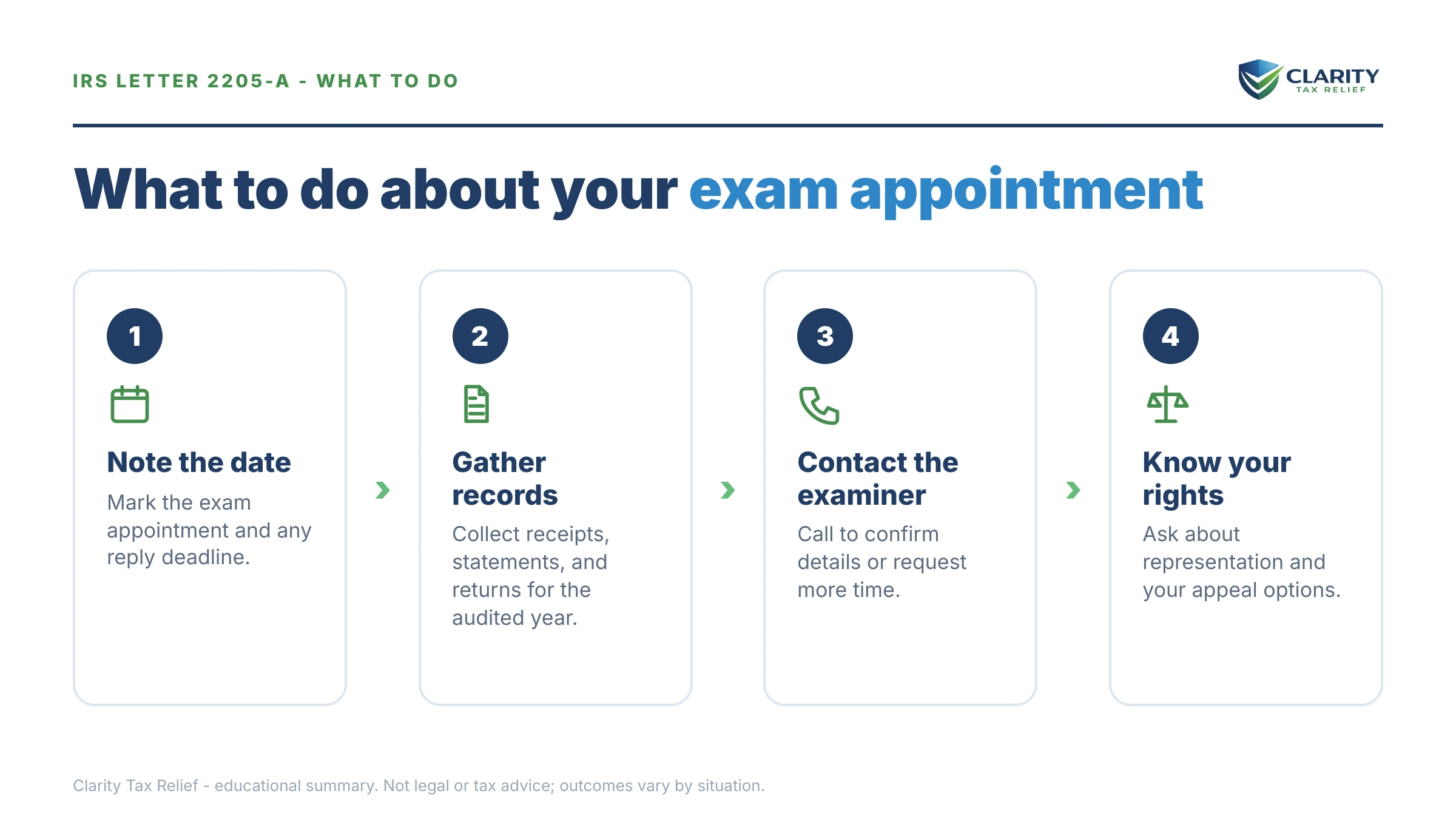
How to respond to Letter 2205-A, step by step
- Locate the key details. Find the examiner's name, phone number, the tax year under exam, and your contact-by date on the letter.
- Pull the return. Get a copy of the return for every year listed and match each questioned item to the records behind it.
- Decide who handles the exam. Choose whether you or a representative under Form 2848 will deal with the examiner — decide before anyone calls.
- Call by the contact-by date. You or your representative should call the examiner to schedule the appointment — never let the date pass silently.
- Answer the document request precisely. Respond to Form 4564 with organized, complete records for exactly what is asked — no more, no less.
- Review before you sign. Read the examination report carefully; signing Form 4549 agrees to the changes and closes your appeal path.
Recently divorced? The items your examiner will check first
A divorce changes four things on a tax return at once — filing status, dependents, support payments, and household income — and 2205-A exams of post-divorce returns tend to focus on exactly those four.
Filing status. Head of household requires that you paid more than half the cost of keeping up a home for a qualifying person. Examiners ask for the math: rent or mortgage, utilities, groceries — your share versus everyone else's. If the divorce finalized late in the year, the December 31 status controls the whole year.
Dependents. When both parents claimed the same child, the IRS often opens related exams on both returns. The custodial-parent rules and a signed Form 8332 decide the outcome — not what the divorce decree says, and not who "deserves" the claim.
Support payments. For divorce agreements executed after 2018, alimony is neither deductible by the payer nor taxable to the recipient — and child support was never deductible. Mislabeling child support as deductible alimony is one of the most common post-divorce exam adjustments.
Joint years in scope. If the exam covers a year you filed jointly with your ex, you are each liable for the entire result regardless of what your decree allocates. And if records ended up split between two households, don't panic — an exam with no receipts can often be rebuilt from bank statements, provider records, and reconstruction methods the IRS itself accepts.
When you can handle a 2205-A exam yourself
You can reasonably handle this alone when the exam covers one straightforward issue for one year, your records are complete, and you're comfortable answering only the questions asked. A single questioned deduction backed by a folder of receipts doesn't need professional fees — it needs organization and punctuality.
Experienced help changes outcomes in specific situations: multiple years or issues in scope, self-employment or cash income the examiner may probe deeper, records lost in the household split, a related exam pulling in your ex-spouse's return, a request to extend the statute on Form 872, or any moment where the exam feels like it's expanding beyond the original document request. In those cases the value isn't hand-holding — it's controlling scope, so the exam ends where it started. The IRS's own overview of the process is at IRS audits explained on IRS.gov, and your protections during any exam are listed in the Taxpayer Bill of Rights. If the exam stalls or the process itself is causing hardship, the independent Taxpayer Advocate Service exists for exactly that.
Terms on your Letter 2205-A, decoded
- Examination: the IRS's formal word for an audit — a review of specific return items, not an accusation.
- Information Document Request (Form 4564): the itemized list of records the examiner wants; it defines the exam's starting scope.
- Publication 1: the rights pamphlet enclosed with your letter — including your right to representation and to appeal.
- Form 4549: the examination-changes report showing proposed tax, penalties, and interest; signing it means agreeing.
- Form 872: a consent extending the IRS's deadline to assess tax — voluntary, and worth advice before signing.
- Notice of Deficiency: the "90-day letter" that follows an unagreed exam, opening your window to petition Tax Court.
Letter 2205-A questions, answered
Is Letter 2205-A an audit?
Yes. Letter 2205-A is the IRS's official notification that your individual return has been selected for examination — the formal name for an audit — and that an examiner wants to schedule an appointment with you. Unlike a mail audit, this exam is handled by an assigned person, usually at an IRS office or in the field. Nothing has been assessed yet; the letter opens the process, it doesn't decide it.
How long do I have to respond to Letter 2205-A?
The controlling deadline is the contact-by date printed on your letter — Letter 2205-A typically asks you to call the examiner within 10 business days. Missing that date doesn't cancel the audit; the examiner can proceed using only IRS records and third-party data, which almost always produces a worse proposed result than a documented response would.
What is the difference between Letter 2205-A and Letter 566?
Letter 566 opens a correspondence audit handled entirely by mail through a central campus, while Letter 2205-A opens an examination with an assigned examiner who wants a scheduled appointment. The 2205-A path usually means broader or more complex issues — self-employment income, filing status, multiple questioned items — and it gives you one specific person to deal with rather than a mail queue.
Do I have to meet with the IRS examiner myself?
No. If you authorize a representative on Form 2848, that person can attend the appointment and handle all communication in your place, and the IRS generally must deal with your representative rather than you. Many taxpayers never speak to the examiner at all. Representation matters most when questions could expand — a stray answer about cash income or a divorce-year filing status can open new issues.
How many years can the IRS examine after Letter 2205-A?
The IRS generally has three years from the date you filed to assess additional tax, which is why most exams cover recent years. That window extends to six years if a return omitted more than 25% of gross income, and there is no time limit for a fraudulent or unfiled return. The examiner may ask you to sign Form 872 to extend the statute — get advice before agreeing.
What happens if I disagree with the audit results?
You don't have to accept the examiner's findings. When the exam ends you'll receive a report — typically with Letter 915 — giving you 30 days to protest to the IRS Independent Office of Appeals, which settles most disputed cases. If Appeals doesn't resolve it, a Notice of Deficiency gives you 90 days to petition the U.S. Tax Court before anything is assessed.
My ex-spouse and I filed jointly for the year under exam — who is liable?
Both of you, in full. A joint return makes each spouse jointly and severally liable for the entire resulting tax, and the IRS is not bound by your divorce decree's allocation of tax debts. If the questioned items were your ex's — hidden income, inflated deductions you didn't know about — innocent spouse relief may limit your share, but you must request it; it isn't automatic.
Does Letter 2205-A mean the IRS thinks I committed fraud?
No. Most examinations are triggered by statistical scoring, document mismatches, or a related exam — like an ex-spouse claiming the same child — not suspicion of fraud. The exam is civil, and the examiner's job is to verify items, not build a case. If an examiner ever suddenly goes silent or reads you rights, that's the rare signal to stop talking and get representation immediately.
Your next 24 hours
- Find three things on the letter: the examiner's name and phone number, the tax year under exam, and the contact-by date. Write the date somewhere you'll see it.
- Gather your file: the return for the year listed, the Form 4564 document request, your divorce decree and any Form 8332, plus bank statements and receipts for each questioned item.
- Get the letter reviewed free before anyone calls the examiner: use the 2-minute form at our free consultation page or call (888) 825-7779. What gets said on that first call sets the exam's scope — make it count.
This guide is general information, not tax or legal advice for your specific situation. Eligibility for IRS programs depends on individual facts and circumstances; no outcome is guaranteed.