
IRS Letters
IRS Letter 915: Your Exam Report and 30-Day Appeal Rights (2026)
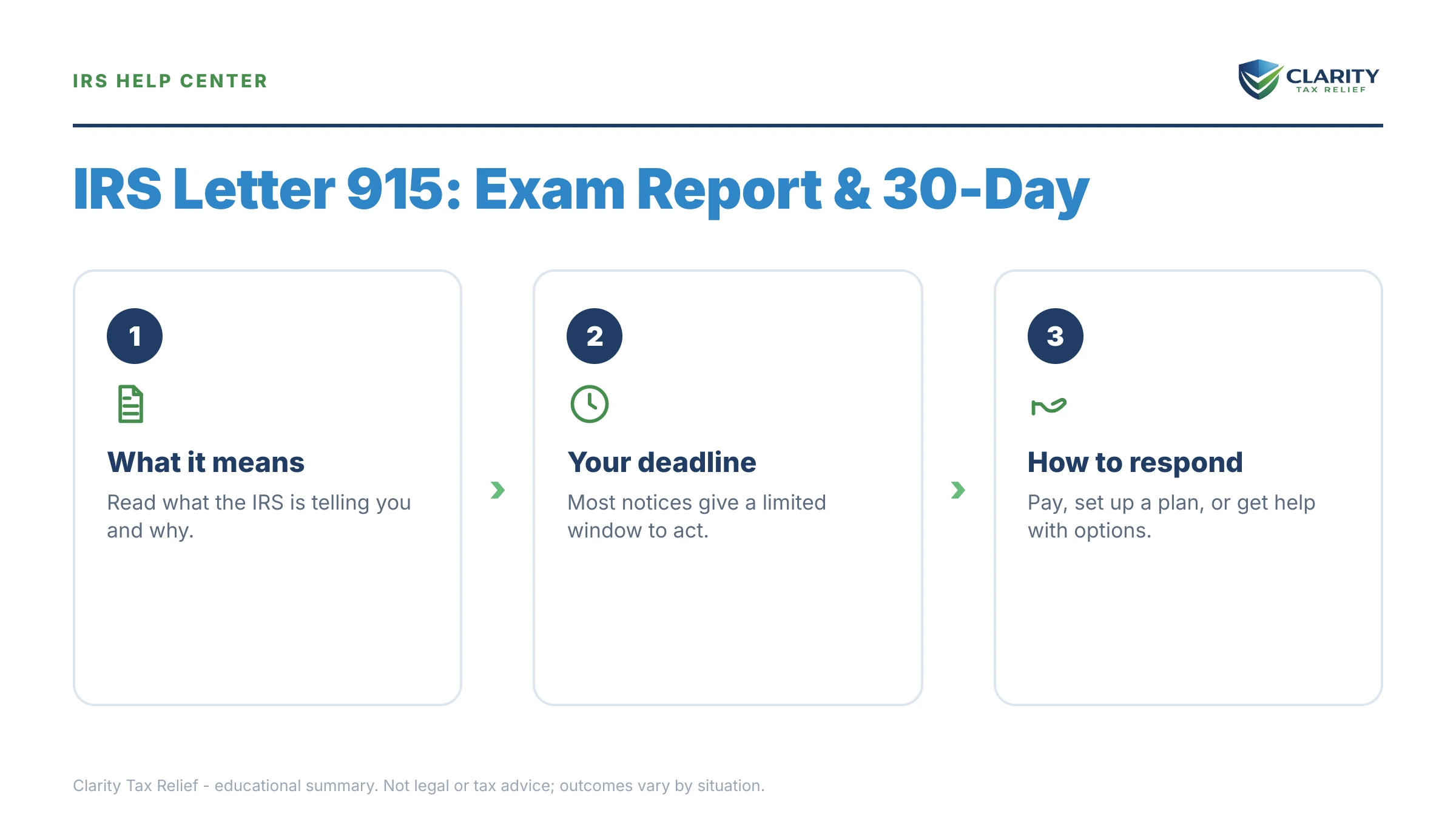
The short answer: Letter 915 transmits your IRS examination report — Form 4549 — listing the changes an auditor wants to make to your return and the added tax, penalties, and interest. You have 30 days from the date on the letter to agree, or to request a free review by the IRS Independent Office of Appeals.
You expected a one-page result from the audit and instead pulled a stapled packet out of the envelope — a Letter 915 on top, a Form 4549 full of recalculated numbers underneath, and a total at the bottom that could swallow a year of retirement income. Take a breath: those numbers are a proposal, not a bill. Nothing has been assessed yet, and the 30 days this letter gives you are exactly enough time to push back the right way.
The date that starts your clock is easy to miss among the attachments — the image below shows exactly what a Letter 915 package looks like and where to look for that date and the response address.
⏱ Your deadline: you have 30 days from the date printed on your Letter 915 to agree with the exam report or request an Appeals review. Miss it, and your next chance to dispute the tax is a formal Notice of Deficiency with a strict 90-day Tax Court window — a harder, more expensive road.
Why you got IRS Letter 915
Letter 915 arrives at the end of an IRS examination and transmits the examiner's report proposing changes to your return. If your audit started with a Letter 2205-A appointment or a mail exam, this packet is the examiner's conclusion: here's what we think you got wrong, and here's what it costs. (If you're still trying to place this letter in the bigger picture of IRS mail, our guide to why you got a letter from the IRS maps the whole system.)
For retirees, the adjustments behind a Letter 915 are usually predictable: a retirement-account distribution the examiner treated as fully taxable, Social Security benefits recalculated as taxable because other income pushed them over the threshold, a home sale or brokerage gain reported differently than the 1099 showed, or itemized deductions the examiner couldn't verify. Whatever the issue, the examiner's math is only as good as the documents they saw — and mail exams routinely conclude without seeing yours.
Letter 915 belongs to the same family as the Letter 525 audit report and the Letter 950 30-day letter. The wrappers differ by exam type; the deal is identical: agree, appeal within 30 days, or let the report become the IRS's final position.
How to read the report inside Letter 915
The Letter 915 packet has three working parts, and the number you're afraid of comes from the second one.
The letter itself carries the date that starts your 30-day clock, the response address, and the examiner's contact information. Form 4549 — Income Tax Examination Changes — is the line-by-line recalculation: each adjustment, your corrected taxable income, the corrected tax, any penalties, and interest computed to a date printed on the form. Form 886-A explains, item by item, why the examiner made each change — this page is your roadmap for a rebuttal, because it tells you exactly what evidence was missing.
Two things to check immediately. First, whether the report includes the 20% accuracy-related penalty — on a large adjustment, that single line can add tens of thousands of dollars, and it is often the most contestable item on the page. Second, the interest computation date: interest keeps running past that date, so the real balance grows every month the report sits unanswered. You can estimate how fast with our Penalty & Interest Calculator.
What happens if you ignore Letter 915
If you don't respond to Letter 915 within 30 days, the IRS issues a Notice of Deficiency and begins making the examiner's numbers permanent. The sequence is automated and it doesn't stall just because IRS staffing is thin — each stage closes a door the previous stage left open:
- Letter 915 + Form 4549 — the proposal stage. You are here. Nothing is assessed; Appeals is free and available.
- Notice of Deficiency — the CP3219A (or Letter 531) "90-day letter." Your only remaining pre-payment dispute path is a U.S. Tax Court petition within 90 days.
- Assessment and first bill — the proposed tax, penalty, and interest become a legal debt, and a balance-due notice arrives demanding payment.
- Collection notices — the escalating sequence ends at a final notice like Letter 1058, after which the IRS can levy bank accounts and, for retirees, take up to 15% of Social Security benefits through the Federal Payment Levy Program.
The cruel part of skipping the 30-day window is that Appeals — the cheapest, most flexible forum you'll ever get — disappears first, while the debt itself only grows.
| Stage | Your window | The right you lose if it passes |
|---|---|---|
| Letter 915 + Form 4549 exam report | 30 days from the letter date | Free IRS Appeals review — no court, no assessment yet |
| Notice of Deficiency (CP3219A / Letter 531) | 90 days from the notice date | The right to dispute the tax before it's assessed (Tax Court) |
| Assessment + first balance-due bill | Typically about 21 days to pay | The lowest-cost window before collection notices begin |
| CP504, then LT11 / Letter 1058 final notice | 30 days from the final notice | Collection Due Process hearing before levy |
Holding a Letter 915 right now?
Get the exam report reviewed free before the 30-day appeal window closes. An experienced tax professional will read the Form 4549 with you, flag what's contestable, and map your strongest response — no pressure, no obligation.
Your options after Letter 915
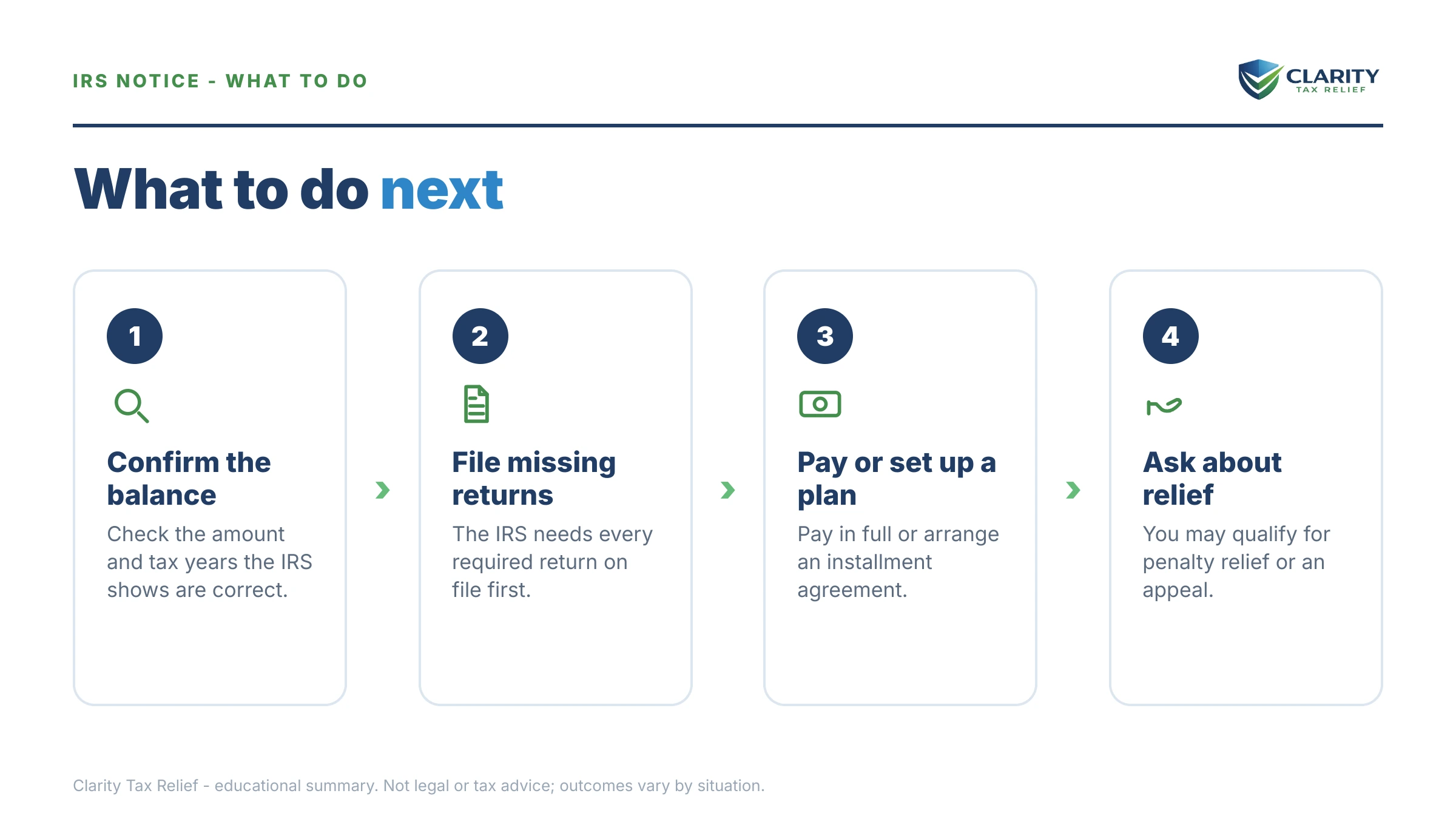
You have four realistic responses to Letter 915: agree and sign, agree but arrange payment, appeal inside the IRS, or wait for the Notice of Deficiency and petition Tax Court. Which one fits depends on two questions — is the report right, and can you pay it?
- Agree in full. Sign Form 4549 and the tax gets assessed as written. If you can't pay at once, payment options open immediately — but note that once the total tops $50,000, a payment plan over $50,000 requires financial disclosure rather than a quick online setup.
- Agree in part. You don't have to accept or reject the whole report. You can concede the adjustments that are correct and contest only the ones that aren't — often the accuracy-related penalty, which requires the IRS to show your position lacked a reasonable basis.
- Disagree — $25,000 or less per year in dispute. File a small case request, typically on Form 12203: a short form naming each item you dispute and why. No legal brief required.
- Disagree — more than $25,000 per year. Send a formal written protest: your name, the letter and tax years, each disputed adjustment, the facts, the law you rely on, and a penalties-of-perjury statement. Appeals officers settle based on the hazards of litigation — how the case would likely fare in court — which is why documented, well-argued protests routinely produce reduced numbers. Be aware Appeals may ask you to extend the assessment deadline via Form 872; whether to sign is a real strategic decision, not a formality.
- Do nothing. The Notice of Deficiency arrives, and your only pre-assessment forum becomes Tax Court. After assessment, audit reconsideration exists as a backstop for evidence the examiner never saw — but it's discretionary, slow, and collection can continue while it's pending.
| Your response | How you do it | When it fits |
|---|---|---|
| Agree in full | Sign and return Form 4549 | Every adjustment is verifiably correct |
| Agree, can't pay | Sign Form 4549, then set up a payment plan or hardship status | The report is right but the balance exceeds what you can pay |
| Disagree, ≤ $25,000 per tax period | Small case request (Form 12203) within 30 days | Smaller disputes with documents to back them up |
| Disagree, > $25,000 per tax period | Formal written protest within 30 days | Large adjustments, penalty fights, multi-year exams |
| Do nothing | No response | Almost never — it trades free Appeals for a 90-day court deadline |
A worked example: what appealing a Letter 915 can be worth
Say you're retired, living on Social Security and IRA withdrawals, and your Letter 915 proposes $61,200 in additional tax — the examiner treated a large IRA-to-IRA rollover as a fully taxable distribution because no rollover paperwork was in the file. The report stacks a 20% accuracy-related penalty on top: $61,200 × 20% = $12,240, for a proposed total of $73,440 before interest.
Now say your records show the funds landed in the receiving IRA within the 60-day rollover window. With that proof in an Appeals request, the biggest adjustment collapses. If the remaining valid adjustments leave, hypothetically, $9,800 in additional tax, the penalty recalculates to $1,960 — the proposal falls from $73,440 to $11,760 before interest. Same taxpayer, same facts; the only difference is that someone answered the 30-day letter with documents instead of silence. That's the entire argument for never letting a Letter 915 expire unanswered.
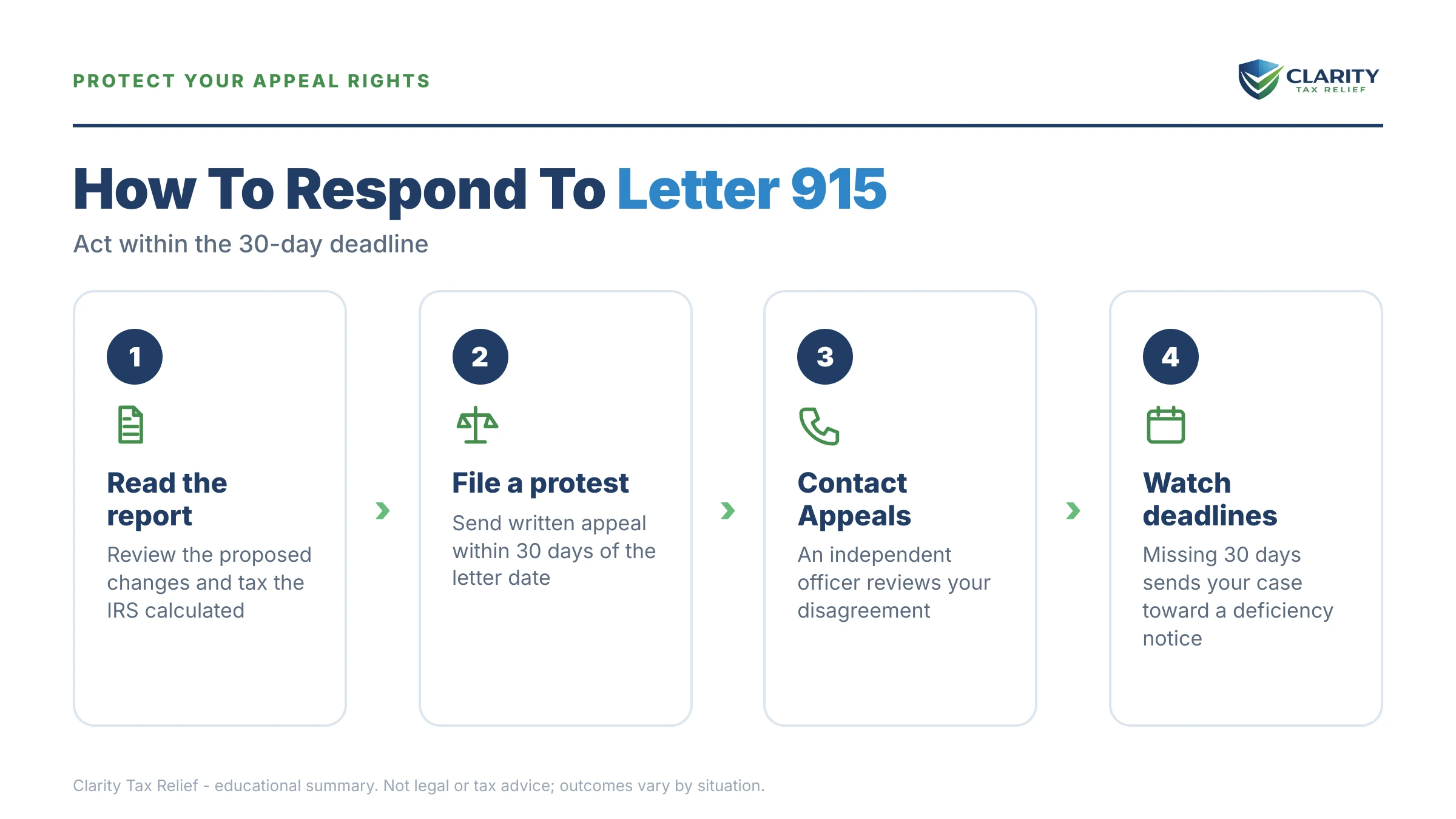
How to respond to Letter 915, step by step
Responding to Letter 915 is a paperwork exercise with a hard deadline — here is the order that protects every right you have:
- Confirm your deadline. Find the date printed at the top of Letter 915 and count 30 days forward — that is the last day the IRS will accept an Appeals request on this report.
- Read Form 4549 line by line. Identify every adjustment the examiner made, then check Form 886-A for the stated reason behind each one.
- Gather proof for each disputed item. Pull the records that substantiate what you reported — 1099-Rs, SSA-1099s, brokerage statements, bank records — one folder per adjustment.
- Choose your response path. Sign Form 4549 only if every adjustment is correct; otherwise send a small case request or written protest before day 30.
- Mail your response by certified mail. Send it to the address on the letter, request a return receipt, and keep a complete copy of everything you send.
- Get experienced help if the numbers are large. A five-figure proposal, multiple years, or penalty exposure is where professional representation typically changes the outcome.
If you end up agreeing and owing, pay whatever you can by the date on the eventual bill at IRS.gov/payments — every dollar paid early shrinks the penalty and interest that follow. Background on how the appeal forum itself works is at the IRS Independent Office of Appeals.
When you can handle Letter 915 yourself
You can handle Letter 915 on your own when the report is small, clearly correct, or clearly wrong on one well-documented point. If the examiner is right and the balance is something you can pay or put on a simple plan, sign and move on. If the whole dispute is a single missing document — a 1099-R rollover confirmation, a basis statement — a small case request with that document attached is well within a careful person's reach.
Experienced help changes outcomes in the harder versions: a proposed balance in the tens of thousands, multiple tax years under exam, an accuracy-related penalty worth contesting on reasonable-cause grounds, or a formal protest that has to argue law as well as facts. Appeals negotiations run on litigation risk, and representatives who work those conferences weekly know where the give is. On a fixed income, the stakes are also downstream — an assessed audit balance eventually reaches benefits and savings, and hardship options for Social Security recipients are far easier to secure before collection starts than after. If a deadline was missed because the IRS mishandled your file, the Taxpayer Advocate Service can sometimes intervene.
Terms on your Letter 915, decoded
- Form 4549 — the examination report itself: the line-by-line recalculation of your return with the examiner's proposed changes, penalties, and interest.
- Form 886-A — the "Explanation of Items" attachment that states the examiner's reasoning for each adjustment.
- 30-day letter — any letter (including 915) offering 30 days to resolve an exam through IRS Appeals before the findings become final.
- Notice of Deficiency — the statutory "90-day letter" that follows if you don't respond; it opens your one fixed window to petition Tax Court.
- Accuracy-related penalty — a 20% penalty on the portion of underpaid tax attributed to negligence or a substantial understatement; frequently contestable.
- Independent Office of Appeals — the IRS division, separate from the exam team, that reviews disputed reports and can settle based on litigation risk.
Letter 915 questions, answered
What is IRS Letter 915?
Letter 915 is the cover letter the IRS uses to send you an examination report — Form 4549 — after auditing your return. It proposes changes, shows the additional tax, penalties, and interest, and gives you 30 days from its date to agree or request a review by the IRS Independent Office of Appeals. Nothing has been assessed yet; the numbers are a proposal until you agree or the appeal windows run out.
What is Form 4549 attached to Letter 915?
Form 4549 is the Income Tax Examination Changes report — the line-by-line recalculation of your return with the examiner's adjustments. It shows each change, the corrected tax, any penalties (often the 20% accuracy-related penalty), and interest computed to a date printed on the form. The attached Form 886-A explains the reasoning behind each adjustment, which is where you find exactly what to rebut.
What happens if I ignore Letter 915?
After the 30-day window closes, the IRS issues a statutory Notice of Deficiency, which starts a strict 90-day clock to petition the U.S. Tax Court. If you miss that too, the proposed tax is assessed exactly as the examiner wrote it, a bill follows, and collection notices begin. Ignoring Letter 915 doesn't make the report go away — it makes the report the final answer.
Do I have to go to court to dispute Letter 915?
No — the whole point of Letter 915 is a chance to dispute the report without court. If the total disputed amount is $25,000 or less per tax period, you can file a small case request on Form 12203; larger amounts require a formal written protest. Either route sends your case to the IRS Independent Office of Appeals, which resolves most cases by phone or correspondence.
Should I sign Form 4549 if the changes are correct but I can't pay?
Yes — if the report is genuinely correct, signing stops additional exam-stage delay and lets you move straight to payment options. Signing Form 4549 agrees to the tax; it does not require immediate payment. You can then set up an installment agreement, seek penalty relief, or pursue hardship status. What you shouldn't do is sign a report you haven't verified just to make the letter stop.
Is Letter 915 the same as a 90-day letter?
No. Letter 915 is a 30-day letter — an administrative offer to resolve the exam through IRS Appeals before anything becomes final. The 90-day letter is the statutory Notice of Deficiency (CP3219A or Letter 531) that comes next if you don't respond; it starts your one fixed window to petition Tax Court. Responding at the 30-day stage is almost always cheaper and easier.
Can the IRS take my Social Security over an audit balance?
Yes — once the proposed tax is assessed and collection notices run their course, the IRS can take up to 15% of Social Security benefits through the Federal Payment Levy Program. That is months away at the Letter 915 stage and entirely preventable: appeal the report, or if you agree with it, set up a payment arrangement before enforcement starts. Fixed-income taxpayers may also qualify for hardship status.
Can I still dispute the tax after the 30 days pass?
Yes, but each later option is narrower. You can petition Tax Court within 90 days of the Notice of Deficiency, or after assessment request audit reconsideration with new documentation the examiner never saw. Reconsideration is discretionary and slow — collection can continue while it's pending unless you arrange otherwise — so the 30-day Appeals window remains the strongest, cheapest place to fight.
Your next 24 hours
- Find the date printed at the top of page one of your Letter 915, count 30 days forward, and write that deadline on the envelope — that is the day your free Appeals rights expire.
- Gather the paper trail: the tax return under exam, the full Letter 915 packet including Forms 4549 and 886-A, and the records behind each adjusted line — 1099-Rs, SSA-1099s, brokerage and bank statements.
- Get the report reviewed free before the 30-day window closes — use the 2-minute form or call (888) 825-7779 and an experienced tax professional will tell you exactly which adjustments are worth contesting.
This guide is general information, not tax or legal advice for your specific situation. Eligibility for IRS programs depends on individual facts and circumstances; no outcome is guaranteed.