
IRS Audits
IRS AI Audits in 2026: How the IRS Really Uses AI to Select Returns for Audit
The short answer: IRS AI audits are real but misunderstood. Computers — the decades-old DIF score plus newer machine-learning models — score and select returns; human examiners still conduct the audits. With the IRS workforce down roughly 27% since 2025, automated selection now drives most audit and underreporter contact you'll actually receive.
You've filed the same quiet return for years — Social Security, a pension, a few brokerage forms — and now either a letter has arrived or a headline about IRS artificial intelligence has you wondering whether a machine is about to pick yours apart. Here's the calm version: computers score returns; people audit them. Once you understand how the scoring actually works, you know exactly what to check on your own account and what to do next.
The image below maps the path a return takes from filing, through the IRS's automated scoring systems, to the letter that lands in a mailbox — so you can see exactly where yours sits in the pipeline.
⏱ Your real clock: AI selection itself has no deadline — the clock starts when a letter arrives. Once it does, the response date printed on that letter controls, typically 30 days for a CP2000 or correspondence exam letter. Interest and penalties accrue monthly on whatever the computer proposes until it's resolved.
What IRS AI audits actually are (and aren't)
In 2026, virtually every individual tax return is scored by computer models before any human ever reads it — but no IRS system closes an audit or issues a final verdict without a person behind it. "AI audit" really describes two different things, and knowing which one you're facing changes everything about your response.
The first is selection. Since 1969, the IRS has run every return through the Discriminant Function — the DIF score — a statistical model that rates how far your numbers sit from the norms for returns like yours. A companion model, UIDIF, scores the likelihood of unreported income. Starting in 2023, the IRS publicly layered modern machine learning on top, aimed first at high-income filers, large partnerships, and abuse-prone credits. The formulas are confidential by law; the systems' existence is not.
The second is automated contact that isn't technically an audit at all. The Automated Underreporter (AUR) program matches your return line by line against every W-2, 1099, SSA-1099, and K-1 the IRS received about you. A mismatch produces a CP2000 notice proposing additional tax — generated with almost no human review. It isn't an examination, but ignore it and the proposed tax becomes just as real.
What AI does not do: it doesn't decide you owe money, it doesn't read your bank account before an exam opens, and it doesn't mean you're personally under investigation. A flag is a statistical score, not an accusation. For the general rules on audit lookback windows that apply regardless of how a return was chosen, see how far back the IRS can audit — this page focuses on the selection machinery itself.
| System | What it scans | What you receive |
|---|---|---|
| DIF / UIDIF scoring | Every return's ratios vs. statistical norms for similar filers | Nothing directly — high scores get routed to human classifiers who decide whether to open an exam |
| Automated Underreporter (AUR) | Your return vs. every W-2, 1099, SSA-1099, and K-1 filed about you | CP2501 or CP2000 proposing additional tax on the mismatch |
| Return Review Program (RRP) | Refund claims and identity signals before a refund is released | Refund holds and verification letters (5071C, 4464C); transcript codes 570/810 |
| Machine-learning exam models (2023+) | High-income returns, large partnerships, and targeted credits (including ERC claims) | An examination opening letter (such as Letter 566) if selected |
| Automated Substitute for Return (ASFR) | Third-party income forms with no matching filed return | Non-filer notices, then a substitute return assessed at the worst-case tax |
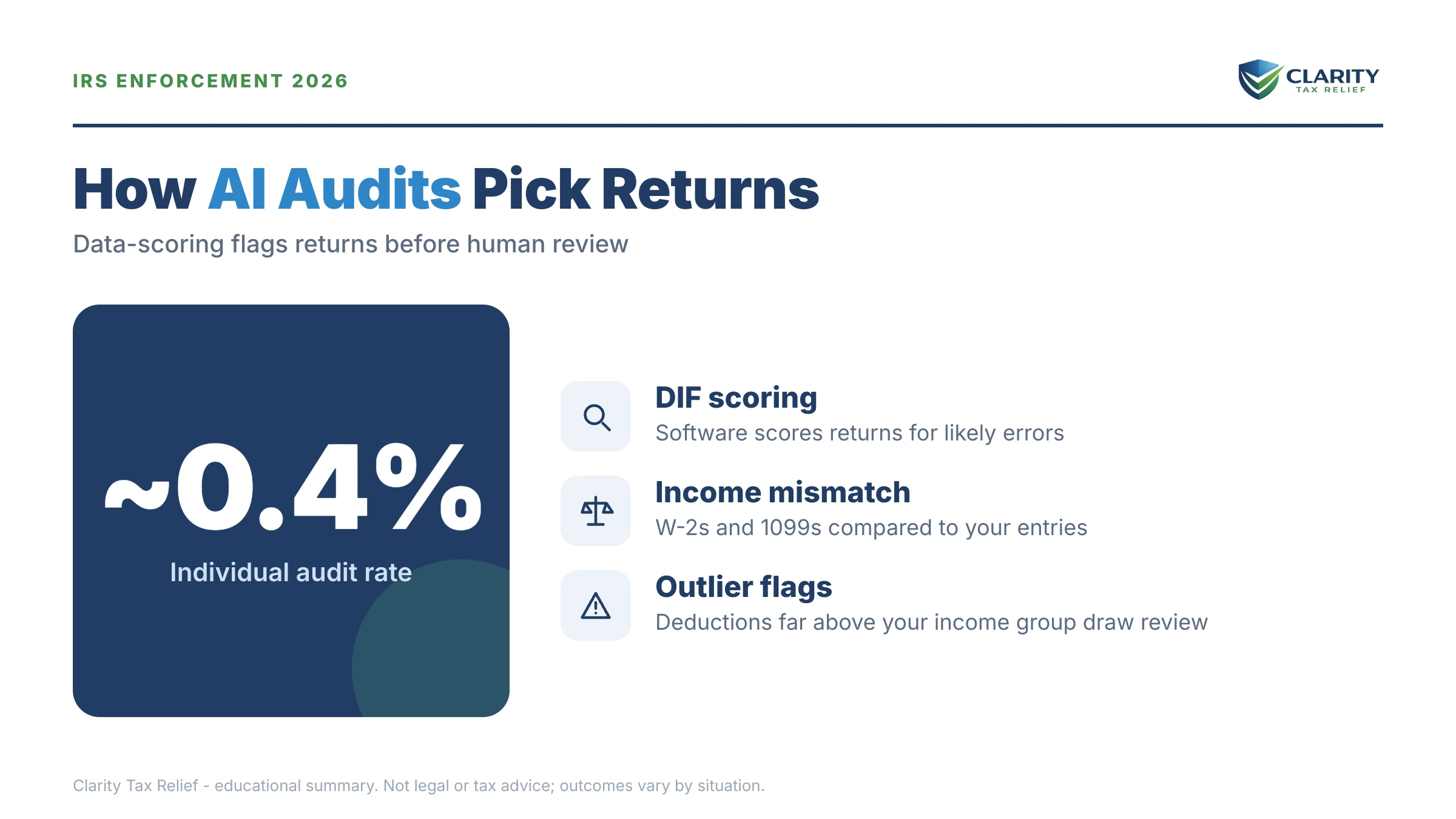
Why the IRS's AI would flag a return like yours
The single biggest driver of automated selection is a mismatch between your return and a form somebody else filed about you. Every payer — your pension administrator, your broker, the Social Security Administration, a casino — sends the IRS a copy of what they paid you. The computer's first and favorite job is checking that your return accounts for every one of those documents.
For retirees, the common flags are specific and mechanical. A brokerage 1099-B reported with gross proceeds but no cost basis is the classic one — the computer treats the entire sale as profit until you prove otherwise. Others: a 1099-R for an IRA distribution that never made it onto the return, a rollover reported as a distribution, a W-2G from a casino trip, or extra income that quietly makes more of your Social Security taxable than the return showed.
Statistical (DIF-style) selection works differently: it compares your deductions and ratios against filers with similar income. Outsized charitable deductions, large Schedule C losses against other income, and heavy vehicle or home-office claims score high. The full list of what raises statistical scores is its own topic — see IRS audit triggers — and businesses that run on currency face a separate scoring layer covered in our cash business audit guide.
One honest note on odds: statistically, most returns are never examined, and audit rates vary enormously by income level. If you want the actual numbers rather than headlines, see the IRS audit rate by income.
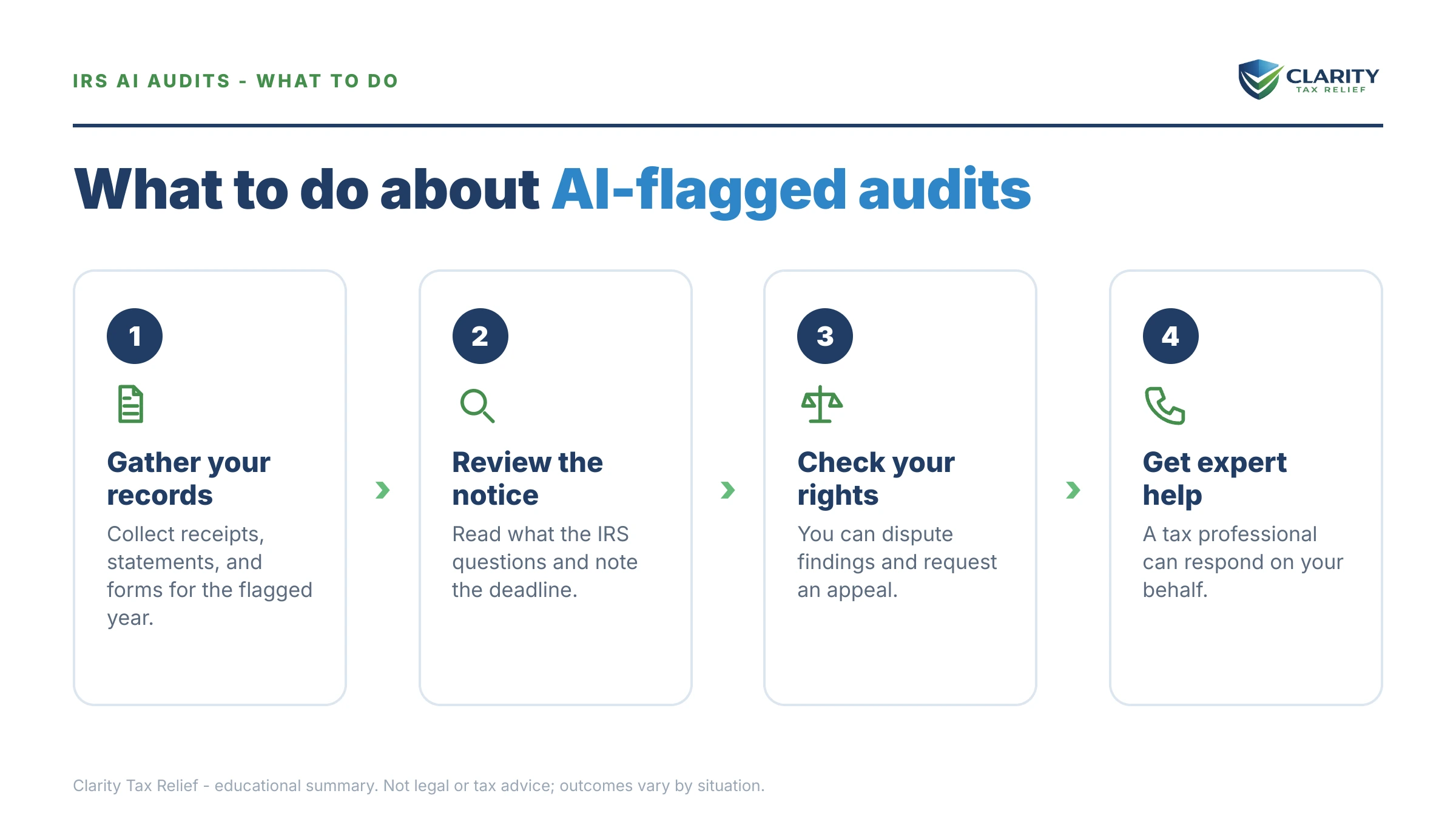
How to tell if a computer selected your return
Your IRS account transcript will usually show an automated selection weeks before any letter arrives. That's the practical advantage this article can give you: instead of waiting on the mail, you can pull your transcript today and read the codes yourself.
Two codes matter most. Code 420 means your return has been assigned to the examination function; code 424 is the earlier "exam request" stage, which sometimes reverses without an audit ever opening. Code 922 means the underreporter system found a mismatch — the CP2000 track, not a full audit.
| Code | What it means | What to do |
|---|---|---|
| 424 | Examination request initiated — a classifier is deciding whether to open a full exam | Nothing yet; gather records for the year shown and watch the mail |
| 420 | Return assigned to examination | Expect an opening letter; don't amend or contact exam preemptively without advice |
| 922 | Underreporter review — a document mismatch was found | Pull your wage & income transcript and find the form your return missed |
| 570 | Account hold — processing or review freeze, many causes | Wait for the paired 971 notice; not proof of an audit by itself |
| 971 | Notice issued — a letter is on its way | Match the date to whatever arrives; respond to the letter, not the code |
| 810 | Refund freeze — often RRP identity or credit verification | Complete any verification requested; see our code 810 guide |
| 1242 (Where's My Refund) | Refund frozen and routed toward examination review | Watch for a CP75-type letter asking for documentation |
Two clarifications worth their own sentence each. First, a refund hold is not an audit — code 810 refund freeze cases are usually verification, not examination. Second, if the letter that arrives asks you to mail documents rather than meet anyone, you're in a mail-based exam; our IRS correspondence audit guide covers that format's specific strategy.
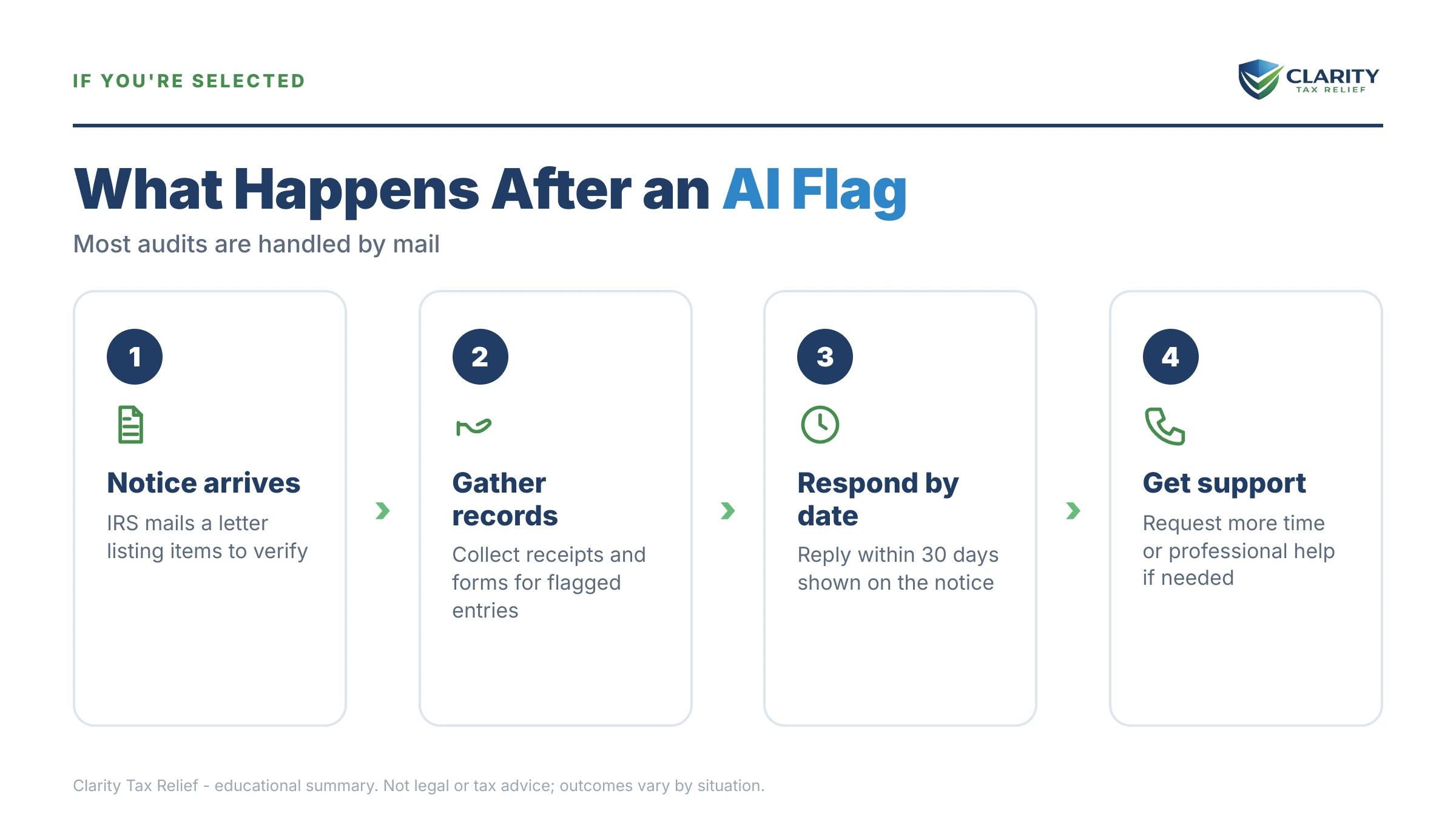
What happens if you ignore an AI-selected exam or CP2000
An automated case that gets no response doesn't stall — it defaults, and every default locks in the computer's worst-case numbers. The sequence runs in stages, and each stage removes an option you had at the one before:
- The response date on your letter passes. For a CP2000, the proposed tax stands as written — including the missing-basis math that assumed 100% gain. For an exam, the examiner closes the audit using only what the IRS already has, disallowing anything unproven.
- The exam report or recalculated notice issues. You typically get one more window (a 30-day letter) to protest to the independent Appeals office. Silence here forfeits that conference.
- The statutory notice of deficiency arrives — CP3219A. This is the 90-day letter: your last chance to contest the tax in Tax Court before paying it. It cannot be extended.
- Assessment posts. The tax, the 20% accuracy-related penalty where asserted, and accumulated interest become a legal debt on your account.
- Collections takes over. The bill sequence begins — first notice, reminders, intent to levy, then a final notice that opens the door to wage and bank levies. The layoffs didn't slow this part; the collection notices are automated too, as we cover in IRS automated collections AI notices.
The pattern to absorb: the human off-ramps (Appeals, Tax Court) appear early and expire. The automated consequences (assessment, collection) appear late and don't.
Holding an exam letter or CP2000 right now?
The response date printed on that letter is the whole ballgame — after it, the computer's proposed numbers start hardening into a real assessment. Send us a photo of the letter and an experienced tax professional will tell you exactly what's being questioned, what proof answers it, and whether the proposed amount is even right. Free and confidential.
Say the computer proposes $27,500: a worked example
Here's a hypothetical that mirrors the most common retiree AI-audit case we see described. Say you're retired, living on Social Security and a modest pension. Last year you sold inherited mutual fund shares — $92,000 in gross proceeds — and your broker's 1099-B went to the IRS without cost basis. Your return reported the sale correctly with the stepped-up basis, or perhaps missed it entirely. Either way, the AUR computer sees $92,000 of proceeds it can't reconcile.
The CP2000 that follows proposes $27,500: roughly $21,500 in additional tax on the full $92,000 treated as gain, a $4,300 accuracy-related penalty (20% of $21,500), and about $1,700 in interest. Terrifying on paper — and mostly wrong.
Now run the real math. The shares' stepped-up basis at the prior owner's death was $84,000. Actual gain: $8,000, not $92,000. At retiree-level capital gains rates, the true additional tax might be around $1,200 — and if the correct amount was reported in the first place, it's $0. Responding with the basis documentation (the estate valuation or the broker's date-of-death statement) can turn a $27,500 proposal into a four-figure or zero adjustment. That is why the response deadline matters more than the scary number.
And if some balance genuinely stands? At $27,500 you're above the $25,000 basic streamlined threshold but well under $50,000, so a 72-month online installment agreement (direct debit) works out to roughly $382 per month before ongoing interest and penalties. You can estimate how much penalties and interest add to your own numbers with our Penalty & Interest Calculator.
Your options if an AI-driven case ends with a balance
Owing money after an automated exam gives you the same resolution menu as any other IRS debt — plus two audit-specific paths most bill-stage taxpayers don't have. Which fits depends on the balance, your income, and whether you actually agree the number is right.
| Option | Eligibility threshold | What it does / what it costs |
|---|---|---|
| Appeals conference | Must request within the window on your 30-day letter | Independent review of the exam findings before assessment; free — see IRS audit appeal |
| Audit reconsideration | Available after a default assessment if you have new documentation | Reopens a closed exam; no fee, but no deadline protection — see audit reconsideration |
| Short-term payment plan | Can pay in full within 180 days | $0 setup; interest and penalties continue but enforcement stops |
| Long-term installment agreement | Balance ≤ $50,000 → up to 72 months, set up online | Setup fee varies (reduced/waived for direct debit and low income); interest continues |
| Currently Not Collectible | Paying anything would prevent basic living expenses (financial disclosure required) | Pauses collection; debt and interest remain; common outcome for fixed-income retirees |
| Offer in Compromise | Assets + future income genuinely can't cover the debt; $205 fee (waived if AGI ≤ 250% of poverty) | Settles for what the IRS could realistically collect; roughly 1 in 5 offers accepted in FY2024 |
| Penalty relief (FTA / AEP) | Clean compliance the prior 3 years — and starting summer 2026, the Automatic Exemption from Penalty applies without a request | Can remove the accuracy-related or late penalties; interest on removed penalties falls with them |
Two notes for the fixed-income reader. Currently Not Collectible status exists precisely for people whose Social Security and pension already go to rent, food, and medicine — we cover the retiree version in IRS hardship social security. And an Offer in Compromise is means-tested math, not a discount program: you may qualify if your assets and monthly disposable income genuinely fall short of the debt, and you won't if they don't. Full details on plan setup are at the IRS payment plans page.
How to respond to an AI-selected audit, step by step
- Verify the letter is real. The IRS opens audits and underreporter reviews by postal mail — never by phone call, text, or email. Confirm the notice number appears in your IRS online account before responding to anything.
- Pull your account transcript. Check for codes 420, 424, or 922 to confirm what kind of review the computer opened and which tax year it covers.
- Identify the exact items questioned. The letter lists the specific income items or deductions at issue. Respond only to those — volunteering unrelated information expands the exam.
- Gather the matching documents. Match each questioned item to its record: the 1099-R, the brokerage statement showing cost basis, the receipt or log. Organize them in the same order the letter uses.
- Respond in writing by the printed date. Mail or upload your response before the deadline on the letter, keep copies of everything, and use certified mail or the IRS document upload tool for proof of delivery.
- Escalate if you disagree. If the examiner's report is wrong, request an Appeals conference within the window on your 30-day letter — and get an experienced tax professional involved before the notice of deficiency issues.
The IRS's own explanation of the underreporter notice is at Understanding your CP2000 notice — worth reading alongside whatever arrived, because the notice's response form is where agreements and disagreements are actually recorded.
When you can handle an AI-selected case yourself
Many automated cases are genuinely do-it-yourself. If a CP2000 flags one missed form and the IRS's math is simply right — you forgot a 1099-R, the number matches your records — checking the "agree" box and arranging payment is the whole job. Same if the fix is one clean document: mailing a basis statement or a corrected 1099 with a short cover letter resolves most single-issue mismatches without anyone's help.
Experienced help changes outcomes in a different set of situations: an exam covering multiple years or multiple issues; income the IRS reconstructed rather than matched (if an examiner starts requesting statements, read our bank deposit method audit guide before responding); records that no longer exist — being audited with no receipts has real reconstruction strategies, but they're technical; a deadline already blown, where audit reconsideration is the remaining path; or a proposed balance large enough that the resolution strategy matters as much as the exam itself. If any of that describes your letter, a free case review before you respond costs nothing and can't hurt your position.
One more honest data point on 2026 staffing: with the workforce cut, reaching a human at the IRS to fix even an obvious computer error takes real persistence — our guide on IRS layoffs: will I still get audited covers what the cuts do and don't change. If you're being bounced between hold queues while a deadline approaches, get your letter in front of a professional before the date passes, not after — the review is free at claritytaxrelief.com/#consult or (888) 825-7779.
Terms in the AI audit process, decoded
- DIF score — the confidential statistical rating every return receives, measuring how far its numbers deviate from norms for similar filers; high scores get human review for possible exam.
- AUR (Automated Underreporter) — the matching program that compares your return to third-party forms and generates CP2000 notices on mismatches.
- RRP (Return Review Program) — the fraud-and-identity screening system that freezes refunds before release; the usual source of verification letters and 810 freezes.
- Correspondence audit — an examination conducted entirely by mail, now the most common audit format by far.
- Statutory notice of deficiency — the "90-day letter" (CP3219A) that is your final chance to contest proposed tax in Tax Court before it's assessed.
- Audit reconsideration — the process for reopening a closed or defaulted exam with documentation the IRS never saw.
IRS AI audit questions, answered
Does the IRS really use AI to select tax returns for audit?
Yes. The IRS has scored every individual return with the statistical DIF model for decades, and since 2023 it has publicly expanded machine-learning selection to high-income individuals, large partnerships, and specific credits. AI selects and prioritizes returns; human examiners still conduct the actual audits. The selection formulas themselves are confidential, but the systems' existence is documented in IRS announcements and Taxpayer Advocate reports.
Can the IRS audit me entirely by computer, with no human involved?
Not technically an audit, but close. The Automated Underreporter program matches your return against W-2s and 1099s and mails a CP2000 proposing extra tax with almost no human review — and if you don't respond, the proposal can become a real assessment. A formal examination, by contrast, always has a human examiner behind it, even when a computer chose the return.
What transcript codes show my return was selected for examination?
Code 424 means an examination request has been made, and code 420 means your return is assigned to the exam function. Code 922 signals an underreporter (CP2000-track) review rather than a full audit. Codes 570 and 810 are holds and freezes that often precede these. Any of them can appear weeks before a letter arrives, which is why checking your account transcript is the fastest early warning.
Are IRS audits more or less likely in 2026 after the layoffs?
Both, depending on the type. In-person field audits require experienced revenue agents, and with the workforce down roughly 27% there are fewer of them. But automated contacts — CP2000 matching notices, correspondence audits, substitute-for-return assessments — run on systems that were not cut, and the IRS is leaning on them harder to replace lost staff. The typical taxpayer's risk has shifted toward mail-based, computer-driven contact.
Do retirees on Social Security get flagged by IRS matching systems?
Yes, regularly — not because retirees are targeted, but because retirement income generates a thick stack of third-party forms the computer cross-checks: SSA-1099, 1099-R for pensions and IRA distributions, and 1099-B for brokerage sales. The most common retiree flag is a stock or fund sale where the broker reported gross proceeds without cost basis, which the computer reads as 100% gain until you prove otherwise.
Does IRS AI look at my bank account or social media?
Selection models run on your return plus the information returns the IRS already holds — W-2s, 1099s, K-1s — not on live bank feeds or social media. Your bank records enter the picture only after an audit opens, if an examiner requests statements or runs a bank deposit analysis to test for unreported income. That is an examination technique, not a selection tool.
Can I appeal an audit that a computer selected?
Yes — your rights are identical no matter how the return was chosen. You can disagree with the examiner's findings, request a conference with the independent IRS Appeals office within the window on your 30-day letter, and ultimately petition Tax Court after a notice of deficiency. 'The algorithm picked me' is not itself a defense, but every proposed adjustment can be contested on its merits.
How far back can an AI-selected audit go?
The same statutes apply as any other audit: generally three years from filing, six years if you omitted more than 25% of your gross income, and no limit for fraud or an unfiled return. AI selection typically works recent years because that's where the matching data is freshest. Most CP2000 notices cover a return filed one to two years ago.
What happens if I ignore a CP2000 or audit letter?
The proposed numbers become real. The IRS issues a statutory notice of deficiency (CP3219A) giving you 90 days to petition Tax Court; if that passes, the full proposed amount — tax, penalties, and interest — is assessed and moves to collections, where the bill sequence eventually reaches levy territory. Responding late is harder but possible through audit reconsideration; responding on time is far cheaper.
If your questions run past what any article can answer — the free, independent Taxpayer Advocate Service also helps taxpayers stuck in IRS processing problems, particularly where a computer error is causing hardship the normal channels won't fix.
Your next 24 hours
- Find the response date and the questioned items on whatever letter you've received — or, if no letter has arrived, pull your account transcript and check for codes 420, 424, or 922 next to the tax year that worries you.
- Gather the matching documents for that year: the return itself, every 1099 and SSA-1099 you received, and — for any investment sale — the statement or estate paperwork proving your cost basis.
- Get a free case review before you respond. An experienced tax professional can often spot in minutes whether the computer's proposed number is inflated by missing basis or a matching error — and interest keeps accruing on whatever stands unchallenged. Call (888) 825-7779 or use the 2-minute form.
This guide is general information, not tax or legal advice for your specific situation. Eligibility for IRS programs depends on individual facts and circumstances; no outcome is guaranteed.