
IRS Audits
IRS Audit Triggers in 2026: What Actually Raises Your Audit Risk
The short answer: IRS audit triggers are mismatches and outliers — income on a 1099 or W-2 that never appears on your return, deductions far above the norm for your income level, repeated Schedule C losses, and unreported gig or crypto income. A computer score, not a human, flags nearly every audited return first.
You filed your return, took every deduction your work earns you, and now — maybe because a 1099 client mentioned "reporting everything to the IRS," maybe because a number felt aggressive in hindsight — you're second-guessing what you claimed. That worry is useful for exactly one thing: understanding how selection actually works, so you can see your own return the way the IRS's computers do.
Here's the part almost no one explains: audits aren't random suspicion. They're arithmetic. Your return gets compared — line by line — against every information document filed under your Social Security number and against statistical norms for people with your income and occupation. Below, you'll find an image that shows what this selection pipeline looks like from the IRS's side — worth a look before you read the trigger list, because every trigger enters at a specific point in it.
⏱ The clock that matters: the IRS generally has 3 years from the date you file to open an audit — and 6 years if you left out more than 25% of your income. The window never closes for a year you didn't file or a fraudulent return. Full rules: how far back can the IRS audit.
Why the IRS flags one return and not another
The IRS scores every individual return with a computer model — the Discriminant Function, or DIF — before any human ever reads it. Your DIF score measures how far your deductions, credits, and income mix deviate from statistical norms for returns like yours. High scores go to a human classifier, who decides whether the oddity is worth an exam.
Running alongside DIF is a second, even bigger machine: the Automated Underreporter (AUR) program. Every 1099-NEC, 1099-K, 1099-B, W-2, and W-2G filed under your SSN gets matched against your return. A mismatch doesn't need a human to notice it — the system generates the notice on its own.
In 2026, a third layer sits on top: machine-learning models the IRS has been deploying for high-income returns, partnerships, and digital assets. That shift matters more now because the IRS workforce shrank roughly 27% in 2025 — fewer humans, so the algorithms do more of the selecting. We break down what that means in practice in our guide to IRS AI audits.
Two smaller doors also lead to exams: related-party audits (your business partner or a promoter you used gets examined, and your return gets pulled with theirs) and informant referrals, which are rarer than internet forums suggest.
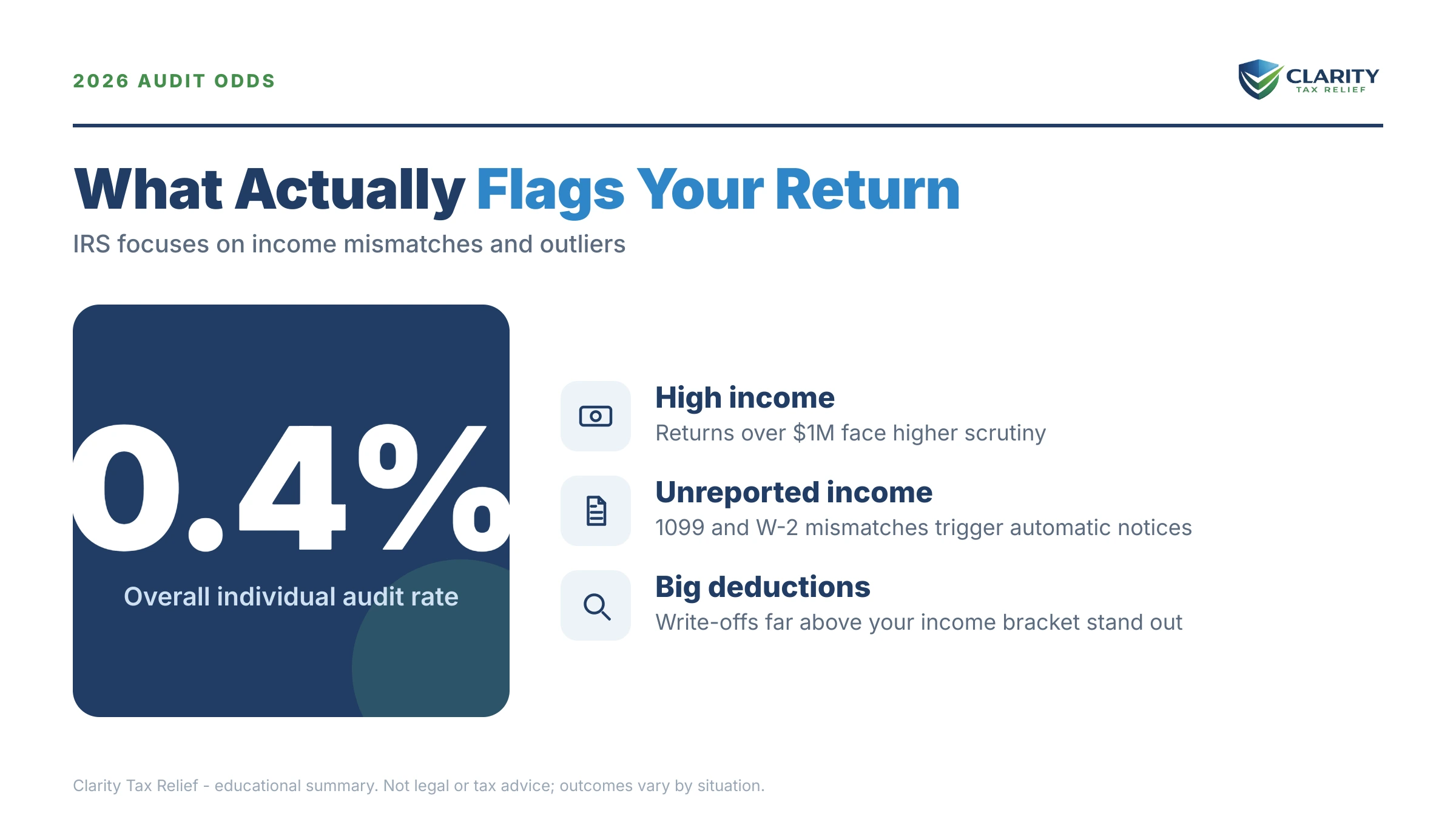
The biggest IRS audit triggers in 2026
The strongest IRS audit trigger in 2026 is income that appears on an information return — a 1099 or W-2 — but not on your tax return. Everything else on this list raises probability; a document mismatch creates near-certainty of contact, because it's caught automatically.
| Trigger | Why it flags your return | How to lower the risk |
|---|---|---|
| Income missing vs. 1099s/W-2s | Every information form is computer-matched to your return; any gap generates an automatic flag | Reconcile every 1099 and W-2 against your return before filing; report gross income, then deduct |
| Repeated Schedule C losses | Losses year after year suggest a hobby or inflated expenses rather than a business | Document your profit motive; never manufacture a loss with aggressive expenses |
| Deductions far above income norms | DIF scores your ratios against statistical peers; outliers score high | Take every legitimate deduction — but keep contemporaneous proof for the unusual ones |
| 100% business vehicle use | Claiming a vehicle is never driven personally is statistically rare and a classic exam item | Keep a mileage log as you drive; claim the real business percentage |
| Cash-heavy income below industry norms | Reported margins that trail your trade's averages invite income reconstruction | Deposit all receipts; keep daily sales records — see cash business audit |
| Round numbers everywhere | Entries like $5,000 and $12,000 across a return read as estimates, not records | Use actual figures pulled from bank and card statements |
| Large charitable deductions vs. income | Giving far above the norm for your income is a ratio outlier; noncash gifts draw extra scrutiny | Keep receipts and acknowledgment letters; get a qualified appraisal for large noncash gifts |
| Digital-asset question answered inconsistently | Exchanges file information returns; checking "No" while crypto forms exist is a direct mismatch | Answer the question honestly and report every disposal, even at a loss |
| EITC and dependent credits | Refundable credits have the highest per-return error rates and are heavily mail-audited (CP75) | Keep school, medical, and lease records proving residency and relationship |
| Home office stacked with other outliers | Triggers compound — home office plus 100% vehicle plus a high expense ratio raises the composite score | Claim the exclusive-use space accurately; keep a floor plan and photos |
Notice what's not on the list: filing an extension, e-filing versus paper, requesting a refund, or taking the standard deduction. None of those move your score. The pattern behind every real trigger is the same — a number the IRS can't verify from a third party, sitting outside the statistical band for your peers.
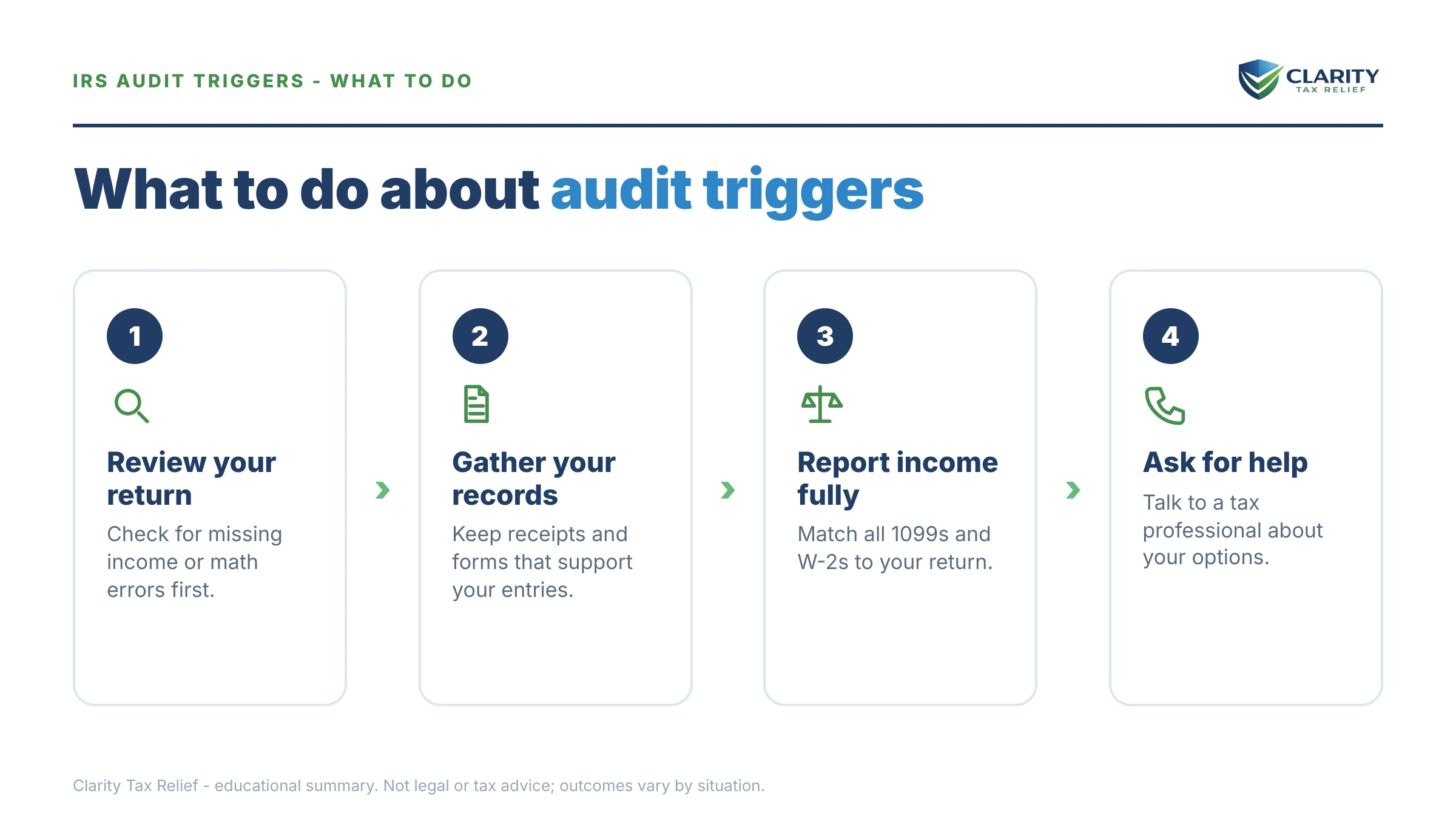
Audit red flags for 1099 contractors and the self-employed
Self-employed filers with Schedule C income have historically faced higher audit rates than W-2 employees at the same income level. The reason is structural: nothing is withheld from your pay, every deduction is self-reported, and the IRS's own research says Schedule C is where most individual underreporting lives. If you're a contractor, three triggers deserve special attention.
First, gross-income reconciliation. Your clients' 1099-NECs and any 1099-K from payment platforms must be equal to or less than the gross receipts on your Schedule C. Report the full gross, then deduct — netting expenses out of your reported income creates a mismatch even when your bottom line is right. Note the 1099-K threshold reverted to $20,000 and 200 transactions for 2026, so fewer forms are being issued — but the IRS still matches every form that IS issued.
Second, the vehicle. Claiming 100% business use with no contemporaneous log is the single most commonly disallowed Schedule C item. The law puts the burden of substantiation on you, not the IRS.
Third, the expense ratio. A designer deducting 60% of gross when peers run 25% is an outlier regardless of whether every dollar is real. Real and provable beats real and undocumented — our Schedule C audit guide covers what examiners actually ask for, and if your records are thin, start with IRS audit no receipts before you panic.
A worked example: how a $68,500 contractor return gets flagged
Say you're a 1099 contractor who grossed $68,500 across three 1099-NECs last year. You reported all of it — good — then claimed $30,800 in Schedule C expenses, including $11,400 of vehicle costs at 100% business use with no mileage log, plus a home office. Your 45% expense ratio sits well above the norm for your trade, and the 100% vehicle claim compounds the score. A mail audit letter asks for your log and receipts.
Without a log, the examiner disallows $9,800 of vehicle expense and $4,200 of other unsupported costs — $14,000 of added profit. Here's the math:
- Self-employment tax: $14,000 × 92.35% × 15.3% ≈ $1,978
- Income tax (22% bracket, after the SE-tax deduction adjustment): roughly $13,000 × 22% ≈ $2,860
- 20% accuracy-related penalty on the underpayment: ≈ $968
- Plus interest running from the return's original due date
Total: roughly $5,800 before interest — from a missing notebook, not a fake deduction. Flip it around: with a contemporaneous log, the identical numbers survive the exam untouched. You can estimate what penalties and interest would add in your own situation with our IRS Penalty & Interest Calculator.
One more contractor-specific warning: if your reported income looks low next to your lifestyle or deposits, the examiner can switch from checking deductions to reconstructing income — totaling every bank deposit and treating what you can't explain as taxable. That's the bank deposit method audit, and it's the point where a routine exam stops being routine.
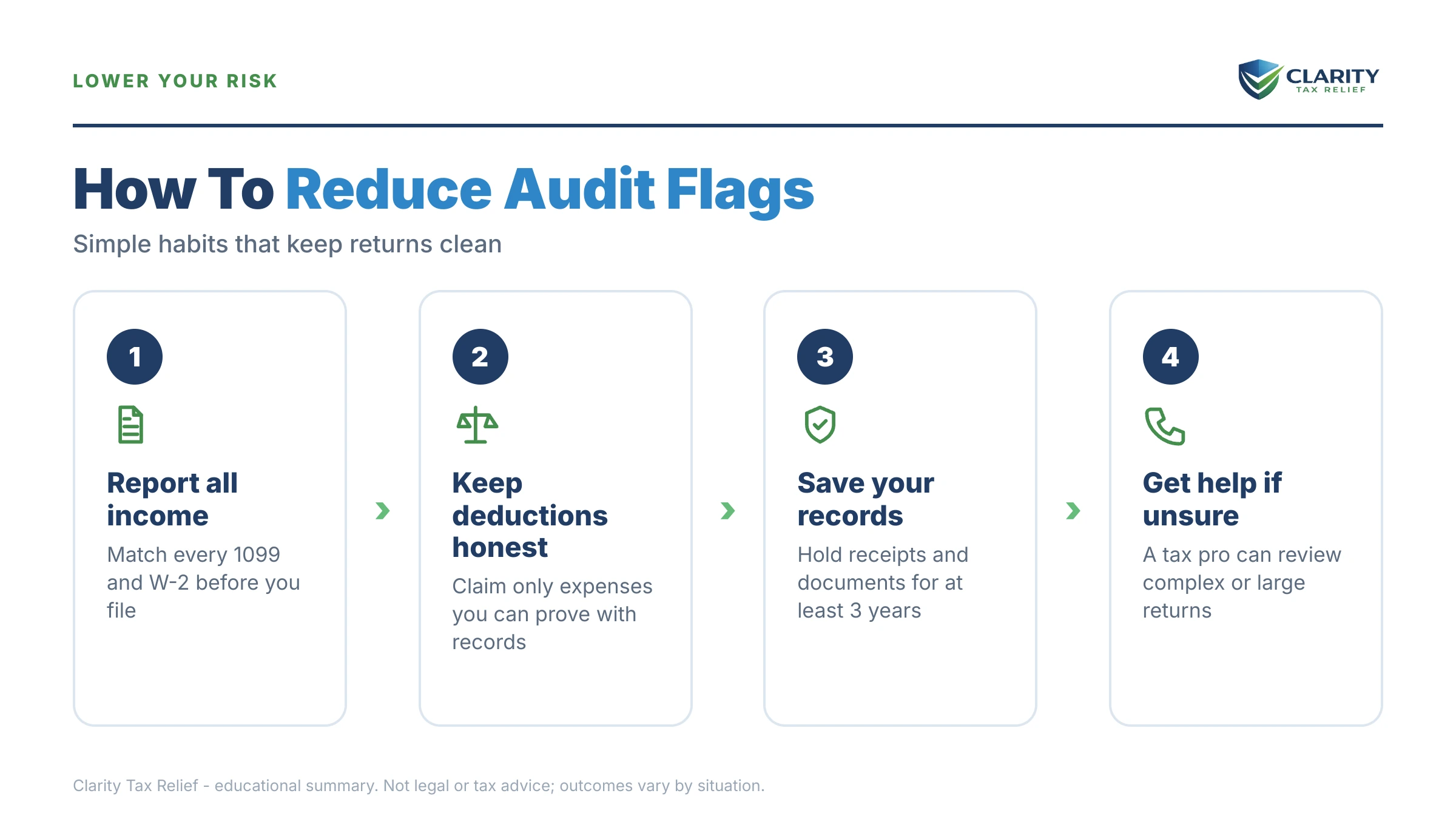
What happens if you ignore an audit letter
An ignored audit doesn't close your file — it ends with the IRS assessing its own numbers, plus penalties, with your side of the story never heard. The sequence is automated and it runs in one direction:
- Selection. DIF, AUR matching, or an AI model flags the return; a classifier confirms it's worth examining. Nothing arrives in your mailbox yet.
- Opening letter. A Letter 566 (general exam) or CP75 (credit exam) names the year and items under review, with a response date printed on it. A CP2000 notice — the mismatch proposal — typically gives about 30 days.
- No response → proposed changes. The examiner writes the report without you: deductions disallowed for lack of substantiation, every third-party income form taxed in full, and the 20% accuracy-related penalty added.
- Statutory notice. A CP3219A Notice of Deficiency starts a 90-day window to petition Tax Court — your last chance to dispute the numbers before they become final.
- Assessment and collection. The balance posts, a CP14 bill arrives, and the notice stream escalates toward liens and levies — a collection problem stacked on top of an audit problem.
Every stage in that list is worse than the one before it, and every stage is avoidable by responding at stage two. Even after a bad result, IRS audit appeal rights exist — but appealing a default assessment is much harder than answering the original letter.
Flagged return — or an audit letter already in hand?
Send us the letter, or just tell us what your transcript shows. An experienced tax professional will map exactly where you are in the exam process and what to send before the response date printed on your letter — free, confidential, no pressure.
Transcript codes that show audit activity
Code 420 on your account transcript means your return has been assigned for examination — often weeks before any letter arrives. If you're worried about triggers, your transcript is the earliest honest signal you can get, and it's free through your IRS online account.
| Code | What it means | What to do |
|---|---|---|
| Code 420 | Return assigned to the Examination division — an audit is in motion | Watch the mail for Letter 566 or CP75; start organizing records now |
| Code 424 | Exam request — a pre-audit review that may or may not become a full exam | Don't panic; many 424s close without contact. Verify your reported income matches your 1099s |
| Code 922 | Automated Underreporter review — a 1099/W-2 mismatch was detected | Expect a CP2000; pull your wage & income transcript to find the gap first |
| Code 810 | Refund frozen, often for credit or identity review | Respond to any verification request quickly — the freeze doesn't lift on its own |
| Code 1242 | Return frozen and routed to examination (shows as a reference number on Where's My Refund) | A letter is coming; don't refile or amend while the review is open |
How to respond if your return is selected, step by step
The letter number on your IRS mail tells you exactly what kind of review you're in — and the right response is different for each. Whatever arrived, the sequence is the same:
- Identify the letter. The number on your IRS mail tells you what you're in: Letter 566 or CP75 means a real audit; CP2000 means a computerized mismatch proposal. The response date printed on page one — not any general rule — is your deadline.
- Pull your transcripts. Your wage and income transcript shows every 1099 and W-2 the IRS has on file, so you can see the exact mismatch before you answer. Your account transcript shows exam codes like 420 or 424.
- Gather records for only the listed items. Answer exactly what's asked. Volunteering extra years, extra schedules, or unrequested documents is how a one-issue mail audit expands into something bigger.
- Respond in writing by the printed date. Send organized copies — never originals — by certified mail or through the upload link on the letter, and keep a complete duplicate of everything you send.
- Get representation before any interview. Field audits, cash-business exams, and anything involving unreported income are where experienced help changes outcomes. A Form 2848 power of attorney lets a professional speak to the examiner so you don't have to.
If the audit ends in a tax bill you can't pay
A post-audit balance under $50,000 can usually go on a monthly plan of up to 72 months, set up online without a detailed financial disclosure. An audit assessment is collected exactly like any other tax debt, which means every resolution program is on the table — matched to your finances, not your preference:
| Option | Who's eligible | Cost and notes |
|---|---|---|
| Pay in full | Anyone, at IRS.gov/payments | Stops interest and the failure-to-pay penalty from growing further |
| Short-term payment plan | Balance you can clear within 180 days | $0 setup fee; interest and penalties continue while you pay |
| Streamlined installment agreement | Balance ≤ $50,000; up to 72 months, set up online | Setup fee applies (lower with direct debit); no financial statement required |
| Guaranteed installment agreement | Tax ≤ $10,000 with a clean filing history; full pay within 3 years | The IRS must accept it — the one plan that can't be refused |
| Currently Not Collectible | Paying anything would prevent basic living expenses (shown on Form 433 data) | Collection pauses; the debt and interest remain on the books |
| Offer in Compromise | Assets plus future income genuinely can't cover the debt | $205 fee and 20% down on lump-sum offers (both waived with low-income certification); roughly 1 in 5 offers accepted in FY2024 |
| Penalty relief | Clean compliance for the prior 3 years (First-Time Abate; the automatic AEP replaces it starting summer 2026) | Removes failure-to-file/pay penalties — but not the 20% accuracy-related penalty, which must be contested in the exam or on appeal |
That last row matters more than most people realize: the accuracy-related penalty from an audit can't be wiped later with an abatement request. The time to fight it is during the exam or the appeal — one more reason not to let an audit default.
When you can handle an audit yourself — and when to get help
A one-issue mail audit with good records is something most people can handle without paying anyone. If the IRS asks for proof of a single deduction and you have the receipts, or a CP2000 correctly flags a 1099 you genuinely forgot, an organized response by the printed date usually closes the matter. The same goes for pure prevention: keeping a mileage log and reconciling your 1099s costs nothing.
Experienced help changes outcomes in specific situations: a field audit at your home or business, a cash-intensive trade, a bank deposit analysis already underway, multiple years or unfiled returns in the mix, a proposed accuracy-related penalty you want removed, or any exam where the examiner starts asking about intent. In those cases, what you say in the first interview shapes everything after it — and a representative can attend that interview so you don't. Honest rule of thumb: if the exam is about your documents, you can often handle it; if it's about your income, get help.
Terms on your audit letter, decoded
- DIF score — the computer rating that measures how far your return's ratios deviate from statistical norms for filers like you.
- AUR (Automated Underreporter) — the matching program that compares every 1099 and W-2 against your return and generates CP2000 proposals automatically.
- Correspondence audit — an exam conducted entirely by mail, usually limited to one or two named items; the most common audit type by far.
- Field audit — an in-person exam at your home, business, or representative's office; the most serious civil exam type.
- Accuracy-related penalty — a 20% penalty on the underpaid tax when the IRS attributes it to negligence or a substantial understatement.
- Statute of limitations (ASED) — the assessment deadline: generally 3 years from filing, 6 years for a 25%+ income omission, unlimited for fraud or non-filing.
If your transcript already shows code 420 or an exam letter is sitting on your counter, a free case review with an experienced tax professional can map your response before the date printed on the letter — or call (888) 825-7779.
IRS audit trigger questions, answered
What are the most common IRS audit triggers?
Income that appears on a 1099 or W-2 but not on your return is the most common trigger, because document matching is fully automated. After that come deductions far above the norm for your income, repeated Schedule C losses, 100% business vehicle claims, large cash income, and refundable credits like the EITC. Most flagged returns are handled entirely by mail, not in person.
What income level is most likely to be audited?
Audit attention concentrates at both ends of the income scale. Filers claiming the Earned Income Tax Credit face elevated mail-audit rates despite modest incomes, and audit rates climb again at high incomes, where returns are more complex. In the broad middle, overall audit rates have run well below 1% in recent years — but a 1099 mismatch can pull any return out of that safety.
Do 1099 contractors get audited more than W-2 employees?
Yes — self-employed filers with Schedule C income face meaningfully higher audit odds than W-2 employees at the same income. Nothing is withheld from contractor pay, every deduction is self-reported, and the IRS knows Schedule C is where most individual underreporting happens. A contractor whose expenses run far above the norm for their trade is one of the classic exam profiles.
Does claiming a home office deduction trigger an audit?
Not by itself. The home office deduction is legal, common, and safe when the space is used regularly and exclusively for business. It becomes a risk factor when it stacks with other outliers — 100% vehicle use, an unusually high expense ratio, or repeated losses — because triggers compound in the IRS's scoring. Measure the space, use it exclusively, and keep photos and a floor plan.
How will the IRS notify me if I'm being audited?
Only by postal mail. An audit opens with a letter such as Letter 566 or, for credit reviews, a CP75, naming the tax year and the items under exam. A CP2000 is a computerized mismatch proposal, not technically an audit, but it works the same way if you ignore it. The IRS never opens an audit by phone call, email, or text — those contacts are scams.
Can the IRS audit me after I already received my refund?
Yes. A refund only means your return was processed, not verified. The IRS generally has 3 years from your filing date to open an audit, and 6 years if you omitted more than 25% of your income. There is no time limit at all for a fraudulent return or for a year you never filed.
Does filing an amended return trigger an audit?
Not automatically, but amended returns get human review rather than pure computer processing, and a large refund claim on an amendment draws closer scrutiny. If your amendment is accurate and documented, file it — correcting an error yourself is far safer than waiting for the matching system to catch it and add a 20% accuracy-related penalty on top.
Does the IRS use AI to select audits in 2026?
Increasingly, yes. The IRS has layered machine-learning models on top of its decades-old DIF scoring to pick returns, especially for partnerships, high-income filers, and digital-asset activity. With the workforce down roughly 27% after the 2025 cuts, automated selection is doing more of the work humans used to do — flagged returns are chosen by pattern, and clean documentation is your best defense.
Do cash businesses face higher audit risk?
Yes. Trades where customers pay cash — salons, restaurants, contracting, rideshare tips — are a longstanding IRS focus because income is easy to leave off. In these exams the IRS often uses the bank deposit method, totaling every deposit into every account and treating unexplained deposits as income. Depositing all receipts and keeping daily sales records is the strongest protection.
Your next 24 hours
- Check your status. If a letter has arrived, find the letter number in the top corner and the response date on page one. If not, log into your IRS online account and scan your account transcript for codes 420, 424, or 810.
- Gather three things: your last filed return, every 1099 and W-2 you received for that year, and whatever records back your three largest deductions.
- Get a free case review. Whether you're holding an exam letter or just see a trigger in your own return, an experienced tax professional can tell you where you actually stand — interest and penalties on any eventual assessment run from the original due date, so earlier is always cheaper. Use the 2-minute form or call (888) 825-7779.
For the IRS's own description of how exams work, see the agency's IRS audits overview. If an audit has created a hardship the normal channels won't resolve, the independent Taxpayer Advocate Service can intervene at no cost.
This guide is general information, not tax or legal advice for your specific situation. Eligibility for IRS programs depends on individual facts and circumstances; no outcome is guaranteed.