
IRS Audits
Chances of Being Audited in 2027: Your Real Odds, by Income and Situation
The short answer: your chances of being audited in 2027 are low — historically, fewer than 4 in 1,000 individual returns (roughly 0.3%–0.4%) get examined, and 2025's IRS staffing cuts point lower still. But odds vary sharply by situation, and automated matching notices like the CP2000 reach millions more filers than audits ever do.
You're searching "chances of being audited 2027" for a reason — maybe this is your first return filed alone since the divorce, with a new filing status, a child you and your ex both feel entitled to claim, and a retirement cash-out you're not sure how to report. That uncertainty is exactly where audit anxiety lives.
Here's the good news: the odds are knowable, most of them are small, and the flags that raise them are specific and avoidable. This guide gives you the numbers by situation, the divorce-year mistakes that actually get caught, and what to do if the IRS writes.
⏱ The real clock: there's no deadline attached to audit odds themselves — but once you file, the IRS generally has 3 years to audit that return (6 years if you omit more than 25% of your income, unlimited for fraud or an unfiled year). The full rules are in our guide to how far back the IRS can audit.
Your real chances of being audited in 2027
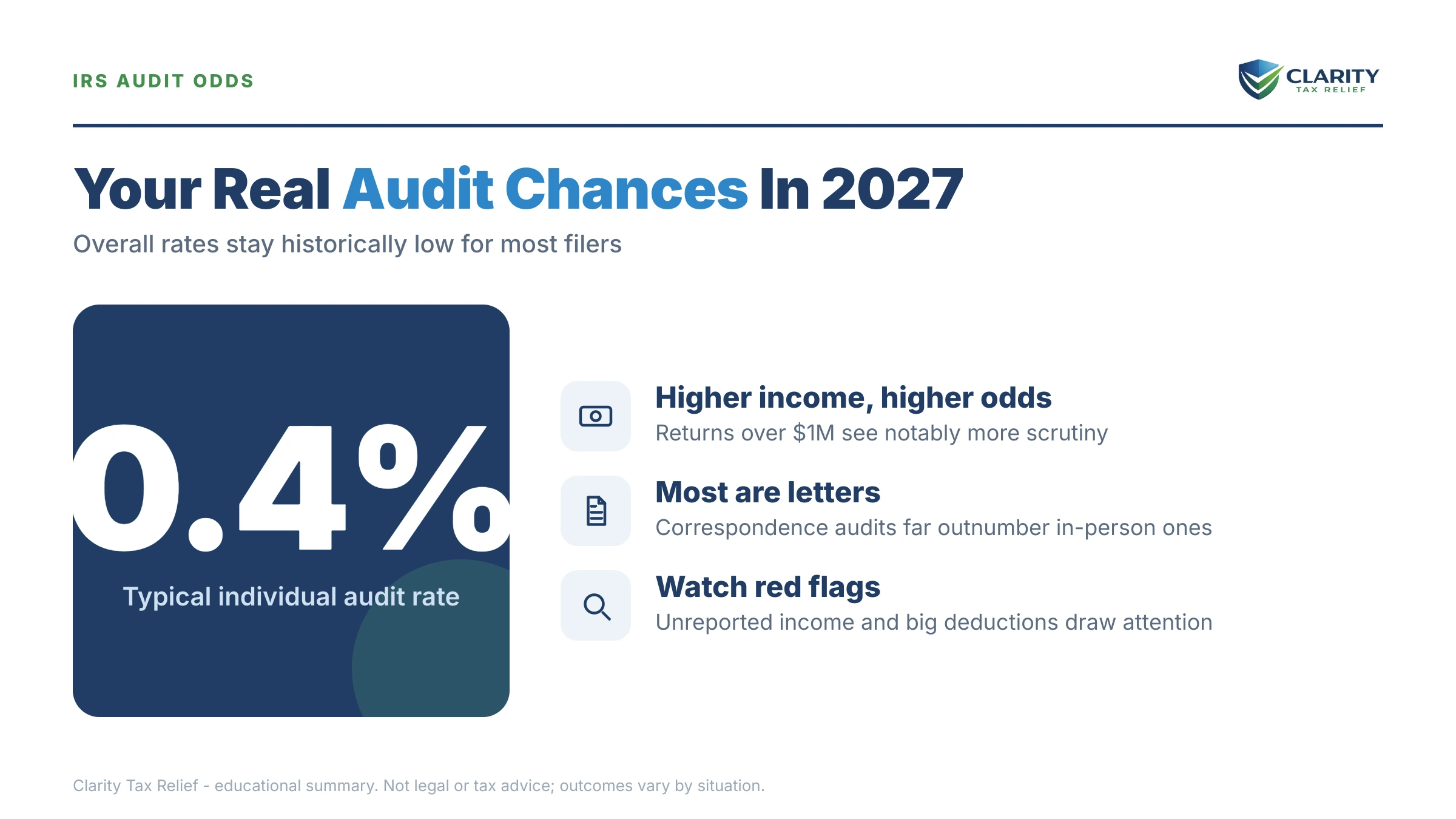
Fewer than 4 out of every 1,000 individual tax returns are audited in a typical year — roughly 0.3% to 0.4%, based on historical IRS Data Book coverage rates. The IRS doesn't publish 2027 rates in advance, but with the IRS workforce reportedly cut by roughly 27% in 2025, the direction for human-led exams is down, not up.
That average hides huge variation. Refundable credits, self-employment income, and very high incomes all carry multiples of the base rate, while a plain W-2 return with the standard deduction sits well below it. Here's how the odds actually break down — for the full income-band data, see our page on the IRS audit rate by income.
| Your situation | Approximate historical odds | Why |
|---|---|---|
| W-2 wages only, standard deduction, no credits | Well below average — on the order of 1–2 per 1,000 | Every number is third-party verified before you file |
| All individual returns (the overall average) | Roughly 3–4 per 1,000 (0.3%–0.4%) | Historical IRS Data Book coverage rates |
| Earned Income Tax Credit claimed | Roughly 1 in 100 | Refundable credits are verified before refunds pay out |
| Schedule C with repeated losses or heavy cash | A multiple of the average | Self-reported income with little third-party matching |
| Income of $1 million or more | Historically around 1 in 100 or higher | Dedicated high-income exam coverage |
| Income of $10 million or more | Highest of any group — historically several per 100 | Priority review territory |
| A W-2 or 1099 missing from your return | Near-certain automated flag (a CP2000, not an audit) | Document matching runs on virtually every return |
Notice what dominates that table: it's not randomness. It's whether the numbers on your return can be checked against something. When they can't — or when they don't match — your odds climb.
Why the IRS picks a return — and why a divorce year raises the score
The IRS scores every return with a computer formula — the DIF score — before any human ever looks at it. Returns whose deductions, credits, or income patterns sit far from the norm for their income band score higher; the highest scores get pulled for classification, and a subset become exams. The other big selection engines are pure document matching and "related pickups" — when one return is examined, returns connected to it (including an ex-spouse's) can be pulled too.
A divorce year concentrates several classic mismatches onto one return:
- Two parents claiming the same child. The second e-filed return claiming a dependent's SSN gets rejected or flagged automatically — no examiner required. If this is your situation, our guide to both parents claiming the same child walks through the tiebreaker rules. A signed Form 8332 releasing the claim prevents the fight before it starts.
- A new head of household claim. HOH requires paying more than half the cost of a home for a qualifying person for more than half the year. Two exes both claiming HOH from the same former household is an easy screen.
- Alimony reported inconsistently. For divorces finalized after 2018, alimony is neither deductible by the payer nor taxable to the recipient. Deduct it anyway — or report it differently than your ex does — and the mismatch is mechanical.
- Retirement money split or cashed out. Every 401(k) distribution generates a Form 1099-R the IRS matches. Money moved under a QDRO and paid to the ex-spouse is treated differently than money you cash out yourself — mixing those up is expensive, as the worked example below shows.
Outside the divorce context, the perennial risers are the ones covered in our full list of IRS audit triggers: unreported income, outsized deductions, and cash-intensive self-employment — the last of which has its own playbook in our cash business audit guide.
The letter you're far more likely to get: CP2000, not an audit
For every taxpayer who gets a true audit, several more get a CP2000 notice — an automated proposal generated when income reported to the IRS doesn't match a return, with no examiner involved at all. If your practical question is "will the IRS notice X," the honest answer is: if X came with a W-2, 1099, W-2G, or 1099-R, the computer will almost certainly notice, staffing cuts or not.
This distinction matters because a CP2000 is both easier and more dangerous than people expect. Easier, because it's resolved by mail with documentation. More dangerous, because the proposed numbers are often wrong in the IRS's favor — they ignore basis, withholding already paid, and offsetting deductions — and agreeing without checking the math is the single most common CP2000 mistake.
A worked example: the divorce-year 1099-R the computer will catch
Say you're recently divorced and cashed out $31,200 from your 401(k) in 2026 to cover legal fees and the equity buyout. The plan withheld 20% ($6,240), and in the chaos of the move the 1099-R never made it into your return. This is hypothetical — but the math is exactly what the Automated Underreporter system would propose:
- Income tax at a 24% marginal rate: $31,200 × 24% = $7,488
- 10% early-withdrawal penalty (you're under 59½): $31,200 × 10% = $3,120
- Total additional tax: $10,608, minus the $6,240 already withheld = $4,368 owed
- If the understatement is substantial — more than the greater of $5,000 or 10% of the tax that should have been shown — the IRS can add a 20% accuracy-related penalty; on an understatement of $4,368 it generally would not apply
- Running total before interest: roughly $4,368 — with interest compounding daily from the return's original due date
Two lessons hide in that math. First, the withholding you already paid gets credited — the CP2000 headline number is rarely what you truly owe. Second, if that $31,200 had been transferred under a QDRO and paid out to your ex as the alternate payee, the $3,120 early-withdrawal penalty wouldn't apply at all. Sequencing the divorce paperwork correctly is worth real money. You can estimate what a proposed adjustment would cost in penalties and interest with our Penalty & Interest Calculator, and if the resulting bill is the real problem, our guide to the early-401(k)-withdrawal tax bill covers the payment side.
What happens if you're selected — and ignore the letters
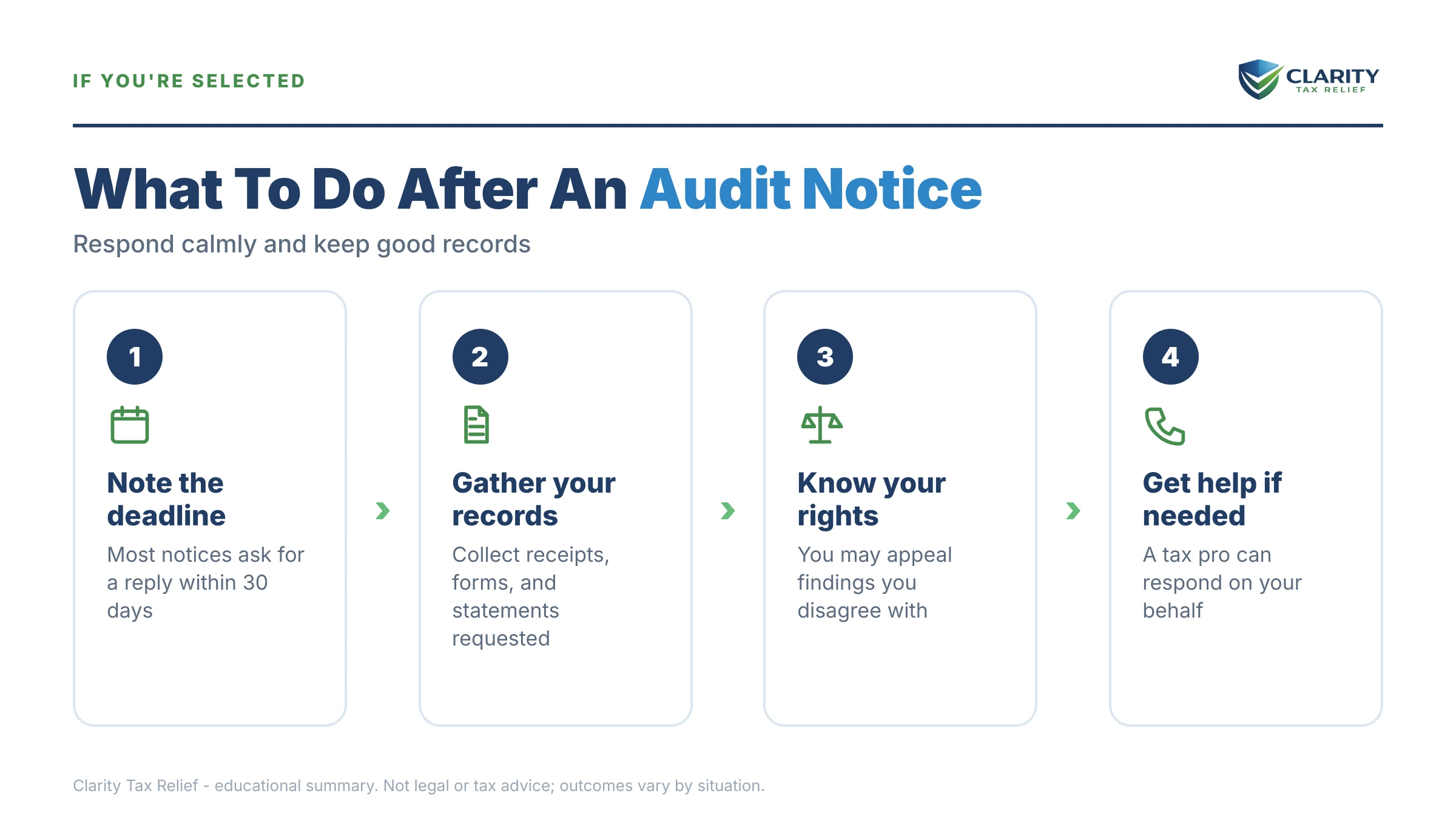
An ignored audit doesn't stall; it ends in an assessment you can no longer easily dispute. Whether the opening letter is a CP2000, an exam notice like Letter 566, or a mail audit handled entirely by correspondence, the sequence runs on its own schedule — and every stage you skip surrenders a right:
- Opening contact. A CP2000 proposal or an examination letter (Letter 566 or similar) arrives by mail, naming the year and the items in question. This is the cheapest stage to respond — your documentation gets full weight.
- Proposed changes. If you don't respond, or the examiner disagrees, you get an exam report (Letter 525 or 915) — the "30-day letter." You can still agree, negotiate, or protest to the IRS Independent Office of Appeals.
- Statutory notice of deficiency (CP3219A). Miss the report stage and the 90-day letter issues. You have exactly 90 days — fixed by statute — to petition the U.S. Tax Court before the tax becomes final.
- Assessment. After the 90 days pass, the proposed tax, penalties, and interest are assessed. Your dispute rights narrow sharply; audit reconsideration is the fallback, not a guarantee.
- Collection. The assessed balance enters the normal collection stream — a CP14 bill, escalating notices, and eventually lien and levy authority. What began as an unanswered letter is now a debt with teeth.
| Letter or notice | What it is | Your window |
|---|---|---|
| CP2000 | Automated proposed change from income matching | Typically 30 days from the date printed on the notice |
| Letter 566 / 2205-A | Examination opening letter | Respond by the date printed on your letter |
| Letter 525 / 915 | Exam report with proposed changes | Typically 30 days to agree or protest to Appeals |
| CP3219A | Statutory notice of deficiency | 90 days (fixed by law) to petition Tax Court |
| CP14 (after assessment) | First collection bill for the assessed balance | Typically about 21 days before the next notice |
Got an exam letter or CP2000 after your divorce year?
The response you send shapes everything that follows — and the date printed on your letter controls your window. Have an experienced tax professional review it free before you reply: no pressure, no obligation.
Your options if an audit ends with a bill
An audit that ends with a balance due drops you into the same IRS collection system as any other tax debt — with the same programs available. Which one fits is a math question, not a marketing one:
| Option | Key threshold or cost | Fits when |
|---|---|---|
| Pay in full | No fee; stops penalty and interest accrual | You can cover it without hardship |
| Short-term payment plan | Up to 180 days; $0 setup fee | You need months, not years |
| Guaranteed installment agreement | Balance $10,000 or less; up to 36 months | Small balance, clean filing history |
| Streamlined / online installment agreement | Balance up to $50,000; up to 72 months online | You need years and want no financial disclosure |
| Currently Not Collectible | Requires showing collection would cause hardship | Paying anything would break the budget |
| Offer in Compromise | $205 fee (waived with low-income certification); roughly 1 in 5 accepted in FY2024 | Assets and income genuinely can't cover the debt |
| Penalty abatement | First-Time Abate with 3 clean prior years; automatic AEP relief begins rolling out from summer 2026 | The penalties, not the tax, are the problem |
Interest and late-payment penalties keep accruing on any plan, so the arithmetic favors resolving the exam itself first — a disputed adjustment knocked down at the report stage is worth more than any payment plan on the inflated number.
How to lower your audit odds for 2027, step by step
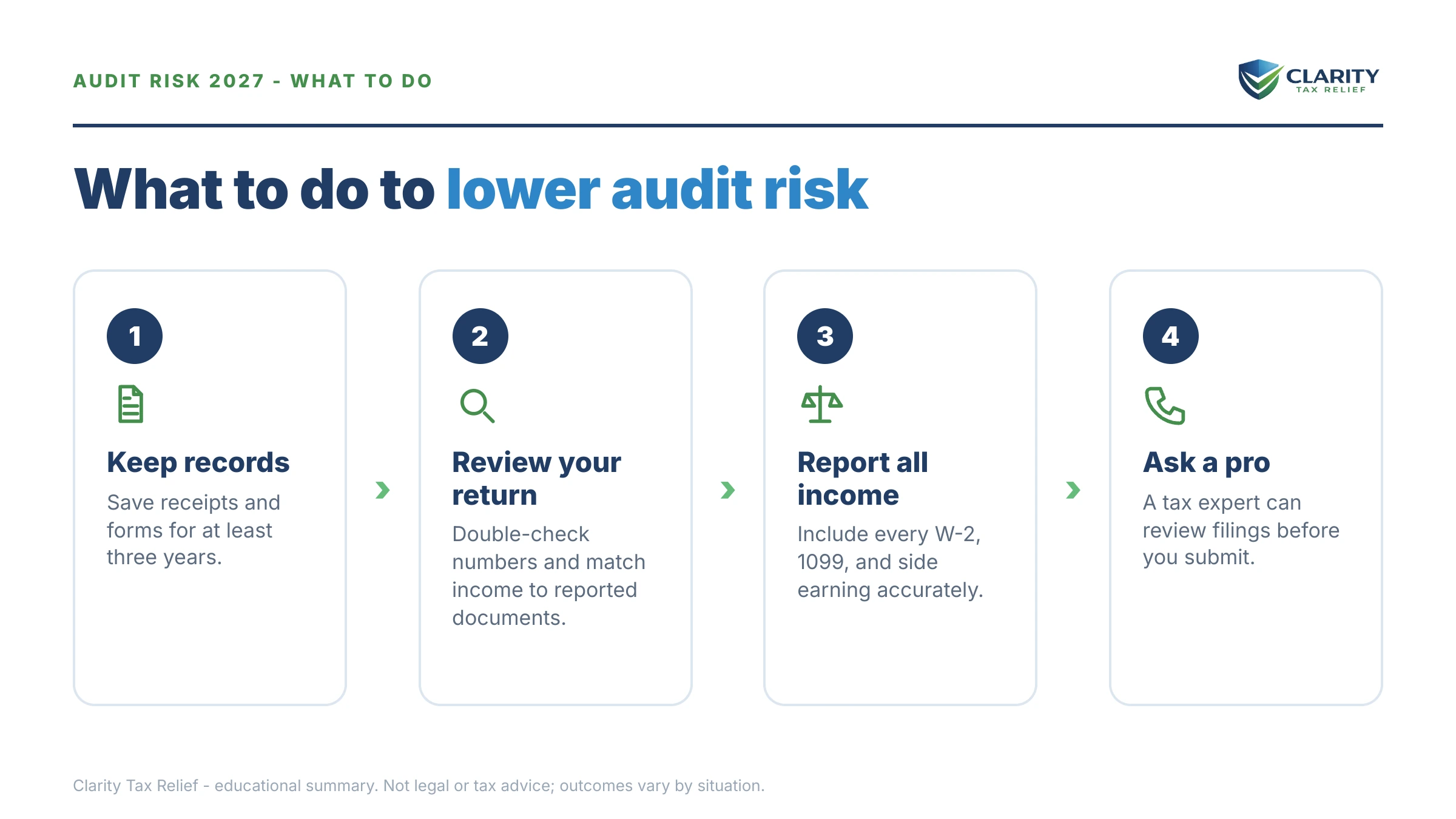
- Pull your wage and income transcript. Before you file, verify every W-2, 1099, and 1099-R the IRS has on record for your SSN — that list is exactly what the matching computers will compare against your return. Our walkthrough on the IRS wage and income transcript shows how.
- Match the divorce paperwork to the return. Confirm in writing who claims which child, attach Form 8332 if you are releasing the claim, and report alimony consistently with your decree's date.
- Report every dollar, then take every legitimate deduction. Flags come from omissions and disproportion, not from claiming what you can document.
- Keep contemporaneous records. Custody calendars, school and medical records, mileage logs, and receipts made at the time beat reconstructions in every type of exam.
- Answer the digital-asset question accurately. Exchange reporting reaches the IRS whether or not you report it, and an inconsistent answer is an easy screen.
When you can handle this yourself — and when help changes the outcome
Most audit-odds anxiety needs information, not representation. You can confidently handle it yourself when you're simply filing a clean return, when a CP2000 flags an item you agree with and the corrected balance is one you can pay, or when the fix is producing a document you already have — a Form 8332, a 1099-R, a closing statement.
Experienced help changes outcomes in a narrower set of situations: an exam covering multiple years or spilling onto a business return, an EITC or dependent audit where residency proof is contested — see our guide to EIC audit proof of residency — a proposed balance large enough that Appeals strategy matters, or any exam where the underlying facts could look worse than they are. That last category, where an innocent-looking audit sits on top of genuinely risky history, is what practitioners call an eggshell audit, and it's the one situation where answering questions freely can hurt you. And if your records are thin or gone, being audited with no receipts is survivable — but reconstruction is a skill worth borrowing.
Terms in audit selection, decoded
- Examination (audit): a formal IRS review of a return's items, by mail, at an IRS office, or in the field — distinct from automated matching.
- DIF score: the computer score every return receives; high scores get pulled for possible exam.
- AUR / CP2000: the Automated Underreporter program, which proposes tax changes when third-party documents don't match a return.
- Correspondence audit: an exam conducted entirely by mail — the most common audit type by far.
- Statute of limitations (assessment): the window — generally 3 years from filing — in which the IRS can audit and assess more tax.
- Notice of deficiency: the "90-day letter" (CP3219A) giving you a fixed right to contest proposed tax in Tax Court before it's assessed.
Chances of being audited: your questions answered
What are the chances of being audited in 2027?
Low for most filers. Historically, fewer than 4 in 1,000 individual returns — roughly 0.3% to 0.4% — are examined, and the IRS's 2025 staffing cuts point to fewer traditional audits in 2027, not more. Your personal odds depend on the return itself: EITC claims, Schedule C activity, and incomes above $1 million all carry multiples of the average rate, while a mismatched 1099 makes an automated CP2000 notice far more likely than any audit.
Does getting divorced increase your audit risk?
Divorce does not trigger audits by itself, but it creates the mismatches that do. The most common flags are two parents claiming the same child, a head of household claim the IRS questions, and alimony one ex reports differently than the other. For divorces finalized after 2018, alimony is neither deductible by the payer nor taxable to the recipient — deducting it anyway is one of the easiest mismatches for IRS computers to catch.
What income level gets audited the most?
Both ends of the income scale. Filers claiming the Earned Income Tax Credit have historically been audited at roughly 1 in 100 — several times the overall average — because refundable credits are verified before refunds are paid. At the top, returns reporting $1 million or more have historically faced coverage rates near or above 1%, with the very highest rates on returns over $10 million. Middle-income W-2 filers with no credits or business income face the lowest odds of all.
Will IRS layoffs mean fewer audits in 2027?
Fewer human audits, yes — the IRS workforce reportedly shrank roughly 27% in 2025, and field and office exams require trained people. But computer-driven enforcement never stopped: document matching that generates CP2000 notices, refundable-credit checks that hold refunds, and automated collection letters all run without an examiner. The practical risk in 2027 is a computer flag, not a knock on the door.
How far back can the IRS audit a return?
Generally three years from the date you file. That window extends to six years if you omit more than 25% of your gross income, and there is no time limit at all for a fraudulent return or a year you never filed. In practice, most exams open well inside the three-year window, because the matching systems that select returns run within a year or two of filing.
Is a CP2000 the same as an audit?
No. A CP2000 is a proposed change generated by the Automated Underreporter system when income reported to the IRS does not match your return — no examiner has reviewed your file. You typically have 30 days from the notice date to agree or dispute it with documentation. Signing and paying without checking the math is a common mistake; the proposed figures often ignore basis, withholding, or deductions that reduce what you actually owe.
Does filing an amended return trigger an audit?
Amended returns are screened, but fixing a genuine error before the IRS finds it is almost always safer than waiting for document matching to catch it. Amendments claiming large refunds draw more scrutiny than those reporting additional tax. If your original return omitted income you know was reported to the IRS, amending promptly usually replaces a CP2000 — with its penalties — with a smaller, cleaner bill.
What are the biggest IRS audit triggers in 2027?
Unreported income is first by a wide margin, because computer matching catches nearly every W-2 and 1099 mismatch. After that: refundable credits like the EITC, Schedule C businesses with repeated losses or heavy cash activity, deductions far out of proportion to income, and an answer to the digital-asset question that conflicts with exchange reporting. None of these guarantees an exam — they raise the return's score until a flag or a human picks it up.
Your next 24 hours
- List what the IRS already knows. Log into your IRS online account or pull your wage and income transcript, and list every W-2, 1099, and 1099-R filed under your SSN for the year — that list is what the computers will match your return against.
- Gather the divorce-year file. Put the decree, any signed Form 8332, custody records, retirement distribution paperwork, and last year's return in one folder — the documents that answer 90% of divorce-year IRS questions.
- Get a free case review if something's already off. If an IRS letter has arrived, or you know your return has a mismatch, talk it through before you respond — interest and penalties accrue on any balance the IRS proposes, so earlier is cheaper. Call (888) 825-7779 or use the 2-minute form.
For the underlying data, the IRS publishes its examination coverage rates each year in the IRS Data Book; its own explainer of the matching notice most filers actually receive is at Understanding your CP2000 notice; and if an IRS delay or error is causing you hardship, the independent Taxpayer Advocate Service can intervene at no cost.
This guide is general information, not tax or legal advice for your specific situation. Eligibility for IRS programs depends on individual facts and circumstances; no outcome is guaranteed.