
IRS Collections
IRS Automated Collections and AI Notices: What's Real in 2026
The short answer: IRS automated collections are real and running at full speed in 2026. The AI notices in your mailbox come from the Automated Collection System — computer-generated, not chatbot-written — and the levies behind them fire automatically. AI only helps the IRS decide which cases to work first. The date printed on your notice controls your deadline.
You've been getting IRS letters on what feels like a schedule — one every month or so, each a little sharper than the last — and no matter how many times you call, no person seems to be handling your case. That's because no person is. Your account lives inside a machine, and the machine follows rules you can learn and use to your advantage.
The image below shows what a computer-generated IRS notice looks like and where to find the two details that control everything: the notice number and the printed date.
⏱ Your real clock: there is no single deadline for "automated collections" — the clock is the date printed on whichever notice you're holding. Between letters, the failure-to-pay penalty adds 0.5% of the balance every month, interest compounds daily, and the system queues the next, more serious notice automatically.

How IRS automated collections actually work in 2026
The IRS lost roughly 27% of its workforce in 2025, but the Automated Collection System (ACS) — the computer network that issues most collection notices, liens, and levies — never slowed down. Layoffs hit people; they didn't hit software.
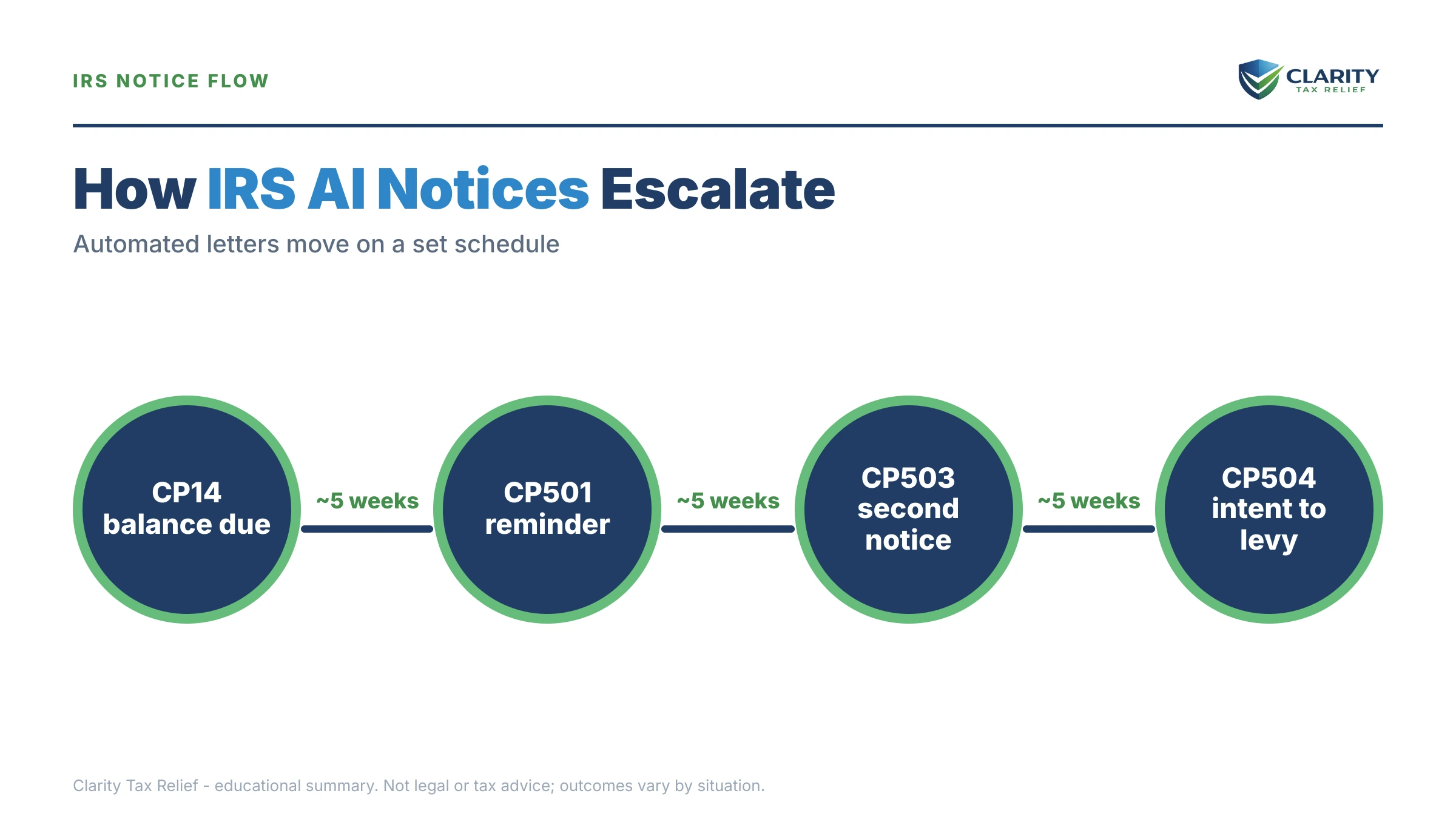
Here's the part most taxpayers never hear: once a balance posts to your account, ACS queues the entire notice sequence in advance. Each letter prints and mails on a fixed cycle unless something interrupts it — a payment, an approved agreement, or an appeal. No employee reads your file between letters.
Where does AI fit? The IRS uses machine-learning models to score and route cases — deciding which accounts get pushed to enforcement fastest, which get assigned to the shrinking pool of human revenue officers, and which returns get examined. AI selects the case; automation executes the collection. Neither one writes you a personal letter, and neither one exercises judgment about your circumstances. That's why deadlines matter more in 2026, not less: there's no human discretion built into the machine, only rules.
For an individual balance in the five figures — say $13,600 — you will almost certainly never have a revenue officer assigned. Your case is worked entirely by computers plus, if you call, whichever ACS phone representative picks up. That cuts both ways: nobody is hunting you personally, but nobody is going to notice you're a retiree on a fixed income unless you tell the system through the proper channel.
Why you're getting automated IRS notices
Automated notices start for exactly one reason: a balance posted to your IRS account. That can come from a return you filed but couldn't pay in full, an IRS adjustment to a past return, or penalties and interest stacking on an old year you thought was closed.
On a fixed income, the most common triggers are quiet ones: taxable Social Security combined with a pension or IRA withdrawal that had too little withholding, a surprise 1099-R, or investment sales that pushed more of your benefits into taxable territory. The tax was real; the withholding just never happened.
Whatever created the balance, the machine treats it identically. The notice sequence is triggered by the balance, not by anything you did wrong since. Understanding that removes the dread: you're not being pursued, you're being processed — and processing can be stopped at any stage.
Are "AI notices" real IRS letters — or scams?
Every genuine IRS collection notice arrives by postal mail — the IRS does not send bills by email, text, or social media. Ironically, the real AI problem in 2026 is on the criminal side: scammers now use AI tools to produce convincing fake "IRS" letters, complete with plausible notice numbers and QR codes pointing to payment sites the IRS doesn't run.
Three checks separate real from fake in under ten minutes. First, log into your IRS online account — a genuine balance and its notices appear there. Second, the notice number in the top corner should match a real IRS notice type you can look up on irs.gov. Third, real IRS payments go only to the United States Treasury or through IRS.gov — never gift cards, wire transfers, crypto, or payment apps. For a deeper checklist, see how to tell if an IRS letter is real.
What happens if you ignore the automated collection sequence
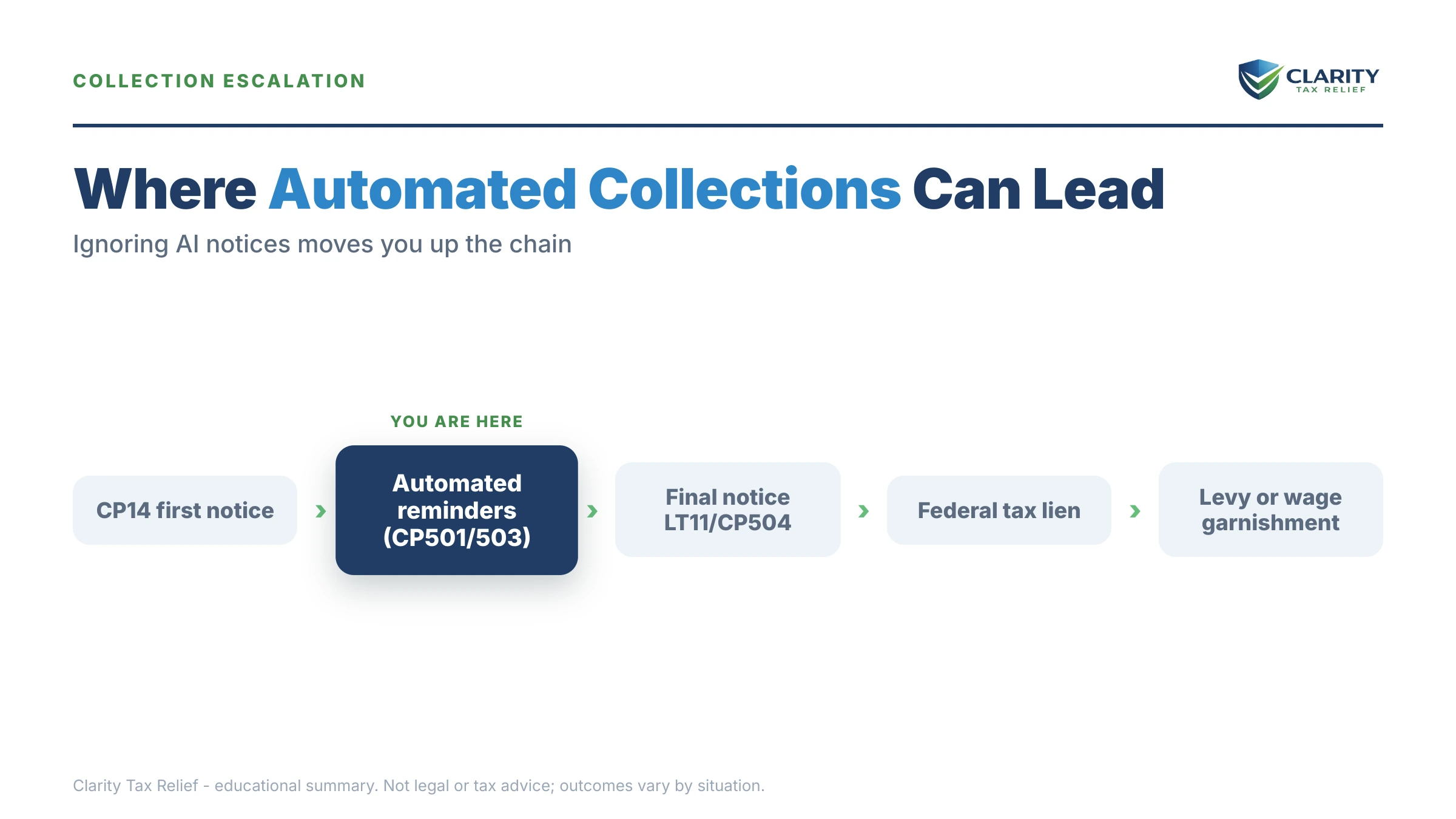
Ignored, the automated sequence escalates from a simple bill to full levy authority in four to five notices — with no human decision required at any step. The order is fixed; only your response changes it:
- CP14 — the first bill. A computer-generated statement of the balance, penalties, and interest. You typically have about 21 days before the system queues the next letter.
- CP501 and CP503 — automated reminders. Same balance plus another month of penalties and interest, printed and mailed on a fixed cycle without anyone reviewing your file.
- CP504 — intent to levy your state refund. Under IRC §6331(d), the IRS can now seize your state tax refund automatically through the State Income Tax Levy Program. It is not the final notice, but it's the last cheap exit. Full breakdown in our CP504 notice guide.
- LT11 or Letter 1058 — the final notice of intent to levy. This starts a 30-day clock and your Collection Due Process rights, requested on Form 12153. Miss the window and the strongest appeal right you have expires. See the LT11 notice guide.
- Systemic levies. Once the 30 days pass, levies issue by computer: a bank levy freezes funds for 21 days before the bank sends them; a wage levy continues every payday until released; and the Federal Payment Levy Program can take up to 15% of a Social Security check each month. At $66,000 of certified debt (the 2026 threshold), passport certification also triggers automatically.
Two things make this sequence unforgiving in 2026. Staffing cuts mean fixing a mistake after a levy takes far longer than preventing one — the computers act in days; the humans who undo errors take months. And the machine doesn't pause for Washington: notices and existing levies largely continue even when government shutdown IRS collections questions dominate the news. If a levy is a realistic risk for you, you can estimate what one could take from a paycheck or benefits with our IRS Wage Garnishment Calculator.
Stuck in the automated notice cycle?
The IRS's computers don't wait for staffing to recover — and penalties and interest accrue every month you're in the queue. Send us your notices and an experienced tax professional will map exactly where you are in the sequence and which option stops it — free and confidential.
Your options: what actually stops the machine
Every option that stops IRS automated collections in 2026 can be started without ever reaching a human on the phone — most of them entirely online. The system that escalates against you is the same system that instantly recognizes an approved agreement and halts the sequence. (For the full DIY playbook on each program, see how to settle tax debt yourself; for a comparison of payment methods, see the best way to pay the IRS.)
| Option | Who may qualify | Cost | Effect on the automated cycle |
|---|---|---|---|
| Pay in full | Anyone | Balance plus accrued penalties and interest | Sequence stops once payment posts |
| Short-term plan (up to 180 days) | Individuals who can pay within 180 days | $0 setup; interest and penalties continue | Enforcement pauses while you pay |
| Streamlined installment agreement | Balance of $50,000 or less; up to 72 months online | Setup fee varies; interest and penalties continue | Notices and levies stop while the agreement is current |
| Guaranteed installment agreement | Balance of $10,000 or less, all returns filed | Setup fee; payoff within 3 years | IRS must accept; the cycle ends |
| Currently Not Collectible (CNC) | Paying would leave you unable to cover basic living expenses | $0; the debt remains and interest accrues | Levies released or prevented; account shelved with periodic review |
| Offer in Compromise (OIC) | Assets plus future income genuinely can't cover the debt | $205 fee + 20% down on lump-sum offers (both waived with low-income certification) | Collection generally paused during review; roughly 1 in 5 offers accepted in FY2024 |
| Penalty relief (FTA / AEP) | Clean compliance the prior 3 years; AEP applies automatically starting summer 2026 | $0 | Shrinks the balance the machine is collecting |
Which of those is realistic depends heavily on how much you owe, because the automated system's own thresholds change with the balance:
| Balance | Realistic options | Automated triggers to know |
|---|---|---|
| Under $10,000 | Guaranteed installment agreement, short-term plan, pay in full | Lowest enforcement priority — but notices and refund offsets still run on schedule |
| $10,000–$25,000 | Streamlined plan set up online in minutes; CNC or OIC if income is fixed and tight | A federal tax lien becomes more likely if notices go unanswered |
| $25,001–$50,000 | Streamlined plan up to 72 months (direct debit typically required at the top of the band) | Systemic levies follow the final notice if no agreement exists |
| $50,001–$65,999 | Non-streamlined plan with financial disclosure (Form 433 series), OIC, or CNC | A human review of your finances enters the picture; lien filing is likely |
| $66,000 and up | Negotiated plan or OIC — act before certification | Passport certification triggers automatically at $66,000 of certified debt (2026) |
A worked example: $13,600 owed on a Social Security income
Say you're 71, your only income is a $1,900 monthly Social Security check, and you owe the IRS $13,600 from the year you cashed out an IRA without enough withholding. This is clearly hypothetical — but the math is exactly what the automated system will run. Here's how each path plays out:
- Do nothing: after the final notice, the Federal Payment Levy Program can take up to 15% of your benefit — $1,900 × 15% = $285 per month, applied automatically, with no upfront review of your budget. Meanwhile the failure-to-pay penalty alone adds about $68 a month ($13,600 × 0.5%), plus daily-compounding interest.
- Streamlined payment plan: $13,600 ÷ 72 months ≈ $189 a month as a floor — set up online, no financial disclosure required at this balance. Interest and the (reduced) late-payment penalty keep accruing, so anything you pay above the minimum shortens the total cost.
- Currently Not Collectible: if $1,900 barely covers rent, utilities, and medications, you may qualify for hardship status — collection pauses while the 10-year collection statute keeps running. The debt doesn't vanish, but neither does your grocery money.
- Offer in Compromise: with income near the federal poverty guidelines, you may qualify for low-income certification (AGI at or below 250% of poverty), which waives the $205 fee, the 20% down payment, and payments during review. Acceptance is never guaranteed — the IRS accepted roughly 1 in 5 offers in FY2024 — but a fixed-income retiree with no significant assets is exactly the profile the program was built for.
Notice the comparison the machine will never make for you: $285 taken involuntarily versus $189 arranged voluntarily — and only one of those two paths protects you from further enforcement. If Social Security is your income, read can the IRS garnish Social Security before assuming your benefits are safe.
How to respond to automated IRS collection notices, step by step
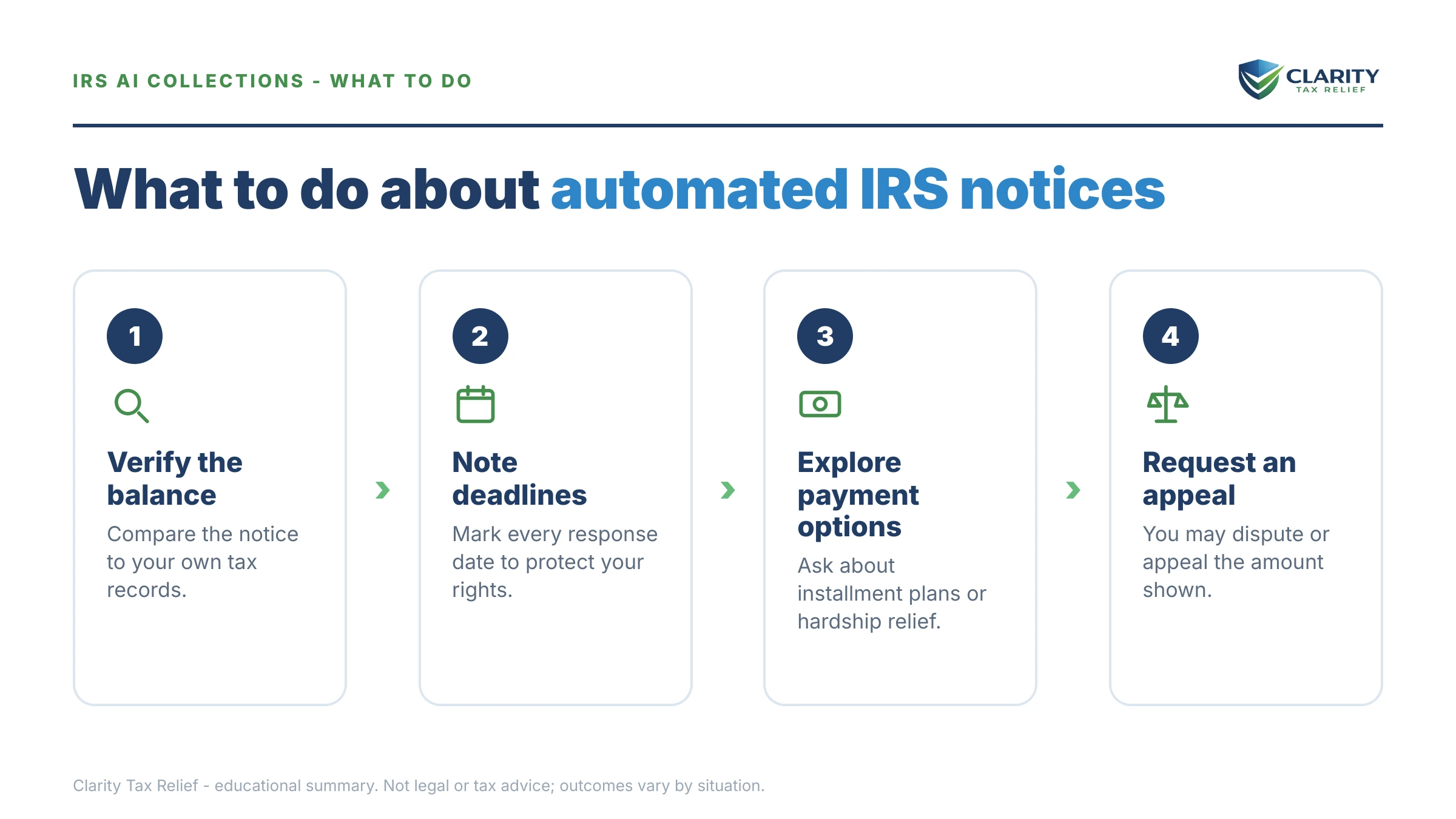
- Verify the notice is real. Log into your IRS online account and confirm the balance and notice match what the IRS actually shows on your account.
- Find your notice number and date. Locate the notice number in the top corner and the printed date — that date, not the day you opened the envelope, starts your response window.
- Pick the resolution that fits your finances. Choose full payment, a payment plan, hardship status, or an offer based on what you can actually afford — before the next notice in the cycle prints.
- Set it up online if you can. Use the IRS Online Payment Agreement for balances up to $50,000 — approval is often immediate, and the notice cycle stops while the agreement stays current.
- Preserve your appeal rights if a final notice arrived. If you are holding an LT11 or Letter 1058, file Form 12153 within 30 days to request a Collection Due Process hearing before any levy.
For step 1, use the IRS's online account for individuals; for step 4, the details live on the IRS's payment plans and installment agreements page.
When you can handle this yourself — and when help changes the outcome
Most people inside the automated system can resolve it without paying anyone. If you agree with the balance, it's a single tax year, the total is under $50,000, and you're comfortable using the online tools, set up the plan yourself this week — the system will accept it, and the letters stop.
Experienced help changes the outcome in specific situations: a levy is already hitting your Social Security or bank account and needs a hardship release; you have multiple unfiled years feeding the machine new balances; you dispute the amount and the automated channels keep rejecting your correspondence; or you're a candidate for an OIC or CNC and the financial-disclosure math has to be right the first time. On a fixed income, the hardship rules have their own wrinkles — our guide to IRS hardship on Social Security covers them. And if the system itself is causing harm no channel will fix, the Taxpayer Advocate Service exists precisely to override the machine.
Terms on your automated notices, decoded
- ACS (Automated Collection System): the IRS computer network — plus call-center staff — that handles collection cases with no assigned revenue officer.
- FPLP (Federal Payment Levy Program): the automated program that takes up to 15% of federal payments, including Social Security, until the debt is resolved or released.
- SITLP (State Income Tax Levy Program): the automated seizure of your state tax refund once a CP504 has been issued.
- CDP (Collection Due Process): your right to a formal hearing before levy, requested on Form 12153 within 30 days of a final notice.
- CSED (Collection Statute Expiration Date): the 10-years-from-assessment deadline on IRS collection — pausable by appeals, offers, and bankruptcy.
- AEP (Automatic Exemption from Penalty): the program replacing first-time abatement starting summer 2026, removing qualifying penalties automatically with no request needed — details in our automatic exemption from penalty AEP 2026 guide.
Automated IRS collections: your questions answered
Does the IRS use AI to write collection notices?
No — your notice was generated by the IRS's automated notice system from fixed templates, not written by AI. Where the IRS does use artificial intelligence is behind the scenes: scoring which accounts to prioritize, which returns to examine, and which cases get routed to enforcement first. The letter in your hand is standard, legally valid, and enforceable regardless of how your case was selected.
If the IRS is understaffed, can I just ignore my balance until it goes away?
No. The IRS workforce shrank roughly 27% in 2025, but collection notices, refund offsets, and systemic levies are issued by computers that never stopped running. The debt itself lasts 10 years from assessment, and that clock pauses during appeals, offers, and bankruptcy — so waiting rarely runs it out. Meanwhile a 0.5% monthly failure-to-pay penalty and daily-compounding interest keep growing the balance.
Can the IRS take my Social Security automatically?
Yes. Through the Federal Payment Levy Program, the IRS can take up to 15% of your Social Security benefit each month, and the levy is applied systemically — no revenue officer signs off on your file. You'll get a CP91 warning first, and the levy can be released if it causes economic hardship, but you have to ask; the computer won't check your budget for you.
Do automated IRS collections continue during a government shutdown?
Largely yes. Notices already queued in the system keep printing and mailing, refund offsets keep running, and previously issued levies stay in place even while most IRS employees are furloughed. What stops is your ability to reach a person to fix a problem. That's why acting while online tools and phone lines are working beats waiting for a better moment.
Can a computer levy my bank account without a human reviewing my case?
After the final-notice window closes, yes — systemic levies go out without an employee reading your file first. The IRS must first send a final notice of intent to levy (LT11 or Letter 1058) and wait 30 days. A bank levy then freezes funds for 21 days before the bank sends them, which is your window to get it released. A wage levy, by contrast, continues every payday until formally released.
Does IRS automation ever work in my favor?
Yes, in two big ways. The Online Payment Agreement tool can approve a payment plan in minutes for balances up to $50,000 — no phone call, and no detailed financial disclosure for most streamlined plans. And starting summer 2026, the Automatic Exemption from Penalty (AEP) begins removing qualifying first-time penalties automatically, with no request required — the successor to first-time abatement.
Does getting an automated notice mean I'm being investigated?
No. An automated collection notice means the IRS's records show a balance due — nothing more. It is not an audit, not a criminal matter, and not a sign anyone singled you out; the same letter goes to millions of taxpayers on the same cycle. That distinction matters because your response is simple: verify the balance and pick a payment path, not prepare for an investigation.
How do I reach a real person at the IRS about an automated notice?
Your fastest "human" is often not the phone line. Your IRS online account shows your balance, notices, and payment options with no hold time. If you must call, use the number printed on your specific notice, early in the morning and midweek. If the system is causing genuine harm — a levy creating hardship that normal channels won't fix — the Taxpayer Advocate Service can intervene.
Your next 24 hours
- Find the notice number and printed date on the most recent letter — top corner of the first page. That single line tells you exactly where you are in the automated sequence and how much room you have.
- Gather three things: your last filed return, every IRS letter you've received, and proof of your income (your SSA-1099 or benefit statement if Social Security is your income).
- Get a free case review. The automated system adds penalties and interest every month and queues the next notice regardless of who's staffing the IRS — an experienced tax professional can tell you in one call which option stops your cycle. Use the 2-minute form or call (888) 825-7779.
This guide is general information, not tax or legal advice for your specific situation. Eligibility for IRS programs depends on individual facts and circumstances; no outcome is guaranteed.