
IRS News & Policy
Government Shutdown: IRS Collections Continue — What Stops and What Doesn't (2026)
The short answer: yes — during a government shutdown, IRS collections continue. Automated notices keep mailing, existing levies keep taking money, interest and the 0.5% monthly late-payment penalty keep accruing, and every deadline printed on your notices keeps running. What actually stops is the help: live phones, appeals, and human casework.
You've spent the year rebuilding after your divorce, the balance from that last joint return landed in your lap, and now the headlines say the government has shut down — and some part of you hoped the IRS shut down with it. It didn't. The collection side of the IRS is a machine, and the machine stays plugged in.
The good news is that a shutdown is a strange, lopsided moment — and once you see which side of the IRS went dark, you can use the quiet to get ahead of your balance instead of falling further behind it. Here's the full map.
⏱ Your real clock: the deadlines printed on your IRS notices do not pause during a government shutdown. The 30-day Collection Due Process window on an LT11, the 90-day Tax Court window on a Notice of Deficiency, and your installment-agreement due dates all keep running — even while no one answers the phone.

Why IRS collections continue during a government shutdown
IRS collection notices, levies, and penalty accrual run on automated systems that keep operating through an appropriations lapse. When Congress fails to pass funding, employees get furloughed — computers don't. The notice queue in the Automated Collection System, the Federal Payment Levy Program, and daily interest accrual are all software, and software doesn't need a paycheck.
On top of that, shutdown contingency plans keep a slice of "excepted" employees working on functions tied to protecting government revenue — which is exactly what collections is. The system that bills you is considered essential. The system that helps you is not.
The 2026 twist makes this sharper than in past shutdowns. The IRS workforce was cut roughly 27% in 2025, so even before any funding lapse, most routine collection was already running on autopilot — a shift we break down in our guide to IRS automated collections and AI notices. A shutdown doesn't slow that autopilot. It removes the last humans who could override it.
That's the asymmetry this whole article turns on: the taking is automated; the fixing is human. Levies issue by machine. Levy releases, hardship determinations, penalty-abatement decisions, and innocent-spouse reviews all need a person — and the people are gone until funding resumes.
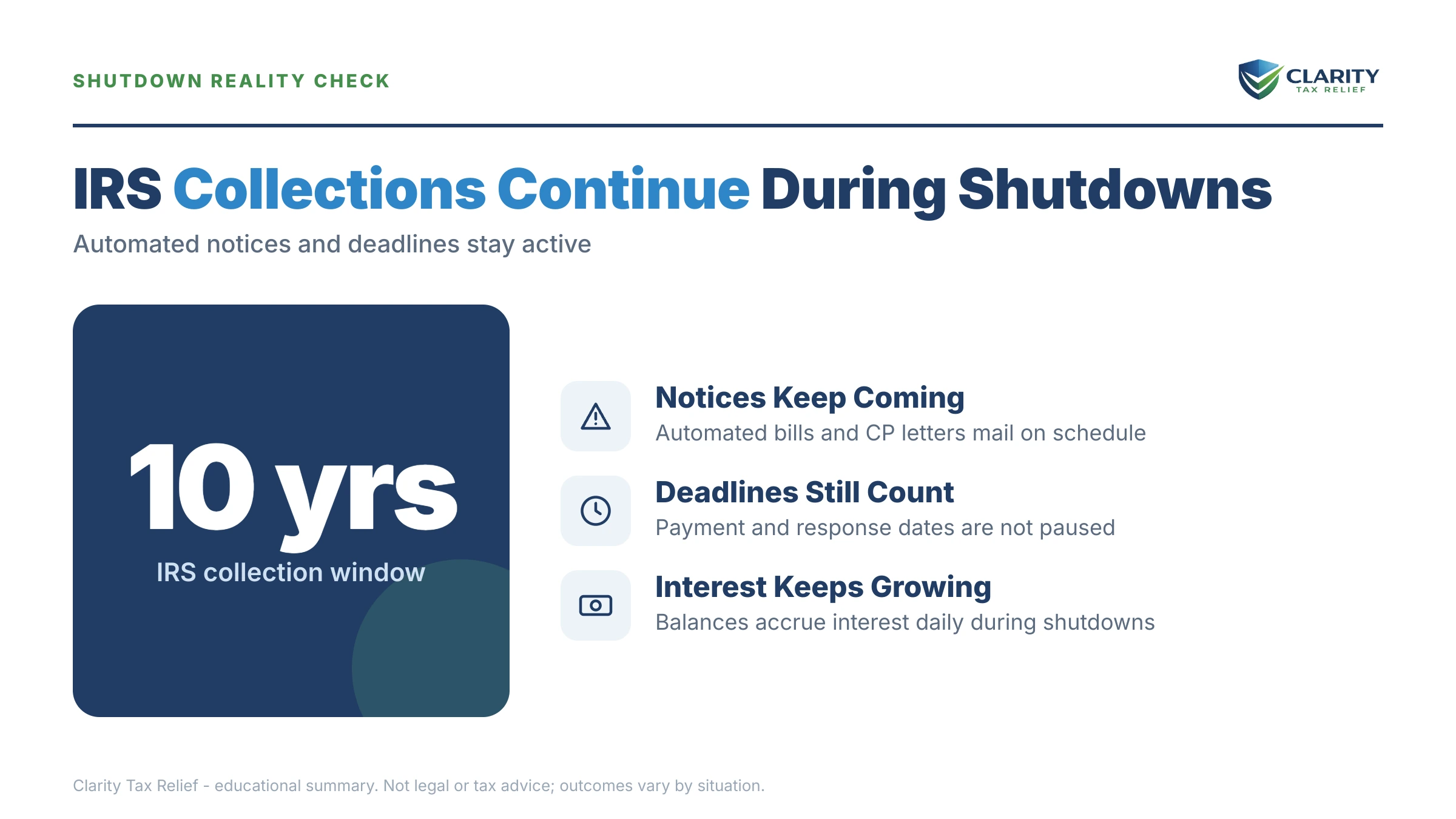
What keeps running and what pauses at the IRS
During a shutdown, everything that collects money from you keeps running, and almost everything that could help you pauses. This table is the reference version — screenshot it:
| IRS function | During a shutdown | What it means for you |
|---|---|---|
| Automated collection notices (CP14 → CP501/503 → CP504 → LT11) | Continue | The escalation sequence keeps mailing on schedule |
| Interest + failure-to-pay penalty | Continue | 0.5%/month penalty plus daily-compounding interest, uninterrupted |
| Existing wage and bank levies | Continue | A wage levy is continuous until released; a bank levy's 21-day hold keeps counting |
| Federal Payment Levy Program (Social Security, federal pay) | Continues | Up to 15% of Social Security keeps being taken automatically |
| Direct-debit installment agreement drafts | Continue | Your monthly payment still comes out — don't stop it |
| IRS.gov, online account, Online Payment Agreement tool | Stay up | You can check balances and self-serve a payment plan |
| Live phone assistance | Mostly unstaffed | Long or unanswered lines; don't wait on hold to protect a deadline |
| Offer in Compromise review, penalty-abatement decisions | Paused | Requests sit in queue; statutory clocks keep running |
| Appeals, Taxpayer Advocate, most audits | Largely paused | Hearings and casework reschedule after funding resumes |
| Paper mail processing, levy releases, refunds | Backlogged | The human side stalls — the fix-it functions are what slow down |
The images on this page show you what this lopsided picture looks like at a glance — worth a scroll if you're skimming.
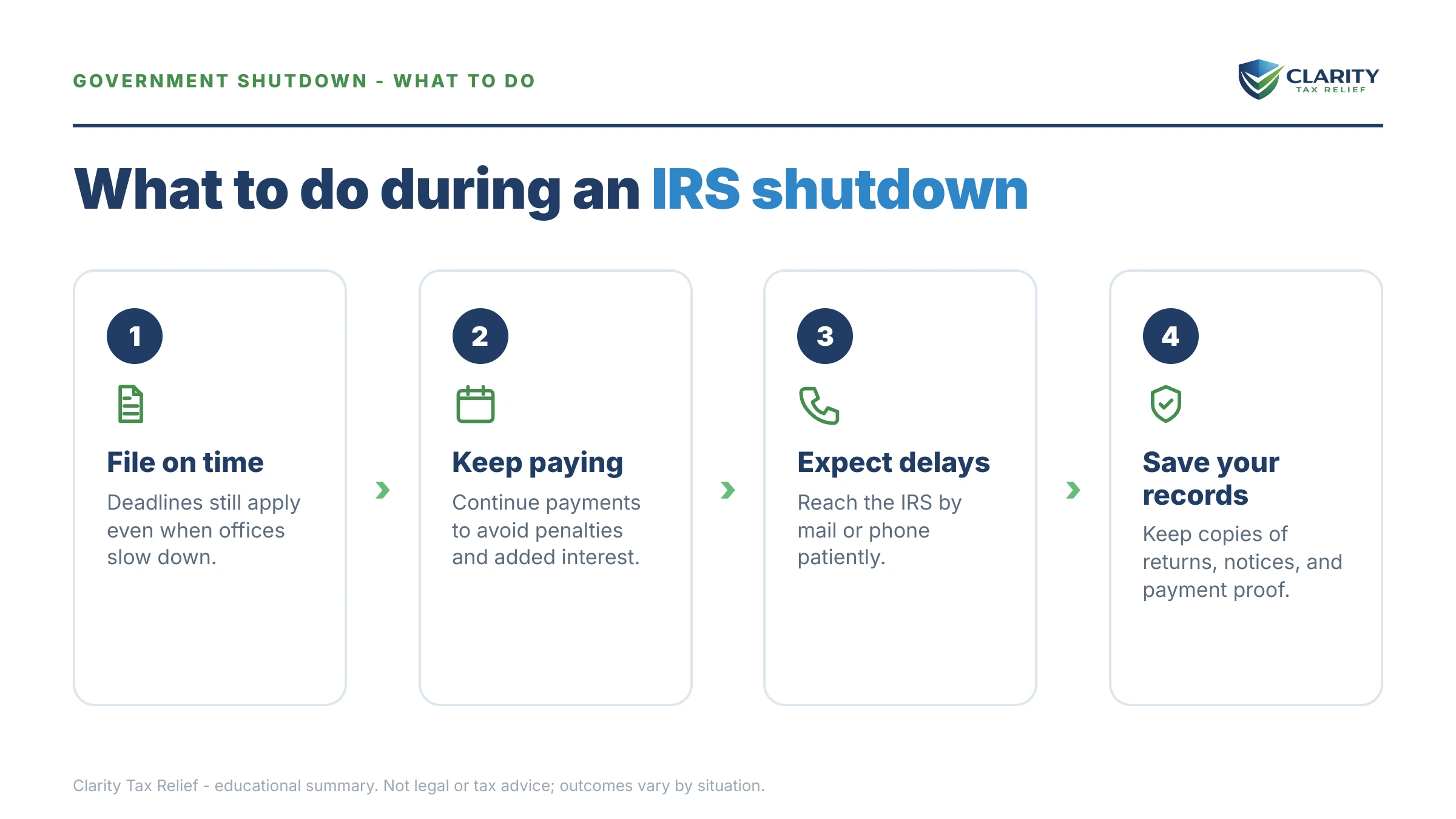
What happens if you ignore an IRS notice during the shutdown
Ignoring an IRS notice during a shutdown produces the same escalation as ignoring it any other month — the sequence is automated end to end. If you're holding a balance-due notice and wait for "the government to reopen," here's the sequence still moving underneath you:
- CP14 — the first bill, with typically about 21 days before the system queues the next notice. No enforcement yet, but accrual has started.
- CP501 / CP503 — automated reminders. Still just bills; the balance grows monthly.
- CP504 — Notice of Intent to Levy under IRC §6331(d). The IRS can seize your state tax refund, and a federal tax lien becomes a live possibility. This is not the final notice.
- LT11 / Letter 1058 — Final Notice of Intent to Levy. A 30-day clock starts on your Collection Due Process rights. That clock does not stop for a shutdown.
- Levy — after the 30 days pass, wage garnishment and bank levies can issue. A bank levy freezes funds for a 21-day hold before the money leaves; a wage levy repeats every payday until released.
The cruelest shutdown scenario is the reader who receives an LT11 notice mid-shutdown, calls the IRS for weeks, never gets through, and lets day 30 pass. The hearing right attached to that notice — requested with Form 12153 — dies with the deadline, and no one at the IRS is obligated to give it back because the phones were down. Mail the form; don't wait for a human.
Here are the specific clocks that keep running, and the right each one takes with it:
| What you're holding | Response window | The right you lose if it passes |
|---|---|---|
| LT11 / Letter 1058 (Final Notice of Intent to Levy) | 30 days from the notice date | Collection Due Process hearing and the levy hold that comes with it |
| CP3219A (Notice of Deficiency, the "90-day letter") | 90 days | The right to contest the tax in Tax Court before paying it |
| CP504 (Intent to Levy state refund) | Typically 30 days | Your state refund becomes seizable; lien risk rises |
| CP14 (first bill) | Typically 21 days | The cheapest window to resolve before the sequence escalates |
| Installment agreement due date | The printed date, every month | Miss it and you risk default, a CP523, and reactivated enforcement |
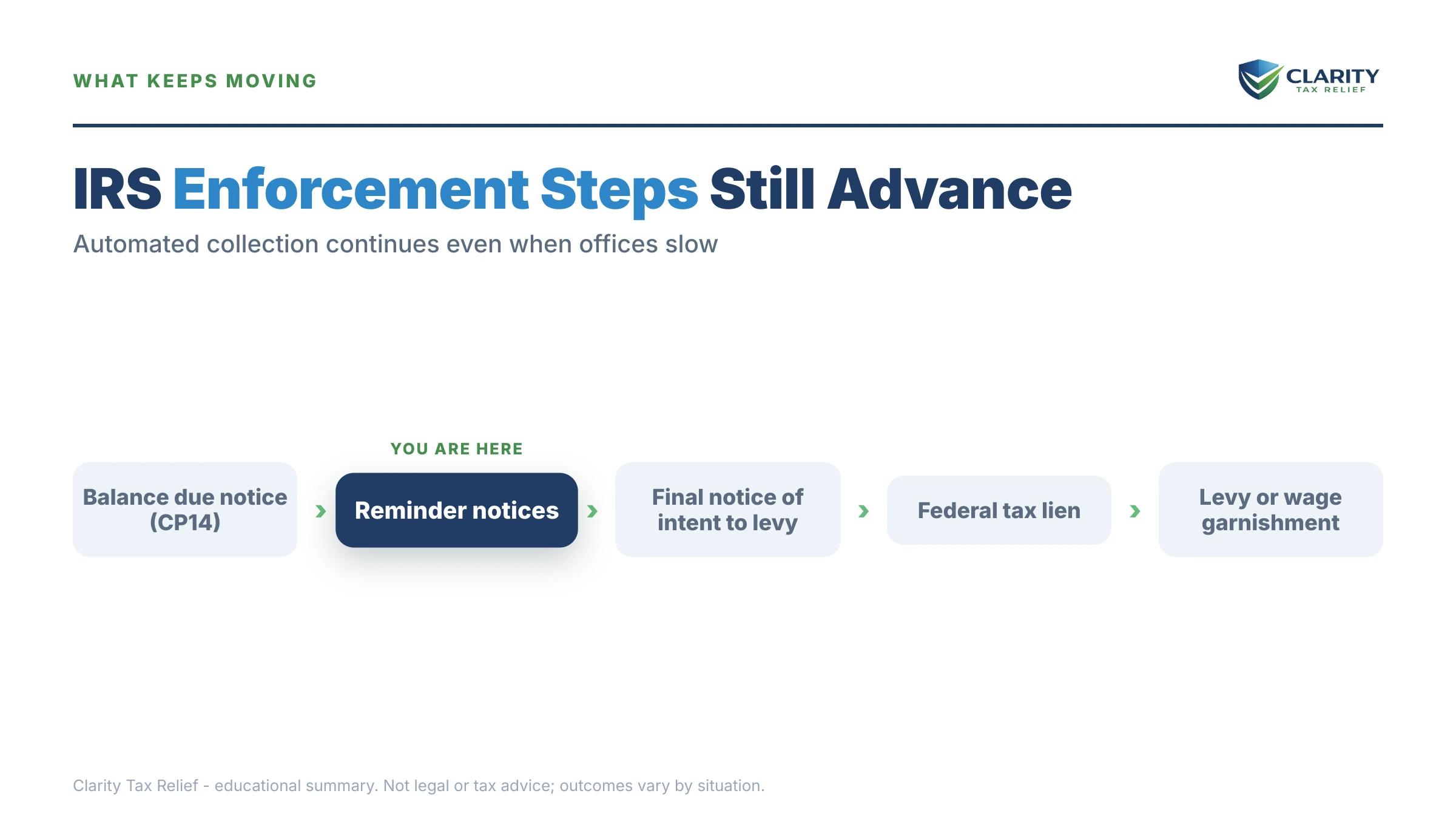
Holding an IRS notice while the government is shut down?
The shutdown paused the IRS's phones — not your penalties, and not the deadline printed on your notice. Send us a photo of what you received and an experienced tax professional will map exactly where you are in the sequence and what to do before your window closes. Free, confidential, no pressure.
What waiting out the shutdown costs: a worked example
A tax balance grows every month of a shutdown even though no IRS employee is working your case. Here's the math, clearly hypothetical:
Say you owe $61,200 — a common post-divorce situation where the balance from a joint return followed you out of the marriage. (The IRS is not bound by your divorce decree, by the way; if the decree says your ex pays half but both names are on the return, the IRS can collect all of it from you — see divorce and IRS debt: who pays.)
- Failure-to-pay penalty: 0.5% × $61,200 = $306 per month, shutdown or not.
- Interest: compounds daily at the federal short-term rate plus 3 percentage points. For illustration, assume 7% annually: $61,200 × 7% ÷ 12 ≈ $357 per month.
- Combined: roughly $660 a month — about $22 a day — added to your balance while you wait on hold.
Now the shutdown-specific danger. The passport-certification threshold for seriously delinquent tax debt is $66,000 in 2026. Your $61,200 balance sits $4,800 below it. At roughly $660 a month in accrual, doing nothing for about seven months — a long shutdown plus the backlog after it — pushes you across the line, and the IRS can certify your debt to the State Department, which can deny or revoke your passport. A funding lapse you had nothing to do with can quietly walk your balance into a consequence you can't easily undo. You can run your own accrual numbers with our Penalty & Interest Calculator to estimate what waiting costs in your situation.
One more $61,200-specific fact: it's over the $50,000 online payment-plan ceilinging — which changes your options during a shutdown, as the next section shows.
Your options while the IRS phones are down
Most IRS resolution options can still be started during a shutdown — the ones you can self-serve online are simply faster than the ones that need a human. If you're new to the programs themselves, our pillar on how to settle tax debt yourself covers each in depth; here's how they behave specifically during a funding lapse:
| Option | Typical eligibility | Available during a shutdown? |
|---|---|---|
| Short-term payment plan | Can pay in full within 180 days; $0 setup fee | Yes — self-serve online, no human needed |
| Long-term installment agreement (streamlined) | Balance ≤ $50,000; up to 72 months | Yes — the online tool stays up |
| Guaranteed installment agreement | Balance ≤ $10,000 with clean filing history | Yes — online |
| Non-streamlined agreement (over $50,000) | Requires Form 433-F financial disclosure | Stalls — needs human review; prepare the paperwork now, or pay down below $50,000 to self-serve |
| Currently Not Collectible (hardship) | Allowable living expenses meet or exceed income | Request it, but the determination waits for staff |
| Offer in Compromise | Means-tested; $205 fee (waived with low-income certification) | Can be filed; review pauses, but collection generally holds while it's pending |
| Penalty abatement (First-Time Abate / AEP) | Clean compliance in the prior 3 years; AEP becomes automatic starting summer 2026 | Request in writing; the decision queues until reopening |
For our divorced reader at $61,200, the shutdown makes one move unusually valuable: paying the balance down below $50,000 — about $11,200 — converts a stuck, human-dependent request into a five-minute online setup at the IRS's Online Payment Agreement tool. If a divorce settlement payout, home-equity split, or retirement division gave you access to cash, this is one of the few times the order you deploy it in genuinely changes what's possible. Compare the mechanics in our guide to the best way to pay the IRS.
Two quiet clocks also work for you during a shutdown. The 10-year collection statute keeps running — the IRS loses collection time it can't recover. And a pending Offer in Compromise is deemed accepted if the IRS doesn't decide within 2 years — with narrow exceptions: a returned or rejected offer stops the clock, and time during court disputes does not count — a clock a shutdown backlog only shortens. (The trade-off: a pending offer pauses the 10-year statute, so don't file one just to stall.)
How to respond during a shutdown, step by step
- Find the deadline printed on your most recent notice. A shutdown does not extend it. Write the date down and work backward from it — that date, not the news cycle, controls what happens next.
- Verify your balance in your IRS online account. IRS.gov stays online during an appropriations lapse. Confirm the exact payoff amount, which tax years it covers, and whether recent payments posted.
- Keep every scheduled payment on time. Direct-debit installment payments keep drafting, and payment systems stay up. A missed payment can still default your agreement and trigger a CP523.
- Respond in writing by certified mail before any deadline. Even if your letter sits unopened for weeks, the postmark preserves your rights. Keep copies of everything and the certified-mail receipt.
- Set up or restructure a payment plan online. The Online Payment Agreement tool works during shutdowns for short-term plans and long-term plans on balances of $50,000 or less — no phone call needed.
- Protect your appeal rights on any levy notice. If you're holding an LT11 or Letter 1058, mail Form 12153 within 30 days to request a Collection Due Process hearing. The clock runs through the shutdown.
When you can handle this yourself — and when the shutdown changes that
Most shutdown-era tax situations are self-serviceable precisely because the online tools stay up. You likely don't need professional help if:
- Your balance is under $50,000 and you agree with it — the online payment-plan tool works right through the shutdown.
- You can pay in full within 180 days — a short-term plan costs $0 to set up and stops the notice sequence.
- You're just anxious because the news is loud — if you have no notice with a deadline and your payments are current, a shutdown changes nothing for you.
Experienced help changes outcomes in the situations where the shutdown removes the exact humans you'd otherwise reach: a levy already taking your pay or holding your bank funds (releases need staff, and knowing which emergency channels still function matters), a balance over $50,000 that requires financial disclosure and negotiation, an LT11 with the 30-day clock running, or a post-divorce joint liability where innocent-spouse or separation-of-liability relief should be filed now so it's first in queue when the IRS reopens. In each of these, the cost of doing the wrong thing during the blackout is measured in lost rights, not just dollars. If your case is stuck in the human backlog after funding resumes, an experienced tax professional can also tell you which channel — practitioner line, Appeals, or Taxpayer Advocate — will actually move it; start with a free review through our 2-minute form.
Terms in the shutdown coverage, decoded
- Lapse in appropriations — the legal name for a shutdown: Congress hasn't passed funding, so agencies furlough non-essential staff.
- Excepted employees — staff who keep working through a lapse because their function protects life, property, or government revenue — which includes collections.
- ACS (Automated Collection System) — the IRS computer system that generates the notice sequence and systemic levies without a human assigned to your case.
- FPLP (Federal Payment Levy Program) — the automated program that takes up to 15% of federal payments like Social Security; it runs through shutdowns, as we detail in our Federal Payment Levy Program guide.
- CDP rights (Collection Due Process) — your right to a hearing before levy, triggered by an LT11/Letter 1058 and requested with Form 12153 within 30 days.
- CSED (Collection Statute Expiration Date) — the end of the IRS's 10-year window to collect; it keeps running during a shutdown but pauses for offers, appeals, and bankruptcy.
Government shutdown & IRS collections: your questions answered
Does the IRS still send collection notices during a government shutdown?
Yes. Collection notices — CP14, CP501, CP503, CP504, and LT11 — are generated and mailed by automated systems that keep running through an appropriations lapse. The sequence escalates on its normal schedule whether or not a human employee ever touches your file. The one wrinkle: your written responses may sit unopened in the mail backlog, which is why postmarked, certified mail matters more during a shutdown, not less.
Can the IRS levy my bank account or garnish wages during a shutdown?
Levies already in place keep taking money — a wage levy is continuous until released, and the Federal Payment Levy Program keeps taking up to 15% of Social Security automatically. New systemic levies can also issue if your account has already passed the LT11 stage. The bigger danger is the reverse problem: getting a levy released requires a human, and humans are exactly what a shutdown removes.
Do IRS deadlines get extended because of a government shutdown?
No. Statutory and notice-printed deadlines are set by law, not by staffing. The 30-day window to request a Collection Due Process hearing after an LT11, the 90-day window to petition Tax Court after a Notice of Deficiency, and your installment agreement due dates all keep running. If a deadline passes while the phones are down, the right attached to it is gone — 'nobody answered' is not a legal extension.
Should I keep making my installment agreement payments during a shutdown?
Yes — never skip a payment because the government is closed. Direct-debit agreements keep drafting automatically, and if you pay by check or online, the payment posting systems stay up. A missed payment can still push your agreement toward default and a CP523 notice, and reinstating a defaulted agreement is the kind of task that requires human staff — the resource a shutdown takes away.
Does interest stop accruing while the government is shut down?
No. Interest compounds daily at the federal short-term rate plus 3 percentage points, and the failure-to-pay penalty adds 0.5% of the balance every month, shutdown or not. On a $61,200 balance, that's roughly $300 a month in penalty alone before interest. Accrual is written into the tax code — it doesn't need a single employee at a desk to keep running.
Can I set up an IRS payment plan during a government shutdown?
Usually yes, if you qualify online. IRS.gov and the Online Payment Agreement tool have stayed operational through past shutdowns, so a short-term plan (up to 180 days, $0 setup) or a long-term plan on balances of $50,000 or less can typically be self-served. Balances over $50,000 normally require financial disclosure and human review — those requests stall until staff return, which is one reason paying a large balance down below $50,000 can be strategic.
Does the 10-year collection statute keep running during a shutdown?
Yes — and this is one of the few shutdown effects that favors you. The CSED, the 10-year clock the IRS has to collect from the date of assessment, is not paused by an appropriations lapse. It only pauses for specific taxpayer actions like a pending Offer in Compromise, a Collection Due Process appeal, or bankruptcy. If your debt is old, a shutdown quietly burns IRS collection time it can't get back.
What happens to my Offer in Compromise during a government shutdown?
Offer review is human work, so pending offers typically sit untouched until staff return — but two clocks keep moving in your favor. Collection generally holds while an offer is pending, and an offer is deemed accepted by law if the IRS doesn't decide within 2 years of receipt — with narrow exceptions: a returned or rejected offer stops the clock, and time during court disputes does not count. Note the trade-off: while the offer is pending, the 10-year collection statute is paused, so the delay extends the IRS's total collection window.
Your next 24 hours
- Find the printed deadline on the most recent IRS notice you've received — it's near the top, and it does not move for a shutdown. That date is your whole calendar now.
- Gather three things: the notice itself, your most recent tax return, and a rough picture of your monthly income and expenses. Then log into your IRS online account and confirm the balance — it stays accessible through the shutdown.
- Get a free case review at the 2-minute form or by calling (888) 825-7779. Penalties and interest are accruing every day the shutdown drags on — the earlier your response is postmarked and your plan is set, the less this costs you.
For deeper background on how the collection machine keeps grinding regardless of staffing, see our IRS tax collections statistics and our practical guide for when you can't reach the IRS on the phone. To verify anything on your own account, use the IRS's own resources: IRS.gov/payments for making payments, the IRS payment plans page for online agreements, and the Taxpayer Advocate Service once its offices reopen after funding resumes.
This guide is general information, not tax or legal advice for your specific situation. Eligibility for IRS programs depends on individual facts and circumstances; no outcome is guaranteed.