
IRS Data & Statistics
IRS Tax Collections Statistics: The 2026 Numbers That Decide What Happens to Your Balance
The short answer: IRS tax collections statistics for 2026 tell one consistent story: the agency collects trillions in gross revenue each year per its annual Data Book, accepts roughly 1 in 5 Offers in Compromise, and — despite losing about 27% of its workforce in 2025, per TIGTA reports — its automated systems keep issuing notices, liens, and levies without a human ever touching the file.
You're probably not searching IRS tax collections statistics for a term paper. More likely, you owe money — or just found out you might — and you want to know what actually happens to people in your position: how hard the IRS really pushes, what it accepts, and what it takes.
Good news: the numbers are knowable, and once you see them, the path out of a tax debt stops feeling like a coin flip. This page collects the verified figures that matter and translates each one into what it means for your balance.
⏱ The clock that's actually running: there's no notice deadline on a statistics page, but there is a meter. The failure-to-pay penalty adds 0.5% of your unpaid balance every month, and interest compounds daily on top of it, until you set up a resolution. Every month of research without action has a price printed on it.
The IRS tax collections statistics that matter in 2026
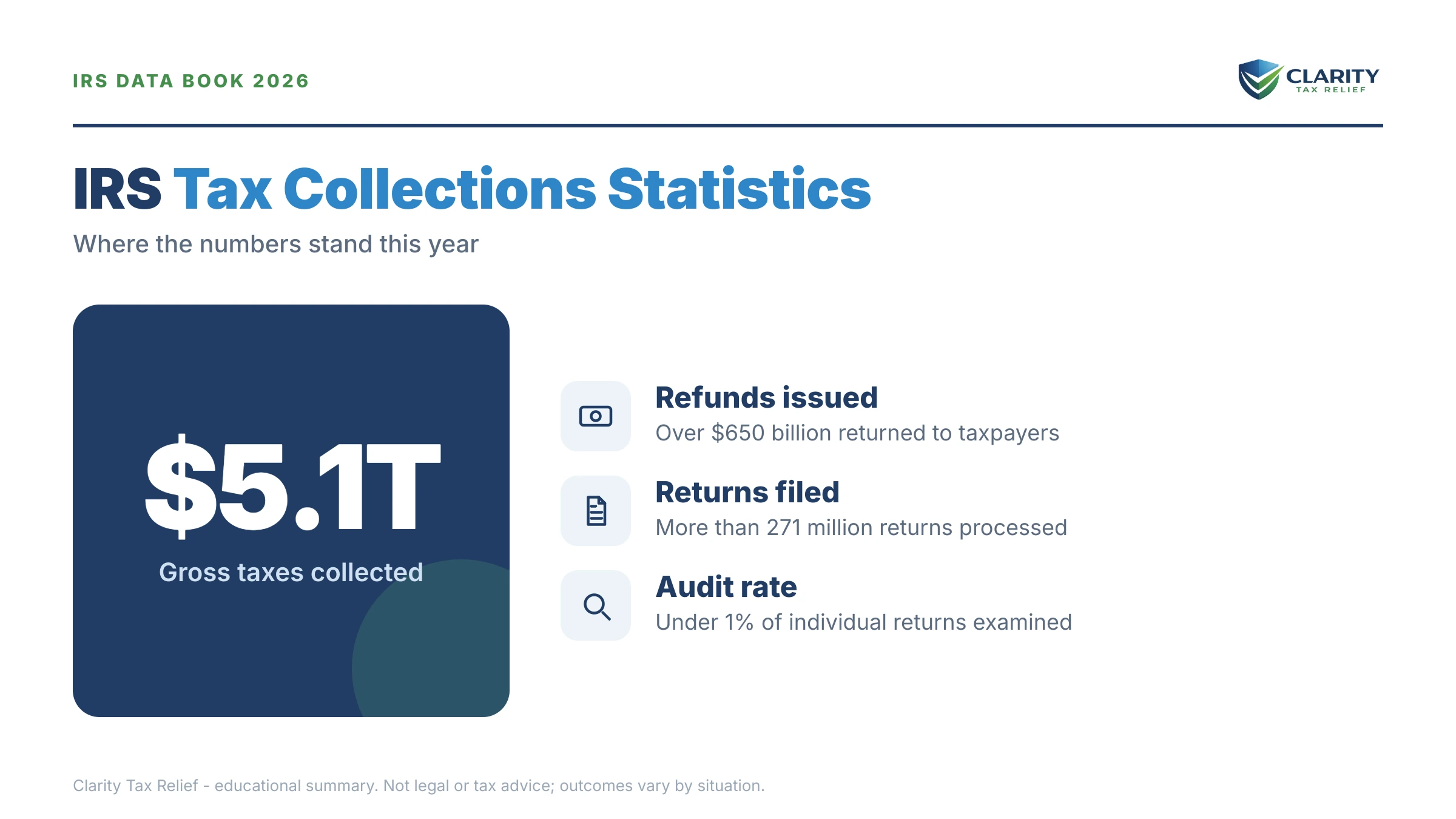
The IRS collects several trillion dollars in gross revenue each year, yet, per IRS data, accepted only about 1 in 5 Offers in Compromise in FY2024. Between those two numbers sits everything a person who owes needs to understand. Here are the verified figures, each with what it means for you:
- Gross collections: trillions per year, per the IRS Data Book. The overwhelming majority arrives voluntarily through withholding and filed returns. Enforced collection — the part that touches delinquent accounts like yours — is a thin slice, which is exactly why it's automated.
- Workforce: down roughly 27% in 2025, per TIGTA reports. Fewer humans answer phones and work cases. The notice, lien, offset, and levy systems are software; they took no cuts.
- OIC acceptance: roughly 1 in 5 in FY2024, per IRS data. Settlement for less than you owe is real, but it's math-tested, not mercy-tested. See the full breakdown in our offer in compromise acceptance rate analysis.
- Failure-to-file penalty: 5% per month — ten times the 0.5% failure-to-pay rate. The single most consequential ratio in all of the collections data.
- Collection statute: 10 years from assessment, pausable by appeals, a pending offer, or bankruptcy — covered in depth in our guide to how long the IRS can collect back taxes.
- Passport certification threshold: $66,000 for 2026, inflation-adjusted each year.
- Bank levy: a one-time grab with a 21-day hold. Wage levy: continuous until released. Two different weapons with two very different recovery windows.
- Social Security: up to 15% taken continuously under the Federal Payment Levy Program.
- 1099-K reporting: back to $20,000 / 200 transactions. The $600 rule is dead — but balances created under the old reporting rules don't disappear with it.
How many people share your situation — and how much they owe collectively — is its own dataset; we break that down in IRS back tax debt statistics.
Why the collections machine runs at full speed with 27% fewer people
The IRS lost roughly 27% of its workforce in 2025, per TIGTA reports, yet its automated collection systems never slowed down. That's the paradox behind most 2026 collections coverage, and it cuts both ways for you.
The parts of collection that hurt — balance-due notices, refund offsets, lien filings, systemic levies — are generated by computers on fixed schedules. No staffing chart changes them. The parts that help — a human who can fix a misapplied payment, negotiate an unusual case, or process an appeal quickly — are exactly what got thinner.
The practical statistic hiding in there: the cost of a mistake went up in 2026, because the wait to get one corrected got longer. We cover the case-level fallout in IRS budget cuts 2026 and the automation side in IRS automated collections and AI notices. Even funding lapses don't switch the machine off — see government shutdown IRS collections for why.
What the numbers say happens if you ignore a tax debt
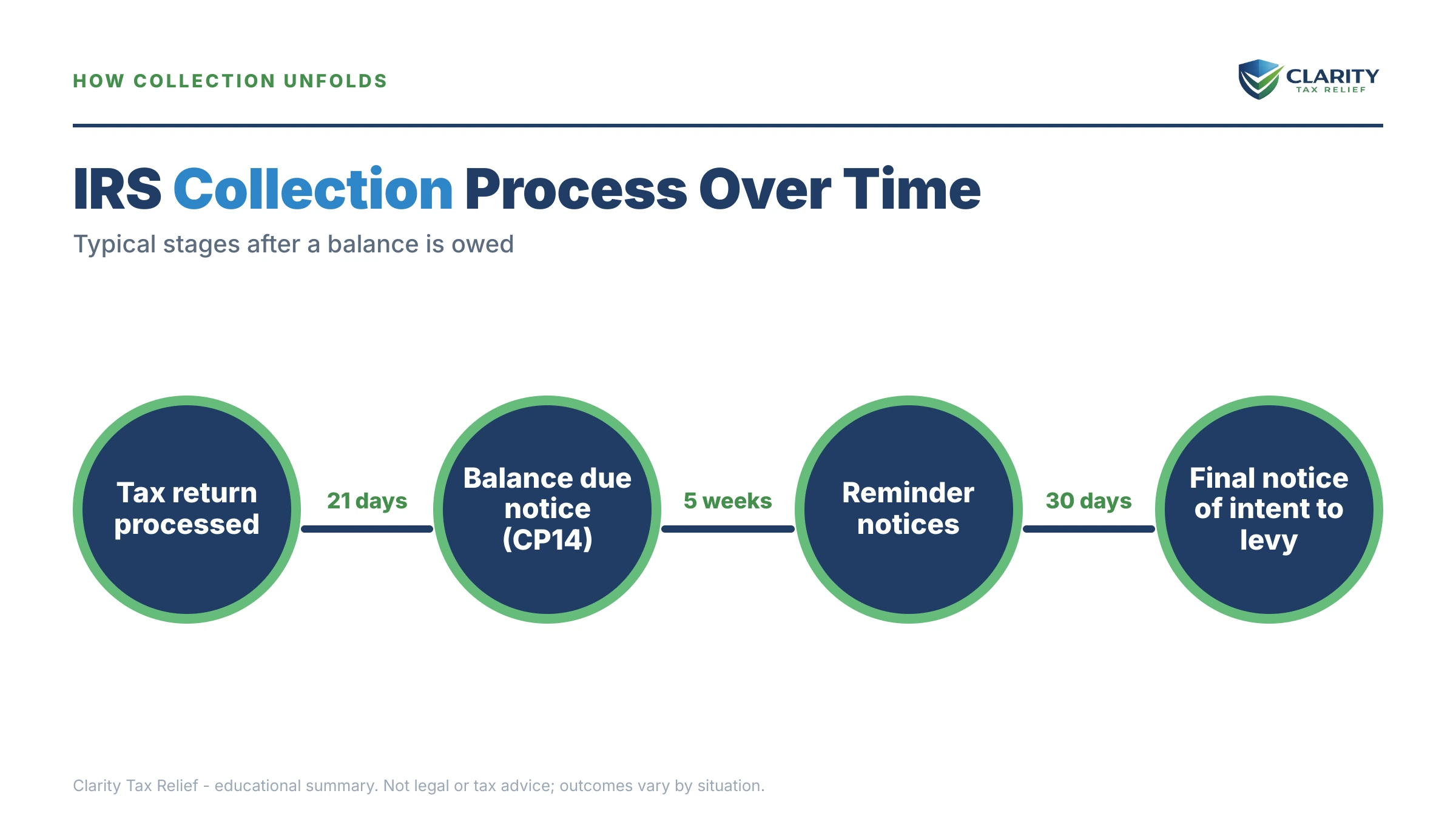
An unpaid federal tax balance moves through a fixed, automated escalation sequence — and every stage carries more enforcement power than the one before. The statistics above are the mileposts on that road:
- First bill (CP14 for individuals). You typically have about 21 days from the notice date — 10 business days when the balance is $100,000 or more — before the sequence advances. No enforcement yet — this is the cheapest moment in the entire timeline.
- Reminder notices (CP501 / CP503). Still bills, but the 0.5% monthly failure-to-pay penalty and daily-compounding interest are posting the whole time.
- CP504 — intent to levy your state refund under IRC §6331(d). A federal tax lien becomes a live possibility here, and your state refund is now reachable.
- LT11 / Letter 1058 — final notice of intent to levy. This starts a 30-day clock and your Collection Due Process rights (requested on Form 12153). Miss the window and you lose the strongest appeal right in the sequence.
- Enforcement. Bank accounts (one-time levy, 21-day hold before funds leave), wages (continuous levy until released), federal payments including up to 15% of Social Security via FPLP, and every future tax refund offset until the balance is gone. At $66,000, passport certification joins the list.
Note what's absent from that sequence: any step that requires a human decision. It's a conveyor belt, and doing nothing is the only way to ride it to the end.
Done reading averages? Get your own numbers.
Statistics describe everyone; your transcript describes you. An experienced tax professional will pull your exact balance, penalties, and program eligibility — free — before another month of interest and failure-to-pay penalty posts to your account.
Your resolution options, by the numbers: thresholds, costs, and timelines
Every IRS resolution program has a published threshold, and your balance determines which doors are open before you ever make a phone call. The two tables below put the eligibility lines and the real costs side by side.
| Option | Eligibility threshold | What it does |
|---|---|---|
| Short-term payment plan | Can pay in full within 180 days | Stops the escalation sequence; interest and penalties continue until paid |
| Guaranteed installment agreement | Balance of $10,000 or less (plus filing-compliance conditions) | The IRS must accept a qualifying plan — the official program name, not a promise about other outcomes |
| Streamlined installment agreement | $25,000 or less ($50,000 with direct debit) | Monthly plan with no detailed financial disclosure |
| Online long-term plan (Form 9465 or IRS.gov) | $50,000 or less, up to 72 months | Self-service setup, often same day |
| Offer in Compromise (Form 656) | Assets plus future income genuinely below the balance — means-tested | Settles for less than owed when the IRS's own math shows full payment is impossible |
| Currently Not Collectible (Form 433-F) | Income at or below IRS allowable living expenses | Pauses active collection while hardship lasts; the debt remains |
| First-Time Abatement / AEP | Clean compliance record for the prior 3 years | Removes qualifying penalties — AEP makes this automatic starting summer 2026 |
| Option | Upfront cost | While it runs | Typical timeline |
|---|---|---|---|
| Short-term plan (≤180 days) | $0 setup | Interest + 0.5%/month failure-to-pay penalty continue | Same-day setup online |
| Long-term installment agreement | Setup fee varies by application method; low-income waivers available | Interest and the monthly failure-to-pay penalty keep accruing on the shrinking balance | Often same-day online for balances ≤ $50,000 |
| Offer in Compromise (Form 656) | $205 fee + 20% down on lump-sum offers — both waived with low-income certification (AGI ≤ 250% of poverty) | Periodic-offer payments continue during review unless low-income certified | Months of review; auto-accepted if the IRS doesn't decide within 2 years, with narrow exceptions — a returned or rejected offer stops the clock, and time during court disputes doesn't count |
| Currently Not Collectible (Form 433-F) | $0 | Balance still accrues interest and penalties; refunds are offset | Weeks to months of financial review; revisited if income rises |
| First-Time Abatement / AEP | $0 | Removes qualifying penalties and the interest charged on them | FTA by phone or letter today; AEP applies automatically starting summer 2026 |
A worked example: a sole proprietor who owes $11,300
Say you're a self-employed sole proprietor who owes $11,300 after your first full year of 1099 income with no quarterly payments. Here's how the statistics above become your numbers:
- You're $1,300 over the guaranteed line. The guaranteed installment agreement caps at $10,000, so the IRS isn't required to accept your plan — but at $11,300 you're comfortably inside the streamlined installment agreement band, meaning no detailed financial disclosure.
- The 72-month floor: $11,300 ÷ 72 ≈ $157 a month minimum, though interest and the 0.5% monthly penalty mean paying faster costs meaningfully less overall.
- The penalty meter: failure-to-pay runs about $56.50 a month on this balance (0.5% × $11,300). If the return were unfiled, failure-to-file would run about $565 a month — the same debt, ten times the bleed. You can estimate your own accruals with our Penalty & Interest Calculator.
- Penalty relief: if your prior three years are clean, first-time penalty abatement could strip the penalties — and the interest charged on them — before you pay a dollar toward them.
- The OIC reality check: with ongoing self-employment income, the IRS's collectibility math on an $11,300 debt will usually show it can collect in full over time. At this size, a payment plan almost always beats chasing the roughly-1-in-5 offer odds.
- Refunds are gone until it's paid: the IRS applies every future refund to the balance automatically — see will the IRS take my refund every year.
This example is hypothetical, but the arithmetic is the same one the IRS's systems will run on your actual balance.
How to act on these numbers, step by step
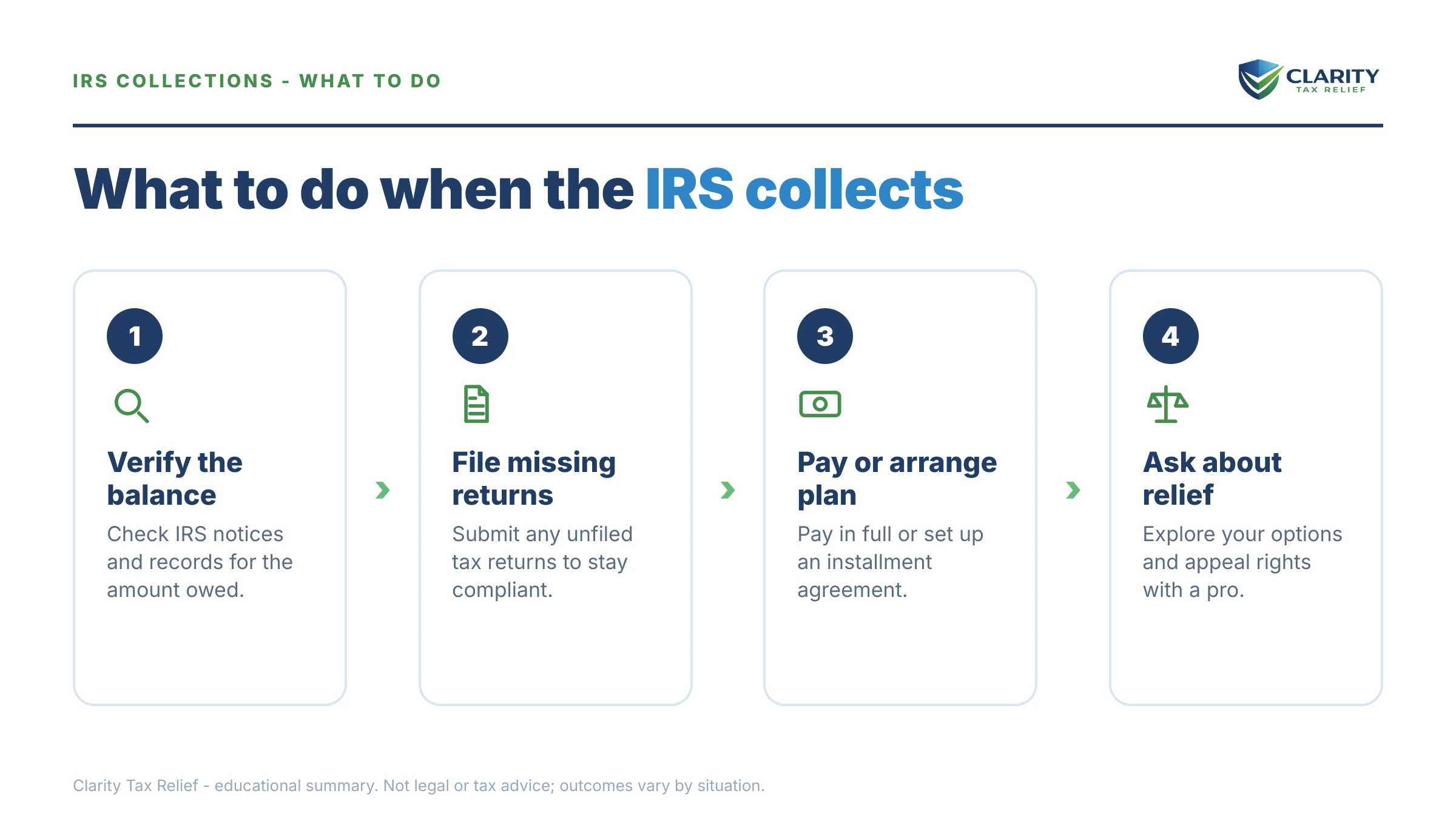
- Pull your exact balance. Log into your IRS online account to see the balance, tax years, and accrued penalties on record — a months-old notice is already out of date.
- File every unfiled return. The failure-to-file penalty runs 5% per month — ten times the failure-to-pay rate — so filing stops the fastest-growing charge even if you can't pay a dollar.
- Match your balance to a threshold. Under $50,000, you can usually set up a long-term payment plan online in one sitting; larger balances and hardship cases require financial disclosure first.
- Request penalty relief before paying penalties. Check first-time abatement — and the automatic AEP rules arriving in summer 2026 — because removing a penalty also removes the interest charged on it.
- Escalate to a professional if enforcement has started. A levy in motion, multiple unfiled years, or business payroll debt changes both the strategy and the stakes.
When you can handle this yourself
Most balances under $50,000 with all returns filed can be resolved without paying anyone for help. If you agree with the amount, can afford the monthly payment, and the sequence hasn't reached the final-notice stage, the online payment plan plus a penalty-abatement request is a genuinely do-it-yourself project — our how to settle tax debt yourself guide walks the whole process, and there are real no-cost resources in free help with IRS tax debt.
The statistics argue for experienced help in a narrower set of situations: a levy or garnishment already in motion, multiple unfiled years that need reconstructing, business or payroll tax debt, or an Offer in Compromise — where roughly 4 in 5 applications fail, usually on math that should have been run before filing. In those cases, the order and quality of the moves changes what you ultimately pay.
Self-employed and staring at a balance you can't cover? That's the exact profile our team resolves most — a free review at the 2-minute form or (888) 825-7779 will tell you which of the thresholds above your case actually clears.
Terms behind the statistics, decoded
- Gross collections — every dollar the IRS takes in, voluntary and enforced combined; the trillions headline number, not a measure of enforcement.
- Tax gap — the IRS's estimate of tax legally owed but not paid on time; the political justification behind enforcement budgets.
- ACS — the Automated Collection System, the computer-and-call-center operation that handles most delinquent accounts without a dedicated human caseworker.
- CSED — Collection Statute Expiration Date: the end of the IRS's 10-year window to collect an assessed tax, extendable by tolling events.
- Lien vs. levy — a lien is a legal claim staking the government's priority in your property; a levy is the actual taking of money or assets.
- FPLP — the Federal Payment Levy Program, which continuously diverts up to 15% of federal payments such as Social Security toward a tax debt.
IRS collections statistics: your questions, answered
How much money does the IRS collect each year?
The IRS collects several trillion dollars in gross revenue every year, according to its annual Data Book. Most of that arrives voluntarily through withholding and filed returns; enforced collections — levies, liens, offsets, and payment plans on delinquent accounts — are a small slice of the total. For someone who owes, the enforced-collection numbers matter far more than the headline total, because they show how the machine treats individual balances.
What percentage of Offers in Compromise does the IRS accept?
The IRS accepted roughly 1 in 5 Offers in Compromise in fiscal year 2024 — about a 20% acceptance rate. Acceptance turns entirely on the IRS's math for what it could collect from your assets and future income, not on how compellingly you ask. Self-employed applicants face extra scrutiny because business income and assets are harder to value, which is why the offer math should be run before the $205 application fee is paid.
Is the IRS still collecting taxes after the 2025 workforce cuts?
Yes. The IRS lost roughly 27% of its workforce in 2025, but collection notices, refund offsets, liens, and levies are generated by automated systems that were never cut. What changed is the human side: it's harder to reach someone by phone to fix an error or negotiate. Balances still escalate on schedule — the layoffs made resolving a debt slower, not owing one safer.
How long can the IRS collect back taxes?
The IRS generally has 10 years from the date a tax is assessed to collect it — the Collection Statute Expiration Date, or CSED. The clock pauses, though, during bankruptcy, a pending Offer in Compromise, certain appeals, and other events, so real-world collection windows often run longer than 10 calendar years. Waiting out the statute rarely works as a strategy, because collection activity typically intensifies in the later years.
Which IRS penalty grows a tax debt fastest?
The failure-to-file penalty is the fastest-growing charge in the collection statistics: 5% of the unpaid tax per month, ten times the 0.5% monthly failure-to-pay penalty. On an $11,300 balance, not filing costs about $565 a month while not paying costs about $56.50. That gap is why filing on time — even with no payment attached — is the single highest-value move a person in tax debt can make.
At what balance can the IRS certify my passport?
The seriously-delinquent-debt threshold for passport certification is $66,000 for 2026, adjusted annually for inflation. Once a debt is certified, the State Department can deny a new passport or renewal, and in some cases revoke an existing one. Getting into a payment plan, an accepted offer, or certain other statuses generally reverses the certification, but the reversal takes processing time — another reason not to let a balance drift toward the line.
Can the IRS take my Social Security check for back taxes?
Yes — through the Federal Payment Levy Program, the IRS can take up to 15% of a Social Security benefit continuously until the debt is resolved. Unlike a bank levy, which is a one-time grab with a 21-day hold, the FPLP deduction repeats every month automatically. Hardship status or a payment plan will typically stop it, but you have to affirmatively set one up; the program doesn't check whether you can afford the deduction.
Your next 24 hours
- Pull your real numbers. Log into your IRS online account and write down the exact balance, the tax years involved, and how much of the total is penalties versus tax.
- Gather three things: your last filed return, any IRS letters you've received, and your current income records (1099s or a rough profit-and-loss if you're self-employed).
- Get the free case review. Call (888) 825-7779 or use the 2-minute form — an experienced tax professional will map your balance against the thresholds on this page while the penalty and interest meter is still small.
Primary sources for the figures on this page: the IRS's annual Data Book and enforcement tables at IRS Tax Statistics, current program terms on the IRS payment plans page, and independent reporting on IRS service levels from the Taxpayer Advocate Service.
This guide is general information, not tax or legal advice for your specific situation. Eligibility for IRS programs depends on individual facts and circumstances; no outcome is guaranteed.