
IRS Data & Research
IRS Back Tax Debt Statistics: What the 2026 Numbers Mean If You Owe
The headline IRS back tax debt statistics for 2026: unpaid federal tax runs roughly $700 billion a year by the IRS's latest projections, about 85% of tax is paid voluntarily on time, the IRS accepted roughly 1 in 5 Offers in Compromise in FY2024 — and its automated collection systems never paused.
You probably didn't look up IRS back tax debt statistics out of curiosity. More likely there's a levy warning on your kitchen table, you rent, and you're wondering whether the IRS actually follows through on people like you — or only chases the big fish. That anxiety is reasonable. The honest answer, backed by the numbers below: enforcement is automated, it scales, and it runs on deadlines — which also means every deadline is a lever you can still pull.
⏱ The real clock: back tax debt has no single deadline — but the failure-to-pay penalty adds 0.5% every month and interest compounds on top of it. If you're holding an LT11 or Letter 1058 final notice, that changes: you have 30 days from the date on the notice to request a Collection Due Process hearing before the IRS can levy.
IRS back tax debt statistics: the 2026 big picture
The IRS collects roughly $5 trillion in gross taxes each year, and its most recent tax-gap projections put annual unpaid federal tax at roughly $700 billion. Those two numbers frame everything else: the system works on most people, and the shortfall is still enormous — far too large for humans to chase case by case. That's why nearly everything in IRS collections is automated.
Here's the working set of figures that actually matter to someone who owes, all current for 2026:
- The tax gap: roughly $700 billion per year in the IRS's latest projections — the difference between tax owed and tax paid on time. About 85 cents of every tax dollar arrives voluntarily and on time; enforcement and late payments claw back a few points more.
- Offer in Compromise acceptance: roughly 1 in 5 offers accepted in FY2024. Anyone promising you a settlement is guessing against a 20% base rate. Full data breakdown in our offer in compromise acceptance rate analysis.
- The IRS workforce: cut roughly 27% in 2025. Phone help got harder to reach; automated notices, liens, and levies did not slow down.
- Passport certification: triggers at $66,000 of seriously delinquent debt in 2026 (inflation-adjusted).
- The collection statute: 10 years from assessment, pausable by appeals, offers, and bankruptcy.
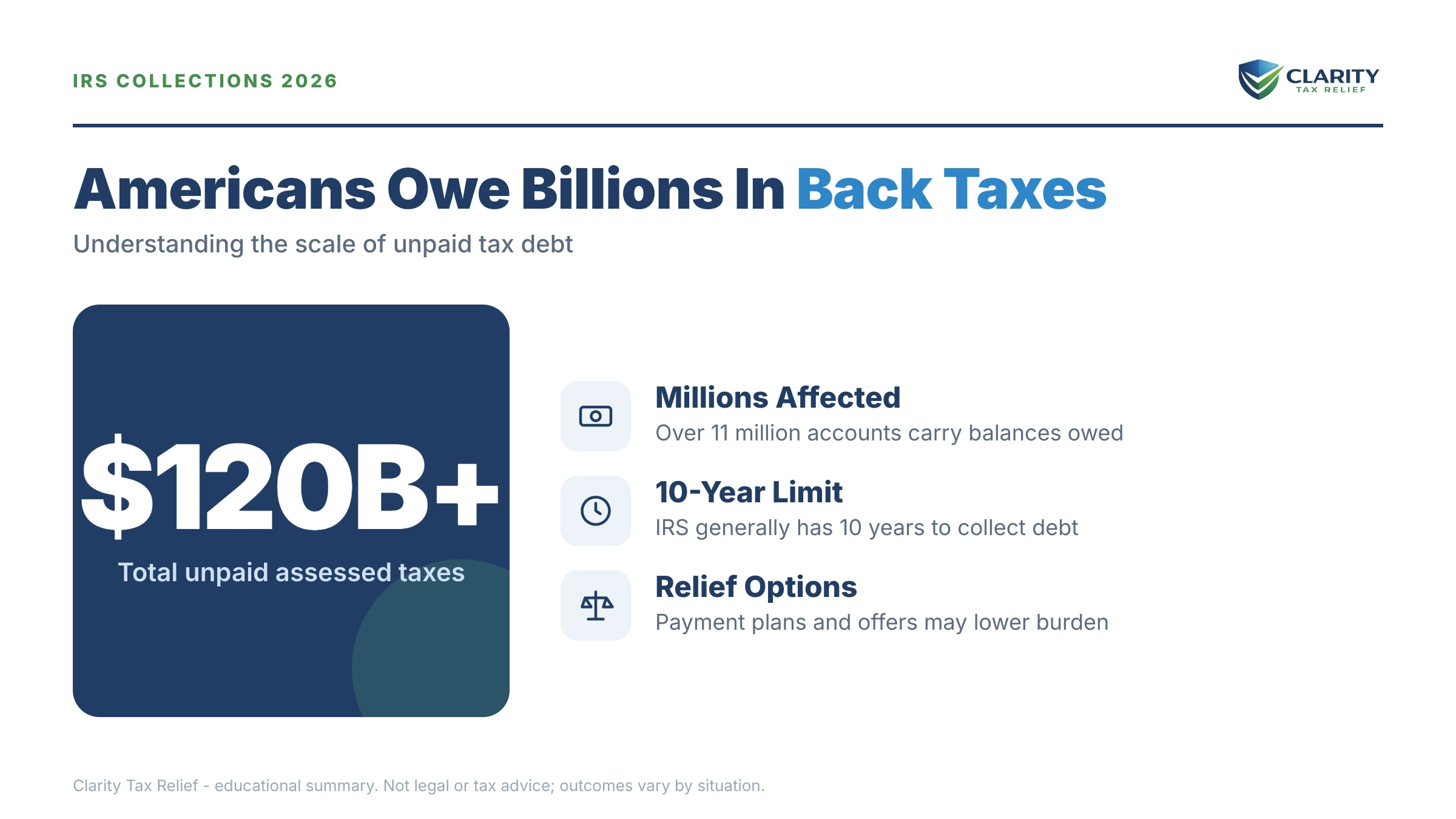
The image below shows exactly how these numbers stack up against each other — it's the fastest way to orient yourself before the detail.
One scope note so you read the right page: this article covers the debt-side numbers — how much is owed, who owes it, and what the IRS does about it. For the revenue-side data (what the IRS brings in and through which channels), see our IRS tax collections statistics page; for enforcement-action counts specifically, see IRS levy statistics.
Why so many Americans owe back taxes
Most back tax debt starts with income that has no withholding — not with fraud. Self-employment, gig work, contractor pay, early retirement withdrawals, and gambling or investment windfalls all arrive without tax taken out, and the bill lands months later, after the money is spent.
Two mechanical facts then turn a missed bill into a statistic:
- The penalty math punishes non-filers hardest. The failure-to-file penalty is 5% per month — 10 times the 0.5% monthly failure-to-pay penalty (in months where both apply, the failure-to-file portion drops to 4.5%, for 5% combined). A large share of the tax gap is people who didn't file because they couldn't pay, which multiplied what they owed. Filing on time, even broke, is the single cheapest move in tax debt.
- Information reporting catches up eventually. The IRS matches W-2s, 1099s, and third-party reports against returns by computer. The 1099-K threshold reverted to $20,000 / 200 transactions for platforms — but balances assessed under the older, broader reporting years don't vanish with the rule change.
Interest compounds daily on top of the penalties, so a balance left alone doesn't sit still — it grows every month the account stays open, regardless of whether anyone at the IRS is looking at it.
How back tax debt turns into a levy: the sequence the statistics hide
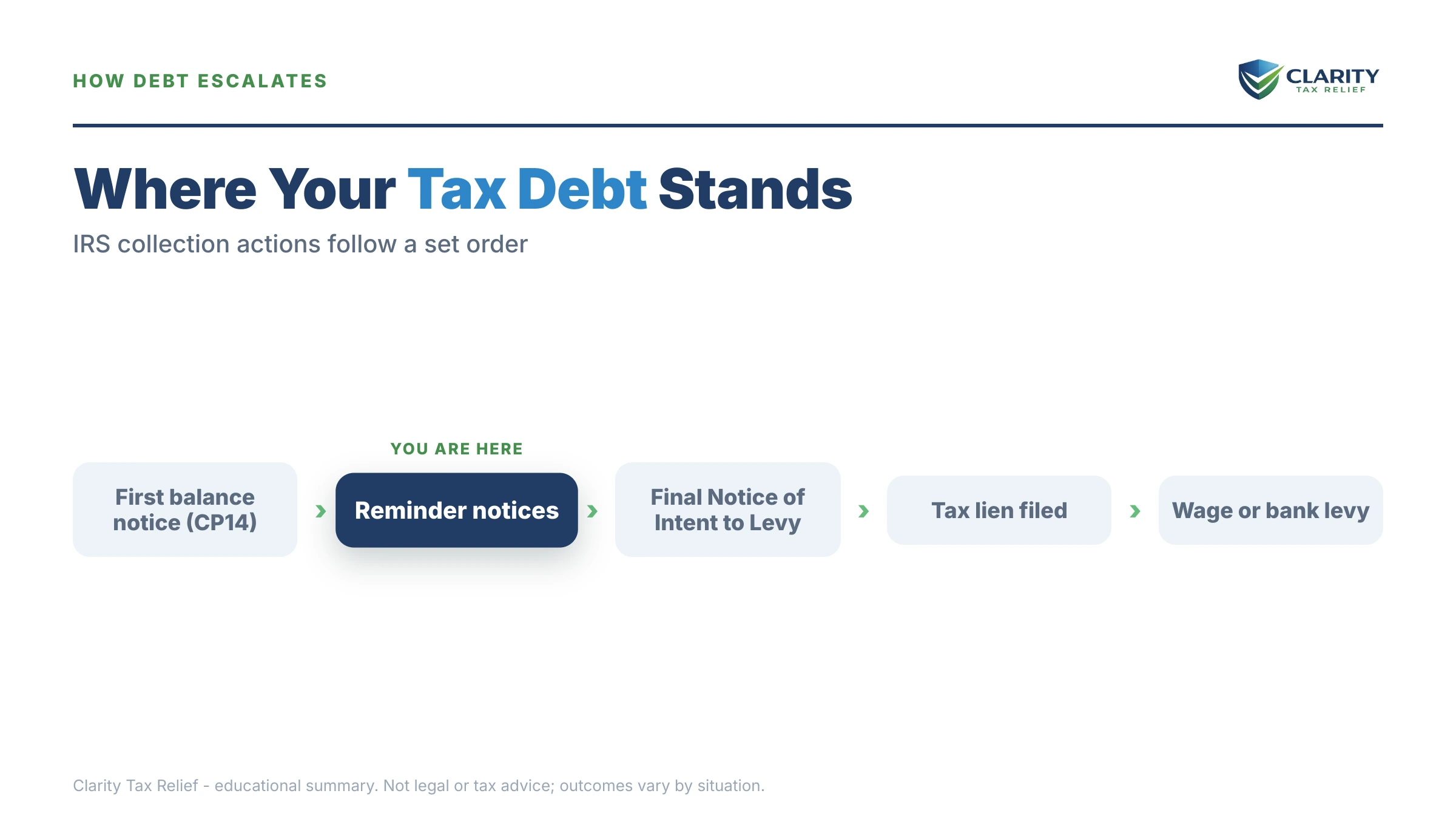
Every unresolved balance moves through the same automated notice sequence, and enforcement power increases at each stage. Aggregate statistics flatten this into one number; your account experiences it as a series of letters, each more serious than the last:
- CP14 — the first bill. Typically about 21 days to pay before the reminders queue up. No enforcement yet; the cheapest moment to act.
- CP501 / CP503 — automated reminders. Still just bills, but the balance grows monthly while they cycle.
- CP504 — intent to levy your state tax refund under IRC §6331(d). Serious, but not the final notice.
- LT11 / Letter 1058 — the final notice of intent to levy. This starts a 30-day clock and your Collection Due Process rights (requested with Form 12153). After 30 days, wage and bank levies are legally on the table.
- Levy — a bank levy freezes funds with a 21-day hold before the money leaves; a wage levy is continuous, hitting every paycheck until released; Social Security can be levied at up to 15% through the Federal Payment Levy Program.
If you rent, one nuance matters: a federal tax lien attaches to property you don't have much of, so levies on wages and bank accounts are the enforcement tools renters actually face — which is exactly why final notices deserve a same-week response, not a someday response. You can estimate how much of a paycheck a wage levy would reach with our IRS wage garnishment calculator, and see the release paths in how to stop an IRS wage garnishment.
Here is what each stage sets in motion — and the right you lose if its window closes:
| Notice / event | The clock | What's at stake |
|---|---|---|
| CP14 (first bill) | ~21 days from the notice date | The cheapest fix — resolve here and no enforcement ever starts |
| CP504 (intent to levy) | Date printed on the notice | State tax refund can be seized; lien filing becomes realistic |
| LT11 / Letter 1058 | 30 days | Collection Due Process hearing rights (Form 12153) — miss it and levies proceed without that appeal |
| Bank levy issued | 21-day hold on frozen funds | Your last window to get the levy released before the money transfers |
| Debt crosses $66,000 (2026) | Ongoing while "seriously delinquent" | Passport certification via CP508C — renewal or issuance can be denied |
| Assessment date + 10 years (CSED) | 10 years, pausable by appeals, offers, bankruptcy | Collection legally ends — but tolling events extend the date |
Facing a levy notice right now?
The statistics stop mattering the day an LT11 lands — then it's your 30-day window. Send us the notice and an experienced tax professional will map where you are in the sequence and which options are still open. Free, confidential, no pressure.
Your options if you're one of the statistics
Every IRS resolution program is means-tested, and your balance determines which doors are open. The full walkthrough of each program lives in our guide to how to settle tax debt yourself — here's the 2026 eligibility map at a glance:
| Option | Who may qualify (2026) | Cost & catch |
|---|---|---|
| Short-term payment plan | Can pay in full within 180 days | $0 setup; interest and penalties keep accruing until paid |
| Guaranteed installment agreement | Owe $10,000 or less, returns filed, compliant | Approval is by statute; setup fee applies, accruals continue |
| Streamlined installment agreement | ≤ $25,000 (or ≤ $50,000 with direct debit); up to 72 months, set up online | No financial disclosure required; balance still grows with interest until paid off |
| Non-streamlined agreement | Over $50,000 | Form 433-F financial disclosure; payment set by ability to pay, not preference |
| Offer in Compromise (Form 656) | Assets + future income genuinely can't cover the debt | $205 fee + 20% down on lump-sum offers (both waived if AGI ≤ 250% of poverty); ~1 in 5 accepted in FY2024 |
| Currently Not Collectible | Paying anything would leave you unable to cover basic living expenses | Collection pauses, debt remains and grows; IRS reviews your income periodically |
| Penalty relief (FTA / AEP) | Clean compliance in the prior 3 years | Removes penalties, not tax; the new Automatic Exemption from Penalty starts applying some relief automatically from summer 2026 |
Two edge cases worth flagging. If you're a business owner behind on payroll taxes, none of the individual thresholds above apply the same way — trust-fund debt follows harsher rules, and partnerships have their own liability quirks covered in our guide to partnership owes irs situations. And if you owe a state as well as the IRS, don't assume the IRS goes first: see state tax debt vs irs for how to sequence the two, since states like California collect for 20 years, not 10.
What $68,500 in back taxes actually looks like: a worked example
Say you owe $68,500, you rent, and a levy warning just arrived. That one number trips three separate thresholds at once — here's the math:
- Passport exposure. $68,500 is above the $66,000 certification threshold for 2026. If the debt is "seriously delinquent," a CP508C can follow and passport renewal can be denied. Getting into an approved installment agreement generally lifts you out of certification territory — details in passport revoked for tax debt.
- Payment plan math. $68,500 is over the $50,000 online-plan ceiling. Path A: pay the balance down by $18,501 to reach $50,000, then set up a streamlined plan online — $50,000 ÷ 72 months ≈ $695/month, plus the interest and 0.5% monthly penalty that keep accruing. Path B: keep the full $68,500 and file Form 433-F financials for a non-streamlined agreement — $68,500 ÷ 72 ≈ $952/month as a rough ceiling, though the IRS sets the actual figure from your ability to pay. Our guide to an irs payment plan over 50000 walks through that disclosure.
- The offer question. As a renter you may have less "reasonable collection potential" than a homeowner with equity. Suppose your only asset is a car with $3,000 of equity and, after IRS allowable expenses, you have $200/month left over. A lump-sum offer is roughly assets plus 12 months of that surplus: $3,000 + ($200 × 12) = $5,400. The IRS compares $5,400 against $68,500 — a gap that wide is what makes some low-asset renters genuine offer candidates. But it's math the IRS verifies line by line, and it accepted only about 1 in 5 offers in FY2024, so run the numbers honestly before paying anyone to file one.
This is a hypothetical, not a promise — swap in your own asset and expense figures and the answer changes completely. That's the point: at this balance level, which program fits is a calculation, not a preference.
How to respond if you owe back taxes, step by step
- Pull your real balance. Log into your IRS online account and get the exact balance, tax years, and penalty breakdown — never work from memory or an old notice.
- Locate your newest notice. Find the most recent letter (CP14, CP504, LT11) — its form number tells you how far down the escalation sequence you are and which clock is running.
- File any missing returns. The IRS won't approve a payment plan or offer while required returns are unfiled, and the failure-to-file penalty is 10 times the failure-to-pay penalty (in months where both apply, the failure-to-file portion drops to 4.5%, for 5% combined).
- Match your balance to an option tier. Under $10,000, under $25,000, under $50,000, and over $50,000 each unlock different programs — use the thresholds table to pick your lane.
- Set up the resolution before any levy clock expires. An approved arrangement stops enforcement; if you're holding an LT11, file Form 12153 within 30 days to preserve your Collection Due Process rights.
- Get a professional review for levies or balances over $50,000. If a levy is in motion, you have multiple unfiled years, or you owe above the streamlined threshold, have an experienced tax professional map the sequence before you commit to anything.
When you can handle this yourself
Most people below the $50,000 line can resolve back taxes without paying anyone. If your returns are filed, you agree with the balance, and a streamlined plan fits your budget, the IRS's own payment plan portal handles it in one sitting — and there are free options for lower incomes, catalogued in our guide to free help with IRS tax debt, including Low Income Taxpayer Clinics and the Taxpayer Advocate Service.
Experienced help changes outcomes in a narrower set of situations: a levy already in motion (release requests are time-critical and evidence-driven), multiple unfiled years (the order you file affects the total), business or payroll debt (personal liability rules apply), and offer-in-compromise math above trivial balances (a badly built offer wastes the fee, months of time — and pauses your CSED while it's reviewed). One 2026-specific reality tilts this further: with the workforce down about 27%, do-it-yourselfers wait longest for a human. What that means for case handling is covered in irs budget cuts 2026.
Terms behind the statistics, decoded
- Tax gap: the difference between all federal tax legally owed in a year and what's actually paid on time — the headline "back tax debt" number.
- CSED: the collection statute expiration date — the day, 10 years after assessment, when the IRS's legal right to collect a debt ends, unless tolling events extended it.
- Lien vs. levy: a lien is a legal claim against your property; a levy is the actual seizure of wages, bank funds, or assets.
- CDP rights: Collection Due Process — your right, after a final notice, to a hearing (via Form 12153) before levies proceed.
- RCP: reasonable collection potential — the IRS's math (assets plus future income) that decides whether an Offer in Compromise gets accepted.
- FPLP: the Federal Payment Levy Program — the automated system that levies federal payments, including up to 15% of Social Security benefits.
Underlying data on returns, collections, and enforcement is published by the IRS itself at IRS.gov/statistics, and payment options at IRS.gov/payments.
IRS back tax debt statistics: questions people ask
How many Americans owe back taxes to the IRS?
The IRS doesn't publish one clean headline count, but its collection inventory covers millions of individual and business accounts at any given time. What the agency does publish is the tax gap: its most recent projections put unpaid federal tax at roughly $700 billion per year. If you owe, you are not an outlier — the system processes balance-due accounts by the millions, which is exactly why enforcement is automated rather than personal.
Does the IRS really collect on old back tax debt, or does it eventually give up?
The IRS generally has 10 years from the date a tax is assessed to collect it — the collection statute expiration date, or CSED — and it does not quietly give up before then. The catch is tolling: an offer in compromise under review, a bankruptcy, or a Collection Due Process appeal pauses that clock, so a debt from 2017 can still be live in 2026. Automated levies can fire at any point while the statute is open.
What percentage of offers in compromise does the IRS accept?
Roughly 1 in 5 — the IRS accepted about 20% of offers in fiscal year 2024. Acceptance is math, not mercy: the IRS compares your offer against your reasonable collection potential (assets plus future income). The application costs $205 with a 20% down payment on lump-sum offers, but both are waived with low-income certification (AGI at or below 250% of the federal poverty level), which also pauses payments during review.
Is the IRS still collecting back taxes after the 2025 budget cuts?
Yes — the IRS workforce shrank roughly 27% in 2025, but collection notices, liens, and levies are generated by automated systems that never stopped running. The practical effect is lopsided: it's harder to reach a human to fix a problem, while the machine keeps escalating on schedule. That's why deadlines on notices matter more now, not less — waiting for a phone agent doesn't pause the sequence.
At what amount of tax debt does the IRS take your passport?
The 2026 threshold is $66,000 in seriously delinquent tax debt, an inflation-adjusted figure. Once you cross it and a lien or levy has been issued, the IRS can certify your debt to the State Department (you'd receive a CP508C notice), which can deny a passport renewal or new application. Debts in an active installment agreement, a pending offer in compromise, or a timely CDP appeal are generally excluded from certification.
Can the IRS levy me if I rent and don't own anything?
Yes — renters get levied through income and accounts instead of property. A wage levy is continuous, taking a portion of every paycheck until it's released, while a bank levy freezes the money in your account with a 21-day hold before the funds go to the IRS. Social Security benefits can be levied at up to 15% through the Federal Payment Levy Program. Owning nothing does not put you out of reach; it changes which tool the IRS uses.
Are state back taxes included in IRS statistics?
No — every state runs its own collection system with its own numbers, statutes, and programs, entirely separate from IRS figures. Some states are tougher than the IRS: California's Franchise Tax Board has a 20-year collection statute under R&TC §19255, double the IRS's 10 years, and New York files tax warrants that act as public civil judgments. If you owe both, the order you resolve them in can change what you pay overall.
Your Next 24 Hours
- Find your place in the sequence. Pull out the most recent IRS letter you've received and note two things: the form number in the corner (CP14, CP504, LT11) and the date printed on it. That pair tells you exactly which clock — if any — is running.
- Gather three documents. Your last filed tax return, every IRS notice you still have, and a rough picture of monthly income and rent. That's everything needed to run the option math above for your real numbers.
- Get the free case review. If a levy notice is in the mix, the 30-day CDP window on a final notice is the one deadline that can't be recovered — and even without one, interest and the monthly penalty are compounding while you wait. Call (888) 825-7779 or use the 2-minute form and an experienced tax professional will map your fastest path out of the statistics.
This guide is general information, not tax or legal advice for your specific situation. Eligibility for IRS programs depends on individual facts and circumstances; no outcome is guaranteed.