
IRS Data & Enforcement
IRS Levy Statistics: How Many Levies the IRS Really Issues (2026)
The short answer: IRS levy statistics show levies served on third parties peaked at roughly 3.7 million in fiscal year 2011, fell for a decade as enforcement budgets shrank, and are climbing again as post-pandemic collections resume. Nearly all levies are computer-generated — which is why the 2025 workforce cut of roughly 27% hasn't slowed them.
You're probably not researching IRS levy statistics for a school project. You're behind — maybe on payments, maybe on filing itself — and you want to know whether the IRS actually follows through, or whether a shrunken agency is too busy to come after someone like you. The honest answer from the data: the humans are stretched thin, but the levies are issued by machines, and the machines are fine.
This page gives you the real numbers, what they say about who gets levied and how, and — more usefully — exactly how to make sure you never become one of them.
⏱ The deadline that matters isn't in the data — it's in your mailbox. You have 30 days from the date on an LT11 or Letter 1058 to request a Collection Due Process hearing before the IRS can levy. If your latest notice is a CP504, the IRS can take your state tax refund after 30 days. Check your notice date now.
IRS levy statistics: the headline numbers for 2026
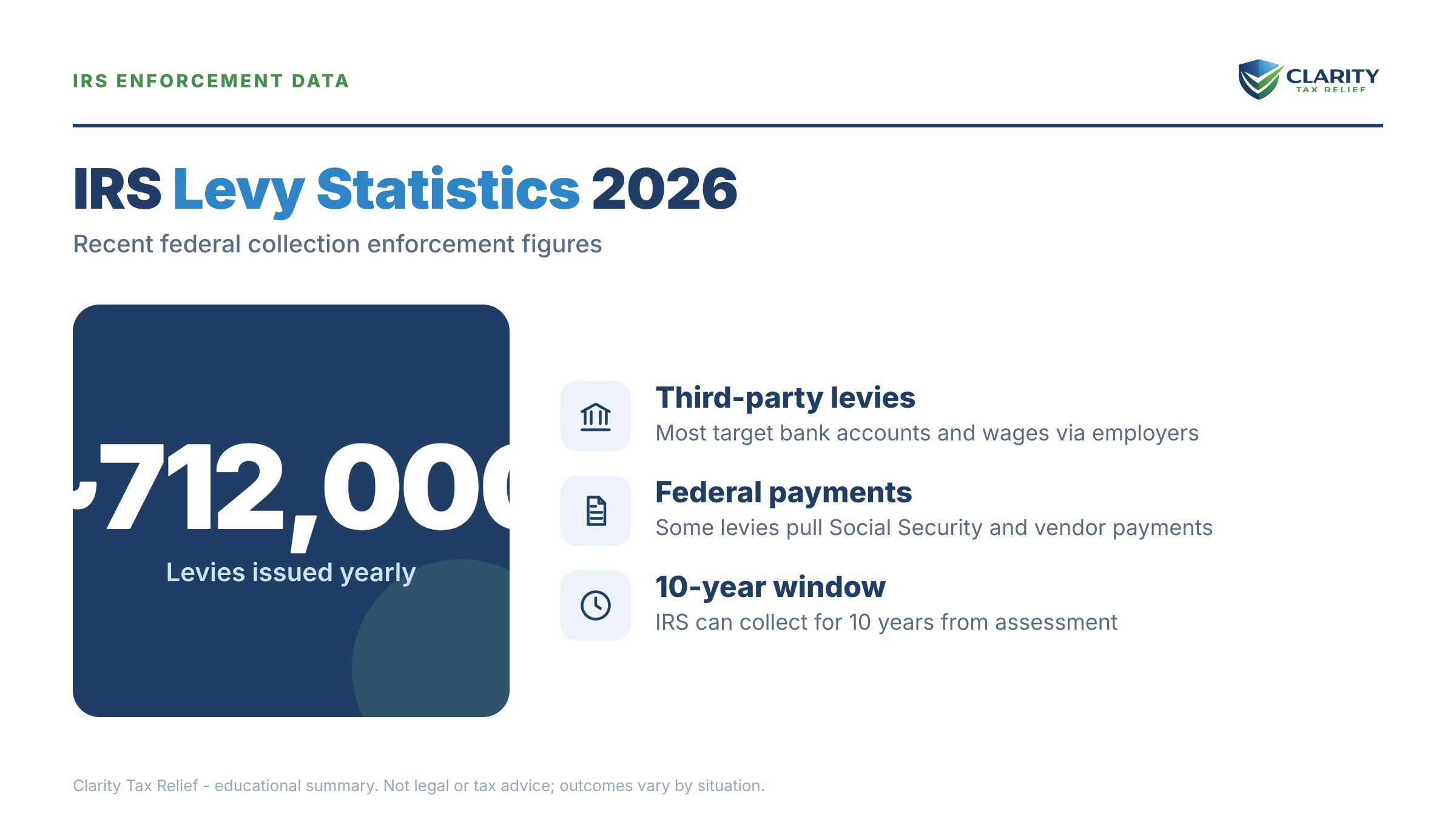
IRS levy volume peaked at roughly 3.7 million levies in fiscal year 2011, according to the IRS Data Book, and after a decade of decline it is rising again as automated collections resume. The broad arc looks like this:
- The 2011 peak: roughly 3.7 million notices of levy served on third parties — banks, employers, and other payers — in a single year.
- The decade of decline: as enforcement budgets and collection staff shrank through the 2010s, annual levy counts fell to a fraction of the peak.
- The pandemic pause: the IRS largely suspended automated collection notices in 2020–2021, driving levy counts to historic lows.
- The restart: automated collection notices resumed, and the levy pipeline refilled — every unresolved balance re-entered the notice sequence that ends in a levy.
- 2025–2026: the IRS workforce was cut roughly 27% in 2025, yet levies continue, because most are generated without a human touching the file.
One reading note that trips people up: the Data Book counts levies served, not taxpayers levied. A single taxpayer with two bank accounts, an employer, and a few 1099 clients can generate five or more levies in one enforcement action. The taxpayer counts are lower than the levy counts — but for the person on the receiving end, that distinction is cold comfort.
Physical property seizures — cars, equipment, real estate — are a different, far smaller category tracked separately in the Data Book, numbering only a few hundred per year nationwide. If that's your worry, our IRS seizure statistics breakdown covers it; this page focuses on the levies that actually happen at scale: bank, wage, and federal-payment levies.
Why levy counts keep rising while the IRS shrinks
Most IRS levies are issued by automated systems that were never part of the 2025 layoffs. Two programs do the heavy lifting:
- The Automated Collection System (ACS) — the computer-driven side of IRS collections. It mails the notice sequence, and when the final notice window closes without a response, it issues bank and wage levies from a queue. No revenue officer reviews your hardship first.
- The Federal Payment Levy Program (FPLP) — a continuous computer match between tax debts and federal payments. It can take up to 15% of Social Security benefits and portions of federal salaries, contractor payments, and retirement payments, automatically, every month.
Here's the 2026 twist the raw statistics hide: the workforce cut made levies harder to stop, not harder to issue. Releasing a levy usually requires reaching a human — on a phone line that now has far fewer people answering. The machine escalates on schedule; the off-switch has a hold time. That asymmetry is the single most practical takeaway on this page, and it's the reason acting before the final notice matters more now than at any point in the last decade.
The levy types behind the numbers
Bank, wage, and federal-payment levies account for nearly all IRS levy activity — and each works differently enough that knowing which one you're facing changes your entire response.
| Levy type | One-time or continuous | What it reaches |
|---|---|---|
| Bank levy | One-time (21-day hold) | Funds in the account on the day the levy is served — not later deposits |
| Wage levy | Continuous until released | Everything above a small exempt floor, every payday |
| FPLP levy | Continuous until released | Up to 15% of Social Security and other federal payments |
| State refund levy | One-time | Your state income tax refund (the authority a CP504 announces) |
| 1099 / receivables levy | One-time per payer | Amounts a client or gig platform owes you the day it's served |
Two of these deserve special attention. The bank levy comes with a built-in clock — the 21-day rule means your bank freezes the money but holds it for 21 days before sending it to the Treasury, which is your window to get it released. The wage levy has no clock at all: it repeats every payday, leaving you only an exempt amount based on filing status and dependents, until you resolve the debt or get it released — the full playbook is in our guide to how to stop IRS wage garnishment, and you can estimate what a wage levy would leave you each check with our IRS Wage Garnishment Calculator.
If you're self-employed, the picture shifts again: the IRS can serve a one-time levy on accounts receivable — including gig-platform payouts — and can reach variable pay through a levy on commission income. One-time doesn't mean once ever; the IRS can re-serve the same payer repeatedly.
What the data says about ignoring IRS notices
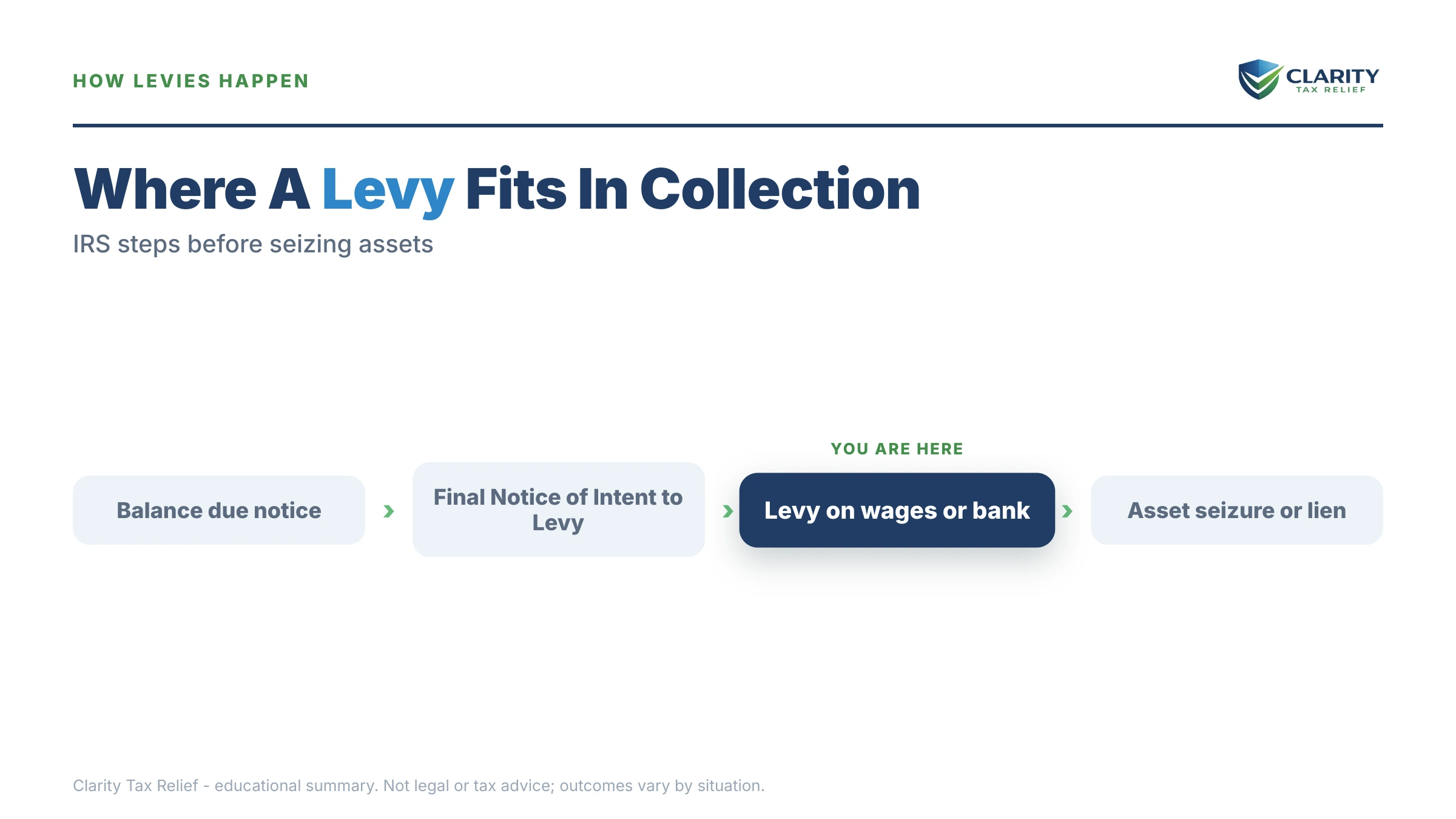
Nearly every levy in the statistics was preceded by the same fixed sequence of notices — the levy counts are, in effect, a tally of people who let that sequence run to the end. The stages, in order:
- CP14 — the first bill. Roughly 21 days to pay before the reminder cycle starts. No enforcement power yet.
- CP501 / CP503 — automated reminders, typically arriving about five weeks apart, each with more interest attached.
- CP504 — Notice of Intent to Levy under IRC §6331(d). After 30 days the IRS can take your state tax refund. Serious, but not yet the final notice.
- LT11 / Letter 1058 — the Final Notice of Intent to Levy. This starts a 30-day clock and your Collection Due Process rights. When the 30 days pass unanswered, ACS can levy banks, wages, and payers.
- Levy issued — you become one of the statistics: a frozen bank account, a garnished paycheck, or a 15% FPLP deduction that runs until resolved.
Each stage takes a right or an option off the table, which is why the most important "statistic" for you personally is which notice sits at the top of your pile:
| Notice or event | Your window | What passes with it |
|---|---|---|
| CP14 (first bill) | ~21 days | The cheapest moment to resolve; escalation queue starts |
| CP504 (intent to levy) | 30 days | Your state tax refund becomes fair game |
| LT11 / Letter 1058 (final notice) | 30 days | Your Collection Due Process hearing right — the strongest appeal you get |
| Bank levy served | 21-day hold | The frozen funds are sent to the Treasury |
| Wage or FPLP levy active | Until released | Money leaves every payday or federal payment until you act |
Worried the levy data is about to include you?
If a CP504 or LT11 is in your mail — or you have unfiled years and haven't seen a notice in a while — get your account reviewed free before the automated system moves to the next stage. An experienced tax professional will pull your notice history and map exactly where you stand.
What the statistics mean for your options
Every levy-prevention option works better before the final notice than after — and each has a known cost and timeline you can compare:
| Option | Upfront cost | Timeline & key limits |
|---|---|---|
| Short-term payment plan | $0 setup fee | Pay in full within 180 days; interest and penalties continue, but levies stop being issued |
| Long-term installment agreement | Setup fee (reduced or waived for low income) | Up to 72 months online for balances ≤ $50,000; above that, financial disclosure required |
| Currently Not Collectible | $0 | Requires documented hardship; collection pauses while the debt and interest remain |
| Offer in Compromise | $205 fee + 20% down on lump-sum offers (both waived with low-income certification) | Months to decide; the IRS accepted roughly 1 in 5 offers in FY2024 — eligibility is strictly means-tested |
| CDP hearing (Form 12153) | $0 | Must be filed within 30 days of the LT11; levies are generally on hold while it's pending |
| Bankruptcy's automatic stay | Court filing costs | Stops levies immediately but carries major consequences — see whether bankruptcy stops an IRS levy in your situation |
A worked example: $92,700, three years unfiled, gig income
Say you're a gig worker who hasn't filed for three years, and the IRS — working from your 1099s — filed substitute returns and now shows you owe $92,700. Here's what the numbers on this page mean for you specifically:
- Levy exposure: you're a prime candidate for the automated pipeline — one-time levies on your gig-platform payouts and clients, plus a bank levy with its 21-day hold. There's no employer paycheck to garnish, so the IRS goes after your payers and your account instead.
- Passport exposure: $92,700 is above the $66,000 certification threshold for 2026, meaning the IRS can certify your debt to the State Department, which can deny or revoke your passport.
- Payment math as-is: $92,700 ÷ 72 months ≈ $1,288 a month before the interest that keeps accruing — and because the balance is over $50,000, you can't set that up online; you'd need to submit financials on Form 433-F.
- The filing lever: substitute returns give you zero business deductions — no mileage, no supplies, no platform fees. Say your legitimate expenses, once you actually file those three years, cut the assessed balance to $48,500. Now you're below the $50,000 online-plan line and below the $66,000 passport threshold, and 72 months looks like roughly $674 a month instead of $1,288. Same taxpayer, same history — completely different case.
That's why, for non-filers, the first move is never negotiating the number the IRS invented — it's replacing it. Our guide for people who haven't filed taxes in 3 years walks through the catch-up sequence.
How to respond if the IRS is about to levy, step by step
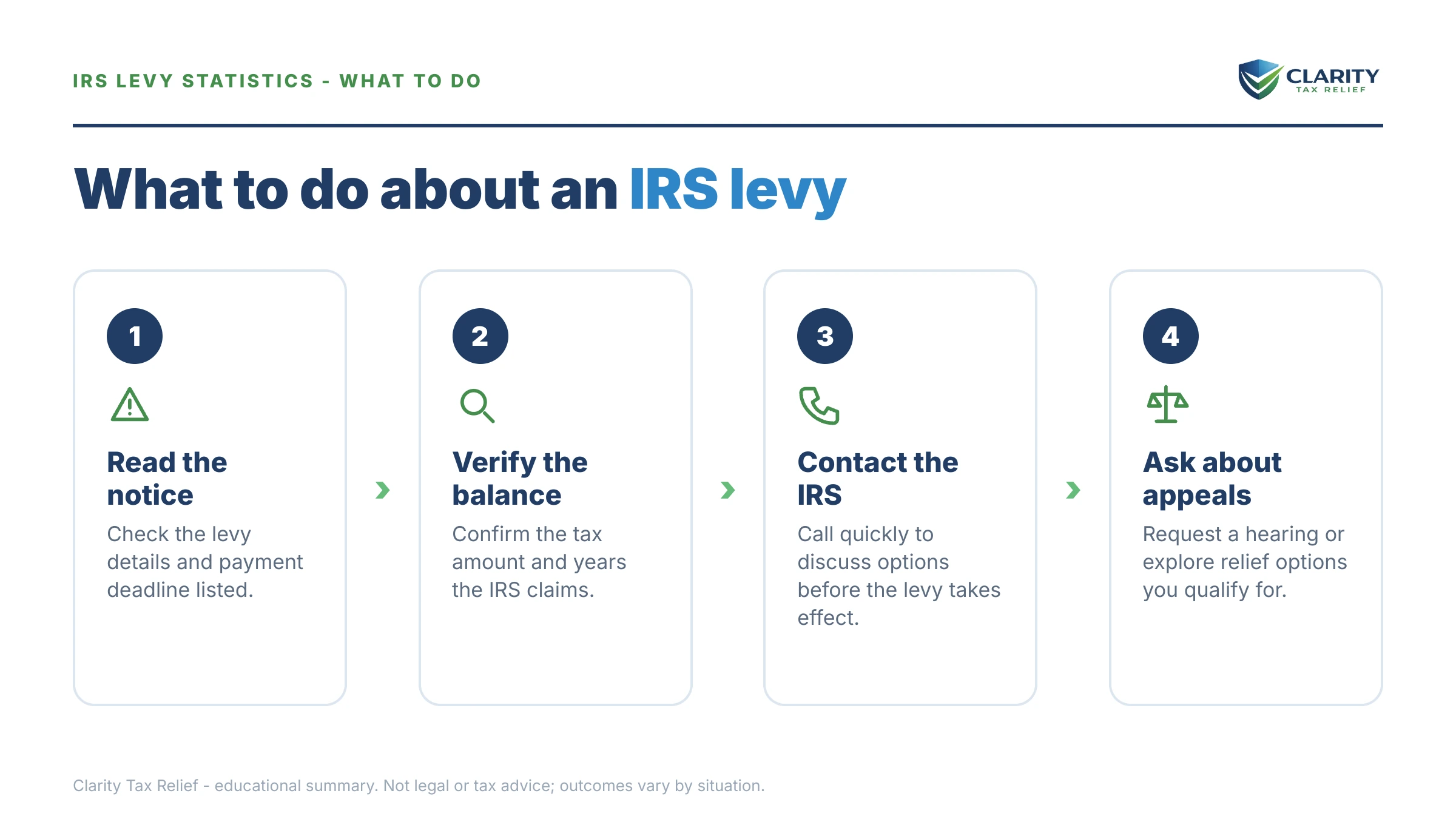
- Pull your IRS records. Get your account transcripts and notice history from your IRS online account so you know every year with a balance and every notice already issued.
- Locate your latest notice. Check the code in the top corner — a CP504 or LT11/Letter 1058 means the levy clock has started; earlier notices mean you have more room.
- File any unfiled returns. The IRS generally won't approve a payment plan, hardship status, or offer while required returns are missing — and filing can shrink a substitute-for-return balance.
- Protect your appeal rights. If you're within 30 days of an LT11 or Letter 1058, file Form 12153 to request a Collection Due Process hearing, which generally holds levies while it's pending.
- Lock in a resolution. Set up the payment plan, hardship status, or offer that fits your finances — once an agreement is in place, new levies stop being issued.
When you can handle this yourself
Not everyone reading levy data needs professional help. You can almost certainly handle it yourself if you owe under $10,000 on a single filed year and can pay within 180 days, or if your latest notice is an early one (CP14 through CP503) and you agree with the balance — a streamlined online payment plan takes about 20 minutes to set up and immediately removes you from the levy pipeline.
Experienced help tends to change outcomes in four situations: a levy is already in motion (the 21-day bank window and IRS phone hold times don't mix well with trial and error), multiple years are unfiled and the balance is built on substitute returns, the debt involves a business or payroll taxes, or you're weighing an Offer in Compromise, where the financial math determines everything and one in five is the acceptance reality, not the marketing. Honest rule of thumb: the smaller and simpler your case, the less you need us.
Terms in the levy data, decoded
- Levy vs. lien: a levy takes your property; a lien is a legal claim against it. The statistics on this page count takings, not claims.
- ACS: the Automated Collection System — the computer-driven arm of IRS collections that issues most levies without human review.
- FPLP: the Federal Payment Levy Program, the automated match that takes up to 15% of Social Security and other federal payments.
- CDP: Collection Due Process — your right, triggered by the LT11/Letter 1058, to a hearing before levy, requested on Form 12153 within 30 days.
- CSED: the Collection Statute Expiration Date — the IRS generally has 10 years from assessment to collect, though appeals, offers, and bankruptcy pause the clock.
- Continuous vs. one-time levy: wage and FPLP levies repeat automatically until released; bank and 1099 levies grab only what exists the day they're served (but can be re-served).
IRS levy statistics: your questions, answered
How many levies does the IRS issue each year?
It varies enormously by year. IRS Data Book figures show levies served on third parties peaked at roughly 3.7 million in fiscal year 2011, then fell for a decade as enforcement budgets shrank, hitting historic lows during the 2020–2021 pandemic pause. Collections have since resumed, and because most levies are computer-generated, volume is climbing again. One taxpayer can account for many levies — each bank or employer served counts separately.
Does the IRS still issue levies after the 2025 workforce cuts?
Yes. The IRS cut roughly 27% of its workforce in 2025, but levies are generated primarily by automated systems — the Automated Collection System and the Federal Payment Levy Program — that kept running. Fewer humans means it is harder to reach someone to stop a levy, not less likely that one issues. That combination makes acting before the final notice more important, not less.
What percentage of IRS levies are automated?
The IRS doesn't publish a precise split, but the overwhelming majority of levies come from automated programs rather than individual revenue officers. The Federal Payment Levy Program alone matches tax debts against federal payments — including up to 15% of Social Security benefits — by computer. Revenue officers generally handle larger or more complex cases, such as business and payroll debts.
How much of my paycheck can an IRS wage levy take?
More than most people expect. A wage levy is continuous and takes everything above a small exempt amount based on your filing status and dependents — the levy doesn't take a percentage; it leaves you a floor. It stays in place every payday until the debt is paid or the levy is released through a payment plan, hardship status, or other resolution.
How long do I have after a bank levy before the money is gone?
21 days. When the IRS levies a bank account, the bank freezes the funds on hand that day and holds them for 21 days before sending them to the Treasury. That window exists so you can prove an error or hardship, or negotiate a release. Money deposited after the levy date isn't taken — a bank levy is a one-time snapshot, though the IRS can levy again.
Can the IRS levy Social Security benefits?
Yes — up to 15% of your monthly benefit through the Federal Payment Levy Program, and the deduction continues automatically until the debt is resolved or the levy is released. If losing 15% creates genuine hardship — you can't cover basic living expenses — you can request a hardship release, but you have to affirmatively ask; the computer won't notice on its own.
Does an IRS levy mean the IRS will seize my house or car?
Almost never. Physical asset seizures number only a few hundred per year nationwide — a rounding error next to bank, wage, and federal-payment levies — and seizing a primary residence requires court approval. The realistic risks are your bank account, your paycheck or 1099 income, your state refund, and federal payments, not a padlock on your front door.
What is the fastest way to get an IRS levy released?
Getting into a resolution the IRS accepts — usually a payment plan, hardship (currently-not-collectible) status, or a filed Collection Due Process appeal. A levy causing immediate economic hardship must be released under IRC §6343 once you document it. Speed depends on compliance: the IRS generally won't release a levy while required returns are unfiled, so filing those first often unlocks everything else.
Your next 24 hours
- Find your most recent IRS notice and check the code in the top corner. CP504 or LT11 means a real 30-day window is running from the printed date; anything earlier means you still have room to act cheaply.
- Gather three things: your last filed return, your 1099s or other income records for any unfiled years, and every IRS letter you've received — that's everything needed to map your position in the collection sequence.
- Get a free case review — use the 2-minute form or call (888) 825-7779. The automated systems that generate the levy statistics above keep running while you wait, and interest and penalties accrue every month a balance sits unresolved.
For the primary sources behind the numbers on this page, see the IRS Data Book (the agency's official annual enforcement statistics), the IRS's own overview of payment plans and installment agreements, and the Taxpayer Advocate Service, which reports independently on IRS collection practices.
This guide is general information, not tax or legal advice for your specific situation. Eligibility for IRS programs depends on individual facts and circumstances; no outcome is guaranteed.