
IRS Levies
IRS Levy on Commission Income: How Far It Reaches and How to Stop It (2026)
The short answer: an IRS levy on commission income works two different ways. If your commissions come on a W-2, the levy is continuous — it takes every check above a small exempt amount until released. If you're paid on a 1099, the levy usually captures only what your payer owes you on the day it arrives.
Your brokerage manager just forwarded you a scan: the IRS served a levy, and the commissions you already closed — money you were counting on this month — are being held for the government. You earn on production, not a salary, so a frozen pipeline hits harder than any garnished paycheck would. Here's the good news: which form the IRS used, and how you're paid, decide exactly how much is exposed — and there is a defined path to getting the levy released.
Two details on the levy paperwork your payer received decide everything: the form number and the levy date. The image below shows exactly what this levy paperwork looks like and where to look for both.
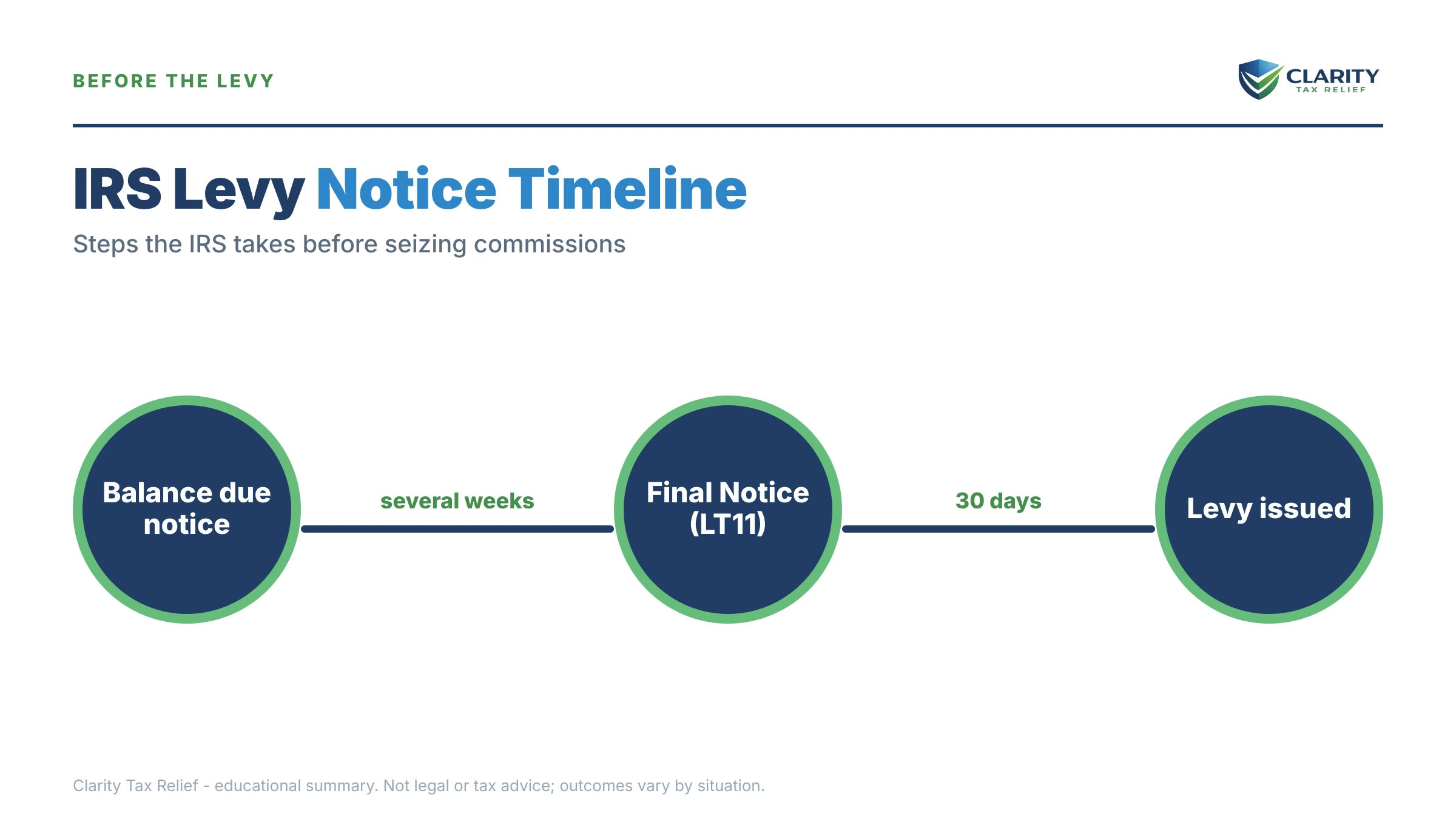
⏱ Your deadline: the IRS cannot levy your commissions until 30 days after it sends a final notice of intent to levy (LT11 or Letter 1058). If that letter arrived within the last 30 days, a Collection Due Process request on Form 12153 blocks the levy while your case is heard. If the levy has already been served, the clock is your payer's remittance date — a release must reach them before your money does.
Why the IRS is levying your commission income
A levy on commissions means an assessed tax balance went through the full notice sequence without a resolution being put in place. The IRS didn't pick your commissions specially — it found your payers automatically, from the W-2s and 1099-NEC forms filed under your Social Security number, and served levy paperwork on the companies that report paying you.
That's what makes commission earners uniquely exposed. Every company that filed a 1099 on you last year is a known levy target — the IRS can serve levies on your brokerage, your carriers, and your biggest client in the same week, all from your own wage and income transcript. It also means your payers now know about the debt: a levy is served on them, not you, and they're legally required to comply.
The other trigger worth checking: unfiled returns. If the IRS filed a substitute return for a year you skipped, the balance being levied may be far higher than what you'd actually owe on a correct return — and fixing the return can shrink the debt itself, not just the levy.
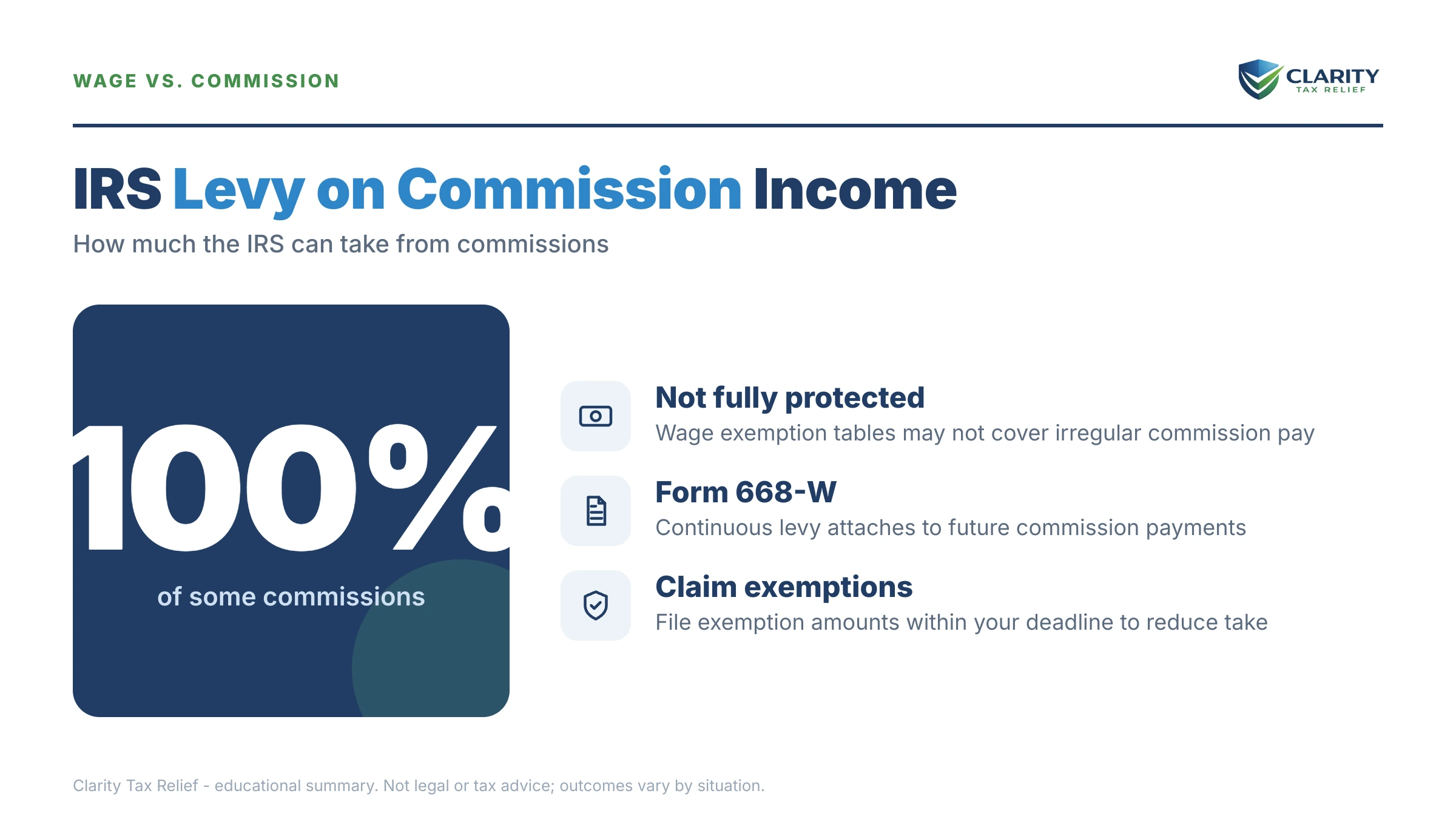
W-2 vs. 1099: how far an IRS commission levy reaches
How you're paid determines which levy form the IRS uses — and the two forms behave completely differently. Commissions paid through payroll as W-2 wages are levied with Form 668-W, a continuous levy that attaches to every future paycheck until it's released. Commissions paid on a 1099 are levied with Form 668-A, a one-time grab of whatever the payer owes you on the levy date.
The W-2 version is brutal on variable pay. A wage levy exempts only a small amount per paycheck — set by the tables in IRS Publication 1494 based on your filing status and dependents — and everything above the exempt amount goes to the IRS. On a salary that's painful; on a commission structure it's devastating, because a $14,000 closing month is levied exactly like a $3,000 slow month: same small exemption, everything else taken. You can estimate your exposure with our IRS Wage Garnishment Calculator to see roughly what a continuous levy would leave you per check.
The 1099 version has no exempt amount at all — the levy takes 100% of what's owed to you — but it only reaches obligations that exist on the levy date. Commissions on deals you haven't closed yet aren't captured; the IRS would have to serve a fresh levy to reach them. The mechanics are covered in depth in can IRS garnish 1099 income and IRS levy independent contractor.
There's one costly exception. If you already hold a contractual right to future payments — insurance renewal commissions, trail commissions, residuals on policies you've written — those streams are "fixed and determinable," and a single levy on the carrier can attach to the entire future renewal stream, not just this month's check. That's why a commission levy hits insurance agents and advisors harder than most contractors; if renewals are your situation, see insurance agent back taxes. Real estate agents fare differently: a commission isn't fixed and determinable until the deal closes, so a levy on your broker generally reaches only closed, unpaid commissions — the same logic behind an IRS levy on accounts receivable.
| How your commissions are paid | Levy form | What the levy reaches |
|---|---|---|
| W-2 wages (payroll commission, draw + commission) | Form 668-W (continuous) | Every future check above a small Publication 1494 exempt amount, until released |
| 1099 commissions (per-deal, per-sale) | Form 668-A (one-time) | 100% of what the payer owes you on the levy date; future deals need a new levy |
| Renewal / trail / residual commissions under an existing contract | Form 668-A (one levy, ongoing effect) | The entire future stream you've already earned the right to — "fixed and determinable" |
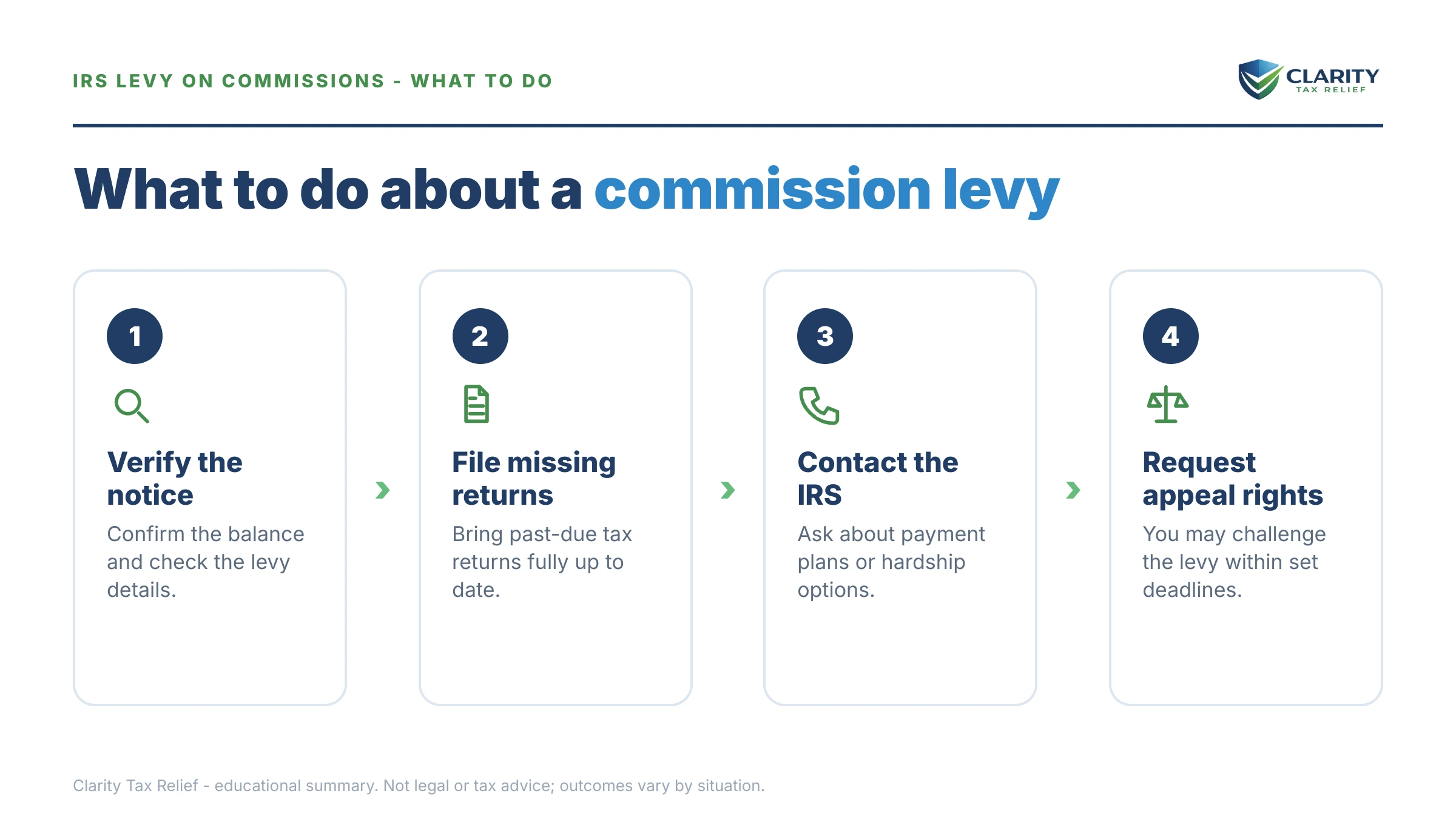
What happens if you ignore a commission levy
A levy is not the end of the collection sequence — it's the beginning of the enforcement phase, and it repeats. Here's the order things escalate in when nothing gets resolved:
- The notices you already got — a balance-due bill, reminders, then a CP504 (which let the IRS take your state tax refund), then the LT11 notice or Letter 1058 that opened the 30-day levy window.
- The first levy — served on the payer the IRS considers most productive. With a 668-A, whatever you're owed that day is remitted and applied to the balance.
- Re-levies and new targets — each new 1099 filing hands the IRS a fresh list. Levies repeat on the same payer as new commissions accrue and spread to other payers. A release doesn't immunize you either — see IRS levied me again.
- Bank levy — once commissions land in your account, the account itself is a target. A frozen account holds funds for 21 days before they're sent; the IRS bank levy 21-day rule is your last release window there.
- Lien and passport exposure — a federal tax lien can attach to everything you own, and if accruals push the debt to $66,000 or more in 2026, passport certification enters the picture.
One 2026 reality check: the IRS workforce shrank roughly 27% in 2025, so reaching a human is harder than ever — but levies are generated by automated systems that never stopped running. Waiting doesn't buy quiet; it buys the next levy.
Commissions frozen by an IRS levy right now?
Every day matters before your payer remits — and if your LT11 is under 30 days old, your appeal rights are still alive. An experienced tax professional will review your levy paperwork free and map the fastest release path for your situation.
Your options to stop a levy on commission income
The IRS releases a levy when the account is resolved — not when you explain how badly you need the money (with one hardship exception below). Which resolution fits depends mostly on the size of the balance and what your income can support. The full playbook for garnishments and levies generally lives in our guide to how to stop IRS wage garnishment; here's how the options map to commission earners by balance:
| Balance owed | Realistic options | What it takes |
|---|---|---|
| Under $10,000 | Guaranteed installment agreement; short-term full pay (up to 180 days, $0 setup) | All returns filed; agree to pay within the statutory window |
| $10,000 – $25,000 | Streamlined installment agreement, set up online, up to 72 months | No financial disclosure; stay current on estimated taxes |
| $25,000 – $50,000 | Streamlined installment agreement (direct debit typically required in this band); CNC or OIC if income can't support payments | Direct-debit enrollment; hardship or offer requires financial documentation |
| Over $50,000 | Non-streamlined agreement, partial-pay agreement, OIC, or CNC | Full financials (Form 433 series); asset and income review |
Two options deserve special mention for commission earners:
Hardship release. If the levy leaves you unable to cover basic living expenses, the IRS is required to release it on economic-hardship grounds — even with no payment plan in place yet. That's a documentation fight, covered in levy causing hardship, and it's often the fastest lever when a renewal stream has been captured.
Offer in Compromise. Real, but means-tested: the IRS accepted roughly 1 in 5 offers in FY2024, and it accepts only when your assets and future income genuinely can't cover the debt before the 10-year collection statute runs. Irregular commission income actually complicates the math in both directions — a strong pipeline can sink an offer, a collapsed one can support it.
Say you owe $31,200: the math, worked out
Say you're a 1099 contractor who owes $31,200 across two tax years, and your brokerage is holding $8,700 in closed, unpaid commissions the day a Form 668-A arrives. This is hypothetical, but the arithmetic is real:
- If the levy stands: all $8,700 is remitted — there's no exempt amount on a 1099 levy — leaving roughly $22,500 owed, plus interest and the 0.5%-per-month failure-to-pay penalty still accruing. And nothing stops the next levy when your next deal pays out.
- If you set up a plan instead: at $31,200 you're under the $50,000 online-agreement ceiling. Spread over the maximum 72 months, that's about $434/month ($31,200 ÷ 72 ≈ $433.33) before accruals — and once an installment agreement is approved, the failure-to-pay penalty rate drops to 0.25% per month and the levy is normally released.
- If your income can't support $434: that's the signal to run the CNC or Offer in Compromise analysis with full financials rather than defaulting a plan you can't keep.
The difference between those first two paths is timing. The plan set up the week the LT11 arrived would have kept the $8,700 in your pocket; the same plan set up after remittance just stops the bleeding going forward.
How to respond to an IRS levy on commission income, step by step
- Identify the form. Ask your payer whether it received Form 668-A (one-time) or Form 668-W (continuous) and note the levy date — that decides whether next month's commissions are exposed.
- Pull your IRS records. Log into your IRS online account to confirm the balance, the tax years, and whether any returns are unfiled — unfiled years block most resolution options.
- Check your 30-day appeal clock. If the LT11 or Letter 1058 arrived within the last 30 days, file Form 12153 for a Collection Due Process hearing — a timely request stops the levy while your case is heard.
- Set up a resolution. Choose the fix your finances support — a payment plan, Currently Not Collectible hardship status, or an Offer in Compromise — because a levy is released by resolving the account, not by arguing about it.
- Request the release in writing. Call the number on the levy notice, ask the IRS to fax Form 668-D (Release of Levy) directly to your payer, and confirm with the payer that it arrived before funds are remitted.
Step 3 is the one people miss. A timely CDP request doesn't just pause things — it preserves your right to take a disagreement to Tax Court, and it's the strongest procedural footing you'll ever have. The full walkthrough is in our Form 12153 CDP hearing guide.
| Trigger | Your window | What you lose if it passes |
|---|---|---|
| CP504 (intent to levy state refund) | The date printed on the notice | Your state tax refund can be seized; the account moves toward final notice |
| LT11 / Letter 1058 (final notice) | 30 days from the notice date | Collection Due Process rights — the appeal that blocks the levy and preserves Tax Court review |
| Form 668-A served on your payer | Until the payer remits (no fixed day count for non-bank payers) | 100% of the commissions owed to you on the levy date |
| Bank levy on deposited commissions | 21-day hold before funds leave | The frozen account balance, applied to your tax debt |
When you can handle this yourself
Not every commission levy needs professional help — and you should know which kind yours is. If you owe under $25,000, all your returns are filed, and the levy hasn't captured a large payment yet, you can likely set up a streamlined installment agreement online yourself and then call the levy unit to request the release. That's a phone-and-patience problem, not an expertise problem.
Experienced help changes outcomes in specific situations: a renewal or residual stream captured by a fixed-and-determinable levy (unwinding that is technical), multiple payers levied at once, unfiled years inflating the balance through substitute returns, a hardship release the IRS is resisting, or Offer in Compromise math on irregular income. In those cases, the order you fix things — returns first, then the resolution, then the release — determines how much of your money you keep.
Terms on your levy paperwork, decoded
- Form 668-A: the one-time levy served on a third party, capturing what it owes you on the levy date.
- Form 668-W: the continuous levy on wages and salary — it attaches to every paycheck until formally released.
- Fixed and determinable: a payment right that already exists even though it pays later (like earned renewal commissions) — one levy can attach to the whole stream.
- CDP hearing: the Collection Due Process appeal (Form 12153) available for 30 days after a final notice; a timely request stops levy action while it's pending.
- Form 668-D: the levy release the IRS sends your payer — the document that actually frees your money.
- CSED: the Collection Statute Expiration Date — generally 10 years from assessment, though appeals, offers, and bankruptcy pause the clock.
Commission levy questions, answered
Can the IRS levy my commission income?
Yes. Commissions are income the IRS can levy, whether they come on a W-2 or a 1099. Before it can levy, the IRS must send a final notice of intent to levy (LT11 or Letter 1058) and wait 30 days. After that, it serves the levy directly on whoever pays you — your employer, brokerage, or carrier — not on you.
Is an IRS levy on commissions one-time or continuous?
It depends on how you're paid. Commissions paid as W-2 wages fall under a continuous levy (Form 668-W) that attaches to every paycheck until released. Commissions paid on a 1099 are usually hit with a one-time levy (Form 668-A) that captures only what the payer owes you on the levy date — but the IRS can serve a new levy each time you earn more.
How much of my commission can the IRS take?
On W-2 commissions, everything above a small exempt amount — set by IRS Publication 1494 tables based on your filing status and dependents — goes to the IRS, so a big commission month is taken almost entirely. On 1099 commissions there is no exempt amount at all: the levy takes 100% of what the payer owes you when it arrives.
Can the IRS take my insurance renewal commissions with one levy?
Yes, in most cases. Renewal commissions you've already earned the right to under an existing contract are treated as "fixed and determinable," so a single levy on your carrier can attach to the entire future renewal stream — not just the payment due this month. This is the exception that makes commission levies far more dangerous for insurance agents and financial advisors than for most 1099 workers.
Will my brokerage or clients find out about my tax debt?
Yes — a levy is served on your payer, so the company that owes you commissions receives the paperwork and is legally required to comply. The IRS finds your payers from the 1099s and W-2s filed under your Social Security number, and it can levy several payers in the same week. Resolving the balance before the levy is served is the only way to keep it private.
How fast can a commission levy be released?
A release can happen the same day the IRS agrees to one — it faxes Form 668-D to your payer. The catch is timing: with a one-time 668-A levy, the payer may remit your money before you get through, and once funds are sent they're applied to your balance. Getting a payment plan or hardship determination in place quickly is what triggers the release.
Can the IRS levy my commissions while I'm on a payment plan?
Generally no. While an installment agreement is pending or in effect, the IRS does not issue new levies, and an existing levy is normally released once the agreement is approved. The exception is default: miss payments or fail to file a new return, and the agreement can terminate — putting levies back on the table.
Your next 24 hours
- Find the form number and levy date on the paperwork your payer received — 668-A or 668-W, and when it was served. That tells you whether future commissions are exposed and how much time is left before remittance.
- Gather three things: your last filed return, every IRS notice you've received (especially the LT11 or Letter 1058, to check the 30-day date), and a list of every company currently holding commissions owed to you.
- Get a free levy review — send us what you found through the 2-minute form or call (888) 825-7779. If your final notice is under 30 days old, your appeal rights are still on the table; if the levy is already served, the race is to get Form 668-D to your payer before your money goes out.
For the IRS's own rules on paying a balance or setting up an agreement, see IRS.gov/payments and the IRS payment plans page. If a levy is causing hardship and you can't get traction with the IRS directly, the Taxpayer Advocate Service is an independent avenue within the agency.
This guide is general information, not tax or legal advice for your specific situation. Eligibility for IRS programs depends on individual facts and circumstances; no outcome is guaranteed.