
Self-Employed & Business Tax Debt
Insurance Agent Back Taxes: 1099 Commissions, Chargebacks, and Your Way Out (2026)
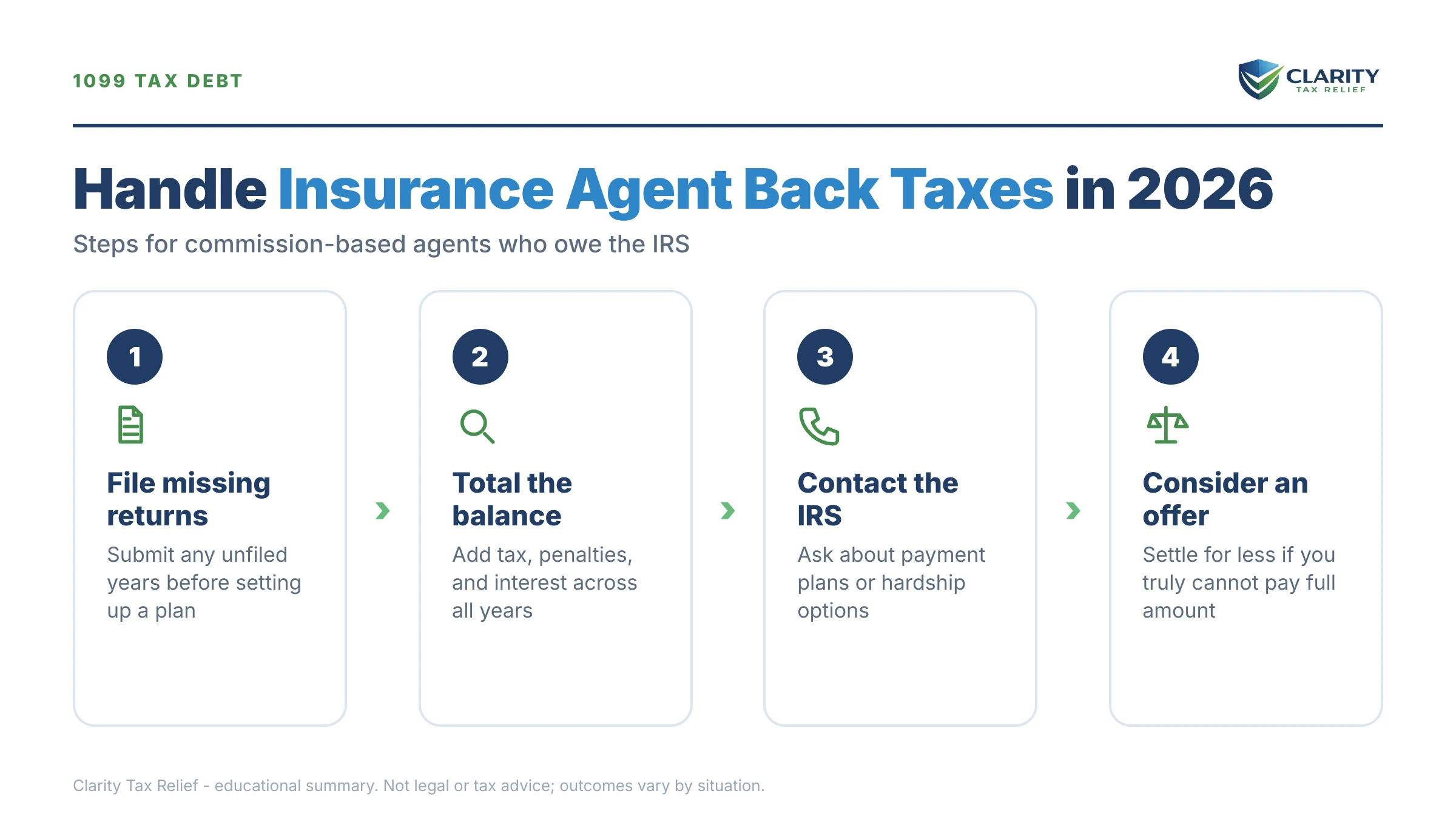
The short answer: insurance agent back taxes usually come from 1099 commission income with no withholding — plus the 15.3% self-employment tax nobody budgeted for. The fix follows a fixed order: file every missing return (usually the last six years), deduct your chargebacks, then resolve the balance through a payment plan, hardship status, or an Offer in Compromise.
You had your best production year ever, then the 1099-NECs landed from three carriers, the chargebacks hit in January, and the tax return spit out a number your checking account can't cover. Now IRS letters are showing up at the agency. This is one of the most fixable tax problems there is — but the order you fix it in decides what you ultimately pay. Here's the whole map.
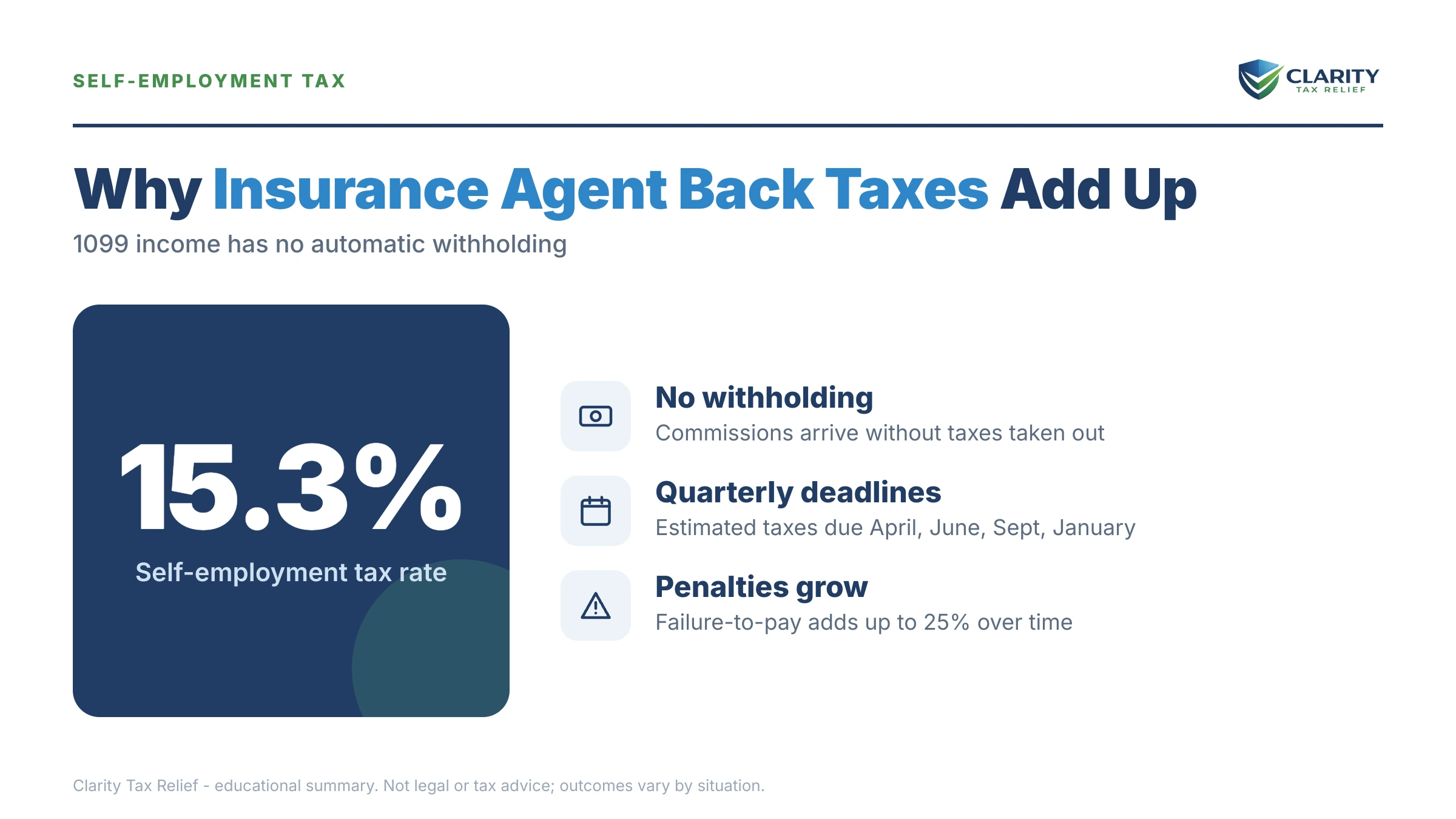
⏱ The clock that's actually running: there's no single printed deadline on back taxes — but the failure-to-file penalty accrues at 5% per month, ten times the 0.5% failure-to-pay rate (though in months where both penalties apply, the failure-to-file portion drops to 4.5%, for 5% combined). Filing stops the 5%-per-month failure-to-file penalty from growing (it maxes out at 25% of the unpaid tax after five months, and amounts already accrued stay on the books), leaving only the 0.5% monthly late-payment penalty and interest going forward. Interest compounds daily on whatever remains.
Why insurance agents end up owing back taxes
Commission income is the only pay structure where you can owe tax on money you later have to give back. Every carrier that pays you files a Form 1099-NEC with zero withholding — so the entire income tax bill, plus 15.3% self-employment tax on your net, lands on you in four quarterly payments most first-year agents never hear about. (The mechanics are covered in our guide to how quarterly estimated taxes work.)
Then the industry adds two twists no other 1099 field has. Advanced commissions mean you're taxed on money the carrier fronted you before the client ever paid a full year of premiums. And chargebacks mean that when policies lapse, you repay income you already paid tax on — while your 1099 for the big year sits in the IRS's computer unchanged.
Layer in contest bonuses, override income if you run a downline, and payroll if you've hired a CSR or producer, and it's easy to see how an agent who never intended to skip a tax bill ends up two or three years behind. Here's where the debt typically comes from:
| Income or event | How it's reported | The trap |
|---|---|---|
| New-business commissions | 1099-NEC, no withholding | Income tax + 15.3% SE tax due quarterly; nothing was set aside |
| Advanced commissions | Generally taxed when paid to you | You owe tax now on money you may repay later |
| Chargebacks (lapsed policies) | Deduction only if YOU claim it | You already paid tax on income you had to return |
| Renewal commissions | 1099-NEC | Levy-exposed as a "fixed and determinable" income stream |
| Contest / bonus income | 1099-NEC or 1099-MISC | Forgotten at filing → CP2000 underreporter notice |
| Agency staff payroll | Form 941 | Trust-fund portion is a personal liability for the owner |
One eligibility note before anything else: if you're a full-time life insurance salesperson working primarily for one company, you may be a statutory employee — the carrier withholds FICA, and you owe no SE tax. If your pay comes on a W-2 with box 13 checked, part of your "SE tax debt" may not exist. If it comes on a 1099-NEC, assume it does.
Chargebacks: the tax problem nobody warns new agents about
A chargeback is taxable income going backward — and the IRS doesn't fix it for you. Say you wrote $40,000 in advanced life commissions in year one, paid (or owed) tax on all of it, and then $9,000 charged back when policies lapsed in year two. Your year-one 1099 still says $40,000. Unless you claim that $9,000 yourself, you're carrying tax debt on income you never got to keep.
There are two legitimate ways to claim it. The default: deduct the repayment on Schedule C in the year the chargeback hits. The alternative, when a single year's repayments exceed $3,000: the claim-of-right rules under IRC §1341 may let you recompute the original year's tax as if the income had never been received — sometimes worth more if you've since dropped into a lower bracket.
Two cautions. First, check your commission statements against the 1099 — some carriers net chargebacks before reporting, and deducting an already-netted chargeback creates a new mismatch. Second, if you already filed a return that ignored chargebacks (or missed mileage, E&O premiums, lead costs, and licensing fees), you may be able to amend the return to reduce the tax debt before you negotiate payment on it. Shrinking the balance always comes before arranging to pay it.
What happens if you ignore insurance agent back taxes
IRS collection runs on an automated sequence, and commission income sits unusually exposed at the end of it. The 2025 workforce cuts made humans harder to reach — but the notice stream and levy systems are automated and never paused. Here's the order things happen in:
- The balance posts (or an SFR is filed). If you filed but didn't pay, the debt is assessed. If you never filed, the IRS can eventually file a substitute return using your gross 1099 totals — no chargebacks, no expenses — and assess a balance far bigger than reality.
- CP14 — the first bill. Roughly 21 days to pay or arrange before the reminders start.
- CP501 / CP503 — automated reminders. Still just bills, arriving roughly five weeks apart while penalties and daily interest compound.
- CP504 notice — intent to levy your state refund. The IRS can now seize your state tax refund, and a federal tax lien — which attaches to your book of business as an asset — becomes likely.
- LT11 notice / Letter 1058 — final notice. A 30-day clock starts on your Collection Due Process rights (requested on Form 12153). After it runs, enforcement begins.
- Levy stage. Bank accounts (funds held 21 days before they leave), then levies served directly on your carriers and upline agency. Because the IRS treats renewal commissions on policies already written as "fixed and determinable," one levy can reach your renewal stream — the closest thing a 1099 agent has to a continuous wage garnishment. How that plays out is covered in our guide to an IRS levy on commission income.
Two more consequences stack on top. At $66,000 of seriously delinquent debt in 2026, the IRS can certify you to the State Department for passport denial — and penalties plus interest can push a mid-$50k balance past that line without you writing a single new check. And a levy notice landing on your carriers' desks is a professional embarrassment no agent wants circulating through their contracting hierarchy.
| Notice | What it means | Your window |
|---|---|---|
| CP14 | First bill after the balance posts | ~21 days from the notice date |
| CP501 / CP503 | Automated reminders; balance growing monthly | Roughly five weeks between notices |
| CP504 | IRS can seize your state refund; lien likely next | The pay-by date printed on the notice |
| LT11 / Letter 1058 | Final notice of intent to levy | 30 days to request a CDP hearing (Form 12153) |
| After LT11 | Bank levy (21-day hold), carrier levies, passport certification at $66,000 | Releases require action — nothing lifts on its own |
Behind on taxes from commission income?
Commission and renewal income is exactly what IRS carrier levies reach — and penalties plus daily interest are compounding toward the $66,000 passport line while you decide. Get your back-tax situation reviewed free by an experienced tax professional: which years to file, what the chargebacks are worth, and which resolution actually fits your numbers.
Your options for resolving insurance agent tax debt
The IRS has one program for every honest financial picture — the trick is matching yours to the right one. The general playbook for each program lives in our guide to how to settle tax debt yourself; here's how the options line up, with the thresholds that matter:
| Option | Who typically qualifies | Cost & catch |
|---|---|---|
| Short-term payment plan | Can pay in full within 180 days | $0 setup; interest and penalties keep accruing |
| Streamlined installment agreement | Balance ≤ $50,000; up to 72 months, set up online | Setup fee (lower with direct debit); no financial disclosure required |
| Non-streamlined installment agreement | Balance over $50,000 | Form 433-F financials required; payment set from your numbers; lien filing more likely |
| Currently Not Collectible (CNC) | Allowable living expenses meet or exceed income | Collection pauses; debt and interest remain; refunds are kept |
| Offer in Compromise (OIC) | Assets + future income genuinely can't cover the debt | $205 fee, 20% down on lump-sum offers (both waived if AGI ≤ 250% of poverty); ~1 in 5 accepted in FY2024 |
| Penalty abatement (FTA / AEP) | Clean compliance the prior 3 years; AEP becomes automatic starting summer 2026 | Removes penalties, not tax or interest |
The $50,000 line is the single most important threshold for most agents: below it, a payment plan is a same-day online setup; above it, the IRS wants your full financial picture, and a lien filing becomes more likely. Penalty relief runs in parallel with any of these — if your prior three years were clean, first-time penalty abatement can strip the failure-to-pay penalties, and starting summer 2026 the new Automatic Exemption from Penalty (AEP) applies qualifying relief without a request. You can preview what penalties and interest are adding to your own balance with our IRS penalty & interest calculator — it estimates, it doesn't promise.
Worked example: a $54,600 balance, shown with the math
Say you own a two-person P&C agency and owe $54,600 on your personal 1040s — two years of commission income where the SE tax and quarterlies never got paid. This is purely hypothetical, but the arithmetic is real:
- Path 1 — pay down to streamlined. At $54,600 you're over the $50,000 online-plan ceiling, so full financial disclosure would normally be required. Pay $4,700 toward the balance and you're at $49,900 — under the line. A 72-month streamlined plan runs $49,900 ÷ 72 ≈ $693/month, set up online, no Form 433-F, while interest continues on the shrinking balance. For an agent with a healthy renewal book, this is usually the fastest, least invasive route.
- Path 2 — negotiate at full balance. Keep the $54,600 and submit Form 433-F financials. The IRS sets the payment from your income minus allowable expenses — which can land lower than $693 if your numbers are tight, but invites scrutiny of the agency's books and makes a lien filing more likely.
- Path 3 — Offer in Compromise, if the math is truly there. Suppose your only equity is $8,000 in a vehicle and $2,500 in accounts, and after allowable expenses you can pay $350/month. A lump-sum offer is roughly assets plus 12 months of that ability: $10,500 + ($350 × 12 = $4,200) = about $14,700 — with a $205 fee and 20% down ($2,940) at filing. The IRS accepted roughly 1 in 5 offers in FY2024, and variable commission income gets averaged, so a rebound year can sink the math. Real, not easy.
Notice what changes the answer: $4,700 of liquidity flips you from "full financial disclosure" to "online plan tonight". That's why sequencing — amend, abate, pay down, then negotiate — matters more than which program you pick first.
If your agency owes payroll taxes too, that debt goes first
Payroll tax debt is the one balance the IRS pursues owners for personally — ahead of, and separately from, your 1040 debt. If you've hired a CSR, an account manager, or a junior producer on W-2 and fell behind on deposits, the withheld income tax and FICA from their paychecks is "trust fund" money. The IRS can assess that portion against you personally through the Trust Fund Recovery Penalty, and the assessment survives even if you close the agency.
The triage order for an agency owner is fixed: get current on this quarter's deposits first, then address the old 941 balances, then your personal 1040s. The IRS will not negotiate any business resolution while new payroll debt is still accruing — the full sequence is in our guide to 941 back taxes. And if you run the agency as a corporation, the entity's own income tax balance follows different rules again — see C corporation tax debt for how 1120 balances resolve.
How to respond to insurance agent back taxes, step by step
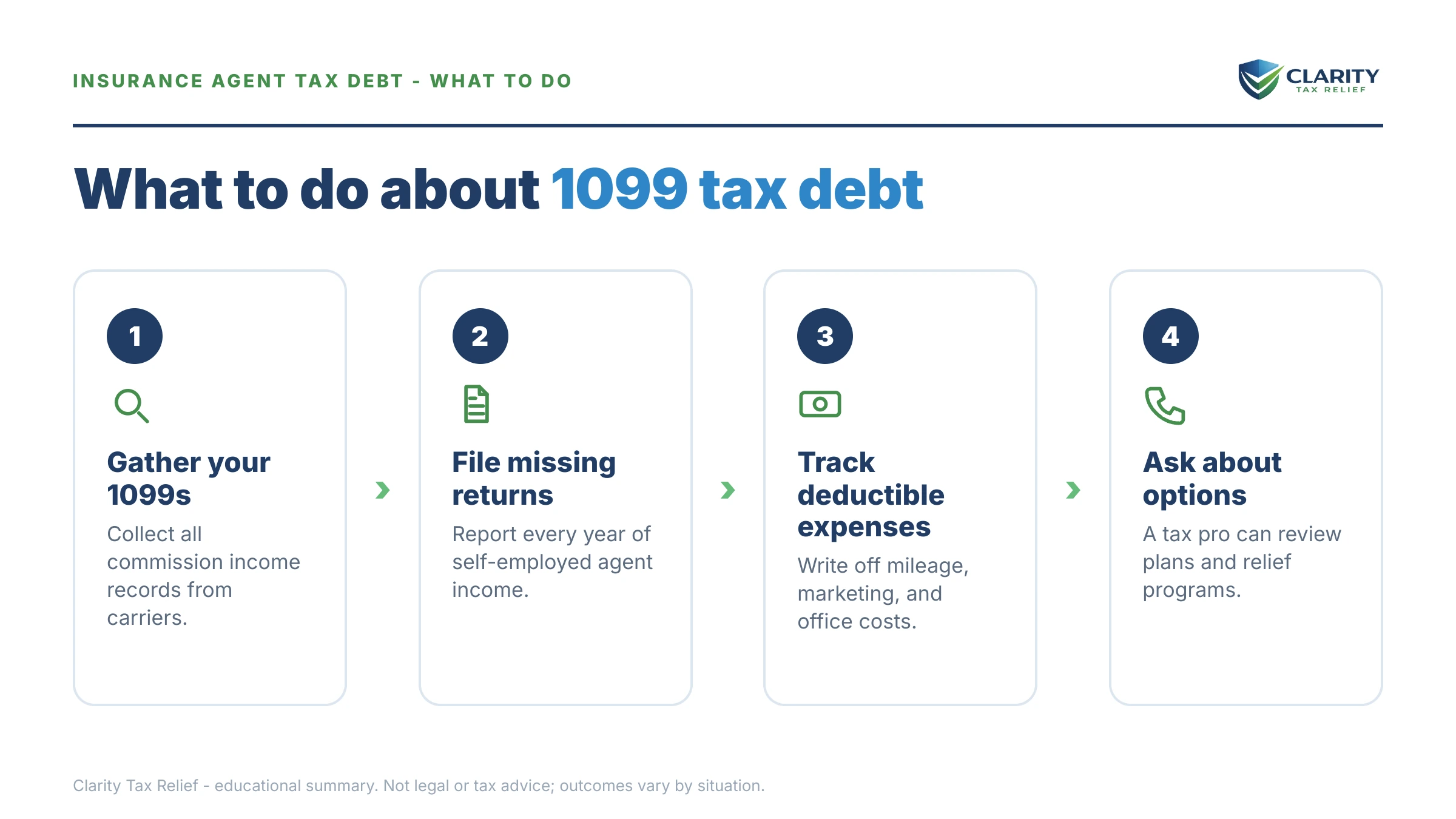
- Pull your IRS records. Log into your IRS online account and request wage and income transcripts to see exactly which 1099-NECs the carriers filed and what balance the IRS shows for each year.
- File every missing return. Prepare your last six years of unfiled returns with real Schedule C deductions — chargebacks, mileage, E&O premiums, lead costs, licensing fees — before negotiating anything.
- Triage payroll debt first. If your agency owes 941 payroll taxes, get current on deposits immediately and address that balance before your personal 1040 debt — it carries personal liability.
- Start current-year estimates. Begin quarterly estimated payments on this year's commissions now; the IRS won't approve any resolution while you keep falling behind.
- Choose and set up your resolution. Match your balance to the right program — payment plan, Currently Not Collectible, or an Offer in Compromise — and set it up before the next notice escalates.
- Request penalty relief. Ask about first-time abatement or reasonable cause once the returns are in; removing penalties can cut thousands off the total.
How many years do you actually have to catch up? For most people the answer is six — the details and exceptions are in how many years of back taxes do I have to file.
When you can handle this yourself — and when help changes the outcome
Plenty of agents can resolve this without paying anyone. If your returns are all filed, the balance is under $50,000, and there's no payroll debt, the streamlined online payment plan is a form, not a negotiation — set it up tonight at IRS.gov and you're done. Same if you can full-pay within 180 days: the short-term plan costs nothing to set up. A first CP14 you agree with needs a payment method, not a professional.
Experienced help earns its fee in specific situations: a levy already served (or about to be served) on your carriers, since a levy on renewal commissions can strangle income until it's released; multiple unfiled years where reconstructing chargebacks, advances, and expenses determines whether you owe $54,000 or $80,000; any 941/payroll balance, because the Trust Fund Recovery Penalty interview is not something to walk into unprepared; and Offer in Compromise math, where a miscounted asset or averaged income year sinks an otherwise viable offer. Balances over $50,000 — where the IRS reviews your full financials — are the gray zone: doable alone, but the presentation of your numbers directly sets your payment.
Terms on your notices, decoded
- Chargeback — a carrier clawing back commissions (usually advanced ones) after a policy lapses; deductible when repaid, but only if you claim it.
- 1099-NEC — the form carriers use to report your commissions to the IRS; the IRS matches it against your return automatically.
- Self-employment tax — the 15.3% Social Security and Medicare tax on net 1099 income, owed on top of income tax.
- Statutory employee — a special W-2 category (including many full-time life agents) where the carrier withholds FICA, so no SE tax applies.
- Trust Fund Recovery Penalty (TFRP) — the IRS's tool for assessing an agency's withheld payroll taxes against the owner personally.
- CSED — the collection statute expiration date; the IRS generally has 10 years from assessment to collect, though appeals, offers, and bankruptcy pause the clock.
If any of these terms is already on a letter in your hand — especially "intent to levy" or anything referencing your carriers — a free review with an experienced tax professional can map your specific options before the next notice arrives: (888) 825-7779 or the 2-minute form.
Insurance agent back taxes: your questions, answered
Do insurance agents pay self-employment tax on commissions?
Independent 1099 agents pay 15.3% self-employment tax on net commission income, on top of regular income tax. One important exception: a full-time life insurance salesperson working primarily for one company is often a "statutory employee" — the carrier withholds Social Security and Medicare, so no SE tax applies. Check box 13 on your W-2; if you got a 1099-NEC instead, you almost certainly owe SE tax.
Are commission chargebacks tax deductible?
Yes. If a policy lapses and the carrier claws back commissions you already reported as income, you generally deduct the repayment on Schedule C in the year it happens. If the repayment exceeds $3,000, the claim-of-right rules under IRC §1341 may let you recompute the earlier year's tax instead, which is sometimes worth more. Also check whether the carrier already netted the chargeback against your 1099 — deducting it twice creates a new problem.
Can the IRS levy my insurance commissions?
Yes. The IRS can serve a levy on the carriers and agencies that pay you, capturing commissions they owe you when the levy arrives. The IRS also takes the position that renewal commissions on policies you've already written are "fixed and determinable," which can let a single levy reach your renewal stream going forward. That makes commission income more exposed than typical one-time 1099 pay.
Will I lose my insurance license over back taxes?
The IRS does not revoke state insurance licenses — that power belongs to your state. Some states, however, can suspend professional licenses over unpaid state taxes, so a state balance can be more dangerous to your license than a federal one. Federally, the real professional risk is passport certification: at $66,000 or more in 2026, the IRS can certify your debt to the State Department.
What if I haven't filed returns for several years?
File before you negotiate anything — the IRS generally requires your last six years of returns before it will approve a payment plan or offer. If you don't file, the IRS can file a substitute return for you using the gross 1099 totals from your carriers, with zero deductions for chargebacks, mileage, or E&O premiums, producing a balance far higher than reality. Your own filed returns almost always shrink the number.
Can I settle insurance agent tax debt for less than I owe?
Sometimes — through an Offer in Compromise, which the IRS accepts only when your assets and future income genuinely can't cover the balance before the collection statute expires. The IRS accepted roughly 1 in 5 offers in FY2024, so it's real but far from automatic. Variable commission income actually complicates the math, because the IRS averages your earnings to project what it could collect.
I own an agency with employees — am I personally liable for its payroll taxes?
For the trust-fund portion — the income tax and FICA withheld from staff paychecks — yes, if you're a "responsible person" who willfully failed to pay it over. The IRS assesses that share against owners personally through the Trust Fund Recovery Penalty, and it survives even if the agency closes. Payroll debt should almost always be triaged ahead of your personal 1040 balance.
How much should I set aside from each commission check for taxes?
For most independent agents, 25–30% of net commissions covers income tax plus 15.3% self-employment tax, though your bracket and state may push that higher. Pay it quarterly: matching 100% of last year's total tax (110% if your AGI topped $150,000) generally protects you from the underpayment penalty even in a big year. Setting aside from every deposit — not at quarter-end — is what actually makes it stick.
Does the IRS know about my commission income?
Yes. Every carrier and agency that pays you files a Form 1099-NEC reporting your commissions directly to the IRS, and its computers match those totals against your return automatically. If you skip filing or underreport, the mismatch typically surfaces as a CP2000 notice or a substitute-for-return assessment — usually with penalties attached. Assume the IRS already has the gross numbers; your job is to file the deductions that shrink them.
Your next 24 hours
- Find your real numbers. Log into your IRS online account and note the balance and years shown — then pull the most recent IRS letter and check which notice in the sequence you've actually reached.
- Gather the paper. Your last filed return, every carrier 1099-NEC and commission statement (including chargeback detail), and — if you have staff — your 941 filings and deposit records.
- Get the free case review. An experienced tax professional will tell you which years to file, what your chargebacks and deductions are worth, and which resolution fits your balance — before penalties and daily interest push the number higher. Call (888) 825-7779 or use the 2-minute form.
Primary sources: the IRS's official payment plans and installment agreements page covers plan thresholds and setup, IRS.gov/payments handles direct payment, and the independent Taxpayer Advocate Service can intervene when collection is causing hardship.
This guide is general information, not tax or legal advice for your specific situation. Eligibility for IRS programs depends on individual facts and circumstances; no outcome is guaranteed.