
Self-Employed & Gig Tax Debt
Personal Trainer Taxes: What to Do When You Owe the IRS (2026)
The short answer: personal trainer taxes work like small-business taxes. Gyms pay you on Form 1099-NEC with zero withholding, so you owe income tax plus 15.3% self-employment tax on your net profit. If you already owe the IRS, you can resolve it through a payment plan, hardship status, or — in limited cases — a settlement.
You built a full client book — the 5 a.m. gym floor sessions, the lunchtime semi-privates, the Venmo clients you train at the park. Then the gym's 1099-NEC landed, you ran the numbers (or the IRS ran them for you), and the balance is bigger than anything a training package will cover. That's the trap built into how trainers get paid: nothing was ever withheld, so the tax bill arrives whole.
This is fixable, and it's fixable in a specific order: know what the IRS knows, file what's missing, cut the penalties, then pick the resolution your numbers support. This guide walks through each step with the real 2026 thresholds.
⏱ The real clock: there's no single notice deadline on self-employment tax debt itself — but the failure-to-pay penalty adds 0.5% of the balance every month, interest compounds on top, and if returns are unfiled, the failure-to-file penalty runs at 5% per month — ten times worse. Every month of waiting has a price tag.
Why personal trainer taxes go wrong: gym 1099s, cash clients, zero withholding
Most personal trainers are paid as independent contractors on Form 1099-NEC, which means no tax is withheld from a single session fee. When you were a W-2 employee, your employer quietly sent the IRS a slice of every paycheck. As a contractor, that slice never leaves — it just sits in your checking account looking like income you can spend.
Three things then stack the bill higher than trainers expect:
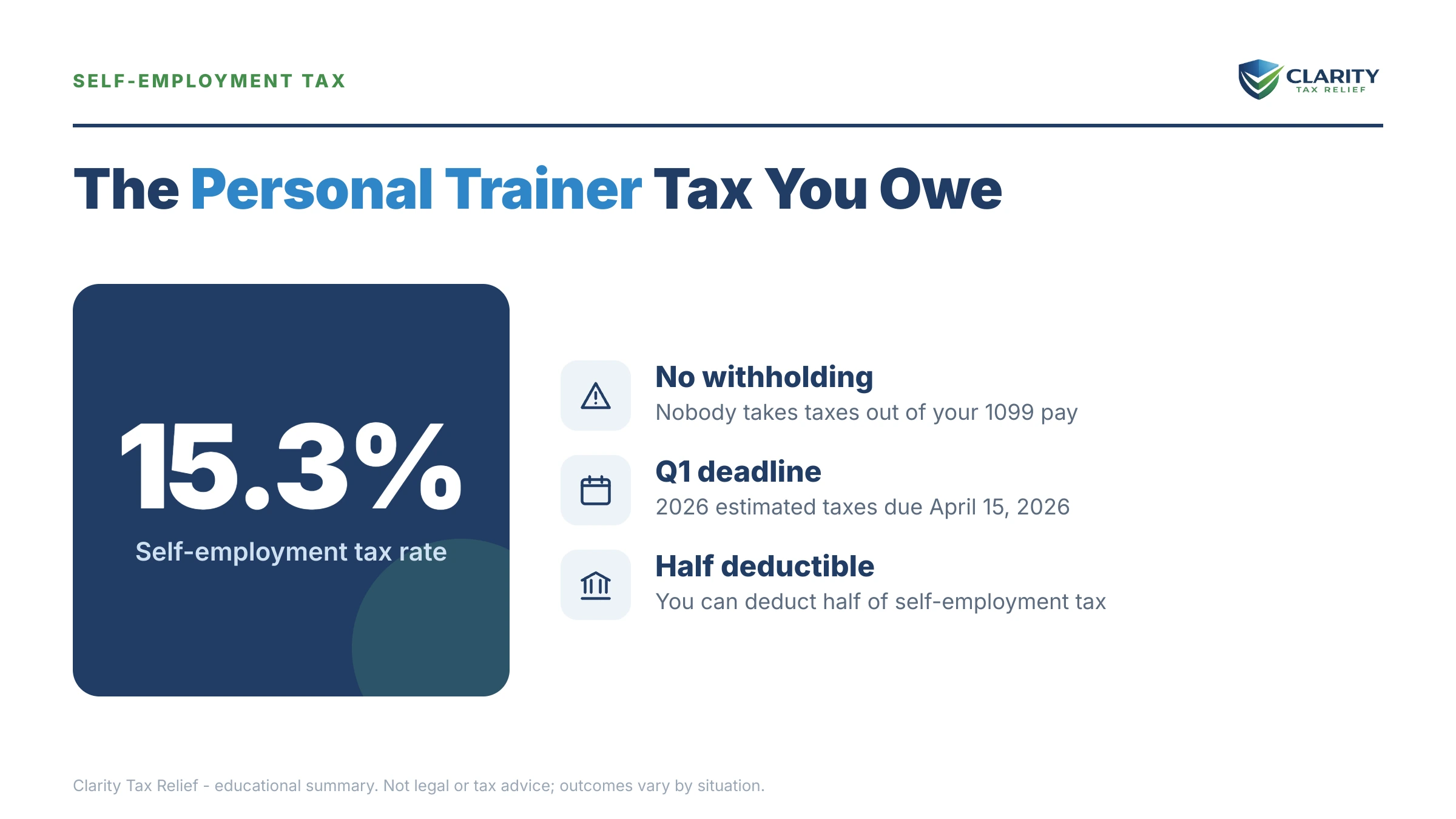
- Self-employment tax. You owe both halves of Social Security and Medicare — 15.3% of net profit — before ordinary income tax even starts. This is the shock at the core of the self employment tax owe irs problem, and it's why a trainer and a W-2 employee with identical income can owe wildly different amounts in April.
- Cash and app clients. Park sessions, online programming, Venmo and Zelle payments — all taxable, whether or not a form reports them. The 1099-k 20000 threshold 2026 reversion means payment apps only issue a 1099-K above $20,000 and 200 transactions, but "no form" has never meant "no tax." In an audit, the IRS can total your bank deposits and treat what you can't explain as income.
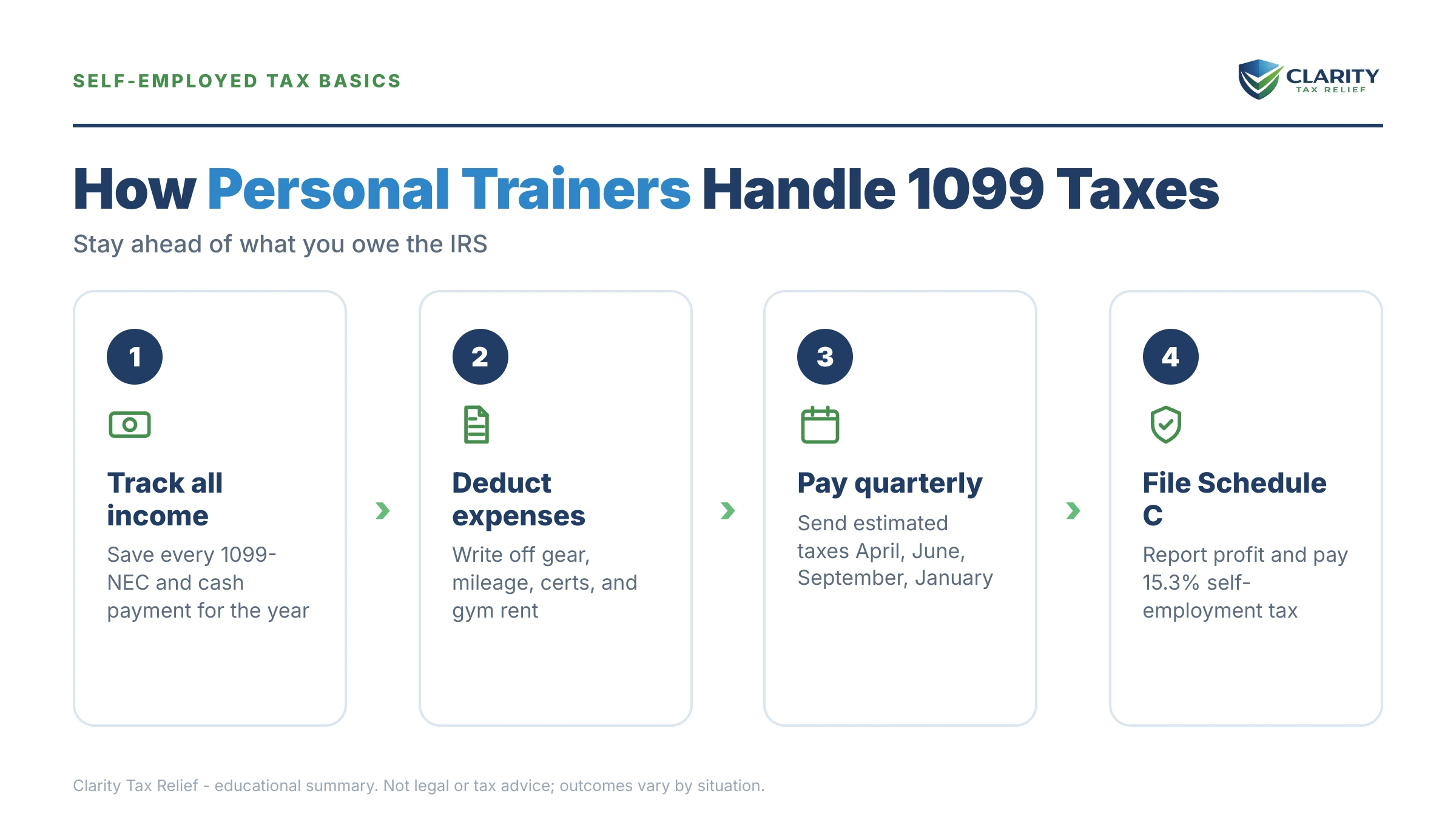
- Missed quarterlies. The system assumes you'll pay yourself the way an employer would — four estimated payments a year. Skip them and an underpayment penalty attaches even if you eventually file on time. If quarterlies are new to you, start with how do quarterly estimated taxes work.
Some trainers are hybrids — W-2 for gym-floor hours, 1099 for private sessions. The W-2 withholding covers only the W-2 income, so the private-session side still builds an unpaid balance. Commission-based 1099 workers hit the same wall; the insurance agent back taxes pattern is nearly identical, minus the chargebacks.
How a trainer's balance reaches $54,600: the math, worked out
A trainer netting $65,000 a year with no withholding generates roughly $16,000 in federal tax annually — so three unpaid years plus penalties can pass $50,000 before a single levy notice arrives.
Say your gym paid $58,000 on a 1099-NEC and cash and app clients added $26,000 — $84,000 gross. After $19,000 in legitimate deductions (floor rent, certifications, mileage, gear, insurance), net profit is $65,000. The federal tax on that looks roughly like this:
- Self-employment tax: $65,000 × 92.35% = $60,028 taxable base × 15.3% ≈ $9,180.
- Income tax: after the standard deduction, the SE-tax deduction, and the QBI deduction, roughly $6,800 for a single filer.
- Per year: about $16,000. Across three filed-but-unpaid years: $48,000.
- Penalties and interest: failure-to-pay at 0.5% per month plus compounding interest has already added roughly $6,600 — bringing the balance to $54,600.
This is a hypothetical, but it's the arithmetic behind most trainer tax debt: not one bad year, but a modest annual shortfall that compounds quietly. You can rough out your own penalty and interest accrual with our Penalty & Interest Calculator — it estimates how fast a balance grows, which is often the push people need to act this month instead of next year.
One number worth knowing: at $66,000 (the 2026 threshold), the IRS can certify your debt to the State Department and block your passport. A $54,600 balance left to accrue can cross that line — a real problem if you run retreats or travel for certifications.
What happens if you ignore personal trainer tax debt
IRS collection against a self-employed trainer runs on autopilot — and in 2026, with the IRS workforce down roughly 27%, the automated notices and levies fire whether or not a human ever reviews your file. The sequence escalates in a fixed order:
- CP14 — the first bill. Typically about 21 days to pay before the next notice queues up. Cheapest moment to act.
- CP501 / CP503 — reminders. Still just bills, but penalties and interest are compounding monthly.
- CP504 — intent to levy your state refund. The IRS can now take your state tax refund, and a federal tax lien — public, and visible to landlords and lenders — becomes a live risk.
- LT11 / Letter 1058 — final notice of intent to levy. A 30-day clock starts, along with your Collection Due Process appeal rights. After it runs, the IRS can levy bank accounts and income.
- Levies land where trainers are most exposed. A bank levy freezes funds for 21 days before they're sent to the IRS. Worse for contractors: the IRS can levy the gym that pays you — and a levy on 1099 pay typically takes 100% of the payment, because the exempt-amount protection built into wage garnishment doesn't apply to contractor pay. See can irs garnish 1099 income for how that works. A levy notice arriving at the front desk also tells your gym about your tax problem — a professional embarrassment you can prevent by acting first.
None of this happens overnight, and none of it is inevitable. Every stage before an actual levy is a stage where a payment plan or hardship filing stops the machine.
Owe the IRS from 1099 training income?
Before a levy notice reaches your gym's front desk, find out exactly where your balance stands and which option your numbers actually support. An experienced tax professional will review your case free — penalties and interest are accruing monthly, so sooner genuinely costs less.
Your options when you owe $54,600 in personal trainer taxes
Every IRS resolution for a self-employed trainer is means-tested — which program fits depends on your balance, income, and assets, not on marketing promises. The full DIY playbook lives in our guide to how to settle tax debt yourself; here's how each option applies at a trainer's numbers:
| Option | Who typically qualifies | Cost & what to know |
|---|---|---|
| Short-term payment plan | Can pay in full within 180 days | $0 setup fee; interest and penalties continue but enforcement stops |
| Streamlined installment agreement | Balance ≤ $50,000; all returns filed | Up to 72 months, set up online, no financial disclosure; see the streamlined installment agreement rules |
| Non-streamlined installment agreement | Balance over $50,000 | Requires Form 433-F financials; the IRS reviews income, expenses, and assets — details at irs payment plan over 50000 |
| Currently Not Collectible (CNC) | Paying anything would prevent basic living expenses | Collection pauses; debt and interest remain; the IRS reviews your income periodically |
| Offer in Compromise (OIC) | Assets + future income genuinely can't cover the debt | $205 fee + 20% down for lump-sum offers (both waived with low-income certification, AGI ≤ 250% of poverty); roughly 1 in 5 offers accepted in FY2024 |
| Penalty relief (FTA / AEP) | Clean compliance in the prior 3 years (FTA) | Removes failure-to-file/pay penalties for one year; AEP begins applying some relief automatically starting summer 2026 |
At $54,600, one move matters more than any other: the $50,000 streamlined line. Pay the balance down by $4,601 — sell an unused rack, drain the "gear fund," take on two extra clients for a quarter — and you unlock the online 72-month agreement with no financial disclosure. That's roughly $695 per month on the remaining $49,999 before interest (realistically somewhat more as interest accrues). Stay above $50,000 and the IRS gets to examine your Form 433-F financials before agreeing to anything.
An Offer in Compromise is real but narrow for trainers: the IRS calculates what it could collect from your equipment equity, bank balances, and future session income before the 10-year collection statute expires. If you clear $5,000 a month training clients, that math rarely produces an accepted offer. If injury, illness, or a collapsed client book has genuinely cut your earning capacity, it might — the self-employed version of the calculation is covered in oic self employed.
Here's how the realistic path shifts as the balance changes:
| Balance | Most realistic path | What changes at this level |
|---|---|---|
| Under $10,000 | Guaranteed installment agreement or 180-day plan | Approval is essentially automatic if returns are filed; handle it yourself online |
| $10,000–$25,000 | Streamlined plan online | No financials needed; lien filing becomes possible but is uncommon with a direct-debit plan |
| $25,000–$50,000 | Streamlined plan (direct debit) | Direct debit keeps you inside the streamlined rules and lowers default risk |
| $50,000–$100,000 | Pay below $50k if possible; otherwise 433-F plan, CNC, or OIC | Financial disclosure required; lien likely; passport certification at $66,000 |
| Over $100,000 | Full financial review; possible revenue officer assignment | Asset scrutiny intensifies; professional representation typically changes outcomes here |
Before you negotiate: shrink the number itself
Many trainers owe less than the IRS says, because the original returns — or the IRS's own substitute versions — missed trainer-specific deductions. If you filed in a rush and skipped Schedule C deductions, amend return to reduce tax debt explains how a corrected return can lower an assessed balance. Deductions trainers most often leave on the table:
- Floor rent or facility fees paid to the gym out of your session split.
- Certifications and CEUs — NASM, ACE, CSCS renewals, specialty courses, workshops.
- Liability insurance, which nearly every gym contract requires you to carry.
- Business mileage between client locations, parks, and gyms (not the commute from home to your first stop).
- Equipment and software — bands, kettlebells, programming platforms, scheduling and payment apps.
Every deduction dollar cuts income tax and 15.3% SE tax, so the effect compounds. If you never filed at all and the IRS assessed you from the gym's 1099 alone, the situation described in irs filed a substitute return for me applies — the IRS's version claims zero deductions, and replacing it with your real return is usually the single biggest reduction available. Multiple unfiled years follow the sequence in haven't filed taxes in 3 years.
How to respond to personal trainer tax debt, step by step
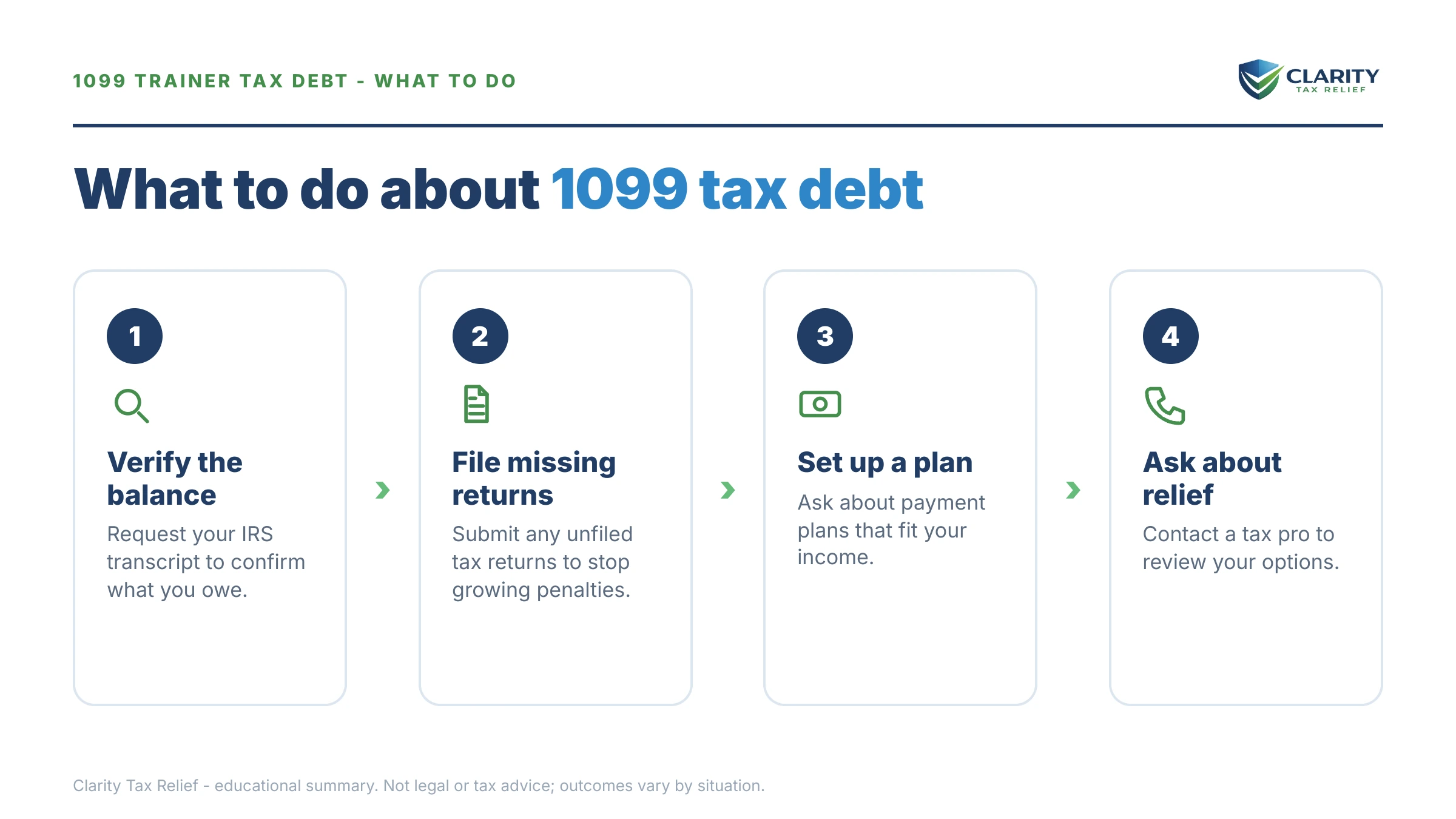
- Get your IRS records. Create an IRS online account and pull your account transcripts plus wage and income transcripts for every year in question — they show exactly what the gyms and apps reported and what the IRS says you owe.
- File every missing return, with full deductions. The IRS generally wants the last six years filed before it will approve any resolution — and your own Schedule C with mileage, certifications, and floor rent claimed will almost always show less tax than the IRS's version.
- Request penalty relief. If your prior three years were clean, ask for first-time penalty abatement — and starting summer 2026, the Automatic Exemption from Penalty (AEP) applies some relief automatically, with no request needed.
- Choose and set up your resolution. Pick the payment plan, hardship status, or offer that fits your numbers — and if your balance sits just above $50,000, consider paying it below that line first to unlock the simpler online agreement.
- Fix the current year so this never repeats. Set aside 25–30% of every payment in a separate account and start quarterly estimated payments now — a resolution on old years defaults if you build a new balance behind it.
Payment plans can be set up directly at the IRS payment plans page, and any payment — full or partial — goes through IRS.gov/payments. Details on penalty relief mechanics, including stacking abatement across years, are in first time penalty abatement.
When you can handle this yourself — and when help changes the outcome
Plenty of trainer tax problems don't need professional help. If you owe under $25,000 on filed returns, agree with the number, and can cover a monthly payment, set up the streamlined plan online yourself in twenty minutes — paying someone to do that buys you nothing. Same if you can pay in full within 180 days: the short-term plan is free to set up and ends the problem.
Experienced help earns its cost in specific situations:
- Multiple unfiled years plus cash income — reconstructing Schedule C records the IRS will accept, in the right order, without volunteering problems.
- A balance above $50,000 — the Form 433-F financial disclosure is a negotiation document, and how expenses are presented against IRS allowable-living-expense standards directly changes your monthly payment.
- A levy already in motion against your bank account or the gym that pays you — release paths exist, but they're time-sensitive.
- Genuine OIC or hardship candidacy — the math is unforgiving, and a badly built offer wastes months and a filing fee.
If money is the barrier, you're not out of options: the Taxpayer Advocate Service helps when IRS processes are causing hardship, and Low Income Taxpayer Clinics represent qualifying taxpayers at no charge.
Terms on your 1099 and IRS letters, decoded
- Form 1099-NEC: the form a gym uses to report what it paid you as a contractor — the IRS gets a copy, so this income is never invisible.
- Form 1099-K: the payment-app version, issued only above $20,000 and 200 transactions in 2026 — but income below the threshold is still taxable.
- Schedule C: the form where your training income and deductions meet; your net profit here drives everything else.
- Self-employment (SE) tax: the 15.3% Social Security and Medicare tax you pay on net profit because no employer pays half for you.
- CSED: the Collection Statute Expiration Date — the IRS generally has 10 years from assessment to collect, though appeals, offers, and bankruptcy pause the clock.
- Levy: actual seizure — of a bank balance, or of a payment the gym owes you. A lien, by contrast, is a legal claim that attaches to what you own.
Personal trainer tax questions, answered
Do personal trainers have to pay self-employment tax?
Yes — if your net profit from training is $400 or more, you owe self-employment tax of 15.3% on top of regular income tax. That covers both the employer and employee halves of Social Security and Medicare, because no gym is paying the employer half for you. Half of the SE tax is deductible, which softens it slightly, but it's the main reason trainers' tax bills feel shockingly large.
How much should a personal trainer set aside for taxes?
A working rule is 25–30% of every payment — gym checks, app deposits, and cash alike. Trainers netting six figures or living in high-tax states should lean toward 30% or more. Move it to a separate account the day you're paid, then send quarterly estimated payments so the money is gone before you can spend it.
Does the IRS know about my cash and Venmo training clients?
Often, yes — and the income is taxable whether or not anyone reports it. The 1099-K threshold reverted to $20,000 and 200 transactions for third-party apps, so smaller app income may not generate a form, but in an audit the IRS can run a bank-deposit analysis and treat unexplained deposits as income. Unreported cash is also where the 20% accuracy-related penalty and worse exposure begins.
Can the IRS levy my 1099 pay from the gym?
Yes. The IRS can send a levy directly to the gym that pays you, and unlike a wage garnishment — which leaves an exempt amount for a W-2 employee — a levy on contractor pay typically takes 100% of the payment it attaches. Each levy grabs what's owed to you at that moment, but the IRS can keep sending new ones until you set up a resolution.
What can a personal trainer write off on taxes?
Certifications and continuing education, liability insurance, floor-rent paid to the gym, equipment, training and scheduling apps, business mileage between client locations, marketing, and a home office if you run the business from home. On $80,000–$90,000 of gross income, legitimate deductions often knock $10,000 or more off net profit — and every dollar cuts both income tax and 15.3% SE tax.
I haven't filed for a few years — how bad is this?
Fixable, but do the returns first: the IRS generally wants the last six years filed, and no payment plan or settlement is available until you're filing-compliant. If you don't file, the IRS can file a substitute return for you using the gym's 1099s with zero deductions, inflating the bill. Filing your own accurate returns — with mileage, gear, and floor rent claimed — almost always beats the IRS's version.
Can I settle personal trainer tax debt for less than the full amount?
Sometimes — through an Offer in Compromise, but it's means-tested, not a discount program. The IRS accepted roughly 1 in 5 offers in FY2024, and approval depends on whether your income and assets genuinely can't cover the debt before the collection statute runs out. A healthy trainer with a steady $70,000 net profit and few obligations usually won't qualify; one facing real hardship might.
Your next 24 hours
- Pull the real number. Log into your IRS online account and write down the exact balance per year — notices lag, and the account shows what penalties and interest have already added.
- Gather three things: every 1099-NEC and 1099-K you can find, your last filed return, and a rough monthly income-and-expense picture from your training business.
- Get a free case review. An experienced tax professional will map which option your numbers actually support — the balance grows a little every month it waits, so use the form at claritytaxrelief.com/#consult or call (888) 825-7779 today.
This guide is general information, not tax or legal advice for your specific situation. Eligibility for IRS programs depends on individual facts and circumstances; no outcome is guaranteed.