
Business Tax Debt
Partnership Owes the IRS: Who's Liable and What to Do in 2026
The short answer: a partnership usually doesn't owe income tax itself — profits pass through to the partners on Schedule K-1. When a partnership owes the IRS, it's almost always one of three debts: a late-filing penalty (CP162), unpaid payroll taxes (Form 941), or a BBA audit assessment. General partners can be personally liable for all three.
The envelope is addressed to the business — its EIN, not your Social Security number — and part of you wants to file it under "the partnership's problem." But your name is on the partnership agreement, and depending on which of the three debts this is, the line between the entity's balance and your personal bank account may not exist at all. The good news: every one of these debts has a defined fix, and the penalty-only ones can often be erased entirely.
Which debts stay locked inside the entity and which follow each partner home is the single most important question on this page — the image below maps exactly how that split works, so keep reading before you assume you're shielded.
⏱ Your deadline: the pay-by date printed on whichever notice you're holding. If it's a Letter 1153 (a Trust Fund Recovery Penalty proposal naming a partner personally), you have 60 days to protest. If it's a final intent-to-levy notice (LT11 or CP297), you have 30 days to request a Collection Due Process hearing. Interest and penalties accrue monthly on everything unpaid.
Why the IRS says your partnership owes money
A partnership files Form 1065 as an information return and normally owes no income tax — so a partnership balance almost always traces to a penalty, payroll taxes, or an entity-level audit assessment.
Debt type 1: the CP162 late-filing penalty. This is the most common partnership debt by far, and it stings because it isn't tax at all — it's pure penalty. File Form 1065 late (or incomplete, or without required K-1s) and the IRS charges a penalty per partner, per month, for up to 12 months. The per-partner rate adjusts for inflation each year and is printed on the notice itself. A three-partner LLC that files eight months late can owe thousands without a dollar of underlying tax. Our CP162 notice guide covers the removal playbook in detail, and you can estimate how fast a balance like this compounds with our Penalty & Interest Calculator.
Debt type 2: unpaid payroll taxes. If the partnership has employees, it withholds income tax and FICA from their paychecks and must deposit those funds. When deposits get skipped — usually because cash flow got tight — the entity racks up 941 back taxes plus failure-to-deposit penalties. This is the most dangerous partnership debt, because part of it can be assessed personally against individual partners no matter what the entity structure says.
Debt type 3: a BBA audit assessment. Since 2018, partnership audits run under the centralized (BBA) regime. If the IRS adjusts a 1065 and the partnership doesn't act, the IRS assesses an "imputed underpayment" against the partnership itself — calculated by default at the highest individual tax rate on the full adjustment. The entity can reduce that number through modification, push the liability out to the partners who actually got the income (a §6226 election due within 45 days of the final adjustment notice), or in some cases file an administrative adjustment request — the partnership-world cousin of the strategy in our amend return to reduce tax debt guide. Small partnerships with 100 or fewer eligible partners can elect out of the BBA regime annually on a timely filed return, which pushes any future audit down to the partner level from the start.
A first business bill typically arrives as a CP161 (balance due, no math error) or CP162 (late-filing penalty). Whichever it is, the notice number in the top-right corner tells you which of the three debts you're dealing with — and everything below depends on that answer.
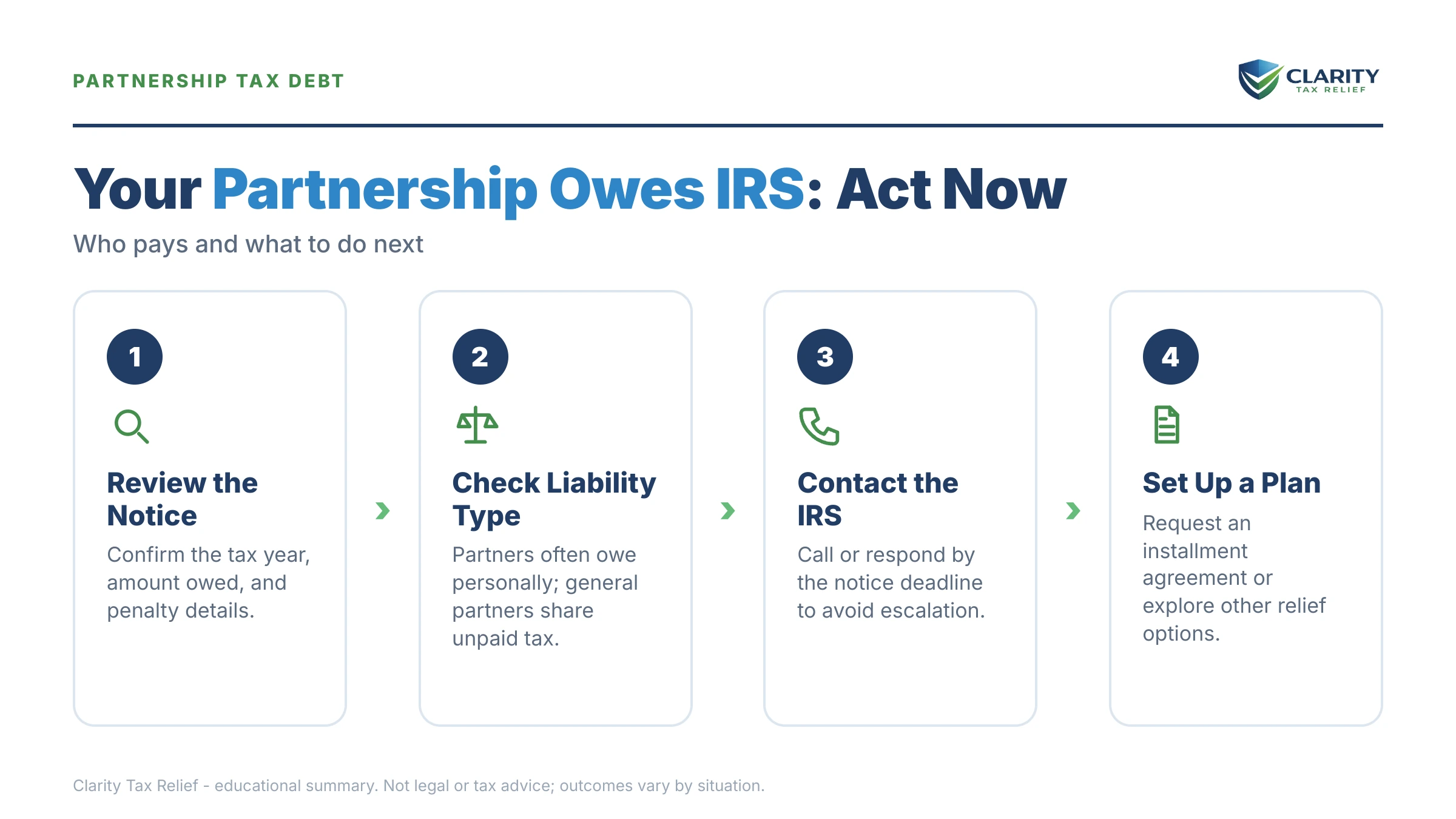
Who is personally liable when a partnership owes the IRS
General partners are personally liable for partnership debts under state law — including federal tax debts the entity can't pay. That's the defining risk of the general-partnership form: there is no corporate veil between the business's IRS balance and your personal assets.
Limited partners and members of an LLC taxed as a partnership are in a different position. Entity-level debts — the CP162 penalty, an imputed underpayment — generally stop at the entity for them. If your business is an LLC filing a 1065, the liability rules run through the LLC layer; our llc owes irs back taxes guide walks through that split.
Payroll debt breaks all of those shields. The withheld portion of payroll taxes — employee income tax withholding plus the employees' share of FICA — is "trust fund" money, and the trust fund recovery penalty (TFRP) lets the IRS assess that portion personally, dollar for dollar, against every "responsible person" who willfully failed to pay it over. In a partnership that usually means any partner who signed checks, ran payroll, or decided which bills got paid — and it can reach a non-partner office manager too. The proposal arrives as a letter 1153 with a 60-day protest window, and once assessed, the IRS collects it from you like any personal tax debt.
Here's why that matters if you rent instead of own: with no house for a lien to sit on quietly, IRS collection against you personally goes straight to the liquid targets — your bank account and your paycheck. A bank levy freezes funds for 21 days before they're sent; a wage levy is continuous until released. For a renter, partnership payroll debt turning personal isn't an abstract lien on paper — it's next month's rent money at risk.
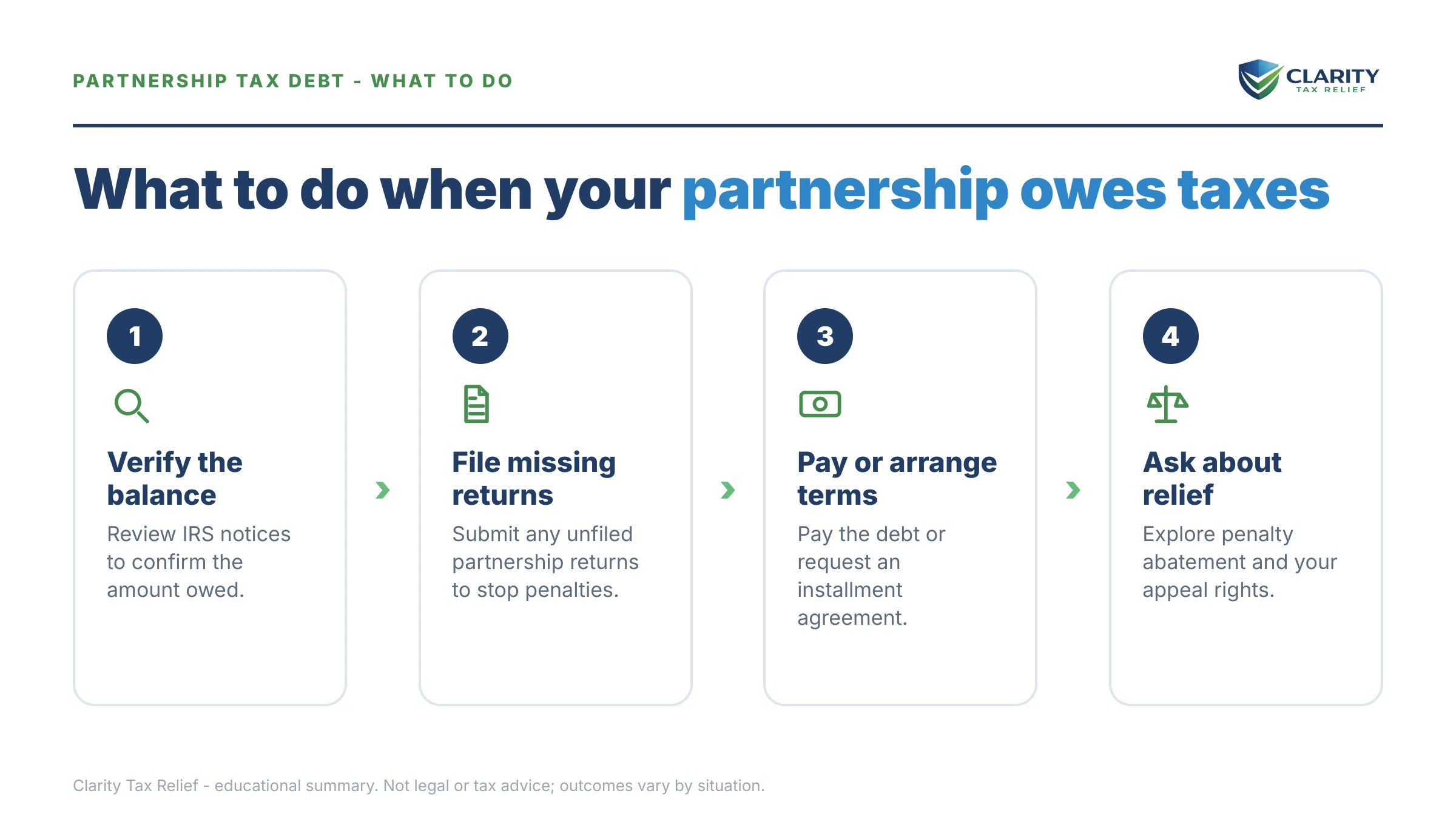
What happens when a partnership owes the IRS and nobody responds
Ignored partnership tax debt escalates on two tracks at once: enforcement against the business, and — for payroll debt — a separate personal assessment against the partners. Both tracks are automated, and in 2026 that matters more than ever: the IRS workforce shrank roughly 27% in 2025, but the notice-and-levy systems kept running untouched. Our irs budget cuts 2026 analysis explains why fewer humans has meant slower help, not slower enforcement.
- CP162 or CP161 — the first bill to the partnership's EIN. No enforcement yet; this is the cheapest moment to act.
- CP504B — the business version of the intent-to-levy notice. The IRS can now take the partnership's state tax refunds, and a federal tax lien against business assets becomes a live possibility. See the cp504b notice guide.
- CP297 or LT11 — the final notice of intent to levy. A 30-day clock starts, along with Collection Due Process rights (requested on Form 12153). After it runs, the IRS can levy the partnership's bank accounts and accounts receivable.
- Parallel track for payroll debt: a revenue officer conducts responsible-person interviews (Form 4180), sends Letter 1153 to each targeted partner, and — after the 60-day protest window — assesses the TFRP personally. From there, personal bank and wage levies follow their own notice sequence against each partner.
One more moving part: the levy on the partnership's operating account doesn't just hurt the entity. It bounces payroll, which creates new unpaid trust-fund taxes, which deepens every partner's personal exposure. That feedback loop is why payroll-debt cases reward early action more than almost any other tax problem.
| Notice | What it means | Your window |
|---|---|---|
| CP162 | Form 1065 filed late or incomplete — per-partner penalty assessed | Pay-by date on the notice; abatement can be requested any time |
| CP161 | First business balance-due bill (payroll or entity-level tax) | Pay-by date printed on the notice |
| CP504B | Intent to levy — state refunds are now reachable | Respond before the date on the notice |
| CP297 / LT11 | Final notice of intent to levy on business assets | 30 days to request a CDP hearing (Form 12153) |
| Letter 1153 (sent to partners) | TFRP proposed against you personally for trust-fund payroll taxes | 60 days to protest |
Partnership debt starting to turn personal?
If a CP504B just arrived — or a Letter 1153 names you personally — get the notice reviewed free before its protest window closes. An experienced tax professional will tell you which of the three debt types you're facing, what your real exposure is, and the fastest fix. Free, confidential, no pressure.
Your options when the partnership can't pay
Every partnership tax debt has at least one structured fix — and on a CP162, the right abatement request can eliminate the entire balance, because the whole debt is penalty. The general DIY mechanics of dealing with the IRS live in our guide to how to settle tax debt yourself; here's how each option applies specifically to a partnership:
- Penalty abatement. First-time abatement applies if the partnership's prior 3 years are clean. Small partnerships of 10 or fewer qualifying partners (all individuals or estates) have historically obtained relief under Rev. Proc. 84-35, which the IRS still grants case by case. And starting summer 2026, the Automatic Exemption from Penalty (AEP) begins replacing first-time abatement — qualifying relief applies automatically, no request needed. Details and templates in business penalty abatement.
- A business payment plan. Operating businesses can generally set up an online agreement for balances of $25,000 or less paid within 24 months; bigger balances mean financial disclosure and negotiation. Payroll debt has its own lane — the In-Business Trust Fund Express agreement (trust-fund balance up to $25,000, full pay within 24 months, direct debit above $10,000), which can also keep the TFRP investigation on hold while you stay current. See business irs installment agreement.
- Business Offer in Compromise. Real but strict: the partnership must be current on all filings and deposits and show the debt genuinely exceeds what it could ever pay. The $205 application fee applies, and the IRS accepted roughly 1 in 5 offers in FY2024 — this is a math test, not a negotiation trick, and trust-fund payroll portions rarely get compromised at the entity level.
- Currently Not Collectible. If enforced collection would kill the business's ability to operate and stay current, collection can be paused. The debt keeps growing and the IRS revisits, but it stops a levy spiral while you stabilize.
- Push-out or modification (BBA debt only). If the debt is an imputed underpayment, the cheapest fix is often structural: modify the calculation or elect within 45 days to push the adjustments out to the partners, who typically pay less at their own rates than the entity pays at the top rate.
| Option | Typical eligibility | Trade-off |
|---|---|---|
| Pay in full | Any balance | Stops penalties and the notice track immediately |
| Penalty abatement (FTA / 84-35 / reasonable cause) | Clean prior 3 years for FTA; ≤10 qualifying partners for 84-35 | Removes penalties (and their interest), not underlying tax |
| Business installment agreement | Generally ≤ $25,000 payable within 24 months to set up online | Setup fee; interest and late-payment penalties keep accruing |
| IBTF-Express IA (payroll debt) | Trust-fund balance ≤ $25,000, paid within 24 months; direct debit over $10,000 | Must stay perfectly current on new deposits or it defaults |
| Business Offer in Compromise | Current on all filings/deposits; debt exceeds collectible value | $205 fee; roughly 1 in 5 offers accepted (FY2024) |
| BBA push-out election (§6226) | Within 45 days of the final partnership adjustment notice | Shifts the bill to partners — usually at lower rates than the entity default |
One caution before you pick: if the partnership also owes a state agency — payroll, sales tax, or a state late-filing penalty — the sequencing matters, because most states escalate faster than the IRS. Our state tax debt vs irs guide covers which to resolve first.
A worked example: $11,300 in partnership payroll debt
Say your two-partner LLC, taxed as a partnership, skipped deposits for two tight quarters and now owes $11,300 on its 941s. It breaks down like this (hypothetical, arithmetic shown):
- Employee income tax withheld but not deposited: $4,900
- Employees' share of FICA withheld but not deposited: $3,300
- Trust-fund portion: $4,900 + $3,300 = $8,200
- Employer's share of FICA: $2,300
- Failure-to-deposit penalties so far: $800
- Non-trust-fund portion: $2,300 + $800 = $3,100 · Total: $8,200 + $3,100 = $11,300
That $8,200 trust-fund slice is the part the IRS can assess against you personally via the TFRP — and against your co-partner too, each of you liable for the full $8,200 until it's paid once. If you rent, there's no home equity for the IRS to wait on: a personal assessment plus an expired final notice means your checking account (21-day hold, then the money leaves) and your paycheck are the targets.
Now the fix. The full $11,300 fits comfortably inside an In-Business Trust Fund Express agreement: $11,300 ÷ 24 months ≈ $471 a month before accruing interest — realistically budget closer to $500 — on direct debit, since the balance is over $10,000. Stay current on every new deposit, and the entity pays the debt down while the personal TFRP assessment typically stays on hold. Miss new deposits, and both tracks reactivate at once.
How to respond when your partnership owes the IRS, step by step
- Identify the debt type. Pull the notice number from the top right corner (CP162, CP161, CP504B, Letter 1153) and match it to penalty, payroll, or audit debt — the fix is different for each.
- Verify the balance. Request the partnership's account transcripts under its EIN, or call the IRS business line, before paying anything — misapplied deposits are common.
- File anything missing. An unfiled 1065 or 941 blocks every resolution option, so get every return in before you negotiate.
- Attack the penalties first. Request first-time abatement or reasonable-cause relief in writing — on a CP162, this can erase the entire balance, because the whole debt is penalty.
- Resolve the remaining tax. Set up a business installment agreement for what's left — and if payroll debt is involved, get a professional review before any Trust Fund Recovery Penalty interview.
When you can handle this yourself — and when it's riskier to
A CP162-only debt is the most DIY-friendly problem in business tax. If the partnership's last 3 years are clean, a written first-time abatement request — or, for a 10-or-fewer-partner partnership, a Rev. Proc. 84-35 request — frequently resolves the whole notice. Likewise, if the balance is small, correct, and the entity can pay it within the plan limits, setting up the agreement online yourself is straightforward.
Experienced help changes outcomes in four situations: any payroll debt where a revenue officer is involved — what you say in a Form 4180 responsible-person interview shapes whether the TFRP lands on you at all; a Letter 1153 already in hand with the 60-day clock running; a BBA audit adjustment, where the push-out-versus-modification math can swing the bill dramatically; and multiple unfiled 1065s or 941s stacked with penalties, where the order you fix things determines what you ultimately pay. If money is the constraint, know that Low Income Taxpayer Clinics and the Taxpayer Advocate exist too — our free help with irs tax debt guide lists every no-cost option.
Terms on your notice, decoded
- Trust-fund taxes: the payroll money withheld from employees' paychecks — legally their money, held in trust for the government, which is why it gets special enforcement.
- Responsible person: anyone with the authority and duty to pay the trust-fund taxes over — partners, and sometimes managers or bookkeepers who controlled the checkbook.
- TFRP: the Trust Fund Recovery Penalty — a personal assessment of the trust-fund portion against each responsible person who willfully let it go unpaid.
- Imputed underpayment: the entity-level tax bill from a BBA partnership audit, computed by default at the highest individual rate.
- Push-out election: the §6226 choice, due within 45 days of the final adjustment notice, to shift a BBA assessment from the partnership to the partners.
- CSED: the collection statute expiration date — generally 10 years from assessment, though appeals, offers, and bankruptcy can pause the clock.
Partnership IRS debt questions, answered
Does a partnership itself pay income tax to the IRS?
Normally, no — a partnership files Form 1065 and the income passes through to the partners, who pay the tax on their personal returns. The partnership itself owes the IRS in three situations: a late-filing penalty (CP162), unpaid employment taxes on its workers, or an entity-level assessment after a BBA audit. Each of those is billed to the partnership's EIN, not to any partner's SSN — at least at first.
Are general partners personally liable for partnership tax debt?
Generally yes — under state partnership law, general partners are personally responsible for the partnership's debts, and the IRS can pursue them when the entity can't pay. Limited partners and members of an LLC taxed as a partnership are usually shielded from entity-level debts. The big exception is payroll: the Trust Fund Recovery Penalty lets the IRS assess the withheld-tax portion personally against any responsible person, regardless of entity type.
Can the IRS remove a CP162 late-filing penalty?
Often, yes. First-time abatement applies if the partnership has a clean compliance history for the prior 3 years, and reasonable cause (illness, disaster, records destroyed) works when the facts support it. Small partnerships of 10 or fewer qualifying partners have also historically obtained relief under Rev. Proc. 84-35. Starting summer 2026, the IRS's Automatic Exemption from Penalty (AEP) begins replacing first-time abatement, applying qualifying relief automatically with no request needed.
Can the IRS levy my personal bank account for a debt my partnership owes?
Yes, in two situations: if you're a general partner personally liable under state law, or if the IRS has assessed the Trust Fund Recovery Penalty against you for unpaid payroll withholding. Once a personal assessment exists and final notice rights have run, the IRS can levy your bank account — the bank holds the funds for 21 days before sending them — and issue a continuous levy on your wages.
What is a BBA imputed underpayment?
It's the tax bill the IRS charges the partnership itself after auditing a Form 1065 under the centralized (BBA) audit regime — calculated by default at the highest individual rate on the adjustments. The partnership can reduce it through modification, or shift the liability to the partners who actually benefited by making a push-out election within 45 days of the final adjustment notice. Miss that window and the entity owes the inflated amount.
Can a partnership set up an IRS payment plan?
Yes. Operating businesses can generally set up an online payment agreement for balances of $25,000 or less paid within 24 months; larger balances require financial disclosure and IRS approval. For payroll debt, the In-Business Trust Fund Express agreement covers trust-fund balances up to $25,000 over 24 months, with direct debit required above $10,000. Interest and late-payment penalties keep accruing on any plan, so shorter is cheaper.
If we dissolve the partnership, does the IRS debt go away?
No. Closing the entity does not erase the debt — the IRS generally has 10 years from assessment to collect, and that clock can pause. General partners remain personally liable for partnership debts under state law, and the trust-fund portion of payroll debt follows every responsible person individually via the Trust Fund Recovery Penalty. Dissolving without a wind-down plan can actually make partners' personal exposure worse, not better.
Your next 24 hours
- Find the notice number and the pay-by date. Top-right corner of the notice: CP162, CP161, CP504B, CP297, or Letter 1153. That one code tells you which debt this is and which clock — 60 days on a 1153, 30 days on a final levy notice — is running.
- Gather three things: the last-filed Form 1065 (with K-1s), the partnership's payroll records and 941s if there are employees, and the partnership or operating agreement showing who's a general partner and who signs checks.
- Get the notice reviewed free. Send it through the 2-minute form or call (888) 825-7779. Penalties and interest are compounding on the balance every month — and if payroll debt is in the mix, every month of delay deepens each partner's personal exposure.
For the IRS's own reference pages, see IRS: Partnerships, the IRS payments portal, and — if enforcement is causing genuine hardship — the Taxpayer Advocate Service.
This guide is general information, not tax or legal advice for your specific situation. Eligibility for IRS programs depends on individual facts and circumstances; no outcome is guaranteed.