
IRS Collections in 2026
IRS Understaffed: Do I Still Owe in 2026? Yes — Here's What Actually Changed
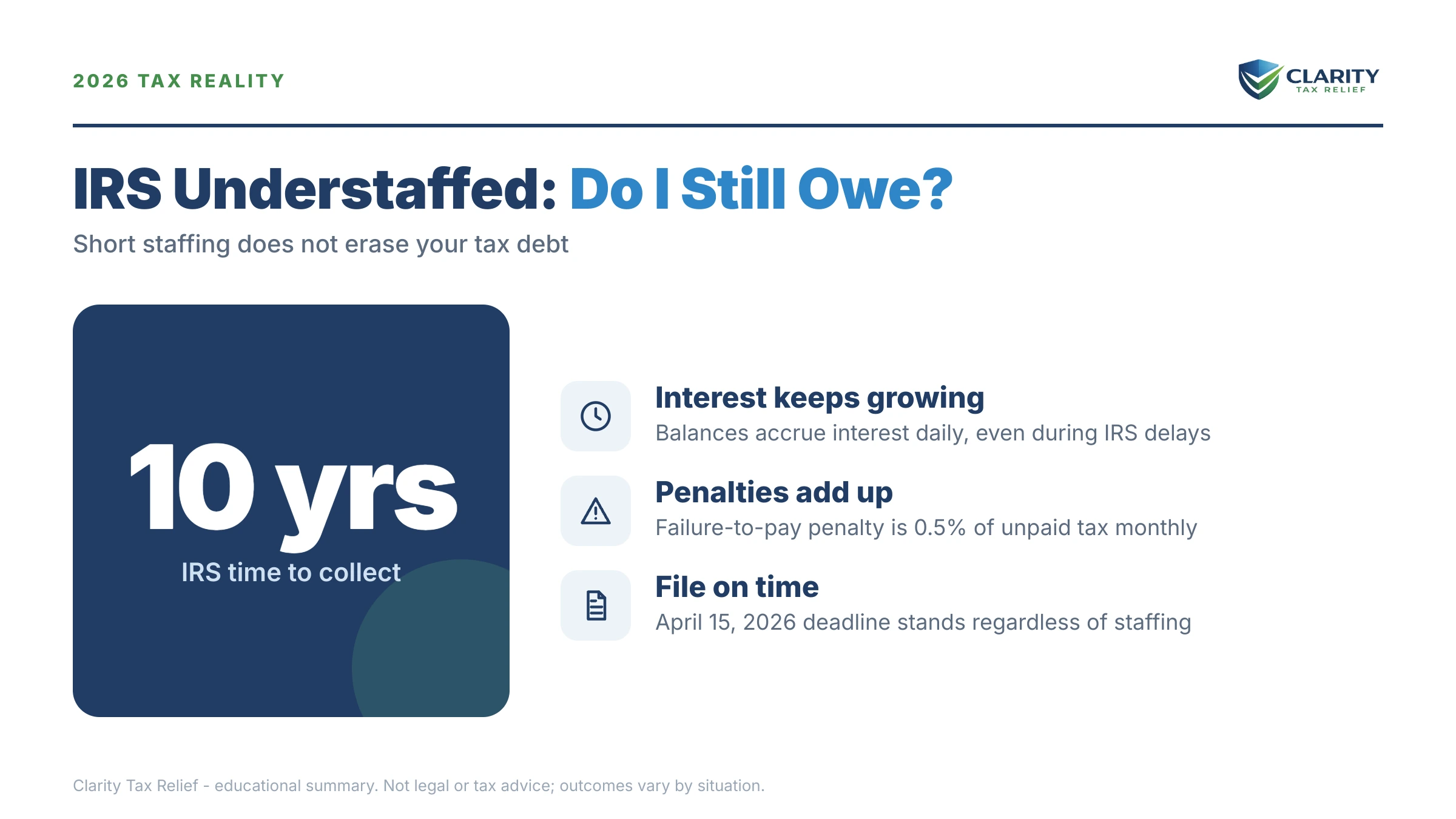
The short answer: the IRS is understaffed, but you still owe every dollar. The agency lost roughly 27% of its workforce in 2025 — yet penalties, interest, and collection notices are all generated by computers that were never laid off. Understaffing slows refunds, phones, and audits. It does not pause your debt.
You've seen the headlines about IRS layoffs — maybe you even called about your balance and gave up after two hours on hold. As a 1099 contractor with no employer withholding to backstop you, it's tempting to read that silence as a reprieve. It isn't: the humans got cut, but the collection computers that actually handle your account didn't.
⏱ The real clock: there's no letter deadline attached to understaffing — the clock is accrual. The failure-to-pay penalty adds 0.5% of your balance every month, and interest compounds daily on top of it. On an $83,100 balance, that's roughly $415 in penalty alone for every month you wait for a callback.
Why an understaffed IRS doesn't erase what you owe
An assessed federal tax debt stays legally collectible for 10 years from the date of assessment — no matter how many IRS employees are at their desks. Once your return posted (or the IRS assessed a balance for you), that debt exists on the government's books as a matter of law, not staffing.
Three things about your balance are set by statute, not by headcount: the tax itself, the penalties that attach to it, and the interest rate that compounds on both. None of them require a human to calculate. The IRS master file updates your account automatically every cycle, and the 2026 quarterly interest rates apply whether your file is ever assigned to a person or not.
And if you e-filed and saw the balance on screen — including anyone whose Direct File return showed a balance due — that amount posted to your account exactly like any other assessment. There's no processing backlog between you and owing it.
The one clock that does keep running in your favor is the 10-year collection statute (CSED) — but at ten years, with tolling events that pause it, it's a marathon, not an escape hatch. For the full menu of ways to actually resolve a balance, our guide to how to settle tax debt yourself covers the shared ground; the rest of this page covers what's different in 2026.
What the 2025 workforce cuts actually slowed down — and what never stopped
The IRS workforce shrank by roughly 27% in 2025, but collection notices come from the Automated Collection System — software that was never laid off. The cuts landed almost entirely on the human side of the agency: phone assistors, correspondence units, exam teams. The systems that bill you, offset your refund, file liens, and issue levies are code, and they ran at full speed through every round of layoffs. We break down the budget mechanics in our guide to the IRS budget cuts of 2026 — here's the practical split:
| IRS function | Status in 2026 | What it means for you |
|---|---|---|
| Phone support & callbacks | Much slower — long holds, dropped calls | Use online tools; don't wait on a callback to act |
| Amended returns & mailed correspondence | Backlogged | Your letters can sit for months — send certified, keep copies |
| Complex audits & field work | Reduced | Fewer new exams, but automated underreporter notices continue |
| Balance-due notices (CP14 → LT11) | Fully automatic | Your notices arrive on schedule regardless of staffing |
| Penalty & interest accrual | Fully automatic | Your balance grows monthly whether anyone calls you or not |
| Refund offsets & lien filings | Fully automatic | Future refunds are taken and liens filed by system rules |
| Systemic bank & wage levies | Fully automatic | Levies fire after the final-notice window with no human review |
Notice the asymmetry: everything that could help you — a person to explain your account, correct an error, process your response — got slower. Everything that collects from you kept running. If you can't reach the IRS on the phone, that's an inconvenience for you and a non-event for the collection system.
What happens if you ignore your tax debt while the IRS is short-staffed
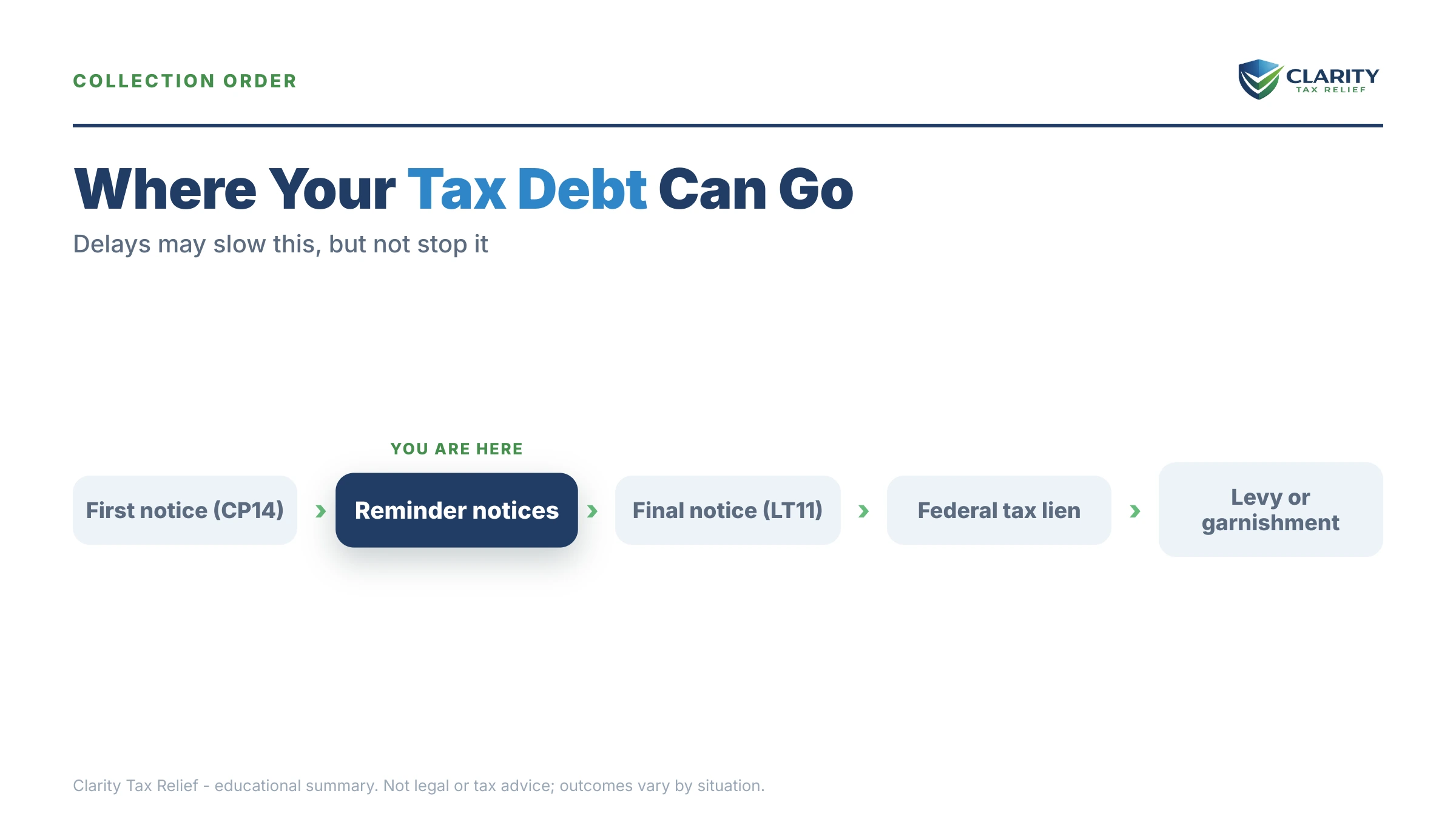
Ignoring a balance in 2026 means the automated sequence escalates from a bill to a levy with no human required at any stage. The order is fixed; only the pace on your specific account varies:
- CP14 — the first bill. You typically have about 21 days from the notice date (10 business days if the balance is $100,000 or more) before the system queues the next letter.
- CP501 / CP503 — automated reminders. Nothing new legally, but the balance compounds between each one.
- CP504 — Notice of Intent to Levy under IRC §6331(d). The IRS can now seize your state tax refund, and a federal tax lien becomes a live possibility. A filed lien is a public record that follows you — including when you try to buy a house while owing the IRS.
- LT11 / Letter 1058 — the final notice of intent to levy. This starts a 30-day clock and your Collection Due Process rights (requested with Form 12153). Miss the window and systemic levies can issue.
- Levy — a bank levy freezes funds for 21 days before they're sent to the Treasury; a levy on wages or a contractor's accounts receivable is where recovery gets hardest and most expensive.
Two additional tripwires hit contractor-sized balances specifically. Above $66,000 (the 2026 threshold), a debt that becomes "seriously delinquent" can be certified to the State Department, blocking passport renewal over tax debt. And any federal payments you receive can be tapped at up to 15% through the Federal Payment Levy Program.
| Notice | Response window | What it unlocks — or what you lose |
|---|---|---|
| CP14 | Typically 21 days from the notice date (10 business days if the balance is $100,000 or more) | First bill — the cheapest moment to resolve |
| CP501 / CP503 | Date printed on each notice | Reminders; penalties and interest keep compounding |
| CP504 | Date printed on the notice | IRS can seize your state refund (IRC §6331(d)); lien exposure |
| LT11 / Letter 1058 | 30 days | Miss it and you lose Collection Due Process rights (Form 12153) — then levies can issue |
| Levy issued | Bank: 21-day hold before funds leave; wages: continuous | Hardest and costliest stage to unwind |
The IRS hasn't called about your balance? That's staffing — not forgiveness.
Every month of silence adds another 0.5% penalty plus daily interest, and the automated sequence keeps advancing toward levy. Get your balance and transcripts reviewed free by an experienced tax professional before the next notice fires.
Your options if you owe the IRS in 2026
Every IRS resolution program stayed open through the staffing cuts — and most can now be set up without ever reaching a human. The dividing line for most readers is $50,000 in combined tax, penalties, and interest: at or below it, the whole thing can be done online; above it, the IRS wants financial disclosure.
| Option | Who qualifies | Cost & catch |
|---|---|---|
| Short-term payment plan | Can pay in full within 180 days | $0 setup; penalties and interest continue until paid |
| Guaranteed installment agreement | Owe $10,000 or less in tax and are filing-compliant | Approval is required by law when the conditions are met |
| Streamlined online plan | Owe $50,000 or less combined | Up to 72 months; setup fee applies, lower with direct debit |
| Non-streamlined plan | Over $50,000 combined | Requires Form 433-F financial disclosure — see IRS payment plan over $50,000 |
| Currently Not Collectible | Paying would leave you unable to cover basic living expenses | Collection pauses; the debt, interest, and possible lien remain |
| Offer in Compromise | Assets plus future income genuinely can't cover the debt | $205 fee and 20% down on lump-sum offers (both waived with low-income certification); the IRS accepted roughly 1 in 5 offers in FY2024 |
| Penalty relief (FTA / AEP) | Clean compliance in the prior 3 years; AEP applies automatically starting summer 2026 | Removes qualifying penalties, not the tax or interest |
One 2026-specific note on penalty relief: you no longer always have to ask. First-time abatement is being replaced by the Automatic Exemption from Penalty (AEP) starting summer 2026, which applies without a request when you qualify. Don't pay a penalty you may not have to carry.
Say you owe $83,100 as a 1099 contractor: the math
Say you owe $83,100 across two years of contractor income where the quarterlies never got paid. This is clearly hypothetical, but the arithmetic is exact:
- The cost of waiting: 0.5% × $83,100 = $415.50 per month in failure-to-pay penalty, plus daily-compounding interest on the whole balance. Waiting six months for the IRS to "get to you" costs roughly $2,500 in penalty before interest is even counted. You can estimate your own accrual with our Penalty & Interest Calculator.
- The $50,000 problem: at $83,100 you're above the streamlined online-plan ceiling. Route one: pay the balance down by about $33,100 to reach $50,000 or less, then set up a 72-month plan online with no financial disclosure. Route two: submit Form 433-F financials for a non-streamlined agreement.
- The payment reality: $83,100 ÷ 72 months ≈ $1,154 per month in principal alone, before interest — and as a contractor, the plan defaults if you fall behind on current-year estimated payments, so the real monthly nut includes your quarterlies.
- The passport tripwire: $83,100 sits above the $66,000 certification threshold for 2026. If the account reaches "seriously delinquent" status, passport certification is on the table — but getting into an installment agreement generally prevents it.
The takeaway: at this size, the order of moves matters more than the moves themselves. A paydown-then-streamline strategy, a 433-F presentation, or a hardship review each produce very different monthly numbers from the same $83,100.
How to respond, step by step
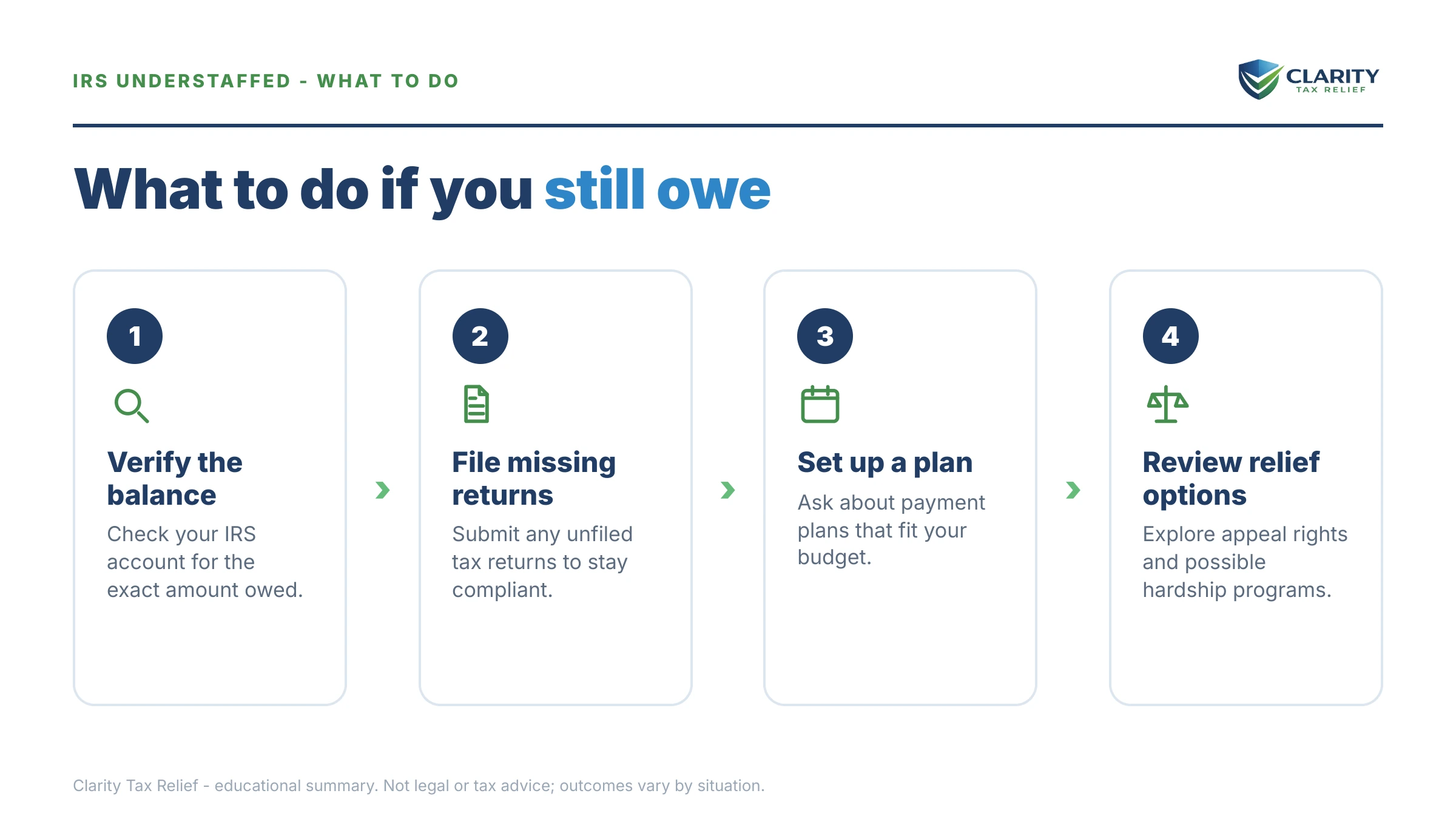
- Confirm what you actually owe. Log into your IRS online account and record the balance, tax years, and any pending notices — don't rely on an old letter or a guess.
- File every unfiled return. The failure-to-file penalty runs 5% per month — ten times the failure-to-pay rate — so filing stops the biggest bleed even if you can't pay a dollar.
- Match your balance to a resolution path. Under $50,000 points to an online payment plan; over it means financial disclosure, a paydown strategy, or hardship review — use the options table above.
- Set it up online, not by phone. The Online Payment Agreement tool works even when hold times don't, and you get instant confirmation instead of waiting on a callback that may never come.
- Keep written proof of everything. Save confirmation numbers, screenshots, and copies of anything you mail — with fewer IRS employees reconciling accounts, your records are what fix a processing error.
When you can handle this yourself — and when experienced help changes the outcome
If you owe $50,000 or less, agree with the balance, and are current on filings, you genuinely don't need to hire anyone: the online payment plan takes about twenty minutes and the confirmation is instant. Same if you can pay in full within 180 days — the short-term plan costs nothing to set up.
Experienced help earns its cost in the situations understaffing makes worse: a balance over $50,000 where the Form 433-F presentation drives your monthly payment, multiple unfiled years that have to land in the right order, a levy already in motion where release requires reaching someone who no longer answers, Offer in Compromise math, or business and payroll debt. In each of those, the bottleneck is a human process at a short-staffed agency — and a representative who knows the practitioner channels moves through it faster than you can on the general line. If cost is the barrier, the Taxpayer Advocate Service and Low Income Taxpayer Clinics are free for those who qualify.
Terms in the headlines, decoded
- ACS (Automated Collection System): the IRS's computer-driven collection arm that mails notices and issues most levies — no assigned human on your case.
- CSED (Collection Statute Expiration Date): the day, 10 years after assessment, when the IRS legally loses the right to collect a debt — subject to pauses.
- Seriously delinquent tax debt: the certification status (over $66,000 in 2026, with enforcement underway) that can block your passport.
- Systemic levy: a levy issued automatically by ACS once the final-notice window closes, rather than by a revenue officer's decision.
- FPLP (Federal Payment Levy Program): the automated program that takes up to 15% of federal payments — including Social Security — toward tax debt.
IRS understaffing and your tax debt: questions, answered
Does IRS tax debt go away if the IRS is understaffed?
No. An assessed tax debt remains legally collectible for 10 years from the date of assessment, regardless of staffing levels. The 2025 workforce cuts slowed human services — phones, audits, correspondence — but the Automated Collection System keeps mailing notices, filing liens, and issuing levies without anyone touching your file. The only ways the debt itself shrinks are payment, an accepted settlement, penalty relief, or the collection statute expiring.
Is the IRS still sending collection notices and levies in 2026?
Yes. Collection notices, refund offsets, lien filings, and systemic levies are generated by IRS computers, and those systems ran at full speed through the layoffs. The workforce fell roughly 27% in 2025, which mostly affected the people who answer phones and work complex cases. If anything, automation now handles a larger share of collection — which means fewer chances for a human to exercise judgment before enforcement fires.
Should I wait for the IRS to contact me before dealing with my balance?
No — waiting is the most expensive option. The failure-to-pay penalty adds 0.5% of the balance every month and interest compounds daily, whether or not a notice has arrived yet. On an $83,100 balance, that is roughly $415 a month in penalty alone. The rare exception is a debt close to its 10-year expiration date, and that call should only be made after a professional confirms the actual CSED on your transcript.
Can I get penalties removed because the IRS was understaffed?
Not just because the agency is short-staffed — penalties attach to your payment behavior, not the IRS's service levels. But two real paths exist: first-time abatement if your prior three years were clean (being replaced by the Automatic Exemption from Penalty starting summer 2026), and interest abatement under IRC §6404 when an IRS error or delay caused extra interest to accrue. Both require your specific facts to fit.
Does the 10-year collection statute keep running while the IRS is understaffed?
Yes — the CSED clock runs continuously and understaffing doesn't pause it, which is genuinely the one clock working in your favor. But it tolls (stops) during bankruptcy, a pending Offer in Compromise, certain appeals, and other events, so the real expiration date is often later than ten years from filing. Pull your account transcript to find the assessment date before assuming anything is close to expiring.
What if I can't reach the IRS by phone to set up a payment plan?
You usually don't need the phone. An individual owing $50,000 or less in combined tax, penalties, and interest can set up a payment plan of up to 72 months entirely online through their IRS account. Over $50,000, you'll need to submit financial information — that's where hold times hurt, and where either paying the balance below the threshold or having a representative handle the submission saves weeks.
Will the IRS still levy my bank account with fewer employees?
Yes. Most levies below the revenue-officer level are issued systemically once the final-notice window closes — no human decision required. A bank levy freezes the funds for 21 days before your bank sends them to the IRS, which is your window to negotiate a release. A wage levy is continuous and stays in place until the IRS releases it, you resolve the balance, or the collection statute expires.
Your next 24 hours
- Log into your IRS online account and write down the exact balance, the tax years it covers, and the date of the most recent notice on your account — that tells you where you sit in the automated sequence.
- Gather your last filed return, any IRS letters you've received, and this year's 1099s and income records — whichever path fits (online plan, 433-F, hardship), these are the documents it starts from.
- Get a free case review at the 2-minute form or (888) 825-7779. The IRS's silence isn't a pause on your debt — penalties and interest are accruing monthly, and the review tells you which option stops the bleed cheapest.
This guide is general information, not tax or legal advice for your specific situation. Eligibility for IRS programs depends on individual facts and circumstances; no outcome is guaranteed.