
Filing & Payments
IRS Direct File Shows a Balance Due: What to Do in 2026
The short answer: if IRS Direct File shows a balance due, the amount is a real tax debt — filing did not pay it or set up a plan. A 0.5% monthly late-payment penalty plus daily interest has run since April 15, 2026. Pay or start a payment plan before the CP14 bill arrives.
You clicked through Direct File's review screens expecting a refund number — and instead the government's own free tool told you that you owe the government money. Now, months later, the amount is still unpaid and you're not sure whether anything is happening behind the scenes. Something is: the debt is growing every day, and it's completely fixable this week.
Here's what makes an IRS Direct File balance due different from software-brand balances: the calculation came from the IRS's own system, submitting the return did nothing to pay it, and the program itself is being shut down — so you can't rely on logging back in later to sort it out. The image below shows you exactly where the amount-you-owe figure sits on your filed return and what to check around it before you pay anything.
⏱ The clock that matters: your payment was due April 15, 2026 — even though you filed on time. A 0.5% monthly failure-to-pay penalty plus daily compounding interest has accrued since that date. Once the IRS mails a CP14 bill for the balance, you typically have 21 days before the notice sequence escalates.

Why IRS Direct File shows a balance due
Direct File shows a balance due when the tax on your income exceeds what was withheld or paid in during the year — and because the tool runs the IRS's own math, the arithmetic is almost never the problem. The usual causes: a job change that reset withholding, a second income stream with no withholding at all, or self-employment income that never had quarterly payments behind it.
One wrinkle specific to this tool: Direct File supported only a narrow set of income types — W-2 wages, unemployment, Social Security, basic interest — and never handled Schedule C self-employment income. Many 1099 contractors got partway through and had to finish in other software. Whether your balance-due figure came from Direct File itself or the software you switched to mid-stream, the debt works exactly the same way once the return is accepted.
What the screen didn't make obvious: filing and paying are two separate transactions. Direct File only moved money if you scheduled a bank withdrawal on the payment screen before submitting. If you clicked submit and closed the laptop, the return went in, the balance went on the books, and nothing else happened. If you filed and owe more than expected, the first job is confirming which of those two situations you're in.
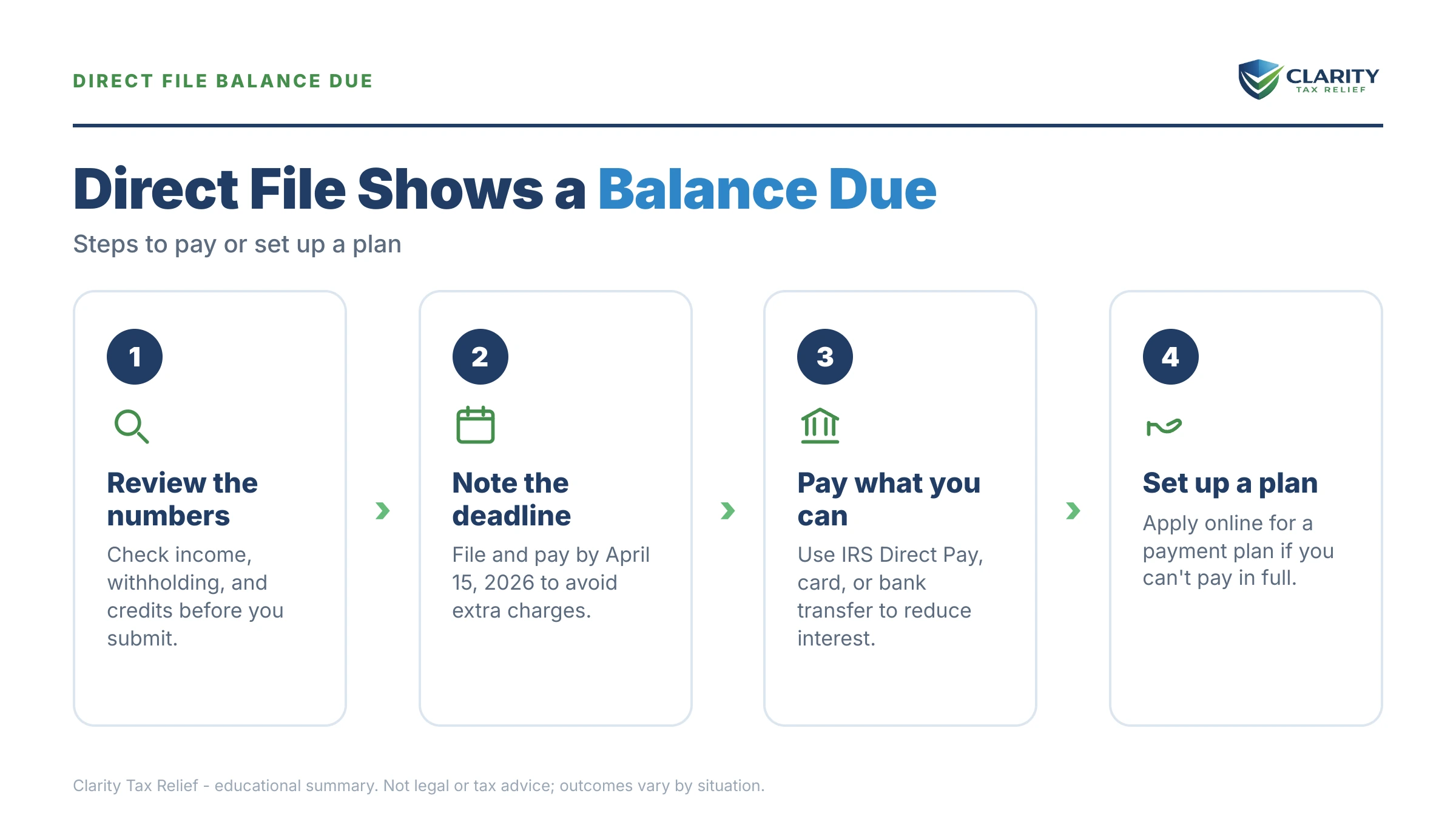
First: confirm whether a payment is actually in motion
Your IRS Online Account — not Direct File — is where the truth lives now. Ten minutes of checking answers three questions that change everything downstream:
- Did the return process? Your account should show the 2025 return filed and the balance assessed. If the balance isn't posted yet, the CP14 hasn't been triggered — you're ahead of the mail.
- Did a scheduled payment go through? If you entered bank details at filing, look for the payment in your account activity. Bank drafts fail quietly — wrong routing number, insufficient funds — and a failed draft leaves the full balance in place with penalties running.
- Does the balance match your return? Compare the account balance to the amount-you-owe line on your saved return. The account figure will be slightly higher — that's accrued penalty and interest since April 15, not an error.
While you're at it, download the PDF of your Direct File return and save it somewhere permanent. You'll need it for a payment plan application, a mortgage, or next year's return — and you should not assume the Direct File portal will be there when you go looking.
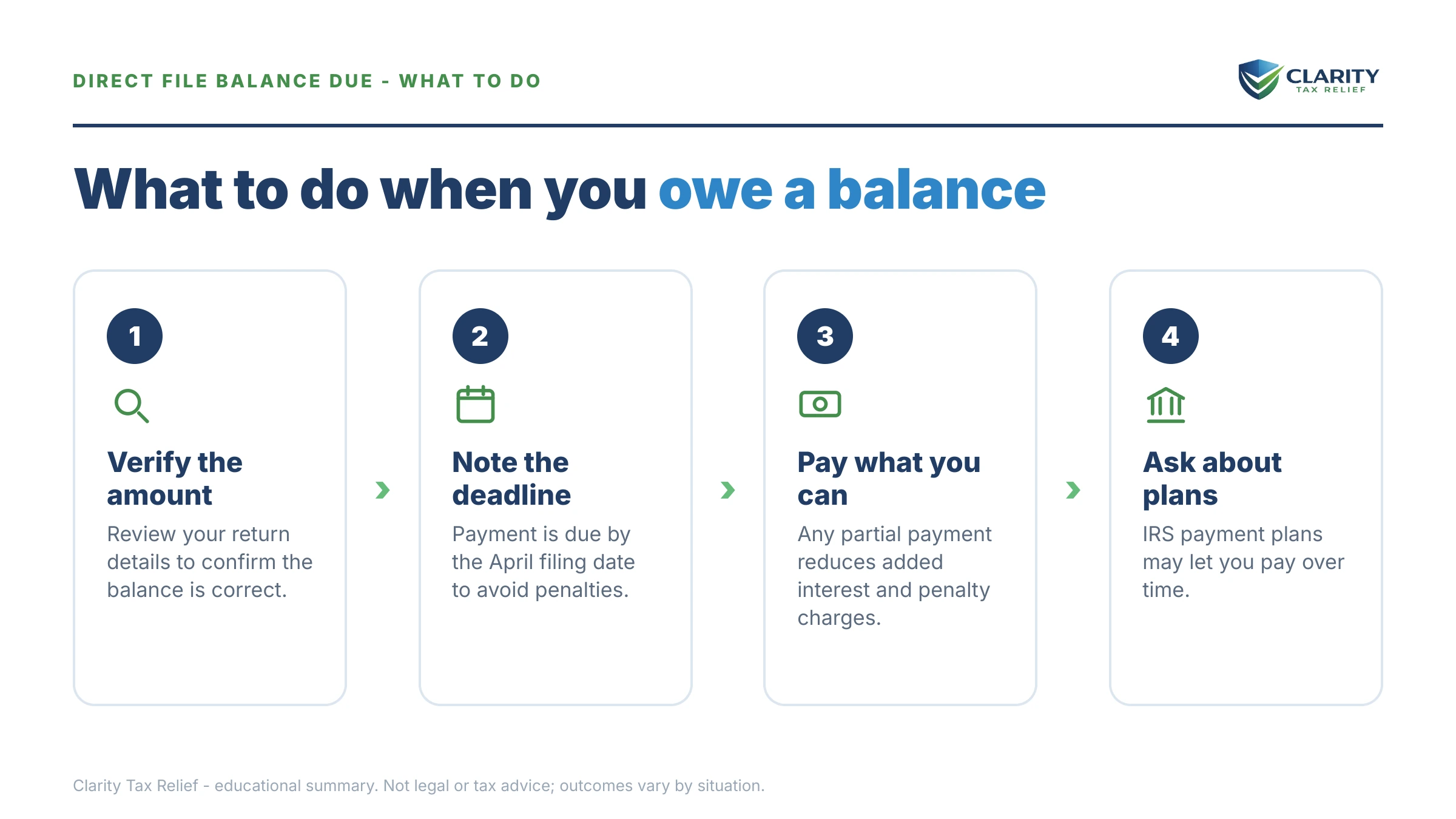
Direct File is ending — your balance isn't
The shutdown of Direct File has zero effect on the balance you owe. The program is being wound down — IRS Direct File ending covers what that means for next year's filing — but your return, your assessment, and your debt live in the IRS's permanent account systems, not in the tool.
The same logic applies to the agency's staffing troubles. The IRS workforce was cut roughly 27% in 2025, per TIGTA reports, which makes humans harder to reach — but the collection notices, penalty calculations, and eventual levies are generated by automated systems that never stopped running. If part of you is hoping the balance slips through the cracks, read IRS understaffed — do I still owe: the honest answer is that enforcement is more automated now, not less.
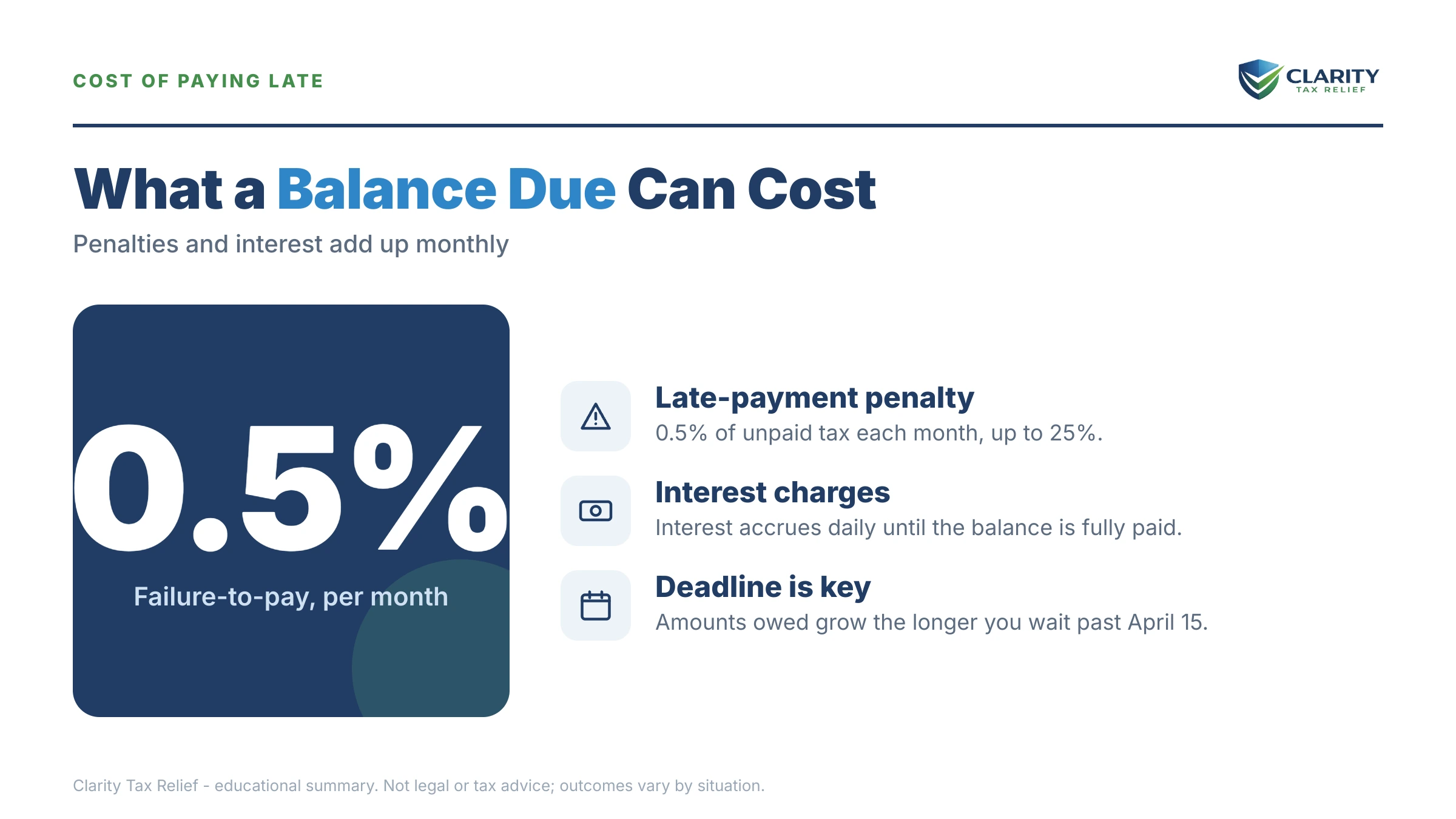
What happens if you don't pay the balance from Direct File
An unpaid balance-due return enters the IRS's automated collection sequence, and each stage carries more enforcement power than the last. Here's the order, from where you are today to where it ends:
- Now — silent accrual. No letters yet, but the 0.5% monthly failure-to-pay penalty and daily interest are compounding on the balance.
- CP14 — the first bill. The CP14 notice states the balance with accruals and typically gives you 21 days to pay or arrange before the next notice queues up.
- CP501 / CP503 — reminders. Still just bills. Every resolution option remains fully open at this stage; the balance is just larger.
- CP504 — intent to levy. The IRS can now seize your state tax refund under IRC §6331(d), and a federal tax lien becomes a realistic next move.
- LT11 / Letter 1058 — final notice. A 30-day clock starts, along with your Collection Due Process appeal rights (Form 12153). After it runs, the IRS can levy bank accounts (with a 21-day hold before funds leave) and garnish wages continuously until released.
For a contractor, that last stage has an extra sting: the IRS can also send a levy to businesses that pay you, intercepting your 1099 checks at the source. You can estimate how fast the penalties and interest are compounding on your own numbers with our penalty & interest calculator.
| Stage | Timing | The right or consequence at stake |
|---|---|---|
| April 15, 2026 payment deadline | Already passed | Penalties and interest begin accruing; no enforcement yet |
| CP14 first bill | Mailed after the balance posts | Typically 21 days to pay or arrange before escalation |
| CP501 / CP503 reminders | Follow if the CP14 is ignored | Still bills — every payment option remains available |
| CP504 intent to levy | After reminders go unanswered | IRS may seize your state refund under IRC §6331(d) |
| LT11 / Letter 1058 final notice | Last stop before enforcement | 30 days to request a CDP hearing (Form 12153) before levies begin |
Sitting on an unpaid Direct File balance?
Whether or not the CP14 has hit your mailbox yet, penalties and interest are compounding daily. Get your balance and options reviewed free by an experienced tax professional before the notice sequence starts — no pressure, no obligation.
Your options if you can't pay the balance in full
A balance in the $7,400 range sits in the friendliest tier of IRS resolution — every self-service option is on the table, and most can be set up online in minutes. The full menu of programs is covered in how to settle tax debt yourself; here's how each one applies to a balance this size:
| Option | Who qualifies | Setup cost | What it means on $7,400 |
|---|---|---|---|
| Pay in full now | Anyone | $0 | Stops all penalty and interest accrual immediately |
| Short-term plan (up to 180 days) | Combined balance under $100,000 | $0 | About $1,240/month over six months, plus accruals |
| Guaranteed installment agreement | Individuals only; income-tax balance of $10,000 or less (excluding penalties and interest); all returns filed; timely filing and payment for the past 5 years with no installment agreement in that period; full payment within 3 years | Modest fee (reduced for direct debit or low income) | About $206/month over 36 months |
| Streamlined installment agreement | Up to $50,000 with direct debit; up to 72 months | Modest fee (reduced for direct debit or low income) | Roughly $103/month minimum — longest interest run |
| Currently Not Collectible | Documented financial hardship | $0 | Collection pauses; debt and interest remain on the books |
| Offer in Compromise | Means-tested — assets and income can't cover the debt | $205 fee (waived with low-income certification) | Rarely fits a $7,400 balance with steady earning power |
Two notes on that table. First, the guaranteed installment agreement is the standout at this balance level — for individuals with an income-tax balance of $10,000 or less (excluding penalties and interest), the IRS must accept it if all your returns are filed, you've filed and paid on time for the past five years without an installment agreement in that period, and you agree to pay in full within three years — which is rare leverage. Second, be skeptical of anyone pitching a settlement on a debt this size: the IRS accepted roughly 1 in 5 offers in FY2024, per IRS data, and its math looks at what it could collect from you over time. A working contractor with ongoing income almost always fails that test at $7,400.
What a $7,400 balance actually costs: the math
Say you spent 2025 on 1099 contracts with no withholding, filed on time this April, and the software put your balance at $7,400. This is a hypothetical, but the arithmetic is real:
- The monthly bleed: the failure-to-pay penalty is 0.5% per month — $7,400 × 0.005 = $37 a month, plus daily compounding interest on top. Drift from April to October and you've added roughly $222 in penalty alone before interest.
- What filing on time already saved you: the failure-to-file penalty runs 5% per month — ten times larger. On $7,400 that would have been $370 a month. Submitting through Direct File by the deadline was the single most valuable move you made this year, even though you couldn't pay.
- Short-term plan: $7,400 ÷ 6 ≈ $1,233 a month for six months, $0 setup fee, accruals continue until paid off.
- Guaranteed installment agreement: $7,400 ÷ 36 ≈ $206 a month — the sweet spot for most contractors: affordable, and it ends before interest snowballs.
- 72-month streamlined plan: $7,400 ÷ 72 ≈ $103 a month minimum — the lowest payment but the most expensive total, because interest and the monthly penalty run for years.
The pattern is the same at any balance: the shorter the payoff, the less the debt costs. Pick the fastest schedule your actual cash flow survives — not the lowest payment offered.
How to respond to a Direct File balance due, step by step
- Confirm what posted: log into your IRS Online Account and verify the return processed, the balance shown, and whether any payment is pending.
- Save your return: download the PDF of your Direct File return now, before the program's tools go offline.
- Pay what you can today: every dollar paid at IRS.gov/payments stops the 0.5% monthly penalty and daily interest on that portion.
- Set up a plan for the rest: apply online for a short-term plan or installment agreement before the CP14 notice arrives.
- Fix the source: adjust your withholding or start quarterly estimated payments so the 2026 return doesn't repeat this.
Step 4 takes about fifteen minutes — our walkthrough on how to set up an IRS payment plan online shows every screen. Full program details are on the IRS payment plans page.
If you're a 1099 contractor: stop next year's repeat
A balance due on contractor income is a withholding problem, and it will recur every April until the withholding problem is fixed. Nobody takes tax out of your checks — the IRS expects you to send it yourself, four times a year.
Three moves before your next invoice clears: set aside roughly 25–30% of each payment in a separate account, calendar the quarterly estimated tax deadlines for 2026, and capture every deduction — mileage, home office, health insurance premiums — because each one shrinks both income tax and self-employment tax. If this was your first full year independent, the guide to being first year self-employed and owing taxes walks through the whole system.
One more reason this matters: staying current on 2026 estimates is a condition of keeping most IRS agreements in good standing. Fall behind on this year's quarterlies while paying off last year's balance, and the plan can default — putting you back at the top of the notice sequence.
When you can handle this yourself — and when to get help
Most people holding a single-year, $7,400 balance can resolve it alone. If you agree with the number, have no other unfiled years, and can manage either the 180-day plan or a monthly agreement, the online tools work fine — no firm needed, including ours.
Experienced help changes the outcome in a narrower set of situations: multiple unfiled years behind this one (the IRS won't approve agreements until everything is filed), a balance you believe is wrong, business or payroll tax mixed in, a levy or garnishment already in motion, or income so tight that hardship status or offer math genuinely comes into play. In those cases, the order you fix things in — returns first, penalties second, balance last — often changes the total you pay, and a review before you commit to anything costs nothing: call (888) 825-7779 or use the 2-minute form.
Whichever route you take, ask about penalty relief before you finish paying. If your prior three years are clean, first-time penalty abatement can remove the failure-to-pay penalty — and the IRS's new Automatic Exemption from Penalty (AEP), rolling out in summer 2026, will apply similar relief automatically for qualifying taxpayers, no request needed.
Terms on your return, decoded
- Amount you owe: the line near the bottom of your 1040 showing tax owed beyond your withholding and payments — the figure Direct File displayed at the end.
- Failure-to-pay penalty: 0.5% of the unpaid tax per month (capped at 25% total), running from April 15 until the balance is paid.
- Estimated-tax penalty: a separate charge (computed on Form 2210) for not paying in quarterly during the year — if it applies, it's already inside your balance-due figure.
- CP14: the IRS's first mailed bill for an unpaid balance — the opening notice of the collection sequence, not an audit.
- Electronic funds withdrawal: the bank-draft payment you could schedule inside Direct File at filing; if you skipped it, no payment exists.
- Installment agreement: a formal monthly payment plan that halts the notice escalation while you pay, though interest and a reduced penalty continue.
Direct File balance due questions, answered
Did filing through Direct File automatically set up my payment?
No — submitting the return and paying the tax are two separate steps. Direct File only initiated a payment if you scheduled a bank withdrawal on the payment screen before filing. Log into your IRS Online Account and check your balance and payment activity: if no payment shows as pending or posted, nothing is in motion and the debt is simply sitting there accruing penalties.
Could the balance Direct File shows be wrong?
The arithmetic is almost certainly right — Direct File runs the IRS's own calculations — but the inputs can be incomplete. Contractors and side-income filers often miss deductions like business mileage, home office, or the deduction for one-half of self-employment tax. If you find a legitimate missed deduction, you can file an amended return to reduce the balance; pay what you agree you owe in the meantime so penalties stop growing on that portion.
What happens if I filed through Direct File but never paid?
The IRS treats it like any other unpaid balance: a 0.5% monthly failure-to-pay penalty and daily compounding interest run from April 15, and a CP14 bill arrives in the mail. If you ignore that, the automated notice sequence escalates — reminders, then a CP504 intent-to-levy notice, then a final notice that opens the door to wage and bank levies. Because you filed on time, you avoided the much larger 5% monthly failure-to-file penalty.
Can I still log back into Direct File to pay or download my return?
Don't count on it. The program is being wound down, so download and save the PDF of your filed return now if you still have access. For everything after filing — checking your balance, making a payment, setting up a plan — use your IRS Online Account and IRS.gov/payments instead; those systems are permanent and show the same balance.
Will I owe penalties even though I filed on time?
Yes, but only the smaller ones. Filing on time means no failure-to-file penalty; you owe the failure-to-pay penalty of 0.5% per month (up to 25% total) plus interest on the unpaid balance. If you're self-employed, your return may also include an estimated-tax penalty for skipping quarterly payments during the year — that one is baked into the balance-due figure, not added later.
Can I get the penalties removed?
Possibly. If you've filed and paid on time for the prior three years, first-time penalty abatement can remove the failure-to-pay penalty on request. Starting in summer 2026, the IRS is rolling out the Automatic Exemption from Penalty (AEP), which applies similar relief automatically with no request needed. Interest on the tax itself generally can't be waived, but it shrinks when the penalty comes off.
How do I set up a payment plan for a balance under $10,000?
Use the IRS Online Payment Agreement tool — individuals with an income-tax balance of $10,000 or less (excluding penalties and interest) may qualify for a guaranteed installment agreement if all required returns are filed, you've filed and paid on time for the past five years without an installment agreement in that period, and you can pay the balance in full within three years. Setup takes minutes online, a short-term 180-day plan costs $0 to set up, and an approved plan stops the notice escalation while you pay.
Your next 24 hours
- Find your real number. Log into your IRS Online Account and note the current balance — it's your Direct File figure plus accruals since April 15 — and confirm whether any payment is pending.
- Gather three things: the PDF of your filed return, your bank account and routing numbers, and a realistic monthly figure you can commit to without missing rent.
- Pick your path today. Set up the plan online, or — if you have unfiled years, a disputed amount, or a payment you genuinely can't afford — get a free case review first at the 2-minute form or (888) 825-7779. Every day of waiting adds penalty and interest; nothing about this balance improves on its own.
This guide is general information, not tax or legal advice for your specific situation. Eligibility for IRS programs depends on individual facts and circumstances; no outcome is guaranteed.