
IRS Programs & News
IRS Direct File Ending: What It Means for How You File in 2026
The short answer: the IRS Direct File ending is official — the free, government-run e-filing tool that grew to 25 states has been discontinued and won't be offered going forward. Your obligation to file hasn't changed: IRS Free File, Free File Fillable Forms, VITA, commercial software, and experienced tax professionals are the replacement paths, and every deadline still applies.
You filed free through Direct File, told your friends about it, and now the tool you counted on is gone. If you're a business owner who pays yourself a W-2 salary through your own payroll, this lands at a bad time — you've got a company return, a personal return, and suddenly no plan for the personal one. The fix is smaller than it feels: pick a replacement this week, and nothing else about your tax life has to change.
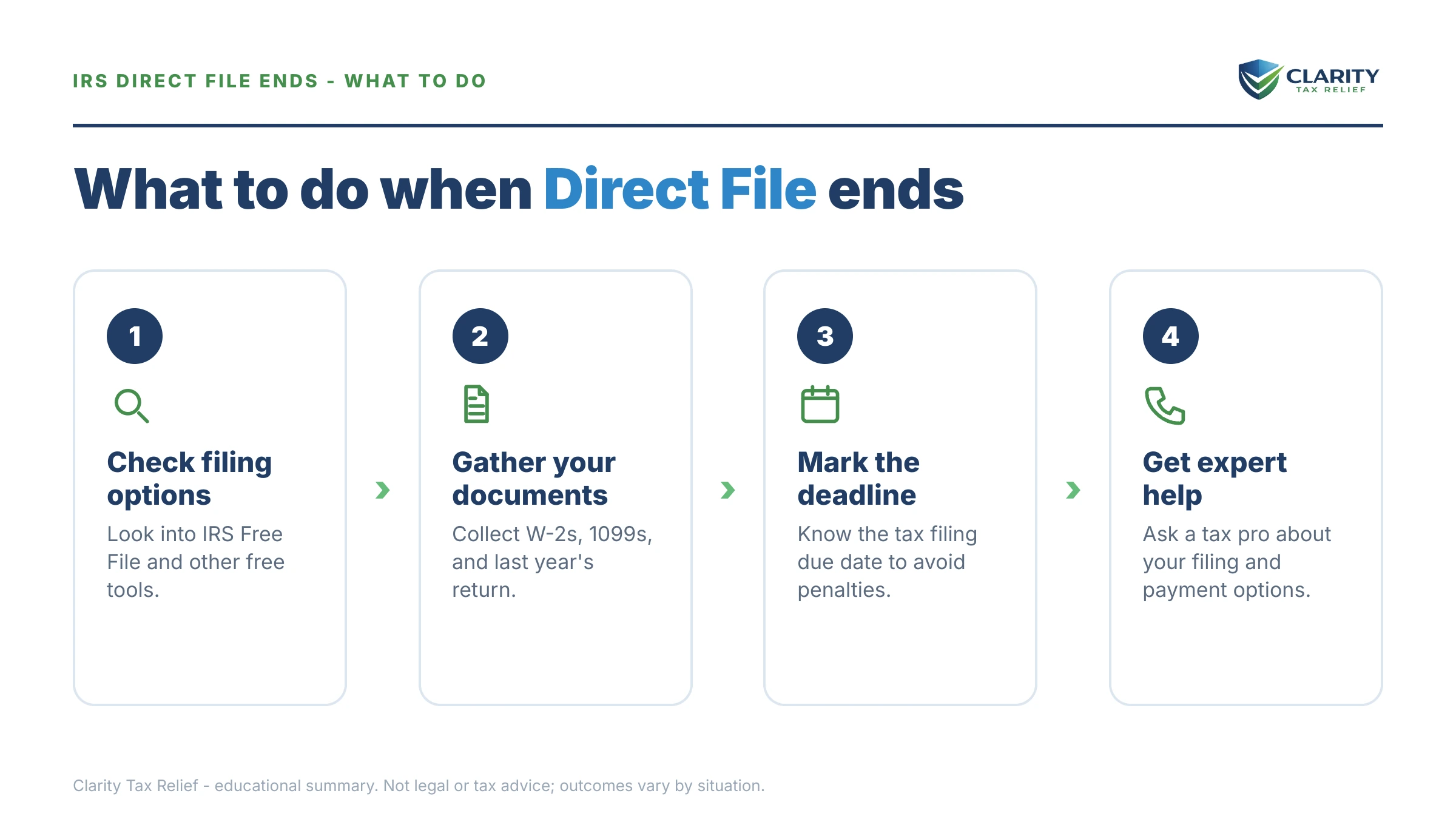
⏱ The clock that still matters: if you filed a 2025 extension, your Form 1040 is due October 15, 2026. An extension never extended your time to pay — interest and the 0.5% monthly late-payment penalty have been accruing on any unpaid balance since April 15, and skipping the return entirely triggers the far larger 5%-per-month failure-to-file penalty.
IRS Direct File ending: what actually happened
IRS Direct File was the government's own free e-filing tool — it grew from a 12-state pilot in 2024 to 25 states in 2025, then was discontinued after Washington moved to replace it with public-private alternatives. The 2025 budget law known as the One Big Beautiful Bill Act directed the Treasury to study those alternatives instead of continuing an IRS-run product, and the program was wound down afterward.
Two facts about Direct File matter for what you do next. First, it only ever handled federal returns — it handed you off to your state's own tools, and those state systems are unaffected by the shutdown. Second, Direct File never supported self-employment income, Schedule C, or K-1s. If your business has grown to the point where you're taking distributions or reporting pass-through income, you were about to outgrow the tool anyway.
What the shutdown does not change: your filing requirement, your deadlines, your estimated-payment schedule, and any balance you already owe. The IRS retired a piece of software, not the tax code.
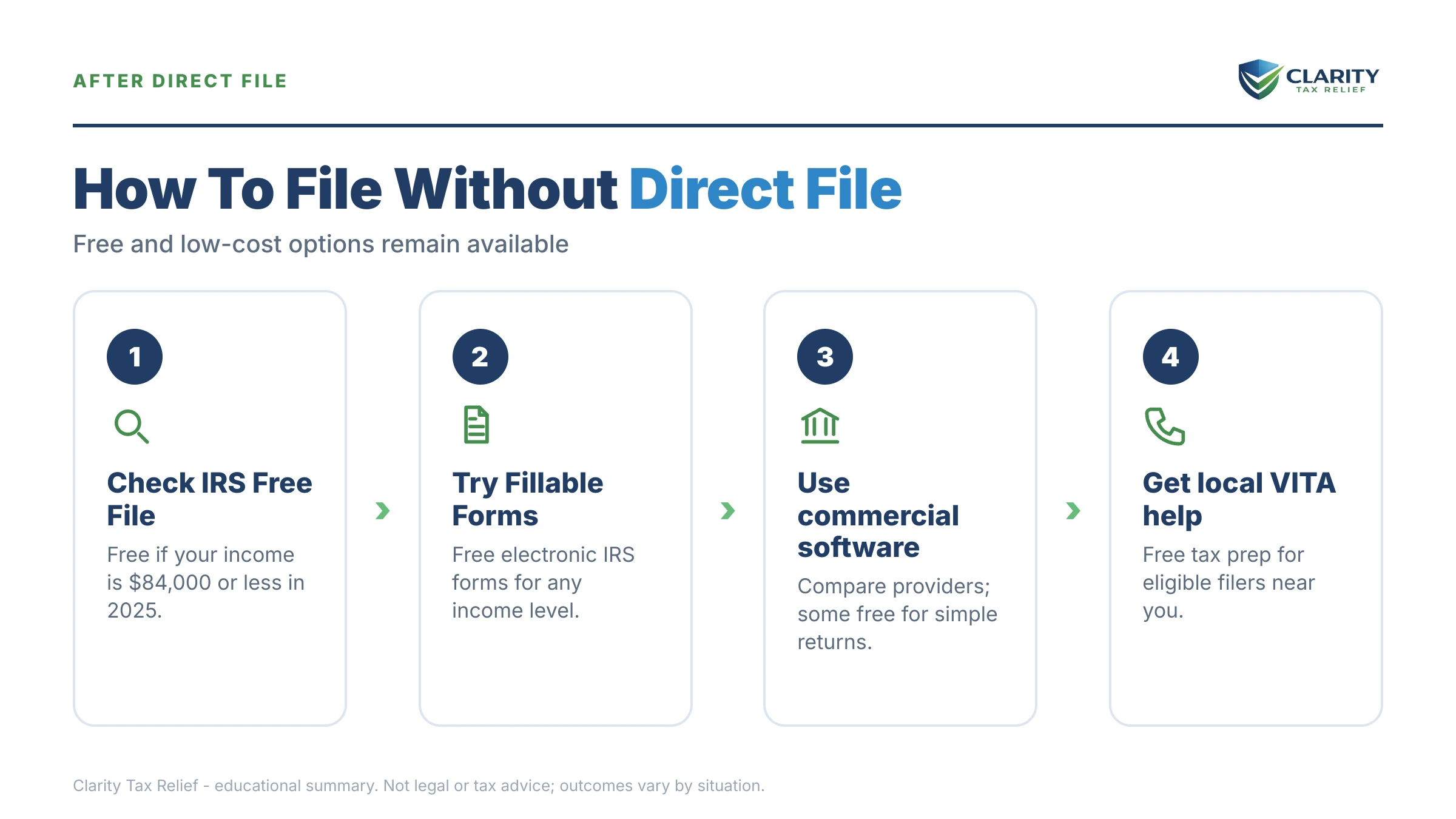
What happens if you don't file after Direct File shuts down
Skipping a return because your filing tool disappeared triggers the exact same penalty machine as skipping it for any other reason. The IRS doesn't record why a return is missing — its systems only see that one is. Here is the sequence, in order:
- The deadline passes. If you owe, the failure-to-file penalty starts at 5% of the unpaid tax per month, capped at 25% — ten times the 0.5% monthly penalty for filing on time but not paying. Interest compounds on top of both.
- Unfiled-return notices arrive. The IRS matches the W-2s and 1099s it received against returns on file and mails increasingly firm letters — CP59 first, then follow-ups demanding the return.
- The IRS files for you. Ignore the letters long enough and the IRS prepares a substitute for return from raw third-party data — no business deductions, no credits, the most expensive possible version of your year — and assesses tax on it.
- Collection begins. The assessed balance enters the standard collection notice stream, ending in a final notice of intent to levy, with liens, bank levies, and wage levies available after that. A balance left to grow can also cross the $66,000 passport-certification threshold for 2026.
One more 2026 reality: the IRS workforce shrank roughly 27% in 2025, so reaching a human is harder than ever — but these notices, assessments, and levies are generated by automated systems that never stopped running. The machine escalates on schedule whether or not anyone answers the phone.
Haven't filed since Direct File went away?
Every month an unfiled return sits, the failure-to-file penalty adds another 5% of the balance — up to 25%. Tell us where you left off and an experienced tax professional will map the fastest way to get filed and squared away. Free, confidential, no pressure.
Your filing options now that IRS Direct File has ended
Every former Direct File user has at least one free replacement — the right one depends on your income and what's on your return. Here's the full menu:
| Option | Cost | Best fit & eligibility |
|---|---|---|
| IRS Free File (guided software) | $0 federal; some partners include a free state return | AGI under the annual cap (about $84,000 for returns filed in 2025 — check the current figure); W-2 and simpler returns |
| Free File Fillable Forms | $0 | Any income level; federal only; you do all the math and lookups yourself |
| VITA / TCE volunteer sites | $0 | Moderate incomes (VITA) or age 60+ (TCE); free in-person preparation by certified volunteers |
| Commercial tax software (paid tiers) | Roughly $0–$150+ federal, plus state fees | Self-employment, K-1s, rentals — the returns Direct File never supported anyway |
| Experienced tax professional (EA or CPA) | Varies; often several hundred dollars for a business owner's returns | Multiple entities, payroll, unfiled back years, or a balance you can't pay |
If your personal return is still simple — W-2 salary from your own company, standard deduction — IRS Free File is the closest one-for-one replacement for what Direct File did, as long as your AGI is under the cap. Above the cap, Fillable Forms cost nothing but hold your hand not at all. If money is tight and your income is moderate, VITA free tax help puts a trained volunteer across the table from you at no charge.
If your business income has moved onto your 1040 — Schedule C, a K-1, rental property — you've left free-tool territory regardless of Direct File's fate, and paid software or a professional preparer is the honest answer. And if a balance comes out the other end of whichever tool you pick, our hub on how to settle tax debt yourself walks through every IRS resolution program in one place. If Direct File itself was the thing that first showed you a balance, our guide to what to do when IRS Direct File shows a balance due covers that exact scenario.
Say you owe $41,800: the math that matters more than your software
The cost of your filing tool is a rounding error next to the cost of filing late. Say your company had its best year yet and your 2025 personal return, once prepared, shows $41,800 due — a purely hypothetical example, with the arithmetic shown:
- File on time, pay nothing yet: the failure-to-pay penalty runs 0.5% per month — about $209 a month on $41,800, plus interest.
- Don't file at all: the failure-to-file penalty runs 5% per month — about $2,090 a month — until it caps at 25%, which is $10,450 after roughly five months. Interest accrues on top.
- The takeaway: filing the return — even with no payment attached — avoids roughly $10,000 in penalties in under half a year. That's why filing even if you can't pay is always the right move; the full comparison lives in our guide to failure-to-file vs. failure-to-pay penalties.
- Then handle the balance: at $41,800 you're under the $50,000 streamlined threshold, so a monthly installment agreement of up to 72 months is generally available online — roughly $580 a month on the raw balance, with interest and the late-payment penalty continuing until it's paid off.
You can estimate your own penalty and interest exposure with our IRS Penalty & Interest Calculator. Interest itself almost never comes off just for asking — see can IRS interest be waived for the narrow exceptions — but penalties often can be abated, and starting summer 2026 the IRS's new Automatic Exemption from Penalty (AEP) applies some first-time relief automatically, with no request needed.
One persona-specific warning: if your business is also behind on payroll deposits, that debt is a different animal entirely — trust-fund money the IRS pursues personally. Handle 941 back taxes before, not after, your personal filing gap.
Deadlines that still apply after Direct File
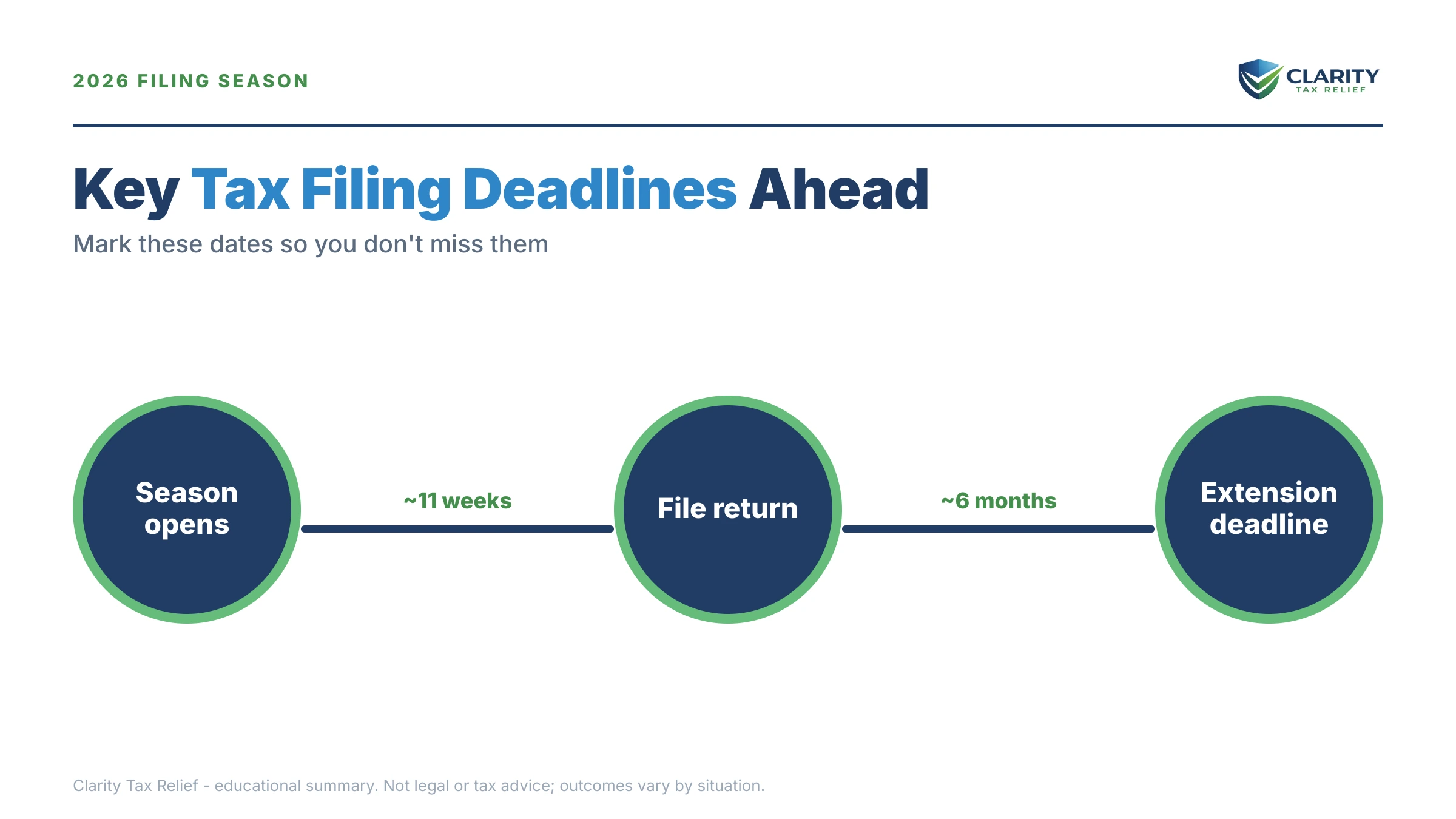
Direct File's shutdown moved zero deadlines. For a business owner filing in the second half of 2026, these are the dates on the board:
| Deadline | What's due | If you miss it |
|---|---|---|
| September 15, 2026 | Q3 2026 estimated payment (self-employed and owners without enough withholding) | Underpayment penalty accrues on the shortfall |
| October 15, 2026 | Extended 2025 Form 1040 (if you filed Form 4868) | Failure-to-file penalty applies to any unpaid balance — 5% per month, up to 25% |
| January 15, 2027 | Q4 2026 estimated payment | Underpayment penalty accrues on the shortfall |
| April 15, 2027 | 2026 Form 1040 and full payment — the first filing deadline with no Direct File | Failure-to-file and failure-to-pay penalties plus interest begin |
If you pay yourself a salary through payroll, check your year-to-date withholding now — bumping withholding for the rest of 2026 can cover an estimated-payment gap, because withholding is treated as paid evenly through the year. The full quarterly calendar is in our guide to quarterly estimated tax deadlines for 2026.
How to switch from Direct File, step by step
- Retrieve your prior returns. Log into your IRS online account and download tax return transcripts for the years you filed through Direct File — or use the PDFs you saved at filing time. You'll need last year's AGI to e-file with any new software.
- Pick your replacement filing method. Match your situation to the options table: Free File under the income cap, Fillable Forms above it, a VITA site for free in-person help, or commercial software or an experienced tax professional for business and K-1 returns.
- Gather this year's documents. Collect W-2s, 1099s, K-1s, payroll reports, and estimated-payment records now, so a new tool's longer interview doesn't push you past a deadline.
- File by the deadline even if you can't pay. Filing stops the 5%-per-month failure-to-file penalty immediately. Payment is a separate problem with its own programs — never hold a finished return hostage to an unpaid balance.
- Set up payment if you owe. Pay in full at IRS.gov/payments if you can. If not, request a short-term plan (up to 180 days, no setup fee) or a monthly installment agreement — balances under $50,000 generally qualify for up to 72 months online.
Step one is easier with our walkthrough of IRS online account setup, and step five is covered click-by-click in how to set up an IRS payment plan online — with a comparison of every payment channel in the best way to pay the IRS. The official starting points are IRS Free File at IRS.gov and the IRS payments page.
When you can handle this yourself — and when help changes the outcome
Most former Direct File users don't need professional help to keep filing. If your return is W-2 income plus the standard deduction, you're current on every year, and any balance is one you can pay within 180 days, pick a free option from the table, file, and move on — hiring anyone for that would be overkill.
Experienced help earns its cost in specific situations: two or more unfiled years (order and penalty strategy change what you pay), a balance you genuinely can't cover on any realistic plan, business payroll debt alongside a personal balance, an IRS-prepared substitute return that inflated your bill, or a levy already in motion. In those cases the question isn't which software to use — it's which resolution program fits your numbers, and getting that sequence wrong is expensive.
Terms you'll be reading, decoded
- Direct File — the IRS's own free e-filing tool (2024–2025), now discontinued; it only handled simple federal returns.
- IRS Free File — a separate, still-active partnership where commercial software companies offer free guided federal returns to filers under an annual income cap.
- Free File Fillable Forms — free electronic versions of the paper Form 1040 with no income limit and no guidance; you compute everything yourself.
- VITA / TCE — IRS-sponsored volunteer programs that prepare returns free, in person, for moderate-income filers (VITA) and taxpayers 60+ (TCE).
- Substitute for Return (SFR) — a return the IRS files for you from W-2/1099 data when you don't file, with no deductions or credits in your favor.
- Failure-to-file penalty — 5% of the unpaid tax per month a return is late, capped at 25%; ten times the 0.5% monthly failure-to-pay penalty.
Direct File shutdown questions, answered
Why is the IRS ending Direct File?
Direct File is ending because of a policy decision in Washington, not because the tool broke. The 2025 budget law known as the One Big Beautiful Bill Act directed the Treasury to study public-private alternatives to an IRS-run filing tool, and the program was wound down afterward. Whatever you think of that decision, your filing obligation is unchanged — you just need a different method.
Is IRS Free File ending too?
No. IRS Free File is a separate program — a partnership between the IRS and commercial software companies — and it is still available. If your adjusted gross income is under the annual cap (about $84,000 for returns filed in 2025; check the current figure), you can prepare a free guided federal return through a Free File partner. Above the cap, Free File Fillable Forms remain free with no income limit.
Can I still get copies of returns I filed with Direct File?
Yes. Even if you can no longer log into the Direct File tool, everything you filed lives in IRS records. Create or sign into your IRS online account and pull a tax return transcript for each year you need — transcripts are free, and lenders and preparers accept them. If you saved the PDF when you filed, that works too.
What is the closest free replacement for IRS Direct File?
For most former Direct File users, IRS Free File guided software is the closest match: free, online, and interview-based. If your income is over the Free File cap, Free File Fillable Forms are free at any income but you do the math yourself. If you'd rather sit with a person, VITA sites prepare returns free for moderate-income filers, and TCE serves taxpayers 60 and older.
Do I still have to file now that Direct File is gone?
Yes — the tool ended, not the law. A free filing path exists at every income level, so cost is never a reason to skip a return. If you don't file and you owe, the failure-to-file penalty runs 5% of the unpaid tax per month, up to 25%, and the IRS can eventually file a substitute return for you that ignores your deductions.
What if Direct File showed a balance due that I never paid?
That balance did not disappear with the program. Interest and a 0.5% monthly late-payment penalty have been accruing since the original due date, and the IRS collection notice sequence runs on autopilot. Check your current balance in your IRS online account, then set up a payment plan — balances under $50,000 can usually be put on a plan of up to 72 months online.
Does the end of Direct File affect my state tax return?
No — state filing runs on separate systems. Direct File only handled federal returns and handed you off to your state's tools, and several states operate their own free direct-file programs that are unaffected. Check your state revenue agency's website for its current free-filing options before paying for state software.
Will the IRS build a replacement for Direct File?
Nothing has been announced that you can plan around. The Treasury task force created in 2025 is studying public-private options, but no launch date or product exists, and outcomes in Washington are unpredictable. For the upcoming season, assume the current lineup — Free File, Fillable Forms, VITA/TCE, commercial software, and professional preparers — is what's available.
Your next 24 hours
- Find last year's AGI. Pull it from your saved Direct File PDF or a transcript in your IRS online account — every replacement tool will ask for it to verify your identity at e-file.
- Gather your documents. Last year's return, this year's W-2s, 1099s, and K-1s, payroll reports, and any estimated-payment confirmations — one folder, ready for whichever option you pick.
- If you're behind or you owe, get a free case review. Unfiled years and unpaid balances only get more expensive as penalties and interest accrue — use the 2-minute form at claritytaxrelief.com/#consult or call (888) 825-7779 and an experienced tax professional will map your fastest path back to current.
This guide is general information, not tax or legal advice for your specific situation. Eligibility for IRS programs depends on individual facts and circumstances; no outcome is guaranteed.