
IRS Audits
Small Business Audit Red Flags: What the IRS Actually Screens For in 2026
The short answer: the small business audit red flags the IRS screens for in 2026: income that doesn't match your 1099s, heavy cash receipts, repeated Schedule C losses, outsized vehicle and home-office deductions, misclassified workers, low S corp owner salaries, and Employee Retention Credit claims. Most flags are fixable with documentation — before a letter ever arrives.
You run the business, you sign the return, and every year the same quiet question follows you to the mailbox: is something on that return going to bring the IRS to your door? Here's the honest answer — audit selection is mostly math, not suspicion. Once you know exactly what the math scores, you can neutralize almost every small business audit red flag before a letter is ever printed.
This guide covers all eleven flags the IRS screens small business returns for, what each one looks like from the IRS side, and — because some readers are already holding an exam letter — what happens next and how to respond. If a letter does arrive, the image below shows you exactly what a real IRS exam notice looks like and where to look on it, so you can recognize the real thing the moment it lands.
⏱ The clocks that matter: there is no deadline to fix red flags — the risk simply compounds with each return you file. But once an audit opens, the response date printed on your letter controls. After the exam report, you typically have 30 days to appeal, and a CP3219A Notice of Deficiency gives you exactly 90 days to petition Tax Court.
Why the IRS flags small business returns (and who does the flagging)
Every small business return is scored by a computer — the Discriminant Function (DIF) model — before any human ever reads it. Your Schedule C, 1120-S, or 1065 is compared against statistical norms for businesses of your size and industry, and the returns that deviate most get pulled for a classifier to review. At the same time, a separate matching system compares your reported income against every 1099-NEC, 1099-K, W-2, and 1098 filed under your taxpayer ID.
That matters more in 2026, not less. The IRS workforce shrank roughly 27% in 2025, so fewer humans answer phones — but the scoring models, the document matching, and newer AI-assisted selection tools run automatically at full capacity. The practical effect: fewer judgment calls, more math. A return that scores clean rarely gets touched; a return with two or three stacked flags gets scored the same way every single year it repeats them.
Self-employed and small business returns have historically drawn more exam attention than comparable W-2-only returns for one simple reason: you self-report both sides of the equation, income and expenses. Nobody withholds for you, and nobody verifies your deductions but you — until an examiner does.
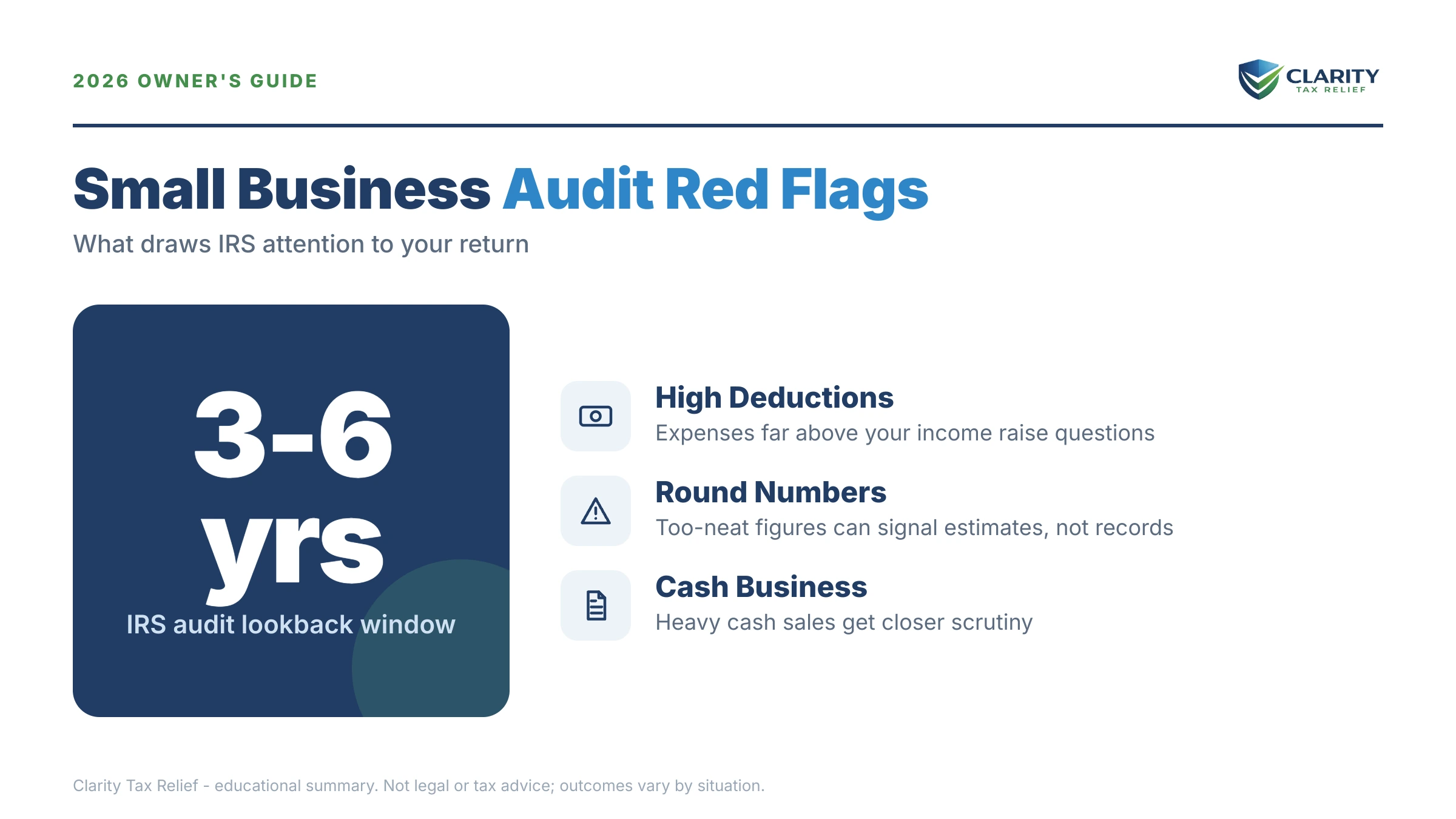
The 11 small business audit red flags the IRS screens for in 2026
Stacked flags — not any single one — are what turn a scored return into an opened exam. Here is the full list, with the reason each item is screened and the fix that actually lowers your score:
| Red flag | Why the IRS screens for it | Your best protection |
|---|---|---|
| Income below your 1099 totals | Computer matching catches the gap automatically | Reconcile every 1099-K and 1099-NEC against gross receipts before filing |
| Heavy cash receipts | No third-party paper trail; income gets reconstructed | Deposit everything; document non-taxable deposits the day they occur |
| Losses in 3+ of the last 5 years | Hobby-loss screening under Section 183 | Real books, a business plan, documented profit efforts |
| Vehicle claimed at 100% business use | Statistically implausible for most owners | A contemporaneous mileage log (app or diary) |
| Oversized home office deduction | The regular-and-exclusive-use test fails often on exam | Measure the space; consider the simplified method |
| Deductions far above industry norms | DIF scoring compares you to similar businesses | Keep receipts for every outlier category; expect to prove them |
| Round numbers everywhere | $5,000 and $12,000 signal estimates, not records | Report actual figures straight from your books |
| 1099 contractors who work like employees | Payroll-tax gap enforcement, federal and state | Contracts, invoices, and genuine contractor control over the work |
| S corp owner: big distributions, low salary | Screened as a payroll-tax avoidance pattern | Pay documented reasonable compensation via W-2 |
| Employee Retention Credit claims | Top enforcement priority with a 5-year assessment window | Keep eligibility workpapers; re-review promoter-filed claims now |
| Missing or mismatched 941s | Cross-checked against W-2/W-3 totals and deposits | File every quarter and reconcile at year-end |
Income red flags: the matches you can't argue with
An income mismatch is the one flag the IRS never has to think about — the computer finds it. Every 1099-K from your card processor, every 1099-NEC from a client, lands in an IRS database keyed to your EIN or SSN. If your reported gross receipts come in below the sum of those forms, a notice or exam follows with near-mechanical certainty. Before filing, total every information return you received and make sure your gross receipts equal or exceed that figure — including income nobody issued a form for.
Cash is the second income flag, and it works differently: instead of matching documents, the examiner reconstructs. In a cash business audit, the IRS adds up your bank deposits, applies industry markup ratios, and treats every deposit you can't explain as taxable income. Restaurants, salons, trades, and vending operations live under this lens permanently.
One more income point matters here: understating gross income by more than 25% extends the assessment window from three years to six. The general rules on how far back the IRS can audit are covered in our hub guide — the takeaway for owners is that income flags don't just raise your odds, they lengthen your exposure.
Deduction red flags: losses, vehicles, home offices, and round numbers
The IRS presumes your business has a profit motive if it made money in at least 3 of the last 5 years. Miss that mark and Section 183 hobby-loss screening kicks in — and a reclassification doesn't just deny this year's loss, it can unwind losses for every open year at once. Losses aren't fatal; undocumented losses are. Separate bank accounts, real bookkeeping, and evidence you're trying to become profitable are what keep a money-losing business a business.
Vehicles are the most commonly disallowed deduction in small business exams, because claiming 100% business use of your only car is almost never true — and examiners know it. When the IRS wants a mileage log, "I didn't keep one" is the answer that costs the entire deduction. A mileage app running in your pocket eliminates this flag completely.
Home offices trigger fear out of proportion to their actual risk. The deduction is legitimate and you should take it — the problems are claiming a space that isn't used regularly and exclusively for business, or deducting a share of your home that doesn't survive a floor-plan check. The simplified method ($5 per square foot, capped at 300 square feet) removes nearly all of the exam friction.
Finally, watch your return's texture. A Schedule C full of round numbers reads like estimation, and expense ratios far above your industry's norms raise your DIF score line by line. If you're already facing questions about a self-employed return, our Schedule C audit guide covers the exam itself — and if your documentation is thin, being audited with no receipts is a solvable problem, not a lost cause.
People and payroll red flags: classification, salaries, and 941s
Worker classification is the flag with the biggest dollar consequences, because it converts one exam into a payroll-tax liability across every worker and every open quarter. If your 1099 contractors work set hours, use your tools, and take your direction, the IRS — and your state — can reclassify them, and the worker misclassification penalty stack includes back withholding, FICA, and failure-to-deposit penalties.
S corporation owners have their own version: taking large distributions while paying yourself little or no W-2 salary. The IRS screens returns for exactly that ratio, and the exposure — reclassified wages plus payroll tax plus penalties — is laid out in our guide to S corp reasonable salary back taxes. There's no magic number; the standard is what a similar business would pay someone to do what you actually do.
Payroll filings themselves are cross-checked, too. Quarterly 941 totals that don't reconcile to year-end W-2s, or quarters that simply never got filed, are flagged mechanically — and payroll problems escalate faster than income tax problems, because withheld taxes are treated as trust funds, not ordinary debt.
The 2026-specific red flags: ERC, the 1099-K myth, and AI selection
Employee Retention Credit claims are the single hottest small business exam category in 2026, with a five-year assessment window that keeps even early claims open. If a promoter prepared your claim and you can't reproduce the eligibility analysis, get it reviewed now — our ERC audit guide walks through what examiners ask for and how disallowance plays out.
Meanwhile, don't misread the 1099-K change. The reporting threshold reverted to $20,000 and 200 transactions, so many platforms will send fewer forms — but the platforms still keep every record, and an examiner can pull your full deposit history regardless of whether a form was issued. "No 1099 arrived" has never meant "not taxable," and treating it that way creates the exact income mismatch pattern the bank-deposit method is built to expose.
Last: selection itself is getting smarter. The IRS has been shifting exam selection toward AI-assisted models that weigh patterns across years — meaning a flag you repeat annually compounds, and a flag you clean up genuinely lowers next year's score. The system is unforgiving of drift but responsive to correction.
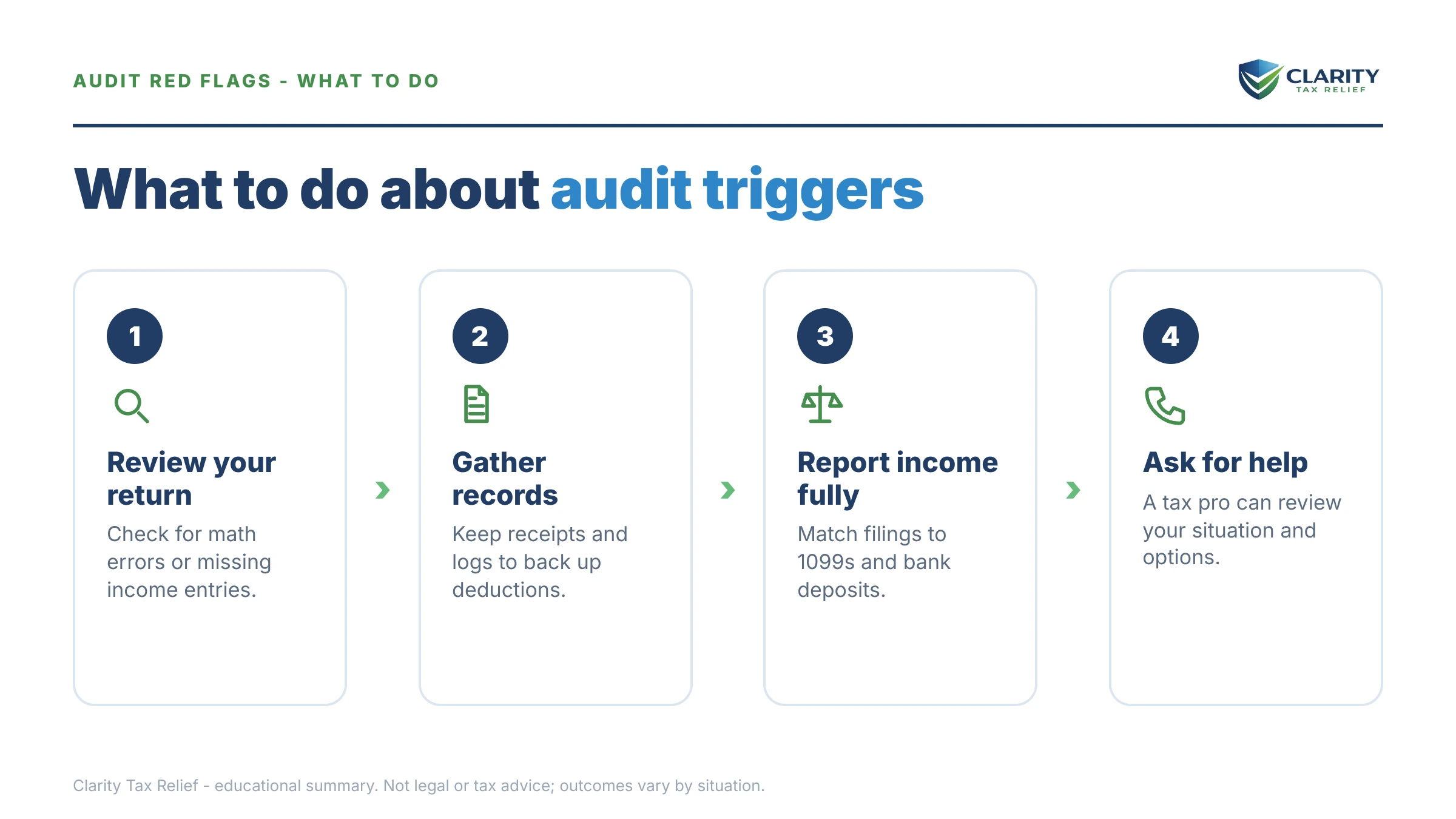
What happens if you ignore an audit letter
An ignored audit letter doesn't close your case — the IRS finishes the exam without you and assesses the full proposed amount. The sequence runs in a fixed order, and every stage you skip costs you a right you don't get back:
- The exam opens — a Letter 566 (correspondence audit) or Letter 2205-A (appointment exam) arrives by mail, naming the tax years and the specific items under review, with a response date printed on it.
- The response date passes — the examiner proceeds with only the information the IRS already holds. Every deduction you didn't substantiate is disallowed; every unexplained deposit becomes income.
- The exam report arrives — Letter 525 or Letter 915 shows the proposed changes, the tax, and usually a 20% accuracy-related penalty. You typically have 30 days to protest to the IRS Independent Office of Appeals.
- The 90-day letter — ignore the report and a CP3219A Notice of Deficiency follows, starting a hard 90-day clock to petition Tax Court. This is your last stop before the amount becomes legally owed.
- Assessment and collection — the proposed amount posts to your account, a bill arrives, and the standard collection sequence begins: escalating notices, then lien filing and levy authority. For a retiree, that eventually includes the Federal Payment Levy Program's reach into Social Security.
Notice what that sequence really means: the exam is the cheap stage. Every document you produce before assessment removes dollars from the bill; every stage after assessment is about managing a debt that already exists.
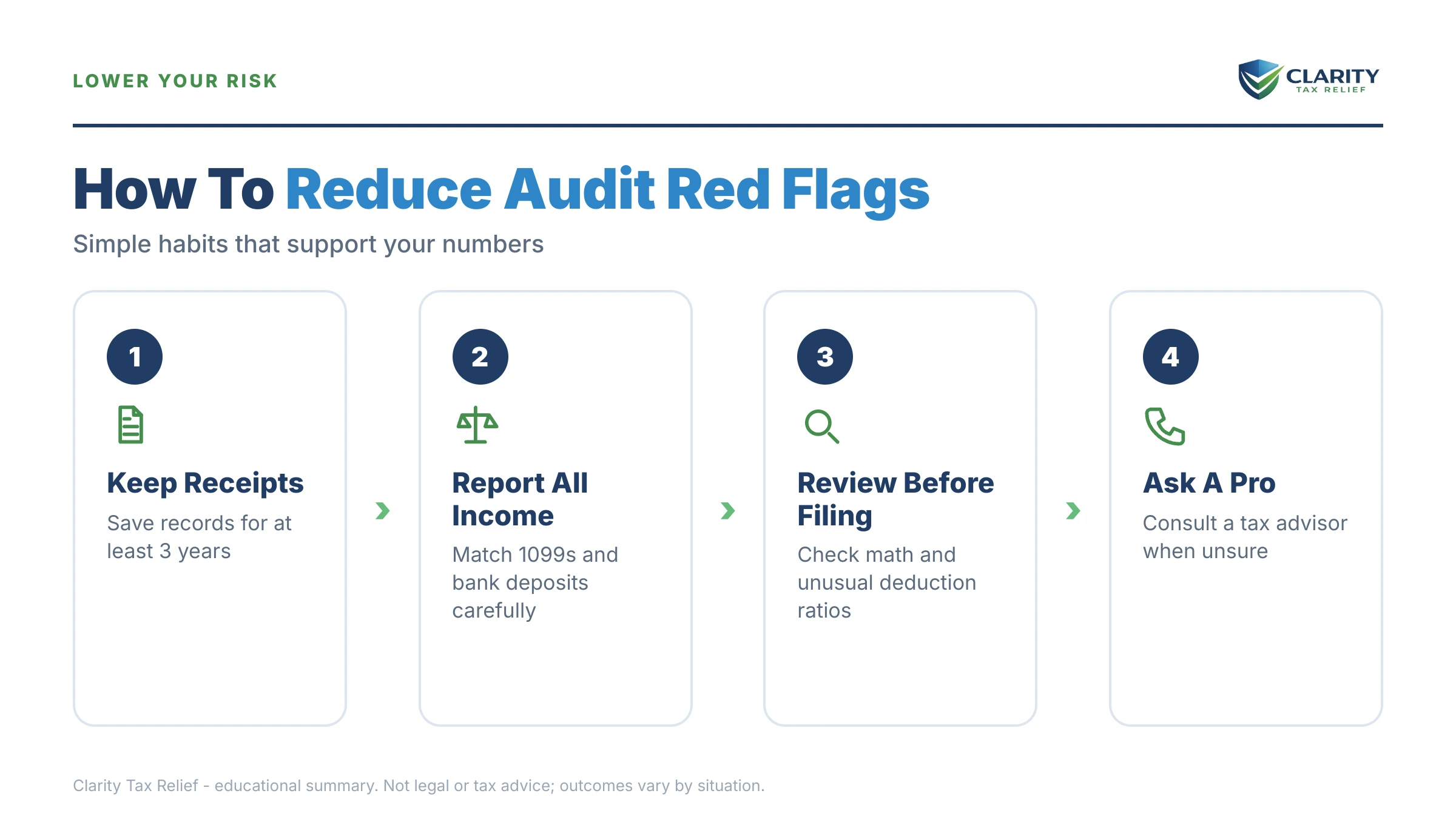
See your own return in these red flags — or holding an exam letter already?
Send us the letter, or just describe what's on your return. An experienced tax professional will tell you exactly where you stand and what to do before your printed response date passes — free, confidential, no pressure.
Your options if the audit ends in a balance you can't pay
A small business audit balance of $50,000 or less can generally go onto a streamlined installment agreement of up to 72 months — set up online, no financial statement required. And before you get to payment options at all, remember the free one: you can contest the findings. An IRS audit appeal filed within the 30-day window costs nothing and resolves a large share of disputed exams for less than the proposed amount.
| Option | Who qualifies | Cost and the catch |
|---|---|---|
| Appeal / audit reconsideration | Anyone who disagrees with the findings | Free; 30-day window after the exam report, or reconsideration later with new documentation |
| Pay in full | Anyone | Stops further penalties and interest immediately; ends the notice sequence |
| Short-term plan (up to 180 days) | Balance you can clear within 180 days | $0 setup; interest and the 0.5%/month late-pay penalty continue until paid |
| Guaranteed installment agreement | Income tax balance of $10,000 or less, clean filing history | Approval is required by law if conditions are met; paid within 36 months |
| Streamlined installment agreement | Up to $25,000 — or up to $50,000 with direct debit | Up to 72 months, set up online; setup fee applies; interest keeps accruing |
| Non-streamlined agreement | Balances over $50,000 | Form 433 financial disclosure; lien filing becomes a live consideration |
| Currently Not Collectible | Income can't cover IRS allowable living expenses | Collection pauses; the debt and interest remain and the IRS reviews periodically |
| Offer in Compromise | Assets plus future income genuinely below the balance | $205 fee and 20% down on lump-sum offers — both waived with low-income certification; roughly 1 in 5 offers accepted in FY2024 |
| Penalty abatement (FTA / AEP) | Clean compliance in the prior 3 years | Removes penalties, not tax; the new Automatic Exemption from Penalty begins applying automatically in summer 2026 |
Which of those is realistic depends heavily on the size of the bill. Here's how the bands break in 2026:
| Audit balance | Realistic path |
|---|---|
| Under $10,000 | Guaranteed installment agreement (36 months) or short-term full pay; usually safe to handle yourself |
| $10,000 – $25,000 | Streamlined agreement online, up to 72 months; penalty abatement worth checking first |
| $25,001 – $50,000 | Streamlined agreement with direct debit; OIC or CNC if income genuinely can't support payments |
| $50,001 – $66,000 | Financial disclosure (Form 433) required; lien exposure; professional review pays for itself here |
| Over $66,000 | Passport certification threshold crossed ($66,000 in 2026); revenue officer assignment possible; get experienced help before responding |
What a small business audit bill looks like: the math on $48,300
Say you're 68, retired on Social Security, and running a small furniture-restoration business on Schedule C — a genuine business, but one that showed losses two years running while your online-marketplace sales went partly unreported. The exam disallows the losses, adds the unreported deposits, and the report proposes $35,000 in additional tax across two years. Add the 20% accuracy-related penalty ($35,000 × 0.20 = $7,000) and roughly $6,300 of accrued interest, and the bill is $48,300. (You can run your own numbers through our IRS Penalty & Interest Calculator to estimate how a proposed assessment grows.)
What are the realistic moves? First, the appeal: if the "unreported deposits" include a CD you cashed out and redeposited, documentation kills that adjustment entirely before assessment — this is why the 30-day window matters more than any payment plan. Second, if the number stands: $48,300 sits just under the $50,000 streamlined ceiling, so a direct-debit agreement over 72 months runs about $48,300 ÷ 72 ≈ $671 per month — with interest continuing to accrue, so the true payoff is somewhat higher and faster payment always costs less.
Third, the fixed-income reality. If $671 a month is impossible on Social Security plus modest shop income, Currently Not Collectible status can pause collection entirely, and an Offer in Compromise may fit if your assets and future income genuinely can't cover the debt — with low-income certification (AGI at or below 250% of the federal poverty level) waiving both the $205 fee and the 20% down payment. And know the stakes of doing nothing: an unpaid assessment eventually reaches benefits, because the IRS can garnish Social Security at up to 15% through the Federal Payment Levy Program.
How to respond to a small business audit, step by step
- Confirm the letter is real. A genuine audit opens by postal mail — verify the notice through your IRS online account or by calling the IRS directly, never a number printed on a suspicious letter.
- Calendar the response date. The date printed on your letter controls everything that follows — missing it lets the IRS finish the exam without you and assess the full proposed amount.
- Read exactly what is being examined. Audit letters list specific years and specific items; answer what is asked and volunteer nothing beyond it.
- Gather and reconstruct your records. Bank statements, invoices, mileage apps, calendars, and photos can rebuild documentation the IRS will accept — missing receipts are a solvable problem.
- Respond in writing by the deadline. Send copies, never originals, with a cover letter matching each document to the item questioned, and keep proof of mailing.
- Appeal before you sign anything you dispute. The exam report gives you typically 30 days to protest to the IRS Independent Office of Appeals — signing away that right is permanent.
The IRS's own overview of the exam process is at IRS audits for small businesses and the self-employed, and any payment you do make should go only through IRS.gov/payments.
When you can handle an audit yourself — and when help changes the outcome
You can handle a correspondence audit over a single, well-documented issue yourself. If the letter questions one deduction, you have the receipts, and the numbers are small, a clear written response with organized copies resolves most of these without anyone else involved. The same goes for a small resulting balance — anything under about $10,000 with clean prior compliance fits the guaranteed installment agreement, and setup takes minutes online.
Experienced help changes outcomes in specific situations: a field audit at your place of business, a cash-income reconstruction where the examiner's method — not your books — sets the number, multiple years or multiple entities under exam at once, payroll or classification issues where trust-fund liability can reach you personally, and any ERC claim you can't independently defend. Representation also matters when there's something under the surface — unreported income you know about, records that don't say what the return says. That scenario has its own name and its own rules, covered in our eggshell audit guide, and it's the one situation where you should say nothing to an examiner before getting advice.
One structural advantage of representation is simple: your representative talks to the examiner so you don't, and casual answers to casual-sounding questions are how small exams become big ones. If the taxpayer service side of the IRS is failing you — lost responses, ignored mail — the Taxpayer Advocate Service exists precisely for cases stuck in the machinery.
If your return shows more than one of the red flags above — or an exam letter is already on your desk — a free review with an experienced tax professional at (888) 825-7779 or through the 2-minute form will tell you whether this is a handle-it-yourself situation before you spend anything.
Terms on your audit letter, decoded
- DIF score — the computer-generated number that ranks your return's audit potential against statistical norms for similar businesses.
- IDR (Information Document Request) — the examiner's formal list of records to produce, usually on Form 4564, each with its own due date.
- Form 872 — a consent extending the time the IRS has to assess tax; whether to sign one is a strategic decision, not a formality.
- Accuracy-related penalty — the 20% penalty added to most audit assessments for negligence or substantial understatement.
- RAR / exam report — the Revenue Agent Report showing every proposed change; signing it accepts the changes and waives your appeal.
- No-change letter — the best possible ending: the exam closed with your return accepted as filed.
Small business audit red flag questions, answered
What are the biggest small business audit red flags in 2026?
Income that doesn't match the 1099-K, 1099-NEC, and W-2 forms the IRS already holds is the single biggest red flag, because the mismatch is caught by a computer with near-perfect reliability. After that come repeated Schedule C losses, outsized vehicle and home-office deductions, worker misclassification, and Employee Retention Credit claims. Multiple flags on one return raise risk far more than any single flag alone.
Does claiming a home office deduction trigger an IRS audit?
No — a legitimate home office deduction does not by itself trigger an audit, and you should never skip a deduction you're entitled to out of fear. Risk comes from claiming a space that isn't used regularly and exclusively for business, or deducting a share of the home that's implausibly large. The simplified method ($5 per square foot, up to 300 square feet) is the lowest-risk way to claim it.
How many years can my business show a loss before the IRS calls it a hobby?
The IRS presumes you have a profit motive if the business made money in at least 3 of the last 5 years. Losses beyond that don't automatically make it a hobby, but they invite scrutiny under Section 183, and if the IRS reclassifies the activity it can disallow the losses for every open year. Businesses with real books, a business plan, and documented efforts to become profitable can defend losses beyond the 3-of-5 window.
Do cash businesses get audited more than other small businesses?
Yes — businesses that take significant cash (restaurants, salons, trades, vending) face higher exam attention because cash leaves no third-party paper trail. In a cash exam the IRS often rebuilds your income from bank deposits and industry ratios rather than your books, so deposits you can't explain get treated as income. Documenting non-taxable deposits — transfers, gifts, loan proceeds — as they happen is the best protection.
Does the $20,000 1099-K threshold mean the IRS sees less of my income now?
No. The 1099-K threshold reverted to $20,000 and 200 transactions, so fewer forms are issued — but every payment platform still keeps the records, and the IRS can reconstruct your deposits in an audit or summons platform data directly. Income below the reporting threshold is just as taxable, and unreported deposits are exactly what a bank deposit analysis is built to find.
How far back can the IRS audit my small business?
Typically three years from the date you filed, extended to six years if you omitted more than 25% of your gross income, and unlimited if the IRS alleges fraud or you never filed. Employee Retention Credit claims carry their own five-year assessment window. Most small business exams open within about two years of filing, which is why this year's return matters most.
What happens if I can't pay what a small business audit says I owe?
You don't have to pay it all at once. Balances of $50,000 or less generally qualify for a streamlined installment agreement of up to 72 months, short-term plans give up to 180 days with no setup fee, and hardship status or an Offer in Compromise may fit if your income genuinely can't cover the debt. You can also appeal the audit results within the 30-day window before the balance is ever assessed.
Can the IRS audit my business if I'm retired and it's just side income?
Yes — the IRS audits the return, not your employment status, and a retiree's Schedule C side business is screened by the same computer models as anyone else's. Retirees face one specific exposure: if a balance goes unpaid, the Federal Payment Levy Program can take up to 15% of Social Security benefits. Fixed-income taxpayers also have strong options, including hardship status and low-income Offer in Compromise terms.
Will paying myself a low salary from my S corp get me audited?
It can. The IRS specifically screens S corporation returns for owners who take large distributions with little or no W-2 salary, because that pattern avoids payroll tax. There is no fixed safe salary — the standard is reasonable compensation for the work you actually perform, measured against what similar businesses pay. If wages are reclassified, you owe back payroll tax plus penalties on the recharacterized amounts.
Your next 24 hours
- If a letter has arrived: find the tax year and the response date printed near the top — that date controls everything. If no letter has arrived, pull your last three filed returns and every 1099 behind them, and check your own return against the red-flag table above.
- Gather the proof: business bank statements, your mileage record, and receipts for your three largest deduction categories. These are the documents that decide almost every small business exam.
- Get a free case review: use the 2-minute form or call (888) 825-7779. If an exam is open, the printed response date is a real deadline — and if it isn't, penalties and interest on any eventual assessment accrue monthly, so the cheapest moment to fix a flagged return is before anyone asks about it.
This guide is general information, not tax or legal advice for your specific situation. Eligibility for IRS programs depends on individual facts and circumstances; no outcome is guaranteed.