
California State Taxes
CDTFA Payment Plan: How to Qualify and Set One Up in 2026
The short answer: yes — the CDTFA offers payment plans for California sales and use tax debt. You request a CDTFA payment plan through your online services account or your assigned collector, you must stay current on every new return and payment while it runs, and interest keeps accruing until the balance is paid. Shorter plans get approved fastest.
You collected the sales tax at the register, but two slow quarters ago it went toward rent and payroll instead of Sacramento — and now a CDTFA billing notice is sitting next to a new quarterly return that's also coming due. That squeeze is exactly what a payment plan is built for, and the order you fix things in matters as much as the amount.
⏱ The real clock: penalties and interest are added to an unpaid CDTFA balance while it sits, and every new filing period is a fresh chance to fall further behind. The date printed on your most recent CDTFA notice controls what happens next — find it before you do anything else, because a plan requested before that date is far easier to get than one requested after enforcement starts.
Why a CDTFA installment agreement works differently than an IRS plan
Most CDTFA debt is money your customers already paid you — California treats unpaid sales tax as collected funds you were holding for the state, not as ordinary business debt. That changes everything about how the agency negotiates.
The California Department of Tax and Fee Administration administers sales and use tax plus dozens of special taxes and fees. It is a different agency from the Franchise Tax Board (income tax) and the EDD (payroll tax). Each keeps its own balance and its own collectors — an FTB payment plan or an EDD payment plan does nothing for a CDTFA bill, and vice versa.
Because the debt is trust-style money, a CDTFA plan comes with a condition the IRS version doesn't emphasize as hard: you must keep collecting, filing, and remitting every new period's sales tax on time while you pay down the old balance. You're carrying two obligations at once. If you also owe federal tax, the rules there are entirely separate — our guide to how to set up an IRS payment plan online covers those thresholds, and state tax debt vs IRS covers which to tackle first when money is tight.
One more difference that shapes strategy: the CDTFA holds a collection weapon no federal agency has — your seller's permit. More on that below, because it should drive how urgently you act.
What happens if you ignore a CDTFA sales tax balance
The CDTFA can revoke your seller's permit for unpaid sales tax — and without a valid permit, making taxable sales in California is unlawful. Collection doesn't jump straight there, though. It moves in stages, and a payment plan is available at every one of them, just on worse terms the later you start:
- Billing and demand notices. The balance grows with penalties and interest. Requesting a plan here — often right from your online services account — is the cheapest, quietest resolution you will ever get.
- Assignment to a collector. A human at the CDTFA now owns your file. Calls and deadlines start; plans are still very much on the table, but expectations firm up.
- Notice of State Tax Lien. A recorded, public lien attaches to business assets — and to personal assets for sole proprietors and general partners. It complicates loans, leases, and any sale of the business.
- Levies and garnishment. The CDTFA can serve an Order to Withhold on your bank, an Earnings Withholding Order on wages, and levies on receivables and payment processors — the cash a retail business lives on.
- Seller's permit revocation proceedings. After notice and an opportunity to be heard, the CDTFA can revoke the permit and legally end your taxable sales. A plan you are honoring is the most direct defense.
- If the business closes owing tax: dual determination. The CDTFA can assess responsible owners and officers personally under Revenue and Taxation Code section 6829, so the debt follows you home. Our guide to a closed business that owes sales tax covers this in depth.
| Stage | What the CDTFA can do | What you can still do |
|---|---|---|
| Billing / demand notices | Add penalties and interest; queue the account for a collector | Request a plan online — the cheapest window |
| Notice of State Tax Lien | Public lien on business (and personal, for sole props) assets | A plan still stops escalation; lien complicates financing |
| Levy & garnishment | Bank Orders to Withhold, wage orders, levies on receivables and card processors | Negotiate a plan and levy release; raise hardship immediately |
| Permit revocation proceedings | Move to revoke the seller's permit — legally ends taxable sales | Honor a plan to protect the permit; request your hearing |
| Business closes owing tax | Dual determination — personal assessment of responsible persons under §6829 | Contest responsibility on time; resolve personally via plan or offer |
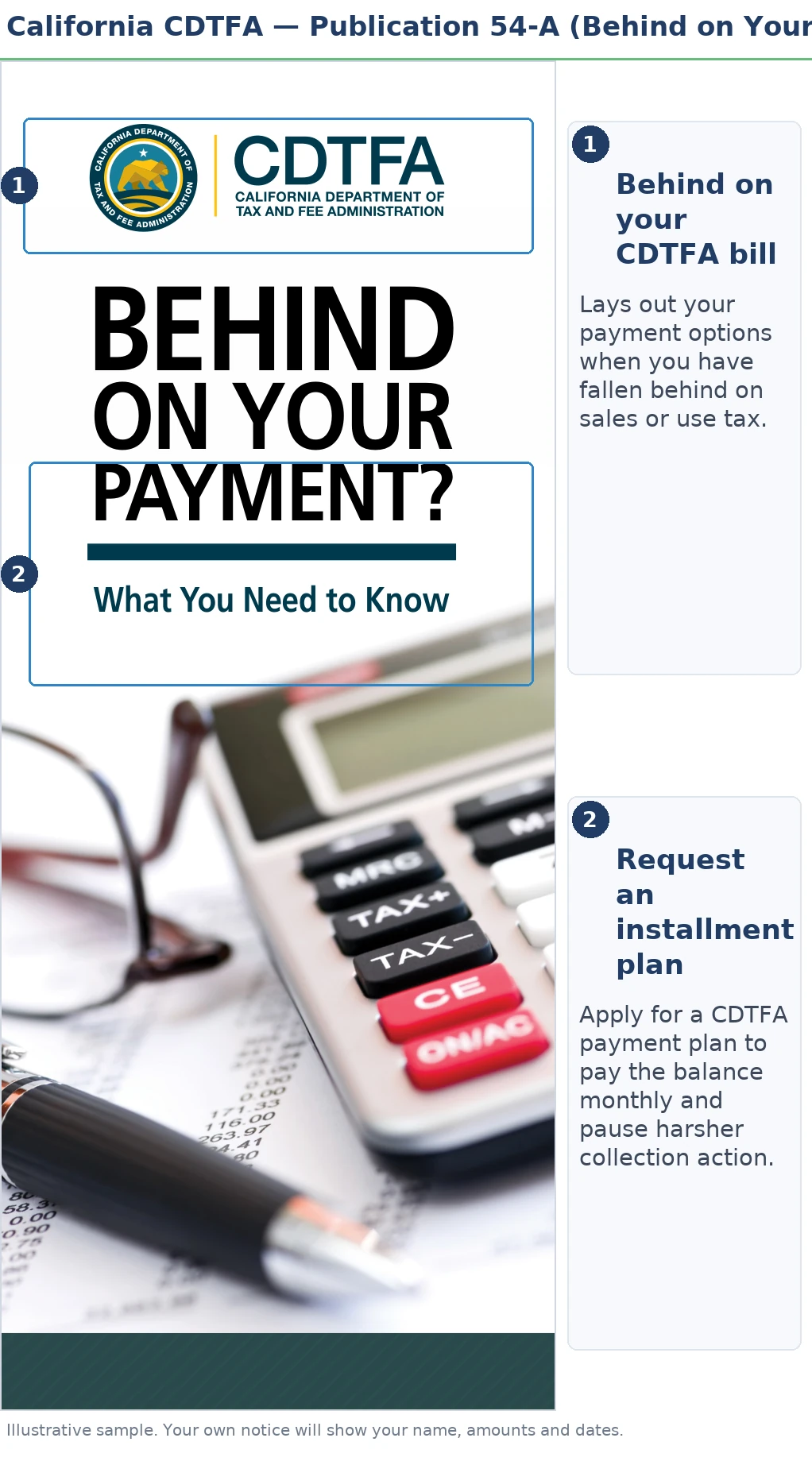
Behind with the CDTFA right now?
If back sales tax is threatening your seller's permit — or a collector is already calling — get your CDTFA notices reviewed free. An experienced tax professional will map the fastest plan the agency is likely to accept, while interest is still the only thing growing.
Your CDTFA payment options, compared
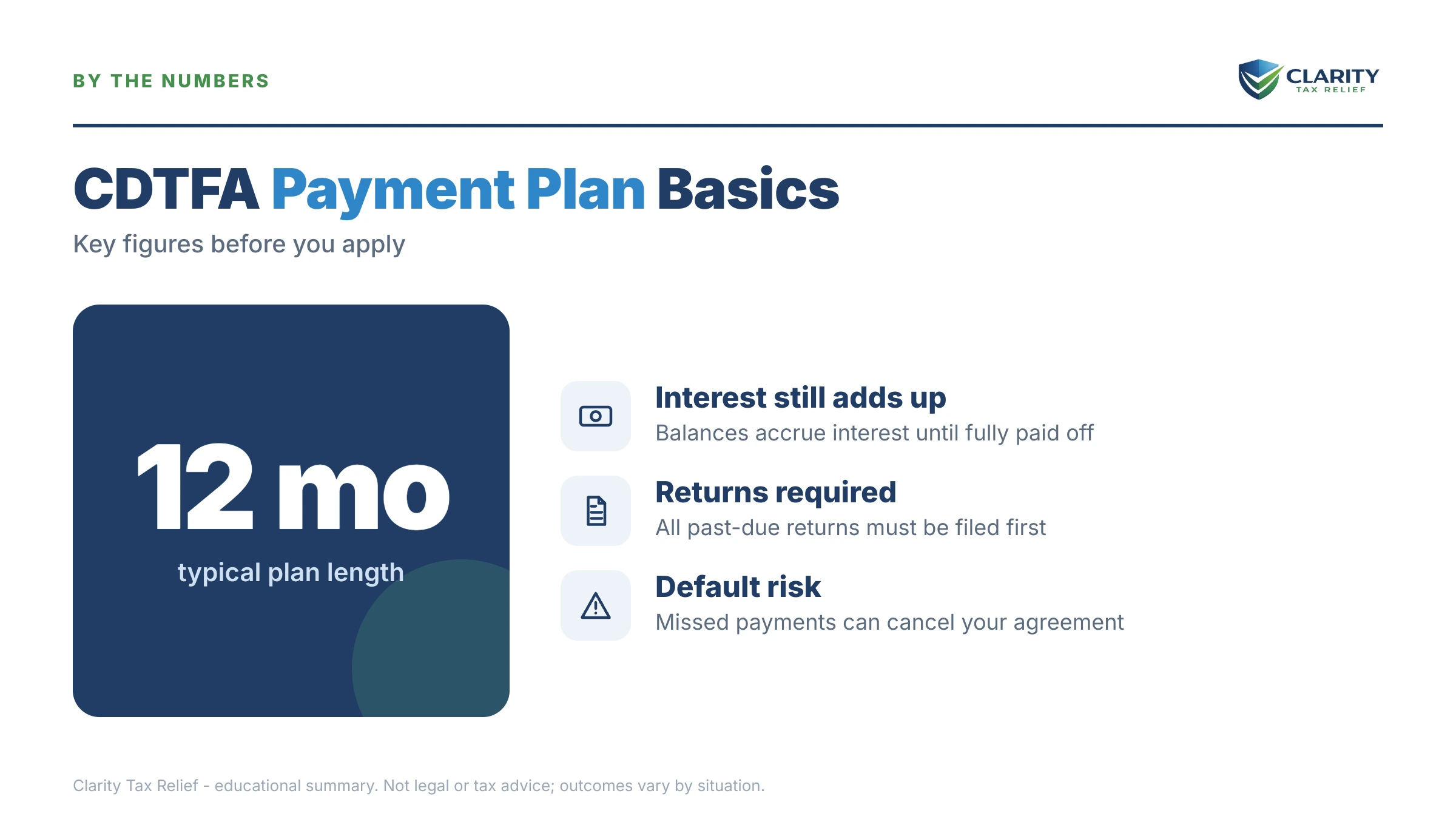
A payment plan is the workhorse, but it isn't the only tool — and the CDTFA evaluates each account on its own facts rather than a single published formula. As a rule, plans that clear the balance within about a year are approved most readily; longer terms usually mean financial disclosure so the agency can verify you're paying what your cash flow genuinely allows. For the wider landscape of state sales tax resolution, see sales tax debt help and our California back sales tax guide.
| Option | Generally fits when | What it costs / requires |
|---|---|---|
| Pay in full | You can raise the money without shorting new tax remittances | Stops interest from growing; the cheapest outcome by far |
| Short-term payment plan | Balance clears in roughly a year; all returns filed | Interest continues; often minimal disclosure; request via online services |
| Longer payment plan | Balance too large for a short term | Financial disclosure; interest continues; a lien becomes more likely; collectors may ask for a good-faith payment up front |
| Penalty relief request | Reasonable cause — disaster, serious illness, events beyond your control | Written request; removes penalties, never the tax or interest |
| CDTFA Offer in Compromise | The balance can never realistically be paid — most often a closed business | CDTFA's own program and forms, means-tested and slow; distinct from the IRS version |
| Dual-determination defense | Business closed and the CDTFA is pursuing you personally | Contest responsibility and knowledge on time; the personal assessment carries its own deadlines |
Two option-specific warnings. First, if your balance came from an audit rather than your own returns, check whether your appeal window on the CDTFA notice of determination is still open before you agree to pay — a payment plan resolves how you pay, not whether the number is right. Second, don't confuse the CDTFA's Offer in Compromise with federal settlement marketing: it's a real program with strict means-testing, not a discount for asking.
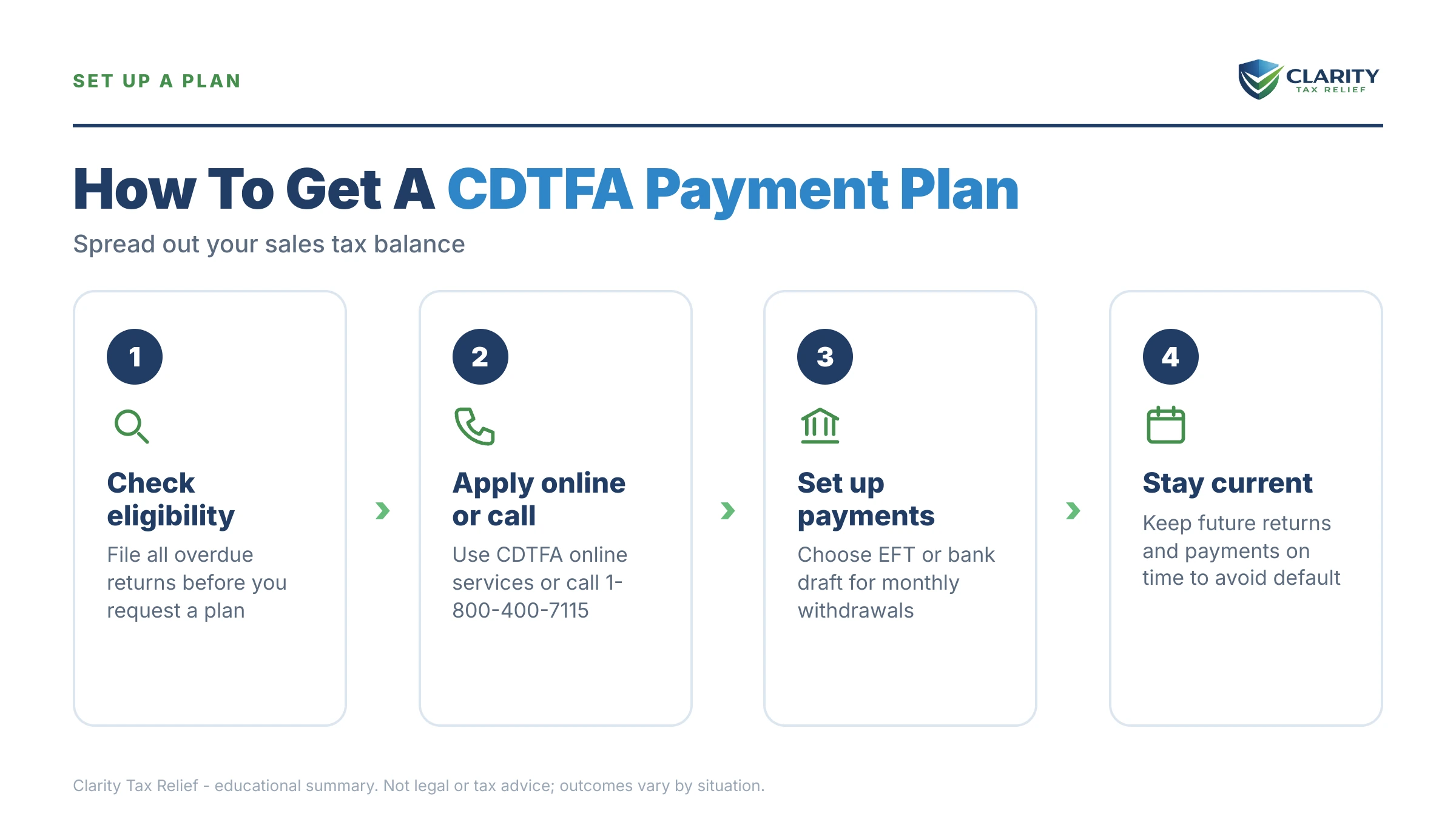
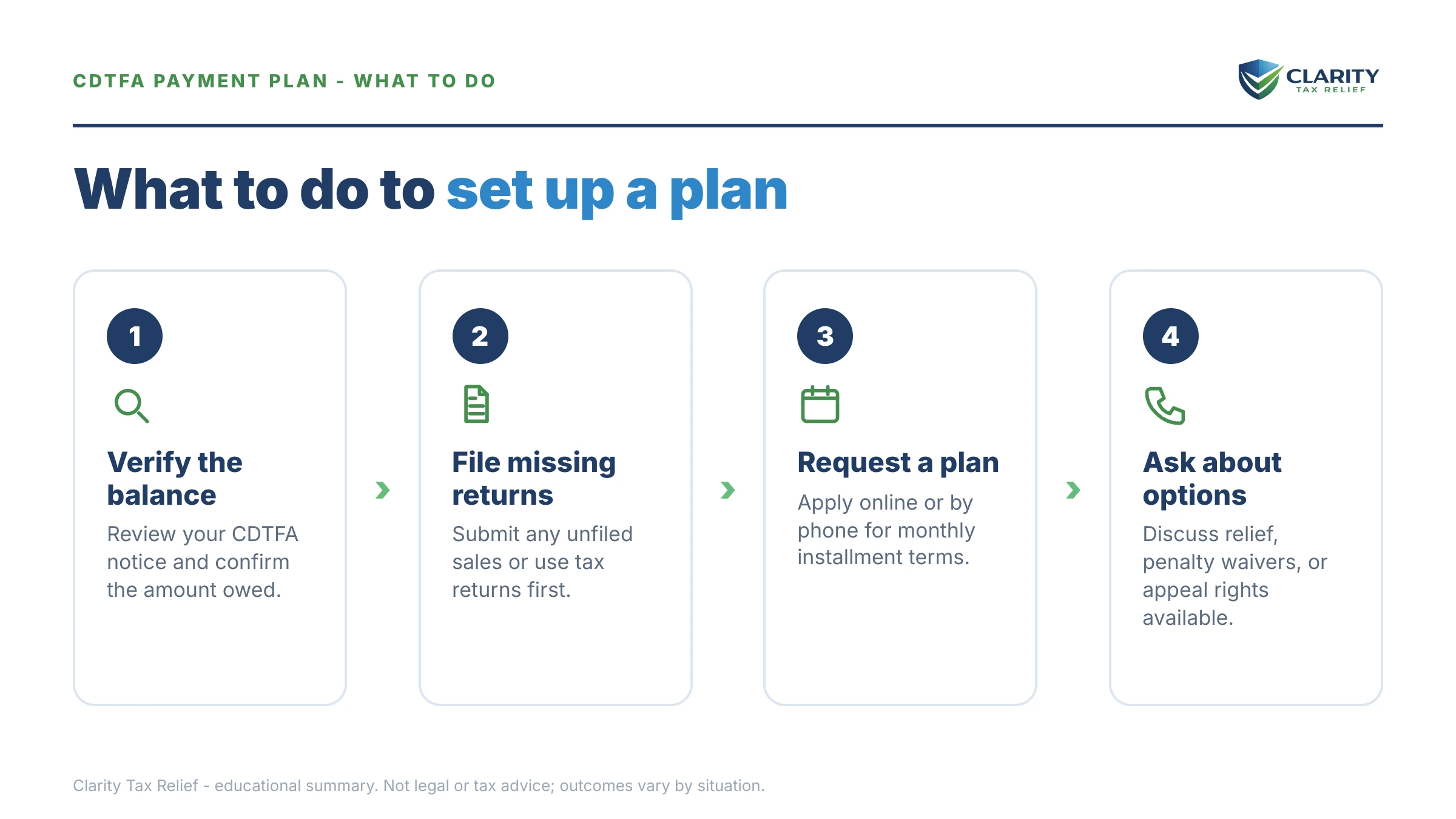
How to set up a CDTFA payment plan, step by step
- Pull your exact balance. Log into your CDTFA online services account and gather every notice. Confirm which periods you owe for and whether the balance is self-reported or came from an audit determination — an audit balance may still have appeal rights attached.
- File every missing return. The CDTFA will not carry a plan on an account with unfiled returns. File everything outstanding first, even zero-sales returns, so the full balance is on the table.
- Set a monthly number your cash flow survives. Add the plan payment to the new sales tax you must keep remitting every period. If the combined number breaks your budget, propose a longer term now rather than defaulting later.
- Request the plan. Submit the request through your CDTFA online services account, or negotiate directly with the collector named on your notices. Have bank details ready; longer terms may require a financial statement, and collectors often ask for a good-faith payment up front.
- Automate payments and stay current. Put the plan payment on autopay and file and pay every new return on time. One missed return or payment can default the whole agreement.
- Request penalty relief in writing. If a disaster, serious illness, or other reasonable cause put you behind, ask the CDTFA in writing to relieve the penalties. Relief removes penalties, not the tax or interest — but on a struggling account, every dollar matters.
What paying off an $8,900 CDTFA balance actually looks like
The math on a CDTFA plan is really two payments stacked on top of each other — the old debt and the new tax you keep collecting. Here's a clearly hypothetical example.
Say you and your spouse run a gift shop as a sole proprietorship and owe the CDTFA $8,900 across two past quarters. On a 12-month plan, the principal alone is $8,900 ÷ 12 ≈ $742 per month, with interest accruing on the shrinking balance on top of that.
But the register keeps running. If the shop collects roughly $2,700 in new sales tax per quarter, that's about $900 per month you must set aside and remit on time. Your real monthly tax obligation during the plan is roughly $742 + $900 = $1,642 until the old debt clears.
Stretch to 24 months and the plan payment drops to about $371 ($8,900 ÷ 24), for a total monthly load near $1,271 — easier on cash flow, but you'll pay more total interest, and a longer term is more likely to trigger financial disclosure and a lien filing. Because a sole proprietorship's tax debt is personal to the owners, the balance can reach household assets, not just the shop's — which is a strong argument for putting the CDTFA ahead of most other creditors in the budget.
The rule that breaks most California sales tax payment plans
Most CDTFA plans fail not on the plan payment but on the current quarter — the new tax the business keeps collecting while paying the old debt. If you're on a prepayment schedule (larger sellers must remit monthly prepayments, not just quarterly returns), the compliance burden is even tighter.
The fix is operational, not financial paperwork: open a separate bank account and sweep the sales tax portion of every deposit into it the day it lands. Money you never see is money you can't accidentally spend. If, even with that discipline, the business can't cover both the plan and the current tax, that's a viability conversation to have early — with an experienced tax professional, before the CDTFA has it with you via a permit revocation notice.
When you can handle this yourself — and when help changes the outcome
An honest line: if your returns are all filed, the balance is a few thousand dollars, you agree with the number, and you can clear it within about a year, request the plan yourself through your CDTFA online services account. You don't need to pay anyone for that.
Experienced help earns its cost when the stakes or complexity jump: a levy or permit revocation is already in motion; the balance came from a CDTFA sales tax audit you may still be able to contest; the business has closed and a dual determination is aimed at you personally; or you owe several agencies at once — CDTFA, FTB, EDD, and maybe a business IRS installment agreement on top. In multi-agency cases, the sequencing (which agency gets paid first, which balance gets contested) often changes the total you pay more than any single plan's terms. For the full California picture, see California tax debt relief.
Terms on your CDTFA notices, decoded
- Seller's permit — the CDTFA-issued license that makes taxable sales legal in California; revocable for unpaid tax.
- Dual determination — a personal assessment under Revenue and Taxation Code §6829 against individuals responsible for a business's unpaid sales tax after it closes.
- Notice of State Tax Lien — a recorded public claim against your property securing the CDTFA's debt.
- Order to Withhold — the CDTFA's levy instrument served on banks and other third parties holding your money.
- Earnings Withholding Order — the state's wage garnishment order, taking a slice of each paycheck until released.
- Prepayment account — a higher-volume seller required to remit sales tax monthly ahead of the quarterly return.
Everything above starts from your account records at the California Department of Tax and Fee Administration. And remember the agency split: California income tax balances live at the Franchise Tax Board, on a completely separate account with separate rules.
CDTFA payment plan questions, answered
Does the CDTFA offer payment plans for back sales tax?
Yes. The California Department of Tax and Fee Administration accepts installment payment agreements on sales and use tax and special tax balances. You can request one through your CDTFA online services account or by working with the collector assigned to your account. Approval is easier for shorter plans, and you must stay current on every new return and payment while the plan runs.
How long can a CDTFA payment plan last?
There is no single published maximum that applies to every account. Plans that retire the balance within about a year are approved most readily, often with little more than a request through your online services account. Longer terms usually require financial disclosure so the CDTFA can verify you are paying as much as your cash flow genuinely allows — and the longer the plan runs, the more interest you pay.
Will a CDTFA payment plan stop a levy or tax lien?
An approved plan generally stops new levy action while you stay compliant, which is the main reason to get one in place quickly. It does not automatically undo a levy already served, and the CDTFA may still record a Notice of State Tax Lien to protect its position even while you pay. If a bank levy or earnings withholding order is already in motion, raise it immediately when you negotiate the plan.
Can the CDTFA revoke my seller's permit if I owe back sales tax?
Yes — permit revocation is one of the CDTFA's strongest collection tools, because selling taxable goods in California without a valid seller's permit is unlawful. Revocation follows notice and an opportunity to be heard, and an active payment plan you are honoring is the most direct way to take that threat off the table. If you have received a revocation notice, treat it as an emergency.
Am I personally liable if my LLC or corporation owes the CDTFA?
You can be. When a business closes owing sales tax, California law (Revenue and Taxation Code section 6829) lets the CDTFA assess responsible individuals personally through a dual determination — typically owners and officers who controlled the money and knew the tax went unpaid. Sole proprietors and general partners are personally liable from the start. This is a core reason sales tax debt is more dangerous than ordinary business debt.
Is a CDTFA payment plan the same as an FTB payment plan?
No. The CDTFA and the Franchise Tax Board are separate California agencies with separate balances, separate plans, and separate collectors. The CDTFA handles sales and use tax and special taxes and fees; the FTB handles income tax. If you owe both, you need two agreements, and your budget has to support both payments at the same time.
What happens if I miss a payment on my CDTFA plan?
Missing a payment — or falling behind on a new return — can default the agreement and put your account straight back into active collection, often further along than where it started. If you see a shortfall coming, contact the CDTFA before the due date; collectors have far more flexibility with a taxpayer who calls ahead than one who simply stops paying. Getting a defaulted plan reinstated is possible but not automatic.
Does interest stop while I'm on a CDTFA payment plan?
No. Interest continues to accrue on the unpaid balance for the life of the plan, at a rate the CDTFA adjusts periodically. That is why a shorter plan almost always costs less overall, even when the monthly payment stings. Penalties already assessed may be addressed separately — the CDTFA accepts written requests for penalty relief when you can show reasonable cause, such as disaster or serious illness.
Your next 24 hours
- Find the controlling facts on your notice: the account number, the total balance, the periods it covers, and the response date printed on the most recent CDTFA letter.
- Gather three things: your last four sales tax returns, every CDTFA notice you've received, and an honest monthly number the business can actually pay on top of current tax.
- Get a free case review — the 2-minute form at claritytaxrelief.com/#consult or (888) 825-7779. Penalties and interest post to a CDTFA balance every month it sits, and the plan you can get before a lien or permit action is better than the one you can get after.
This guide is general information, not tax or legal advice for your specific situation. Eligibility for IRS programs depends on individual facts and circumstances; no outcome is guaranteed. Eligibility for CDTFA and other California programs likewise depends on individual facts and each agency's own rules.