
California Tax Debt
EDD Payment Plan: How to Set One Up for a Benefit Overpayment or Payroll Tax Debt (2026)
The short answer: an EDD payment plan lets you repay a California Employment Development Department debt — a benefit overpayment or employer payroll taxes — in monthly installments. Claimants request one through Benefit Overpayment Services in myEDD; employers call the number on their notice. A current plan keeps liens, judgments, and wage garnishment on hold.
The billing statement in your hand says you owe the Employment Development Department money you already received — and already spent — while you were out of work. Nobody budgets to hand unemployment or disability benefits back. But the EDD arranges repayment every day, and what you do this week decides whether this stays a bill or becomes a court judgment.
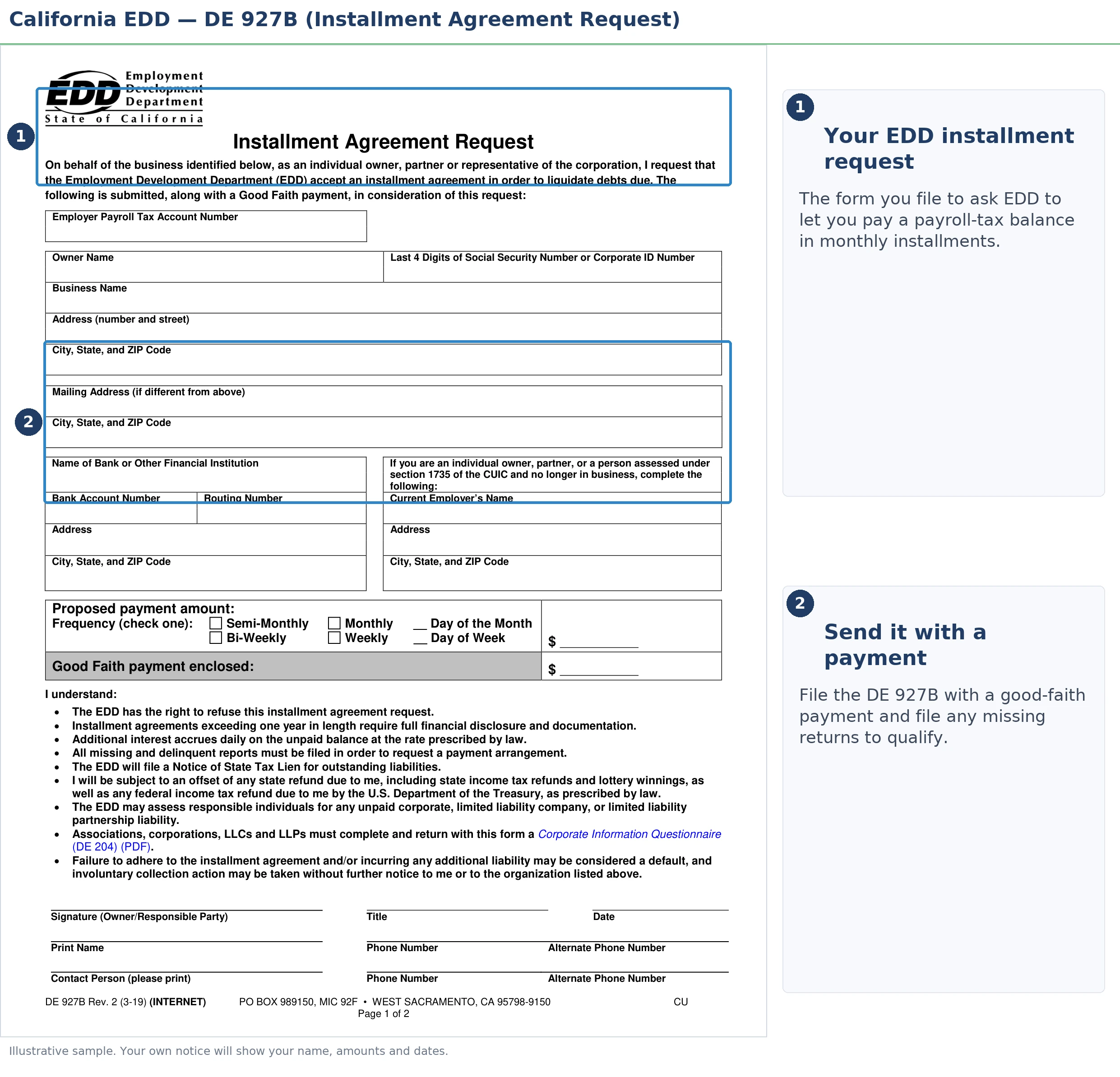
Two things on your notice control the whole strategy: the classification (fraud or non-fraud) and the mailing date. The image below shows exactly what an EDD overpayment notice looks like and where those two details sit, so pull yours out before you read on.
⏱ Your clock: the appeal deadline runs from the mailing date printed on your EDD Notice of Overpayment or Notice of Assessment — typically 30 days. Check the exact date on your notice before agreeing to any payment plan; the plan can wait a day, but a missed appeal window doesn't come back.
Why you owe the EDD: two very different debts, one agency
The EDD collects two separate kinds of debt: benefit overpayments from workers and payroll taxes from employers — and the payment plan path is different for each. Knowing which one you have is step zero.
A benefit overpayment means the EDD paid you unemployment, disability, or paid family leave benefits it now says you weren't entitled to. Common triggers: earnings you reported (or didn't) while working part-time, an employer winning an eligibility appeal after you were already paid, a retroactive disqualification on a pandemic-era claim, or the EDD's own processing error. The notice classifies the debt as fraud or non-fraud — and a fraud classification adds a 30% penalty on top of the benefits you must repay, so read that line carefully.
A payroll tax debt means you're an employer behind on UI, ETT, SDI, or California income tax withholding — usually after an EDD audit (often over contractor classification) produces an EDD Notice of Assessment. Unlike a benefit overpayment, an assessment accrues interest and penalties while unpaid, and for corporations and LLCs, responsible individuals can be assessed personally under CUIC Section 1735 — the full picture is in our guide to California EDD payroll tax debt.
| Question | Benefit overpayment (claimant) | Payroll tax debt (employer) |
|---|---|---|
| What you owe | UI/SDI/PFL benefits paid in error, plus a 30% penalty if classified as fraud | UI, ETT, SDI, and PIT withholding, plus interest and penalties that keep accruing |
| How to request a plan | Benefit Overpayment Services in myEDD, or the number on your notice | Call the collections contact on your Notice of Assessment; larger balances may require financial disclosure |
| Relief besides a plan | Timely appeal; waiver if non-fraud, no fault, and hardship | Timely petition against the assessment; penalty relief in limited cases |
| Worst-case enforcement | Benefit offsets, refund intercepts, summary judgment, garnishment | Liens, levies, and personal assessment of responsible individuals |
What happens if you ignore an EDD debt
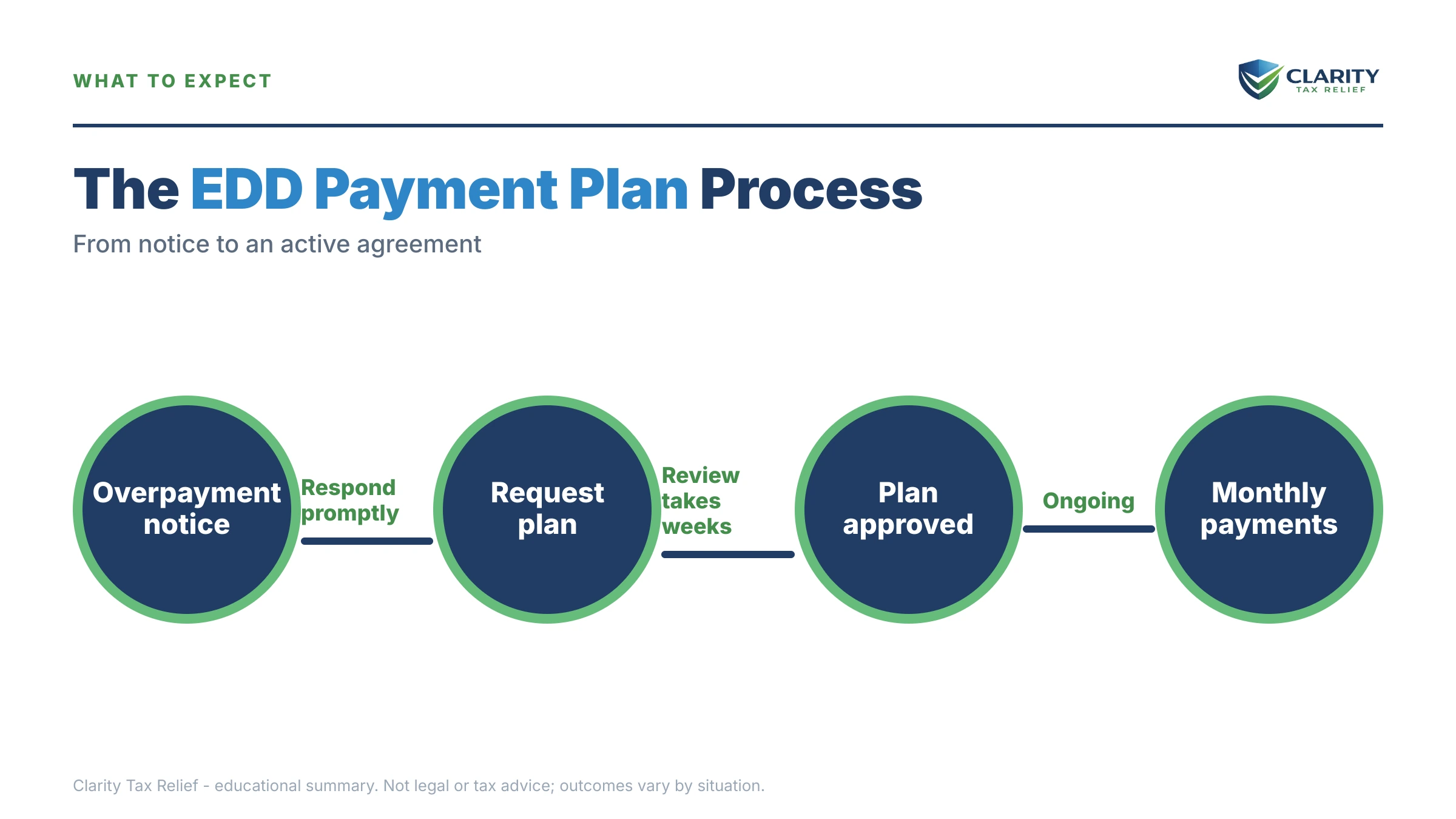
An unpaid EDD benefit overpayment moves in a fixed sequence: billing statements → benefit offsets → tax-refund intercepts → summary judgment and lien → wage garnishment. There's no exact calendar — the EDD doesn't print one — but every stage is worse than the one before it:
- Notice of Overpayment (or Notice of Assessment) — the debt is established and your appeal window starts running. You are here.
- Monthly billing statements — the balance is formally due. This is the cheapest, easiest stage to set up a plan.
- Benefit offset — any future unemployment or disability benefits you claim are reduced or withheld to repay the debt, exactly when you can least afford it.
- Refund and lottery intercepts — your California refund is grabbed through the FTB's intercept program (see how the FTB refund intercept works), and fraud-classified unemployment debts can be referred to the federal Treasury Offset Program, which takes IRS refunds too.
- Summary judgment and lien — the EDD obtains a court judgment without a trial and records it. It's a public record that follows your property.
- Garnishment and levy — with a judgment in place, wages and bank accounts are reachable. For employers, add liens on business assets and possible personal assessment of owners and officers.
Our full breakdown of EDD overpayment collection covers each enforcement tool in detail. The point for today: the payment plan exists to stop this sequence at stage two.
Holding an EDD overpayment notice you can't pay?
If it arrived in the last few weeks, your appeal window may still be open — and that changes the entire strategy before a single payment is due. An experienced tax professional will review your notice free, check the fraud classification and waiver angle, and map your cheapest way out before offsets and a judgment enter the picture.
Your EDD payment plan options — and the two alternatives to check first
Every EDD debt has at least four possible resolutions: pay in full, an installment agreement, a waiver (non-fraud overpayments only), or a timely appeal. The billing statement only advertises the first one.
| Option | Who it fits | Cost & what to know |
|---|---|---|
| Pay in full | Balances you can clear without hardship | Ends billing and enforcement immediately; pay online, by phone, or by mail using the details on your notice |
| Installment agreement (claimant) | Overpayments you agree with but can't pay at once | Requested through myEDD Benefit Overpayment Services; terms set case by case, longer terms may require income/expense details |
| Overpayment waiver | Non-fraud overpayments where you weren't at fault and repayment causes extraordinary hardship | Can eliminate the repayment obligation; never available for fraud-classified debts — ask before you agree to pay |
| Timely appeal | Anyone inside the window printed on the notice (typically 30 days) | Sends the case to an administrative law judge; the EDD generally holds collection while the appeal is pending |
| Installment agreement (employer) | Businesses behind on payroll tax assessments | Interest keeps accruing during the plan; expect financial disclosure on larger balances, and address personal-liability exposure early |
One structural difference from federal debt is worth naming: the IRS publishes fixed plan rules — up to 180 days short-term, up to 72 months online under $50,000 (our hub on how to set up an IRS payment plan online walks through those). The EDD publishes no equivalent chart. Terms are negotiated account by account, which cuts both ways: no bright-line ceiling caps you, but nothing locks in a specific term either. That's why your opening proposal — a payment you can genuinely sustain — matters more with the EDD than with the IRS.
Also don't mix agencies in your head. An EDD plan covers only EDD debt. If you owe California income tax, that's a separate FTB payment plan; sales tax debt runs through a CDTFA payment plan. Each agency bills, enforces, and negotiates independently.
What's realistic at your balance
The size of the debt shapes what the EDD expects and how much scrutiny you'll get. These bands reflect typical practice, not published EDD rules:
| Balance | Realistic path | What to expect |
|---|---|---|
| Under $2,500 | Pay in full or a short plan | Fastest way to stop billing; small balances rarely justify long terms or professional fees |
| $2,500–$10,000 | Installment agreement; waiver review if non-fraud | Modest monthly payments are usually accepted; raise the waiver question before agreeing to repay |
| $10,000–$50,000 | Installment agreement at a defensible monthly figure | Expect questions about income and expenses on longer terms; get every term in writing |
| Any fraud-classified balance | Experienced review before you commit | 30% penalty added, no waiver available, and federal refund offset possible — the classification itself may be worth challenging |
A worked example: repaying a $31,200 EDD overpayment
Say you owe $31,200 — a hypothetical single W-2 employee whose pandemic-era unemployment claim was retroactively disqualified after she was already back at work. Here's the arithmetic at three plan lengths:
- 24 months: $31,200 ÷ 24 = $1,300/month — heavy on a single paycheck, but done in two years.
- 36 months: $31,200 ÷ 36 = about $867/month — often the sweet spot between speed and survivability.
- 48 months: $31,200 ÷ 48 = $650/month — easier monthly, but expect the EDD to want financial detail before agreeing to a longer runway.
Now the classification math. If that same debt were classified as fraud, the EDD adds a 30% penalty: $31,200 × 0.30 = $9,360, making the total $40,560 — at $867/month, roughly 47 payments instead of 36, nearly a year of extra checks. And if the overpayment is non-fraud, wasn't her fault, and $867/month would break her budget, the waiver could eliminate the debt entirely. That's why the order of operations is always: classification, then appeal, then waiver, then plan.
One more note for this persona: if you also got a surprise federal bill because you owe taxes on unemployment income, that IRS debt is separate from the EDD overpayment — repaying the EDD doesn't erase the tax, and vice versa.
How to set up an EDD payment plan, step by step
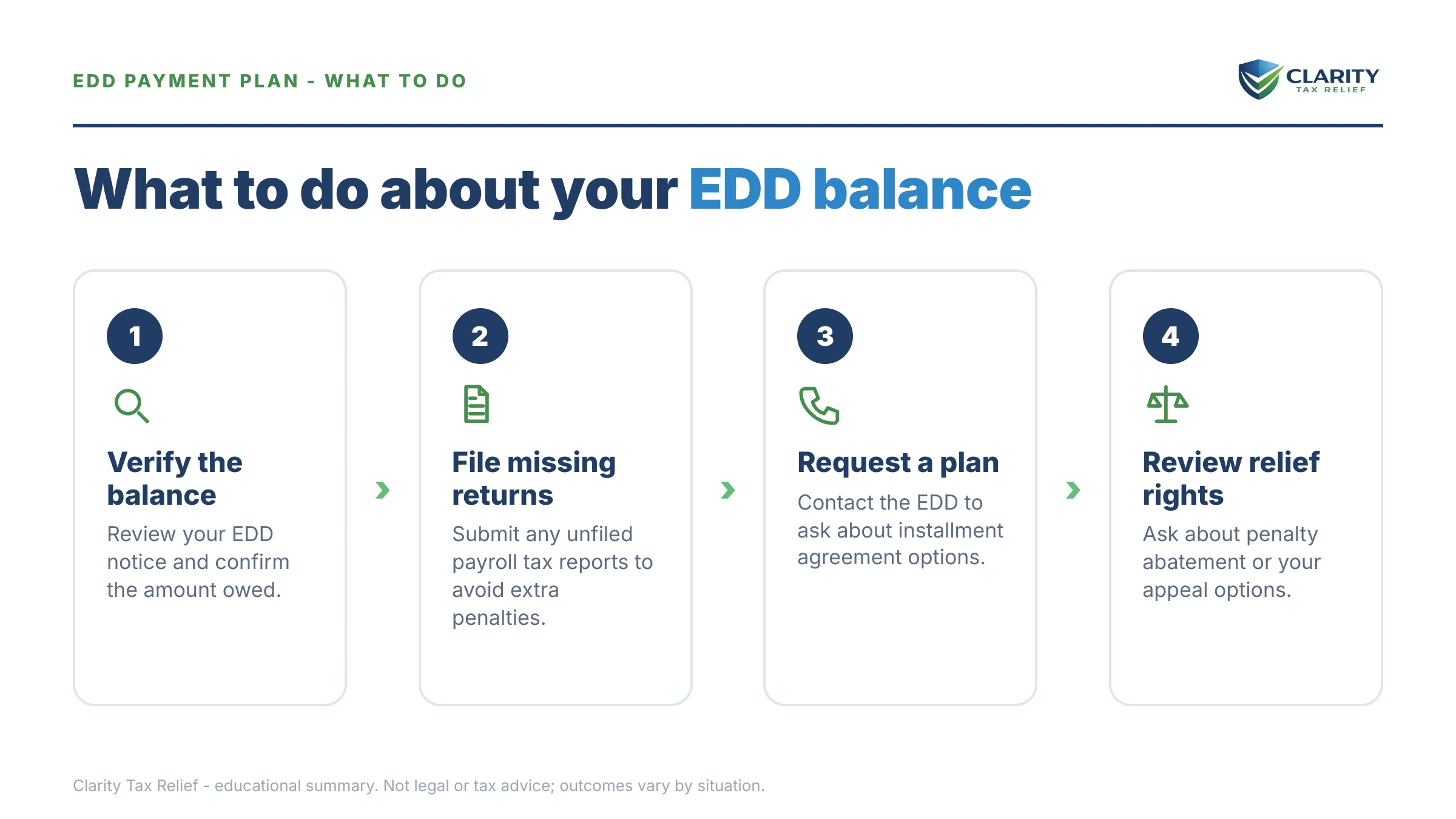
- Identify which EDD debt you have. A Notice of Overpayment means a benefit overpayment; a Notice of Assessment means employer payroll tax — the plan path is different for each.
- Check your appeal and waiver angles first. If you're inside the appeal window, or the overpayment is non-fraud and wasn't your fault, resolve that question before agreeing to repay anything.
- Set a monthly number you can actually sustain. Total the balance, look at your real budget, and pick a payment you won't miss — a defaulted plan restarts collection where it left off.
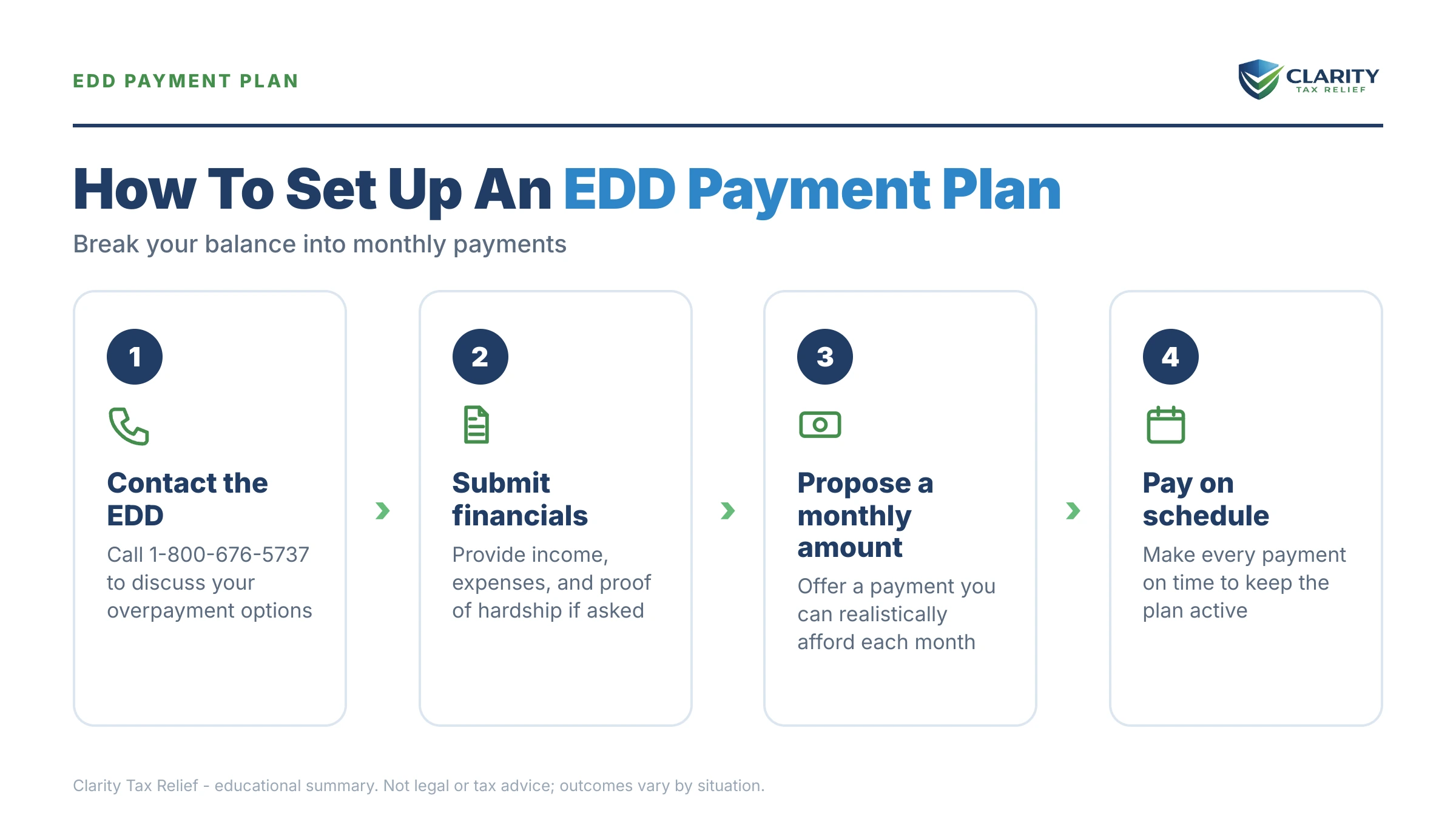
- Request the plan. Claimants: log into myEDD and use Benefit Overpayment Services, or call the number printed on your notice. Employers: call the collections contact on your assessment.
- Get the terms in writing and calendar every payment. Save the confirmation, note each due date, and contact the EDD before any payment you might miss instead of after.
When you can handle this yourself — and when help changes the outcome
You don't need professional help for a small, non-fraud overpayment you agree with. If the balance is a few thousand dollars, the facts on the notice are right, and a modest monthly payment fits your budget, log into myEDD, set up the agreement, and keep it current — that's the whole job.
Experienced help changes outcomes in four situations: a fraud classification you dispute (the 30% penalty and lost waiver rights make the classification itself the fight), a summary judgment or garnishment already in motion, an employer payroll tax assessment with personal-liability exposure for owners or officers, and stacked debts — EDD plus FTB plus IRS — where the sequencing decision (see state tax debt vs IRS) determines who gets paid first and who escalates. In those cases, the review is worth more than the plan.
Terms on your EDD notice, decoded
- Notice of Overpayment: the EDD's formal determination that you were paid benefits you weren't entitled to, and the document that starts your appeal clock.
- Fraud vs. non-fraud: the EDD's finding on whether you intentionally withheld or misstated information — fraud adds a 30% penalty and blocks the waiver.
- Waiver: the EDD's authority to cancel repayment of a non-fraud overpayment when you weren't at fault and repayment would cause extraordinary hardship.
- Benefit offset: the EDD withholding future unemployment or disability benefits to repay the overpayment.
- Summary judgment: a court judgment the EDD can obtain without a trial, which acts as a lien and unlocks garnishment and levy.
- Interagency Intercept: the FTB-run program that grabs your state refund or lottery winnings and applies them to your EDD balance.
Official contact points: the Employment Development Department publishes payment and overpayment information at edd.ca.gov, and state refund intercepts are administered through the California Franchise Tax Board.
EDD payment plan questions, answered
How long does an EDD payment plan last?
EDD sets payment plan terms case by case — unlike the IRS, it publishes no fixed maximum like 72 months. Small balances are usually expected to be repaid quickly, while larger balances can run longer, often after the EDD reviews your income and expenses. The realistic rule: propose the highest monthly payment you can sustain without missing, because a defaulted plan restarts collection.
Can an EDD overpayment be forgiven or waived?
Yes, but only non-fraud overpayments qualify. The EDD can waive repayment when you weren't at fault for the overpayment and paying it back would cause extraordinary hardship. Fraud-classified overpayments cannot be waived and carry a 30% penalty on top of the benefits owed. If you believe your overpayment came from an EDD error or an employer's reporting mistake, raise the waiver before agreeing to a payment plan.
Will EDD take my tax refund for an overpayment?
It can. The EDD intercepts California state refunds and lottery winnings through the FTB's Interagency Intercept Collection Program, and fraud-classified unemployment overpayments can be referred to the federal Treasury Offset Program, which reaches IRS refunds too. A current payment plan is your best protection against escalation — and confirm with the EDD in writing how intercepts will be handled while you're on the plan.
Does EDD add penalties to an overpayment?
Yes, when the overpayment is classified as fraud: the EDD adds a 30% penalty and can disqualify you from future benefits for a period of weeks. Non-fraud overpayments are billed at the benefit amount you received. Employer payroll tax debts are different — those accrue interest and penalties until paid, which is why employer plans cost more the longer they run.
Can EDD garnish my wages?
Yes. For benefit overpayments, the EDD can obtain a summary judgment through the court, record it as a lien, and then garnish wages or levy bank accounts. This is the late stage of collection, not the first — billing statements, benefit offsets, and refund intercepts typically come earlier. A current installment agreement is what keeps your account out of that judgment pipeline.
What happens if I miss a payment on my EDD payment plan?
Your agreement can default, and involuntary collection — offsets, liens, garnishment — can resume where it left off. If you see a miss coming, contact the EDD before the due date; collection agencies are far more flexible with someone who calls ahead than someone who goes silent. If your income has genuinely dropped, ask about restructuring the plan rather than abandoning it.
Is an EDD payment plan the same as an FTB payment plan?
No. The EDD and the Franchise Tax Board are separate California agencies collecting separate debts — the EDD handles benefit overpayments and payroll taxes, while the FTB collects state income tax. Paying one does nothing for the other, and each requires its own agreement. If you owe both, prioritize by which agency is closest to enforcement, not by which balance is bigger.
Can I appeal an EDD overpayment instead of paying it?
Yes, if you're inside the appeal window — typically 30 days from the mailing date printed on your Notice of Overpayment. A timely appeal sends the case to an administrative law judge, and the EDD generally holds collection while the appeal is pending. If the window has passed, the waiver and payment-plan routes remain open, and you can still ask the EDD to review a clearly wrong balance.
Your next 24 hours
- Find two things on your notice: the fraud/non-fraud classification and the mailing date. Together they tell you whether a waiver is possible and whether your appeal window is still open.
- Gather your paperwork: the notice, any billing statements, your recent pay stubs, and a rough monthly budget — everything a waiver request or plan negotiation will need.
- Get a free case review: call (888) 825-7779 or use the 2-minute form. If your notice is recent, the appeal clock is already running; if it isn't, every month of silence moves your account closer to offsets and a court judgment — a current plan is what stops that.
This guide is general information, not tax or legal advice for your specific situation. Eligibility for IRS programs depends on individual facts and circumstances; no outcome is guaranteed. Eligibility for California EDD programs likewise depends on your individual facts and the agency's review.