
Tax Debt & Life Changes
Owe the IRS and Moving Abroad: What Follows You and What to Fix First (2026)
The short answer: if you owe the IRS and are moving abroad, the debt moves with you. Leaving the U.S. actually pauses the 10-year collection statute, and a combined balance of $66,000 or more (the 2026 threshold) can cost you your passport. Set up a payment plan or other resolution before you fly — everything is easier from inside the country.
You've signed the overseas contract, the visa is approved, and the one-way ticket is half-booked — but there's a balance from your 1099 years sitting on your IRS account, and you're wondering whether an ocean puts it behind you. It doesn't, but that's not bad news: every resolution program the IRS offers still works for someone leaving the country, and most work better if you start before departure. Here's exactly what follows you, what can't reach you, and the order to fix things in.
⏱ The two clocks that actually matter: there's no letter deadline attached to moving — but interest and the monthly late-payment penalty accrue wherever you live, and under IRC §6503(c) the 10-year collection statute stops running while you're outside the U.S. for a continuous period of six months or more. Waiting abroad doesn't age the debt out; it preserves it.
Why moving abroad doesn't move your IRS debt
The IRS can collect from U.S. citizens and green-card holders anywhere in the world — moving abroad changes how it collects, not whether it can. The United States taxes its citizens on worldwide income, so your filing obligation, your assessed balance, and the automated collection system all continue exactly as if you'd moved to another state.
What the IRS can still reach easily after you leave: any U.S. bank or brokerage account, federal tax refunds, and payments owed to you by U.S. clients. That last one matters most for a contractor — a levy served on a U.S. client can capture an entire invoice payment, because non-wage contractor pay has no exempt amount the way wages do. The mechanics are covered in can IRS garnish 1099 income. Social Security benefits, if you're drawing them abroad, remain subject to a continuous 15% levy through the Federal Payment Levy Program.
What the IRS generally cannot reach quickly: bank accounts held at foreign institutions with no U.S. branch. Only five treaty partners — Canada, Denmark, France, the Netherlands, and Sweden — have mutual collection assistance clauses that let the local tax agency collect on the IRS's behalf. If you're moving to one of those five, assume your local accounts are eventually reachable. Everywhere else, the practical pressure points are your U.S. assets, your U.S. income sources, and your passport.
And don't count on staffing shortages as protection. The IRS workforce shrank roughly 27% in 2025, but notices, liens, levies, and passport certifications are generated by automated systems that never took a day off — IRS understaffed, do I still owe walks through why the machine keeps running even when the phones don't.
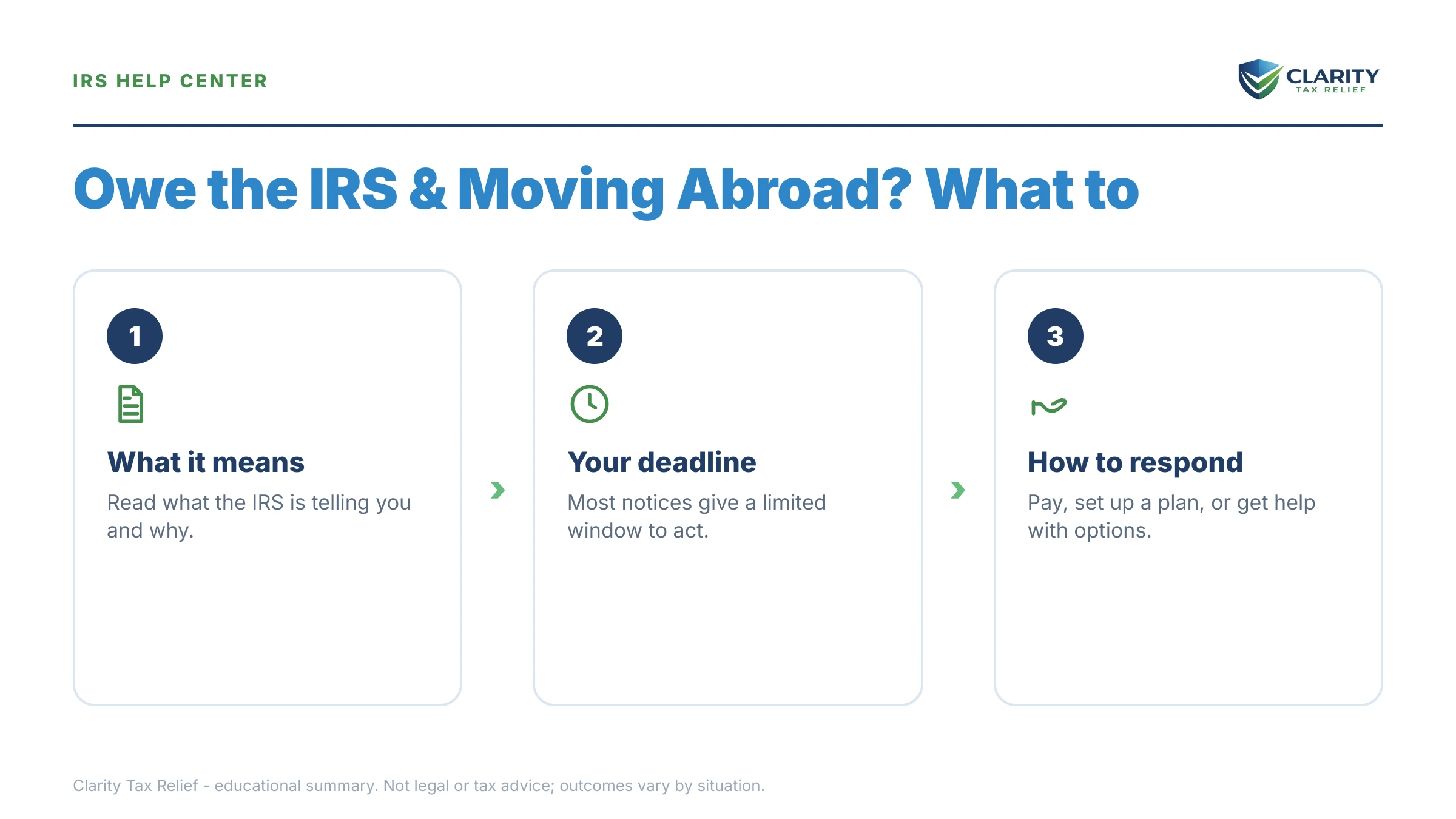
What happens if you owe the IRS and move abroad anyway
Ignoring the balance from overseas triggers the same automated escalation sequence — except each notice now chases an address you may have left behind. The sequence looks like this:
- CP14 — the first bill, typically giving about 21 days before escalation. If it's crossing the ocean, part of that window is gone before you open it.
- CP501 / CP503 — reminder notices. No enforcement yet, but penalties and interest compound monthly while letters stack up at your old address.
- CP504 — Notice of Intent to Levy. The IRS can now seize your state tax refund, and a federal tax lien against your U.S. assets becomes a real possibility.
- LT11 / Letter 1058 — the final notice of intent to levy, which starts a 30-day clock to request a Collection Due Process hearing on Form 12153. Miss it because the letter never reached you, and the IRS can levy U.S. accounts and U.S.-client payments without further warning.
- Levies and liens — a bank levy freezes funds for a 21-day hold before the money leaves; a lien attaches to any U.S. property you still own, including a house you kept as a rental.
- CP508C — once combined balances hit the seriously-delinquent threshold, the IRS certifies the debt to the State Department, which can deny your passport renewal or revoke the passport outright.
The critical legal point: an IRS notice mailed to your "last known address" counts even if you never see it. Deadlines run from the notice date, not from when mail reaches Lisbon or Bangkok. That's why updating your address (Form 8822) and monitoring your IRS online account are non-negotiable steps below.
| Notice | What it does | Why it's riskier from overseas |
|---|---|---|
| CP14 | First bill; roughly 21 days before escalation | International mail lag can eat most of the window |
| CP501 / CP503 | Reminder bills; balance grows monthly | Letters pile up at an old U.S. address unanswered |
| CP504 | Intent to levy your state refund; lien exposure begins | You may never learn a lien hit U.S. property you kept |
| LT11 / Letter 1058 | Final notice; 30-day window to request a CDP hearing (Form 12153) | The 30 days can expire before the letter crosses the ocean |
| CP508C | Certifies "seriously delinquent" debt ($66,000+ in 2026) to the State Department | Can block a passport renewal while you're living abroad on that passport |
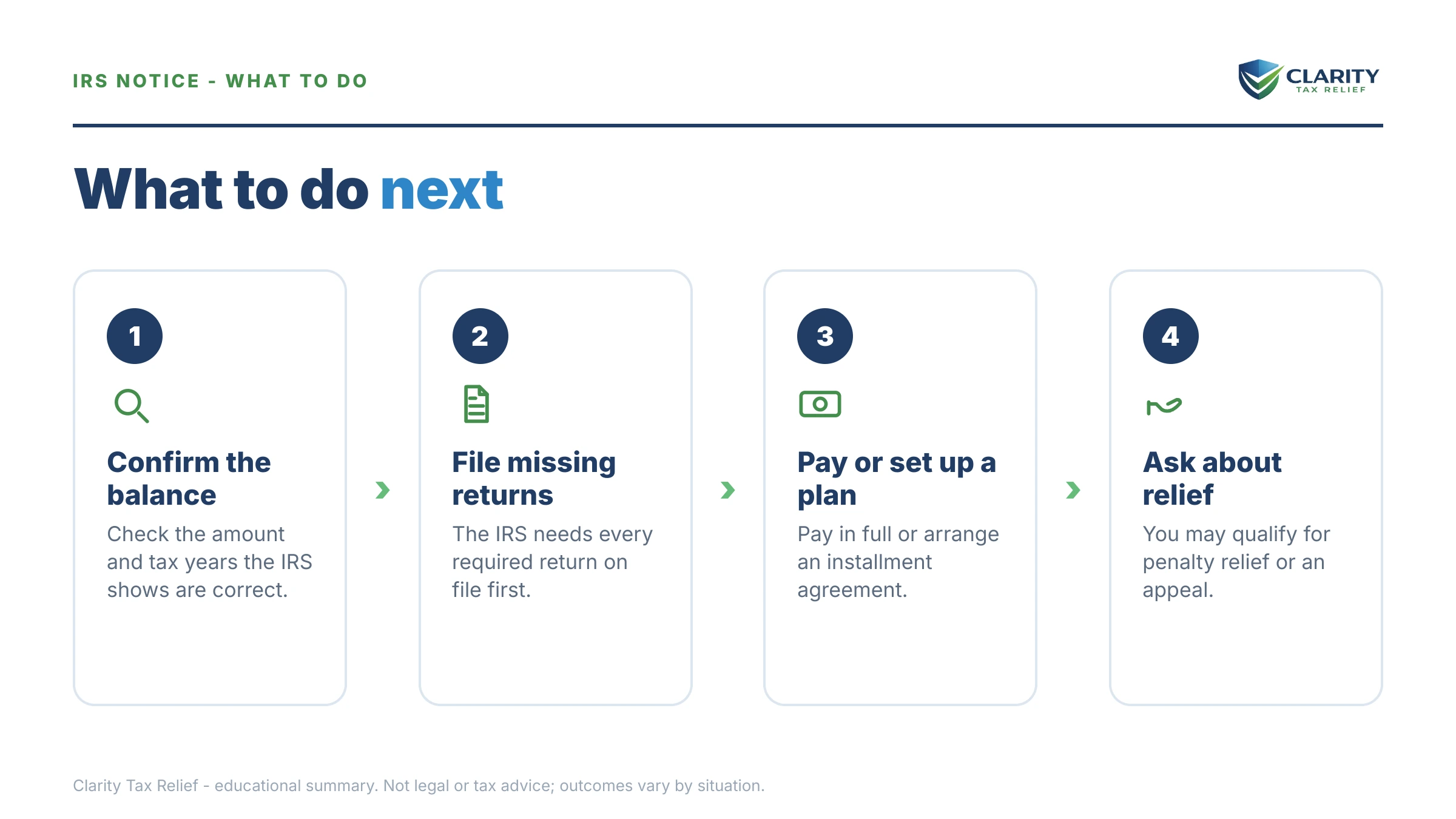
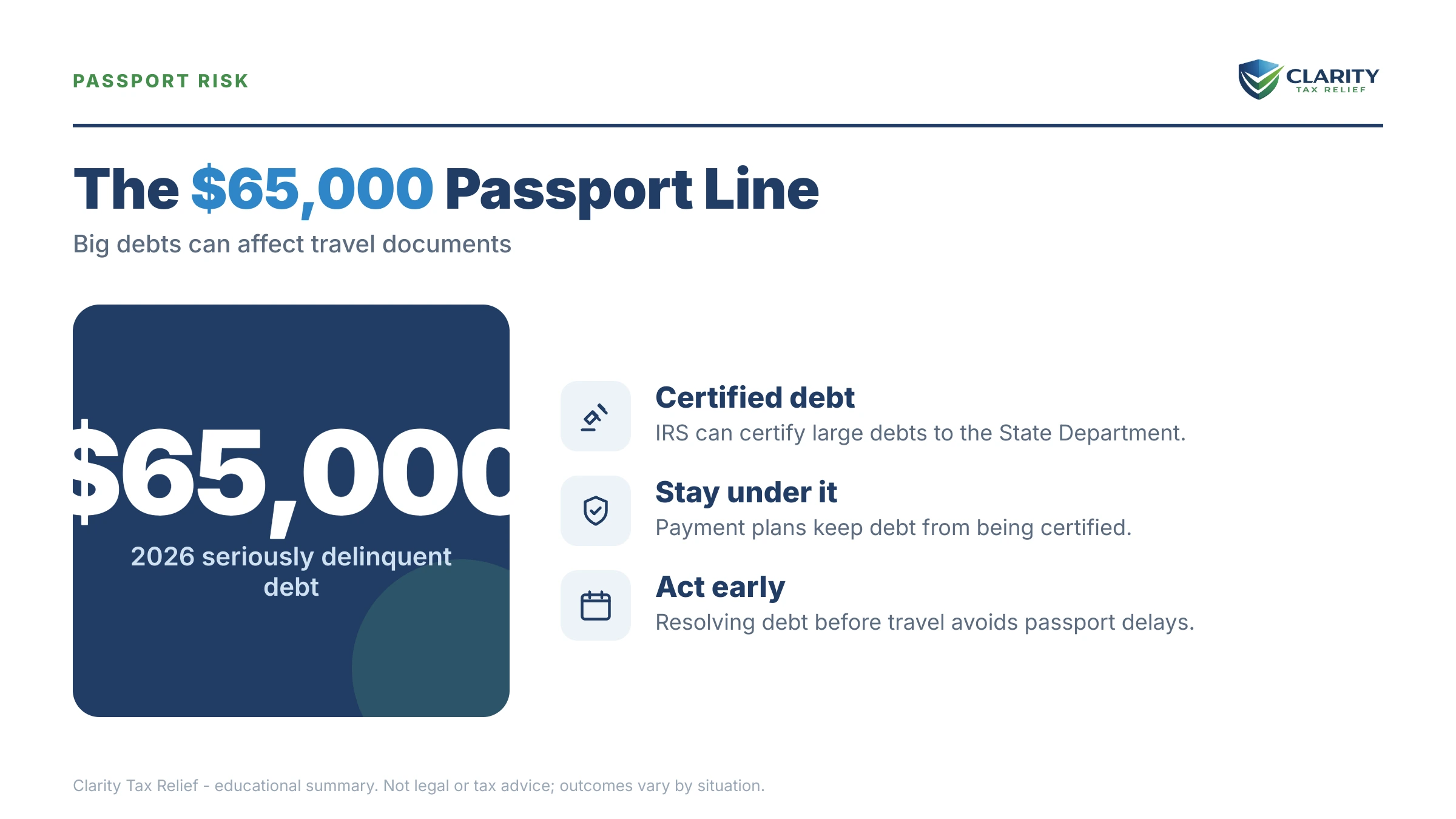
The $66,000 passport line — the one consequence built for expats
A combined IRS balance of $66,000 or more in 2026 — tax, penalties, and interest across all years — can be certified as "seriously delinquent tax debt," letting the State Department deny your passport application or renewal and, in some cases, revoke the passport you're holding. For someone whose entire life abroad depends on that document, this is the single collection tool aimed squarely at you.
Certification isn't automatic at the dollar figure alone: the IRS must also have filed a lien or issued a levy notice, and debts covered by an active installment agreement, a pending Offer in Compromise, or Currently Not Collectible hardship status are excluded. That exclusion is the strategy — getting into an agreement before certification keeps your passport out of the fight entirely. The full mechanics are in our guides to passport revoked for tax debt and the CP508C notice.
If you owe well under the threshold today, remember that the number is a running total. A contractor who stops paying quarterlies abroad can add a five-figure assessment every filing season — two or three neglected years can walk a $31,200 balance across the line.
Leaving the country pauses the 10-year collection clock
The IRS normally has 10 years from assessment to collect a debt — but under IRC §6503(c), that clock is suspended while you're outside the United States for a continuous period of at least six months. The "wait it out overseas" plan fails on its own terms: the years you spend abroad simply don't count against the statute, so the debt is still collectible when you come home, with a decade of compounded interest attached.
This is the least-known fact on this page and the one that changes the most decisions. If your assessment dates are old and the statute is your best asset, staying stateside — or resolving before you go — may be worth real money. You can estimate where your own expiration dates stand with our CSED Calculator, and what extends the IRS collection statute covers the other events that pause the clock, like offers and bankruptcy.
Moving abroad with a balance on the books?
Get your IRS account reviewed free before you fly. An experienced tax professional will pull your balances, check your passport exposure against the $66,000 threshold, and map the resolution that's easiest to run from overseas — while interest is still the only thing growing.
Your options for resolving IRS debt before (or after) the move
Every major IRS resolution program remains available to someone living overseas — eligibility is about your finances, not your address. The general playbook for each program lives in our guide to how to settle tax debt yourself; here's how each one behaves when a move abroad is in the picture:
| Option | Who qualifies | How it works from abroad |
|---|---|---|
| Short-term payment plan | Can pay in full within 180 days; $0 setup | Fine from anywhere, but payments are simplest from a U.S. bank account |
| Streamlined installment agreement | $50,000 or less combined; up to 72 months, set up online with no financial disclosure | Works abroad, but online identity verification is far easier before you leave the U.S. |
| Offer in Compromise | Assets plus future income genuinely can't cover the debt; $205 fee + 20% down on lump-sum offers (both waived with low-income certification); roughly 1 in 5 accepted in FY2024 | Available overseas — but foreign income, foreign accounts, and lower foreign living costs all enter the IRS's math |
| Currently Not Collectible | Paying anything would leave you unable to cover basic living expenses, shown on Form 433-F | Available abroad; the debt remains, interest accrues, and the account is excluded from passport certification while in hardship status |
| Penalty relief (FTA / AEP) | Clean compliance history for the prior 3 years; the new Automatic Exemption from Penalty begins applying automatically in summer 2026 | Works from anywhere — it shrinks the balance but doesn't resolve the underlying tax |
A worked example: a 1099 contractor owing $31,200
Say you're a freelance developer who owes $31,200 across two 1099 years and you're relocating to Portugal in the fall. Because the balance is under $50,000, you qualify for a streamlined installment agreement online — no Form 433-F, no asset disclosure. The bare minimum math is $31,200 ÷ 72 months ≈ $434/month. But interest plus the late-payment penalty (which drops from 0.5% to 0.25% per month once the agreement is active) keeps accruing on the declining balance, so budgeting closer to $550–$600/month is what actually retires the debt inside 72 months at current accrual rates.
Passport check: $31,200 is well under the $66,000 certification threshold — today. But if you stop making quarterly estimated payments abroad and add, say, $15,000 of new self-employment tax per year, you cross the line in roughly two unpaid seasons. The plan here writes itself: set up the streamlined agreement from a U.S. IP address and U.S. bank account before departure, keep quarterlies current overseas, and the move never touches your passport. This is a hypothetical illustration — your notice balances and accrual will differ.
How to handle IRS debt before moving abroad, step by step
- Pull your IRS balance and transcripts before you book anything — confirm exactly what you owe, for which years, and whether every return is filed.
- File Form 8822 the week you move — IRS notices sent to your "last known address" count legally even if you never see them.
- Set up your resolution before departure — a streamlined plan on a balance of $50,000 or less takes minutes online while you still have easy identity verification and a U.S. address.
- Keep one U.S. bank account open — direct-debit installment agreements and most IRS payment methods work far better from a U.S. account than a foreign one.
- Calendar your expat filing duties — the automatic June 15 filing extension, quarterly estimated payments on contractor income, and FBAR reporting if foreign accounts top $10,000.
- Check your passport exposure — if your combined assessed balances are approaching $66,000, get into an agreement before a CP508C certification is issued.
Your new filing duties abroad — and how they quietly grow the debt
Living overseas adds obligations on top of the old balance; missing them is how a manageable debt becomes an unmanageable one. Taxpayers abroad get an automatic two-month extension to June 15 to file — but interest on any new balance still runs from April 15. The Foreign Earned Income Exclusion (Form 2555) can shelter a six-figure chunk of earned income from income tax, but here's the trap for contractors: the FEIE does not reduce the 15.3% self-employment tax unless your new country has a totalization agreement with the U.S. Your quarterly estimated payments don't stop at the border.
Opening local bank accounts creates reporting duties too: an FBAR (FinCEN Form 114) once foreign accounts exceed $10,000 in aggregate, and possibly Form 8938 at higher balances. The penalties for skipping these dwarf most people's tax debt — see didn't file FBAR penalty. And if you're reading this from abroad with years already unfiled, the streamlined procedures in expat hasn't filed US taxes are usually the cleanest way back in.
One state-side note: your state may not let go as easily as you'd hope. California's FTB, for example, collects under a 20-year statute — twice the IRS's window — and residency doesn't always end the day you fly out. If you're leaving from California, read moving out of California taxes before you assume the FTB file is closed; for other states, confirm your final-year filing rules with that state's tax agency directly. And if you're keeping a U.S. house as a rental or planning to buy again later, understand how a lien changes that in can I buy a house if I owe the IRS.
When you can handle this yourself
Plenty of pre-move situations don't need professional help. If your balance is one that can be paid off within 180 days, if you owe under $50,000 with all returns filed and just need to click through the online streamlined agreement, or if your only issue is a first-time penalty you can request abatement on — do it yourself, before departure, and go enjoy the move.
Experienced help changes outcomes in the harder versions: multiple unfiled years (the order you file and resolve in changes the total), a balance near or over the $66,000 passport threshold, a lien already filed against U.S. property you're keeping, OIC math involving foreign income and assets, or a levy already served on a U.S. client. Once you're overseas, a Form 2848 power of attorney lets a representative deal with the IRS in U.S. business hours while you sleep — Form 2848 instructions shows how that works.
Terms you'll run into, decoded
- Seriously delinquent tax debt — a legally certified balance of $66,000+ (2026) that lets the State Department act against your passport.
- CP508C — the IRS notice telling you that certification has been sent to the State Department.
- CSED — the Collection Statute Expiration Date: 10 years from assessment, after which the IRS can no longer collect.
- §6503(c) suspension — the rule that stops the 10-year clock while you're outside the U.S. for six continuous months or more.
- Last known address — the address in IRS records; notices mailed there are legally effective whether or not you receive them.
- FBAR — FinCEN Form 114, the annual report required once your foreign accounts exceed $10,000 combined.
Moving abroad with IRS debt: your questions, answered
Can I leave the country if I owe the IRS?
Yes — there is no exit checkpoint, and owing back taxes doesn't stop you from boarding a plane. The exception is your passport: once a debt is certified as seriously delinquent ($66,000 or more in 2026), the State Department can deny your renewal or revoke the passport itself. Getting into a payment plan or other resolution before certification keeps that door open.
Does IRS debt go away if I move abroad?
No — moving abroad can actually make the debt last longer. Under IRC §6503(c), the 10-year collection statute is suspended while you're outside the United States for a continuous period of six months or more. A debt that would have expired in 2031 if you'd stayed home can still be collectible years later if you spent that time overseas.
Can the IRS take money from a foreign bank account?
Rarely, and almost never quickly. The IRS has mutual collection agreements with only five countries — Canada, Denmark, France, the Netherlands, and Sweden — where the foreign tax agency can collect on its behalf. What it can reach easily: your U.S. bank accounts, payments from U.S. clients, federal tax refunds, and up to 15% of Social Security benefits.
Do I still have to file US taxes if I live in another country?
Yes. The U.S. taxes citizens and green-card holders on worldwide income no matter where they live. Taxpayers abroad get an automatic extension to June 15 to file — but not to pay; interest runs from April 15. The Foreign Earned Income Exclusion can shelter earned income from income tax, but it does not reduce the 15.3% self-employment tax on contractor income.
Can I set up an IRS payment plan from overseas?
Yes — balances of $50,000 or less can be set up online for up to 72 months, and phone or mail applications work from anywhere. In practice it's far easier before you leave: identity verification for the IRS online account can be difficult from abroad, and direct-debit plans generally need a U.S. bank account. Set the plan up, then move.
At what amount does the IRS take your passport?
The 2026 threshold for 'seriously delinquent tax debt' is $66,000, counting tax, penalties, and interest across all years combined. Certification also requires that the IRS has filed a lien or issued a levy notice on the debt. Debts in a pending or active installment agreement, a pending Offer in Compromise, or hardship (Currently Not Collectible) status are excluded from certification.
What happens to IRS letters after I move abroad?
The IRS keeps mailing them to your last known address — and legally, that counts as notice even if you never see the letter. Deadlines like the 30-day window on a final notice of intent to levy run from the notice date, not from when the mail reaches you. File Form 8822 when you move and monitor your IRS online account so nothing expires unread.
Does renouncing US citizenship wipe out IRS debt?
No. Renunciation ends future filing obligations, but every debt assessed while you were a citizen survives — and Form 8854 requires you to certify five years of tax compliance to avoid being treated as a 'covered expatriate,' which can trigger an exit tax on unrealized gains. Renouncing with an open balance leaves the debt fully collectible.
For the primary-source versions of everything above, see the IRS's hub for international taxpayers, its payment plans and installment agreements page, and the independent Taxpayer Advocate Service if the IRS's own processes have stalled your case.
Your next 24 hours
- Log into your IRS online account and write down your total balance by year — and how much headroom you have under the $66,000 passport threshold.
- Gather your last filed return, every IRS letter you have, your departure date, and a rough monthly income figure from your current contracts.
- Get a free case review before you book the flight — call (888) 825-7779 or use the 2-minute form. Interest accrues monthly and the collection clock pauses the day your six months abroad begin; every resolution on this page is simpler to set up while you're still stateside.
This guide is general information, not tax or legal advice for your specific situation. Eligibility for IRS programs depends on individual facts and circumstances; no outcome is guaranteed.