
Unfiled Returns
Voluntarily File Old Tax Returns: How to Come Clean With the IRS (2026)
The short answer: to voluntarily file old tax returns, pull your IRS wage and income transcripts, prepare the last six years of missing returns — the IRS's standard compliance window — and mail them in before the IRS builds returns for you. Voluntary filers are handled civilly, keep their real deductions, and unlock every payment option.
Maybe there's a levy notice on your kitchen counter, and behind it sit the returns you never filed. When you rent and have no house or big savings to protect, the IRS reaches for what you do have — your paycheck and your bank account. Here's the part that matters: filing those old returns voluntarily is the single move that unlocks every fix, and it's far more doable than the dread suggests.
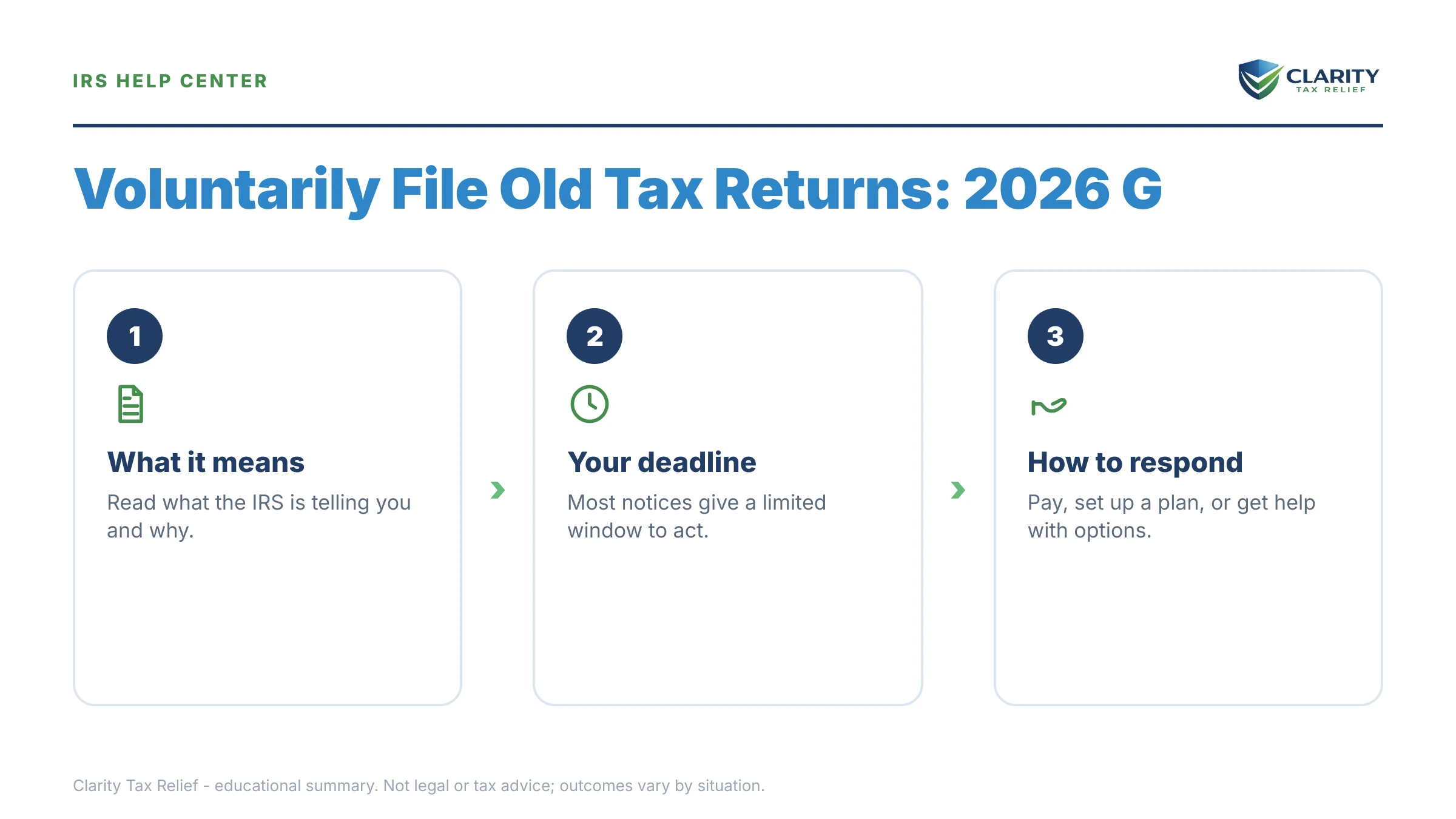
The IRS already knows most of your numbers. Every W-2 and 1099 ever issued to you sits in its files, and you can pull that data for free — the image below shows what a wage and income transcript looks like and where each employer's and payer's figures appear, so you can see exactly what the IRS expects each missing year to report.
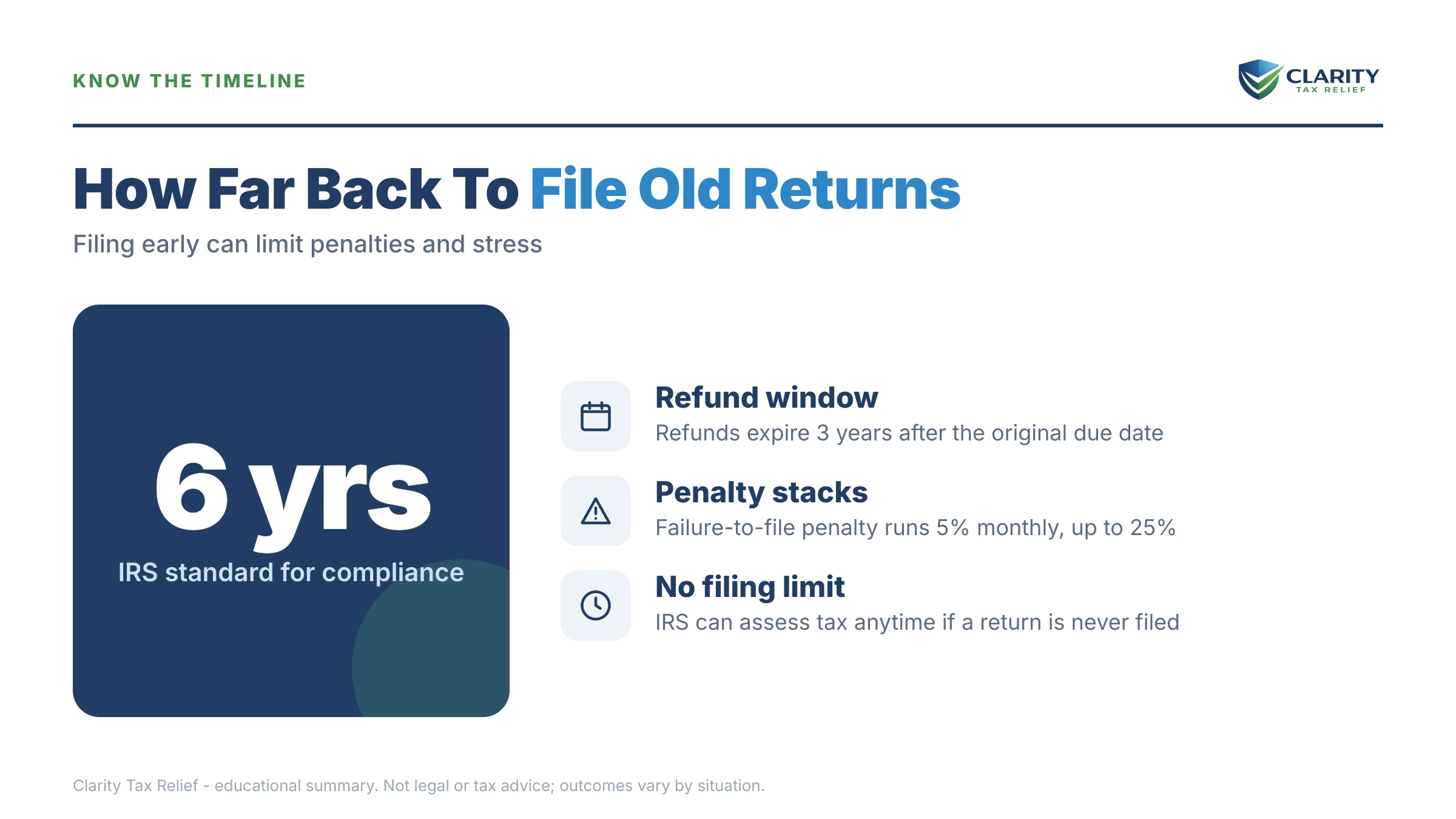
⏱ The clock that actually matters: there's no deadline you've already blown that can't be fixed — but refunds die on a fixed schedule. You have 3 years from a return's original due date to claim its refund. As of July 2026, refunds from 2022 and earlier are gone; the 2023 refund window closes April 15, 2027. Meanwhile the failure-to-file penalty grows 5% per month on any unpaid tax, up to a 25% cap.
Why voluntarily filing old tax returns beats waiting for the IRS
Voluntary filing means you hand the IRS accurate returns before it builds worst-case versions for you — and your version is almost always cheaper. There are three concrete reasons the person who comes forward ends up better off than the person who gets caught.
First, you keep your deductions. If the IRS files a substitute return for you (an SFR), it uses single or married-filing-separately status, no dependents, no business expenses, and nothing beyond the standard deduction. Your gross 1099 income gets taxed as if every dollar were profit.
Second, voluntary filing is what keeps a non-filing problem civil. Willful failure to file can be prosecuted, but the IRS's longstanding practice is to treat people who come forward on their own — before being contacted — as a collections matter, not a criminal one. Waiting until an agent finds you removes that framing.
Third, filing is the entry ticket to every resolution program. The IRS will not approve an installment agreement, hardship status, or an Offer in Compromise — and generally won't release a levy — while required returns are missing. For a renter staring at a levy notice, the fastest route to stopping it runs directly through those old returns.
How many years of old returns do you actually have to file?
The IRS generally requires only the last six years of returns to consider you filing-compliant, under its internal Policy Statement 5-133. If you're twelve years behind, you almost never need to prepare twelve returns — our guide to how many years of back taxes do i have to file covers the exceptions, but the short version: a revenue officer can demand more years when there's significant known income in them, and any year the IRS has already assessed via SFR should be corrected regardless of age.
Which years to prioritize depends on whether they're refund years or balance years. Refund years have a hard expiration; balance years just get more expensive. Here's where each old year stands right now — see can i still get a refund from 3 years ago for the full rule:
| Tax year | Original due date | Refund still claimable? |
|---|---|---|
| 2021 and earlier | 2022 and earlier | No — expired permanently |
| 2022 | April 18, 2023 | No — window closed April 2026 |
| 2023 | April 15, 2024 | Yes — until April 15, 2027 |
| 2024 | April 15, 2025 | Yes — until April 15, 2028 |
| 2025 | April 15, 2026 | Yes — until April 15, 2029 |
Two wrinkles worth knowing. If you filed an extension for a year, the 3-year window runs from the extended due date. And an expired refund isn't just money you can't receive — it also can't be applied against balances you owe on other years. Every month of delay on 2023 risks losing an offset you may badly need.
What happens if you keep waiting: the non-filer escalation path
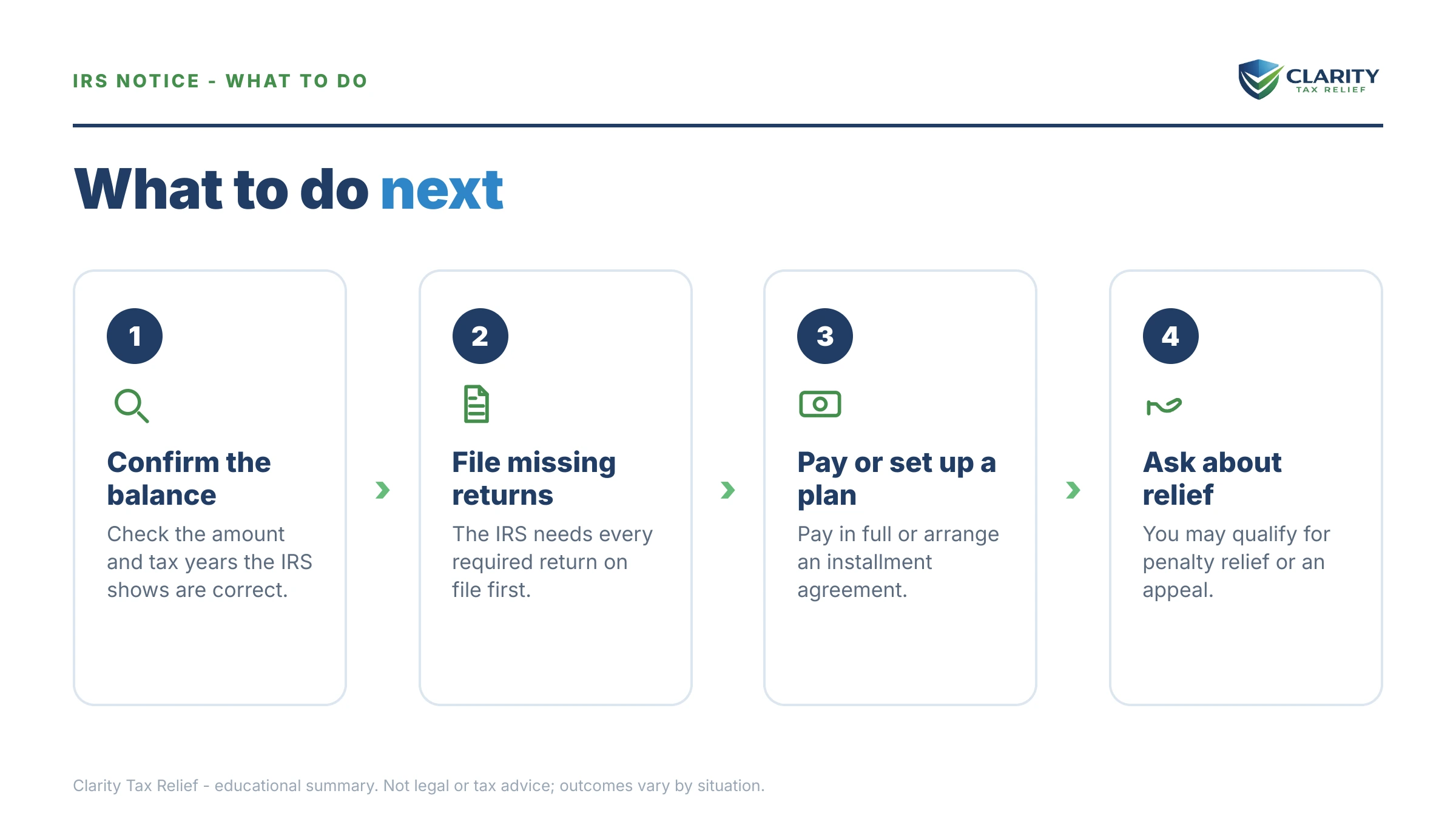
A non-filer's account escalates in a fixed, automated order: reminder notices, a substitute return, a 90-day letter, then assessment and full collection. In 2026, with the IRS workforce down roughly 27%, humans are harder to reach — but this sequence runs on automation that never stopped:
- CP59 — "we have no record of your return." A request, not yet a threat.
- CP516 / CP518 — escalating reminders, ending in a final demand to file.
- SFR proposal (CP2566) — the IRS builds a return from your W-2s and 1099s using the worst assumptions: no dependents, no expenses, no credits.
- CP3219N — a notice of deficiency giving you 90 days to file your own return or petition Tax Court before the SFR number becomes a legal assessment (see the 90 day letter tax court petition basics).
- Assessment and collection notices — the inflated balance is now on the books, accruing penalties and interest, and the CP14-through-CP504 bill sequence begins.
- LT11 notice — final notice of intent to levy, starting a 30-day clock on your Collection Due Process rights.
- Levy — a wage levy runs continuously until released; a bank levy freezes funds for 21 days before they're sent to the IRS.
Notice what's absurd about this path: at the end of it, you still have to file the returns — every resolution requires it. Waiting doesn't skip the work. It just adds penalties, an inflated SFR assessment, and a levy on top of the same filing job you could do today.
Unfiled years and a levy notice in the same pile?
The IRS won't release or hold off a levy while required returns are missing — so the filings and the payment fix have to be sequenced right. Send us what you're looking at and an experienced tax professional will map the exact order, free and confidential.
Your options once the old returns are filed
Every IRS resolution program requires filing compliance first — which means the moment your returns are in, all of these doors open. The full playbook for working these programs on your own lives in our guide to how to settle tax debt yourself; here's how each one applies to a freshly-filed backlog:
| Option | Typical eligibility | Cost / trade-off |
|---|---|---|
| Short-term payment plan | Can pay in full within 180 days | $0 setup; interest and penalties continue until paid |
| Guaranteed installment agreement | Total owed $10,000 or less | Approval is automatic by statute if conditions are met; pay within 3 years |
| Streamlined installment agreement | Up to $50,000, set up online, up to 72 months | No financial disclosure needed; setup fee applies; interest continues |
| Currently Not Collectible | Allowable living expenses consume your income (shown on Form 433-F) | Collection pauses; debt and interest remain; refunds get kept |
| Offer in Compromise | Assets plus future income genuinely can't cover the debt | $205 fee + 20% down on lump-sum offers (both waived if AGI ≤ 250% of poverty); roughly 1 in 5 accepted in FY2024 |
| Penalty abatement | Clean prior 3 years (FTA) or reasonable cause; automatic AEP begins summer 2026 | Free to request; removes penalties, not the underlying tax |
One caution specific to old-return filers: penalties on late-filed years are often a quarter of the whole balance, because the failure-to-file penalty caps at 25% of the unpaid tax. First time penalty abatement can wipe that from one year if your compliance history before the missed years was clean — and starting summer 2026, the new Automatic Exemption from Penalty (AEP) will apply some relief with no request at all. You can estimate how much of your balance is penalty and interest with our Penalty & Interest Calculator.
What will you owe? A worked example at $6,200
The balance you fear is usually not the balance you'll actually owe, because SFR numbers and expired-refund years distort the picture. Here's a clearly hypothetical example with the math shown.
Say you rent, you're three years behind (2022–2024), and the IRS filed a substitute return for 2022 from your gig-work 1099s: $24,000 of gross income, single, standard deduction, zero expenses — a $6,200 assessment with penalties and interest. An LT11 final notice just arrived threatening your bank account and paycheck.
Filing your real 2022 return changes the math:
- Gross 1099 income: $24,000. Actual mileage and expenses: $8,500 → net profit of $15,500.
- Income tax plus self-employment tax on $15,500 comes to roughly $2,400 — versus roughly $4,300 on the SFR's assumption that all $24,000 was profit.
- Failure-to-file penalty at the 25% cap: about $600 on the real number, versus about $1,075 on the SFR's.
- Result: the $6,200 assessment drops to roughly $3,400 with penalties, before interest — around $2,800 saved by filing one accurate return.
Then 2023 — a W-2 year with withholding — turns out to show a $600 refund, still claimable until April 15, 2027, which the IRS applies against 2022. Suppose 2024 roughly breaks even. Your total is now under $3,000: comfortably inside the guaranteed installment agreement threshold, payable at roughly $85 a month over 36 months. Requested inside the LT11's 30-day window, that agreement is what stands between your paycheck and a levy. If you're facing a wage levy specifically, see how to stop IRS wage garnishment for the release paths.
| Total balance after filing | Realistic resolution path |
|---|---|
| $0 or refunds due | Nothing to resolve — refunds inside the 3-year window are paid or offset; penalties don't apply to refund years |
| Under $10,000 | Guaranteed installment agreement (pay within 3 years), or a 180-day short-term plan at $0 setup |
| $10,000–$50,000 | Streamlined installment agreement online, up to 72 months (direct debit required above $25,000); penalty abatement to shrink the total |
| Over $50,000 | Financial disclosure on Form 433-F; non-streamlined agreement, CNC, or an Offer in Compromise if the collection math supports one |
How to voluntarily file old tax returns, step by step
- Pull your wage and income transcripts. Download the IRS's record of every W-2 and 1099 filed under your Social Security number for each missing year — free through your IRS online account or by mailing Form 4506-T.
- Confirm which years you must file. Six years is the standard compliance window under IRS Policy Statement 5-133, but a revenue officer can require more — verify the required list before you prepare anything.
- Prepare each return on that year's forms. Use the form versions for the correct tax year and claim the real filing status, dependents, and deductible expenses that any IRS substitute returns left out.
- Mail the returns with tracking. Old years generally cannot be e-filed — send each return in its own envelope to the address on your most recent IRS notice, or hand them to your assigned revenue officer if you have one.
- Set up a resolution for any balance. Request a payment plan, hardship status, or an Offer in Compromise as soon as the returns process, so the collection machine has nothing left to escalate.
- Request penalty relief. Ask for first-time abatement or reasonable-cause relief on the failure-to-file penalties, and watch for the automatic AEP exemption rolling out in summer 2026.
If self-employment years are the sticking point — no mileage log, no receipts — you can rebuild deductions from bank statements, calendars, and reasonable estimates. Our guide to filing back taxes with no records walks through reconstruction year by year.
Plain voluntary filing vs. the formal Voluntary Disclosure Practice
For the overwhelming majority of non-filers, "coming clean" means simply preparing and mailing the returns — no special program, no application, no negotiation to be allowed to file. The IRS's formal voluntary disclosure program is a different animal, built for cases with willful conduct and criminal exposure: deliberately hidden income, offshore accounts, falsified records.
The practical line: if you didn't file because life fell apart, money was tight, or the fear snowballed — and your income was reported to the IRS on W-2s and 1099s anyway — you're a plain voluntary filer. If you actively concealed substantial income and are worried about prosecution, talk to a professional about the formal program before filing anything, because the order of operations matters there.
One more distinction worth a sentence: this article is about years with no return on file. If you filed a return that overstated what you owe, the fix is different — see amending a return to lower a tax debt. Unfiled years need original returns, never amendments.
When you can handle this yourself — and when help changes the outcome
Plenty of people catch up on old returns without paying anyone. You can likely handle it yourself if you're one or two years behind, your income was all W-2, and the transcripts show withholding that covers most of the tax — some of those years are refund years, and filing them is nearly identical to filing a current return, just on paper.
Experienced help tends to change the outcome in four situations: a levy is already in motion and the filings have to land in sync with a collection hold; the IRS has assessed SFR years that need to be reconsidered downward; the missing years involve self-employment income that must be reconstructed defensibly; or the post-filing balance is large enough that the choice between an installment agreement, CNC, and an offer turns on financial-analysis math you'd be doing for the first time. In those cases the fee usually buys sequencing, not just preparation — and sequencing is what stops the levy.
Not sure which camp you're in? A free review of your transcripts answers it in one conversation — request one here or call (888) 825-7779.
Terms on your notices and transcripts, decoded
- Substitute for Return (SFR): a return the IRS builds for you from third-party forms, using the worst-case filing status with no dependents or expenses.
- Wage and income transcript: the IRS's free record of every W-2, 1099, and 1098 filed under your Social Security number for a given year.
- Policy Statement 5-133: the internal IRS rule that six years of returns is generally enough to be considered filing-compliant.
- RSED (Refund Statute Expiration Date): the date — 3 years after a return's original due date — when an unclaimed refund is gone for good.
- Filing compliance: having all required returns on file — the entry ticket to every IRS payment plan and relief program.
- CP3219N ("90-day letter" for non-filers): the notice giving you 90 days to file your own return or petition Tax Court before an SFR balance becomes a final assessment.
Voluntarily filing old returns: your questions, answered
How many years of old tax returns do I have to file to get compliant?
Six years is the general rule. Under IRS Policy Statement 5-133, filing the last six years of returns usually satisfies the IRS and makes you eligible for payment plans and other programs. A revenue officer can require more years in unusual cases — significant known income in an older year, for example — so confirm the required list before you start preparing.
Will I go to jail if I voluntarily file old tax returns?
Almost certainly not. Willful failure to file can be charged as a crime, but the IRS's longstanding practice is to treat people who come forward voluntarily — before being contacted — as a civil matter, not a criminal one. Criminal cases target ongoing concealment and fraud. Filing accurate returns before the IRS forces the issue is exactly the behavior that keeps a case civil.
Can I still get refunds on old returns I file now?
Only within 3 years of the return's original due date. As of mid-2026, returns for 2023 and later can still produce refund checks, while refunds from 2022 and earlier are gone permanently. Expired refunds also cannot be applied against balances you owe on other years — which is the strongest reason to file the newer years quickly.
What if the IRS already filed a substitute return for me?
File your own return for that year anyway. A substitute for return (SFR) uses single or married-filing-separately status, no dependents, and no deductions beyond the standard deduction, so it almost always overstates the tax. When you file an accurate original return for an SFR year, the IRS typically adjusts the assessment down — often by thousands of dollars.
Do I have to file my old returns before the IRS will stop a levy?
Generally yes. The IRS treats filing compliance as a precondition for nearly every collection alternative — installment agreements, Currently Not Collectible status, and Offers in Compromise all require your required returns to be on file. If a levy is pending or already in place, filing the missing years is usually the first step to getting it prevented or released.
Can I e-file old tax returns?
Usually only the current year and the two prior years. Most tax software and the IRS e-file system accept returns that far back; anything older must be printed and mailed. Use the form versions for the correct year — not this year's forms — and mail each year in its own envelope with tracking so you can prove when it was filed.
What if I don't have W-2s or records for the old years?
The IRS already holds most of what you need. A wage and income transcript lists every W-2, 1099, and 1098 filed under your Social Security number for each year, free through your IRS online account or by mailing Form 4506-T. For self-employment expenses, a reasonable reconstruction from bank statements, calendars, and mileage estimates is an accepted way to rebuild deductions.
What penalties will I owe when I file old returns?
The failure-to-file penalty is the big one: 5% of the unpaid tax per month, capped at 25%, plus a 0.5%-per-month failure-to-pay penalty and interest. Years with refunds owe no penalty at all, because penalties are calculated on unpaid tax. Relief is real — first-time abatement can clear one year if your prior three were clean, and reasonable-cause relief can cover more.
Your next 24 hours
- Make the list of missing years. Pull your account and wage and income transcripts through your IRS online account and note which of the last six years have no return on file — and which have an SFR assessment that's inflating your balance.
- Gather what you have. Your last filed return, any IRS notices (especially anything mentioning a levy), and whatever income records exist for the missing years — the transcripts fill the rest of the gaps.
- Get the sequence reviewed free. If a levy is threatened or refund windows are in play, the order you file and resolve matters. Start at the 2-minute form or call (888) 825-7779 — every month of waiting adds failure-to-file penalties to any balance year, and the 2023 refund window is already counting down to April 15, 2027.
Primary sources: the IRS's own page on filing past due tax returns, its overview of payment plans and installment agreements, and the independent Taxpayer Advocate Service if IRS processing of your returns stalls and creates hardship.
This guide is general information, not tax or legal advice for your specific situation. Eligibility for IRS programs depends on individual facts and circumstances; no outcome is guaranteed.