
IRS Enforcement
High Income Non Filer: What the IRS Does in 2026 — and How to Fix It Before a Substitute Return
The short answer: a high income non filer is someone the IRS has flagged as earning six or seven figures without filing a required return. Since 2024 the IRS has mailed CP59 letters to over 125,000 of them; if you still don't file, it files a substitute return for you — with zero deductions.
Maybe the income never slowed down — it was the filing that did. One busy year became three, and it felt survivable right up until your mortgage lender asked for tax transcripts, or an IRS envelope arrived addressed to a version of you the system already knows earns real money. Here's the part that matters: this is one of the most fixable problems in tax, and the person who files first — you, before the IRS files for you — controls the outcome.
If a letter did arrive, it was most likely a CP59 notice, the opening move of the high-income non-filer initiative. The image below shows exactly what that letter looks like and where to find the tax year and response section the IRS is asking about.
⏱ The clock that never starts — and the one that never stops: an unfiled return has no statute of limitations. The IRS's assessment and 10-year collection clocks don't begin until a return is filed, so the year stays open forever. Meanwhile the failure-to-file penalty grows at 5% per month up to a 25% cap, and interest compounds daily with no cap at all. Refunds run the opposite way: you generally lose any refund not claimed within 3 years.
Why the IRS flagged you as a high income non filer
The IRS already knows most of your income — every W-2, 1099, and K-1 issued in your name was also filed with the government. When those information returns show large income and no matching Form 1040, its systems open a non-filer case automatically. No human has to notice you; the mismatch itself is the trigger.
In early 2024 the IRS announced it was mailing compliance letters on more than 125,000 high-income non-filer cases covering tax years 2017–2021 — including over 25,000 people with income above $1 million and roughly 100,000 more between $400,000 and $1 million. That campaign has continued, and it's largely automated, which matters in 2026: the IRS workforce shrank about 27% in 2025, but the systems that generate non-filer letters, substitute returns, and levies kept running at full speed.
One more thing worth naming plainly: getting a CP59 does not mean you're under criminal investigation. It's a compliance letter, not an accusation. The civil path stays wide open — as long as you use it.
What happens if a high income non filer keeps waiting
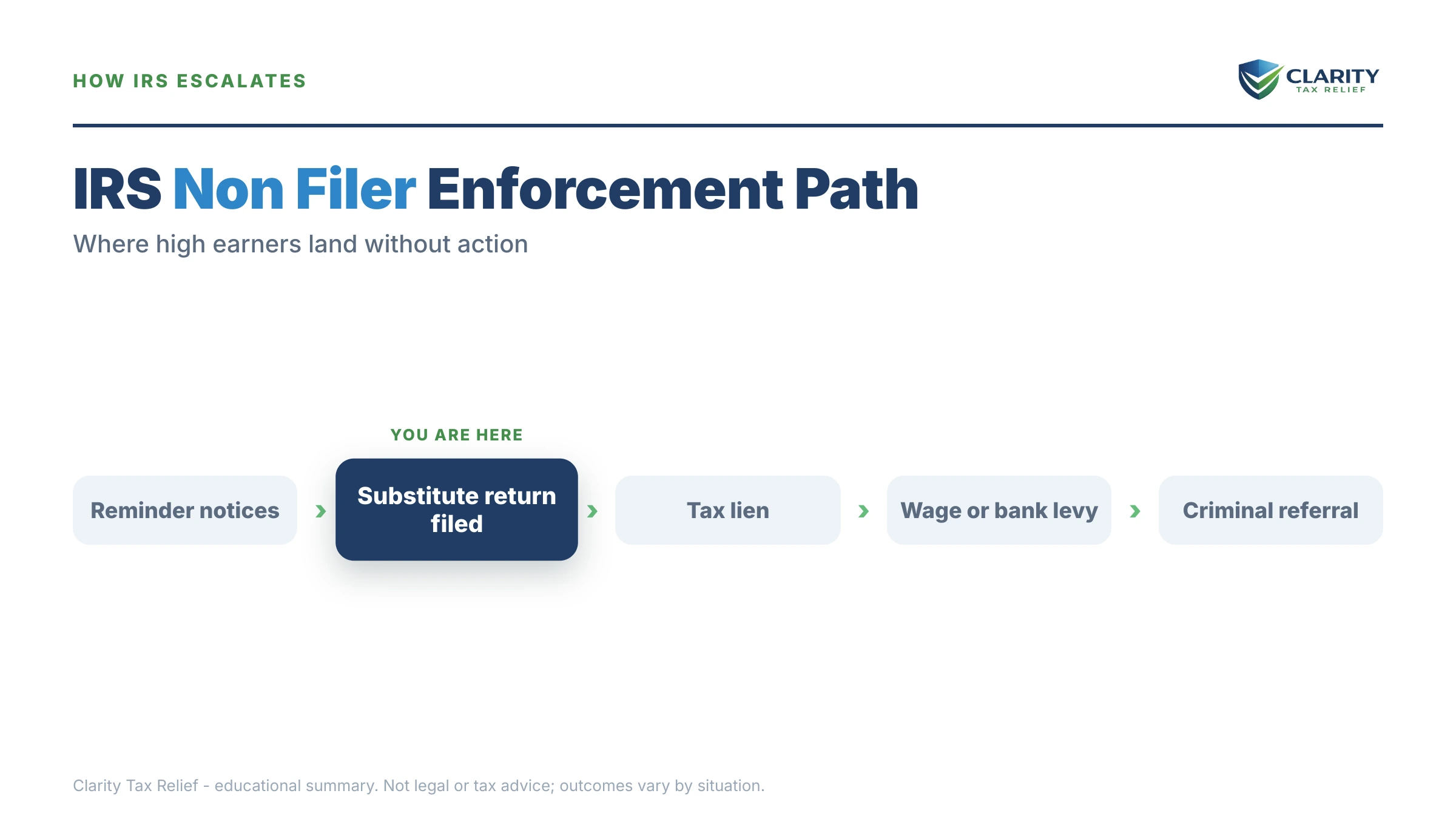
Silence doesn't close a non-filer case — it hands the IRS permission to calculate your tax for you, using the least favorable assumptions allowed. The sequence runs in stages, each one narrowing your options:
- CP59 — first notice that the IRS has no return on file for a specific year. A request, not yet a demand.
- CP516 — a firmer follow-up asking again for the missing return.
- CP518 — the final written request. After this, the IRS stops asking and starts calculating.
- Substitute for Return (SFR) — the IRS builds a return from your information documents: single or married-filing-separately status, no dependents, no itemized deductions, no business expenses, and investment sales often counted at full proceeds with no cost basis. A CP2566 typically proposes this figure and gives you a window — usually about 30 days — to respond.
- CP3219N Notice of Deficiency — the 90-day letter. You have 90 days to file your own return or petition Tax Court; after that, the SFR amount is assessed as legally owed.
- Collection — the assessed balance enters the normal bill-to-levy notice stream: liens, state-refund seizures, wage and bank levies, and — once the debt tops $66,000 (the 2026 threshold) — passport certification.
For high earners there are two extra risks the average non-filer doesn't face. The fraudulent failure-to-file penalty can triple the normal penalty to as much as 75% of the tax. And willful failure to file is a misdemeanor carrying up to a year in jail per unfiled year — prosecutions are rare, but large income plus multiple unfiled years is precisely the profile they target. Filing voluntarily, before contact escalates, is what keeps a case civil; here's the honest answer on jail for not filing taxes.
High income, unfiled years, and a mailbox you dread?
Every month you wait, the failure-to-file penalty and daily interest grow — and once a substitute return is assessed, you're negotiating against the worst-case number. Get your unfiled years reviewed free by an experienced tax professional before the IRS files for you.
Your options as a high income non filer in 2026
Every resolution path runs through the same gate: the missing returns must be filed first — the IRS will not negotiate a balance it hasn't assessed from your own numbers. The good news is that filing usually shrinks the problem, because your real return includes the deductions, basis, and business expenses an SFR ignores. Once the returns post, the balance becomes an ordinary tax debt with ordinary solutions (the full DIY playbook is in our guide to how to settle tax debt yourself):
| Option | Who it fits | Cost and catch |
|---|---|---|
| File and pay in full | Any balance you can cover | Stops penalty growth immediately; fastest route to a clean lender file |
| Short-term payment plan | Balance payable within 180 days | $0 setup fee; interest and penalties still accrue |
| Streamlined installment agreement | Assessed balance ≤ $50,000, up to 72 months | Set up online, no financial statement; all required returns must be filed first |
| Non-streamlined agreement | Balance over $50,000 | Requires financial disclosure (Form 433 series); lien filing becomes likely |
| Offer in Compromise | Only if assets + future income genuinely can't cover the debt | $205 fee, 20% down on lump-sum offers; roughly 1 in 5 accepted in FY2024 — most high earners don't qualify |
| Currently Not Collectible | Genuine hardship — realistic only after an income collapse | Pauses collection; debt, interest, and lien exposure remain |
| Penalty abatement (FTA / reasonable cause / AEP) | Clean prior 3 years for FTA; documented cause otherwise | Can remove the 25% failure-to-file penalty for qualifying years; AEP applies some relief automatically starting summer 2026 |
| Voluntary Disclosure Practice | Willful conduct with real criminal exposure | Formal program run through IRS Criminal Investigation — get representation before applying |
Comparing payment mechanics — direct debit, online agreements, payroll deduction — is its own decision; see the best way to pay the IRS once your balances are assessed.
How to respond as a high income non filer, step by step
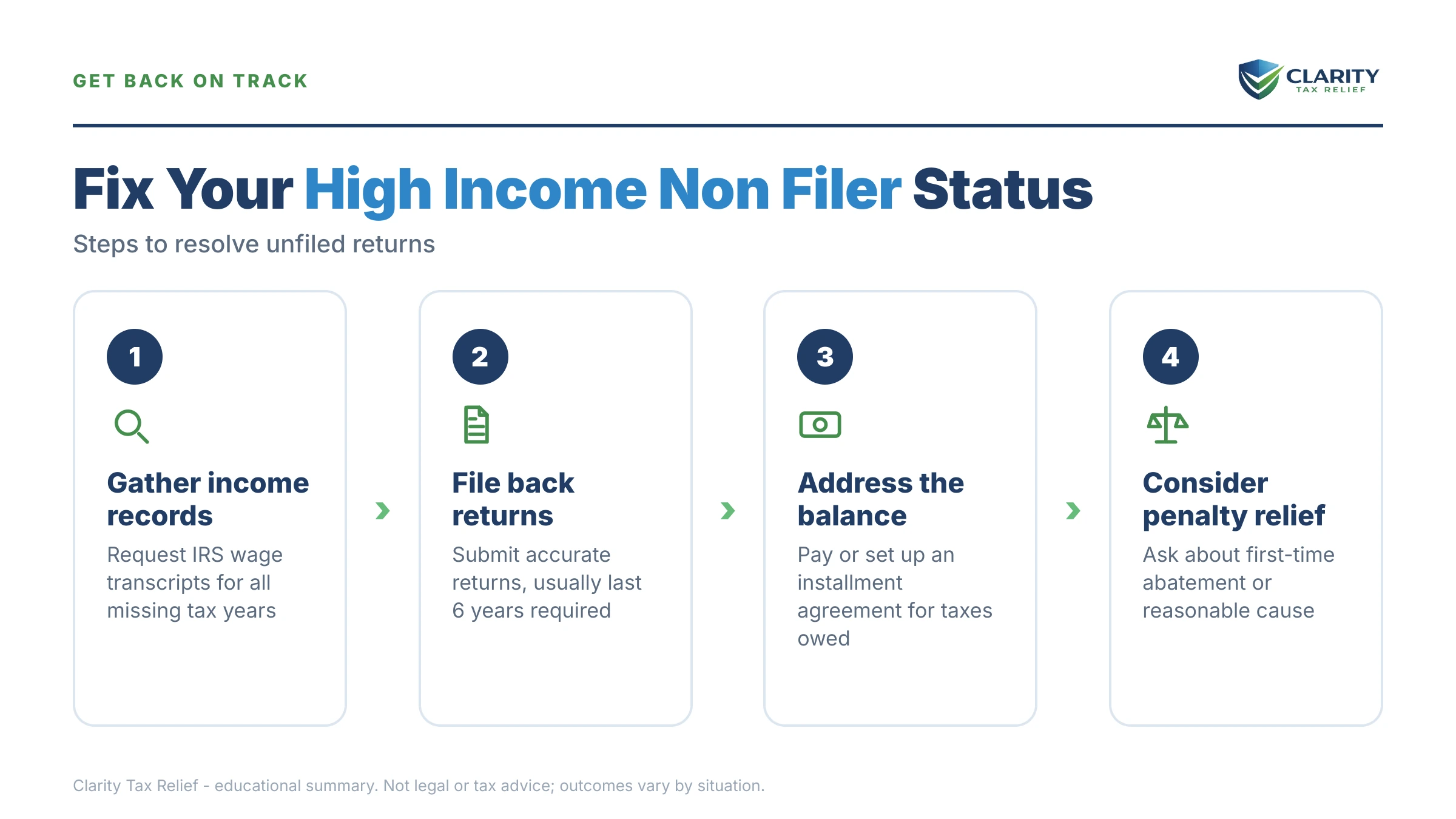
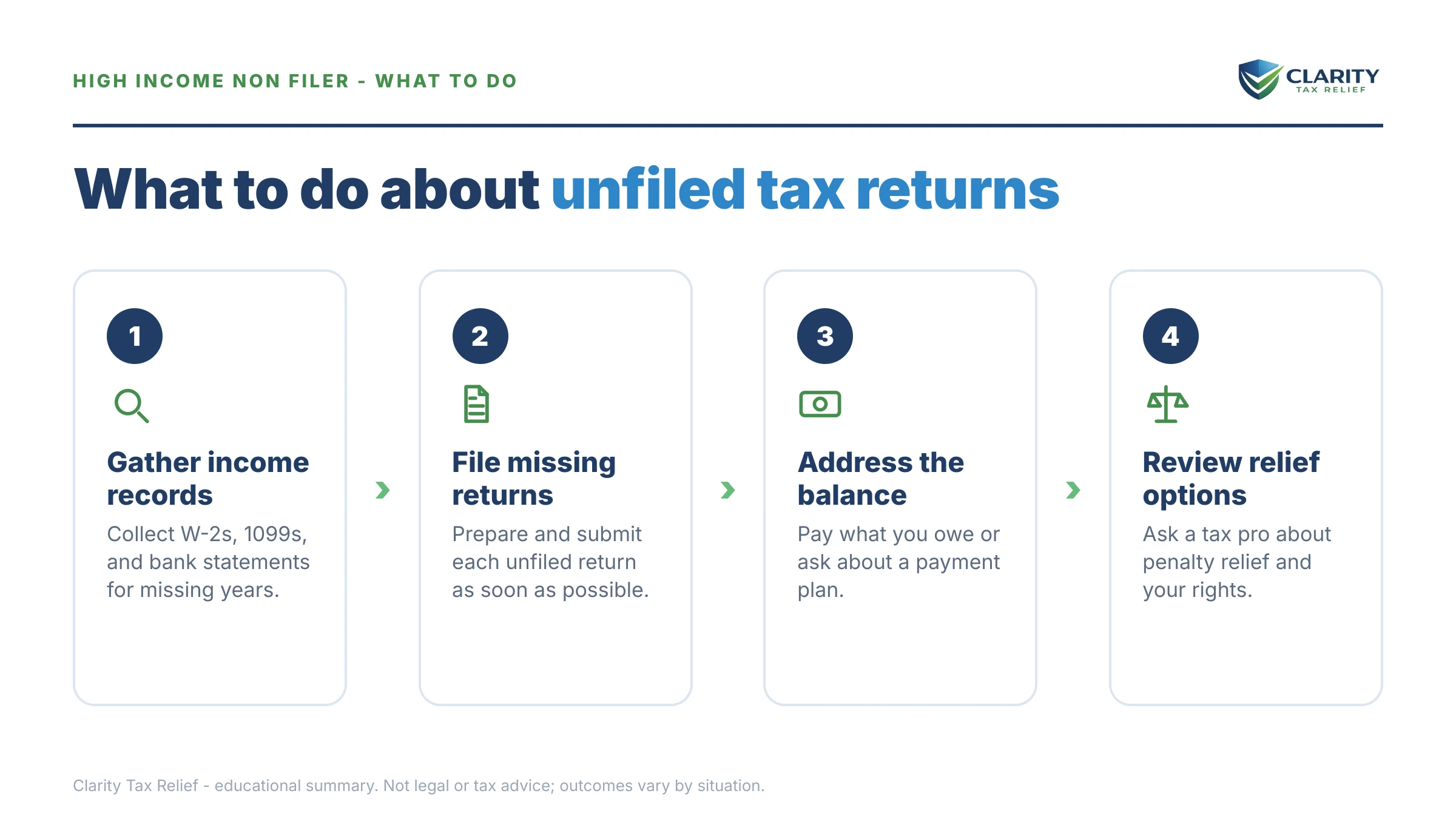
- Pull your IRS transcripts — download the wage and income transcript for every unfiled year plus account transcripts, so you know exactly what the IRS has and whether a substitute return has already posted.
- File the last six years first — prepare accurate original returns for the six-year lookback window, building each one from the transcript data so your figures reconcile with what the IRS already received.
- Replace any SFR with a real return — if the IRS filed a substitute return for you, file your accurate original for that year and request the assessment be corrected to the true figure.
- Set up a payment path the same week — once the balances are real numbers, choose full payment, a 180-day short-term plan, or an installment agreement before collection notices start.
- Request penalty relief after the returns post — ask for First-Time Abatement or reasonable-cause relief on the penalties once each year's return has processed and the penalty amounts are fixed.
Missing records are not a dead end — transcripts, bank statements, and reasonable reconstruction can rebuild a defensible return. Here's how to file back taxes without records.
The math on one unfiled year: a worked example
One unfiled year can add roughly 40% to the real tax through penalties and interest alone. Say your unfiled 2024 return, done correctly, would show $27,500 in tax due — a self-employed consultant's year with legitimate expenses deducted. Fourteen months after the deadline, here's the hypothetical arithmetic:
- Failure-to-file penalty: 5% per month, capped at 25% of the tax — about $6,875, fully accrued after five months.
- Failure-to-pay penalty: 0.5% per month ($137.50) that keeps running toward its own 25% cap — roughly $1,925 so far.
- Interest: set quarterly and compounded daily; on a balance this size it adds well over $100 a month, call it roughly $2,400 across fourteen months.
Total: somewhere around $38,700 — about $11,200 of it avoidable cost. Now the SFR contrast: if this consultant's gross receipts were $145,000 and the IRS filed for them, the substitute return would tax the full $145,000 as if every dollar were profit, with single filing status and no deductions — an assessed bill tens of thousands above the real $27,500. You can run your own figures with our IRS Penalty & Interest Calculator to estimate how much of a balance is penalty rather than tax.
And if a payment plan is the path: $38,700 spread across a streamlined 72-month agreement is roughly $540 a month before ongoing interest — a manageable line item next to a refinance, not a catastrophe.
What your IRS transcripts reveal before you file
Your account transcript tells you which stage the case has reached before any letter does. Pull it first — filing strategy changes completely depending on whether an SFR has posted:
| What you see | What it means | What to do |
|---|---|---|
| Wage & income transcript full of 1099s, W-2s, K-1s | The income the IRS already has on file for that year | Use it as the skeleton of your return so every figure reconciles |
| Account transcript with no Code 150 | No return or SFR assessed yet — your best window | File your accurate original return now, before the IRS calculates for you |
| Code 150 marked as a substitute return | The IRS filed an SFR and assessed its worst-case number | File your true original return and request the assessment be corrected |
| Code 290 | Additional tax assessed, usually after the SFR/deficiency process | Compare it to your real numbers; a correct return can still reduce it |
| Code 971 | A notice was issued on that date | Match it to the letter you received to confirm which stage you're at |
| Code 599 | Your delinquent return was received and secured | Good sign — monitor for processing, then move to the payment and penalty steps |
Unfiled returns and your refinance
A refinance file cannot close over an unfiled tax year, because your lender independently verifies your returns with the IRS using Form 4506-C. When that transcript request comes back "no record of return filed," underwriting stops — and for self-employed borrowers, who typically must show one to two years of filed returns, there's no workaround document that substitutes.
The sequencing matters. File the missing years first, let them post, then set up a payment arrangement in good standing — many lenders can underwrite around an IRS installment agreement, treating the monthly payment like any other debt. What they generally cannot underwrite around is a recorded federal tax lien clouding title, which is exactly what escalating balances over $50,000 tend to produce. If a lien or balance already exists, see what actually happens when buying a house while owing the IRS — the same underwriting logic governs a refi.
Timeline honesty: late returns filed on paper can take months to process in 2026's understaffed IRS, so a homeowner planning a refinance should start filing well before rate-locking — not the month of the application.
When you can handle this yourself
Not every non-filer needs professional help. You can reasonably do this alone if you have one or two unfiled years, complete records (or clean transcripts), W-2-style income with straightforward deductions, and a resulting balance you can pay in full or within 180 days. File, pay or set up the plan online, request penalty relief — done.
Experienced help changes the outcome when the stakes or complexity climb: multiple unfiled years with self-employment or business income, an SFR already assessed that needs to be unwound, gross-proceeds stock or crypto sales missing basis, a CP3219N with its 90-day clock already running, potential willfulness questions, or a combined balance large enough to trigger a lien right when your refinance depends on clean title. In those cases, the order of operations — which years to file first, how to correct the SFR, when to request abatement — directly changes what you pay.
Terms on your notices, decoded
- SFR (Substitute for Return): a return the IRS prepares for you from information documents, with no deductions, credits, or favorable filing status.
- ASED (assessment statute): the IRS's deadline to assess tax — it never begins running for a year you never filed.
- CSED (collection statute): the 10-year limit on collecting an assessed debt; it also can't start until there's an assessment.
- Policy Statement 5-133: the internal rule under which the IRS generally requires the last six years of returns for compliance.
- Form 4506-C: the form your mortgage lender uses to pull your IRS transcripts and verify what you filed.
- Willful failure to file: the misdemeanor charge for deliberately not filing — the line between "behind" and "criminal" is willfulness, not the dollar amount.
One cost that mostly can't be erased: interest. It's statutory and survives almost every relief program — here's the narrow truth about whether IRS interest can be waived.
High income non filer questions, answered
What income makes you a high income non filer?
The IRS's 2024 mailing campaign focused on people with total income above $400,000 who didn't file, including more than 25,000 cases above $1 million. But broader non-filer programs reach well below that — the IRS receives W-2s, 1099s, and K-1s for you either way, so any six-figure earner with unfiled years should assume they're visible to the system.
Can you go to jail for not filing taxes as a high earner?
It's possible but uncommon — willful failure to file is a misdemeanor that can carry up to a year in jail per unfiled year, and high income is exactly what prosecutors look for. The overwhelming majority of non-filer cases are resolved civilly with penalties and interest. Filing voluntarily before the IRS contacts you is the single strongest way to keep the case civil.
How many years of back taxes do I have to file?
Under IRS Policy Statement 5-133, the IRS generally requires the last six years of returns to consider you compliant, though it can demand more in cases involving large balances or fraud indicators. Refunds work differently: you can only collect a refund for roughly the last three years, so refund-due years older than that are lost if you keep waiting.
What happens if the IRS already filed a substitute return for me?
An SFR is built from information returns using single or married-filing-separately status, no dependents, no itemized deductions, no business expenses, and often no cost basis on investment sales — so the assessed tax is usually the worst-case number. You can still file an accurate original return, and the IRS will generally adjust the assessment down to the correct figure once it's processed.
Can I refinance my house with unfiled tax returns?
Almost never. Your lender pulls IRS transcripts with Form 4506-C, and "no record of return filed" typically stops underwriting cold — especially for self-employed borrowers, who usually need one to two years of filed returns. Filing the missing years and getting a payment arrangement in good standing is usually the fastest route back to a closable file; a recorded tax lien adds a separate title problem.
Will filing several years at once trigger an audit?
There is no automatic audit for filing late returns — they are processed like any other returns. What matters is accuracy: the IRS matches every return against the W-2s, 1099s, and K-1s already on file, so unexplained gaps invite scrutiny. Build each return from your wage and income transcripts so your numbers reconcile with what the IRS already knows.
Can the penalties be removed once I file?
Sometimes. First-Time Abatement requires a clean prior three years, which multi-year non-filers usually can't show for every year — though it may cover the first delinquent year. Reasonable-cause relief (illness, disaster, reliance on bad advice) can reach the rest, and starting summer 2026 the IRS's Automatic Exemption from Penalty applies some relief with no request needed. Interest itself is rarely waivable except when caused by IRS error.
Your next 24 hours
- Find every IRS letter you've received. Note the notice number in the top corner — CP59, CP516, CP518, or CP3219N — and any response date printed on it. If a 90-day letter is in the stack, that date now governs everything.
- Open your IRS online account and download transcripts. Pull the wage and income transcript for each unfiled year and the account transcript showing whether a Code 150 has posted — that one line tells you if the IRS has already filed for you.
- Get a free case review. Penalties and daily interest keep compounding on every unfiled year, and a refinance can't close until the returns post. Call (888) 825-7779 or use the 2-minute form, and an experienced tax professional will map the filing order, the SFR fix, and the payment path — free and confidential.
For the IRS's own description of the first letter in this sequence, see Understanding your CP59 notice. Payment mechanics once your balances are assessed are at the IRS payment plans page, and if processing delays are hurting you — a refinance stalled on an unprocessed return, for example — the Taxpayer Advocate Service exists for exactly that.
This guide is general information, not tax or legal advice for your specific situation. Eligibility for IRS programs depends on individual facts and circumstances; no outcome is guaranteed.