
IRS Penalties
Federal Tax Deposit Penalty: The 2%, 5%, 10% and 15% Tiers (2026)
The short answer: the federal tax deposit penalty is 2%, 5%, 10%, or 15% of each late payroll tax deposit. Deposits 1–5 days late cost 2%, 6–15 days late cost 5%, more than 15 days late cost 10% — and the rate jumps to 15% if the tax stays unpaid 10 days after the IRS's first demand notice.
You made payroll — your people got paid — but the deposit to the IRS didn't go out, and now the notice in your hand adds thousands in penalties on top of tax you already couldn't cover. You rent your home and your shop, there's no equity to borrow against, and the newest letter warns the IRS intends to levy.
Here's what matters: the federal tax deposit penalty follows exact, predictable rules — and several of those rules can be turned in your favor if you move before the levy clock runs out. The four tiers are easier to see than to read; the image below shows you exactly how the rates stack and where your late deposits land.
⏱ The 10-day rule: you have 10 days from the date on the IRS's first notice demanding payment before the federal tax deposit penalty on unpaid amounts jumps to its top 15% tier. Interest and the 0.5% monthly failure-to-pay penalty keep accruing the whole time — and if a CP504B or LT11 has arrived, the response date printed on that notice is your levy deadline.
Why you got a federal tax deposit penalty
You got this penalty because IRS records show at least one required payroll tax deposit arrived late, arrived short, or never arrived. The penalty — the IRS calls it the failure-to-deposit (FTD) penalty, under IRC §6656 — attaches to deposits, not to your Form 941 itself. You can file every 941 on time and still rack up this penalty every payday.
Employers can't simply pay employment taxes with the quarterly return. Withheld income tax and FICA must be deposited electronically through EFTPS on a fixed schedule, and the schedule is set by your lookback period: report $50,000 or less in the lookback window and you're a monthly depositor (due the 15th of the following month); report more and you're a semiweekly depositor (due the Wednesday or Friday after payday). Accumulate $100,000 in tax on any single day and the deposit is due the next business day, no matter your schedule.
Common triggers we see: a cash crunch where rent and payroll won out over the deposit, a bookkeeper or payroll provider who dropped the ball, a business that grew past $50,000 in the lookback period without realizing its schedule changed, or a deposit made by check instead of through EFTPS. If your notice is a CP276B notice, the IRS specifically changed or assessed the penalty because your deposits didn't match the schedule it has on file for you.
One disambiguation worth 10 seconds: this is a payroll penalty for employers. If you're a freelancer who got penalized for skipping quarterly payments, you're looking for the estimated tax penalty rate 2026 guide instead — different statute, different math, different fixes.
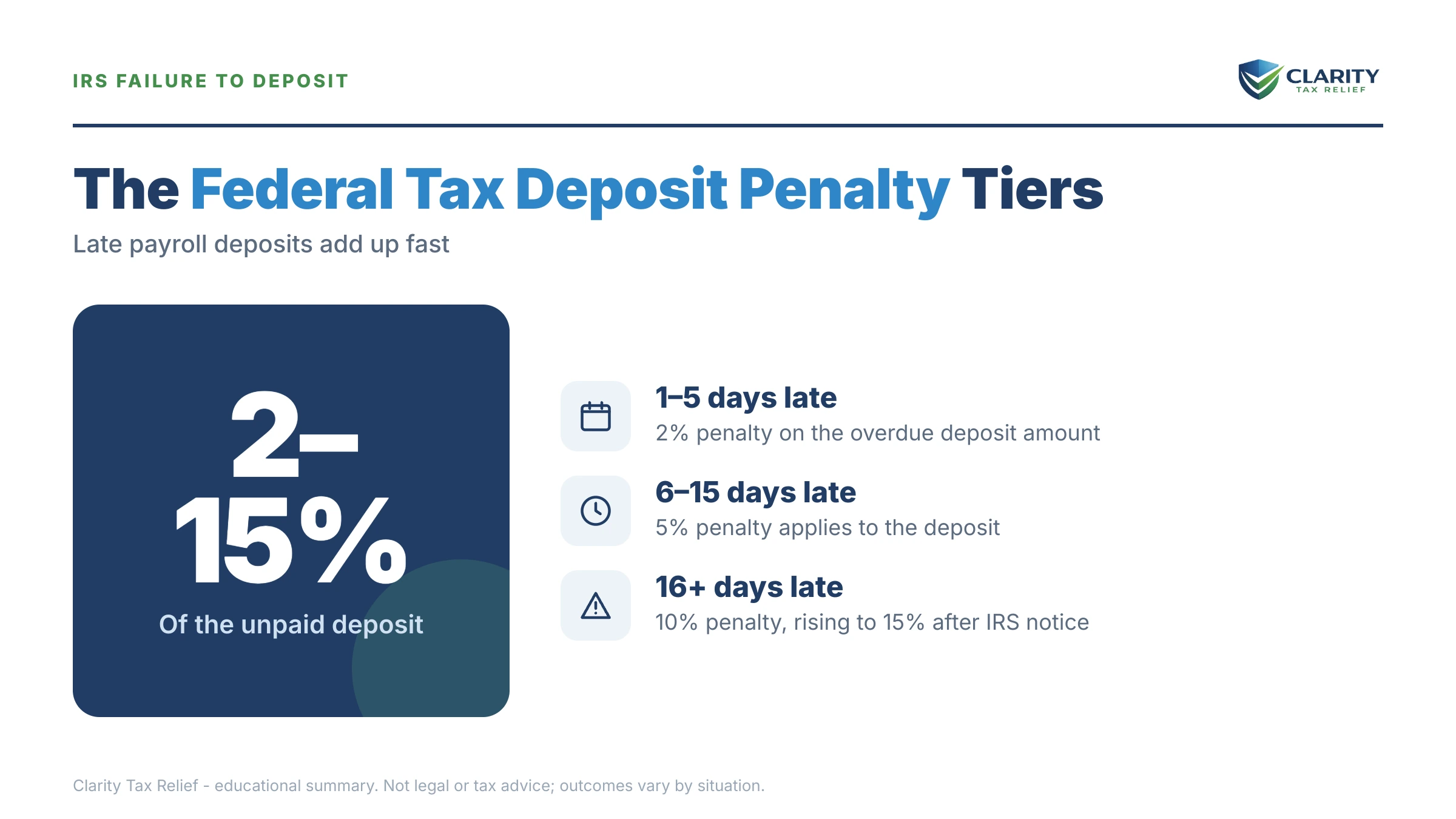
How the 2%, 5%, 10% and 15% penalty tiers work
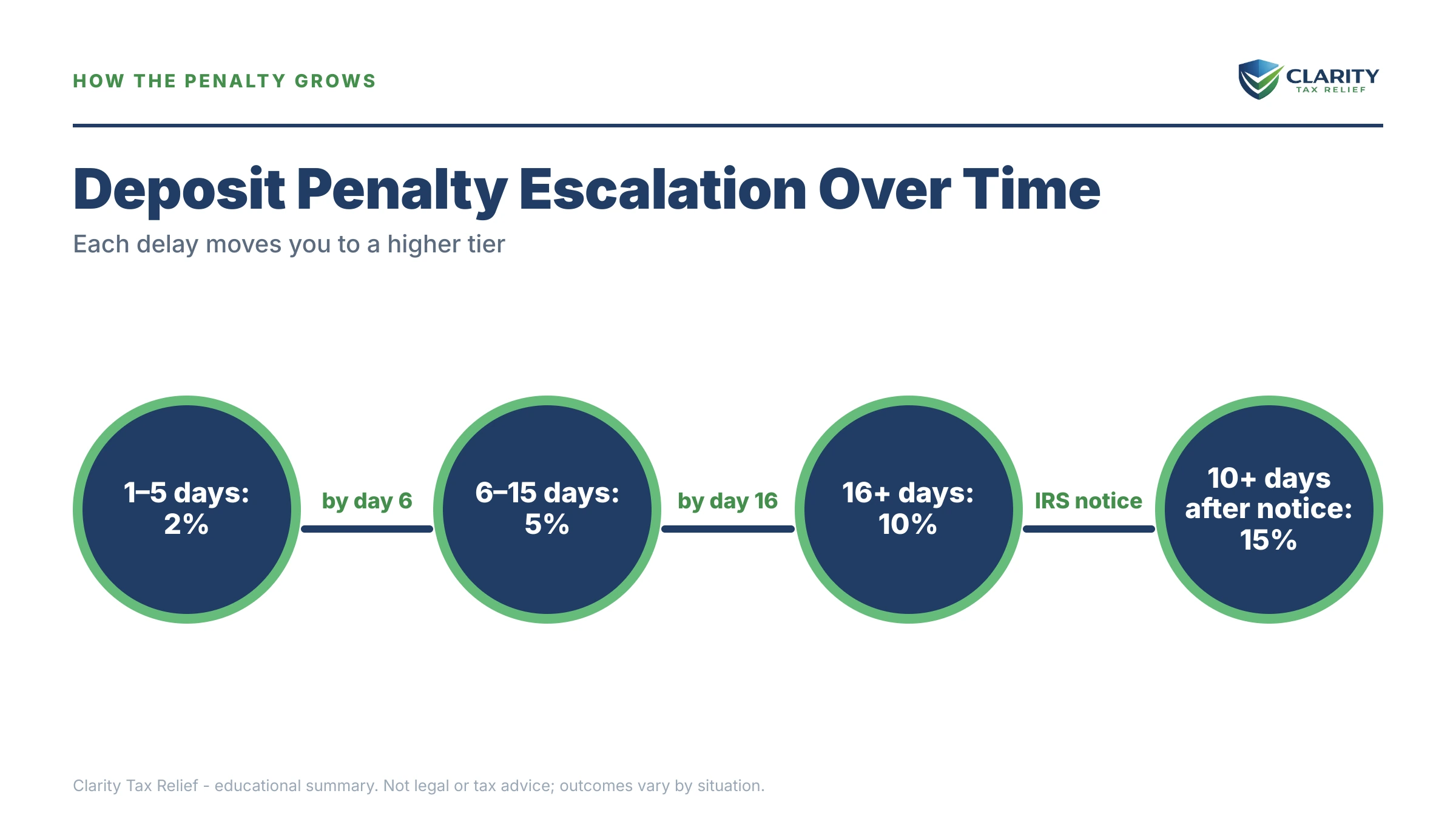
The penalty rate is set entirely by how late each deposit is — 2% at 1–5 days, 5% at 6–15 days, 10% beyond 15 days, and 15% once the IRS has demanded payment and 10 days pass. There's no discretion in the initial assessment; a computer compares each required deposit date against each received deposit and applies the grid.
| How late the deposit is | Penalty rate | What it means in practice |
|---|---|---|
| 1–5 calendar days | 2% | Even one day late triggers the penalty on that deposit |
| 6–15 calendar days | 5% | The rate more than doubles in the second week |
| More than 15 days | 10% | Also applies to amounts paid directly to the IRS instead of deposited through EFTPS |
| Still unpaid 10+ days after the first IRS demand notice | 15% | The top tier — triggered by ignoring the notice, not by the original lateness |
Two mechanics make this penalty grow faster than owners expect. First, it applies per deposit — a semiweekly depositor who struggles for one quarter can accumulate 25+ separate penalties, each at its own tier. Second is the cascade: by default the IRS applies each deposit you make to the oldest outstanding liability first. Skip one deposit, and every on-time deposit after it gets pulled backward to cover the old gap — which makes each of those later deposits "late" too. One missed payday can quietly penalize an entire quarter.
Two built-in relief valves exist. A shortfall safe harbor: if a deposit is short by no more than the greater of $100 or 2% of the required amount, and you make it up by the applicable makeup date, no penalty applies to the shortfall. And deposit designation: within 90 days of the penalty notice, you can tell the IRS how to apply your deposits — pointing them at the newest liabilities instead of the oldest, which breaks the cascade and can meaningfully shrink the penalty. More on that in the options below.
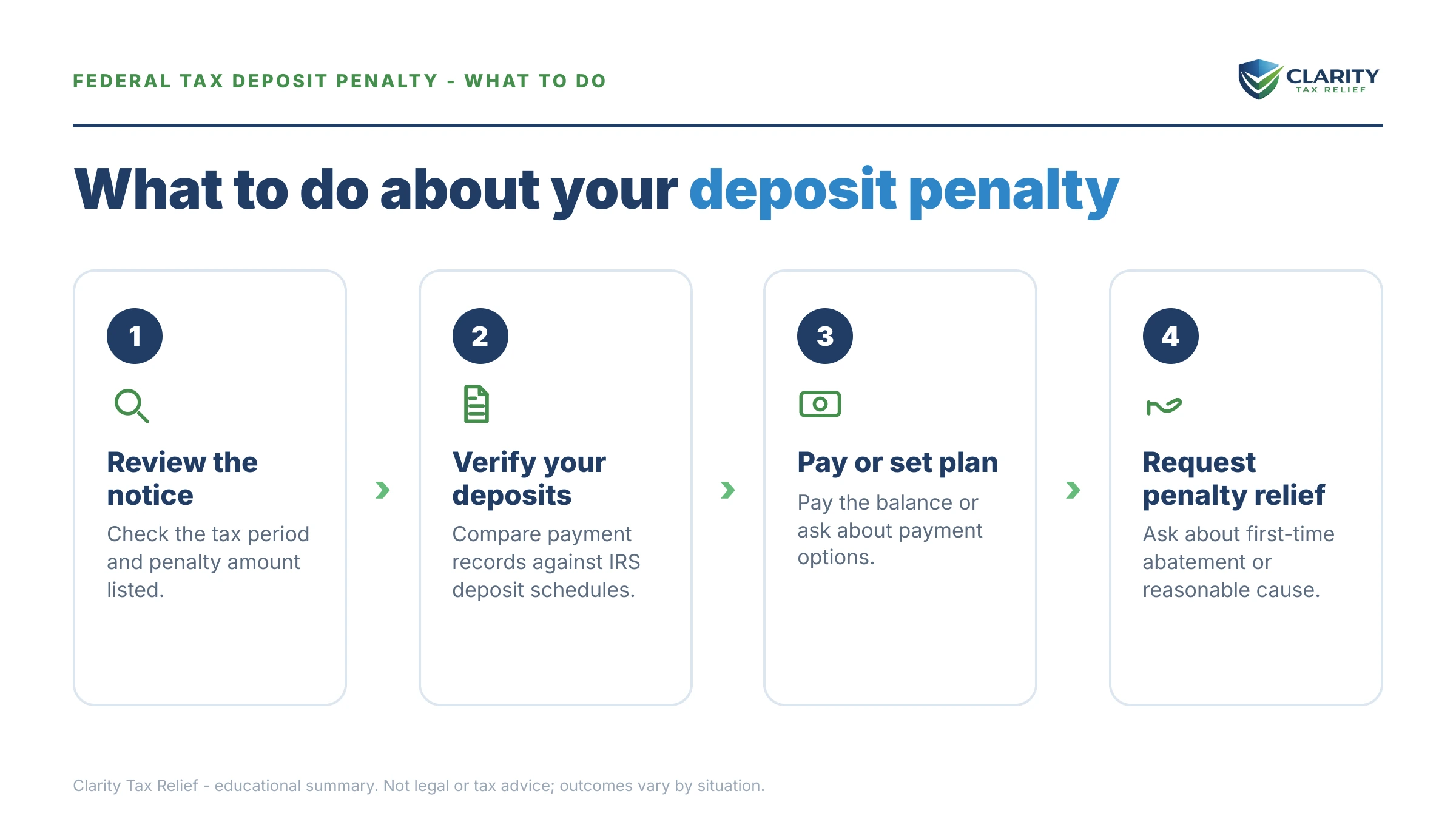
What happens if you ignore a deposit penalty
An unpaid deposit-penalty balance follows the business collection track — balance-due notice, intent to levy, final notice, then levy — with a personal-liability track that can run alongside it. The sequence is automated: IRS staffing fell roughly 27% in 2025, but the notice system and the levies it issues never paused, so "nobody's called me" means nothing about where you sit in the queue.
- Penalty assessed — the FTD penalty posts with your 941 processing, often announced on a CP276B. The 10-day clock toward the 15% tier starts with the first demand for payment.
- CP161 — the business balance-due bill: tax, penalty, and interest, with a pay-by date printed on it.
- CP504B — notice of intent to levy. The IRS positions itself to seize business property and payments owed to you.
- LT11 / Letter 1058 — final notice of intent to levy. A 30-day clock starts, along with your Collection Due Process appeal rights (requested on Form 12153).
- Levy — the business bank account (funds held 21 days before they're gone), accounts receivable, or merchant deposits.
| Notice | Your window | What you lose if it passes |
|---|---|---|
| First demand notice (often CP276B or CP161) | 10 days from the notice date | The FTD penalty on unpaid tax escalates from 10% to 15% |
| CP504B | The response date printed on the notice | Your last low-friction chance to set terms before final-notice enforcement |
| LT11 / Letter 1058 | 30 days from the notice date | Your Collection Due Process hearing rights — and levy protection while you negotiate |
| Letter 1153 (parallel track) | 60 days to protest | Your chance to contest personal liability before the trust fund penalty is assessed against you |
That last row is the one payroll debt adds that ordinary tax debt doesn't. The withheld income tax and the employees' share of FICA are "trust fund" money, and the IRS can assess that portion personally — against owners, officers, check-signers, sometimes bookkeepers — through the Trust Fund Recovery Penalty. Being a renter with no assets doesn't make you levy-proof: a TFRP assessment follows your personal wages and bank accounts, not your (nonexistent) home equity. And if deposits keep getting skipped quarter after quarter, the IRS treats it as pyramiding — the pattern that moves payroll cases from automated collections to a revenue officer, and in the worst cases toward criminal referral.
Deposit penalties piling up and a levy notice on the desk?
Get your penalty notice reviewed free before the response date printed on it passes. An experienced tax professional will check the tier math, the abatement angles, and the fastest way to take the levy off the table — no pressure, no obligation.
Your options for reducing or resolving the penalty
Every path to fixing a federal tax deposit penalty starts the same way: get current on this quarter's deposits, because the IRS won't negotiate anything while new deposits are still being missed. From there, the real options — most of which the notice never mentions — look like this. (For how deposit penalties compare with every other IRS penalty, see how much are IRS penalties on back taxes.)
| Option | Cost & eligibility | Timeline & effect |
|---|---|---|
| Deposit designation | Free; must act within 90 days of the penalty notice | Redirects deposits to newest liabilities, breaking the cascade — can cut the penalty itself |
| First-time abatement | Free; requires a clean penalty history for the prior 3 years | Often granted by phone; removes the FTD penalty for one period |
| Reasonable-cause abatement | Free; requires events beyond your control, with documentation | Written request (often Form 843); weeks to months for a decision |
| In-Business Trust Fund Express installment agreement | Balance of $25,000 or less; setup fee applies | Full pay within 24 months; no financial statement required |
| Regular business installment agreement | Balances above $25,000; requires Form 433-B financial disclosure; setup fee applies | Monthly payments negotiated from your business financials; stops levy action once in place |
| Full payment | The balance, at IRS.gov/payments | Immediate; stops the 15% escalation, monthly failure-to-pay penalty, and the notice stream |
Designation is the FTD penalty's one unique fix — and it expires 90 days after the penalty notice. Because the IRS applies deposits oldest-first by default, a business that missed one early deposit but stayed current afterward is often penalized on a whole chain of deposits that actually arrived on time. Designating those deposits to the periods you intended them for confines the penalty to the deposit you really missed. It's arithmetic, not mercy — but it regularly cuts penalties more than any abatement request.
Abatement stacks on top. First-time abatement applies to the FTD penalty if your prior three years are penalty-clean — and note that starting summer 2026, the IRS's Automatic Exemption from Penalty (AEP) begins applying that first-time relief automatically, so check your transcript before assuming you must ask. For messier facts — a bank failure, an embezzling bookkeeper, a payroll provider who pocketed the money — reasonable cause is the route; our guide to 941 penalty abatement covers what payroll-specific arguments actually succeed, and the Form 843 walkthrough covers the paperwork. If a provider caused this, know that the deposit duty stays legally yours, but their failure strengthens your case — see payroll company didn't pay taxes.
For the balance that remains, the payment-plan rules for in-business payroll debt are stricter than for personal tax debt — current-quarter compliance is non-negotiable, and above $25,000 the IRS wants full financials. The business payroll tax payment plan guide walks through both tiers.
A worked example: $68,500 in missed deposits
Say your business missed deposits totaling $68,500 across two quarters, all more than 15 days late, and the first IRS demand notice just arrived. Here's the math, all hypothetical:
- FTD penalty at the 10% tier: $68,500 × 10% = $6,850.
- If the notice sits 10 days unanswered: the tier rises to 15% — $68,500 × 15% = $10,275. Missing one 10-day window costs an extra $3,425.
- Failure-to-pay penalty: 0.5% per month on the unpaid tax — about $342.50 every month, on top.
- Interest: compounds daily on the whole balance, tax and penalties alike.
Left alone for a year, penalties alone add roughly $14,385 before a dollar of interest — and if, say, $45,000 of that $68,500 is trust fund money (the withholding and employee FICA), that portion can be assessed against you personally even though the business owes it. Now run it the other way: respond within the 10-day window (penalty stays at $6,850), designate deposits within the 90-day window to unwind any cascade, and request abatement on what's left. The same $68,500 problem can carry a five-figure penalty load or a much smaller one depending entirely on which windows you catch. You can estimate your own penalty and interest buildup with our Penalty & Interest Calculator.
How to respond to a federal tax deposit penalty, step by step
- Verify the penalty math. Pull your EFTPS deposit history and payroll records, and confirm which deposits the IRS counted late — and at which tier.
- Get current on this quarter's deposits. The IRS will not negotiate anything — plans, abatement, or levy holds — while new deposits are still being missed.
- Designate your deposits if you're within 90 days of the penalty notice. Direct payments to the newest liabilities first to break the cascade and shrink the penalty.
- Request abatement. Ask for first-time abatement by phone if your prior three years are clean, or make a reasonable-cause request on Form 843.
- Set up a payment arrangement for the rest. Do it before the response date printed on your levy notice passes — an installment agreement in place stops enforcement.
- Respond to any Trust Fund Recovery Penalty letter within its 60-day window. A Letter 1153 proposing personal liability has its own deadline and appeal rights — never let it lapse by default.
When you can handle this yourself — and when help changes the outcome
Plenty of deposit-penalty cases are genuinely do-it-yourself. If you missed one deposit, the penalty is a few hundred dollars, and your prior three years are clean, a single phone call requesting first-time penalty abatement will often clear it. Same if a payroll provider error is documented and the money is otherwise paid — a clear reasonable-cause letter with proof usually works. And a one-tier, one-deposit penalty you agree with can simply be paid at IRS.gov/payments before it compounds.
Experienced help changes outcomes in four specific situations: a CP504B or LT11 is already in hand and a levy on the operating account would kill the business; deposits have been missed across multiple quarters (the cascade math, designation strategy, and abatement sequencing interact, and the order you fix them in changes the total); a Letter 1153 or Form 4180 interview request has arrived, because what you say there determines whether the debt becomes personally yours; or the missed deposits are ongoing — a pattern the IRS reads as pyramiding and treats as its most serious civil payroll problem. If the underlying quarters are also behind, start with the broader picture in missed payroll tax deposit.
Terms on your notice, decoded
- Federal tax deposit (FTD): the scheduled electronic payment of withheld income tax and FICA an employer must make between quarterly returns.
- EFTPS: the Electronic Federal Tax Payment System — the free Treasury system (EFTPS.gov) through which required deposits must generally be made.
- Lookback period: the July 1–June 30 window the IRS uses to measure your reported taxes and set your deposit schedule — $50,000 is the monthly/semiweekly dividing line.
- Trust fund taxes: the withheld income tax and employees' share of FICA — money the IRS treats as held in trust, and the portion it can pursue personally.
- Trust Fund Recovery Penalty (TFRP): the assessment that makes a "responsible person" who "willfully" failed to pay over trust fund taxes personally liable for them.
- Notice and demand: the IRS's formal request for payment — the letter that starts the 10-day clock toward the 15% tier.
Federal tax deposit penalty FAQs
How much is the federal tax deposit penalty?
The penalty is 2% of the late deposit if it's 1–5 days late, 5% if it's 6–15 days late, and 10% if it's more than 15 days late. It jumps to 15% if the tax is still unpaid more than 10 days after the IRS's first notice demanding payment. The rate applies separately to each late deposit, so one bad quarter can generate a dozen separate penalties.
Is there a penalty if my deposit is only one day late?
Yes — a deposit that is 1 to 5 days late is penalized at 2% of the deposit amount. There is a narrow safe harbor for small shortfalls: if your shortfall is no more than the greater of $100 or 2% of the required deposit, and you make up the difference by the applicable makeup date, no penalty applies to that shortfall.
Can the failure-to-deposit penalty be waived?
Yes, in three main ways. First-time abatement can remove it if you have a clean penalty history for the prior three years. Reasonable cause — a fire, serious illness, bank failure, or similar events beyond your control — can remove it in any year, usually requested on Form 843 or by responding to the notice. And starting summer 2026, the IRS's Automatic Exemption from Penalty program begins applying qualifying first-time relief automatically, without a request.
What's the difference between the failure-to-deposit penalty and the failure-to-pay penalty?
The failure-to-deposit penalty is a one-time percentage — 2% to 15% — of each payroll deposit that arrives late, charged when the deposit is missed. The failure-to-pay penalty is a recurring 0.5% per month on any balance that stays unpaid. A business that misses deposits usually gets both: the FTD penalty when the deposit is late, then monthly failure-to-pay penalties and daily-compounding interest on whatever remains unpaid.
Am I personally liable for my business's payroll tax debt?
You can be — for the trust fund portion of the tax, though not for the FTD penalty itself. Through the Trust Fund Recovery Penalty, the IRS can assess the withheld income tax and the employees' share of FICA against any responsible person who willfully failed to pay it over — owners, officers, and sometimes bookkeepers or check-signers. Operating as an LLC or corporation does not shield you from the TFRP.
What if my payroll company failed to make the deposits?
Your business is still liable — the deposit obligation legally belongs to the employer, even when a payroll provider takes the money and never sends it to the IRS. That said, provider failure is one of the stronger reasonable-cause arguments for removing the penalties, especially if you can show the funds left your account on time. Document everything and report the provider's failure to the IRS.
How do I know if I'm a monthly or semiweekly depositor?
Your lookback period decides. For Form 941 filers, the IRS looks at the taxes you reported from July 1 through June 30 ending in the prior year. If you reported $50,000 or less, you deposit monthly, by the 15th of the following month. If you reported more, you deposit semiweekly. And regardless of schedule, accumulating $100,000 or more in tax on any day triggers a next-business-day deposit requirement.
Does the penalty apply if I paid the IRS directly instead of using EFTPS?
It can. Required deposits generally must be made electronically through EFTPS, and amounts sent to the IRS some other way — a check mailed with the return, for example — can be treated as non-deposited and penalized at 10%, even if the money arrived on time. A small exception lets employers with less than $2,500 in tax for the quarter pay it with a timely filed Form 941.
The IRS's own summary of the penalty is at IRS.gov: failure to deposit penalty.
Your next 24 hours
- Find two dates on your notice: the notice date (that starts the 10-day clock toward the 15% tier) and any response or levy date printed on a CP504B or LT11. Write both on the envelope.
- Gather your records: the notice itself, your last four Forms 941, your EFTPS deposit history, and payroll registers for the affected quarters — that's everything needed to check the tier math and spot a cascade.
- Get the free case review: call (888) 825-7779 or use the 2-minute form before the response date on your notice passes. We'll map the designation, abatement, and payment-plan sequence for your exact quarters — free.
This guide is general information, not tax or legal advice for your specific situation. Eligibility for IRS programs depends on individual facts and circumstances; no outcome is guaranteed.