
IRS Notices
IRS CP276B Notice: What It Means and What to Do Next (2026)
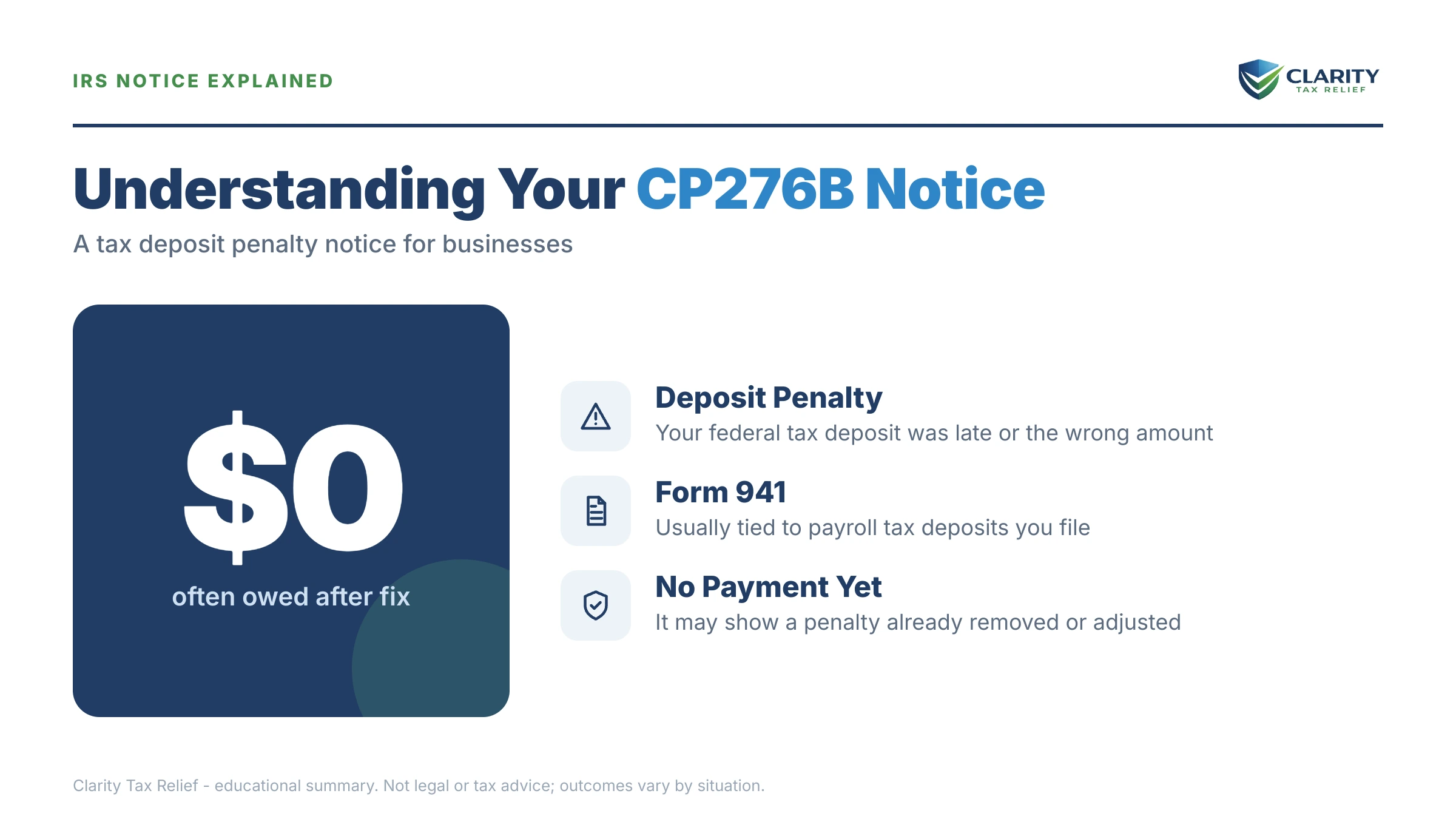
The short answer: a CP276B notice means the IRS found a problem with your federal tax deposits — they didn't match your required deposit schedule — but it chose not to charge the deposit penalty this time. Nothing is due. Fix your deposit routine now, because a repeat typically costs 2%–15% of the late amount.
You saw the word "penalty" in the first paragraph, braced for a dollar figure, and then hit the strangest sentence the IRS writes: we didn't charge you one. If you run payroll for a small business, a CP276B is the closest thing the IRS sends to a warning shot — the computer caught your deposits landing on the wrong dates, logged it, and let it slide once.
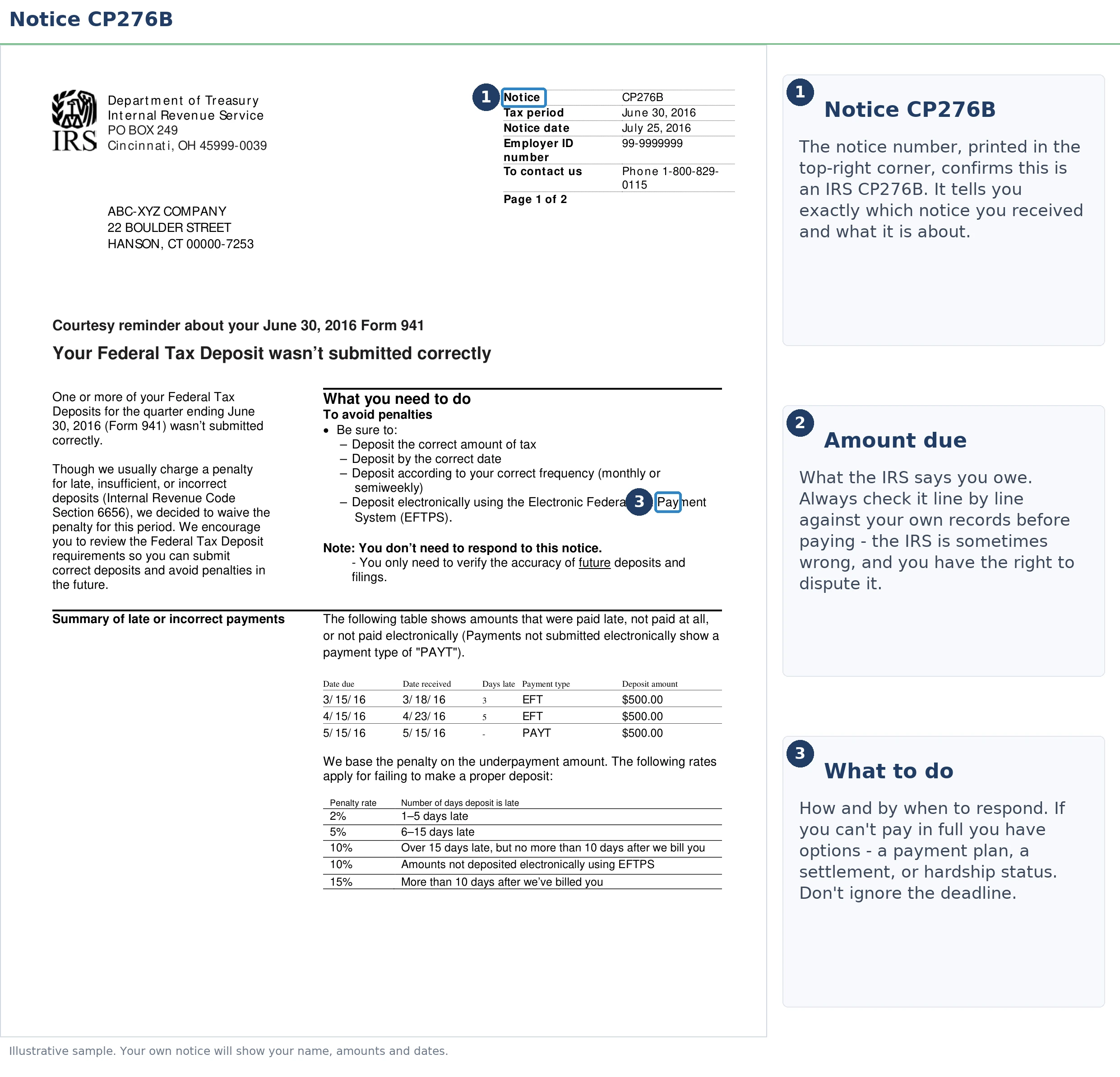
That "once" is the entire point of this page. The notice costs you nothing today, but it documents that the IRS's deposit-matching system has your employment tax account on its radar. The image below shows exactly what a CP276B looks like and where to find the form number, tax period, and deposit-requirement language that tell you what to fix.
⏱ Your real clock: a CP276B has no payment deadline — no penalty was charged and no balance is due. The deadline that matters is your next federal tax deposit due date. If the same discrepancy shows up again, the IRS typically assesses the federal tax deposit penalty of 2% to 15% instead of waiving it.
Why you got a CP276B notice
The IRS sends a CP276B when the deposit dates in its payment records don't line up with the liability dates on your employment tax return. Most CP276Bs trace to a Form 941 quarter, though the same notice can flag Form 940, 943, 944, or 945 deposits. The computer compared when you owed each chunk of payroll tax against when your money actually arrived — and found a gap.
The specific triggers we see most often:
- A late deposit. The full amount was paid, but one or more deposits settled after the due date for your schedule.
- The wrong deposit schedule. You deposited monthly when your lookback-period liability made you a semiweekly depositor — or you crossed the $100,000 next-day threshold on a big payroll and didn't know the rule.
- A deposit applied to the wrong period. An EFTPS entry keyed to the wrong quarter looks like a missing deposit in one period and an early one in another.
- Schedule B dates that don't match reality. If the liability dates you reported on Schedule B (Form 941) disagree with your actual paydays, the match fails even when the money was on time.
- A payroll-provider handoff. Switching providers mid-quarter is the classic cause — each side assumes the other made the transition deposit.
What a CP276B is not: an audit, a bill, or an accusation. It's automated output from deposit matching, the same way most IRS mail starts — our guide to why did I get a letter from the IRS covers how that machinery works. If your notice looks different from what's described here — say it mentions a missing or incomplete liability schedule — you may be holding its sibling, the CP276A, covered in the FAQ below.
What a CP276B just saved you: the FTD penalty math
The federal tax deposit penalty runs 2% to 15% of the late amount, depending on how late the deposit was. That's the charge the CP276B waived — and the charge that's typically waiting if the pattern repeats. The full tier structure is covered in our federal tax deposit penalty guide; here's what it looks like in dollars.
Say your Form 941 shows $16,400 in liability for the flagged quarter — a hypothetical two-employee shop running payroll out of rented space. You paid every dollar, but the whole quarter's deposits ran late after a bookkeeping handoff. Here's what each tier would have cost:
| How late the deposit is | Penalty rate | Cost on $16,400 |
|---|---|---|
| 1–5 days late | 2% | $328 |
| 6–15 days late | 5% | $820 |
| More than 15 days late | 10% | $1,640 |
| Still unpaid more than 10 days after an IRS demand notice | 15% | $2,460 |
Run the arithmetic forward and the stakes get clearer. If that $16,400 pattern repeats every quarter at the 10% tier, you're volunteering $6,560 a year in penalties on tax you were going to pay anyway — plus interest on any unpaid penalty. You can estimate your own exposure with our Penalty & Interest Calculator. The CP276B is the one quarter where that number was zero. Treat it that way.
Getting your deposit schedule right
Your deposit schedule is set by your lookback period — roughly, your total employment tax reported in a prior four-quarter window — not by what's convenient. Most CP276Bs come down to a business depositing on the wrong schedule without realizing its liability crossed a threshold. Here are the rules the IRS matched you against:
| Your situation | Your schedule | Deposit deadline |
|---|---|---|
| Lookback-period liability of $50,000 or less | Monthly depositor | 15th of the following month |
| Lookback-period liability over $50,000 | Semiweekly depositor | Paydays Wed–Fri: following Wednesday. Paydays Sat–Tue: following Friday |
| $100,000 or more accumulated on any single day | Next-day rule | Next business day — and you become a semiweekly depositor going forward |
(Form 944/annual filers use a different lookback period — the second preceding calendar year, e.g., 2024 for 2026 — but the same $50,000 threshold).
Two traps worth flagging. First, a growing business can silently cross the $50,000 lookback line and become a semiweekly depositor while still depositing monthly — every deposit is then "late" even though nothing changed on your end. Second, one large bonus run can trigger the $100,000 next-day rule on a single payday, and that one event reclassifies your schedule. If a deposit was genuinely missed rather than mistimed, that's a different and more urgent problem — our guide to a missed payroll tax deposit walks through the fix.
What happens if you ignore a CP276B
Ignoring a CP276B costs nothing this quarter — the risk is what the same behavior costs in every quarter after it. The notice itself never escalates, but the underlying deposit problem feeds a very real business collection sequence if it continues:
- This quarter: the free pass. No penalty, no balance, no required response. The discrepancy is logged on your account.
- The repeat quarter: the penalty gets assessed. The same mismatch next time typically draws the 2%–10% FTD penalty — a real balance, billed on a business balance-due notice such as a CP161 notice.
- Unpaid penalties: intent to levy. An ignored business balance moves to a CP504B notice, which lets the IRS seize your state tax refund and puts a federal tax lien on the table.
- Final notice: 30 days to levy. A final notice of intent to levy — the CP297A notice for businesses — starts a 30-day clock and your Collection Due Process rights. After it runs, the IRS can levy business bank accounts and receivables.
- Chronic non-deposit: it gets personal. Quarter-after-quarter deposit failures on trust fund taxes can bring a revenue officer and the trust fund recovery penalty — which moves the withheld-tax portion of the debt onto owners and check-signers personally, where it survives even a closed business.
In 2026, with IRS staffing down roughly 27%, no human decides any of this. The deposit matching, the penalty assessment, and the notice sequence are all automated — the system that waived your penalty this time is the same one that won't next time.
Holding a CP276B and not sure what triggered it?
Send us a photo of the notice and your last Form 941. An experienced tax professional will pinpoint the deposit mismatch and confirm your correct schedule before the next quarter can turn a free warning into a real penalty — free, confidential, no pressure.
Your options after a CP276B notice
A CP276B asks for nothing, so your "options" are really about which of three situations you're in — and each has a different next move.
- The IRS is right and it was a one-off. No reply needed. Fix the routine (schedule deposits in EFTPS in advance, confirm your depositor status each January), and file the notice with your payroll records as proof you addressed it.
- The IRS is right and the cause is structural. A provider handoff, a schedule change you missed, or a Schedule B habit of reporting deposit dates instead of liability dates. Fix the root cause now — if deposits keep slipping because cash is tight, that's an early symptom of the spiral covered in our guide to 941 back taxes, and it's far cheaper to solve at this stage.
- The IRS is wrong. It happens — most often when a deposit posted to the wrong period or your Schedule B dates were off even though the money was timely. Reply to the address on the notice with your EFTPS confirmations and a corrected Schedule B plus a one-paragraph explanation. Keep copies of everything.
One more branch: if a different quarter already carries an assessed FTD penalty, that quarter can often be relieved separately. First-Time Abate can remove it if your prior three years were clean, reasonable cause covers events like disaster, serious illness, or a payroll provider's failure, and starting summer 2026 the IRS's Automatic Exemption from Penalty (AEP) begins applying qualifying relief automatically — no request needed. Our guides to 941 penalty abatement and business penalty abatement cover how to make the case for the quarters AEP doesn't reach.
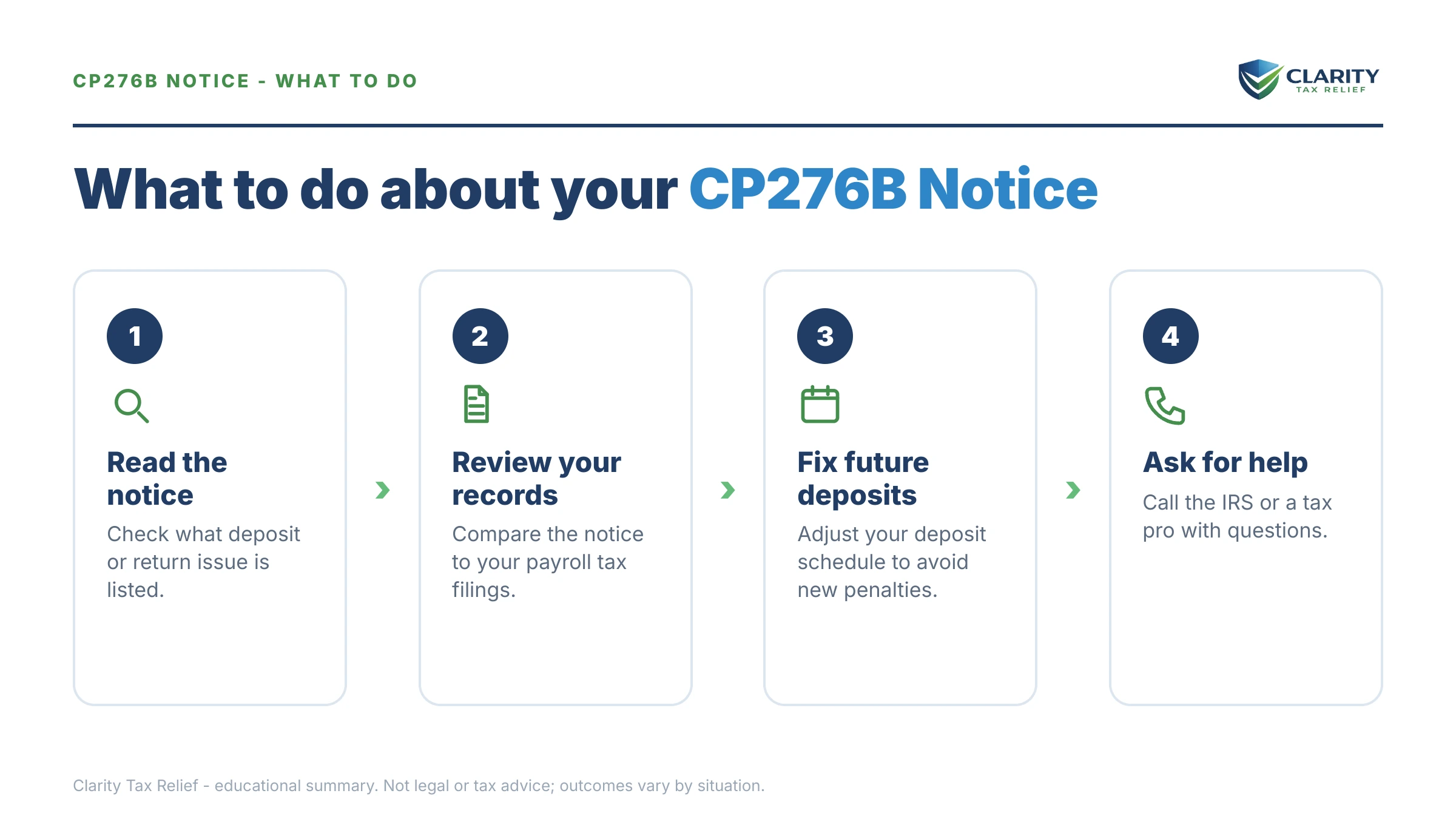
How to respond to a CP276B notice, step by step
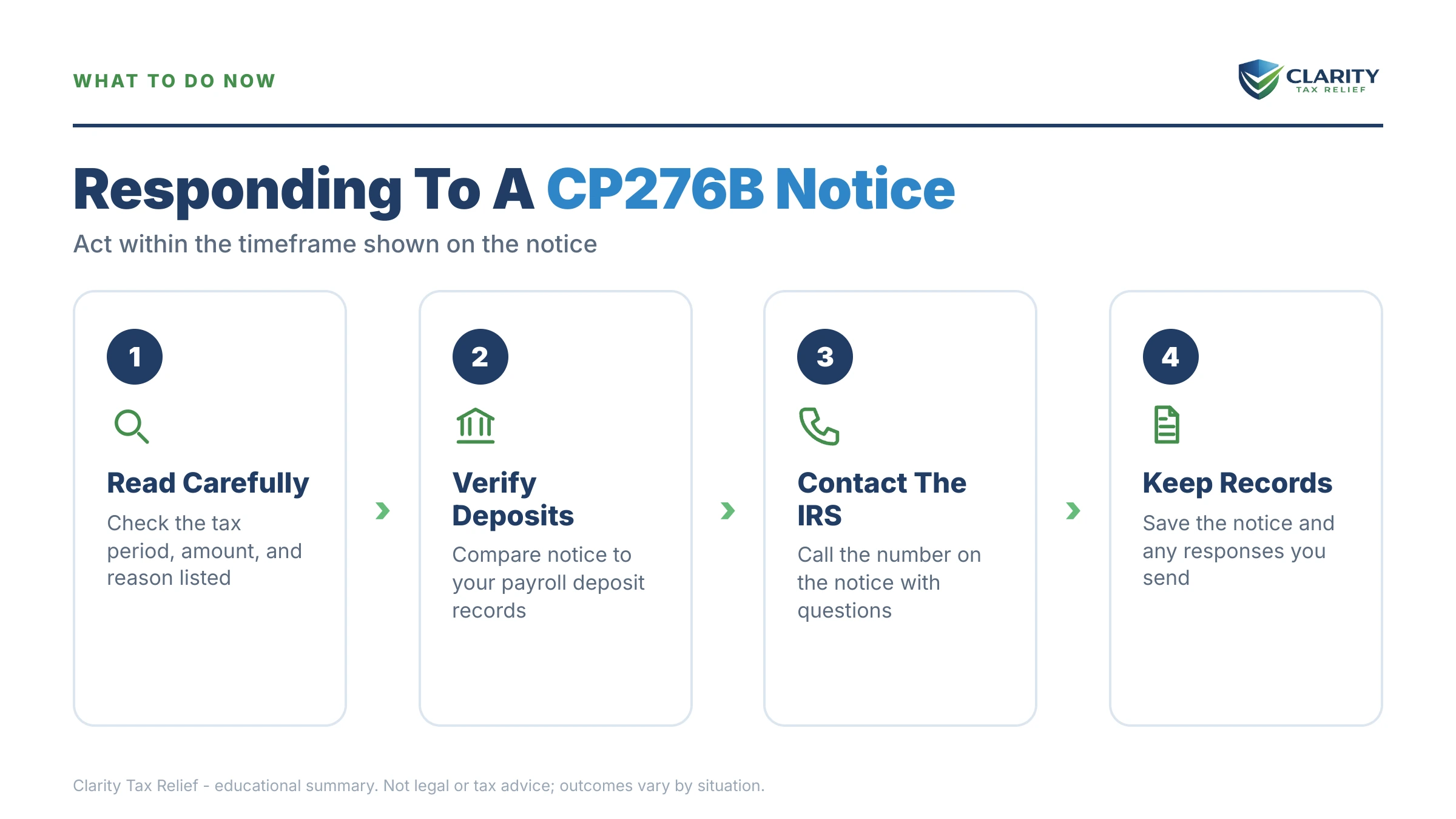
- Confirm the form and tax period — the top corner of the notice names the return (usually Form 941) and the exact quarter the IRS flagged.
- Pull your deposit history — log into EFTPS and list every deposit for that quarter with its settlement date and the period it was applied to.
- Match deposits to liability dates — compare each deposit against the liability dates on your Schedule B (or Form 941, line 16) to find the late, missing, or misapplied deposit.
- Verify your deposit schedule — recompute your lookback-period total to confirm whether you're a monthly or semiweekly depositor, and check whether the $100,000 next-day rule ever applied.
- Fix the routine before the next due date — schedule upcoming deposits in EFTPS in advance so the next quarter matches cleanly.
- Reply only if the IRS is wrong — send deposit confirmations and a corrected Schedule B with a brief explanation to the address on the notice; otherwise file the CP276B with your payroll records.
When you can handle a CP276B yourself
Most CP276B recipients don't need professional help — and it would be dishonest to pretend otherwise. Handle it yourself if the cause is obvious (one late deposit, a keying error, a known provider handoff), your deposit schedule is confirmed correct, and no other quarter carries a balance. The fix is twenty minutes in EFTPS and a calendar reminder.
Experienced help changes the outcome in a narrower set of situations: your lookback math says you should be semiweekly and you've been depositing monthly for multiple quarters (meaning penalties are likely already queued on other periods), deposits are slipping because the business can't cover them, you have unfiled 941 returns mixed in with the deposit problem, or the IRS has started asking who the responsible people are. Those are the cases where the order you fix things in — returns first, deposits current, then penalties — determines whether the debt stays on the business or lands on you personally.
Terms on your CP276B, decoded
- Federal tax deposit (FTD): the payroll tax payment employers must send through EFTPS on a set schedule during the quarter — separate from filing the return itself.
- Deposit schedule: your required deposit timing — monthly or semiweekly — set each year by your lookback period, not by preference.
- Lookback period: the prior four-quarter window of reported employment tax the IRS uses to assign your schedule; over $50,000 makes you semiweekly.
- Schedule B (Form 941): the day-by-day liability record semiweekly depositors attach to Form 941 — the dates the IRS matched your deposits against.
- Trust fund taxes: the income tax and employee-share FICA you withheld from paychecks — the portion the IRS can pursue from responsible individuals personally.
- Averaged FTD penalty: what can happen when liability dates are missing or unusable — the IRS spreads the quarter's liability evenly across it and computes the penalty on that assumption, often overstating it.
CP276B notice FAQs
Do I have to pay anything with a CP276B notice?
No. A CP276B carries no balance due and no penalty — the IRS specifically chose not to charge the federal tax deposit penalty this time. There is nothing to pay and no response is required if the IRS's finding is accurate. If you also owe on a different quarter, that balance is billed separately on a notice like a CP161, not on the CP276B.
What is the difference between CP276A and CP276B?
A CP276A says the IRS didn't receive a correctly completed liability schedule — usually Schedule B of Form 941 — so it couldn't verify your deposit timing. A CP276B says your deposits themselves weren't made according to your deposit requirements, but no penalty was charged. Both are warning notices with no balance due, and both point to the same underlying task: get your deposit dates and your reported liability dates to match.
Will the IRS charge me a penalty next quarter?
If the same deposit problem repeats, a penalty is the normal outcome. The federal tax deposit penalty runs 2% of the late amount for deposits 1–5 days late, 5% for 6–15 days late, and 10% for deposits more than 15 days late — rising to 15% if the amount is still unpaid more than 10 days after the IRS demands it. The CP276B is best read as the IRS documenting the problem before it starts charging for it.
Why did I get a CP276B if I paid all my payroll taxes?
Because the FTD penalty is about timing, not just totals. You can pay 100% of the quarter's liability and still trip the deposit rules if a deposit landed after its due date, if a deposit was applied to the wrong quarter, or if the liability dates on your Schedule B don't line up with your deposit dates. A payroll-provider switch mid-quarter is one of the most common causes.
Is a CP276B notice an audit?
No. A CP276B comes from automated deposit matching — a computer comparing the liability dates on your return against the deposit dates in the IRS's payment records. Nobody is examining your books, and no examiner is assigned. That said, repeated deposit discrepancies across quarters do make your payroll account more visible to IRS collection systems, which is a good reason to fix the pattern now.
Do I need to respond to a CP276B notice?
Not if the IRS's finding is correct — the notice requires no reply and no payment. Respond only if the finding is wrong: send copies of your EFTPS deposit confirmations and a corrected Schedule B with a short explanation, using the address on the notice. Either way, keep the notice with your payroll records, because it documents that the IRS has flagged your account once already.
Can the IRS levy my bank account over a CP276B?
No — a CP276B assesses nothing, so there is nothing to levy for. A levy requires an assessed, unpaid balance plus a notice sequence that ends in a final notice of intent to levy, which gives you 30 days and Collection Due Process appeal rights. The risk is downstream: if the deposit problem repeats and penalties go unpaid, that sequence can begin with a business balance-due notice and escalate from there.
What if I already have an FTD penalty from a different quarter?
That quarter can often be fixed separately through penalty relief. First-Time Abate may remove the penalty if your deposits and filings were clean for the prior three years, reasonable cause applies for events like disasters, serious illness, or a payroll provider's failure, and starting summer 2026 the IRS's Automatic Exemption from Penalty (AEP) begins applying qualifying relief automatically. Relief is requested by letter or Form 843 for the specific quarter penalized.
Your next 24 hours
- Find the form number and tax period in the top corner of your CP276B — that tells you exactly which return and which quarter the IRS matched against.
- Gather three things: your EFTPS deposit history for that quarter, the filed Form 941 with its Schedule B, and your payroll register showing actual paydays. The mismatch will be visible when you lay them side by side.
- Get a free review if the cause isn't obvious — call (888) 825-7779 or use the 2-minute form. The notice costs nothing today, but the same discrepancy next quarter typically comes with a 2%–15% penalty attached, so this is the cheap moment to get the schedule confirmed.
Primary sources: the IRS's official page on understanding your CP276B notice, the Electronic Federal Tax Payment System (EFTPS) where deposit histories and future deposits are managed, and IRS.gov/payments for any balance that does exist on other periods.
This guide is general information, not tax or legal advice for your specific situation. Eligibility for IRS programs depends on individual facts and circumstances; no outcome is guaranteed.