
IRS Deadlines & Relief
IRS Disaster Relief Deadline Extension: How It Works and What It Covers (2026)
The short answer: an IRS disaster relief deadline extension automatically postpones filing and payment deadlines for anyone whose IRS address of record sits in a FEMA-declared disaster area. No application is required. Your new deadline is the specific date printed in the IRS announcement for your disaster — and covered payments accrue no penalty or interest until then.
Your county just made the news for all the wrong reasons — flood, fire, or storm — and somewhere between the insurance calls and the cleanup, you remembered a tax deadline is coming. Here's the part almost nobody explains: the IRS disaster relief deadline extension has probably already been applied to your account, it moved your payments too, and the only thing you need to find is one date. This guide shows you where that date lives, exactly what moved with it, and the two traps — the address-of-record gap and payments that were due before the disaster — that catch people every year.
The relief comes from Internal Revenue Code §7508A, which lets the IRS postpone tax deadlines after a FEMA major disaster declaration. Each disaster gets its own IRS news release naming the covered counties and the postponement date. The image below shows you exactly how a relief window works and which dates move inside it.
⏱ Your deadline: the specific postponement date printed in the IRS announcement for your FEMA declaration — every disaster gets its own date, and windows vary widely from one declaration to the next. Covered filings and payments are penalty-free until that date. Miss it, and penalties and interest start running from the postponed date forward — not retroactively, but immediately.
Why the IRS extended your deadline — and how to confirm you're covered
Disaster relief is applied automatically to every taxpayer whose IRS address of record is inside the covered disaster area — you do not file anything to get it. When FEMA issues a major disaster declaration, the IRS follows with a news release under §7508A listing the covered counties and a single postponement date. If the address on your last filed return is in one of those counties, the IRS's systems flag your account by themselves.
That automation is also the trap. Relief keys to your address of record, not to where the disaster actually hit you. If you moved into the area and haven't filed from the new address, the system doesn't know you're there. If your home is fine but your business, records, or tax preparer sit inside the covered counties, you can still qualify — but only by calling the IRS disaster hotline at 866-562-5227 and asking, because no computer will find you.
Confirming coverage takes five minutes: find the IRS announcement for your state's declaration, check that your county is named, and write down the postponement date. That one date is the spine of everything else in this article. For the current year's specific declarations and dates, see our running disaster relief tax deadline extension 2026 tracker.
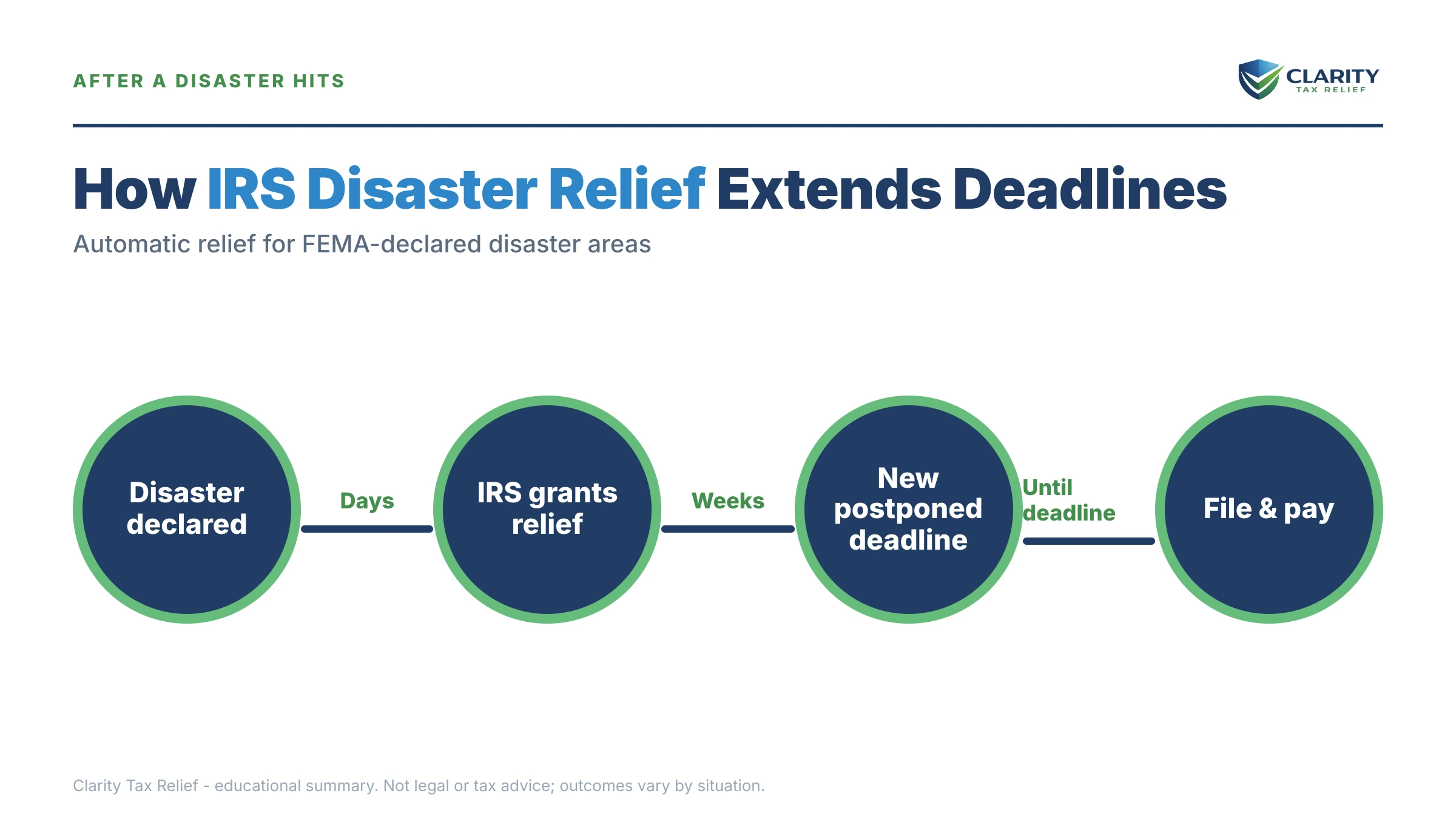
What the disaster extension postpones — and what it doesn't
A disaster extension postpones both filing and payment for every covered deadline that falls inside the relief window — which makes it far more valuable than a regular extension. A normal Form 4868 extension moves only the paperwork; your money is still due in April, a distinction we break down in does an extension give more time to pay. Disaster relief moves the money too.
But the window has hard edges, and they're where people get burned. The table below is the reference the IRS announcement assumes you already understand:
| Deadline or obligation | Postponed? | What to know |
|---|---|---|
| Individual return filing and the payment due with it | Yes, if due inside the window | Both move to the postponement date; no failure-to-file or failure-to-pay penalty accrues in between. |
| Quarterly estimated tax payments | Yes, if due inside the window | One long window can swallow two or three quarters — they all come due at once on the new date. |
| Business returns (partnership, S-corp, corporate, payroll return filings) | Yes, if due inside the window | Filing deadlines move; check the announcement for exactly which forms are named. |
| Payroll tax deposits | Usually only a short grace period | Deposit relief is typically far narrower than return relief — often just penalty abatement for deposits due in the first days after the disaster. Read your announcement's deposit language carefully. |
| A payment that was due before the disaster period began | No | Classic gotcha: you filed Form 4868, the disaster hits over the summer, your October filing date moves — but the payment was due back in April and gets no relief. |
| Pre-existing IRS balances and installment agreement payments | No | Interest and the 0.5%/month failure-to-pay penalty keep running on old assessed debt; existing plan payments generally remain due unless the IRS says otherwise. |
| State tax deadlines | Separate decision | Many states conform to the federal date, but none are required to — confirm with your state agency directly. |
Two more pieces of relief ride along with the deadline extension and are easy to miss. First, uninsured casualty losses from a federally declared disaster are deductible on Form 4684 — and you can elect to claim them on your prior-year return, which often turns a loss into a refund months sooner. Second, if you need to tap retirement money to rebuild, qualified disaster recovery distributions of up to $22,000 per disaster escape the 10% early-withdrawal penalty, spread the income over three years, and can be repaid within three years. Both deserve a calculation before you decide, not after.
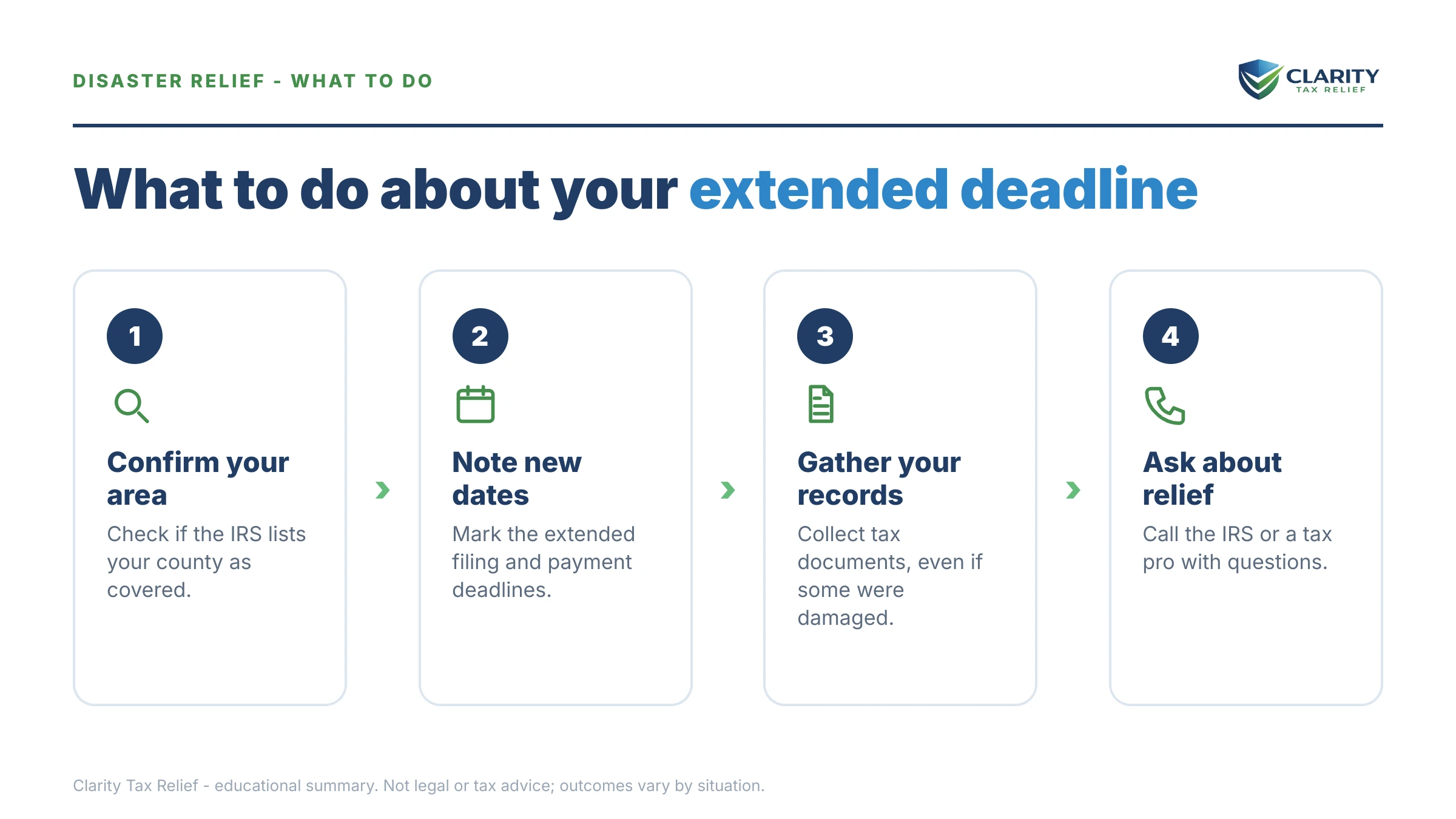
What happens if you miss the postponed deadline
Miss the postponed date, and penalties begin from that date and the normal IRS collection sequence starts — the disaster window doesn't buy you a gentler process afterward. The system that follows is automated and doesn't reconsider your circumstances:
- The postponed date passes — failure-to-file (5%/month if the return is late) and failure-to-pay (0.5%/month) penalties start accruing, plus interest, from the postponed deadline forward.
- First bill — a CP14 notice arrives showing the balance with penalties and interest attached.
- Reminder notices — CP501 and CP503 follow, each with a larger balance.
- CP504 — Notice of Intent to Levy — the IRS can now take your state tax refund, and a federal tax lien becomes a live possibility.
- LT11 / Letter 1058 — Final Notice — a 30-day clock starts, after which the IRS can levy bank accounts and garnish income. You still have appeal rights here, but far fewer good options than you have today.
Remember the asymmetry baked into that first stage: the failure-to-file penalty is ten times the failure-to-pay penalty. If the postponed date arrives and you can't pay, file anyway — the return itself costs nothing to submit, and filing on time cuts the worst penalty out of the equation entirely.
In 2026, don't count on a human catching your disaster flag if something goes wrong. The IRS workforce shrank roughly 27% in 2025, but the notice stream is generated by computers that never stopped running — which means erroneous penalty notices to disaster-area taxpayers do happen, and it's on you to call and get them fixed.
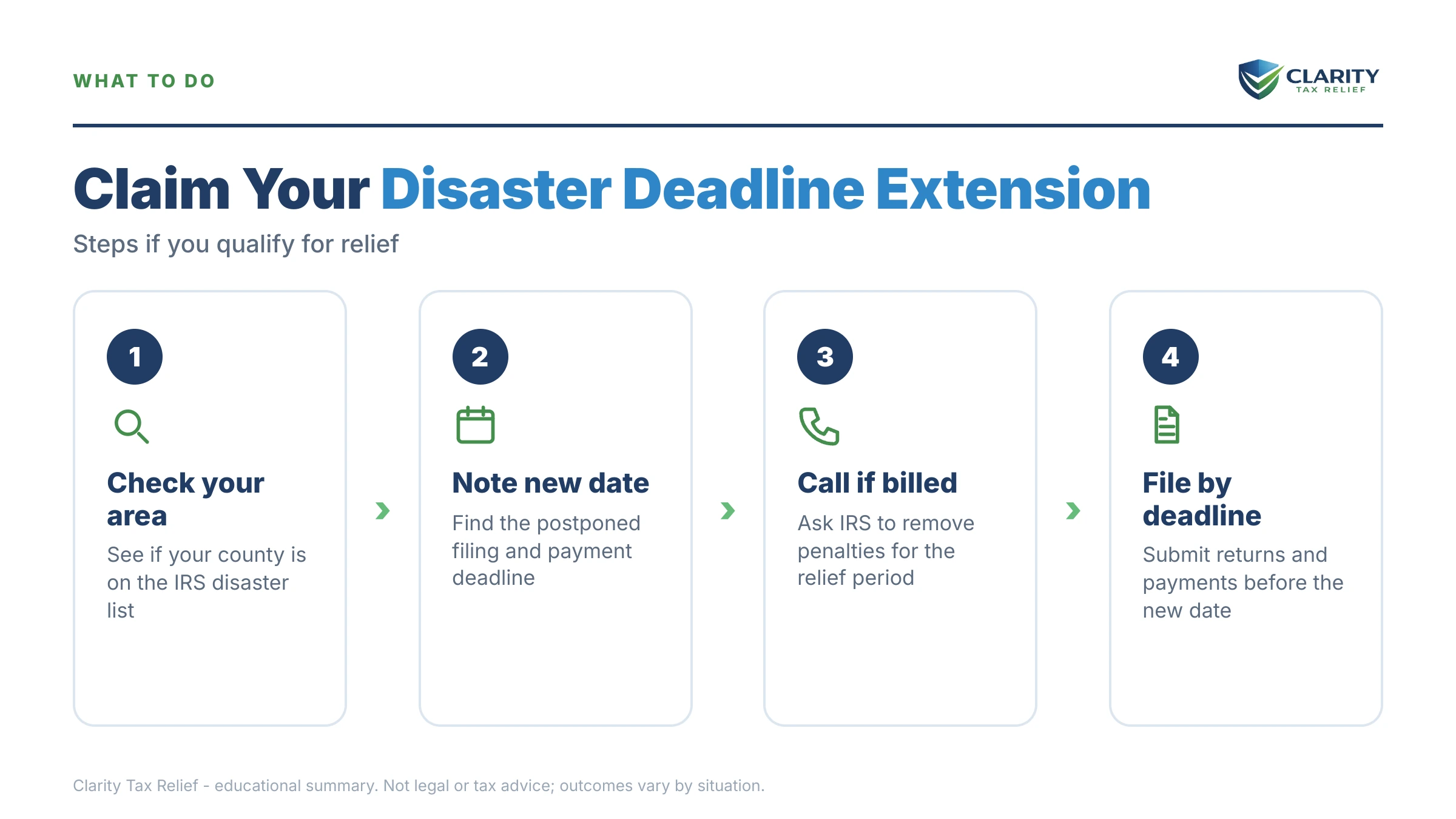
Disaster window closing and the money isn't there?
Your postponed deadline is a real date, and what you set up before it arrives determines everything after. Get a free review of your situation — which deadlines actually moved, what you'll owe on the new date, and the plan that fits — from an experienced tax professional before the window closes.
Can't pay by the new deadline? Your realistic options
If you can't pay everything on the postponed date, the IRS has structured options — and setting one up before the deadline keeps penalties from ever restarting on the covered amounts. Which option fits is mostly a function of how much you owe; the full DIY playbook for each lives in our guide to how to settle tax debt yourself, but here's the map by amount band:
| Total you'll owe on the new date | Realistic options | Key threshold or catch |
|---|---|---|
| Any amount, payable within 180 days | Short-term payment plan | $0 setup fee; interest and penalties still accrue, but enforcement stops. |
| Under $10,000 | Guaranteed installment agreement | The IRS must accept it if you meet the basic conditions; no financial disclosure. |
| $10,000–$50,000 | Streamlined installment agreement, set up online | Up to 72 months, no detailed financials at or below $50,000 (direct debit required at the top of the band). |
| Over $50,000 | IRS payment plan over $50,000 with financial disclosure — or pay down below $50k first | Form 433-series financials required; strategy before setup matters here. |
| Debt genuinely exceeds what you could ever pay | Offer in Compromise or Currently Not Collectible status | OIC costs $205 to apply (waived with low-income certification) and roughly 1 in 5 offers were accepted in FY2024 — it's real, but means-tested, never automatic. |
One disaster-specific note on penalties: if a disaster prevented you from filing or paying something the extension didn't cover, that's a textbook case for reasonable cause penalty abatement — the IRS's own guidance names disasters as a qualifying circumstance. And starting summer 2026, the new Automatic Exemption from Penalty (AEP) begins replacing first-time abatement, applying qualifying relief without a request. You can estimate what penalties and interest are actually costing you month to month with our Penalty & Interest Calculator.
What a disaster extension is actually worth: a $68,500 example
Say you're a self-employed sole proprietor in a covered county. Your Form 1040 shows $41,000 due April 15 (a strong year, plus self-employment tax), and your Q2 and Q3 estimates of $13,750 each fall inside the relief window — $68,500 in total obligations. The IRS announcement for your disaster moves everything to a hypothetical November 2.
Here's the math on what the window saves. Without relief, the $41,000 balance would accrue the 0.5% monthly failure-to-pay penalty from April 15: 0.5% × $41,000 = $205 per month, or roughly $1,330 across the 6.5-month window — plus compounding interest on top, plus underpayment penalty exposure on the skipped estimates. With relief, all of that is zero, provided you pay by November 2.
Now the stacking problem: on November 2, the return, the $41,000, and both $13,750 estimates come due on the same day — and your Q4 estimate lands about ten weeks later. If $68,500 in cash isn't realistic, note where you sit on the table above: you're over the $50,000 streamlined ceiling. That means either paying down below $50,000 before requesting the online plan, or filing full financials — a sequencing decision worth getting right before the deadline, not after. Whatever you do, file the return on time; at $68,500, the failure-to-file penalty alone would run about $3,425 per month.
How to respond to an IRS disaster relief deadline extension, step by step
- Confirm your county is covered. Find your FEMA declaration on the IRS disaster relief page and write down the exact postponement date printed in the announcement.
- Verify your IRS address of record. Relief is applied using the address on your last filed return — if you've moved into or out of the area, file Form 8822 or call the disaster hotline at 866-562-5227.
- Calendar every deadline that moved. List each covered filing and payment; they all come due on the same postponed date, so work backward from it now.
- Keep paying what the extension doesn't cover. Pre-existing balances, existing installment agreements, and payments that were due before the disaster keep running as usual.
- Arrange payment before the new deadline if you'll be short. A payment plan set up before the postponed date stops the penalty clock from ever restarting; silence after it starts the collection sequence.
When you can handle this yourself
Most people covered by a disaster extension need no professional help at all — the relief is automatic and the only required action is a calendar entry. Handle it yourself if your county is clearly listed, your address of record is current, you'll have the money by the postponed date, and you have no older IRS balances. Setting up a short-term plan or a streamlined agreement online is also genuinely DIY territory; our guide to the best way to pay the IRS walks through every payment channel.
Experienced help changes outcomes in a handful of specific situations: a balance over $50,000 you can't pay by the new date (the disclosure-versus-paydown decision above), a business with payroll deposits caught in the narrow deposit-relief window — see our buyer's guide to tax relief for small business — records destroyed on top of unfiled prior years (our guide to filing back taxes with no records covers reconstruction), or an old IRS debt that the disaster just made unpayable, where hardship status or a restructured plan has to be negotiated rather than clicked. In those cases, the sequencing decisions made before the postponed date are worth more than anything done after it.
Terms in the IRS announcement, decoded
- §7508A postponement: the tax-code provision that lets the IRS move deadlines after a federally declared disaster — it's why the relief covers payments, not just filings.
- FEMA major disaster declaration: the presidential declaration that triggers IRS relief; the IRS generally follows the counties FEMA designates for individual assistance.
- Covered disaster area: the specific counties named in the IRS news release — coverage is county-by-county, not statewide by default.
- Address of record: the address on your most recently filed return; it's the sole trigger for automatic relief, which is why moves create gaps.
- Casualty loss: uninsured or unreimbursed disaster damage, deductible on Form 4684 — with an election to claim it on the prior year's return for a faster refund.
- Qualified disaster recovery distribution: a retirement withdrawal of up to $22,000 per disaster that skips the 10% early-withdrawal penalty and spreads the tax over three years — the 10% penalty is waived, but the withdrawal is still taxed as ordinary income (spread over three years unless you elect otherwise) and applies only to federally declared qualified disasters.
Service members get a parallel — and in some ways stronger — version of this relief under different rules; if that's your situation, see combat zone IRS collection relief. And if a skipped quarter is your main worry, our quarterly estimated tax deadlines 2026 guide lays out every due date.
Primary sources worth bookmarking: the IRS's official tax relief in disaster situations page lists every active declaration and its postponement date; FEMA is where declarations originate; and when your date arrives, every payment channel runs through IRS.gov/payments.
IRS disaster relief questions, answered
Do I need to apply for IRS disaster relief?
No. Relief under IRC §7508A is automatic for any taxpayer whose IRS address of record is in the covered disaster area — the IRS applies it by county using the address on your last return. You only need to call if you qualify another way, such as your records or preparer being inside the area, or if a penalty notice arrives anyway; the IRS disaster hotline is 866-562-5227.
Does an IRS disaster extension give me more time to pay, or just to file?
Both, which makes it fundamentally different from a regular filing extension. Every covered payment that comes due inside the relief window — the balance on your return, quarterly estimates — is postponed to the new date with no failure-to-pay penalty or interest during the window. The big exception: payments that were already due before the disaster period began don't get relief, even if the related filing deadline moved.
I got a penalty notice even though I'm in the disaster area. What do I do?
Don't pay it — call the number printed on the notice and tell the agent your address of record is in the covered disaster area. This usually happens because a return carried an out-of-area address or the system missed your county. Once eligibility is confirmed, the IRS abates penalties that accrued during the relief window; keep the notice and note the call date in case you have to follow up.
Does disaster relief stop interest on taxes I already owed before the disaster?
No. Interest and the 0.5% monthly failure-to-pay penalty keep running on any balance that was assessed before the disaster, and payments under an existing installment agreement generally remain due unless the IRS announcement says otherwise. The extension only protects deadlines that fall inside the relief window. If the disaster destroyed your ability to pay an older debt, that is a hardship conversation — Currently Not Collectible status or a restructured plan — not automatic relief.
My records or tax preparer are in the disaster area, but I'm not. Do I qualify?
You can, but not automatically. The IRS extends the same relief to taxpayers whose necessary records are located inside the covered area, to relief workers, and to certain others affected by the disaster. Because the address-of-record system won't pick you up, you must call the IRS disaster hotline at 866-562-5227 and ask to have the relief applied to your account.
Do quarterly estimated tax payments get extended too?
Yes — any estimated payment whose due date falls inside the relief window moves to the postponed date. For self-employed taxpayers this is often the biggest piece of the relief, since one long window can swallow two or even three quarterly due dates. The catch is stacking: those skipped quarters all come due at once on the new date, alongside your return balance, so budget for the pile-up rather than treating the window as forgiveness.
Can I deduct my disaster losses, and on which year's return?
Uninsured or unreimbursed casualty losses from a federally declared disaster are claimed on Form 4684, and you can elect to deduct them on your prior-year return instead of the current year. That election often produces a faster refund at exactly the moment you need cash for repairs. Run the numbers both ways before choosing — the better year depends on your income and tax rate in each.
Does my state tax deadline get extended when the IRS extends mine?
Not automatically. States set their own disaster relief, and while many conform to the federal postponement date, some don't participate or announce different dates and different covered taxes. Check the announcement from your state tax agency directly before assuming your state return, payment, or sales-tax deadline moved with the federal one.
Your next 24 hours
- Find your date. Pull up the IRS announcement for your FEMA declaration, confirm your county is listed, and write the exact postponement date somewhere you'll see it.
- Gather your numbers. Last year's return, every filing and payment that was due inside the window, and your income records so far this year — or a list of what needs reconstructing if records were lost.
- Get a free case review. If the total due on your postponed date is more than you can pay — or old balances and unfiled years are tangled into it — call (888) 825-7779 or use the 2-minute form. What you set up before that date arrives is worth far more than anything arranged after it passes.
This guide is general information, not tax or legal advice for your specific situation. Eligibility for IRS programs depends on individual facts and circumstances; no outcome is guaranteed.