
Tax Liens
How to Sell a House With an IRS Lien in 2026 (Yes, You Can)
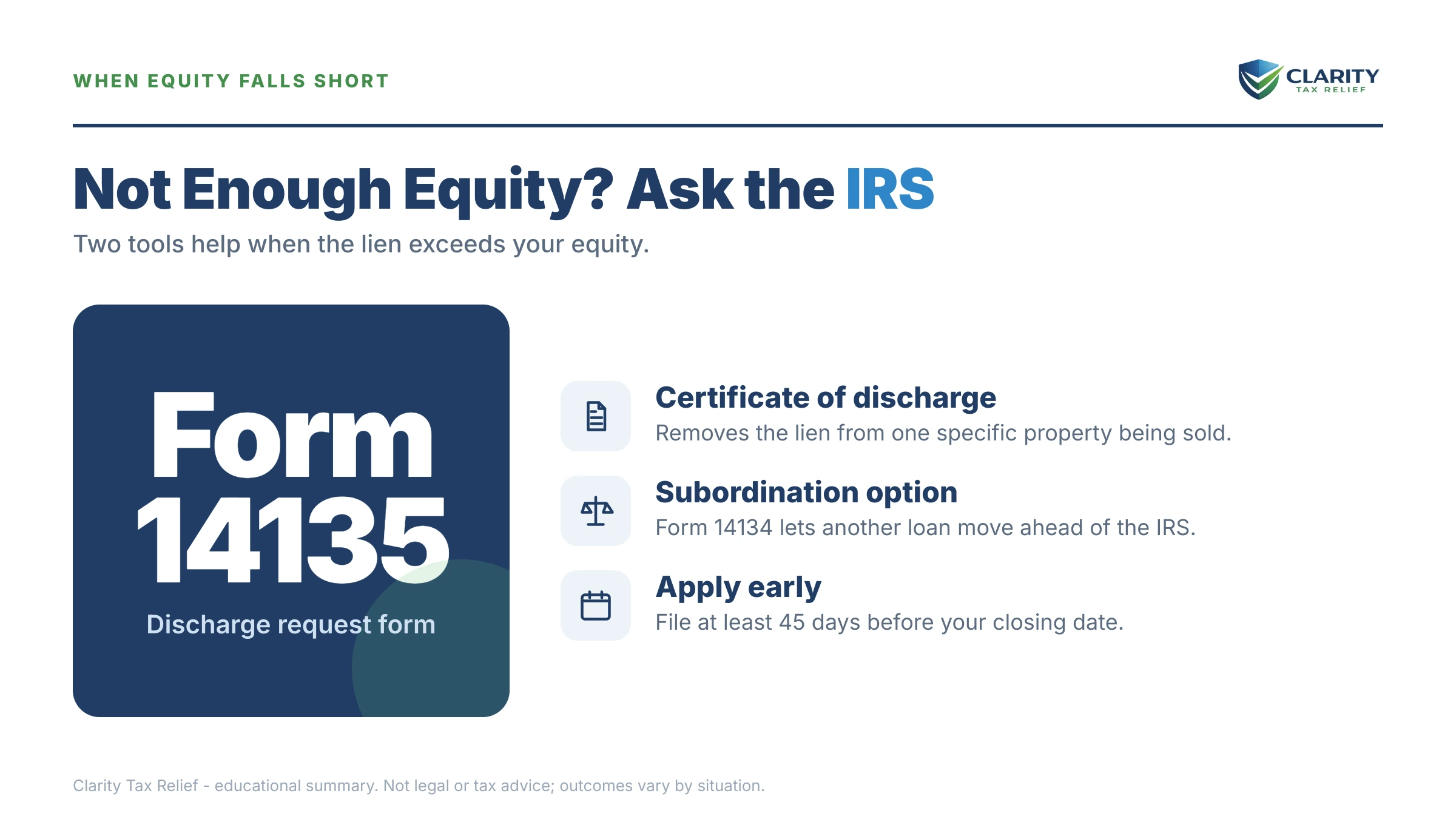
The short answer: yes — you can sell a house with an IRS lien. If your equity covers the payoff, escrow pays the IRS at closing and the sale goes through. If equity falls short, Form 14135 asks the IRS to discharge the property from the lien — file it at least 45 days before closing.
You listed the house, an offer came in, and then the title report landed: a Notice of Federal Tax Lien, recorded at the county, sitting between you and closing. It feels like the sale just died. It didn't — the IRS handles thousands of lien payoffs and discharges through escrow every year, and there is a defined process for exactly this. Your job is to start it early enough that the IRS's calendar doesn't collide with your buyer's.
The image below shows exactly what a recorded Notice of Federal Tax Lien looks like and where to find the figures — the assessed amounts and tax periods — that drive your payoff and your paperwork.
⏱ Your working deadline: if sale proceeds won't fully pay the lien, the IRS asks you to submit Form 14135 at least 45 days before your closing date. There's no penalty clock on the lien itself — but a late discharge application means your closing waits on the IRS, while interest and the failure-to-pay penalty keep accruing on the underlying debt.
Why an IRS lien changes your closing — but doesn't block it
A federal tax lien attaches to everything you own — including your house — once the IRS assesses the debt and you don't pay after its demand. When the IRS also records a Notice of Federal Tax Lien with your county, that claim becomes public, and every title search on your property will surface it. The full background is in our guide to a federal tax lien on your house; here's what matters for a sale.
The lien is a claim on your equity, not a padlock on the deed. In most cases your mortgage was recorded before the IRS lien, so the mortgage gets paid first, then the IRS, then you — the same waterfall escrow already runs at every closing. (The ordering rules are covered in tax lien vs mortgage priority.) The lien also attaches to the sale proceeds themselves, which is why the IRS is willing to let the house go: it gets paid out of escrow either way.
What the lien does change is who must sign off before title clears. A buyer's title company will not insure title with a live federal lien on it. So the IRS must either be paid in full at closing or issue a certificate of discharge releasing this specific property from the lien. Both happen routinely — but neither happens by accident.
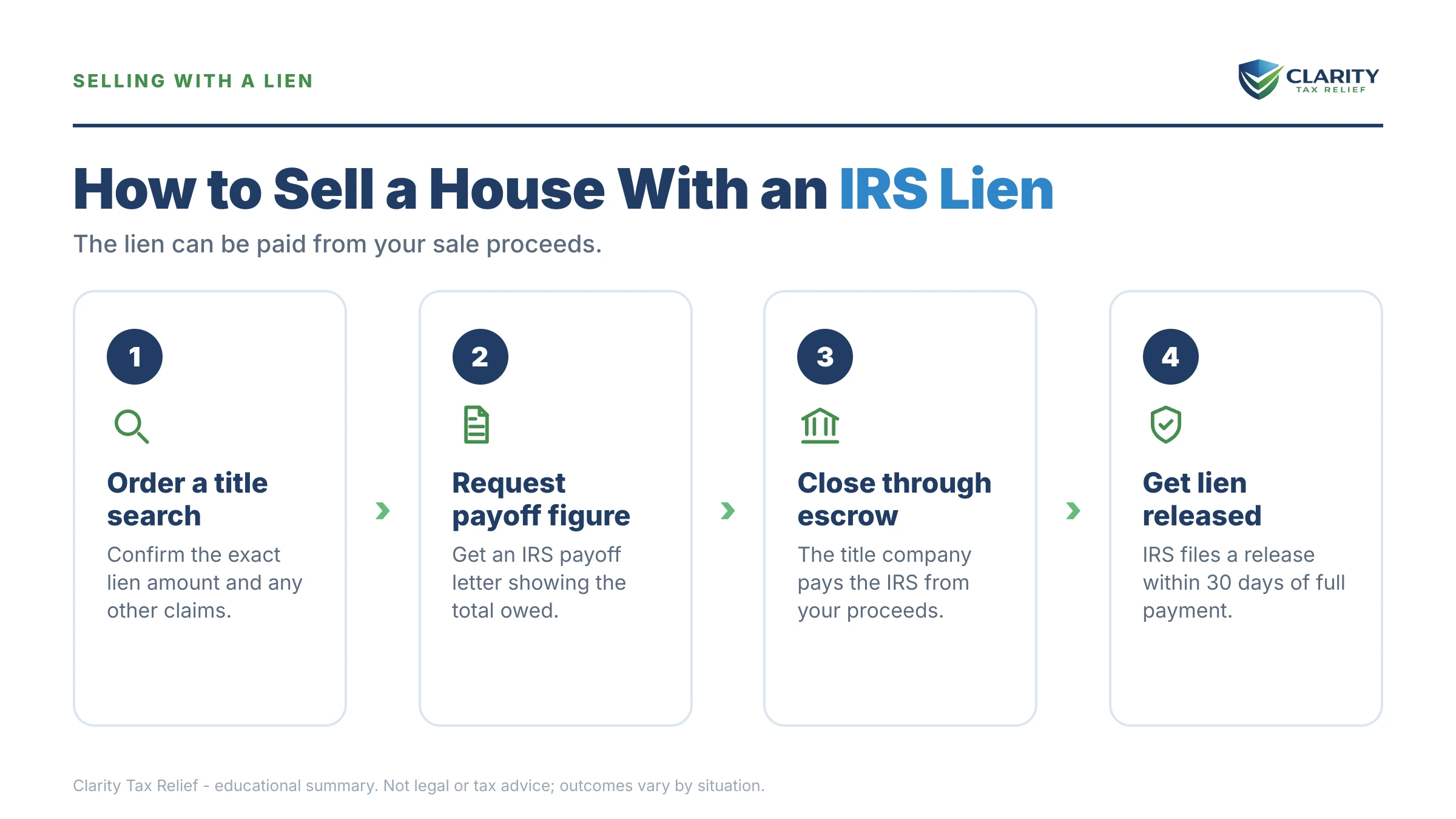
What happens if you ignore the lien and list anyway
A recorded Notice of Federal Tax Lien is a public document, and your buyer's title company will find it — usually in the first days of escrow. Sellers who hope it slips through hit the same wall in the same order:
- The title search flags the lien as a cloud on title. The title company won't issue a policy, and the buyer's lender won't fund a loan on uninsurable title.
- Escrow demands an IRS payoff or discharge plan before it will set a firm closing date. If you're hearing about the lien for the first time here, you've already lost the head start the 45-day discharge window assumes.
- The closing date slips. Buyers with rate locks and moving dates start renegotiating — price reductions, seller credits, or per-diem penalties — or invoke their right to walk.
- The deal dies, and the debt keeps growing. The balance behind the lien continues to accrue interest and the monthly failure-to-pay penalty, and the lien stays on title for the next buyer's search to find.
One more trap: selling "around" the lien doesn't work. Because the lien follows the property, a cash sale with no title insurance simply hands the buyer a house the IRS still has a claim against — and a below-market transfer to a relative can be unwound as a fraudulent conveyance. The only exits are through the IRS, not around it.
Lien on your title and a buyer waiting?
Get your payoff, equity math, and discharge strategy reviewed free — before the 45-day Form 14135 window collides with your closing date. Call (888) 825-7779 or use the 2-minute form.
Your options to sell a house with an IRS lien
Which path fits depends on one number: your net equity after the mortgage and selling costs, compared to the IRS payoff. Here is the full menu:
| Option | When it fits | How it works | Timeline |
|---|---|---|---|
| Pay the lien at closing | Net equity covers the full IRS payoff | Escrow pays the IRS from proceeds using a current payoff letter | Handled on closing day; release recorded after payment |
| Discharge with partial payment | Some equity, but less than the payoff | Form 14135 — IRS takes your remaining equity and releases the property (IRC §6325(b)(2)(A)) | Apply 45+ days before closing |
| Discharge with no payment | House underwater — senior liens and costs exceed the price | Form 14135 — the IRS's interest is worth $0, so it can release the property for nothing (IRC §6325(b)(2)(B)) | Apply 45+ days before closing |
| Escrowed-proceeds discharge | Equity exists but the IRS's share is disputed | Form 14135 — proceeds held in escrow while the amounts get sorted out (IRC §6325(b)(3)) | Apply 45+ days before closing |
| Subordination — not for sales | You're refinancing, not selling | Form 14134 lets a new loan jump ahead of the lien; the lien stays on title | See the refinancing guide below |
| Withdrawal of the notice | After the lien is resolved and you want the record cleaned up | Form 12277 asks the IRS to pull the public notice itself | After payoff or qualifying agreement |
Two clarifications sellers mix up constantly. First, discharge frees the house, not you — whatever debt the sale doesn't cover remains yours, with the lien still attached to your other property. Our tax lien discharge guide walks through the Form 14135 package in detail. Second, subordination is the wrong tool for a sale — it's how a lender agrees to close a new loan over an existing lien, which is the refinancing with a tax lien problem, not yours.
If the house is co-owned and only you owe — say, you hold title with a sibling or an ex — the lien attaches only to your interest, and the IRS is entitled to your share of the equity, not the whole pot. The mechanics are different enough that they get their own guide: IRS lien on jointly owned property.
Worked example: a $54,600 lien, two very different closings
Say you're a single W-2 employee with a recorded federal tax lien securing $54,600, and your house goes under contract. The same lien plays out two ways depending on the numbers:
Scenario A — equity covers it. Contract price $385,000. Mortgage payoff $268,000; commission and closing costs $27,100. Net before the lien: $385,000 − $268,000 − $27,100 = $89,900. Escrow pays the IRS its $54,600 payoff at closing, you walk away with $35,300, and the IRS must generally record a certificate of release within 30 days of full payment. No IRS application needed — just a current payoff letter.
Scenario B — equity falls short. Contract price $329,000. Mortgage payoff $278,000; commission and closing costs $24,000. Net before the lien: $329,000 − $278,000 − $24,000 = $27,000 — well under the $54,600 payoff. Here you file Form 14135. The IRS takes the full $27,000 at closing, issues a certificate of discharge so the buyer gets clear title, and the remaining $54,600 − $27,000 = $27,600 stays with you personally. A balance that size typically fits a streamlined installment agreement — up to 72 months, set up online, no detailed financial disclosure — though interest and penalties continue until it's paid.
Both scenarios are hypothetical, but the arithmetic is exactly what escrow and the IRS will run on your file — which is why step one below is getting the real numbers.
Deadlines and rights when there's a tax lien on your title
The IRS's 45-day discharge window is the clock that most often kills closings — everything else on this timeline exists to protect it.
| Milestone | When | Why it matters |
|---|---|---|
| Request an IRS lien payoff letter | As soon as you list | Interest accrues daily; escrow needs an exact figure good through closing |
| Submit Form 14135 (if equity is short) | At least 45 days before closing | A late or incomplete application delays the closing, not the IRS |
| IRS discharge commitment | Before closing day | Tells escrow exactly what to pay and gets the certificate issued once funds clear |
| Escrow pays the IRS | Closing day | Paid from proceeds like the mortgage — you don't bring separate funds unless proceeds fall short |
| Certificate of release recorded | Generally within 30 days of full payment (IRC §6325(a)) | The document that proves the lien is gone — follow up if it doesn't appear |
| CSED — lien self-releases | 10 years from assessment, unless the notice is refiled or the clock was paused | Almost never worth delaying a sale for; see whether your lien can expire below |
On that last row: federal tax liens do eventually die with the collection statute, but appeals, offers, and bankruptcies pause the clock, and the IRS can refile the notice. If your assessment dates are old, it's worth checking before you pay — does an IRS tax lien expire covers the rules, and you can estimate your own collection deadline with our CSED Calculator. For most sellers mid-escrow, though, the payoff or discharge path is faster than any statute.
How to sell your house with an IRS lien, step by step
- Get your exact payoff. Call the IRS Centralized Lien Operation at 800-913-6050 and request a lien payoff letter good through your expected closing date.
- Run the equity math. Sale price minus mortgage payoff, commissions, and closing costs tells you whether proceeds cover the lien — that answer picks your path.
- Tell your agent and title company now. Escrow handles IRS payoffs routinely, but only if they know before the closing calendar is set.
- Pay the IRS at closing if equity covers the payoff. Instruct escrow to send the lien payoff from proceeds, exactly like the mortgage payoff.
- File Form 14135 if equity falls short. Submit the discharge application with the full Publication 783 document package at least 45 days before closing.
- Confirm the certificate is recorded. After closing, verify the certificate of discharge — or release, if paid in full — actually hits the county records.
The Publication 783 package for step 5 typically includes your sales contract, a title report showing every lien in priority order, the proposed closing statement, and a valuation. Incomplete packages are the number-one reason discharges miss closings — the IRS doesn't chase missing documents; it waits for them. On step 6, if you paid in full and no release appears, our guide to the certificate of release of tax lien shows how to force the paperwork through, and the hub on how long for the IRS to release a tax lien covers the timelines. If the recorded notice itself is still haunting your county records afterward, a lien withdrawal (Form 12277) can remove it.
When you can handle this yourself — and when help changes the outcome
If your equity clearly covers the payoff, you usually don't need professional help. Get the payoff letter, hand it to a competent escrow officer, and the closing table does the rest — that's a routine transaction, and paying someone to supervise it rarely changes anything.
Experienced help earns its cost in the harder versions: a Form 14135 package on a tight closing calendar, a disputed IRS payoff figure, a jointly owned house where only one owner owes, multiple tax years stacked behind one lien notice, or a discharge that leaves a large balance you still have to resolve. In 2026 there's an added wrinkle — IRS staffing is down sharply after the 2025 workforce cuts, so a discharge application with any defect can sit. A complete, correctly documented package the first time is the difference between closing on schedule and re-signing contract extensions. An experienced tax professional can also sequence what comes after the sale — payment plan, hardship status, or an offer — so the leftover debt doesn't restart the collection cycle.
Terms on your lien paperwork, decoded
- Notice of Federal Tax Lien (NFTL): the public document the IRS records at your county to announce its claim — the thing your buyer's title search found.
- Payoff letter: the IRS's exact figure to satisfy the lien through a specific date; escrow can't close around a guess.
- Discharge: removes the lien from one specific property so it can sell — the debt, and the lien on anything else you own, survive.
- Release: extinguishes the lien entirely, generally required within 30 days after the debt is fully paid.
- Subordination: the IRS agreeing to let a new loan get paid ahead of its lien — a refinancing tool, not a sale tool.
- Withdrawal: pulls the recorded notice itself from the public record, as if it hadn't been filed.
Primary sources if you want the IRS's own words: Understanding a federal tax lien explains attachment, discharge, and release; the discharge application itself lives at About Form 14135; and any payoff or leftover balance can be paid at IRS.gov/payments.
Selling with an IRS lien: your questions, answered
Can you sell a house with an IRS lien on it?
Yes. A federal tax lien doesn't freeze the title — it means the IRS must be dealt with before clear title passes to the buyer. If your equity covers the payoff, escrow pays the IRS at closing like any other lienholder. If it doesn't, the IRS can discharge the property from the lien through Form 14135 so the sale still closes.
Does the IRS take all the money when you sell your house?
No. The IRS only collects up to its lien payoff, and only from equity left after lienholders who recorded first — usually your mortgage — plus normal selling costs are paid. If the payoff is $54,600 and your net equity is $89,900, the IRS takes $54,600 and the rest is yours.
How long does IRS Form 14135 take to process?
The IRS asks for the application at least 45 days before closing and aims to work complete applications within that window, but it does not guarantee a decision date — build slack into your closing timeline. Missing documents restart the clock, which is the most common reason discharges delay closings. Submit the full Publication 783 package — contract, title report, payoff figures, and proposed closing statement — the first time.
Who pays the IRS tax lien at closing?
The settlement agent — your escrow company or closing attorney — pays it directly out of your sale proceeds, the same way your mortgage payoff is handled. You don't bring cash unless the proceeds fall short. The agent works from an IRS payoff letter good through your closing date, so request an updated letter if the closing slips.
Can I sell my house to a family member to get around an IRS lien?
No — the lien follows the property, not the seller, so a family buyer takes title with the lien still attached. A below-market transfer to an insider can also be unwound as a fraudulent conveyance, and it doesn't reduce what you owe. Sell at market value and deal with the lien through payoff or discharge instead.
What happens to the rest of my tax debt if the sale doesn't cover the lien?
You still owe it — discharge removes the lien from the house, not the debt from you. The remaining balance keeps accruing interest and the monthly failure-to-pay penalty until you resolve it. If what's left is under $50,000, you can usually set up an online installment agreement of up to 72 months; hardship status or an Offer in Compromise may fit if your finances qualify.
Does selling the house remove the lien from my credit report?
Tax liens haven't appeared on credit reports since 2018, so there's nothing to remove there. But the recorded lien remains in county land records until the IRS files a certificate of release, which it must generally do within 30 days of full payment. Lenders and title companies check land records, not credit bureaus, so confirm the release actually gets recorded.
Your next 24 hours
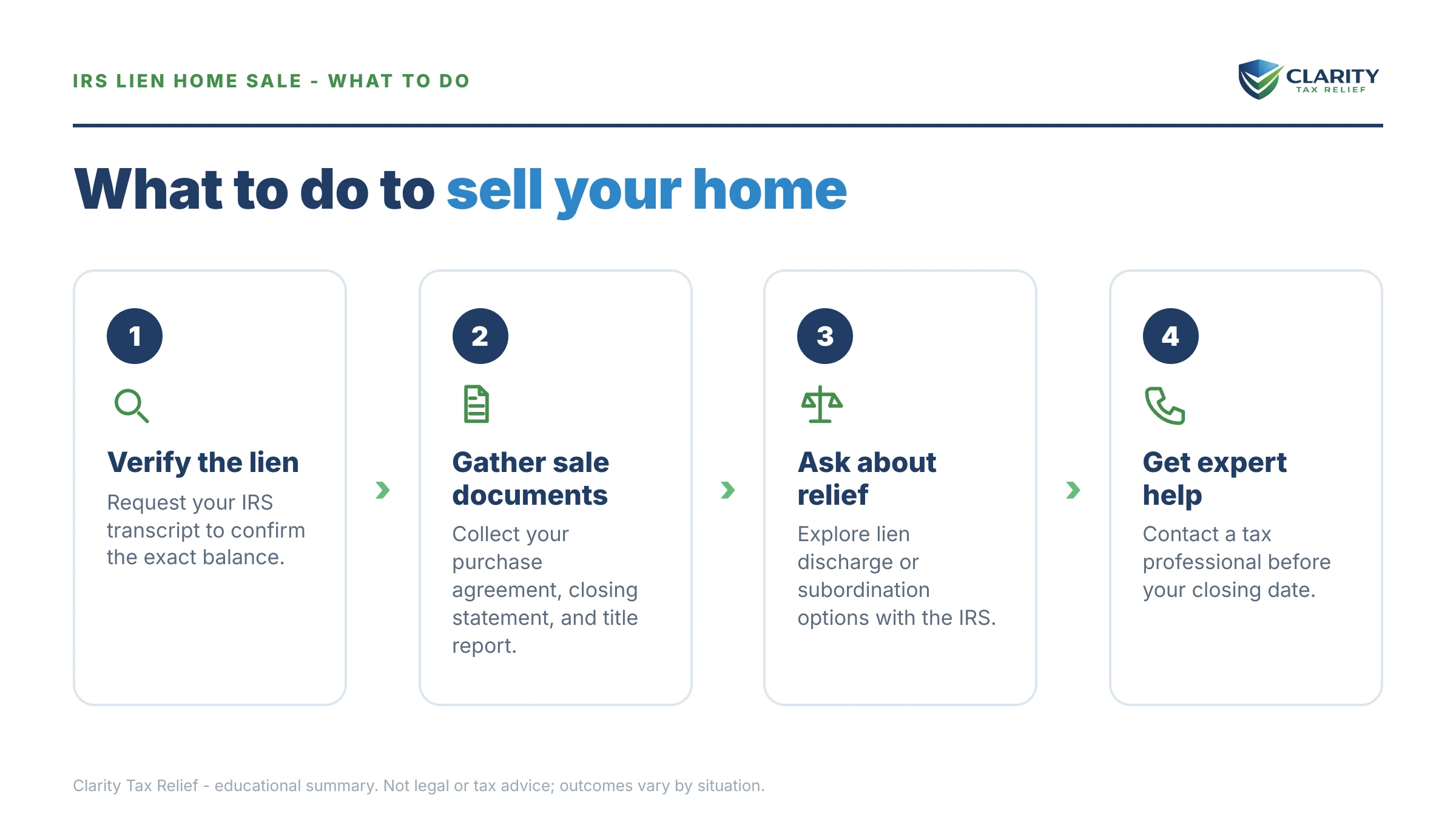
- Pull the lien document. Get a copy of the recorded Notice of Federal Tax Lien from your county recorder (or your title report) and note the tax periods and assessed amounts — those drive the payoff and every form that follows.
- Gather your sale numbers. Your mortgage payoff statement, the contract or expected list price, and an estimate of commissions and closing costs — that's everything needed to run the equity math above.
- Get the strategy reviewed free. Send us the lien notice and your numbers at the 2-minute form or call (888) 825-7779. If Form 14135 is your path, the 45-day window means the application needs to move before your closing calendar does — and interest is accruing on the balance either way.
This guide is general information, not tax or legal advice for your specific situation. Eligibility for IRS programs depends on individual facts and circumstances; no outcome is guaranteed.