
IRS Data & Statistics
IRS CP2000 Underreporter Statistics: What the Numbers Mean for You in 2026
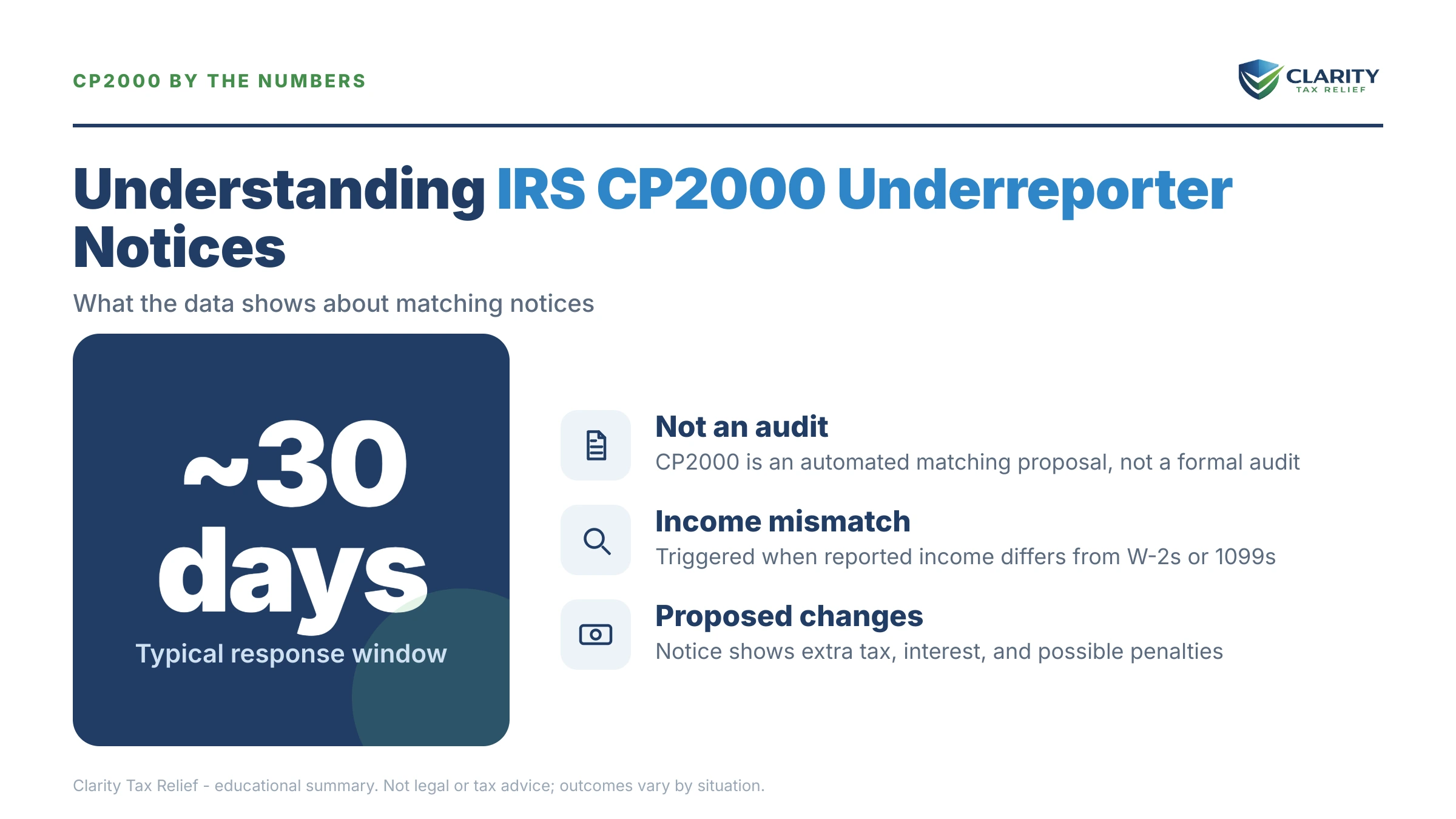
The short answer: IRS CP2000 underreporter statistics come from the Automated Underreporter (AUR) program, which matches the billions of W-2s and 1099s payers file each year against tax returns, closing millions of mismatch cases in a typical year. The number that matters most: a CP2000 is a proposal — documented responses routinely change it.
Maybe the CP2000 on your kitchen table proposes more than you collect from Social Security in a year, and you want to know how often the IRS's computers actually get these right before you write a check. That instinct is correct — the numbers behind the underreporter program favor people who respond with documents over people who panic-pay, and this 2026 guide walks through exactly why.
If you're holding a notice right now, the image below shows exactly what a CP2000 looks like and where the proposed amount and the response date sit on the page — orient yourself there before you read the statistics, because those two boxes define everything that follows.
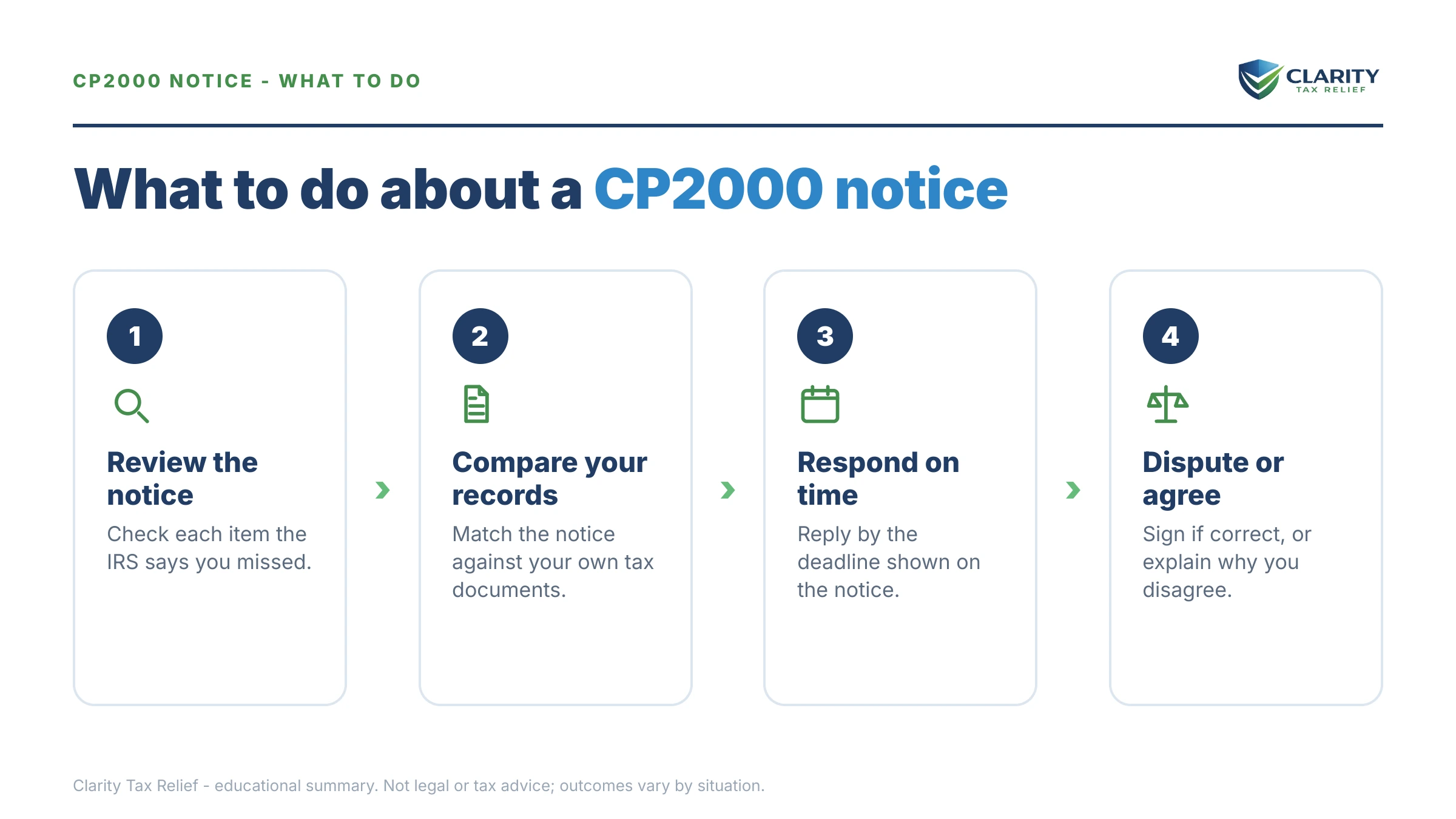
⏱ Your deadline: a CP2000 typically gives you 30 days to respond, and the exact "respond by" date is printed near the top of page 1 of your notice — that printed date controls. Miss it and the IRS moves toward a Statutory Notice of Deficiency, where the clock becomes 90 days and the stakes become Tax Court.
IRS CP2000 underreporter statistics: what the numbers actually show
Every CP2000 begins as a statistic: a computer-flagged mismatch between an information return a payer filed and the income reported on a tax return. The Automated Underreporter (AUR) program sits on top of the billions of W-2s, 1099s, SSA-1099s, and W-2Gs the IRS receives each year, and when the income on file exceeds the income on your return by enough to clear internal thresholds, the system generates a notice.
The IRS's annual Data Book — its official statistical report — shows the AUR program closing millions of underreporter cases in a typical year and proposing billions of dollars in additional tax across them. The IRS doesn't publish a line labeled "CP2000s mailed," and the exact case counts move year to year, so treat the current Data Book as the primary source for this year's figures. What the trend consistently shows: document matching is the IRS's highest-volume enforcement tool by far — it dwarfs traditional audits — because a computer does nearly all of it.
A timing statistic that surprises people: CP2000s typically arrive a year or more after you filed. Payer documents have to post, matching runs, and cases queue — which is why a notice about a return you barely remember is completely normal, not a sign something new went wrong.
The 2026 wrinkle: the IRS workforce was cut roughly 27% in 2025, and reaching a human is genuinely harder — but AUR is software, and software didn't get laid off. Matching, notices, and the escalation that follows all continue at machine speed. That imbalance is exactly why written, documented responses filed early beat waiting on hold. For the wider enforcement picture, see our IRS tax collections statistics and IRS back tax debt statistics.
One more statistic the IRS doesn't publish: how often taxpayers win. There's no official "CP2000 error rate." But the program's structure tells you what the missing number hides — AUR computes proposals from gross figures, with no knowledge of your cost basis, rollovers, or business expenses. A proposal built without half the facts is not a final answer. You can even watch your case on your account transcript: code 922 is the marker that an underreporter review posted to your year.
Why you got a CP2000: the mismatches behind the numbers
A CP2000 means one specific thing: a payer told the IRS about income the computer couldn't find on your return. It is not an audit, and nobody is combing through your deductions — the full walkthrough of the notice itself lives in our CP2000 guide. What matters here is which document triggered yours, because the trigger dictates the fix.
| Income the IRS matched | Form the payer filed | What usually shrinks an overstated proposal |
|---|---|---|
| Retirement withdrawals or rollovers | Form 1099-R | Proof of a rollover or the taxable-amount computation — many "distributions" were never taxable |
| Stock, fund, or crypto sales | Form 1099-B | Cost-basis records on Form 8949 — the IRS often starts from zero basis |
| Social Security benefits | Form SSA-1099 | A recomputation of the taxable share — benefits are at most 85% taxable |
| Gig, freelance, or platform income | Form 1099-NEC or 1099-K | A Schedule C with expenses — AUR proposes tax (and self-employment tax) on the gross |
| Gambling winnings | Form W-2G | Session and loss records if you itemize |
| Interest and dividends | Forms 1099-INT / 1099-DIV | Statements showing the income was reported on a different line or a joint account split |
Three edge cases change the picture. On a joint return, matching runs against both Social Security numbers — a spouse's forgotten 1099 lands on both of you, and both of you own the response. Self-employed filers get hit hardest, because AUR adds self-employment tax on top of income tax when it proposes changes on a 1099-NEC. And the 1099-K threshold has reverted to $20,000 and 200 transactions — but a CP2000 always covers a past year, so notices built on forms filed under the older, lower thresholds are still working through the pipeline.
What happens if you ignore a CP2000: the escalation sequence
An ignored CP2000 becomes a legally assessed debt without a single human ever reviewing your side. The sequence is automated and it only moves one direction:
- The CP2000 window closes. Your printed response date passes. In some cases a CP2501 came even earlier — that was the gentlest version of this letter you'll ever get.
- CP3219A — Statutory Notice of Deficiency. The 90-day letter. You now have 90 days to petition Tax Court — your last chance to dispute the amount without paying it first.
- Assessment posts. The proposal is now a real debt. The 10-year collection statute starts here, the 0.5%-per-month failure-to-pay penalty begins, and a CP14 bill arrives with roughly 21 days to pay (10 business days when the balance is $100,000 or more).
- Collection notices escalate. CP501 and CP503 reminders, then CP504 — at which point the IRS can seize your state tax refund.
- LT11 / Letter 1058 — final notice. A 30-day clock starts, with Collection Due Process appeal rights via Form 12153. After it runs, the IRS can levy.
- Levy. Bank accounts (a 21-day hold before funds leave), wages (continuous until released), and — the one retirees feel most — up to 15% of Social Security through the Federal Payment Levy Program. Details in can the IRS garnish Social Security.
| Stage | Typical window | What changes |
|---|---|---|
| CP2501 (some cases) | Date printed on the notice | Early heads-up before amounts are formally proposed |
| CP2000 | Typically 30 days (printed date controls) | Proposal stage — the cheapest, easiest point to fix anything |
| CP3219A (90-day letter) | 90 days | Last chance to dispute in Tax Court without paying first |
| Assessment + CP14 | ~21 days on the CP14 (10 business days when the balance is $100,000 or more) | Proposal becomes legal debt; failure-to-pay penalty and CSED clock start |
| CP501 / CP503 / CP504 | Date printed on each notice | At CP504 the IRS can take your state tax refund |
| LT11 / Letter 1058 | 30 days | Final notice — request a CDP hearing (Form 12153) or levies can begin |
| Levy | Ongoing until released | Bank (21-day hold), wages (continuous), up to 15% of Social Security |
Interest accrues through every stage. Nothing on this timeline requires a revenue officer, a phone call, or a human decision — which is why "I never heard back from the IRS" is never evidence the case went away.
Holding a CP2000 with the response date approaching?
Get it reviewed free before the deadline printed on page 1 passes — a CP2000 is easiest to shrink while it's still a proposal, and hardest after it becomes an assessment. Send us a photo and an experienced tax professional will tell you exactly where the number came from and what answers it.
How a $61,200 CP2000 proposal can shrink: a worked example
The most useful CP2000 statistic isn't in any Data Book — it's the gap between the proposed amount and what's actually owed once the missing facts are supplied. Here's a clearly hypothetical example of how that gap opens up.
Say you're retired, living on Social Security plus modest withdrawals, and last year you sold shares you inherited for $170,000. The brokerage filed a Form 1099-B reporting the proceeds — but no cost basis. You didn't think to report the sale, so the AUR computer treats the entire $170,000 as taxable gain. The CP2000 proposes roughly $48,000 in additional tax, a $9,600 accuracy-related penalty (20% of the tax), and about $3,600 in interest: $61,200 total.
Now the response. Inherited shares get a stepped-up basis — say they were worth $150,000 at the date of death. The real gain is $20,000, not $170,000. At the 15% long-term capital gains rate that's $3,000 of tax; add the knock-on effect of the extra income making more of your Social Security taxable, and the true additional tax lands around $4,500. The accuracy-related penalty recomputes on the smaller figure (about $900) and may be removed entirely with a clean compliance history or reasonable cause — the mechanics are in our accuracy-related penalty guide, and you can estimate how penalties and interest grow on any balance with our IRS penalty & interest calculator.
The result: a documented response turns a $61,200 proposal into something under $6,000. One more reason not to sit on it — $61,200 is below the $66,000 passport-certification threshold for 2026, but an ignored proposal that keeps accruing penalties and interest can cross that line and put your passport at risk on top of everything else.
If the CP2000 is right but you can't pay: your options
Sometimes the computer is correct — the income was real, unreported, and taxable. Agreeing doesn't mean writing one impossible check. The full DIY playbook for resolving a balance lives in our guide to how to settle tax debt yourself; here's how the options map to a CP2000 balance, with the specifics for the agree-but-broke scenario in CP2000 — agree but can't pay.
| Option | Key threshold | Cost and notes |
|---|---|---|
| Short-term payment plan | Balance you can clear within 180 days | $0 setup; interest and the 0.5%/month penalty continue until paid |
| Guaranteed installment agreement | Balance of $10,000 or less, returns filed | The IRS must accept when the conditions are met — it's the official program name, not a promise |
| Streamlined installment agreement | Total balance up to $50,000 | Up to 72 months, set up online with no financial statement; setup fee applies (reduced for direct debit and low income) |
| Currently Not Collectible | Income covers only allowable living expenses | Collection pauses; the debt and interest remain — a common fit for fixed-income retirees |
| Offer in Compromise (Form 656) | Assets plus future income genuinely below the balance | $205 fee and 20% down on lump-sum offers — both waived with low-income certification; the IRS accepted roughly 1 in 5 offers in FY2024 |
| Penalty relief | Clean prior 3 years, or reasonable cause | Removes penalties, not tax; the new Automatic Exemption from Penalty (AEP) makes qualifying relief automatic starting summer 2026 |
One CP2000-specific wrinkle: you can dispute part of the notice and arrange payment on the rest in the same response. Agreeing to the piece that's clearly right while documenting the piece that's wrong is often the fastest path to a small, manageable final number.
How to respond to a CP2000, step by step
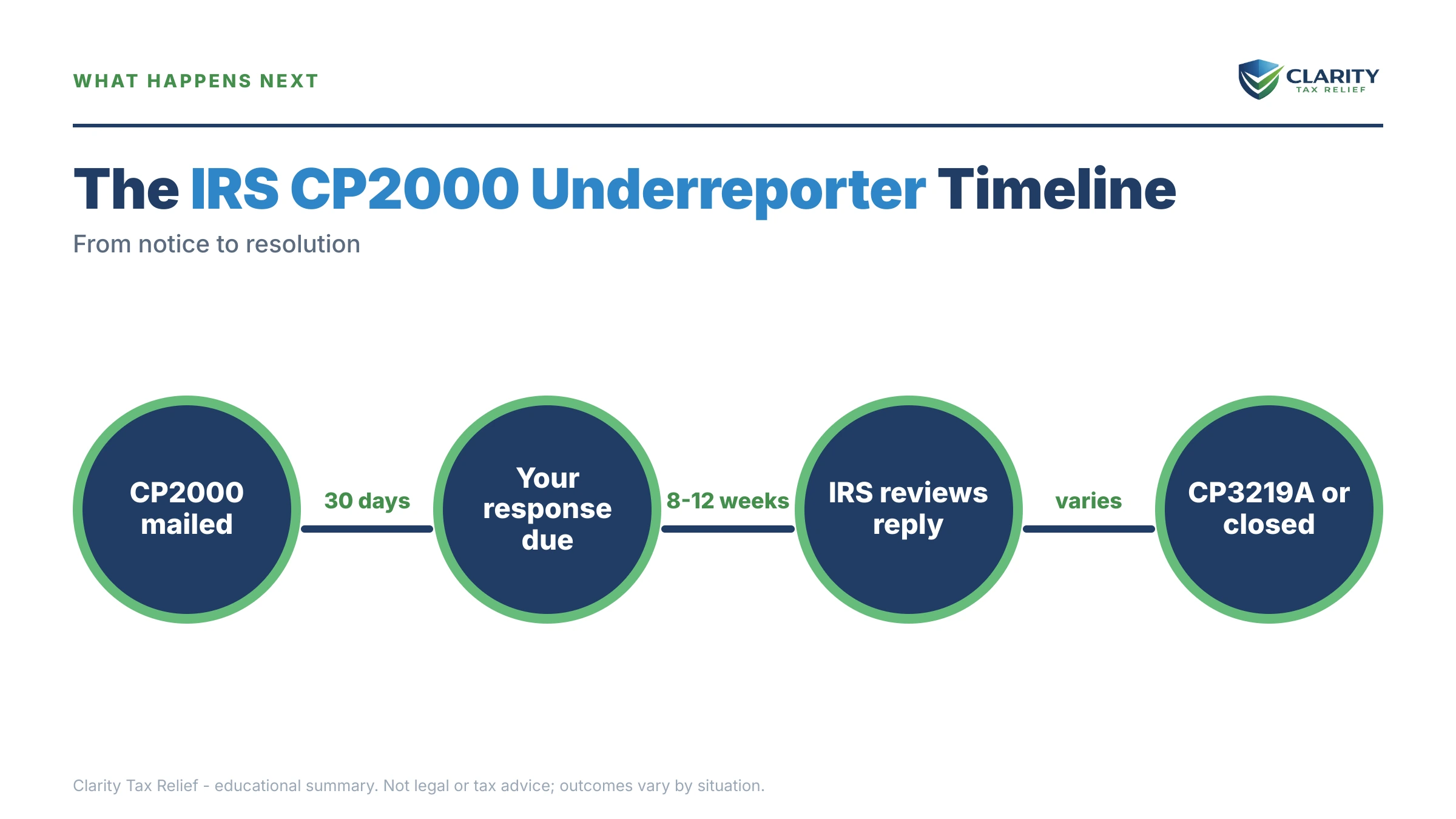
- Compare the notice to your records. Match every income item the CP2000 lists against your filed return and your own 1099s, W-2s, and SSA-1099 before deciding anything — the mismatch is often narrower than the total suggests.
- Choose agree, partly agree, or disagree. The response form built into the notice allows all three — you can accept one item and dispute another on the same page (the dispute playbook is in CP2000 — disagree).
- Gather the document that answers the mismatch. Cost-basis records, a rollover confirmation, a Schedule C with expenses, or proof the income was reported on a different line does the work — not an explanation letter alone.
- Respond in writing by the printed date. Send the signed response form with your documentation attached, keep copies, and use tracked mail. If you agree but need monthly payments, include Form 9465 with your response — and our free CP2000 response letter sample shows the format.
- Track the IRS's reply. Answers can take months. Watch the mail for a recomputed notice or a CP3219A Statutory Notice of Deficiency, and calendar every new deadline the moment it arrives.
When you can handle a CP2000 yourself — and when help changes the outcome
Many CP2000s are genuinely a do-it-yourself project. If the notice flags one item, you agree with it, and you can pay in full or within 180 days, respond, pay, and move on — no professional needed. Same if the fix is a single document, like one forgotten 1099-INT or a rollover confirmation: attach it, mail it, done.
Experienced help changes the outcome in specific situations: reconstructing cost basis across multiple accounts or years of trades; self-employment proposals where a Schedule C with expenses has to be built from scratch; CP2000s hitting more than one tax year at once; a CP3219A already in hand with the 90-day Tax Court clock running; or a fixed income where the real question isn't the mismatch but whether Currently Not Collectible or an Offer in Compromise fits your finances. In those cases, the order and quality of the response — not just responding — determines the final number. Eligibility for every program here is means-tested; a review tells you whether you may qualify before you spend anything pursuing it.
And if part of your worry is criminal exposure: a CP2000 is civil, full stop. The numbers on prosecutions — and how different that world is from a matching notice — are in our IRS criminal investigation statistics.
Terms on your CP2000, decoded
- Automated Underreporter (AUR): the IRS computer program that matches payer-filed forms against tax returns and generates CP2000 notices.
- Information return: any form a payer files with the IRS about money paid to you — W-2, 1099-B, 1099-R, 1099-K, SSA-1099, W-2G.
- Proposed amount due: the figure on your notice — a proposal you can accept, dispute, or partially dispute, not yet a legal debt.
- Accuracy-related penalty: a 20% penalty the IRS proposes when an understatement of tax is substantial; it recomputes if the tax shrinks and can be removed with cause.
- Statutory Notice of Deficiency (90-day letter): the CP3219A that follows an unanswered CP2000, starting a 90-day window to petition Tax Court.
- Transcript code 922: the marker on your IRS account transcript showing an underreporter review posted for that year.
If your CP2000 involves missing cost basis, self-employment income, or more than one tax year, a free case review — or one call to (888) 825-7779 — will tell you whether a documented response can shrink it before the printed deadline passes.
CP2000 underreporter questions, answered
How many CP2000 notices does the IRS send each year?
The IRS doesn't publish a CP2000-specific count, but its annual Data Book shows the Automated Underreporter program that generates them closes millions of cases in a typical year and proposes billions of dollars in additional tax. The exact figures move year to year, so check the current Data Book for the latest numbers. Because the program is automated, the 2025 staffing cuts did not meaningfully slow the flow of notices.
Is a CP2000 notice an audit?
No. A CP2000 is a proposed change generated by computer matching, not an examination of your return. Nobody is reviewing your deductions or asking for receipts across the board — the IRS is asking about specific income items its records show and your return doesn't. It carries a response deadline all the same, and ignoring it converts the proposal into a real assessed debt.
How often is a CP2000 wrong?
The IRS doesn't publish an error rate, but the structure of the program means proposals frequently overstate what's actually owed. The matching computer works from gross figures — it doesn't know your cost basis on a stock sale, whether a retirement distribution was rolled over, or what business expenses offset a 1099. That's why comparing every line against your own records before paying is the single highest-value step.
What are my chances of getting a CP2000?
Essentially every return is run through document matching, but a notice only goes out when the computer finds a discrepancy large enough to clear internal thresholds the IRS doesn't publish. Your odds rise with the number of information returns filed under your Social Security number — brokerage accounts, retirement distributions, gig platforms, and gambling payers all add matching points. W-2-only filers with simple returns rarely see one.
Can I get more time to respond to a CP2000?
Often, yes. Call the number printed on your notice before the response date and ask for an extension — the IRS will frequently grant additional time when you request it before the deadline passes. Get the representative's name and ID number and note the new date. An extension to respond does not stop interest from accruing on whatever amount is ultimately assessed.
Will a CP2000 lead to criminal charges?
No — a CP2000 is a civil matter handled entirely by mail, and it does not mean you're suspected of fraud. Criminal tax cases come out of a separate division and are rare, generally involving willful, repeated conduct rather than a missed 1099. The realistic risks here are financial: the proposed tax, a possible 20% accuracy-related penalty, and interest — all of which a timely response can reduce.
Does a CP2000 include penalties?
Usually. Most CP2000s propose a 20% accuracy-related penalty when the understatement is substantial, and once an amount is assessed, the 0.5%-per-month failure-to-pay penalty and daily interest begin on top. Penalties can be challenged in your response or reduced afterward — through reasonable cause, a clean three-year compliance history, or the new Automatic Exemption from Penalty rolling out in summer 2026.
Can the IRS take my Social Security over a CP2000 balance?
Eventually, yes — but not at the CP2000 stage. If the proposal becomes an assessed debt and you ignore the collection notices that follow, the IRS can take up to 15% of your Social Security through the Federal Payment Levy Program. That takes months of escalation and a final notice with appeal rights first, and hardship protections can stop or release a levy that leaves you unable to cover basic living expenses.
What happens if I ignore a CP2000?
The proposal hardens into a legal debt. You'll typically receive a CP3219A Statutory Notice of Deficiency giving you 90 days to petition Tax Court; if that passes, the tax is assessed and collection notices begin — CP14, then escalating letters ending in levy power over bank accounts, wages, and federal payments. You also lose the cheapest window to dispute: fixing a mismatch after assessment requires slower, harder processes.
Does responding to a CP2000 increase my audit risk?
No. The Automated Underreporter program runs separately from the IRS examination function, and answering the notice with documentation resolves the matter inside that program. Responding is how proposals shrink; silence is what escalates. The one caution: your response should answer the specific mismatch asked about — a clear, documented reply closes cases rather than opening new questions.
Your next 24 hours
- Find two things on page 1 of your CP2000: the "respond by" date and the summary of proposed changes. Those two boxes define your deadline and your dispute.
- Gather your records for that year: the tax return on the notice, every 1099, W-2, and SSA-1099 you received for it, and any basis, rollover, or expense records tied to the flagged item.
- Get a free review before your printed deadline: call (888) 825-7779 or use the 2-minute form. A documented response filed on time is what turns a proposal into a smaller number — after the date passes, every option gets harder.
Primary sources: the IRS's own explainer at Understanding your CP2000 notice, the annual IRS Data Book for current underreporter program figures, and IRS.gov/payments for official payment and plan options.
This guide is general information, not tax or legal advice for your specific situation. Eligibility for IRS programs depends on individual facts and circumstances; no outcome is guaranteed.