
IRS Notices
IRS CP2501 Notice: What It Means and How to Respond (2026)
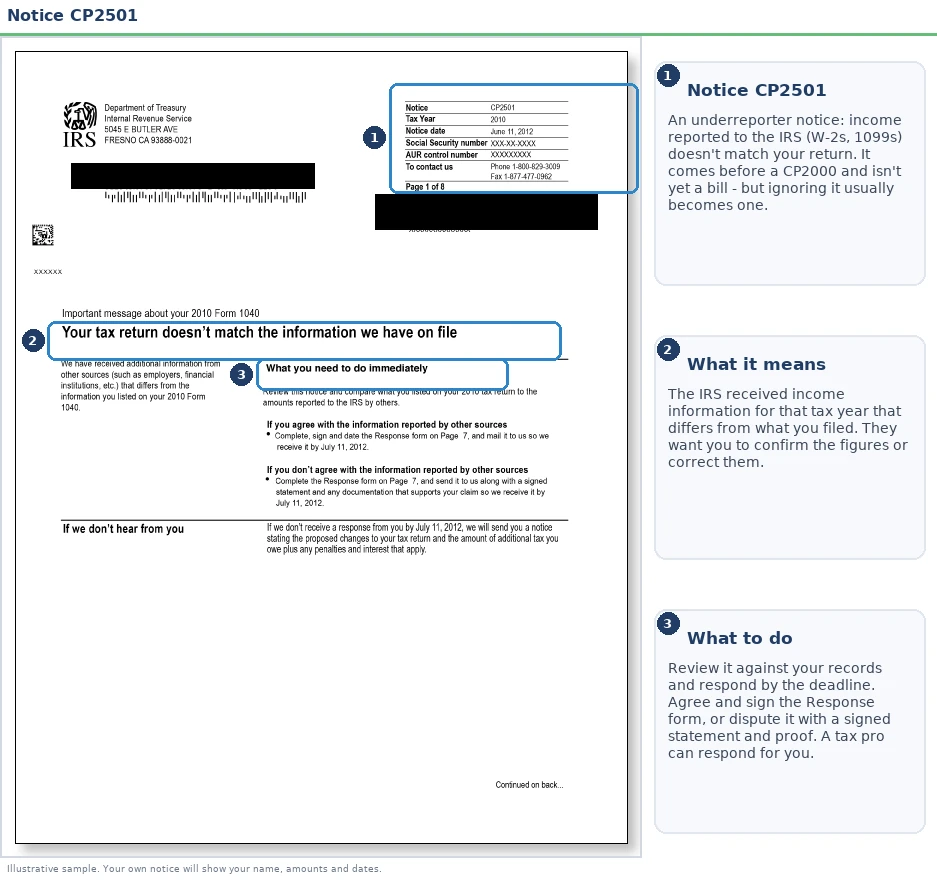
The short answer: a CP2501 notice means the income on your tax return doesn't match what employers, banks, or brokers reported to the IRS. It is not a bill and not an audit — it's a question. Respond by the date printed on the notice, or the IRS follows up with a CP2000 proposing extra tax.
You filed that return over a year ago and hadn't thought about it since — until this letter announced that "the income or payment information we have on file doesn't match your tax return." No dollar amount due. No accusation. Just a payer-by-payer list and a request to explain. That's the strange thing about a CP2501: it's the one IRS letter that asks before it charges — which means how you answer it, and how fast, decides whether it ends with a stapled explanation or a tax bill.
⏱ Your deadline: the response date printed on the first page of your CP2501 — the IRS sets the window on the notice itself, so use that date, not a rule of thumb. If it passes with no response, the case moves automatically toward a CP2000 with tax calculated on the IRS's assumptions. Need more time? Call the number on the notice and ask before the date arrives.
Why you got a CP2501 notice
A CP2501 notice means the IRS Automated Underreporter (AUR) program found income on file under your Social Security number that it couldn't locate on your tax return. Every W-2 and 1099 a payer issues to you is also filed with the IRS. Long after filing season, a computer lines those documents up against your return — and when a payer's number doesn't match a line on your 1040, the AUR system generates this notice.
The notice lists each payer, the form they filed, and the amount that doesn't match. It does not propose any tax — that's what separates a CP2501 from nearly every other IRS letter. The image below shows exactly what a CP2501 looks like and where to find the two things that matter most: the response date and the payer-by-payer mismatch list.
Two related signals you may have already seen: code 922 on your IRS transcript marks the underreporter review that produced this notice, and if you're not certain which letter you're actually holding, start with our decoder on why you got a letter from the IRS.
CP2501 vs. CP2000: which notice you're holding
A CP2501 proposes no tax — it asks a question; a CP2000 proposes a specific dollar amount of additional tax. The IRS uses the CP2501 when it wants your explanation before running the math, often when the mismatch is large or ambiguous. Answer it well and the case can close without a number ever being attached. The follow-up CP2000 notice is the harder stage: proposed tax, proposed penalties, and a formal agree-or-disagree decision.
Don't confuse it with adjustment notices either. If the IRS already changed your return and billed you, that's a CP11 notice; if it changed your refund, that's a CP12 notice. Those announce a decision. A CP2501 is still asking.
What the IRS thinks is missing: the most common CP2501 mismatches
Most CP2501s trace back to a handful of document types — and several of them look far worse to the computer than they really are. The classic example: a brokerage reports the gross proceeds of a stock sale, so a sale you nearly broke even on reads to the IRS like pure unreported income.
| What the IRS flags | Why the mismatch happens | What to send |
|---|---|---|
| 1099-B stock or fund sale | The broker reports gross proceeds; your cost basis never reached the IRS, so the entire sale looks like income | Broker statement or Form 8949 detail showing purchase price and dates |
| 1099-NEC or 1099-K | The income was reported inside a larger Schedule C gross figure the computer can't line up | A short schedule reconciling the 1099 totals to your reported gross receipts |
| W-2 from a second or old job | The return missed one employer, or the W-2 was issued under a slightly different name or SSN | The W-2 plus where it appears on your return — or an agreement that it was missed |
| 1099-R retirement distribution | A rollover looks taxable, or the taxable-amount box doesn't match what you reported | The receiving account's statement showing the funds landed within 60 days |
| 1099-C cancelled debt | Forgiven debt is income unless an exclusion applies, and many filers leave it off entirely | Form 982 with an insolvency worksheet if you qualify — or agreement if you don't |
| SSA-1099 or 1099-INT | Small benefit or interest amounts get overlooked at filing time | Usually agreement — these are typically valid and cheap to concede |
One more possibility worth ruling out: a form for income you never earned. If the notice lists a payer you've never heard of, read our guide to getting a 1099 you weren't expecting — it may be a payer error or identity theft, and both have a specific fix.
What happens if you ignore a CP2501
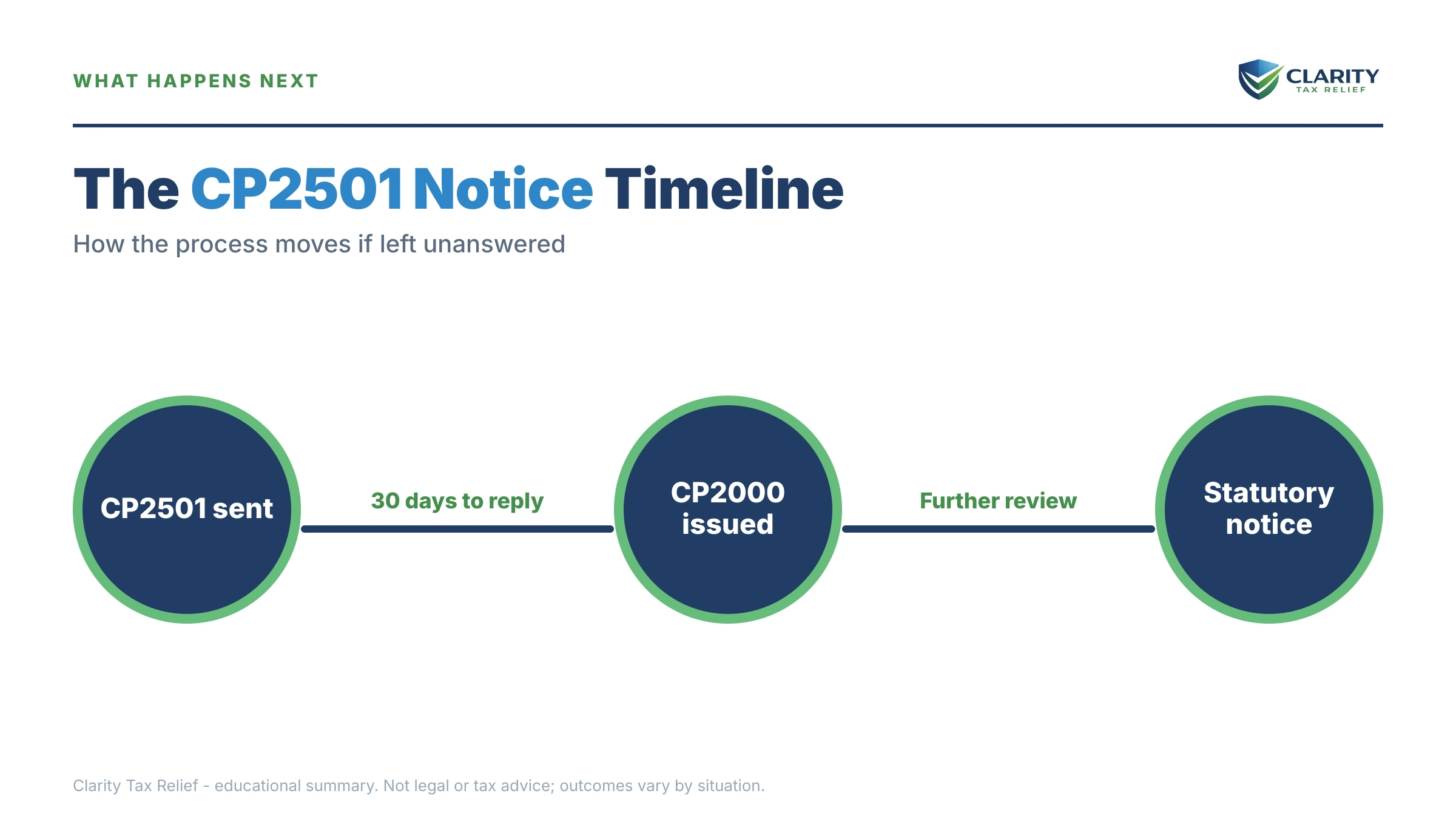
An ignored CP2501 doesn't close — it converts into a CP2000 that calculates tax on the IRS's assumptions, without your basis, your schedules, or your side of anything. From there, the sequence is automated and each stage strips away an option:
- CP2501 — the inquiry. You are here. No tax proposed, full flexibility.
- CP2000 — a proposed tax change, often with a proposed 20% accuracy-related penalty. You typically get about 30 days to respond, and the case is now priced.
- CP3219A — the statutory notice of deficiency. A hard, statutory 90-day clock to petition Tax Court — your last chance to dispute the amount without paying it first.
- Assessment and CP14 — the proposed amount becomes a legal debt, billed with roughly 21 days (10 business days if the balance is $100,000 or more) before the collection sequence begins.
- Collection notices, then levy — reminders escalate to a CP504 and eventually an LT11 final notice; 30 days after that, wages, bank accounts, and state refunds become reachable.
Interest doesn't wait for any of this. On whatever tax you genuinely owe, it accrues from the original due date of the return — a CP2501 that arrives 14 months after filing already carries 14 months of interest on the true balance.
| Stage | What arrives | Your window | What you lose if it passes |
|---|---|---|---|
| CP2501 (you are here) | An income-mismatch inquiry — no tax proposed | The response date printed on the notice | The chance to resolve the mismatch before any tax is calculated |
| CP2000 | Proposed tax, often with a proposed 20% accuracy-related penalty | Typically about 30 days | The easiest paper-only dispute; the IRS's numbers harden |
| CP3219A | Statutory notice of deficiency | 90 days to petition Tax Court | Your right to dispute the tax before paying it |
| Assessment + CP14 | A legal bill for the full amount | About 21 days (10 business days if the balance is $100,000 or more) before escalation | Clean transcripts — the balance now shows to lenders, and collection begins |
| CP504 → LT11 → levy | Escalating collection notices, then a final notice of intent to levy | 30 days after the LT11 | Protection for wages, bank accounts, and state refunds |
Holding a CP2501 with the response date closing in?
Send us a photo of the notice and the return it questions. An experienced tax professional will match the IRS's list against your records and tell you exactly what to send back — free, before your printed response date passes.
Your CP2501 response options
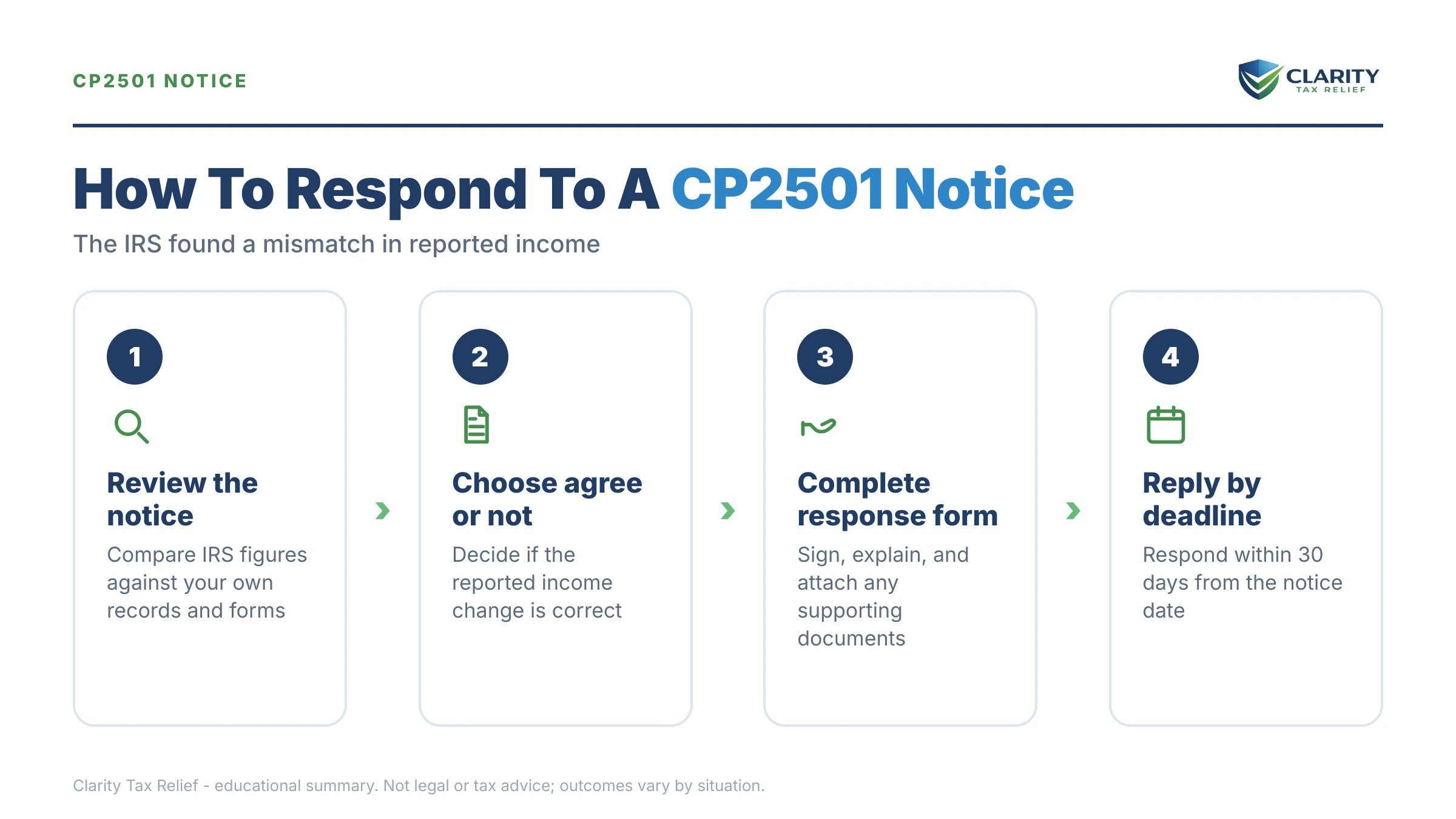
The notice comes with a response page offering three positions — agree, partially agree, disagree — and each demands different paperwork. The mistake that costs people the most is agreeing by default because arguing feels risky: if the flagged item is gross proceeds or a rollover, "disagreeing" with documents is often both correct and easy.
| Your position | What to send | What happens next |
|---|---|---|
| Agree completely | The signed response page; consider a payment toward the eventual balance to slow interest | The IRS calculates the tax and sends the bill or a CP2000 confirming the amount |
| Partially agree | The response page marked accordingly, plus documents for each item you dispute | AUR adjusts the items your documents support and prices only what remains |
| Disagree completely | Proof the income was reported (the exact line or schedule) or that the payer's form is wrong | If your documentation holds, the case closes with no change to your return |
| The payer misreported | A corrected 1099 or W-2 from the payer — or proof you requested one, plus your own records | The IRS matches against the corrected figure instead |
| You never earned it | A short identity-theft statement and, where appropriate, Form 14039 | The item is routed out of the match while the identity issue is worked |
If you agree and the resulting tax will be more than you can pay at once, don't let that change your answer — the balance can go onto a payment plan after it's assessed. Our guide to a CP2000 you agree with but can't pay covers the same playbook that applies here.
What a CP2501 can cost: a $13,600 worked example
Say you're a homeowner planning a refinance this fall, and your CP2501 flags a $13,600 1099-B from the brokerage account you tapped last year for a roof repair. This is a hypothetical, but the math is the real AUR math:
- If you respond with your basis: you bought those fund shares for $11,200, so the actual long-term gain is $13,600 − $11,200 = $2,400. At the 15% capital-gains rate, that's about $360 of tax, plus modest interest back to the return's due date.
- If you ignore the notice: the IRS has only the $13,600 in proceeds and no basis, so the CP2000 that follows treats the entire amount as gain — $13,600 × 15% = $2,040 of proposed tax. If the understated tax were larger — the 20% accuracy-related penalty generally applies only when the understatement exceeds the greater of $5,000 or 10% of the correct tax — the IRS would add 20% on top; at roughly $2,040 it typically would not apply. Even so, with interest added you're staring at roughly $2,040-plus instead of $360.
A two-page broker statement is the entire difference. You can rough out what penalties and interest would add to any proposed balance with our Penalty & Interest Calculator — it estimates, and your notice controls.
The refinance is the quiet second stake. A CP2501 by itself is invisible to your lender — but let it ride to assessment and the balance appears on the account transcripts underwriters pull, and an unpaid assessment can eventually mean a federal tax lien. If your timeline is tight, see what refinancing with an IRS lien actually involves — then do everything possible to never need that article.
How to respond to a CP2501, step by step
- Find your response date. It's printed on the first page of the notice, along with the tax year under review. Everything else waits until you know how much runway you have — and if it's too tight, call the number on the notice to request more time before the date passes.
- Pull your wage and income transcript. Get it free through your IRS online account. It lists every W-2 and 1099 filed under your Social Security number — the same data the AUR computer matched against your return.
- Compare each flagged item to your return. For every payer line on the notice, decide whether you agree, partially agree, or disagree — and pull the document that proves your position, such as a broker basis statement, a corrected 1099, or the schedule where you actually reported the income.
- Complete the response page and attach your evidence. Use the response form included with the notice, check the box that matches your position, attach copies of your documents (never originals), and add a short letter explaining each disputed item in one or two sentences.
- Send it by the method on the notice and keep proof. Fax it if a fax number is provided, or mail it certified with return receipt to the address shown. Proof of a timely response protects you if the IRS takes months to process it.
- Calendar the follow-up. Expect a written reply in weeks to months; a Letter 2645C just means the IRS needs more time. If a CP2000 arrives anyway, respond to it too — your CP2501 documentation does double duty.
For the explanation letter in step 4, the format in our CP2000 response letter sample works for a CP2501 with minor edits — item, position, proof, one paragraph each.
When you can handle a CP2501 yourself
You can usually handle a one-item CP2501 yourself. A single missed W-2 you agree with, an overlooked 1099-INT, or a stock sale where your broker statement plainly shows the basis — those need the response page, a copy of the document, and a stamp, not a professional fee. The IRS's own instructions at Understanding your CP2501 notice and the free transcript tool at IRS Get Transcript cover the mechanics.
Experienced help changes the outcome when the facts get layered: multiple flagged years, self-employment income where 1099-K totals overlap Schedule C receipts, a brokerage or crypto account with dozens of transactions to reconstruct, an identity-theft item tangled into real income, or a refinance or sale closing on a schedule the IRS doesn't care about. In those cases the response has to be right the first time — AUR units in 2026 are slow enough that a rejected first answer can burn months you don't have. And if the IRS goes silent past its own stated timeframes while a deadline of yours approaches, the Taxpayer Advocate Service exists for exactly that.
Terms on your CP2501, decoded
- AUR (Automated Underreporter): the IRS computer program that matches payer-filed W-2s and 1099s against tax returns and generates CP2501 and CP2000 notices.
- Information return: any form — W-2, 1099, SSA-1099 — that a payer files with the IRS to report money it paid you.
- Wage and income transcript: the IRS's own list of every information return filed under your SSN; it shows you exactly what the computer matched against.
- Proposed vs. assessed: a proposed amount is a suggestion you can still dispute on paper; an assessed amount is a legal debt the IRS can collect.
- Accuracy-related penalty: a 20% add-on the IRS can propose when it treats an understatement as substantial or negligent.
- Statutory notice of deficiency: the "90-day letter" (CP3219A) — your final chance to take the dispute to Tax Court before the tax is assessed.
CP2501 questions, answered
Is a CP2501 notice an audit?
No — a CP2501 is not an audit. It comes from the IRS Automated Underreporter (AUR) program, a computer match between your return and the W-2s and 1099s payers filed, not an examination of your books. No auditor is assigned and your deductions are not being questioned. That said, an unanswered CP2501 can grow into a real tax assessment, so treat the response date as seriously as you would an audit letter.
What is the difference between a CP2501 and a CP2000?
A CP2501 asks about an income mismatch without proposing any tax; a CP2000 proposes a specific additional tax, plus penalties and interest. The CP2501 is the earlier, softer stage — the IRS wants your explanation before it runs the numbers. If your CP2501 response resolves the discrepancy, no CP2000 ever arrives. If you ignore the CP2501 or your answer doesn't hold up, the CP2000 that follows prices the mismatch on the IRS's assumptions.
What happens if I ignore a CP2501 notice?
The case moves to a CP2000 that proposes additional tax calculated without your side of the story — often assuming zero cost basis — and can include a 20% accuracy-related penalty where it applies. Ignore that too and a CP3219A statutory notice of deficiency follows, giving you 90 days before the amount is assessed and IRS collection begins. Each stage is more expensive and harder to unwind than answering the CP2501 now.
Do I need to file an amended return to answer a CP2501?
Usually not. The AUR unit asks you to respond to the notice itself with an explanation and documents, and it processes any adjustment internally. The IRS generally instructs you not to file a Form 1040-X for the item under review unless the notice tells you to, or you have unrelated corrections to make. If other changes exist, mention them in your response so the two processes don't collide.
How long does the IRS take to respond after I reply to a CP2501?
Expect weeks to a few months, and don't panic if a Letter 2645C arrives saying the IRS needs more time — that's a standard interim letter, not a rejection. In 2026, AUR processing is slower than usual because the IRS workforce shrank roughly 27% in 2025 while notice volume didn't. Keep proof that you responded on time, such as a fax confirmation or certified-mail receipt; a timely response protects you even when the IRS is slow.
Will a CP2501 notice affect my mortgage or refinance?
Not by itself — a CP2501 is an inquiry, not a debt, so there is nothing for a lender to see yet. The risk is letting it escalate: once the IRS assesses a balance, it appears on the account transcripts lenders pull, and an unpaid assessment can lead to a federal tax lien that complicates closing. If you're refinancing soon, resolving the CP2501 quickly is the cheapest way to protect the deal.
Can I get more time to respond to a CP2501?
Often yes — call the number printed on your notice before the response date and ask for an extension; the AUR unit routinely grants additional time when you ask in advance. What doesn't work is silence: if the date passes with no response and no extension, the system moves your case toward a CP2000 automatically. Write down who you spoke with, the date of the call, and the new deadline you were given.
Why did I get a CP2501 a year after filing?
Because the matching happens late. Employers, banks, and brokers file their W-2s and 1099s on their own schedules, and the AUR program compares them to your return only after everything is processed — so CP2501s commonly arrive a year or more after you filed. The delay works against you in one way: interest on any tax you do end up owing runs from the original due date of the return, not from the notice date.
Your next 24 hours
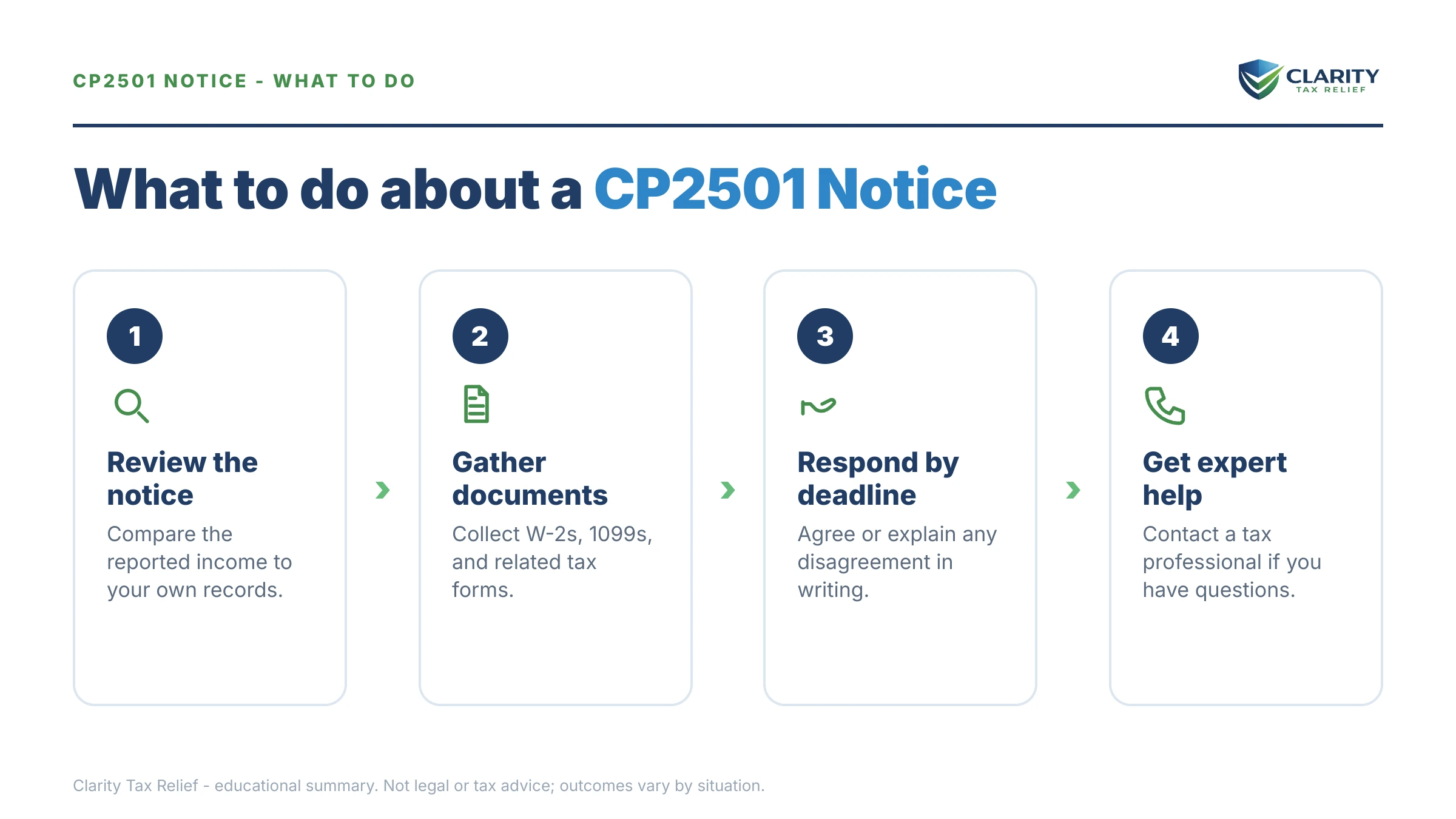
- Find two things on page one of the notice: the response date and the tax year — then read the payer list on the following pages so you know exactly which documents the IRS can't match.
- Gather your side: the filed return for that year, every W-2 and 1099 you received, and basis or account statements for anything sold or rolled over.
- Get a free case review before the printed response date: call (888) 825-7779 or use the 2-minute form. Answering a CP2501 well is the cheapest this ever gets — every stage after it adds tax, penalties, and interest to the exact same facts.
This guide is general information, not tax or legal advice for your specific situation. Eligibility for IRS programs depends on individual facts and circumstances; no outcome is guaranteed.