
IRS Letters
IRS Letter 6173: The Crypto Letter You Must Answer (2026)
The short answer: IRS Letter 6173 is the only virtual currency compliance letter that requires a response. By the respond-by date printed on it, you must file delinquent returns, amend past returns, or mail a statement — signed under penalties of perjury — showing you already reported your crypto correctly. Ignoring it can trigger an examination.
The first paragraph of the letter in your hands says the IRS "has information that you have or had one or more accounts containing virtual currency." Then comes the line that separates Letter 6173 from nearly every other piece of IRS mail: it demands a written answer, in your own signature, under penalties of perjury. That's a jolt — but this letter also hands you three clear, defined ways to close it out, and you get to pick which one.
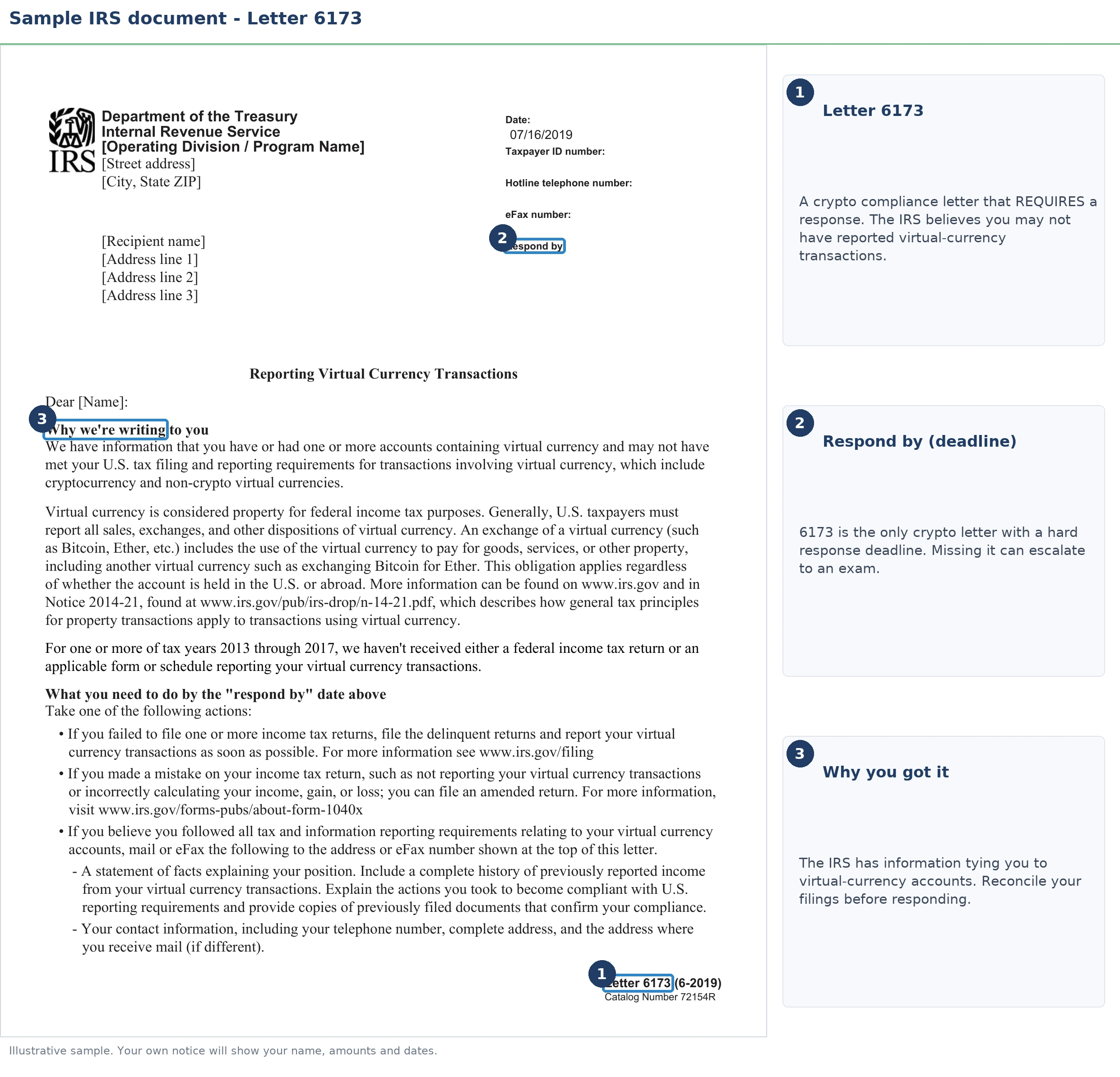
The image below shows exactly what Letter 6173 looks like and where to look for the two items that control everything: the respond-by date and the list of tax years the IRS is asking about.
⏱ Your deadline: the "respond by" date printed on your Letter 6173. The letter itself states that failing to respond can result in your account being referred for examination. If you need more time, call the number printed on the letter and request an extension — but you must ask before that date passes.
Why you got IRS Letter 6173
The IRS sends Letter 6173 when it holds virtual currency account records for you that don't match the returns you filed — or returns you never filed — for the tax years listed on the letter. This isn't a random mailing and it isn't a phishing blast: the IRS already has account-level records from at least one exchange tied to your Social Security number.
Where does that data come from? Court-approved John Doe summonses served on exchanges — Coinbase was the first big one, with Kraken and Circle following — plus information returns exchanges file, like Forms 1099-K and 1099-MISC. Starting with 2025 transactions, brokers also report digital asset sales on the new Form 1099-DA, which means the matching that once required a summons now happens automatically.
The first wave of these letters went out in July 2019 to roughly 10,000 taxpayers, split across three versions: 6173, 6174, and 6174-A. The version you received matters enormously — if yours says 6174, see our separate guide to IRS Letter 6174, because that one works very differently.
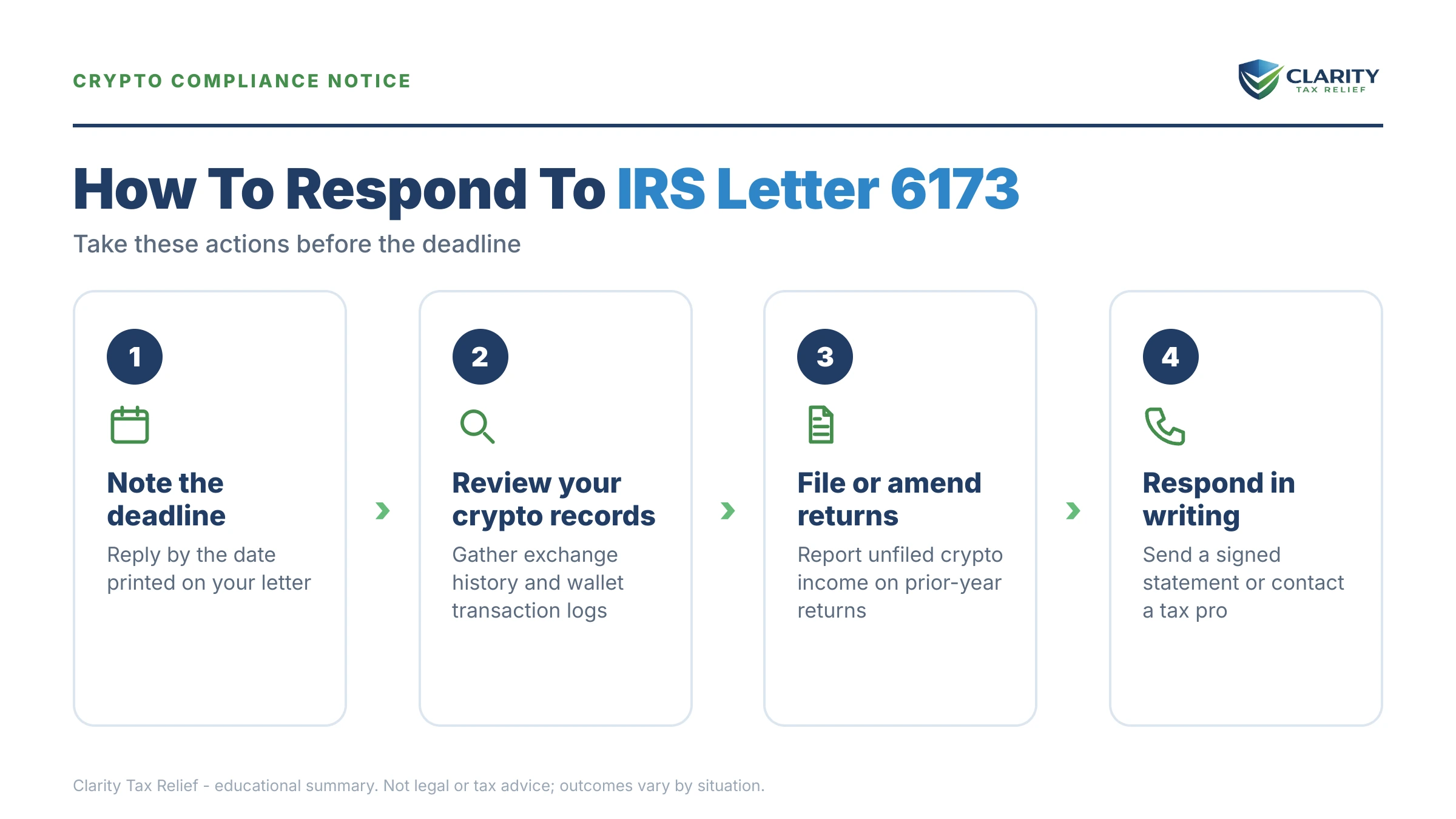
Letter 6173 vs. 6174 vs. 6174-A: which crypto letter do you have?
Letter 6173 is the only one of the three IRS virtual currency letters that legally requires a response. The other two are warnings; this one is a demand. Check the letter number in the corner of page one before you do anything else.
| Letter | Response required? | What it signals | Risk if you do nothing |
|---|---|---|---|
| 6173 | Yes — signed, by the printed respond-by date | The IRS believes you didn't file, or didn't report crypto transactions it can see | Referral for examination of the listed years |
| 6174 | No | Educational — the IRS knows you held crypto and is reminding you of reporting rules | None directly, but errors on your returns remain exposed |
| 6174-A | No | Stronger nudge — the IRS suspects underreporting and warns of possible future enforcement | No response deadline, but the IRS may still open an exam later |
Because Letter 6173 arrives unexpectedly and mentions specific personal data, plenty of recipients assume it's a scam. It's worth ruling that out in five minutes — our guide to how to tell if an IRS letter is real walks through the checks. The short version: real IRS letters come by postal mail, and no real IRS letter ever asks for gift cards or payment-app transfers.
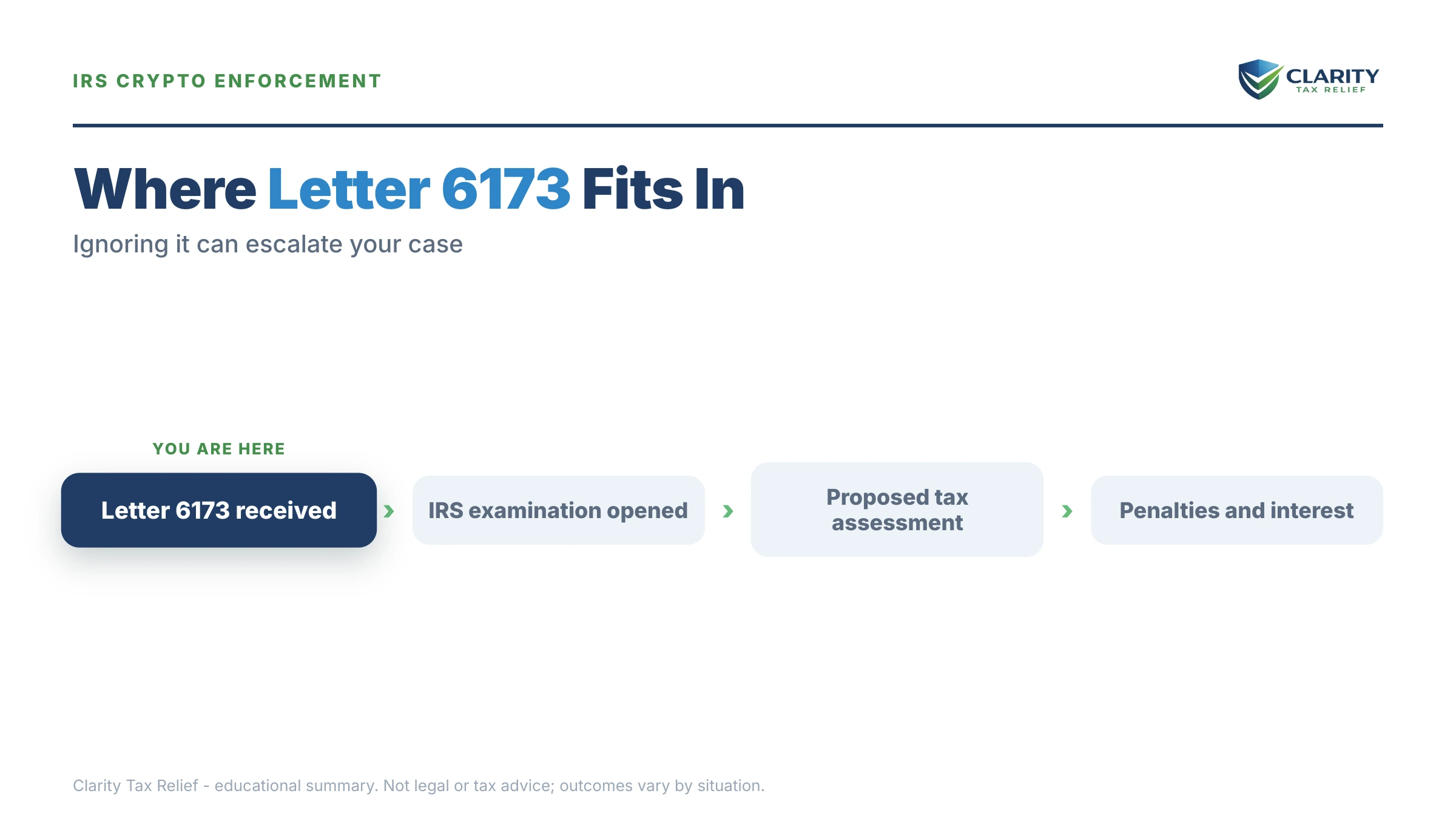
What happens if you ignore Letter 6173
Ignoring Letter 6173 converts a problem you control into an audit the IRS controls. The letter says it plainly: non-response can result in your account being referred for examination. Here's the sequence, stage by stage:
- The respond-by date passes. No returns, no amendments, no statement on file. Your case moves from "compliance outreach" to "non-responsive."
- Examination referral. The IRS opens an audit of the listed years. Now the IRS sets the scope — and it can expand into anything else on those returns, not just crypto.
- Assessment on the IRS's numbers. Exam calculates your gains from the exchange data it already holds. If you don't prove cost basis, the IRS can treat proceeds as nearly all gain. Expect the tax plus a 20% accuracy-related penalty, failure-to-file penalties on any unfiled years, and interest running back to each year's original due date. If the omission looks deliberate, the civil fraud penalty reaches 75%.
- Collection. The assessed balance enters the automated collection pipeline — a CP14 bill, escalating notices, then lien and levy authority. Once the total certified balance passes $66,000 (the 2026 threshold), the IRS can also certify your debt to the State Department, which can deny or revoke your passport for tax debt.
One more stage exists for a small minority: the three-letter program was designed partly to separate honest mistakes from willful evasion. Responding truthfully puts you firmly in the first group. Doing nothing — or worse, responding falsely — is what moves files toward the second.
Holding Letter 6173 with the respond-by date getting closer?
Send us a photo of it before your response window closes. An experienced tax professional will identify which of the three response paths fits your situation and what the corrected numbers actually look like — free, confidential, no pressure.
Your three response options
Letter 6173 gives you exactly three ways to respond, and every one of them must reach the IRS by the respond-by date. Which path is yours depends on one question: did you file for the listed years, and did those returns include your crypto activity?
| Response path | Who it's for | What you send |
|---|---|---|
| File delinquent returns | You never filed for one or more of the listed years | Original returns for those years, reporting all crypto gains and income |
| File amended returns | You filed, but left crypto transactions off | Form 1040-X for each affected year, with Form 8949 and Schedule D showing every disposal, plus ordinary income for mining, staking, and airdrops |
| Statement of compliance | You already reported everything correctly | A statement of facts explaining your compliance for each listed year — signed under penalties of perjury — with supporting documentation |
The third option is where people get hurt. That statement must be signed under penalties of perjury — a legal declaration that your compliance story is true. Signing it to buy time, when you actually have unreported trades sitting in an exchange the IRS has already summonsed, converts a fixable civil tax problem into potential criminal exposure. If there's any doubt about what your old returns captured, amend; never bluff on the statement.
What counts as reportable is broader than most people realize. Selling crypto for dollars, trading one coin for another, and spending crypto on goods are all taxable disposals. Mining rewards, staking income, interest programs, and airdrops are ordinary income when received. Our guide to what to do if you didn't report crypto taxes covers the reconstruction work year by year.
If the listed years were joint returns with an ex-spouse: amending a joint year affects both signers, and the IRS collects from either of you regardless of what your settlement says — the divorce decree doesn't bind the IRS. If the trading was entirely your ex's and you had no reason to know about it, innocent spouse relief may limit your share — raise it before you respond, not after the balance is assessed.
Say the corrected returns show $92,700: a worked example
A hypothetical, with the arithmetic shown. Say you're recently divorced. During the marriage you traded on two exchanges, and in the divorce year you sold most of the portfolio to split the accounts. None of it made it onto the returns. Letter 6173 lists three years, and the amended returns come out like this:
- Unreported gains: $88,000 (year one, joint), $62,000 (year two, joint), $115,000 (year three, filed single after the split) — $265,000 total
- Additional tax across the three years: $63,500
- 20% accuracy-related penalty: $12,700
- Interest accrued to date: roughly $16,500
- Total: $92,700
Notice two thresholds this number crosses. It's above $50,000, so the easiest online payment plan isn't available without extra steps. And it's above the $66,000 passport-certification line, so letting it sit unaddressed puts your passport in play. One move changes both: paying $42,701 up front drops the balance to $49,999 — under the streamlined line and under the passport threshold at once.
Penalties may also shrink. If the earliest year had a clean compliance history for the three years before it, First-Time Penalty Abatement can remove that year's penalty — and starting summer 2026, the IRS's new Automatic Exemption from Penalty (AEP) applies similar relief automatically, with no request needed. You can estimate how much penalties and interest are adding to your own balance with our IRS Penalty & Interest Calculator.
If you owe after responding: payment options, costs, and timelines
The respond-by deadline applies to your returns and statement — not to full payment. File first, then choose a payment path; every option below stops the escalation toward levy while it's in place, though interest and some penalties keep accruing until the balance is paid.
| Option | Upfront cost | Timeline & terms | Best fit |
|---|---|---|---|
| Short-term payment plan | $0 setup | Full payment within 180 days | You can clear the balance with a bonus, sale proceeds, or savings |
| Streamlined installment agreement | Setup fee applies | Up to 72 monthly payments; balances of $50,000 or less can be set up online without full financials | Steady income; balance at or paid down below $50,000 |
| Non-streamlined installment agreement | Setup fee applies | Requires Form 433-F financial disclosure; terms set from your ability to pay | Balance stays over $50,000 |
| Currently Not Collectible | $0 | Collection paused while hardship lasts; debt and interest remain | Paying anything would leave you unable to cover basic living costs |
| Offer in Compromise | $205 fee + 20% down on lump-sum offers (both waived with low-income certification) | Months-long review; the IRS accepted roughly 1 in 5 offers in FY2024 | Assets and future income genuinely can't cover the debt before collection expires |
| Penalty relief | $0 | First-Time Abate, reasonable cause, or the new AEP starting summer 2026 | Clean prior compliance, or circumstances beyond your control caused the miss |
In the $92,700 example, a full-pay installment agreement at 72 months runs about $1,288 per month before the interest that continues to accrue — which is why the paydown-below-$50,000 move, penalty relief, and an honest look at Offer in Compromise math belong in the same conversation. If crypto is the whole story behind your balance, our crypto tax debt help guide maps these options to trading-specific situations, and the general DIY playbook lives in how to settle tax debt yourself.
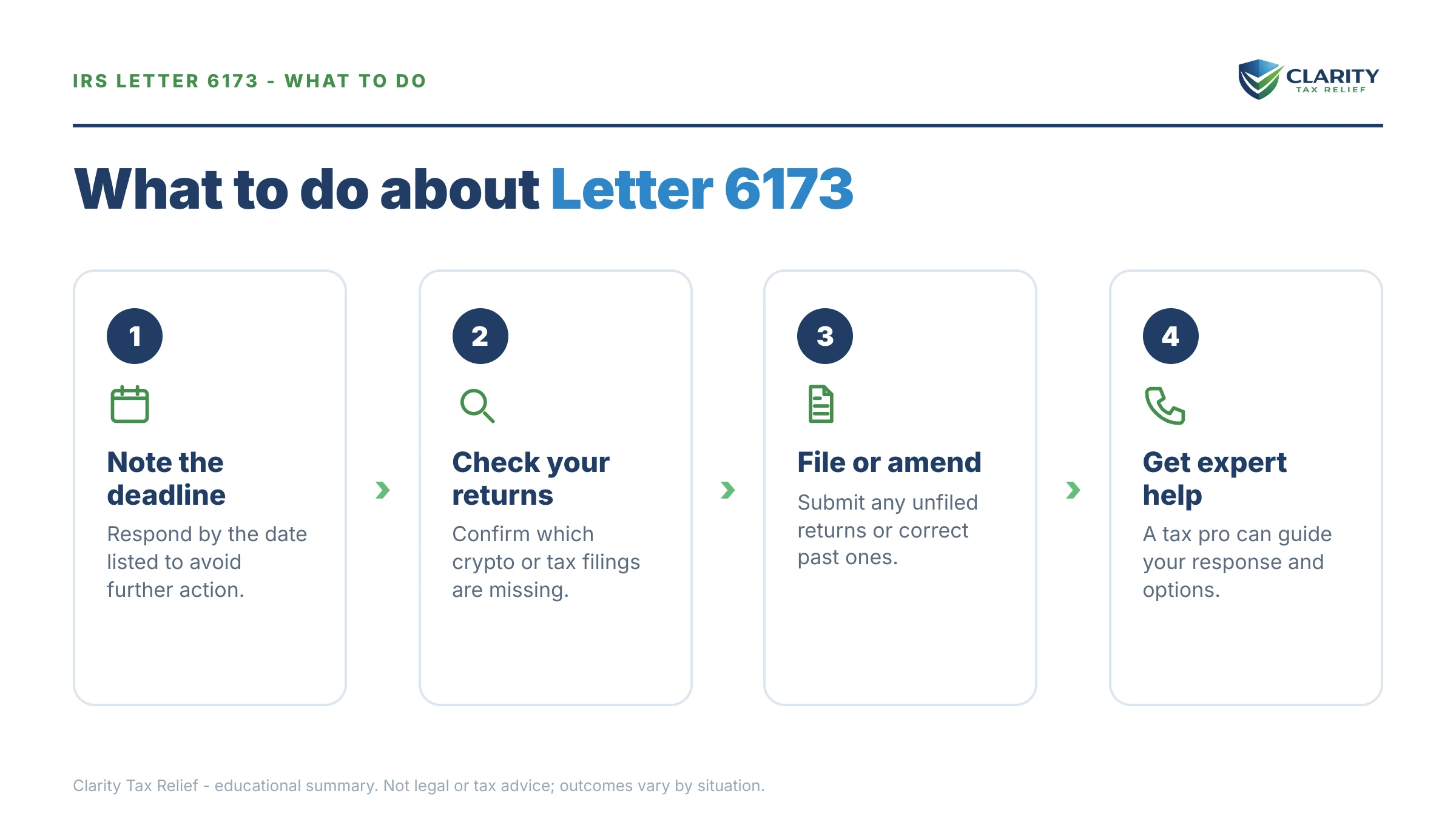
How to respond to Letter 6173, step by step
- Verify the letter. Confirm it's genuine — a real Letter 6173 arrives by U.S. mail, never by email or text, and never asks for gift cards, wire transfers, or payment apps.
- Pull your records. Download complete transaction histories from every exchange and wallet you used in the listed years, and gather the returns you filed plus your IRS wage and income transcripts.
- Run the numbers for every listed year. Calculate gains and losses on Form 8949 and Schedule D, and count mining, staking, and airdrop rewards as ordinary income.
- Prepare your response. File the delinquent returns, prepare Form 1040-X amendments, or draft the statement of facts signed under penalties of perjury — whichever path matches your situation.
- Mail it before the respond-by date. Send everything to the address on the letter by certified mail and keep copies of every page you send.
- Arrange payment for any balance. Pay at IRS.gov/payments if you can, or set up a payment plan before the balance-due notices start arriving.
When you can handle Letter 6173 yourself
Not every Letter 6173 needs professional help — and it's worth being honest about which is which. You can reasonably handle this yourself when you reported everything and can prove it: your filed returns show the crypto activity, your records are complete, and the compliance statement is simply the truth on paper. Same if the fix is one year, a handful of trades on one exchange, and clean cost-basis records — a single 1040-X and a payment plan you set up on the IRS payment plans page may close this out entirely.
Experienced help changes the outcome when the facts get heavier: multiple unreported years, six-figure proceeds, lost or incomplete records that require cost-basis reconstruction, joint-return years tangled up with an ex-spouse, activity on foreign or defunct exchanges, or any concern that the omission could look deliberate. In willful-looking cases, the right move may be the IRS's formal voluntary disclosure track rather than a bare amendment — a judgment call worth making with a professional before anything is mailed. And if a resulting balance creates hardship the normal channels can't resolve, the independent Taxpayer Advocate Service exists for exactly that.
Terms on your letter, decoded
- Penalties of perjury: a legal declaration that what you're signing is true — a false statement under it is a crime, not just a tax error.
- Virtual currency / digital asset: the IRS's terms for cryptocurrency, stablecoins, and NFTs — all treated as property, so disposals create gains or losses.
- John Doe summons: a court-approved demand forcing an exchange to hand over records on unnamed account holders — how the IRS got your data.
- Examination: the formal word for an audit — what the letter warns will happen if you don't respond.
- Cost basis: what you paid for the crypto you sold; without proof of it, the IRS can tax your gross proceeds as if they were nearly all gain.
- Accuracy-related penalty: the 20% penalty added to tax understatements from negligence or substantial understatement.
Letter 6173 questions, answered
Do I have to respond to IRS Letter 6173?
Yes. Letter 6173 is the only IRS virtual currency letter that requires a response — by the respond-by date printed on the letter. You must either file delinquent returns, file amended returns, or mail a statement signed under penalties of perjury explaining how you already complied. Its siblings, Letters 6174 and 6174-A, are educational and need no reply; 6173 is a direct demand.
Why did I get IRS Letter 6173?
The IRS obtained records showing you held or traded virtual currency — usually from a John Doe summons served on an exchange, or from information returns like 1099-K, 1099-MISC, or the newer Form 1099-DA — and those records don't line up with your filed returns for the years listed. Receiving the letter doesn't prove you owe anything; it means the IRS wants the mismatch explained or corrected.
What happens if I ignore Letter 6173?
The letter states that non-response can result in your account being referred for examination — a full audit of the listed years. In an audit, the IRS calculates your gains using the exchange data it already holds, often with little or no cost basis credited, then adds a 20% accuracy-related penalty and interest. Responding first keeps you in control of the numbers.
What is the difference between Letter 6173 and Letter 6174?
Letter 6173 requires a signed response by a printed deadline; Letters 6174 and 6174-A do not require any reply. All three tell you the IRS has virtual currency information about you, but 6173 signals the strongest data mismatch and carries the examination warning. If you received 6174 or 6174-A, review your returns and fix any errors — but only 6173 puts a response clock on you.
Can Letter 6173 lead to criminal charges?
For most people this stays a civil matter — correct the returns, pay or arrange payment, done. Two paths create criminal exposure: signing the compliance statement under penalties of perjury when you actually had unreported transactions, and unreported activity large or deliberate enough to look willful. If either could describe your situation, talk to an experienced tax professional before you send anything to the IRS.
Can I get more time to respond to Letter 6173?
You can call the phone number printed on the letter and ask for an extension of the respond-by date — but you have to ask before the date passes. Extensions buy weeks, not months, so use the time to gather exchange records and prepare returns, not to wait. If you need serious reconstruction work across several years, request the extension on day one.
What if I amend my returns and can't pay the balance?
File the amended returns anyway — the response deadline applies to the returns, not to full payment. Then set up a payment arrangement: a short-term plan gives up to 180 days at no setup fee, and installment agreements stretch payment over years. Balances over $50,000 require financial disclosure, and balances over $66,000 can trigger passport certification, so getting a plan in place quickly matters.
Do I have to respond if I only bought and held crypto?
Buying cryptocurrency with dollars and holding it isn't a taxable event, so you may genuinely be compliant. But Letter 6173 still requires a response: you'd use the statement option, explaining under penalties of perjury that you had no taxable transactions in the listed years, with documentation. Check carefully first — trading one coin for another, spending crypto, and earning staking or interest rewards all count as taxable events people commonly miss.
Your next 24 hours
- Find two things on page one of your Letter 6173: the respond-by date and the list of tax years. Write both down — they define the entire job.
- Gather your records: transaction-history exports from every exchange and wallet you used in those years, plus the tax returns you filed for them.
- Book your free case review — the 2-minute form at claritytaxrelief.com/#consult or (888) 825-7779 — before your respond-by date, so there's still time to prepare amended returns or the compliance statement properly instead of racing the deadline.
This guide is general information, not tax or legal advice for your specific situation. Eligibility for IRS programs depends on individual facts and circumstances; no outcome is guaranteed.