
Crypto & Back Taxes
Didn't Report Crypto Taxes? How to Fix It Before the IRS Does (2026)
The short answer: if you didn't report crypto taxes, fix it before the IRS's matching system does it for you. Starting with 2025 transactions, exchanges report your sales to the IRS on Form 1099-DA. Amend the affected years with Form 1040-X and Form 8949, then arrange payment — voluntary fixes cost far less than IRS-initiated ones.
You run payroll on time, your business returns are clean — but the exchange account you traded on nights and weekends never made it onto a Schedule D, and now you keep reading that exchanges report to the IRS. That instinct to fix it is right. Handled now, on your terms, this is an amendment and a payment plan. Handled later, on the IRS's terms, it's a bill computed as if you had no cost basis at all.
The image below shows exactly what the IRS's crypto paper trail looks like and where your numbers sit in it — worth a look before you decide anything, because it explains why waiting no longer works.
⏱ Your real clock: there's no letter deadline yet — but two clocks are already running. Interest compounds daily from each understated return's original due date, and the voluntary fixes in this guide work fully only before the IRS contacts you first. First contact closes doors; it never opens them.
How the IRS knows you didn't report crypto in 2026
Starting with the 2025 tax year, U.S. crypto exchanges must report customers' gross sale proceeds directly to the IRS on the new Form 1099-DA. The first wave of those forms went out in early 2026, and cost-basis reporting phases in behind it. For the first time, crypto sales feed the same automated document-matching engine that has caught unreported stock sales and 1099 income for decades.
The 1099-DA is the newest tool, not the only one. Before it, exchanges issued a patchwork of 1099-K, 1099-B, and 1099-MISC forms. The IRS has also used John Doe summonses to pull years of historical customer records from major platforms, including Coinbase and Kraken, and contracts with blockchain-analytics firms to trace on-chain activity back to identified wallets.
Then there's the question you may have already answered. The front of Form 1040 asks whether you received, sold, or disposed of digital assets. Checking "No" in a year you traded converts a reporting gap into a signed false statement — which is exactly what the IRS's crypto compliance letters, IRS Letter 6173 and IRS Letter 6174, are designed to probe. When the mismatch is purely numerical, it surfaces instead as a CP2000 notice proposing additional tax.
What counts as crypto income you had to report
Every crypto disposal — selling for dollars, trading one coin for another, or spending it — is a taxable event, because the IRS treats crypto as property. Coin-to-coin swaps are where most people slip: trading ETH for SOL is a sale of the ETH at fair market value, even though no dollars ever touched your bank account.
Gains are capital gains: short-term (held one year or less) at your ordinary rate, long-term at preferential rates. But several crypto events are ordinary income, not capital gain: mining rewards, staking income, airdrops, interest from lending platforms, and getting paid in crypto — all taxed at fair market value when received.
If you own a business, two more traps apply. Paying a contractor in crypto is 1099 income to them at fair market value — and a disposal by you, with its own gain or loss. Paying an employee in crypto is wages, subject to withholding and payroll deposits like any paycheck; skip that and you've created a second, more dangerous debt, because 941 back taxes carry personal liability that income tax doesn't.
Losses count too. A year you finished down still required a Form 8949 — and reporting it usually works in your favor, offsetting gains in other years.
What happens if you didn't report crypto taxes and do nothing
Unreported crypto usually surfaces as a CP2000 proposal calculated at zero cost basis — the IRS taxes your gross proceeds as if every dollar you sold were pure profit, because the exchange reported what you sold for, not what you paid. From there the sequence is automated:
- Silent matching. Form 1099-DA and older exchange data sit in IRS systems against your filed returns. No letter yet — but the mismatch is already flagged.
- Crypto compliance letters. Letter 6174 or 6174-A is a nudge requiring no reply; Letter 6173 demands a response signed under penalty of perjury. Either one means a human or algorithm has connected your name to unreported activity.
- CP2000 or examination. The IRS proposes tax on the full proceeds, typically stacking the 20% accuracy-related penalty on top.
- Statutory notice of deficiency. A 90-day letter follows if you don't respond. Miss that window and the proposed amount is assessed as legally owed.
- Collection. A CP14 bill arrives, then escalating notices, then lien filing and levy authority over bank accounts and wages.
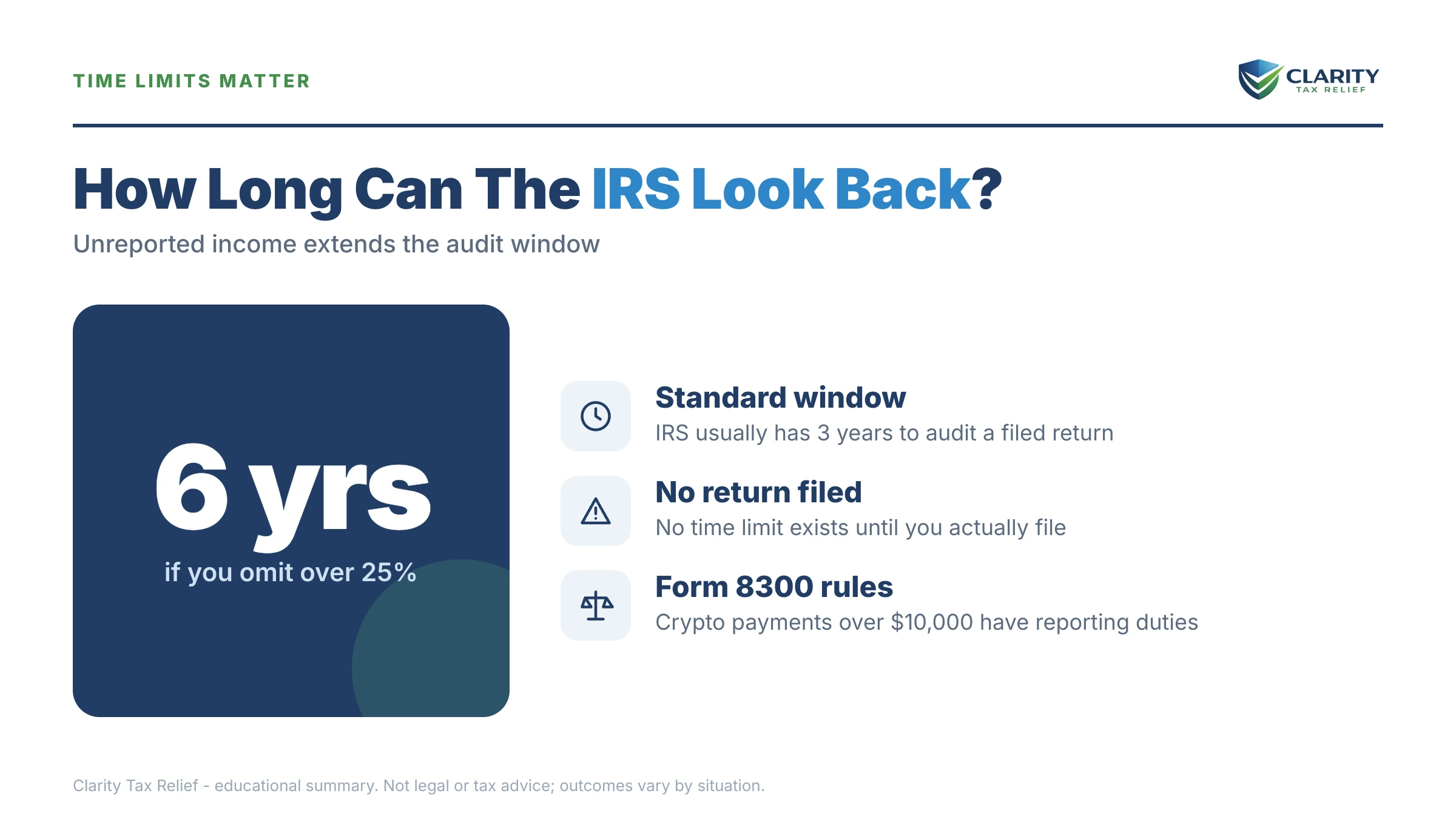
The statute of limitations rewards acting first. The IRS normally has 3 years from filing to assess more tax — but omitting more than 25% of your gross income stretches that to 6 years, and large crypto gains routinely cross that line. For fraud, or for a year you never filed at all, there is no time limit.
The penalty math compounds the longer you wait: the 20% accuracy-related penalty on the understatement, the 0.5%-per-month failure-to-pay penalty, and daily-compounding interest — and in willful cases the civil fraud penalty runs to 75% of the understatement. If a year was never filed, the failure-to-file penalty of 5% per month is ten times worse than failure-to-pay — though in months where both penalties apply, the failure-to-file portion drops to 4.5% (5% combined) — which is why filing always comes before worrying about payment. You can estimate what's already accrued on your balance with our IRS penalty and interest calculator.
Unreported crypto years hanging over you?
Get them reviewed free before the IRS's matching program bills you at zero basis. Every option in this guide works better while the fix is still voluntary — and interest is compounding daily either way.
Your options: how to disclose and how to pay
Fixing unreported crypto comes down to two questions: was the omission willful, and can you pay what you'll owe. For most people — you didn't understand coin-to-coin trades were taxable, or assumed the exchange handled it — the fix is straightforward: file Form 1040-X with a corrected Form 8949 and Schedule D for each open year. If you knowingly checked "No" on the digital-asset question or deliberately hid gains, slipping in amendments and hoping nobody notices is a quiet disclosure — a strategy that can backfire badly. Willful cases belong in the IRS Voluntary Disclosure Practice, which requires applying before the IRS contacts you.
Once the amendments set the real balance, payment works like any tax debt — the DIY mechanics live in our guide to how to settle tax debt yourself. Here's how each option maps to a crypto balance:
| Option | Best for | Key eligibility requirement |
|---|---|---|
| Amend + pay in full | You can cover the balance now | Always available; stops penalty and interest accrual fastest |
| Short-term payment plan | You can pay within 180 days | $0 setup fee; interest and penalties continue until paid |
| Streamlined installment agreement | Total balance ≤ $50,000 after amending | Up to 72 months online; ≤ $25,000 without direct debit, ≤ $50,000 with it |
| Installment agreement over $50,000 | Larger combined balances | Requires financial disclosure (Form 433 series); paying down below $50,000 first may avoid it |
| Currently Not Collectible | Any payment would cause hardship | Must document income and allowable expenses; debt remains and interest accrues |
| Offer in Compromise | Assets + future income genuinely can't cover the debt | $205 fee and 20% down on lump-sum offers (both waived with low-income certification); roughly 1 in 5 offers accepted in FY2024 |
| Voluntary Disclosure Practice | Willful non-reporting or false "No" answers | Must apply before IRS contact; professional guidance strongly advised |
| Option | Upfront cost | Typical timeline |
|---|---|---|
| Amend + pay in full | Tax, penalties, and interest at once | Amended returns take months to process; your balance stops growing on the payment date |
| Short-term plan (≤ 180 days) | $0 setup fee | Set up online in minutes; paid off within 180 days |
| Streamlined installment agreement | Setup fee varies (lower with direct debit; waived or reduced for low income) | Up to 72 months; interest and the 0.5%/month penalty continue |
| Offer in Compromise | $205 application fee + 20% of the offer for lump sum, unless low-income certified | Often a year or more; auto-accepted if the IRS doesn't decide within 2 years — with narrow exceptions: a returned or rejected offer stops the clock, and time during court disputes does not count |
| Currently Not Collectible | $0 | Reviewed periodically; collection resumes if your finances improve |
A worked example: $54,600 of unreported crypto tax
Say you own a small business and, in 2024, sold crypto for $210,000 in proceeds against $60,000 of cost basis — a $150,000 gain you never reported, most of it short-term. Amended properly, the numbers might look like this (hypothetical, for illustration):
- Additional tax on the $150,000 gain at your blended short/long-term rates: roughly $42,000
- 20% accuracy-related penalty: $42,000 × 0.20 = $8,400
- Interest accrued by mid-2026: call it about $4,200
- Total: ≈ $54,600
Now compare the do-nothing path. A CP2000 built from the exchange's 1099 data would propose tax on the full $210,000 at zero basis — inflating the proposed tax by tens of thousands before you prove what you paid, with the penalty calculated on the inflated figure.
On payment: $54,600 sits just above the $50,000 online-plan ceiling. Pay $4,700 up front to bring the balance to $49,900, and a 72-month direct-debit streamlined agreement becomes available online — roughly $693/month before the interest that continues to accrue, with no financial-disclosure forms required. One more persona-specific rule: never fund that paydown from payroll tax deposits. Trust-fund payroll debt creates personal liability and is treated far more harshly than income tax; if you're juggling both, our guide to 941 vs 940 back taxes explains which dollars are untouchable.
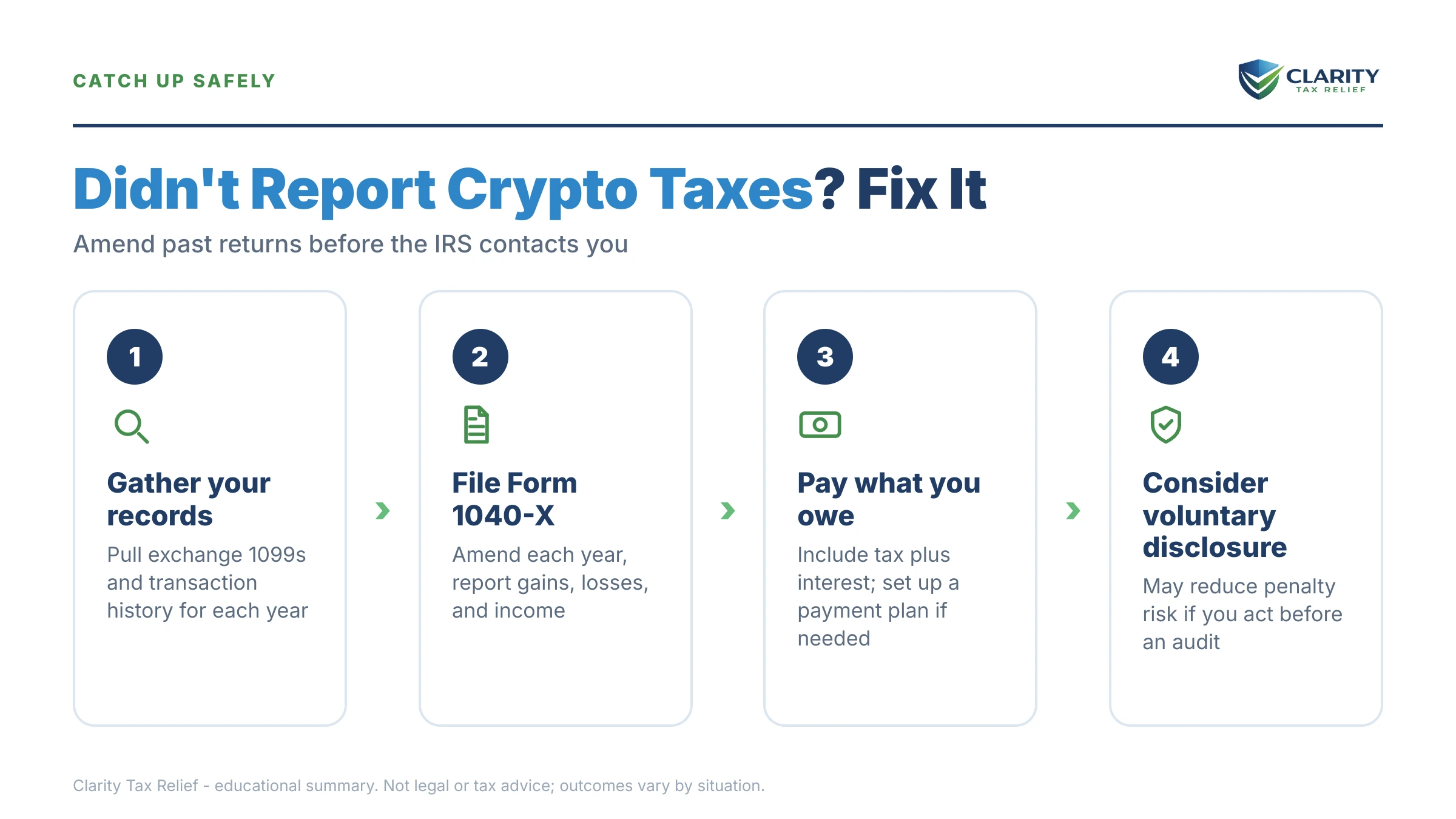
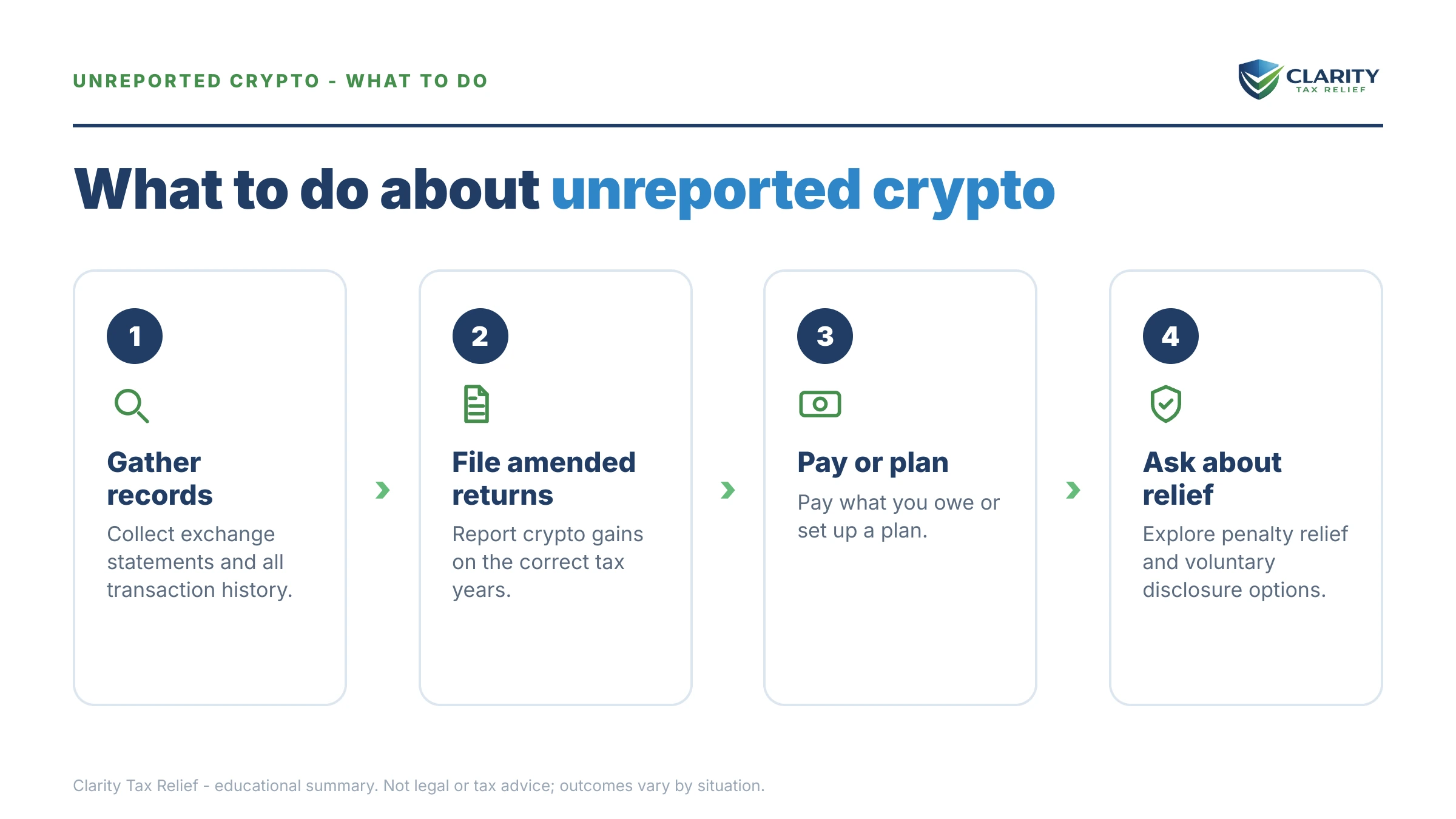
How to fix unreported crypto taxes, step by step
- Pull your records. Export the full transaction history (CSV) from every exchange and wallet you used — including closed accounts — for each unreported year.
- Reconstruct your cost basis. Use crypto tax software or a professional to match every disposal to what you originally paid, including coin-to-coin trades and transfers between your own wallets.
- Amend each affected year. File Form 1040-X with a corrected Form 8949 and Schedule D for every open year with unreported activity, and report ordinary income like staking or mining where it belongs.
- Pay what you can now. Send as much as possible with each amendment — every dollar paid stops the 0.5% monthly failure-to-pay penalty and daily interest on that amount.
- Arrange payment for the rest. Set up a short-term plan, installment agreement, or other resolution before the IRS bills you, so the account never reaches enforced collection.
- Get a professional review if willfulness is in play. If you answered "No" to the digital-asset question in a trading year, or have multiple large unreported years, have an experienced tax professional assess voluntary-disclosure options before you file anything.
When you can handle unreported crypto yourself
Plenty of unreported-crypto situations don't need professional help. If you traded on one U.S. exchange, one or two years are affected, the CSV export is complete, you answered the digital-asset question honestly (or it was left blank on an older return), and you can pay in full or fit a streamlined plan — amend it yourself and move on. The IRS's own primer at IRS.gov digital assets covers the reporting mechanics.
Experienced help changes outcomes in specific situations: multiple years with six-figure volume, DeFi, wallet-to-wallet transfers, or heavy coin-to-coin activity that needs full reconstruction (see crypto trader back taxes); a "No" answer you knew was wrong; accounts on foreign platforms with possible offshore crypto reporting exposure; a balance you genuinely can't pay, where Offer in Compromise math needs to be run before you commit; or a business where crypto debt is colliding with payroll obligations. For the full landscape of professional options, start with our crypto tax debt help guide.
Terms on your crypto paperwork, decoded
- Cost basis — what you originally paid for a coin, including fees; the number that turns gross proceeds into your actual (smaller) taxable gain.
- Disposal — any event that gives up a crypto asset: selling, swapping coin-to-coin, or spending it. Each one is separately taxable.
- Form 1099-DA — the digital-asset broker form, first issued for 2025 transactions, that reports your sale proceeds to the IRS.
- Underreporter (AUR) / CP2000 — the automated program that compares third-party forms against your return and proposes tax on any gap; the IRS explains the notice at Understanding your CP2000 notice.
- Quiet disclosure — amending willful years without flagging them, hoping to avoid scrutiny; a red-flag strategy that can worsen penalties.
- Willfulness — the legal line between a mistake (civil penalties) and evasion (criminal exposure); knowing what the law required and choosing not to comply.
Whatever path you choose, the payment mechanics run through the official IRS payment plans page — never a third-party site asking for gift cards or wire transfers.
Didn't report crypto? Common questions, answered
Will the IRS know if I didn't report my crypto?
Almost certainly, yes — it is now a matter of when, not if. Starting with 2025 transactions, U.S. exchanges must report your gross sale proceeds to the IRS on Form 1099-DA, and the IRS has also obtained years of historical customer records from major exchanges through John Doe summonses. Matching that data against your returns is automated, so a blank Schedule D in a trading year stands out.
Can I go to jail for not reporting crypto?
Jail is reserved for willful tax evasion, not honest mistakes — the vast majority of unreported-crypto cases are resolved civilly with tax, penalties, and interest. The biggest criminal-exposure mistake is answering "No" to the digital-asset question on Form 1040 in a year you traded, because that is a signed false statement. If you checked "No" knowingly, talk to an experienced tax professional about the IRS Voluntary Disclosure Practice before amending anything.
How many years back do I need to fix?
Start with every open year. The IRS normally has 3 years from filing to assess more tax, but that stretches to 6 years if you omitted more than 25% of your gross income — which large crypto gains often do — and there is no time limit at all for fraud or for years you never filed. Most people end up amending the last 3 to 6 years, depending on the size of the omission.
Do I have to report crypto if I lost money?
Yes — every disposal goes on Form 8949 whether it produced a gain or a loss. The good news is that reporting losses usually helps you: capital losses offset your gains, and up to $3,000 of net loss can be deducted against ordinary income each year, with the rest carried forward. Some people who amend loss years actually reduce their overall balance.
Should I amend or wait for a CP2000?
Amend first, almost always. A CP2000 is built from the gross proceeds the exchange reported — with no cost basis — so the IRS's proposed tax is calculated as if every dollar you sold were pure profit. Filing an accurate Form 1040-X with Form 8949 puts your real basis on record and typically produces a far smaller bill, and voluntary correction also strengthens any penalty-relief request.
What penalties apply to unreported crypto?
Expect three additions: the 20% accuracy-related penalty on the understated tax, the failure-to-pay penalty of 0.5% per month on the unpaid balance, and interest that compounds daily from each return's original due date. In willful cases the civil fraud penalty can reach 75% of the understatement. Penalty relief such as first-time abatement or reasonable cause may remove part of this — the tax and interest, though, generally stay.
What if my crypto is on a foreign exchange?
You may have information-reporting exposure on top of the income issue. The rules on whether crypto-only foreign accounts trigger FBAR and Form 8938 filings are still developing, and foreign accounts that also held fiat currency can clearly cross the reporting thresholds. Because those penalties are separate from — and often larger than — the tax itself, get a professional review before disclosing anything. Our guide to offshore crypto reporting covers the details.
Your next 24 hours
- Make the inventory. List every exchange, app, and wallet you've used since your first unreported year and confirm you can still log into each — that list determines how many years you're fixing.
- Gather the paper. Pull the tax returns for those years, export the full CSV history from each platform, and collect any record of what you originally paid — even bank statements showing deposits to the exchange help.
- Get a free case review. Call (888) 825-7779 or use the 2-minute form. An experienced tax professional will map which years need amending and which payment path fits — before the IRS makes first contact, while every voluntary option is still on the table and interest compounds daily either way.
This guide is general information, not tax or legal advice for your specific situation. Eligibility for IRS programs depends on individual facts and circumstances; no outcome is guaranteed.