
Crypto & Digital Assets
NFT Taxes Owed: What to Do When You Can't Pay the IRS (2026)
The short answer: if you have NFT taxes owed that you can't pay, the debt is real even though the crypto crashed afterward — your gain locked in on the day of each sale. Your options: payment plans up to 72 months on balances under $50,000, hardship status, penalty relief, or a means-tested Offer in Compromise.
You flipped NFTs during a hot stretch, the profits sat in ETH, and by the time the return got filed the wallet was worth a fraction of the gain the IRS is taxing. Now you and your spouse are staring at a balance you can't cover with money that no longer exists.
Here's the part that matters: this is a solvable collection problem, not a permanent hole. The IRS has structured programs for exactly this situation — and the earlier you pick one, the less the accruals cost you.
⏱ Your real clock: there's no single due date on NFT tax debt — the clock is the accrual. The failure-to-pay penalty adds 0.5% of the balance every month, and interest compounds daily on top. If an IRS notice is already in your hand, the date printed on that notice controls; act before it.
Why you owe NFT taxes you can't pay
NFTs are property for tax purposes, so every sale, swap, and even the crypto you spent to buy one can create taxable gain. That's why NFT tax bills routinely surprise people — a single flip often triggers two taxable events, not one: the gain on the NFT you sold, plus the gain on the appreciated ETH you originally used to buy it.
Three traps produce most of the "how do I owe this much?" balances:
- The gain locked in at sale. If you sold an NFT for 12 ETH when ETH was high, your gain is measured in dollars that day. The tax doesn't shrink when ETH falls 60% before April.
- Paying in crypto stacked a second gain. Buying an NFT with ETH you'd held since it was cheap is a disposal of that ETH — taxable gain on the payment itself.
- The rate was higher than you budgeted. Short-term flips are taxed at ordinary income rates. And in Notice 2023-27, the IRS said it intends to treat certain NFTs as collectibles under a look-through test — meaning some long-term NFT gains can be taxed at up to 28% instead of the usual 20% cap. Creators who minted and sold their own work owe ordinary income tax plus self-employment tax on top.
Here's how each type of NFT activity actually gets taxed — this table is where most surprise balances come from:
| What you did | How it's taxed | Where it's reported |
|---|---|---|
| Sold an NFT held ≤ 1 year | Short-term capital gain at ordinary income rates | Form 8949 / Schedule D |
| Sold an NFT held > 1 year | Long-term gain — up to 28% if treated as a collectible (Notice 2023-27) | Form 8949 / Schedule D |
| Bought an NFT with appreciated crypto | Taxable disposal of the crypto you spent — a second gain | Form 8949 / Schedule D |
| Traded one NFT for another | Taxable disposal of the NFT you gave up, at fair market value | Form 8949 / Schedule D |
| Minted and sold your own NFTs | Ordinary income plus self-employment tax | Schedule C / Schedule SE |
| Royalties on secondary sales (creators) | Ordinary income as it's received | Schedule C (for active creators) |
| Received an NFT airdrop | Generally ordinary income at fair market value when received | Ordinary income on your return |
One more trap specific to NFTs: a dead floor price is not a deductible loss. You generally can't write off a worthless NFT until you actually dispose of it in a closed transaction — and even then, the loss lands in the year of disposal and can't reach back to erase the year you owe for.
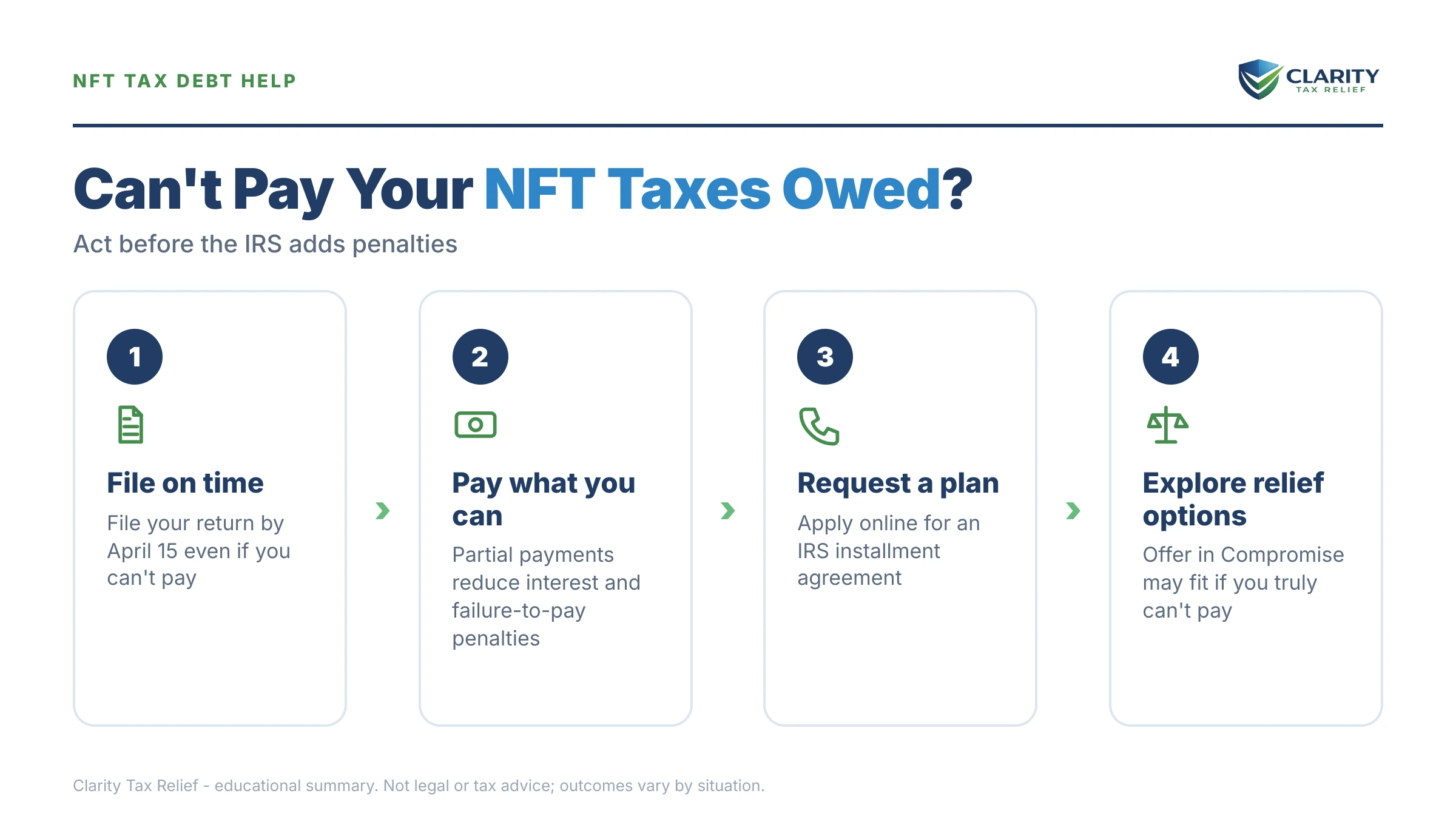
What the IRS can see about your NFT trades in 2026
Digital-asset brokers began reporting sales to the IRS on Form 1099-DA for transactions starting in 2025 — so NFT and crypto disposals now feed directly into IRS matching systems. Marketplace payouts through payment processors can also generate a 1099-K at the $20,000 / 200-transaction threshold, and every Form 1040 asks the digital-asset question under penalty of perjury.
The IRS has used blockchain analytics for years and has mailed compliance letters — see our guide to IRS Letter 6173 — to taxpayers with known wallet activity. If you never reported your sales at all, start with our guide to what to do when you didn't report crypto: correcting it voluntarily is treated far better than waiting for a mismatch notice.
There's a hidden upside in broker reporting: forms report proceeds, not your cost basis. When the IRS computes a balance from a CP2000 notice using zero basis, the assessed amount is often far larger than what you truly owe — which means correcting basis can shrink the debt itself before you ever negotiate payment.
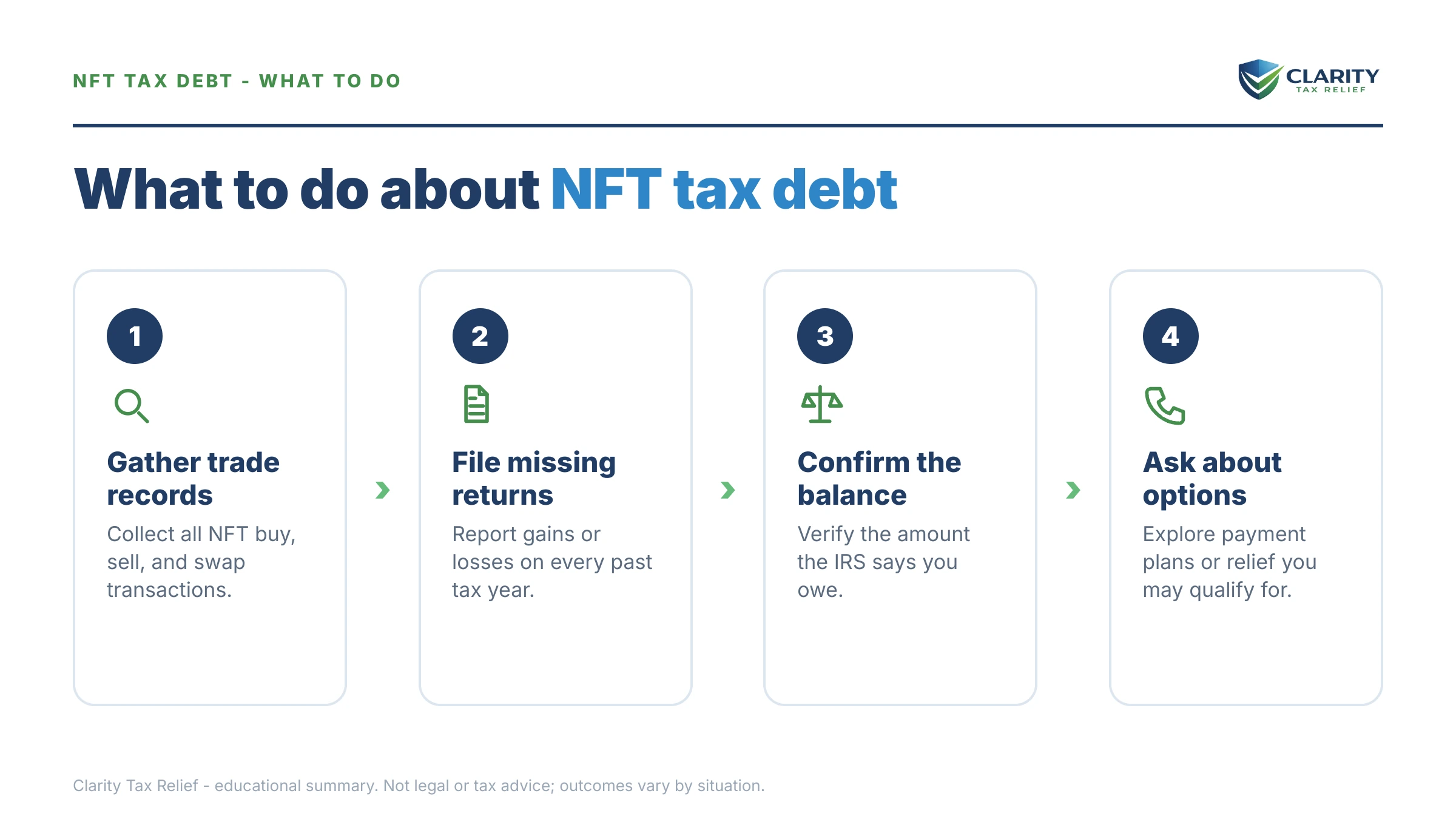
What happens if you ignore NFT tax debt
An unpaid NFT tax balance moves through the same automated collection sequence as any IRS debt — and in 2026, with the IRS workforce cut roughly 27% in 2025, the humans are harder to reach but the automated notices and levies never stopped. The sequence runs in order:
- Balance assessed — from your filed return, or from an IRS-built number after a CP2000 mismatch. Penalties and interest start immediately.
- CP14 — the first bill, with roughly 21 days to pay or arrange something before escalation.
- CP501 / CP503 — reminder notices while the balance grows monthly.
- CP504 — intent to levy your state tax refund under IRC §6331(d); a federal tax lien becomes a live risk.
- LT11 / Letter 1058 — the final notice. A 30-day clock starts on your Collection Due Process rights (Form 12153). After it runs, the IRS can levy bank accounts (funds are held 21 days before they leave) and garnish wages continuously until released.
Two escalations hit NFT traders specifically. First, a levy can reach the exchange or custodial account where your remaining crypto sits. Second, if the combined debt grows past $66,000 (the 2026 threshold), the IRS can certify it to the State Department and block your passport renewal.
| Notice | Your window | What's at stake |
|---|---|---|
| CP2000 (unreported NFT sales) | The response date printed on the notice — typically about 30 days | Your chance to supply real cost basis before a zero-basis balance is assessed |
| CP14 (first bill) | Roughly 21 days from the notice date | The cheapest moment to set up a plan — no enforcement yet |
| CP504 (intent to levy) | The date printed on the notice | State tax refund can be seized; lien filing becomes likely |
| LT11 / Letter 1058 (final notice) | 30 days | Collection Due Process rights via Form 12153 — the last formal stop before bank and wage levies |
Holding an NFT tax bill you can't pay?
Every month adds another 0.5% penalty plus daily interest to your balance. Get your NFT gain math and resolution options reviewed free by an experienced tax professional — before the notice sequence escalates.
NFT taxes owed: your realistic resolution options
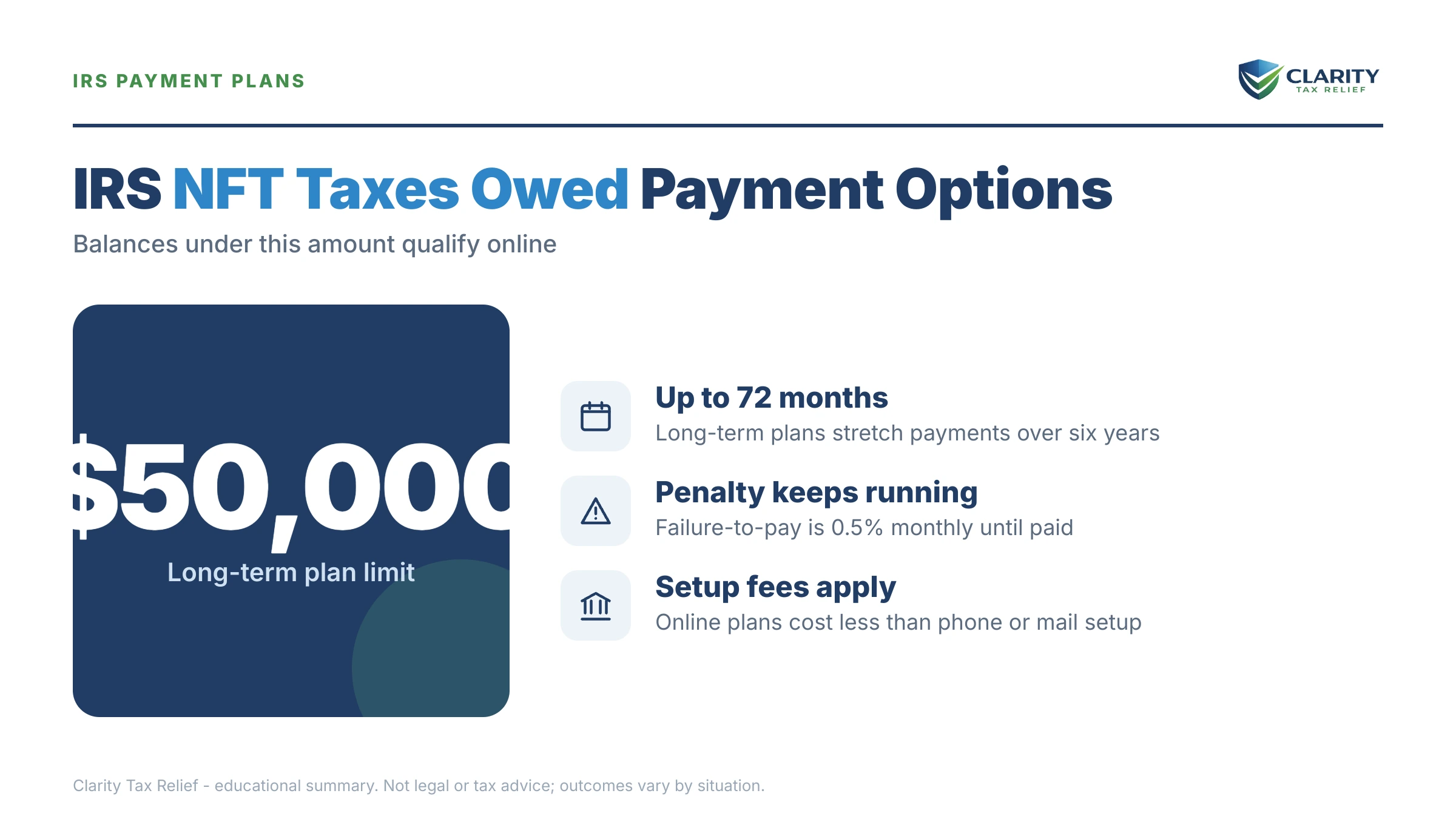
The IRS has five main paths for a balance you can't pay in full, and eligibility is set by dollar thresholds and financial math — not by how you feel about the debt. For the full DIY playbook on each program, see our pillar guide on how to settle tax debt yourself; here's how they map to a typical NFT balance:
| Option | Who typically qualifies | Cost & key notes |
|---|---|---|
| Short-term payment plan | Can pay in full within 180 days | $0 setup; interest and penalties still accrue |
| Streamlined installment agreement | Balance ≤ $50,000; up to 72 months, set up online | Setup fee applies; failure-to-pay penalty drops to 0.25%/month on an approved plan |
| Guaranteed installment agreement | Balance ≤ $10,000 with clean compliance | Official IRS program name; minimal financial disclosure |
| Currently Not Collectible | Allowable living expenses meet or exceed income | Collection pauses; the debt remains and keeps accruing |
| Offer in Compromise | Assets + future income genuinely can't cover the balance | $205 fee; 20% down on lump-sum offers; ~1 in 5 accepted in FY2024; low-income certification waives fee and down payment |
| Penalty relief (FTA / AEP) | Clean prior 3 years (FTA); AEP arrives automatically starting summer 2026 | Free to request; removes penalties, not tax or interest |
| Corrected or amended return | Basis was missing, zero, or wrong on the assessed year | Shrinks the debt itself — often the biggest lever on NFT balances |
| Bankruptcy | Income-tax debt meeting the age and filing tests | Last-resort tool; rules differ sharply by chapter |
A few of these deserve NFT-specific notes:
- Fix the number before you finance it. If your NFT gains were assessed with missing basis, double-counted swaps, or the wrong rate, our guide to how to amend a return to reduce tax debt walks through cutting the balance itself. Never set up a 72-month plan on a number that's wrong.
- A streamlined installment agreement is the workhorse for balances under $50,000 — no detailed financial disclosure, set up online, and the monthly failure-to-pay penalty is cut in half while it's active.
- Currently Not Collectible status fits when the boom income is gone and today's budget genuinely has nothing left after allowable expenses. Levies stop; the balance doesn't.
- The Offer in Compromise is math, not mercy. One caution: remaining NFTs and wallet balances count as assets in the IRS's calculation — you can't offer $5,000 while holding a wallet the IRS values at $30,000.
- Penalty relief stacks with everything above. If your prior three years were clean, first-time penalty abatement can strip penalties from the first bad year — and the new Automatic Exemption from Penalty (AEP) starts applying automatically in summer 2026, no request needed.
- Bankruptcy is a real but narrow tool for older income-tax debt. If the balance is several years old and large, compare Chapter 7 vs 13 for tax debt before assuming it's off the table.
A worked example: married, filing jointly, $41,800 in NFT tax debt
Say you and your spouse filed jointly and owe $41,800 from a year of NFT flips — and because the return was joint, the IRS can collect the whole amount from either of you, regardless of who did the trading. Here's the math on each path (all figures hypothetical and rounded):
- Doing nothing: the failure-to-pay penalty runs 0.5% × $41,800 = about $209 every month — roughly $2,500 a year — plus interest compounding daily at the federal short-term rate plus 3 points. You can estimate your own accruals with our Penalty & Interest Calculator.
- Streamlined installment agreement: $41,800 is under the $50,000 line, so you can set up to 72 months online — about $581/month before accruals. On an approved plan the monthly penalty drops to 0.25% (~$105 at the start), and paying it off in 36 months (~$1,161/month) cuts total interest roughly in half versus the full term.
- Offer in Compromise check: suppose your joint income is $6,800/month against $6,200 in IRS-allowable expenses — $600/month of collection potential. Roughly a year of that surplus (~$7,200) plus, say, $30,000 of home equity and a $9,000 wallet puts your reasonable collection potential near $46,200 — more than the $41,800 owed, so an offer would very likely be rejected. This is why most working couples with equity resolve through a payment plan, not a settlement.
- Penalty relief: if your prior three years were clean, first-time abatement on a couple thousand dollars of accrued penalties comes off the top — free to request, and it stacks with the payment plan.
One persona-specific note: switching to married-filing-separately next year protects future refunds from a spouse's separate debts, but it does nothing to undo joint liability on the year you already filed together.
How to respond to NFT tax debt, step by step
- Pull your records — download your IRS account transcript and wage & income transcript, then export complete transaction histories from every marketplace, exchange, and wallet you used.
- Verify the balance — recalculate each disposal with real cost basis and holding periods; if the IRS or your original return used zero or wrong basis, the balance may be overstated.
- File anything unfiled — the failure-to-file penalty (5% per month) is ten times the failure-to-pay penalty (0.5% per month), so file every missing return even if you can't pay a dime.
- Correct an overstated year — if your gains were misreported, amend with Form 1040-X to shrink the assessment itself before you negotiate how to pay it.
- Set up a resolution — choose the option your finances support — short-term plan, installment agreement, hardship status, or a means-tested offer — and put it in place before the notice sequence escalates.
- Request penalty relief — ask for First-Time Abatement if your prior three years are clean, and watch for the Automatic Exemption from Penalty rolling out in summer 2026.
When you can handle this yourself — and when help changes the outcome
Plenty of NFT tax debts don't need professional help. If you agree with the number, the balance is under $50,000, and your transaction history is a handful of clean sales on one marketplace, setting up a streamlined plan online takes about twenty minutes — do it yourself and keep your money.
Experienced help changes outcomes in four situations: hundreds of disposals across wallets and chains that need basis reconstruction (that recalculation alone often cuts the balance), an IRS-built assessment using zero basis, multiple unfiled years layered under the debt, or a levy already in motion against your bank or exchange account. High-frequency traders should start with our companion guide to crypto trader back taxes — the reconstruction problem is the same, at larger scale.
Terms on your NFT tax bill, decoded
- Disposal: any event where you give up an asset — a sale, a swap, or spending crypto — that triggers gain or loss.
- Cost basis: what you paid for the asset, in dollars, at the time you acquired it; gain is proceeds minus basis.
- Collectible gain: long-term gain on assets like art — taxed at up to 28%; the IRS applies a look-through test to decide if an NFT counts.
- Form 1099-DA: the digital-asset broker form reporting your sale proceeds to the IRS, starting with 2025 transactions.
- Joint and several liability: on a joint return, the IRS can collect the entire balance from either spouse.
- CSED: the Collection Statute Expiration Date — generally 10 years from assessment, pausable by offers, appeals, and bankruptcy.
NFT tax debt questions, answered
Do I still owe NFT taxes if my crypto crashed after I sold?
Yes. Your gain was measured in dollars on the day of each sale, and the tax on it doesn't shrink because the ETH you received lost value afterward. A later crash can create a capital loss — but only in the year you actually dispose of the crashed asset, and a net capital loss offsets only $3,000 of ordinary income per year. The original bill stands until it's paid or resolved through an IRS program.
Are NFT gains taxed at the 28% collectibles rate?
Sometimes. In Notice 2023-27 the IRS said it intends to treat certain NFTs as collectibles using a look-through test — if the NFT represents a collectible like art, the NFT is taxed like one. That matters only for long-term gains, where the collectibles rate can run up to 28% instead of the usual 20% top capital-gains rate. Short-term flips are taxed at ordinary rates either way.
Does the IRS actually know about my NFT trades?
Increasingly, yes. Digital-asset brokers began reporting sales on Form 1099-DA for transactions starting in 2025, marketplace payouts can generate a 1099-K at the $20,000 / 200-transaction threshold, and every Form 1040 asks the digital-asset question under penalty of perjury. The IRS also uses blockchain analytics and has sent compliance letters like Letter 6173 to taxpayers with known wallet activity. Assume visibility, not anonymity.
What if I never reported my NFT sales at all?
File or amend before the IRS contacts you — voluntary correction is treated far better than waiting for a CP2000 underreporter notice. If the IRS builds the number itself from broker forms, it often uses zero cost basis, which inflates the balance well past what you truly owe. Reconstruct your purchase records, report the real gain, and then set up a resolution for whatever balance remains.
Can I write off worthless NFTs against what I owe?
Not just because the floor price hit zero — a loss generally isn't deductible until you actually dispose of the NFT in a sale or other closed transaction. Even then, the loss lands in the year of disposal, not the year of your original gain, so it can't retroactively erase a prior year's bill. Capital losses offset capital gains first, then up to $3,000 of ordinary income per year, with the rest carried forward.
My spouse did all the NFT trading — am I still liable?
If you signed a joint return, yes — joint filing creates joint and several liability, meaning the IRS can collect the entire balance from either spouse. Filing separately in future years protects future refunds but does not undo liability on years already filed jointly. Innocent spouse relief exists but is narrow; it generally requires understatements you didn't know about and had no reason to know about, not simply a debt you regret.
Can NFT tax debt be settled with an Offer in Compromise?
Only if the math works — an OIC is means-tested, not negotiated on hardship stories. The IRS accepted roughly 1 in 5 offers in FY2024, and acceptance requires showing your assets plus future income can't cover the balance before the collection statute runs. The application costs $205 with 20% down on lump-sum offers, though low-income certification (AGI at or below 250% of the poverty line) waives both.
Does NFT tax debt ever expire?
The IRS generally has 10 years from the date of assessment to collect — the Collection Statute Expiration Date, or CSED. But the clock pauses (tolls) during a pending Offer in Compromise, bankruptcy, certain appeals, and other events, so the real date is often later than ten calendar years. Waiting out the statute is rarely a plan; levies and liens can arrive long before it expires.
Your next 24 hours
- Find your exact balance. Log into your IRS online account (or check the amount box on any notice you've received) so you're planning around the real number — with penalties and interest — not the number from April.
- Gather your records. Last year's return, any IRS notices, and complete transaction exports from every marketplace, exchange, and wallet you touched — basis reconstruction starts here.
- Get the free case review. An experienced tax professional will check whether your NFT gain math is even right, then map the resolution your finances support — while the balance is still growing 0.5% a month plus daily interest, not after a levy notice arrives. Call (888) 825-7779 or use the 2-minute form.
For the IRS's own rules on digital-asset reporting, see the IRS digital assets page. Payment plan terms are on the IRS payment plans page, and all payment methods are at IRS.gov/payments.
This guide is general information, not tax or legal advice for your specific situation. Eligibility for IRS programs depends on individual facts and circumstances; no outcome is guaranteed.