
Business Tax Debt
Dissolve a Business That Owes the IRS Payroll Taxes: The 2026 Wind-Down Sequence
The short answer: you can dissolve a business that owes the IRS, but dissolution does not erase payroll tax debt. The trust-fund portion — withheld income tax plus the employees' share of FICA — can be assessed against you personally through the Trust Fund Recovery Penalty. The order you wind down in decides how much follows you.
You're ready to be done. The doors are closed, the last employee is gone, and you're living on Social Security — but the business still owes back 941 taxes, and now you're staring at dissolution paperwork wondering whether filing it buries the debt or hands it to you personally. The honest answer: it depends almost entirely on the sequence you follow over the next few weeks, and that sequence is completely within your control.
When you dissolve a business that owes the IRS payroll taxes, the debt splits in two — a part that generally dies with the entity, and a trust-fund part the IRS can chase you for personally, forever within its collection window. This guide walks the exact wind-down order that keeps the second number as small as legally possible.
⏱ The real clocks here: there is no fixed deadline for dissolving, but two clocks run anyway. Failure-to-pay penalties and interest accrue on the payroll balance every month it sits unresolved. And if IRS Letter 1153 arrives proposing the Trust Fund Recovery Penalty against you personally, you have 60 days to file a protest — miss it, and the penalty is assessed against you.
Why dissolving the business doesn't erase payroll tax debt
Dissolving a business ends the legal entity — it does not end the trust-fund portion of its payroll tax debt. Every 941 balance is really two debts stacked together, and the IRS treats them completely differently once the business is gone.
The trust-fund portion is money that was never the business's to begin with: federal income tax withheld from paychecks, plus the employees' half of Social Security and Medicare. Because the business held it in trust for the government, IRC §6672 lets the IRS assess 100% of the trust-fund portion against every "responsible person" who willfully paid other bills instead — through the Trust Fund Recovery Penalty. Dissolution doesn't touch this. It simply removes the entity as a collection target and points the IRS at the people.
The non-trust-fund portion — the employer's own share of FICA, the FUTA tax on Form 940, and the entity's penalties and interest — is generally collectible only from the entity. Once the entity is dissolved and has no assets, that portion usually becomes uncollectible. The word "usually" matters: if you distribute business assets to yourself before paying the IRS, the government can pursue transferee liability and follow those assets into your hands — potentially for the whole balance, not just the trust-fund part.
Entity type changes the starting point. If you operated as a sole proprietorship or single-member LLC, the payroll debt was personal from day one — dissolution changes nothing, a scenario covered in sole proprietor payroll tax debt. If you ran a corporation or multi-member LLC, the split above applies, and the question of who counts as a responsible person — owner, officer, bookkeeper, check-signer — is covered in depth in personally liable payroll taxes. The broader rules for a company that no longer exists are in payroll tax debt when the business has closed.
One more distinction before the numbers: if the business also owes state trust-fund taxes — sales tax it collected or state withholding — the state runs its own personal-liability process on its own timeline, separate from anything the IRS does. See closed business owe sales tax for that side of the ledger.
| Debt component | Share of a $61,200 balance | After dissolution |
|---|---|---|
| Trust-fund taxes (withheld income tax + employees' FICA) | $38,700 | Survives — assessable against every responsible person via the TFRP |
| Employer's share of FICA | $13,400 | Entity-only — generally uncollectible once the entity has no assets, unless assets were distributed to owners |
| Entity penalties and interest on the 941s | $9,100 | Entity-only — but interest starts accruing separately on any TFRP later assessed against you |
What happens if you dissolve and walk away
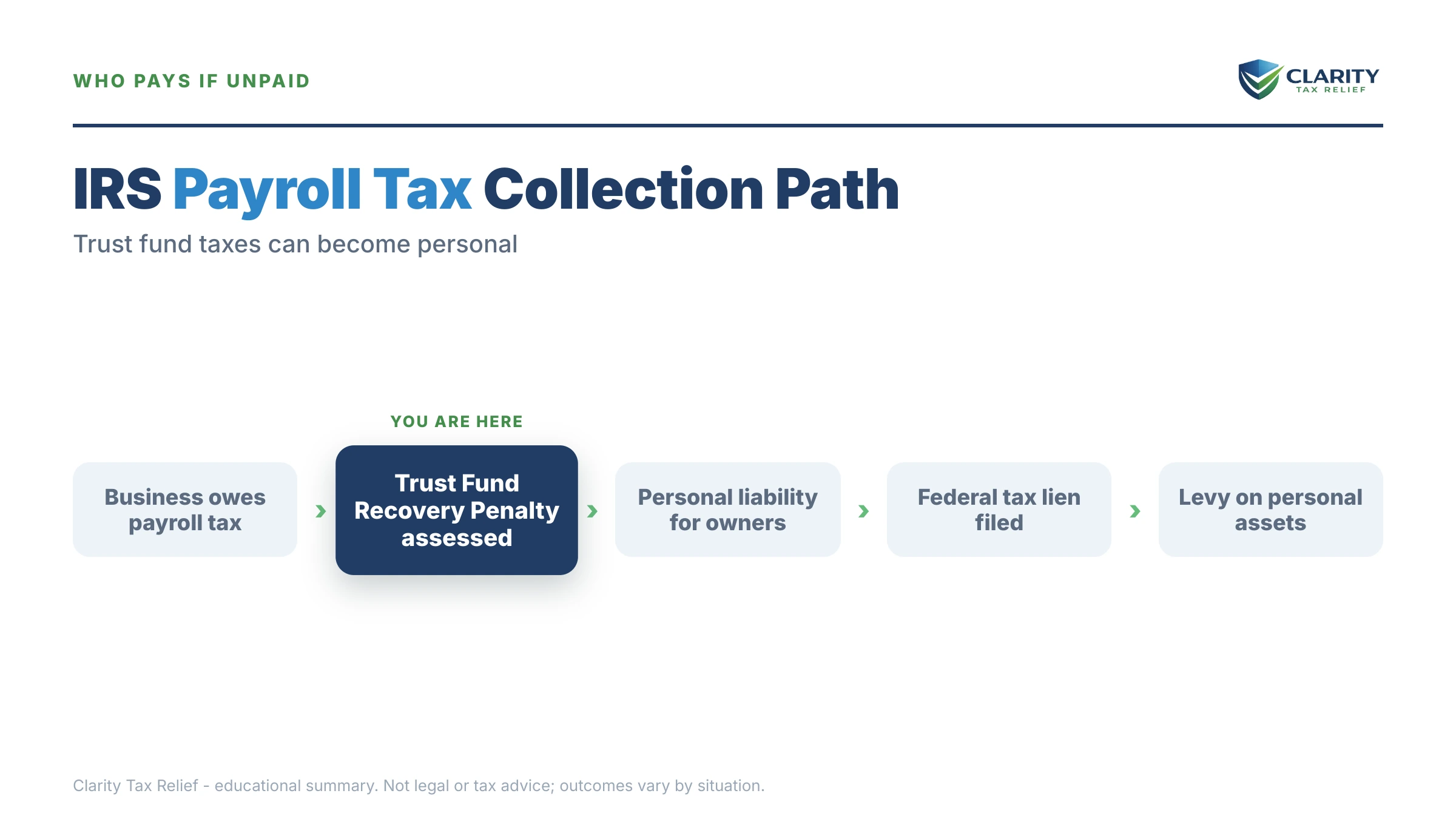
When a business dissolves with unpaid 941 taxes, the IRS shifts collection from the dead entity to the living people behind it. The stages run in a fixed order, and each one narrows your options:
- Entity notices continue. Balance-due and intent-to-levy notices keep arriving addressed to the business — dissolution doesn't stop the mail, and the balance keeps growing with monthly penalties and interest.
- The TFRP investigation opens. A revenue officer identifies everyone who could be a responsible person and schedules Form 4180 interviews — asking who signed checks, who decided which bills got paid, and who knew the taxes weren't being deposited.
- Letter 1153 proposes the penalty against you. The Letter 1153 states the trust-fund amount the IRS intends to assess against you personally. You have 60 days to protest. Silence equals assessment.
- The TFRP is assessed — and becomes your personal tax debt. The IRS can assess the full trust-fund amount against each responsible person, jointly and severally, and a fresh 10-year collection statute starts from that assessment date. You can estimate when an assessed balance would expire with our CSED Calculator.
- Personal collection begins. Federal tax lien, bank levies with a 21-day hold before funds leave, and — for a retiree — the Federal Payment Levy Program taking up to 15% of every Social Security check, continuously. Details in the 15% Social Security levy.
Note what's absent from that list: the IRS never has to sue you. Assessment alone gives it lien and levy power. And in 2026, with the IRS workforce down roughly 27%, these steps are driven by automated systems and case queues that never stopped running — the machine escalates whether or not you can reach a human to talk about it.
Winding down a business with a payroll balance?
The sequence you file, pay, and dissolve in decides how much of that debt follows you personally — and once the IRS proposes the Trust Fund Recovery Penalty, you have only 60 days to push back. Get your wind-down plan reviewed free by an experienced tax professional before the IRS decides who's liable.
Your options: pay smart, protest, or resolve it personally
Your leverage is highest while the entity still exists and still owns something. The general playbook for resolving a balance is covered in our guide to how to settle tax debt yourself — what's different here is that a dissolving business gets one tool nobody else gets: the power to aim its last dollars at the exact slice of debt that would otherwise follow you home.
That tool is the designated payment. When the business pays voluntarily, it can instruct the IRS in writing to apply the money to the trust-fund portion of specific quarters. The IRS honors designations on voluntary payments — but applies involuntary money (levies, seized refunds) however it chooses, which typically doesn't reduce your personal exposure. Every dollar of business money spent without a designation is potential leverage wasted.
| Option | When it applies | Key requirement or limit |
|---|---|---|
| Designated voluntary payments | While the entity still has cash, receivables, or sellable assets | Written designation to the trust-fund portion of named quarters; must be voluntary, not levied |
| TFRP protest (Letter 1153) | After the IRS proposes the penalty against you | File within 60 days; argue you weren't responsible, weren't willful, or the math is wrong |
| Personal installment agreement | After the TFRP is assessed against you | Up to $50,000 assessed → up to 72 months, set up online; above that, financial disclosure required |
| Currently Not Collectible | Fixed income that can't cover payments after basic living expenses | Form 433-F financial review; levies pause, but the debt and interest remain |
| Personal Offer in Compromise | Income and assets can't full-pay before the collection statute runs | $205 fee + 20% down on lump-sum offers — both waived if AGI ≤ 250% of the poverty line |
| Penalty abatement on the entity's penalties | Late-deposit and late-file penalties stacked on the 941s | Reasonable cause; shrinks the entity balance, but never the trust-fund tax itself |
A note on the last two rows. An Offer in Compromise on trust-fund debt is real but has its own quirks — the entity-level version is rare and strict, covered in business offer in compromise payroll; once the TFRP is assessed against you personally, the offer is evaluated on your retirement-income finances instead, which is often a much better posture. And penalty abatement can meaningfully shrink the entity's balance (useful if the entity is paying anything), but the trust-fund tax is withheld employee money — no abatement program forgives it.
Once a TFRP lands on you personally, the realistic path depends on the assessed amount:
| Amount assessed against you | Realistic options |
|---|---|
| Under $10,000 | Guaranteed installment agreement — the IRS must accept full payment within 3 years if you're filing-compliant |
| $10,000–$50,000 | Streamlined plan online, up to 72 months, no detailed financial disclosure (direct debit required above $25,000) |
| $50,001–$65,999 | Financial disclosure on Form 433-F; still below the $66,000 passport-certification threshold for 2026 |
| $66,000 and up | Passport certification risk, likely revenue-officer handling; CNC or an OIC decided on full financials |
A worked example: closing with $61,200 in back 941s
Say you're 68, retired on $2,000 a month in Social Security, and the S-corporation you're shutting down owes $61,200 in back payroll taxes: $38,700 of it trust-fund (withheld income tax plus the employees' FICA), $13,400 employer-share FICA, and $9,100 in penalties and interest. This is a hypothetical, but the arithmetic is how the IRS actually runs it.
Path A — dissolve and walk away. The IRS investigates, proposes, and assesses a TFRP of $38,700 against you personally. A federal tax lien follows, and the Federal Payment Levy Program starts taking 15% of your Social Security: $2,000 × 15% = $300 a month, or $3,600 a year — while interest keeps compounding on the $38,700. At that pace the levy wouldn't retire the debt inside the 10-year collection window, so expect the IRS to press for a financial statement, and expect the lien to sit on your home's title the whole time.
Path B — sequence the wind-down. Before dissolving, the business sells its remaining van and collects its last receivables — $40,000 total. It sends $38,700 to the IRS as a voluntary payment with a written designation: "apply to trust-fund taxes only" for the specific delinquent quarters. The trust-fund portion is now paid; assuming your payments were voluntary, designated in writing to the trust-fund portion, and fully cover the IRS's trust-fund calculation, there is generally nothing left to assess against you personally. The remaining $22,500 ($13,400 + $9,100) is entity-only debt, and once the entity is dissolved with no assets — and nothing was distributed to you — it is generally uncollectible.
Same business, same $61,200 debt. The difference between a decade of Social Security levies and a clean exit was the order of operations and one written designation line. That is why the sequence below matters more than the dissolution form.
How to dissolve a business that owes the IRS, step by step
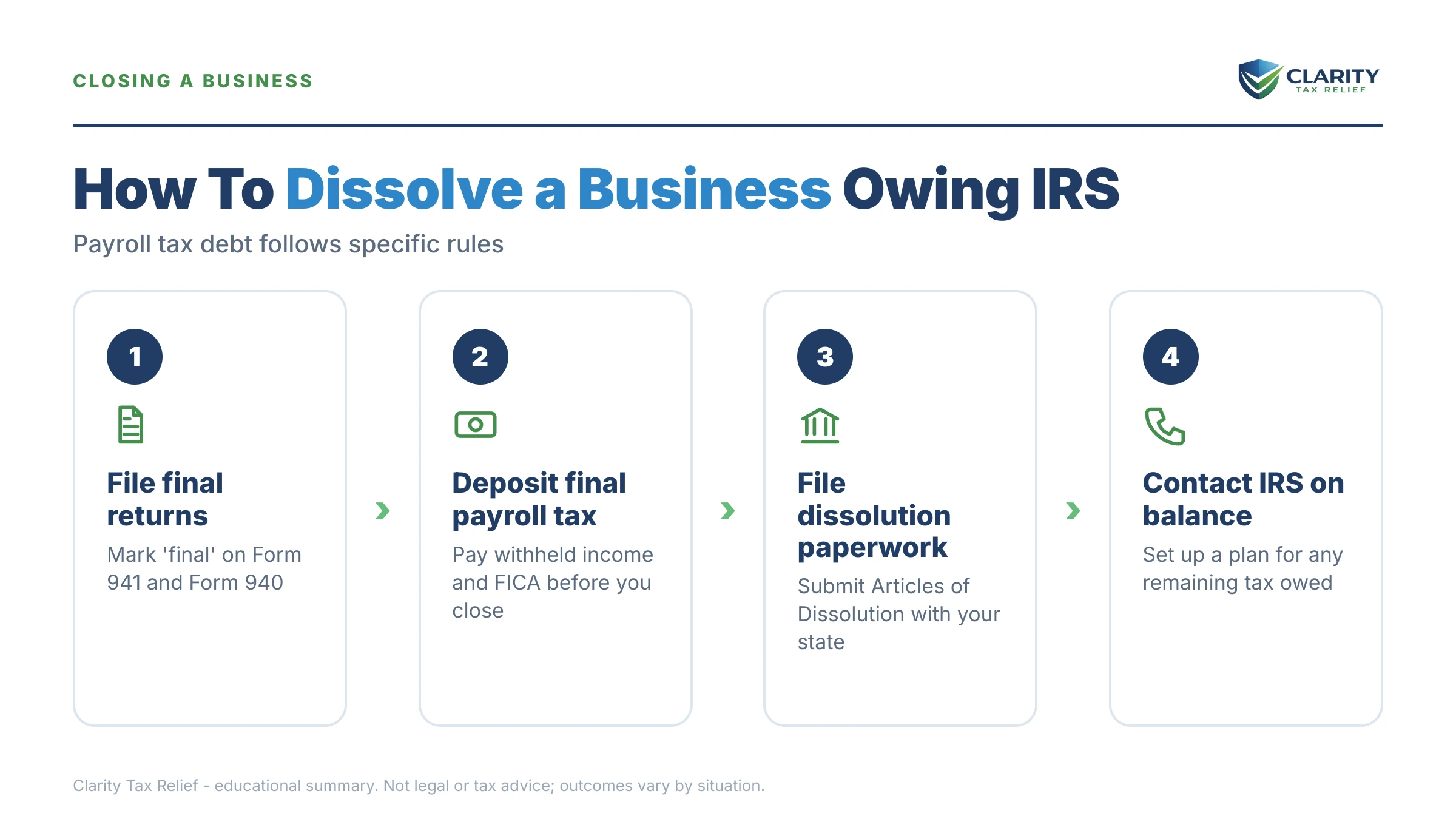
The wind-down sequence matters more than the dissolution paperwork. Done in this order, each step protects the next:
- File every missing payroll return. Get all unfiled Forms 941 and 940 in now, even if you can't pay a dollar — unfiled 941 returns block every resolution option, keep penalties running, and invite the IRS to compute the debt for you at the worst possible numbers.
- Split the balance into trust-fund and non-trust-fund dollars. Pull the business's account transcripts and compute the trust-fund portion quarter by quarter — withheld income tax plus the employees' share of FICA. That number, not the total, is your personal exposure.
- Designate remaining business money to the trust-fund portion. Before distributing or abandoning any asset, make voluntary payments from the entity with a written designation applying them to the trust-fund taxes of specific quarters. Never distribute assets to yourself while the IRS is unpaid.
- File final returns and close the IRS accounts. Check the final-return box on the last Form 941, file the final income tax return, file Form 966 if the business is a corporation, and ask the IRS to close the EIN account once filings are complete — the IRS's own checklist is at Closing a business.
- Dissolve with the state last. File articles of dissolution only after the federal sequence is done, so the entity stays available to sell assets, collect receivables, and make designated payments while it still legally exists.
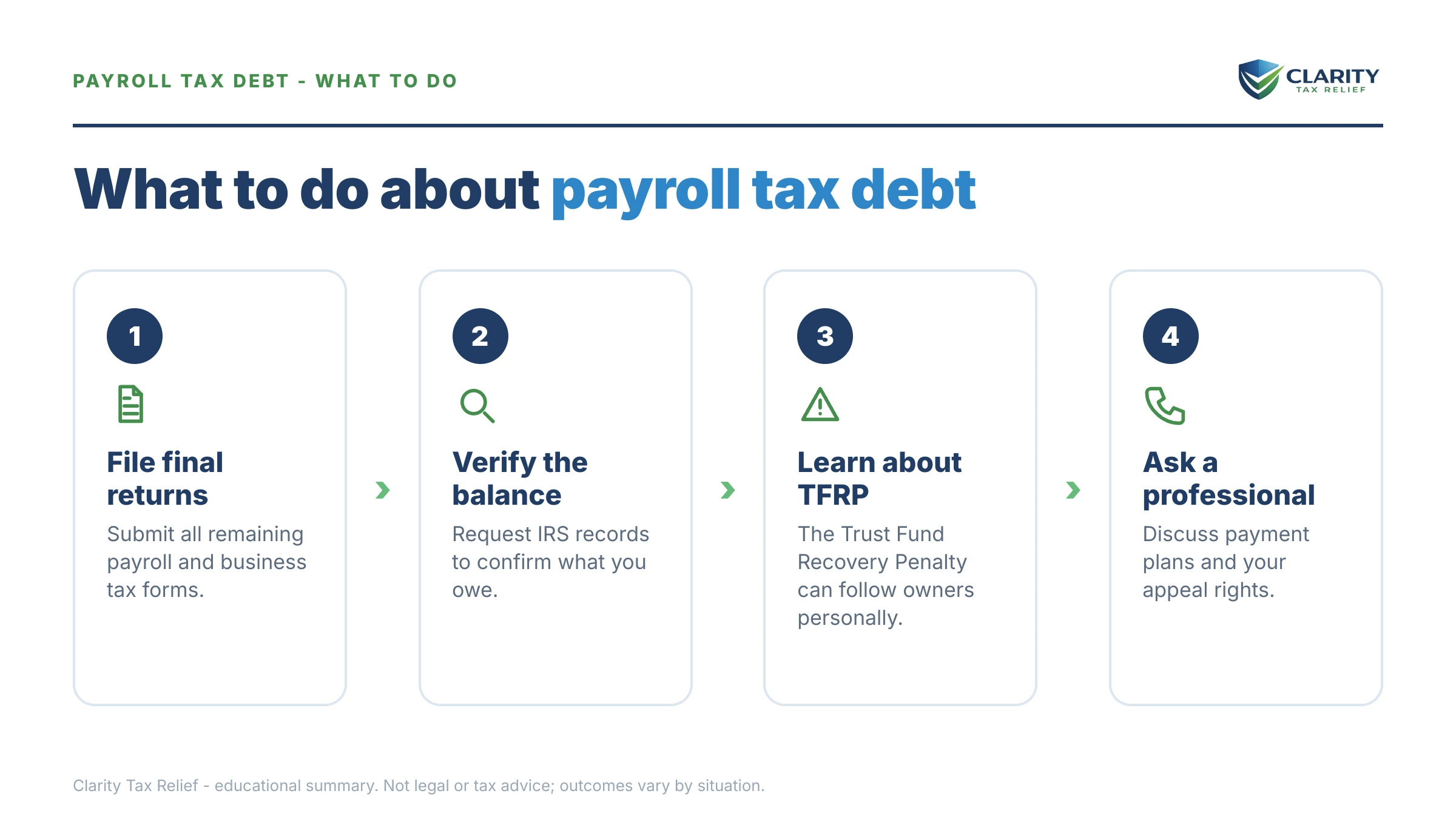
- Resolve whatever follows you personally. If Letter 1153 arrives proposing the Trust Fund Recovery Penalty, protest within 60 days if you have a defense. If the TFRP is assessed, resolve it as personal debt — installment agreement, Currently Not Collectible, or an Offer in Compromise.
When you can handle this yourself — and when help changes the outcome
You don't need professional help to close a business whose remaining IRS balance is small and entirely entity-only. If the returns are filed, there's no trust-fund shortfall — or the entity can pay the trust-fund portion in full from its own assets — the sequence above is genuinely a do-it-yourself project: file, designate, close the accounts, dissolve.
Experienced help earns its cost in a different set of situations: a Form 4180 interview has been scheduled (your answers there decide who gets assessed), multiple people could be tagged as responsible and the IRS is deciding among you, quarters of 941s are unfiled, business assets have already been distributed or sold, a revenue officer is assigned, or the trust-fund portion is large enough that a protest, CNC case, or personal OIC is the real endgame. If the business is still operating and you're weighing closure against fighting on, read can the IRS take my business before you decide — sometimes keeping the entity alive to earn and pay down the trust-fund portion beats dissolving it.
Terms on your payroll notices, decoded
- Trust-fund taxes: the withheld income tax and employees' share of FICA that the business collected from paychecks and held in trust for the government.
- Trust Fund Recovery Penalty (TFRP): the IRC §6672 assessment that makes responsible individuals personally liable for 100% of the unpaid trust-fund portion — the IRS explains it at Employment taxes and the TFRP.
- Responsible person: anyone with the duty and authority to see the taxes paid — owners, officers, and sometimes bookkeepers or check-signers.
- Willfulness: knowing the taxes were unpaid and paying other creditors anyway; no bad intent is required.
- Designated payment: a voluntary payment with written instructions directing the IRS to apply it to a specific tax, quarter, and portion of the debt.
- Form 966: the form a corporation files with the IRS after adopting a resolution to dissolve or liquidate.
Dissolving with IRS debt: your questions, answered
Can you dissolve a business that owes the IRS?
Yes. Dissolution is a state filing, and no state requires you to pay the IRS first (some require state tax clearance, but that is a separate debt). What dissolution cannot do is erase federal payroll tax liability — the trust-fund portion survives and can be assessed against you personally, so the order you wind down in matters far more than the dissolution paperwork itself.
Does IRS payroll tax debt go away when an LLC or corporation is dissolved?
Only part of it, and only sometimes. The non-trust-fund portion — the employer's share of FICA, plus the entity's penalties and interest — is generally collectible only from the entity, so it often becomes uncollectible once the entity has no assets. The trust-fund portion never dies with the entity: the IRS can assess 100% of it against every responsible person under IRC §6672.
Who is personally liable for payroll taxes when a business closes?
Anyone the IRS decides was a responsible person who willfully failed to pay — owners, officers, and sometimes bookkeepers or anyone with check-signing authority who paid other bills while payroll taxes went unpaid. Liability is joint and several: the IRS can assess the full trust-fund amount against each responsible person and collect from whoever pays first, though it only collects the total once.
What is a designated payment and why does it matter when closing a business?
A voluntary payment the business makes with written instructions telling the IRS to apply it to the trust-fund portion of specific quarters. The IRS honors designations on voluntary payments but applies involuntary payments — levies and offsets — however it chooses, which usually does not reduce your personal exposure. Designating final payments correctly is often the single move that decides whether anything follows you personally.
Can the IRS take my Social Security for my closed business's payroll taxes?
Yes, once the Trust Fund Recovery Penalty is assessed against you personally. Through the Federal Payment Levy Program the IRS can take up to 15% of each Social Security check, continuously, until the debt is resolved. If that deduction would leave you unable to cover basic living expenses, you may qualify for Currently Not Collectible status, which pauses levies while the debt itself remains.
How long can the IRS collect a Trust Fund Recovery Penalty?
Ten years from the date the penalty is assessed against you personally — a separate, later clock than the business's own assessment. The 10-year period pauses while an Offer in Compromise, bankruptcy, or a Collection Due Process appeal is pending, which pushes the expiration date out. The IRS does not have to sue you first; the assessment alone lets it file liens and issue levies.
Can I settle a Trust Fund Recovery Penalty with an Offer in Compromise?
Yes — once the TFRP is assessed against you, it is personal tax debt and eligible for a personal Offer in Compromise. The IRS accepted roughly 1 in 5 offers in FY2024, and acceptance depends entirely on whether your income and assets show you could never pay in full. A retiree living on Social Security with little equity is often a stronger candidate than an operating business ever is.
Your next 24 hours
- Find the number that matters. Pull the most recent IRS notice addressed to the business and note the tax periods and total balance — then flag which quarters had employees, because that's where the trust-fund exposure lives.
- Gather the wind-down file. Filed and unfiled 941s and 940s, business bank statements showing who signed checks, and a list of every asset the business still owns — cash, vehicles, equipment, receivables.
- Get the sequence reviewed before you file anything. An experienced tax professional can split your trust-fund number, map the designated payments, and flag whether a TFRP protest is coming — free at the 2-minute form or (888) 825-7779. Every month the entity sits unresolved, penalties and interest keep compounding on the balance.
This guide is general information, not tax or legal advice for your specific situation. Eligibility for IRS programs depends on individual facts and circumstances; no outcome is guaranteed.