
Business Tax Debt
Sole Proprietor Payroll Tax Debt: Why It's Personal and How to Fix It (2026)
The short answer: sole proprietor payroll tax debt is personal debt from day one. There is no corporate shield and no Trust Fund Recovery Penalty step — unpaid Form 941 taxes, the employer match, penalties, and interest are all assessed directly against you, and the IRS can levy your personal bank account, wages, and receivables to collect.
The levy warning on your kitchen table names your business — but the account it threatens is the one that pays your rent. That's the defining fact of owing payroll taxes as a sole proprietor: legally, there is no line between the shop's money and yours. The good news cuts the same way: every fix is a personal fix, and there are more of them than the notices suggest.
This guide covers what makes your situation different from a corporation's payroll debt, the exact notice sequence heading your way, every resolution option with its real thresholds, and the one compliance rule that controls whether the IRS says yes to any of them. The image below shows exactly what the IRS's payroll collection paperwork looks like and where to find the numbers that control your deadline.
⏱ Your real clock: if an LT11 or Letter 1058 is in your mail, you have 30 days from the notice date to request a Collection Due Process hearing (Form 12153) before the IRS can levy. If a bank levy has already landed, the bank holds the funds for 21 days before sending them to the IRS — that hold is your last window to negotiate a release. If you haven't reached those notices yet, the clock is quieter but still running: failure-to-deposit and failure-to-pay penalties plus interest compound on the balance every month.
Why sole proprietor payroll tax debt is different: it's already yours
A sole proprietor owes 100% of unpaid payroll taxes personally — the IRS never needs a separate Trust Fund Recovery Penalty assessment to collect from you. When a corporation or LLC falls behind on 941 back taxes, the IRS must first investigate who the "responsible person" was and assess the trust fund portion against them individually before touching personal assets. You get no such buffer, because a sole proprietorship isn't a separate legal entity. The quarter the deposit was missed, the debt attached to your Social Security number.
That distinction has three practical consequences most articles about business payroll debt gloss over:
- You owe the whole balance, not just the trust fund portion. Corporate officers hit with the TFRP owe only the withheld income tax and the employee half of FICA. You also owe the employer FICA match, the failure-to-deposit penalties, and all interest — typically 130% or more of what a corporate officer would owe on the same payroll.
- Every asset with your name on it is in play. Business checking, personal checking, your paycheck if you also work a W-2 job, customer receivables, even a joint account — the IRS doesn't have to distinguish, because legally there is nothing to distinguish.
- There's no entity to walk away from. Dissolving a corporation can complicate the IRS's collection; closing your sole proprietorship changes nothing about who owes. The payroll tax debt business closed guide covers what actually happens when you shut the doors — short version: the debt follows you.
How the debt got this big is usually the failure-to-deposit penalty. It runs on tiers — 2% for deposits 1–5 days late, 5% for 6–15 days, 10% beyond 15 days, and 15% after an IRS demand — and it stacks quarter after quarter on top of failure-to-pay penalties and interest. If you're still missing deposits right now, the missed payroll tax deposit guide walks through stopping that cascade this pay period.
Payroll tax vs. self-employment tax: many sole proprietors owe both
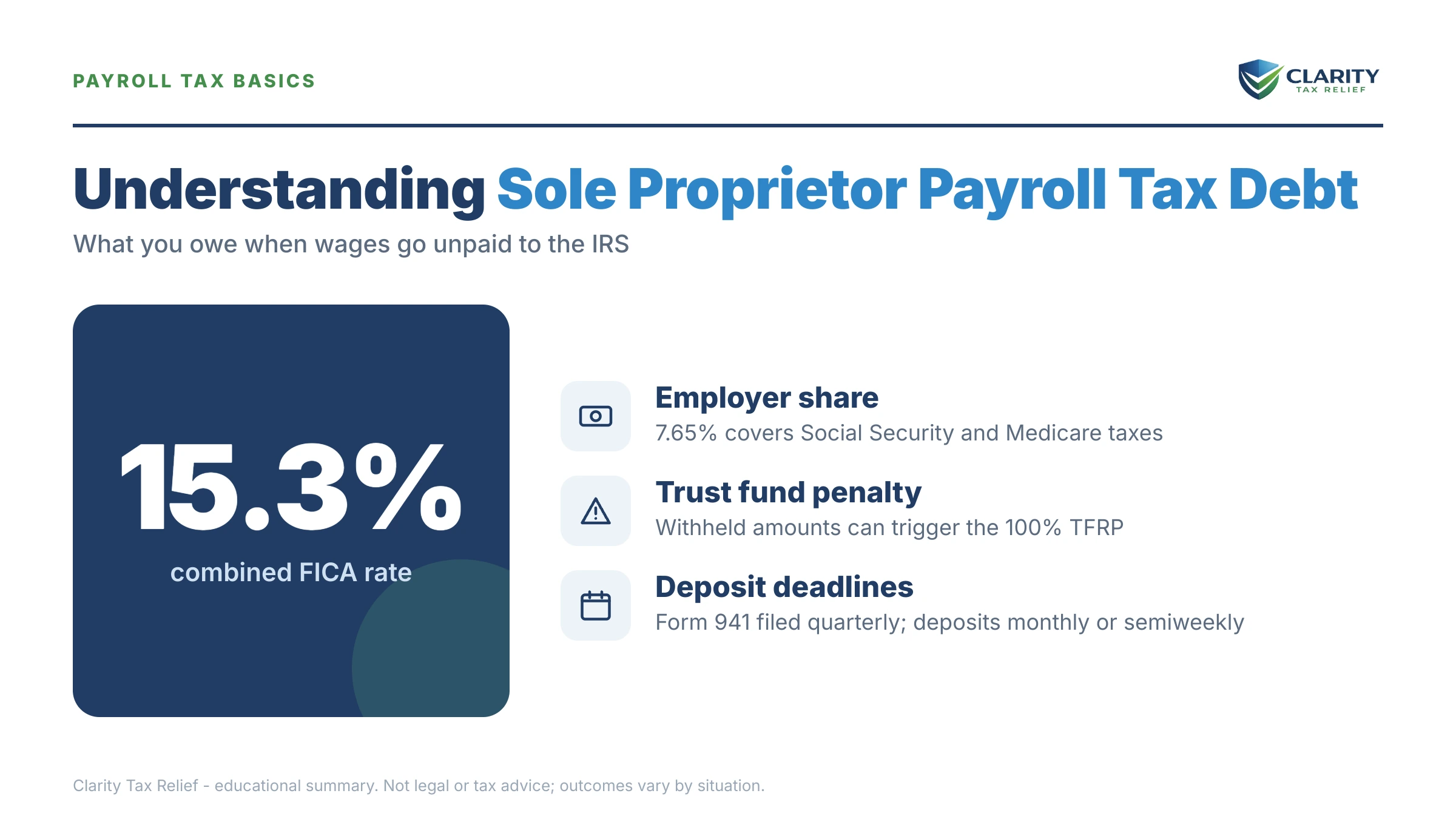
Payroll tax and self-employment tax are two separate debts that both land on the same person — you. Payroll tax is what you withheld from your employees' paychecks plus your employer FICA match, reported quarterly on Form 941 (with FUTA on the annual Form 940). Self-employment tax is the 15.3% Social Security and Medicare tax on your own Schedule C profit, reported on your Form 1040.
Why this matters when you're negotiating: the IRS sees both balances on one taxpayer, and any resolution has to account for all of it. A payment plan that covers your 941 quarters but ignores a $14,000 income-tax balance from the same years will default the moment the IRS matches the accounts. If your own self employment tax is part of the pile, get every balance on the table before you propose anything.
The reverse trap also exists: some sole proprietors treat helpers as contractors to avoid payroll entirely, and a reclassification exam converts years of "1099 payments" into payroll tax debt retroactively. If that's how your balance was born, the worker misclassification penalty guide covers Section 530 relief, which can wipe out much of a reclassification assessment when you had a reasonable basis for the treatment.
What happens if you ignore sole proprietor payroll tax debt
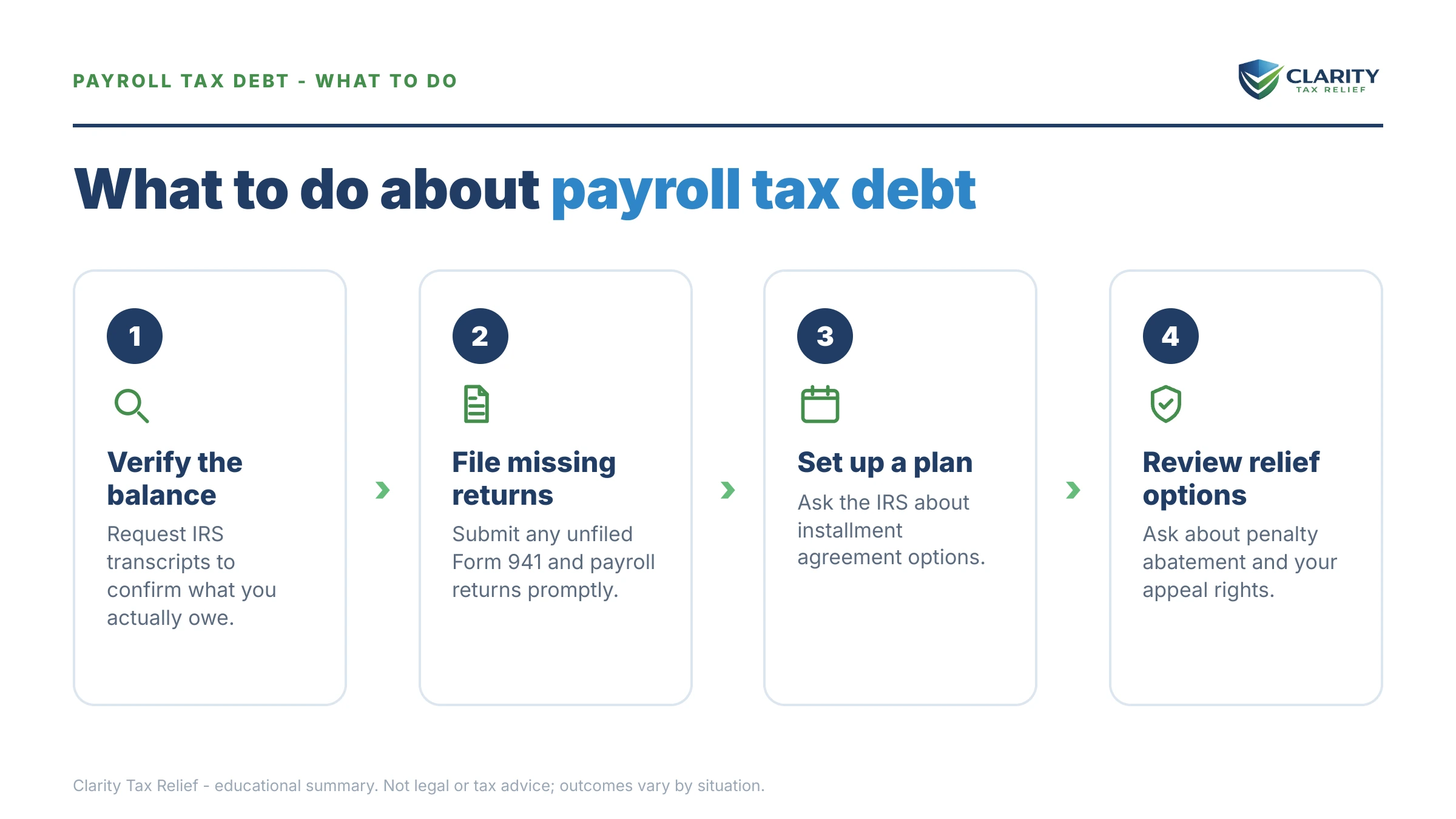
The IRS treats unpaid Form 941 taxes as its highest collection priority, because most of the money was withheld from employees' paychecks and never forwarded. For a sole proprietor, every stage of that escalation targets your personal assets directly:
- CP161 — the first business balance-due bill for an unpaid quarter. Tax, penalty, and interest broken out, with a pay-by date printed on the notice. No enforcement yet — and the cheapest moment to fix this.
- CP504B — Notice of Intent to Levy. The IRS can now take your state tax refund, and a federal tax lien against everything you own becomes likely. Despite the name, this is not yet the final notice.
- LT11 / Letter 1058 — the true final notice. A 30-day clock starts, during which you can demand a Collection Due Process hearing with Form 12153. Once it lapses, levies need no further warning.
- Levy and, often, a revenue officer. Bank accounts (frozen 21 days, then swept), accounts receivable — a single levy letter to your biggest customer — and wages from any job, continuously until released. Payroll cases above certain balances are routinely assigned to a local revenue officer who can show up at your business, announced by Letter 725-B.
One more escalation is unique to payroll debt: if you keep running payroll while missing new deposits, the IRS calls it pyramiding payroll taxes — the pattern that moves cases from the automated system to enforced shutdown, and in repeat cases to criminal referral. In 2026, with IRS staffing down roughly 27%, the humans are scarcer but the automated notice stream and levy issuance never paused. Silence from the IRS is not the same as safety.
| Notice | What it does | Your window |
|---|---|---|
| CP161 | First bill for an unpaid 941 quarter | Pay-by date printed on the notice |
| CP504B | Intent to levy; state refund can be seized; lien likely | Act before the final notice follows — the sequence is automated |
| LT11 / Letter 1058 | Final notice of intent to levy on all assets | 30 days to request a CDP hearing (Form 12153) |
| Bank levy | Account frozen, then funds remitted to the IRS | 21-day hold before the bank sends the money |
| Letter 725-B | Revenue officer assigned; in-person collection begins | Respond by the contact date on the letter |
Payroll debt and a levy notice on the table?
If an LT11 or Letter 1058 has arrived, the 30-day window to protect your accounts is already running. Send us the notice — an experienced tax professional will map exactly where your case sits and which fix fits your numbers. Free, confidential, no pressure.
Your options for resolving sole proprietor payroll tax debt
Every IRS resolution for payroll tax debt requires one thing first: current federal tax deposits. The IRS will not approve a payment plan, hardship status, or offer while new payroll taxes are going unpaid — compliance going forward is the price of admission to every program below. (For the general mechanics of each program, the DIY pillar on how to settle tax debt yourself covers them in depth; here's how each one applies to your situation.)
One structural note before the table: while you're still running payroll, the IRS treats you as an in-business trust fund case with stricter rules — smaller balances may fit the express-style terms covered in the business payroll tax payment plan guide. Once you've stopped having employees, the debt is collected more like an individual balance, which generally widens your options.
| Option | Who it fits | The catch |
|---|---|---|
| Short-term payment plan | Can pay in full within 180 days; $0 setup fee | Interest and penalties keep accruing; deposits must be current |
| Installment agreement | Smaller in-business payroll balances may get express-style terms; larger balances require Form 433 financial disclosure | At $68,500, expect full disclosure of income, expenses, and assets |
| Currently Not Collectible | Paying anything would prevent basic living and business expenses | Debt keeps growing; IRS re-reviews when income rises; lien likely |
| Offer in Compromise | Assets plus future income genuinely below the balance; all deposits and filings current | $205 fee and 20% down on lump-sum offers (both waived with low-income certification); roughly 1 in 5 accepted in FY2024 |
| Penalty abatement | Clean 3-year compliance history (First-Time Abate) or a reasonable-cause story | Reduces penalties, not the tax itself |
Two option-specific notes worth their own sentence. First, penalty relief on payroll debt is its own discipline — the failure-to-deposit penalty has different abatement standards than the income-tax penalties, and the 941 penalty abatement guide covers what reasonable cause actually looks like for missed deposits. Also note that starting summer 2026, the IRS's new Automatic Exemption from Penalty (AEP) begins replacing First-Time Abate for qualifying taxpayers — automatic, no request needed — so don't assume a formal FTA letter is the only path.
Second, if a levy is already choking your income, hardship rules exist independent of the programs above: a levy that prevents you from meeting basic living expenses can be released under IRC §6343 even while the debt remains. The levy causing hardship guide covers how to make that showing fast.
What $68,500 of payroll tax debt actually looks like: a worked example
Say you owe $68,500 — a clearly hypothetical sole proprietor with four unpaid 941 quarters, renting your home, with a levy notice just arrived. A typical breakdown: $52,000 in unpaid quarterly tax, about $9,800 in failure-to-deposit and failure-to-pay penalties, and roughly $6,700 in accrued interest.
Payment-plan math: $68,500 spread over 72 months is about $951/month before accruing interest — realistically closer to $1,000–$1,100/month once interest is factored in. Because the balance is over $50,000, this isn't a quick online setup: the IRS will want Form 433-F or 433-B financials before agreeing. Paying the balance below $50,000 first, if you can, simplifies the whole negotiation.
Offer math: being a renter actually helps here, because there's no home equity for the IRS to count. Its yardstick is Reasonable Collection Potential — your net realizable assets plus a multiple of monthly disposable income. Suppose you have $3,100 in the bank, about $4,500 of counted vehicle equity, and $400/month left after IRS-allowed expenses. A lump-sum offer would run roughly $3,100 + $4,500 + ($400 × 12) = $12,400 against the $68,500 owed. You can estimate your own numbers with our Offer in Compromise Calculator — but remember the gate: no offer gets processed until current deposits and filings are clean, and the IRS accepted roughly 1 in 5 offers in FY2024. It's real relief for the right facts, never a shortcut.
Penalty-relief math: if reasonable cause or First-Time Abate removed even half the $9,800 in penalties, the balance drops by nearly $5,000 before you negotiate anything else — which is why penalty relief is usually the last step of the plan, not an afterthought.
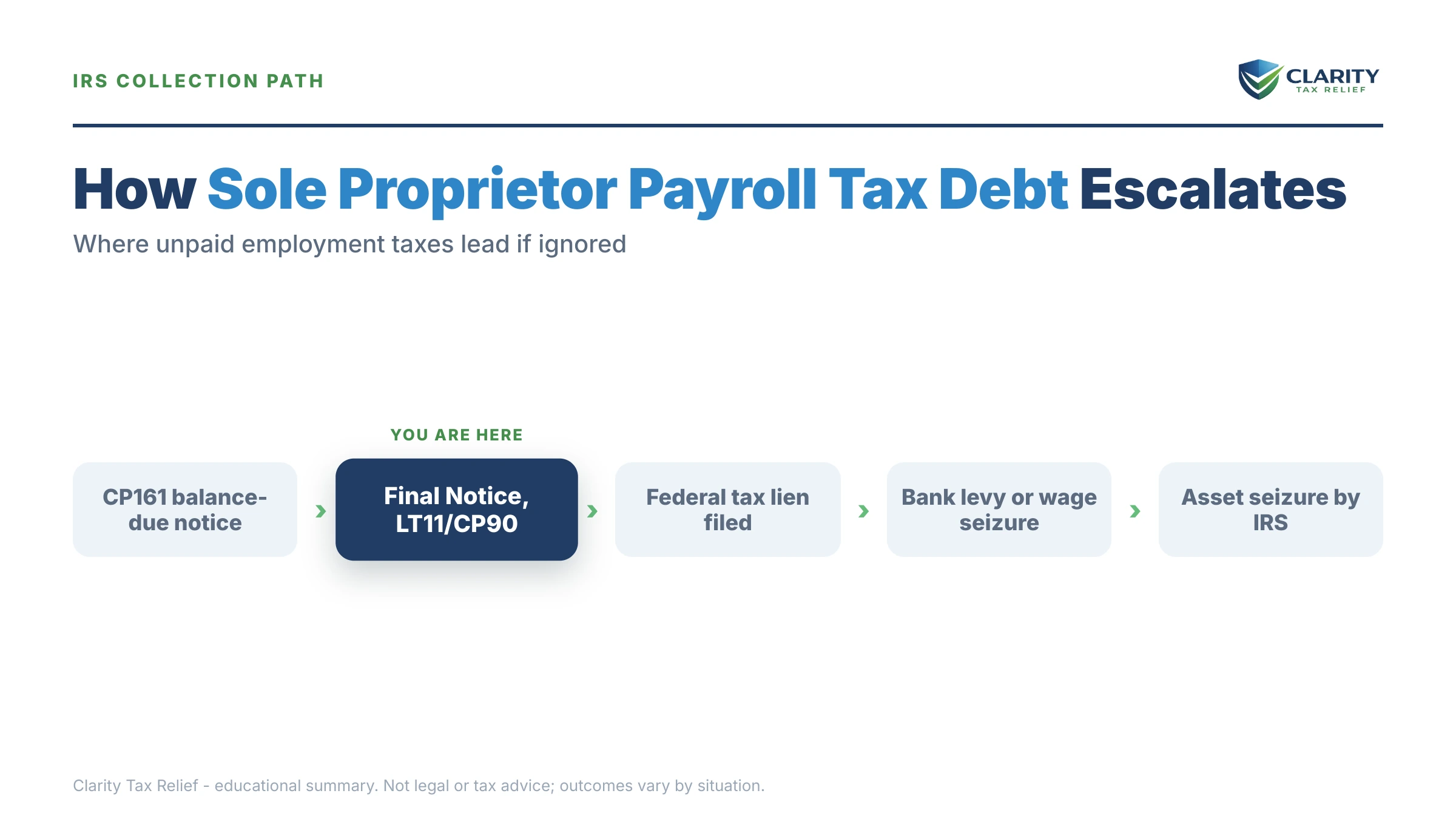
How to respond to sole proprietor payroll tax debt, step by step
- Start making this quarter's federal tax deposits today — the IRS will not approve any payment plan, hardship status, or offer while new payroll taxes go unpaid.
- File every missing Form 941 and Form 940 — no agreement gets finalized with unfiled returns outstanding, and filing stops the IRS from assessing inflated substitute amounts.
- Pull your business and individual account transcripts to confirm exactly what tax, penalty, and interest is assessed for each quarter before you negotiate anything.
- Choose and submit a resolution — payment plan, Currently Not Collectible, or an Offer in Compromise — before any 30-day levy window on a final notice closes.
- Request penalty relief on the failure-to-deposit and failure-to-pay penalties through First-Time Abate or reasonable cause once the core plan is in place.
When you can handle this yourself — and when help changes the outcome
Plenty of sole proprietor payroll cases don't need professional help. If you missed one or two deposits, can get current this pay period, and can pay the balance within 180 days, do it yourself: set up the short-term plan at IRS.gov/payments, then request penalty abatement in writing. The same goes for a small balance you agree with on a first CP161 — pay or arrange payment, and this never escalates.
Experienced help tends to change outcomes in four situations. A levy is in motion or an LT11's 30-day window is running — the CDP request and the proposal behind it have to be right the first time. Multiple quarters are unfiled — the sequencing of returns, deposits, and negotiation determines what you ultimately pay. Both payroll and personal income-tax balances exist — the accounts have to be resolved together or the agreement defaults. Or you're weighing an offer — the Reasonable Collection Potential math on a business owner's income is where most self-filed offers die. If your trade adds its own wrinkles — job-cost cash flow, prevailing-wage rules, subs on 1099s — the construction payroll tax debt guide covers that industry's specific exposure.
Terms on your notices, decoded
- Trust fund taxes — the money you withheld from employees' paychecks (income tax plus their FICA half); the IRS treats it as employee money you were holding in trust.
- Employer share — your matching half of Social Security and Medicare; as a sole proprietor you owe this portion personally too, unlike a corporate officer hit with the TFRP.
- Failure-to-deposit (FTD) penalty — the tiered penalty (2%, 5%, 10%, 15%) for late payroll deposits; it's usually the biggest single add-on to a 941 balance.
- Levy vs. lien — a lien is a public claim against everything you own; a levy is the actual taking of money or property. Payroll cases often produce both.
- CDP rights — your right to a Collection Due Process hearing after a final levy notice; requesting it (Form 12153) within 30 days pauses the levy while an appeals officer reviews alternatives.
- CSED — the Collection Statute Expiration Date; the IRS generally has 10 years from each quarter's assessment to collect, paused by offers, bankruptcy, and certain appeals.
Sole proprietor payroll tax questions, answered
Am I personally liable for my business's payroll taxes as a sole proprietor?
Yes, for every dollar. A sole proprietorship is not a separate legal entity, so unpaid Form 941 taxes — the withheld trust fund portion, your employer FICA match, penalties, and interest — are assessed against you directly. The IRS skips the Trust Fund Recovery Penalty process it uses against corporate officers because there is nothing to pierce. Your personal bank account, wages, and receivables are all reachable.
Can the IRS levy my personal bank account for payroll tax debt?
Yes. Because you and the business are legally the same taxpayer, the IRS can levy any account with your name on it, business or personal, once it issues a final notice of intent to levy and the 30-day window passes. A bank levy freezes funds for 21 days before the bank sends them to the IRS — that hold is your window to negotiate a release. Joint accounts you share with someone else can be reached too.
Is payroll tax debt the same as self-employment tax?
No, and many sole proprietors owe both. Self-employment tax is the 15.3% Social Security and Medicare tax you pay on your own Schedule C profit through your Form 1040. Payroll tax is what you withhold from employees' paychecks plus your employer match, reported quarterly on Form 941. They are separate assessments — but because you are one taxpayer, both debts land on you personally and usually need to be resolved together.
Can I settle sole proprietor payroll tax debt with an Offer in Compromise?
It's possible, but the bar is high. You must be current on all federal tax deposits and filings before the IRS will even process the offer, and the offer amount is driven by your assets and future income — not by how much you'd like to pay. The application fee is $205 (waived with low-income certification), and the IRS accepted roughly 1 in 5 offers in FY2024, so it is never a sure thing.
If I close my business, does the payroll tax debt go away?
No. Because the debt was assessed against you personally, it follows you after the business closes — into your next job's wages, your bank accounts, and your future tax refunds. Closing does change the resolution picture: with no employees to stay current on, you may fit individual payment-plan or hardship rules more easily. The 10-year collection statute keeps running either way.
Can payroll tax debt be discharged in bankruptcy?
Mostly no. The trust fund portion — taxes you withheld from employees' paychecks — is a priority claim that survives Chapter 7 and generally must be paid in full through a Chapter 13 plan. Older employer-share amounts and some penalties can sometimes be treated differently, so bankruptcy occasionally helps around the edges. For most sole proprietors, an IRS payment plan or offer resolves payroll debt better than bankruptcy does.
How long can the IRS collect old payroll tax debt?
Generally 10 years from the date each quarter's tax was assessed, under the collection statute (CSED). Each Form 941 quarter has its own clock, so a debt spanning several quarters expires in stages, not all at once. The clock pauses during an Offer in Compromise, bankruptcy, or certain appeals, which can stretch collection well past 10 calendar years — so waiting it out rarely works while levies are active.
What happens if I keep missing deposits while I owe back payroll taxes?
That pattern — called pyramiding — is the fastest way to turn a civil debt into a revenue officer case, and repeat non-deposit can carry criminal exposure. The IRS will not approve any payment plan or offer while new quarters go unpaid, and it can move to shut down a business that keeps accruing. Stopping the bleeding on current deposits is step one of every fix.
Your next 24 hours
- Find your most recent notice and check its name and date. If it's an LT11 or Letter 1058, count 30 days from the notice date — that's your Collection Due Process window, and it controls everything else.
- Gather your last four quarters of 941s (filed or not), your latest 1040 with Schedule C, and a current bank statement. Those three items are enough to price every option above — including whether deposits are the immediate fire to put out.
- Get the free case review. Call (888) 825-7779 or use the 2-minute form — an experienced tax professional will tell you whether your $68,500-sized problem points toward a payment plan, hardship status, or an offer, before the levy clock decides for you.
For the primary sources: the IRS's payment plans and installment agreements page covers plan setup, IRS.gov/payments handles deposits and direct payments, and if collection action is causing a hardship the IRS won't address, the Taxpayer Advocate Service is an independent avenue inside the IRS.
This guide is general information, not tax or legal advice for your specific situation. Eligibility for IRS programs depends on individual facts and circumstances; no outcome is guaranteed.