
Business Tax Debt
IRS Revenue Officer for Payroll Taxes: Your First 24 Hours (2026)
The short answer: a revenue officer assigned to your payroll taxes means your 941 debt has been escalated from automated notices to a human collector with levy and seizure authority. Your first moves: make this quarter's federal tax deposits on time, file every missing 941, and get representation before any Form 4180 interview.
You run your own work on 1099 contracts, you put a small crew on payroll when the jobs got bigger, and now a letter from an IRS revenue officer — not a computer-generated notice from a service center — wants to meet about your Form 941s. A person, not an algorithm, owns your case now. That cuts both ways: an officer can enforce faster than the automated system, and can also approve resolutions a phone-line agent never could.
The image below shows exactly what the officer's appointment letter looks like and where to find the meeting date, the officer's direct contact information, and the tax periods the case covers.
⏱ Your deadlines: the ones printed on the documents in your hand — the appointment date on Letter 725-B and each due date the officer writes on Form 9297. There is no grace period behind those dates: missing a Form 9297 deadline is what moves a payroll tax case from cooperative to enforced, and interest and penalties keep accruing monthly either way.
Why a revenue officer gets assigned to payroll taxes
The IRS assigns a revenue officer to payroll taxes because 941 debt is other people's money — tax withheld from your employees' paychecks that never reached the Treasury. The IRS treats that as its money that you were holding in trust, which is why employment tax cases skip much of the slow mailed-notice cycle that individual income tax debt gets.
Getting a human officer in 2026 is itself a signal. The IRS lost roughly 27% of its workforce in 2025, and field officers are scarce — yet employment tax cases are among the few still routinely assigned to a person. Your file was ranked a priority. (If you're not sure what kind of IRS employee you're dealing with, start with what is an IRS revenue officer — officers, agents, and scammers behave very differently.)
For a contractor, the debt usually comes from one of two places. Either you put a crew on payroll and the deposits slipped when a customer paid late — the classic path into 941 back taxes — or you paid your crew on 1099s, the IRS reclassified them as employees after an exam, and a payroll tax balance was assessed on labor you never withheld from. The second scenario changes your defenses, so tell your representative immediately if that's how the balance arose.
Your entity matters too. If you operate as a sole proprietor or single-member LLC, the entire employment tax balance is already your personal debt. If you formed a corporation or multi-member LLC, the entity owes it — but as you'll see below, the trust fund portion can still reach you personally. The general playbook for negotiating with the IRS is in our guide on how to settle tax debt yourself; a revenue officer payroll case follows that playbook plus rules of its own, starting with the paperwork.
The revenue officer's paperwork, decoded
A revenue officer runs a payroll tax case through a handful of standard documents, and each one carries its own deadline. Since mid-2023, the case almost always opens with Letter 725-B — the appointment letter that replaced most unannounced field visits. Everything after it follows a pattern you can anticipate:
| Document | What it means | Your move and deadline |
|---|---|---|
| Letter 725-B | An officer has your case and is scheduling an initial meeting | Confirm or reschedule before the appointment date printed on it; use the letter's number to verify any contact is real |
| Form 9297 | The officer's written list of what you must provide, with due dates | Meet every listed date or ask for an extension in advance — these deadlines control the case |
| Form 433-B | Business financial statement: income, assets, receivables, expenses | Complete it accurately with documentation; it decides which resolution the officer can approve |
| Form 4180 | Interview to decide who is personally liable for the trust fund taxes | Prepare with representation first — answers here drive the personal assessment |
| Letter 1153 | Proposed Trust Fund Recovery Penalty against you personally | Protest within 60 days or the penalty is assessed against you as an individual |
| Letter 1058 / LT11 | Final notice of intent to levy | Request a Collection Due Process hearing (Form 12153) within 30 days to pause levy action |
What happens if you ignore the revenue officer
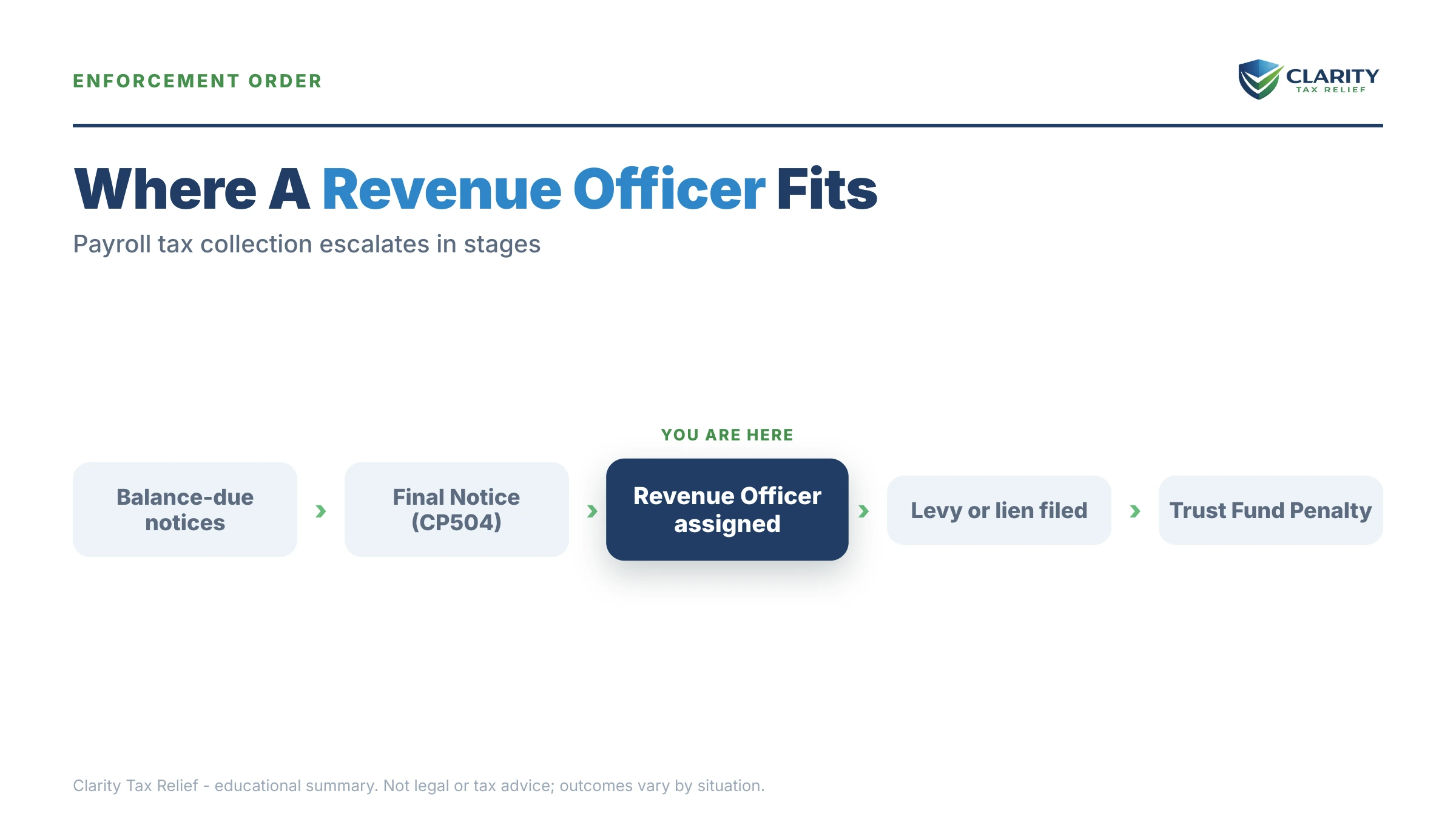
Ignoring a revenue officer converts a negotiable payroll tax case into an enforced one — and field enforcement against a business moves faster than the mailed-notice cycle individuals experience. The sequence runs in a predictable order:
- Missed appointment or Form 9297 deadline. The officer stops treating the case as cooperative. Records you didn't hand over can be pulled by summons — from you, your bank, or your customers.
- Final notice of intent to levy (Letter 1058). If not already issued, it starts a 30-day clock and your Collection Due Process rights under Form 12153. After 30 days, the officer can levy without further warning.
- Levies begin. A business bank levy freezes the funds with a 21-day hold before the money leaves. An IRS levy on accounts receivable is often worse for a contractor — the levy notice goes straight to your general contractors and customers, cutting off cash flow and your reputation in one stroke.
- The trust fund track runs in parallel. Form 4180 interviews lead to Letter 1153, and 60 days later the withheld portion of the debt is assessed against you personally — reachable through your personal bank account, wages, and a lien against your home.
- Continued pyramiding invites seizure. A business that keeps accruing new quarters while ignoring old ones is the profile the IRS seizes. That endgame — and how to stop it — is covered in can the IRS take my business.
Every stage above is avoidable, and the officer would rather not run it. Officers close cases by agreement far more often than by seizure — but only for taxpayers who engage before the deadlines pass.
A revenue officer has your payroll tax case?
Get it reviewed free before the appointment date on your Letter 725-B — or before the next Form 9297 deadline. An experienced tax professional will map your trust fund exposure and the resolution the officer can actually approve.
How $41,800 in payroll tax debt becomes your personal debt
The Trust Fund Recovery Penalty lets the IRS assess the withheld portion of a 941 balance against you personally — your LLC or corporation does not block it. The trust fund portion is the money that came out of employees' paychecks: their federal income tax withholding plus their share of Social Security and Medicare. The employer's matching share, deposit penalties, and interest stay with the business.
The officer decides who gets assessed through the Form 4180 interview — questions about who signed checks, who decided which bills got paid, and who knew the taxes were due. "Responsible" and "willful" are broader than most owners expect: paying any other creditor while knowing the payroll taxes were unpaid generally counts as willful. A spouse who signs checks or a bookkeeper with payment authority can be assessed alongside you. The proposal arrives as Letter 1153, with 60 days to protest, and once assessed the penalty gets its own 10-year collection clock against you as an individual.
A worked example: splitting and shrinking a $41,800 balance
Say your crew's payroll ran about $180,000 last year, four quarters of deposits slipped, and the officer is collecting $41,800. A typical split: roughly $27,900 is trust fund money (withheld income tax plus the employees' FICA share) and about $13,900 is the employer's matching share plus failure-to-deposit penalties and interest. That split drives strategy two ways:
- Personal exposure: if the business later fails, the $27,900 — not the full $41,800 — is what can follow you personally through the TFRP (unless you're a sole proprietor, in which case all of it is already yours).
- The paydown play: the streamlined IBTF-Express agreement is only available on balances of $25,000 or less. Pay $16,800 down to reach $25,000, and the remaining balance divides into roughly $25,000 ÷ 24 months ≈ $1,042/month — generally with no Form 433-B and, while you stay compliant, often without a trust fund assessment being pursued.
One more move worth real money: designate every voluntary payment in writing to the trust fund portion of the oldest quarters. Voluntary payments can be directed; levied money is applied however the IRS chooses — usually to the non-trust-fund portion first, which keeps your personal exposure at maximum. Interest continues to accrue on any plan, so the true payoff runs somewhat higher than the flat division.
Your options with a revenue officer on a 941 case
Every payroll tax resolution has the same entry ticket: all 941s filed and this quarter's deposits being made on time. Officers call it "compliance," and no option below is available without it.
| Option | Who qualifies | Cost and catch |
|---|---|---|
| Pay in full | Anyone with access to the funds | Ends the case and stops the monthly failure-to-pay accrual; commercial borrowing often costs less than IRS penalties plus interest |
| IBTF-Express installment agreement | Operating business owing $25,000 or less (including after a paydown) | Full pay within 24 months; direct debit generally required above $10,000; no Form 433-B; trust fund assessment typically not pursued while you comply |
| Regular in-business installment agreement | Balances above $25,000 | Form 433-B with full documentation; officer approval required; the trust fund analysis usually still runs alongside it |
| Currently Not Collectible | Business that can prove it cannot pay anything after allowable expenses | Pauses collection against the business, not the debt; TFRP against individuals typically still proceeds |
| Offer in Compromise | Rarely an operating business with trust fund debt | $205 application fee; the IRS seldom compromises trust fund money while the business runs — realistic mostly after closure |
| Penalty abatement | Reasonable cause: payroll-provider fraud, disaster, serious illness | Can remove failure-to-deposit and failure-to-pay penalties — which run from 2% up to 15% of each late deposit depending on how late it is — the 15% tier applies only if the tax is still unpaid more than 10 days after the IRS's first demand notice — plus 0.5% per month — but never the tax itself |
On a $41,800 balance, penalties and interest are often a five-figure slice of the total — our IRS Penalty & Interest Calculator can estimate how much of your number is penalty rather than tax, which tells you what an abatement request is worth. The deeper rules on trust fund payment plans, including how officers evaluate them, are in our business payroll tax payment plan guide, and the IRS's own terms are on its payment plans page.
How to respond to a revenue officer, step by step
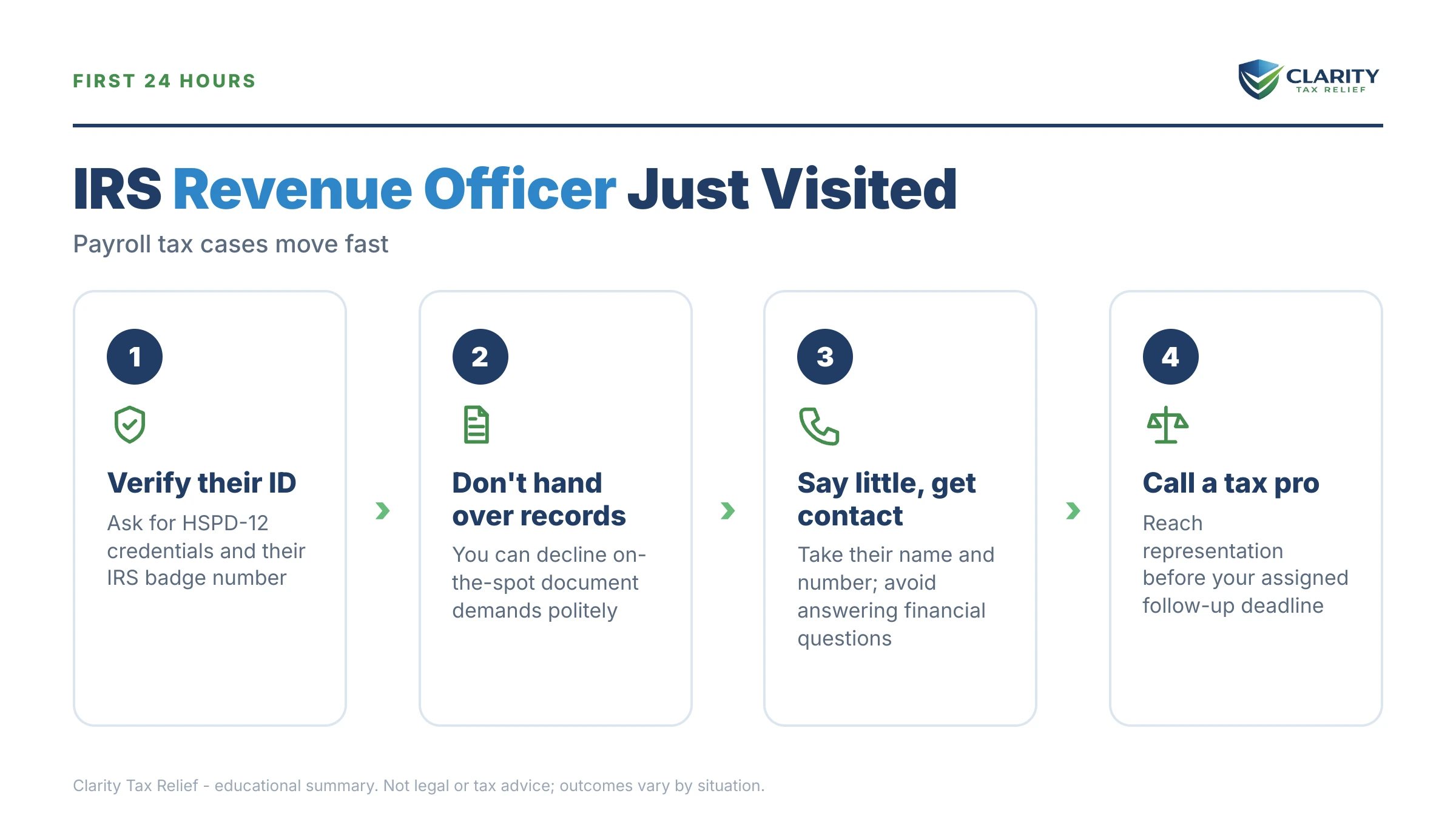
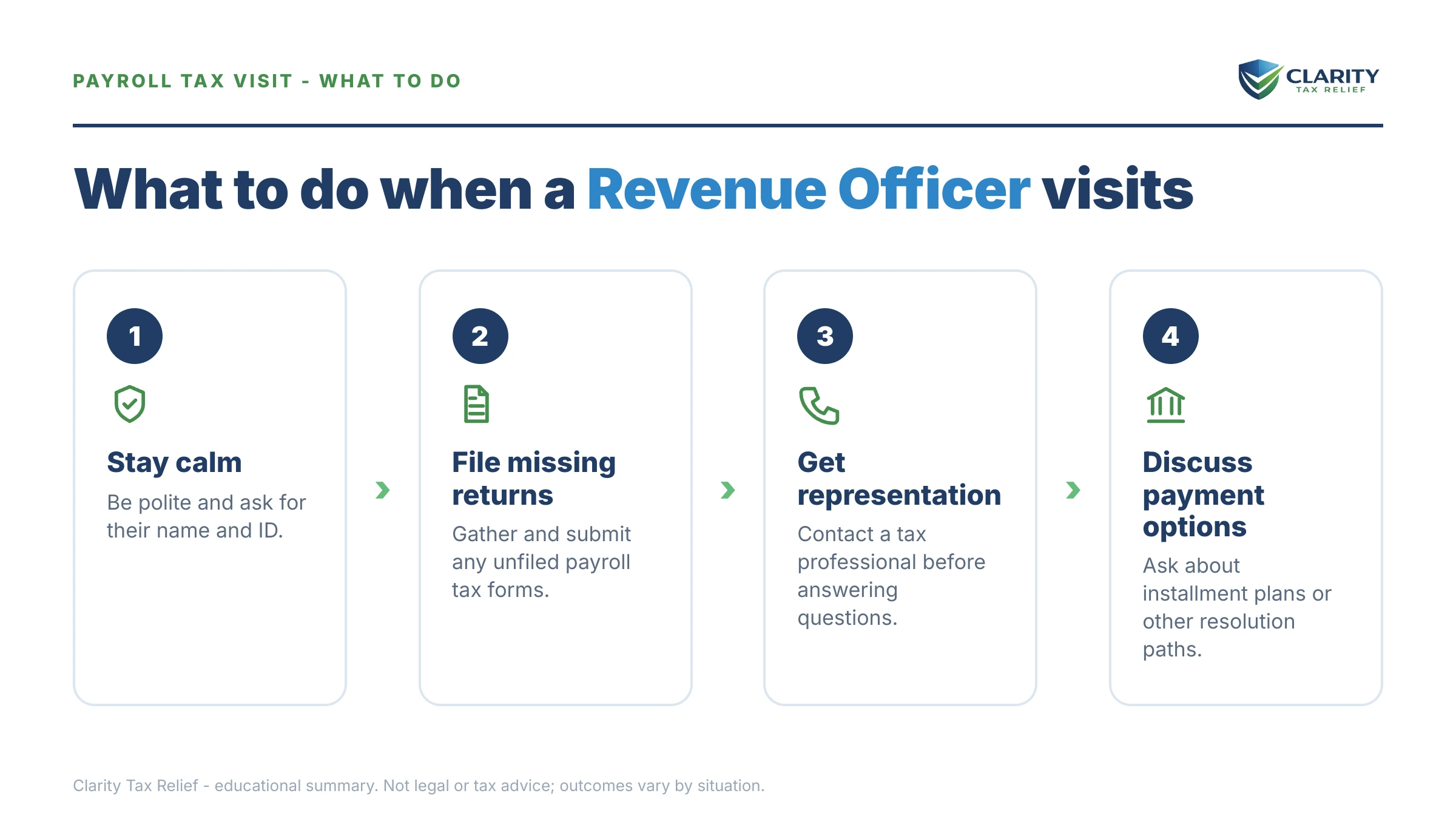
- Verify the officer is real. Match the name and phone number against your Letter 725-B, and ask to see both IRS credentials (the HSPD-12 card and pocket commission) before sharing any financial information.
- Stop the bleeding with current deposits. Make this quarter's federal tax deposits on time starting now — no agreement can be approved while new payroll tax debt is still accruing.
- File every missing Form 941. The officer cannot accept any resolution until all required returns are filed, so filing the missing quarters unlocks every option on the table.
- Get representation before the Form 4180 interview. File Form 2848 so the officer works through your representative and your interview answers are prepared, not improvised under pressure.
- Propose a resolution before the Form 9297 deadline. Deliver your Form 433-B or an IBTF-Express proposal by the officer's written deadline so the case stays cooperative instead of moving to enforcement.
Deposits and any paydown can be made electronically through IRS.gov/payments — pay electronically and keep the confirmations; they're your proof of compliance at the next meeting.
When you can handle this yourself — and when help changes the outcome
You can reasonably work directly with the officer if the balance is at or under $25,000 (or you can pay it down there), every 941 is filed, current deposits are being made, and there's no dispute about who your workers are. In that lane, an IBTF-Express agreement is largely a paperwork exercise: show up prepared, propose the 24-month payment, and comply.
Experienced help changes the outcome when the stakes shift from paperwork to liability: a Form 4180 interview is scheduled, more than one person could be tagged as responsible (a spouse who signs checks, a bookkeeper, a partner), a levy has already hit your bank or receivables, the debt came from worker reclassification, or you're weighing whether the business survives at all. Those are the decisions where the officer's math and a prepared representative's math produce very different personal outcomes. If the officer's process itself is causing hardship and you can't get traction, the Taxpayer Advocate Service is an independent, free channel inside the IRS.
Terms your revenue officer will use, decoded
- Trust fund taxes: the money withheld from employees' paychecks — federal income tax plus their share of Social Security and Medicare — which the law treats as government funds you held in trust.
- Responsible person: anyone with the status, duty, and authority to pay the trust fund taxes over — owners, officers, and sometimes bookkeepers or check-signers.
- Willfulness: for TFRP purposes, simply knowing the taxes were due and paying anyone else first — no bad intent required.
- Form 9297: the officer's written list of what you must provide and by when; missing a listed date is what triggers enforcement.
- Pyramiding: accruing new payroll tax quarters while owing old ones — the pattern that turns a collection case into a seizure candidate and, in extreme cases, a criminal referral.
- IBTF-Express: the streamlined in-business trust fund installment agreement for payroll balances of $25,000 or less, fully paid within 24 months.
Revenue officer payroll tax questions, answered
Can an IRS revenue officer show up at my business unannounced?
Usually not anymore. Since mid-2023, the IRS's standard practice is to mail Letter 725-B and schedule an appointment instead of making unannounced field visits. The main exceptions are serving a summons and carrying out an approved seizure. If someone appears at your door claiming to be from the IRS with no appointment letter behind it, verify their credentials before sharing anything — impersonation scams target business owners specifically.
Should I talk to a revenue officer without representation?
You can, but be careful: everything you say — especially in the Form 4180 interview — can be used to build a personal Trust Fund Recovery Penalty case against you. You have the right to representation, and once you submit Form 2848 the officer must generally work through your representative. You can also pause an interview that has already started in order to get representation.
Can the IRS collect my business's payroll taxes from me personally?
Yes — the trust fund portion. The income tax you withheld plus your employees' share of Social Security and Medicare can be assessed personally against any responsible person who willfully failed to pay it over, through the Trust Fund Recovery Penalty. An LLC or corporation does not shield you from this; the assessment attaches to you as an individual regardless of entity type.
Will a revenue officer shut down my business over 941 debt?
It is possible but rare, and it is a last resort requiring multiple levels of IRS approval. Officers escalate toward seizure when a business keeps pyramiding — accruing new payroll tax quarters while owing old ones — because every new quarter deepens the government's loss. Stopping the pyramiding by making current deposits on time is the single strongest thing you can do to take seizure off the table.
What if my business can't pay anything toward the payroll taxes right now?
Compliance still comes first: make this quarter's deposits and file every missing 941, because no relief option is available to a business that keeps falling behind. From there, the officer can report the account currently not collectible if a Form 433-B shows the business genuinely cannot pay. Understand that hardship status for the business does not stop the Trust Fund Recovery Penalty from being assessed against you personally.
Does a revenue officer mean I'm under criminal investigation?
No. Revenue officers are civil collectors — their job is getting returns filed and balances paid, not prosecution. Criminal payroll tax cases are handled by IRS Criminal Investigation special agents, who identify themselves differently and typically arrive in pairs. That said, continuing to withhold from employees' paychecks and spending the money elsewhere after an officer is involved is the pattern most likely to draw a criminal referral.
What if my payroll company took the money and never paid the IRS?
You are still liable — the law puts the deposit obligation on the employer even when a third-party provider commits fraud. Report it to the officer immediately with proof of the transfers, because it strengthens penalty-relief arguments and matters in the Trust Fund Recovery Penalty willfulness analysis. Employers who used a certified professional employer organization (CPEO) have more protection than those who used a standard payroll service.
Your next 24 hours
- Find your controlling dates. Pull the appointment date and the officer's direct phone number off your Letter 725-B, and every due date on any Form 9297 you've been handed — write them where you'll see them daily.
- Gather the case file. Your last four quarters of 941s (filed or not), payroll records, business bank statements, and proof of any deposits made — the raw material for Form 433-B and any agreement proposal.
- Get a free case review before the appointment. Send us the letter at the 2-minute form or call (888) 825-7779 — an experienced tax professional will map your trust fund exposure and your strongest proposal before you sit across from the officer.
This guide is general information, not tax or legal advice for your specific situation. Eligibility for IRS programs depends on individual facts and circumstances; no outcome is guaranteed.