
IRS Notices
IRS LT18 Notice: What It Means, Your Deadline, and What to Do (2026)
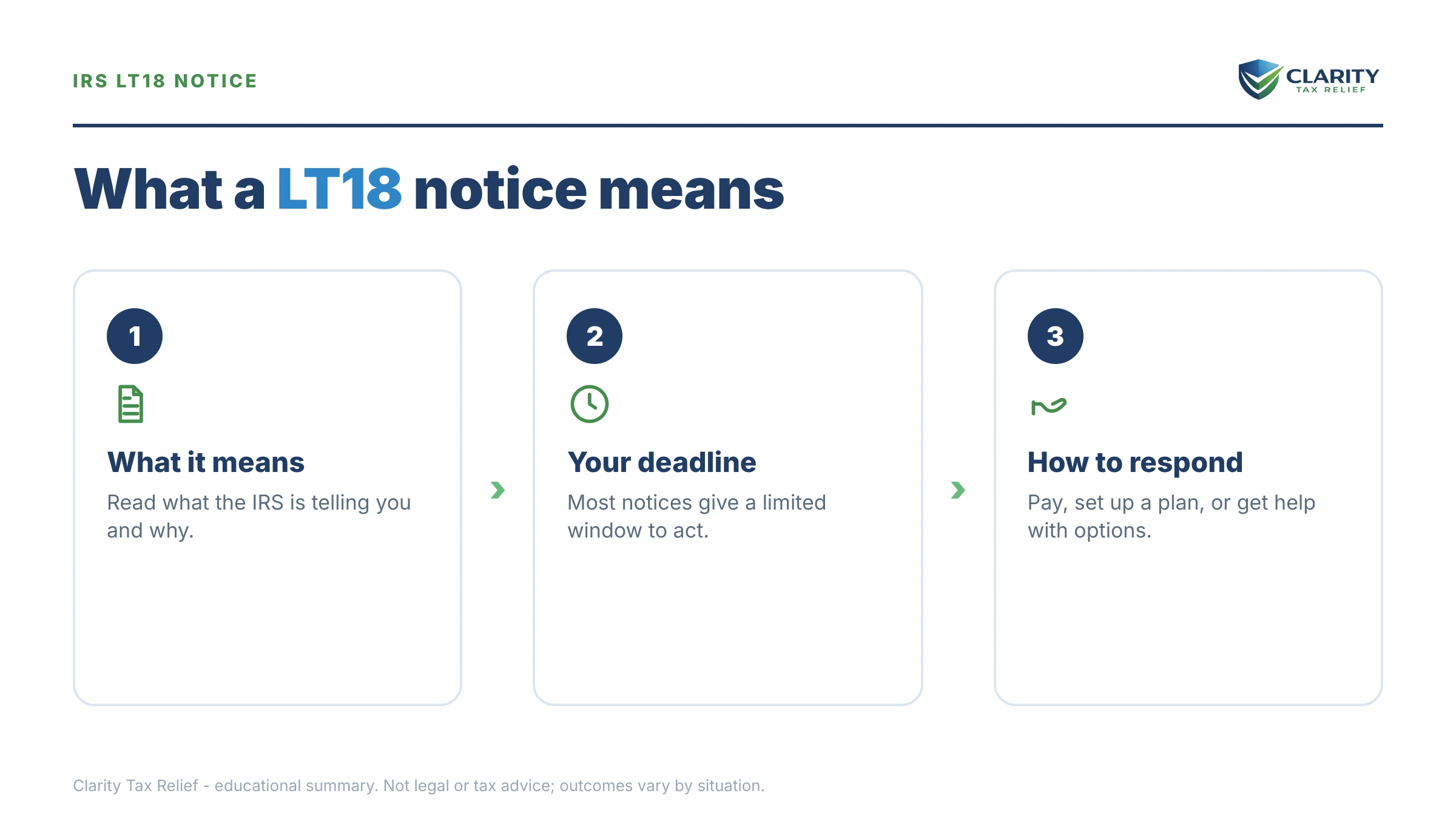
The short answer: an LT18 notice is the IRS's demand that you file one or more overdue tax returns — it is not a bill for a balance. It lists the missing tax years and gives a short response date. File those returns, or explain why you're not required to, before the IRS prepares a substitute return for you.
The LT18 is different from most IRS letters: it isn't asking for money, it's asking for paperwork. The IRS already has your W-2s and 1099s on file, sees returns that were never filed, and wants them now. That's the whole message — and the danger is what the IRS does if you stay silent.
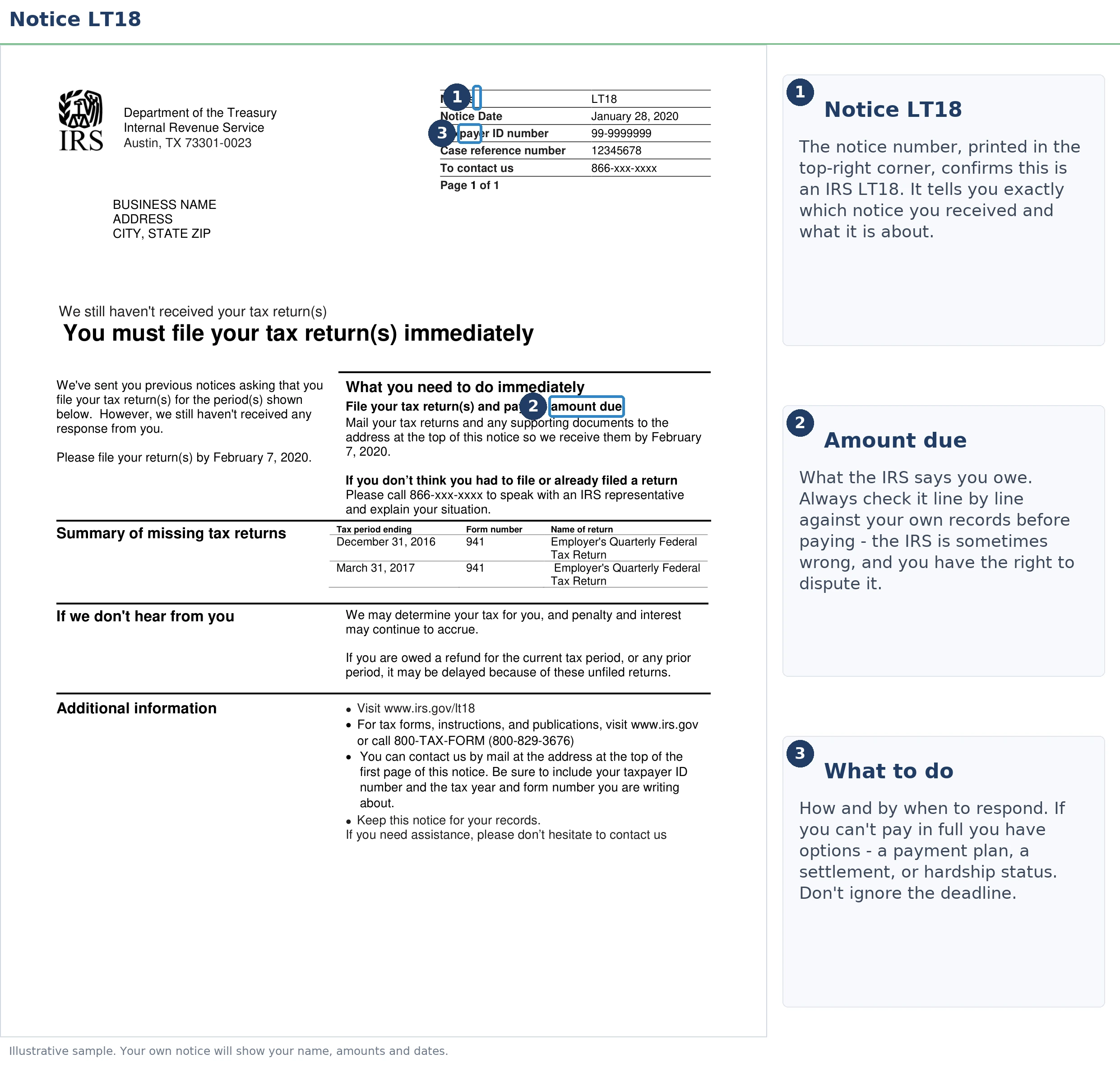
You opened the envelope, saw years listed that you'd rather forget, and your stomach dropped. That reaction is normal, and this is fixable. The image below shows exactly what an LT18 looks like and where to find the two things that matter most: the list of years and the response date.
⏱ Your deadline: the response date printed on your LT18 — often a short window of about 10 days. Miss it and the IRS can build a Substitute for Return against you, taxing your full reported income with zero deductions. The failure-to-file penalty runs 5% of the unpaid tax per month, up to 25%, so every month unfiled costs you.
Why you got an LT18 notice
An LT18 means the IRS's records show you had a filing requirement for one or more years and no return posted. The notice comes from the Automated Collection System — a computer, not a person — which cross-matches the income documents third parties reported under your Social Security number against the returns on file. When those don't line up, the letter goes out.
For gig and 1099 workers, this is the most common trigger. Every platform you drove, delivered, or freelanced for filed a 1099 with the IRS. If you never filed a return reporting that income, the IRS sees a large gap and wants it closed. If you're not sure why the letter arrived at all, our hub on why you got a letter from the IRS maps the full notice landscape.
One thing an LT18 is not: an audit or a balance-due bill. Compare it to the LT19 notice, which says "pay the amount you owe," or the LT16 notice, which pushes on both a balance and missing returns. The LT18 is squarely about getting your unfiled returns into the system.
What happens if you ignore it
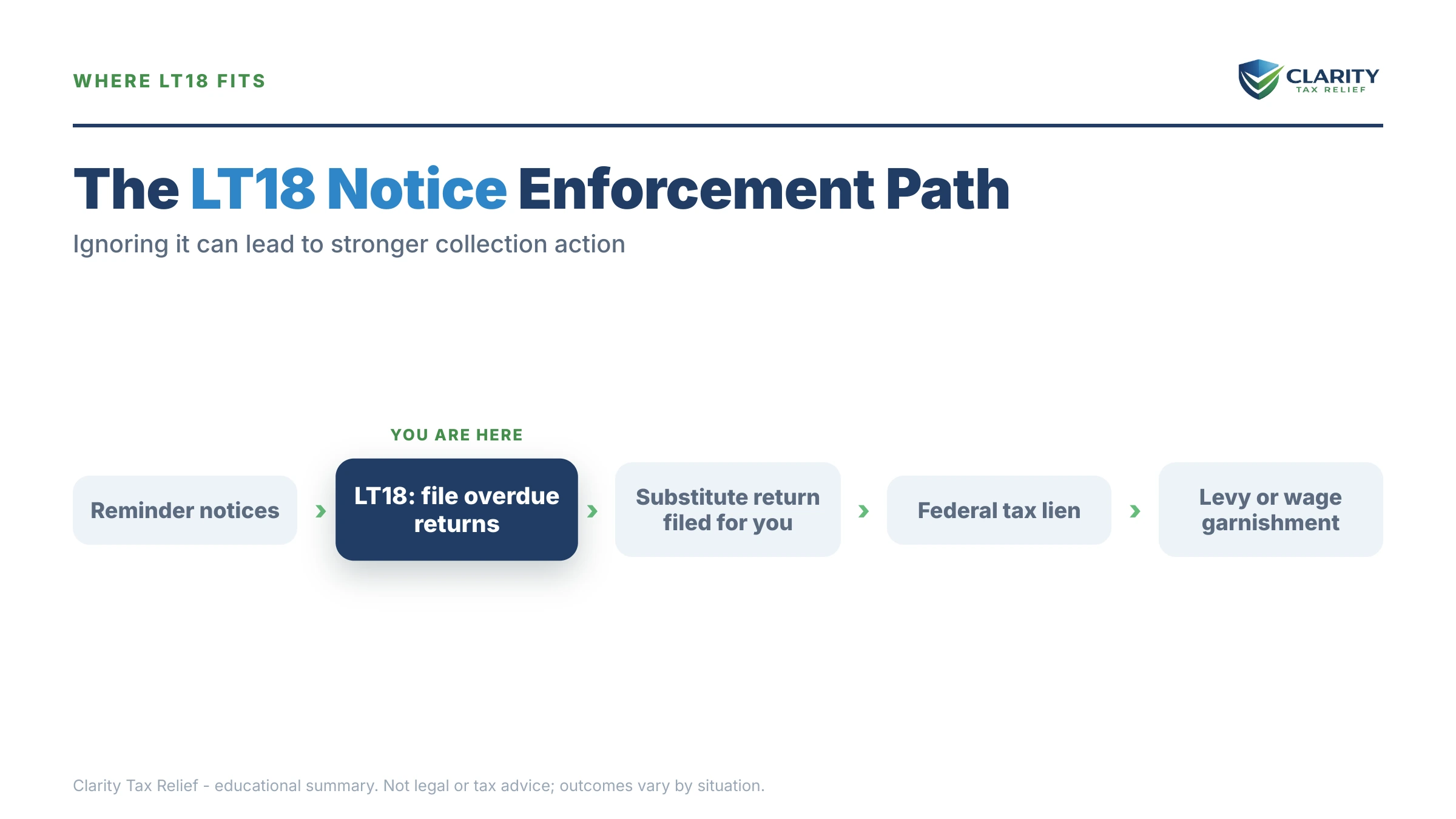
Ignore an LT18 and the IRS eventually files for you — badly. The consequence isn't a fine for silence; it's that the IRS builds a return using only the income it can see, giving you none of the deductions or credits that would lower the bill. That sequence runs on autopilot:
- LT18 — demand for overdue returns. You are here. No balance assessed yet.
- Substitute for Return (SFR) — the IRS prepares returns from your 1099/W-2 data only: no business expenses, no dependents, filing status set to the least favorable option. The number is almost always higher than your real liability.
- CP3219N — Notice of Deficiency — a proposed assessment based on the SFR. You get 90 days to file the real return or petition Tax Court before it becomes final.
- Assessment & collection — once the SFR balance is assessed, it flows into the collection machine: balance-due notices, then a final notice of intent to levy (LT11), then wage garnishment and bank levies.
In 2026 this matters more than it used to. IRS staffing was cut roughly 27% in 2025, but the SFR and levy programs are automated — they never stopped. The machine keeps building substitute returns and issuing notices whether or not a human ever reviews your file. Filing the real returns is the only thing that stops it.
Got an LT18 with a response date closing in?
Send us a photo of the notice. An experienced tax professional will confirm exactly which years the IRS wants and map the fastest path to file them — before a substitute return locks in a higher balance. Free, confidential, no pressure.
The LT18 escalation sequence, at a glance
The LT18 is early — but the path from here to a levy is short if nothing is filed. This table shows where the notice sits and what each stage triggers.
| Stage | What it is | What it triggers |
|---|---|---|
| CP59 | Early automated "return not filed" notice | First request; no assessment |
| LT18 / LT26 | ACS demand for overdue returns | Short response window; SFR begins if ignored |
| Substitute for Return | IRS-prepared return, no deductions | Inflated proposed balance |
| CP3219N | Notice of Deficiency for non-filers | 90 days to file real return or petition Tax Court |
| Assessment → LT11 | Balance assessed, then final levy notice | Wage garnishment & bank levies possible after 30 days |
If a revenue officer gets assigned instead, the demand can arrive as an in-person or letter contact and may include a request for financials — that's the world of the LT24 notice, which asks for a completed Form 433. An LT18 in the mail means you're still in the automated lane, where you have more room to act.
First: file the returns — then deal with any balance
The single most important response to an LT18 is to file accurate returns, because your real return almost always beats the IRS's substitute. You claim your business expenses, the correct filing status, dependents, and credits — none of which an SFR gives you.
You don't need every receipt to start. Pull your IRS wage and income transcript for each year; it lists every W-2 and 1099 the IRS received. Even if you filed nothing and kept nothing, that transcript is usually enough to reconstruct income, and bank or payment-app history fills in expenses. If your records are truly gone, our guide on filing back taxes without records walks through reconstruction.
Note the six-year rule: IRS policy generally treats filing the last six years of returns as bringing you into good standing, and the agency usually requires that before approving any payment plan or settlement. If you've been out of the system for years, our walkthrough on voluntarily filing old tax returns shows how coming forward first protects you.
Your options once the returns are filed
Filing the returns tells you the real number. If it turns out you owe, you have the full menu of IRS resolution programs — each with its own eligibility line.
| Option | Who it fits | Key threshold / cost |
|---|---|---|
| Pay in full | You can cover the balance now | Stops penalties & interest immediately |
| Streamlined installment agreement | Balance ≤ $50,000 | Up to 72 months; interest keeps accruing |
| Currently Not Collectible | Paying anything causes hardship | Collection paused; debt remains |
| Offer in Compromise | Assets + income can't cover the debt | $205 fee (waived if low-income); ~1 in 5 accepted |
| Penalty abatement | Clean prior 3 years or reasonable cause | Removes failure-to-file / failure-to-pay penalties |
A word on penalties, since unfiled years pile them up fast: the failure-to-file penalty is 10 times the failure-to-pay penalty — 5% per month versus 0.5% — which is exactly why filing beats waiting even if you can't pay a dime. You can estimate what's accruing with our IRS penalty and interest calculator before you decide on a plan.
A worked example: three unfiled gig years
Say you drove and delivered for platforms across three years, never filed, and the IRS's substitute returns now say you owe $83,100. Those SFRs counted every dollar the apps reported on your 1099s as taxable income — with zero deductions for mileage, phone, hot bags, or supplies, and filed you as single with only the standard deduction. That's how the number got so large.
Now file the real returns. Say each year you had $95,000 in gross platform payments and $30,000 in legitimate, documentable business expenses — mostly mileage. Your net self-employment income drops to about $65,000 a year, and both the income tax and the self-employment tax on it fall with it. The real three-year balance could land far below the SFR's $83,100 — hypothetically closer to $38,000 once the deductions are counted.
On a $38,000 balance under a streamlined agreement, spreading it over 72 months is roughly $528 a month before interest — versus the $83,100 the IRS would have chased on the substitute returns. If your income genuinely can't support that, the same filed returns are what make you a candidate for hardship status or an Offer in Compromise. The math only works in your favor once the returns exist. (Figures are hypothetical and illustrate the mechanics, not a promised result.)
How to respond, step by step
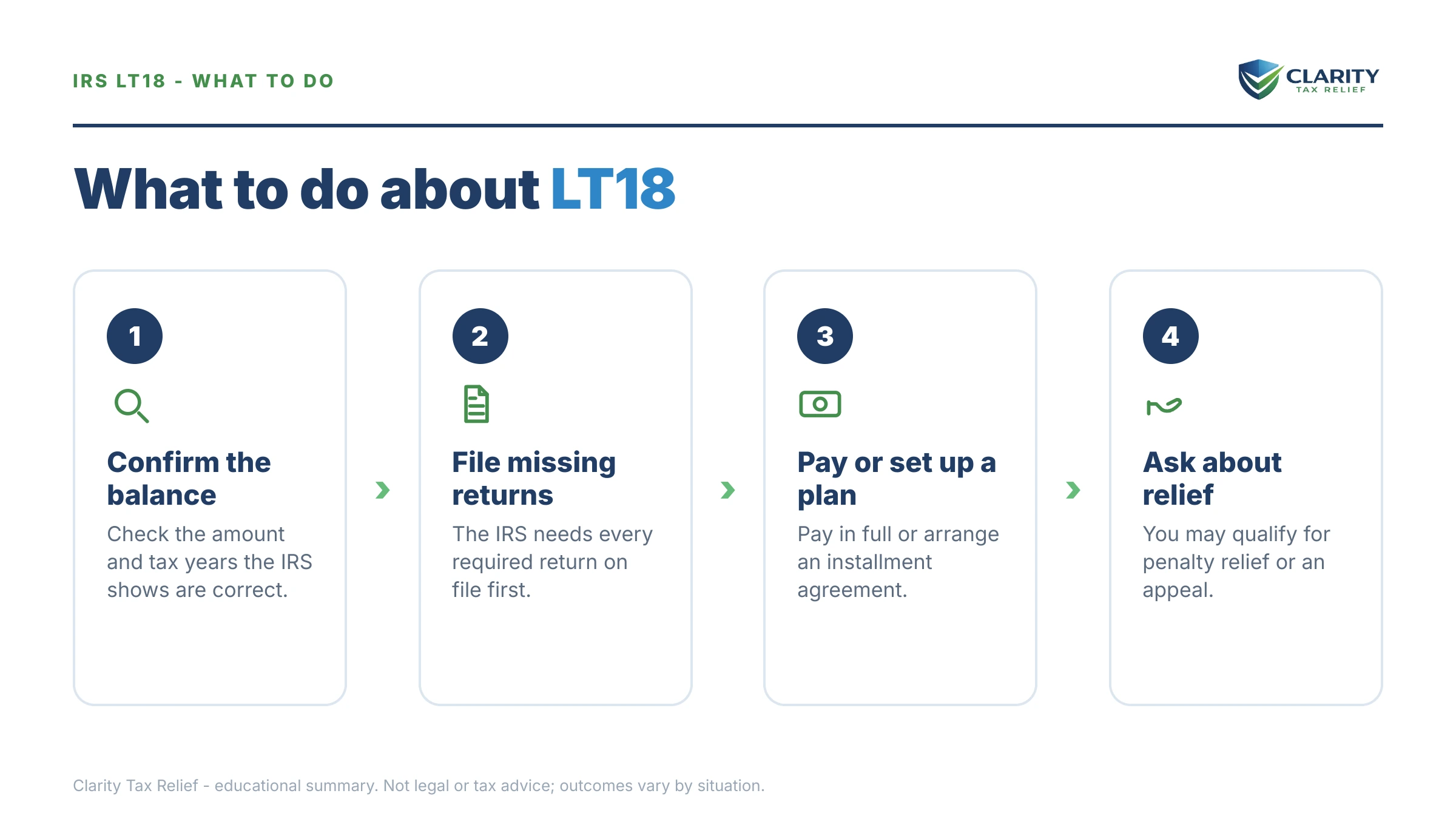
- Confirm the years — read exactly which tax years the LT18 lists and note the response date printed on the notice.
- Pull your income transcripts — order IRS wage and income transcripts for each missing year so you know every W-2 and 1099 the IRS already has.
- Prepare and file the real returns — file accurate returns claiming the deductions and credits you're entitled to; this almost always beats any substitute return the IRS would file for you.
- Respond by the notice date — file or mail the returns, or contact the IRS to explain why a year isn't required, before the response date on the LT18 to stop the substitute-return process.
- Set up a plan for any balance — if the filed returns show tax due, choose a payment plan, hardship status, or Offer in Compromise before collection escalates.
- Get help if multiple years or large balances are involved — for several unfiled years, an SFR already assessed, or a five-figure balance, have an experienced tax professional handle the filing order and resolution.
Not sure whether to handle this alone? An experienced tax professional can review your LT18 free and tell you the exact filing order before a substitute return locks in a higher number — start a free case review or call (888) 825-7779.
When you can handle an LT18 yourself
You can often handle this alone if it's one recent year with simple income, you still have your W-2s and 1099s, and the return is straightforward. File the missing return, pay or set up an online payment plan for any balance, and the LT18 resolves itself. If you're a wage earner with a single missing year, this is usually a weekend task.
Experienced help changes the outcome when the LT18 lists multiple unfiled years, when the IRS has already built substitute returns, when you're self-employed with expenses to reconstruct, or when the eventual balance runs into five figures. Filing order matters — file the wrong year first or miss a credit and you can leave money on the table or trip a deadline. If you've been out of the system for a long stretch, see haven't filed taxes in 3 years for the full catch-up strategy, and the high-income non-filer initiative if your income was substantial.
Terms on your LT18, decoded
- Substitute for Return (SFR): a return the IRS prepares for you from third-party income data only, with no deductions — nearly always higher than your real liability.
- Automated Collection System (ACS): the computerized IRS unit that issues the LT18 and escalates automatically if you don't respond.
- Notice of Deficiency (CP3219N): the letter that turns an SFR into a proposed assessment and starts a 90-day clock to file the real return or go to Tax Court.
- Failure-to-file penalty: 5% of unpaid tax per month, up to 25% — ten times the failure-to-pay penalty, which is why filing comes first.
- Refund statute: the three-year window to claim a refund on a late-filed return; miss it and any refund for that year is forfeited.
LT18 questions, answered
What is an LT18 notice from the IRS?
An LT18 is a demand from the IRS Automated Collection System for one or more overdue tax returns. It is not a bill for a balance — it lists the tax years the IRS shows as unfiled and asks you to file them or explain why you are not required to. The IRS already has your income data from W-2s and 1099s, which is how it knows a return is missing.
What happens if I ignore an LT18 notice?
If you don't respond, the IRS can prepare a Substitute for Return (SFR) for you using only the income reported on 1099s and W-2s — with no deductions, no business expenses, and the least favorable filing status. That inflated SFR becomes a proposed assessment, then a CP3219N Notice of Deficiency, and eventually a real balance the IRS can collect through levies.
How many years of returns does an LT18 make me file?
The LT18 lists the specific years the IRS is asking for, but IRS policy (IRM 4.12.1) generally treats filing the last six years as bringing you into good standing. If you have older unfiled years, you may still owe on them, but the IRS usually requires the recent six to consider a payment plan, an Offer in Compromise, or hardship status.
Can I still get a refund on the overdue returns the LT18 wants?
Only for returns filed within three years of the original due date. If a refund year is older than that, the money is gone — the IRS keeps it under the refund statute — but you still have to file. If you had withholding or estimated payments on a recent year, filing quickly can preserve a refund that offsets what you owe on other years.
What if I don't have my old income records to file?
You can pull an IRS wage and income transcript, which lists every W-2 and 1099 the IRS received for each year, and use it to reconstruct your returns. Bank statements, payment-app histories, and mileage apps fill the gaps for business expenses. Missing paperwork is never a valid reason to keep ignoring an LT18 — the transcript is usually enough to start.
Will I go to jail for the unfiled returns on my LT18?
Almost certainly not. Failure to file is usually handled as a civil matter — penalties and interest, not prosecution. Criminal charges are reserved for willful evasion involving hidden income or fraud, and voluntarily filing before the IRS refers your case is the strongest protection against that. Coming forward on your own is treated very differently than being caught.
What's the difference between an LT18, an LT26, and a CP59?
All three concern unfiled returns, but they come from different stages. A CP59 is an early automated notice that a single return is missing. An LT18 and an LT26 are firmer demands from the Automated Collection System covering one or more overdue years. If a revenue officer is assigned, the demand escalates to in-person contact — a sign your case is now being worked by a human.
Your next 24 hours
- Find two things on the notice: the list of tax years the IRS wants, and the response date printed near the top of the LT18.
- Gather what you have: any W-2s or 1099s, and log in to order your IRS wage and income transcript for each missing year.
- Get a free case review: before the response date passes and a substitute return locks in a higher balance, use the 2-minute form or call (888) 825-7779 to map your filing order.
This guide is general information, not tax or legal advice for your specific situation. Eligibility for IRS programs depends on individual facts and circumstances; no outcome is guaranteed.