
IRS Notices
IRS LT19 Notice: What It Means, Your Deadline, and What to Do (2026)
The short answer: an LT19 notice is a payment demand from the IRS Automated Collection System (ACS) — pay your unpaid balance or arrange to pay it. It is not a levy notice, but it means your account is in active collection inventory, and the ACS letters that follow it carry real enforcement power.
You saw the "LT19" in the corner, a balance you maybe half-expected, and one blunt instruction: pay the amount you owe. If you've been driving gigs on 1099s and quietly skipping tax season, this letter is the system telling you it hasn't forgotten. The good news: an LT19 notice arrives before the IRS has legal authority to touch your paycheck or bank account — which makes right now the cheapest moment you'll get to fix this.
Two details on the letter matter more than everything else: the balance for each tax year listed, and the pay-by date near the top. The image below shows exactly what an LT19 looks like and where to find both. (Not sure why the IRS is writing to you at all? Start with our guide to why did I get a letter from the IRS.)
⏱ Your deadline: the response date printed on your LT19 — use the one on your letter, because the window isn't the same for every account. The real ongoing clock: the 0.5% monthly failure-to-pay penalty plus daily-compounding interest keeps growing after that date, and ACS queues the next, more forceful letter automatically.
Why you got an LT19 notice
An LT19 means your unpaid balance has moved into the IRS Automated Collection System — the enforcement unit that ultimately issues levies, not the service center that mails routine bills. That "LT" prefix is the tell. CP-series bills like a CP14 come from return-processing computers; LT-series letters come from ACS, the arm of the IRS with levy authority once the required warnings run out.
The balance itself usually traces to one of three things: a return you filed with tax you couldn't pay, penalties and interest stacked on an old balance, or — very common when you have unfiled years — an assessment the IRS created for you. When you skip filing, the IRS can eventually file a substitute return (SFR) using only the 1099s it received, with zero business expenses, and bill you for the inflated result. For a gig worker, that means tax computed on gross app payouts as if you never bought gas.
One thing an LT19 is not: a levy or an audit. Nobody is seizing anything today, and nobody is questioning your deductions. It's a demand letter — from the unit you least want holding your file.
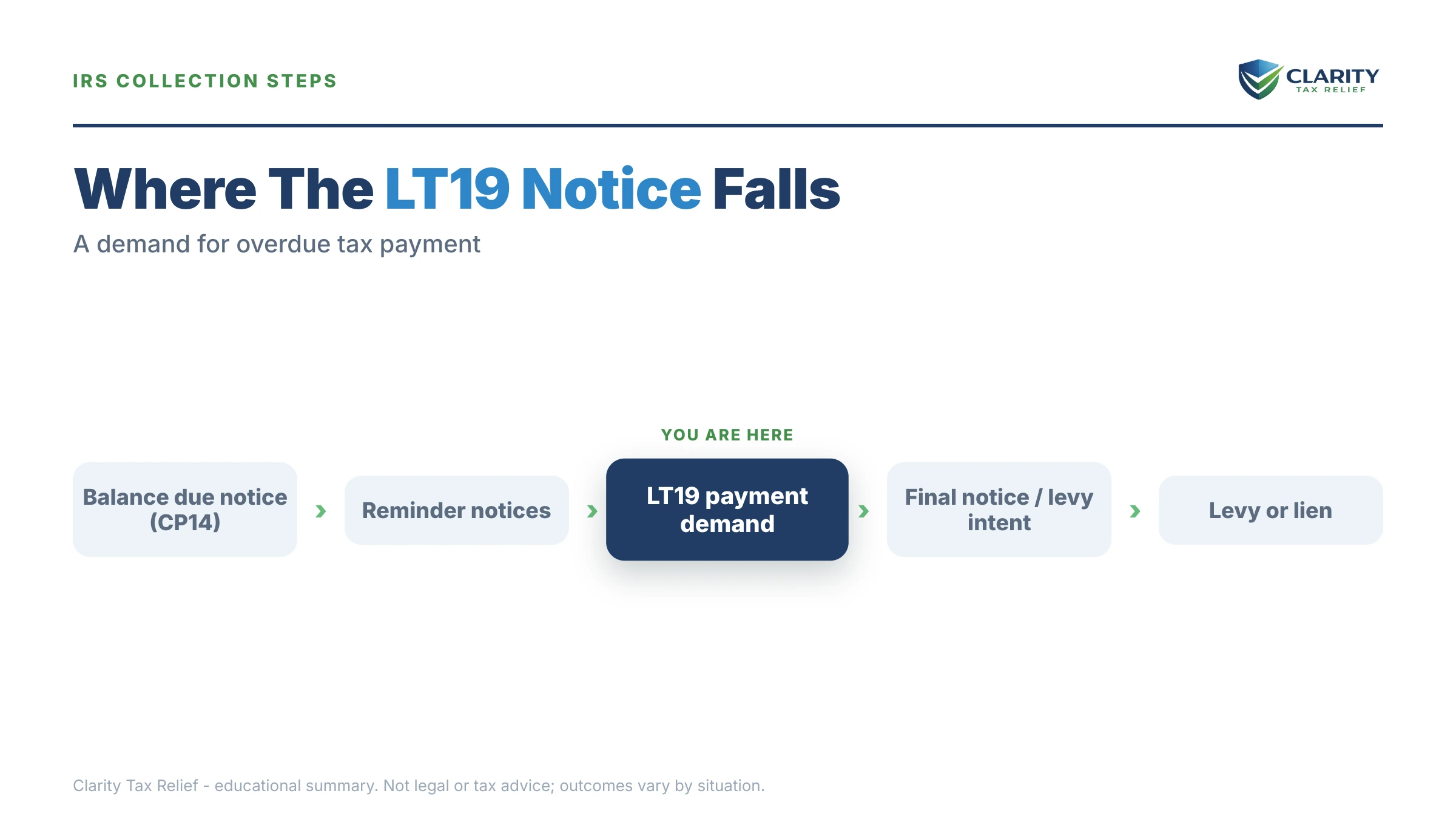
What happens if you ignore an LT19 notice
An LT19 itself cannot take your money, but the letters behind it can — the ACS sequence ends at LT11, the final notice that authorizes wage and bank levies 30 days after it's issued. The sequence is automated. IRS staffing fell roughly 27% in 2025, but the notice stream and the levies it feeds are generated by computers that never got cut. Ignoring the LT19 doesn't buy quiet; it buys escalation:
- LT19 — pay the amount you owe. You are here. A demand, not an enforcement action. Every option is still open.
- LT16 — "your tax debt requires urgent attention." Same balance, sharper language, and your account moves closer to the front of ACS's enforcement queue. See our lt16 notice guide.
- LT11 / Letter 1058 — final notice of intent to levy. This one starts a hard 30-day clock and your Collection Due Process rights (requested on Form 12153). After 30 days, the IRS can garnish wages and levy bank accounts. Full breakdown in our lt11 notice guide.
- Levy. A bank levy freezes the funds for a 21-day hold before they leave; a wage levy is continuous, paycheck after paycheck, until released. For 1099 workers, the IRS can also send levies to the apps and companies that pay you.
If you also have unfiled returns, ACS runs a parallel track: the lt18 notice and lt26 notice demand the missing returns, and ignoring those invites SFR assessments that add new balances to the pile the LT19 already covers.
| Notice | What it says | Enforcement power |
|---|---|---|
| LT19 | Pay the amount you owe or arrange to pay | None yet — a demand letter from ACS |
| LT16 | Your balance requires urgent attention | None yet — but your account is nearing the levy queue |
| LT11 / Letter 1058 | Final notice of intent to levy | Starts the 30-day clock + CDP appeal rights (Form 12153) |
| Levy (after LT11 + 30 days) | No letter — the IRS acts | Bank levy (21-day hold), continuous wage levy, levies on payers |
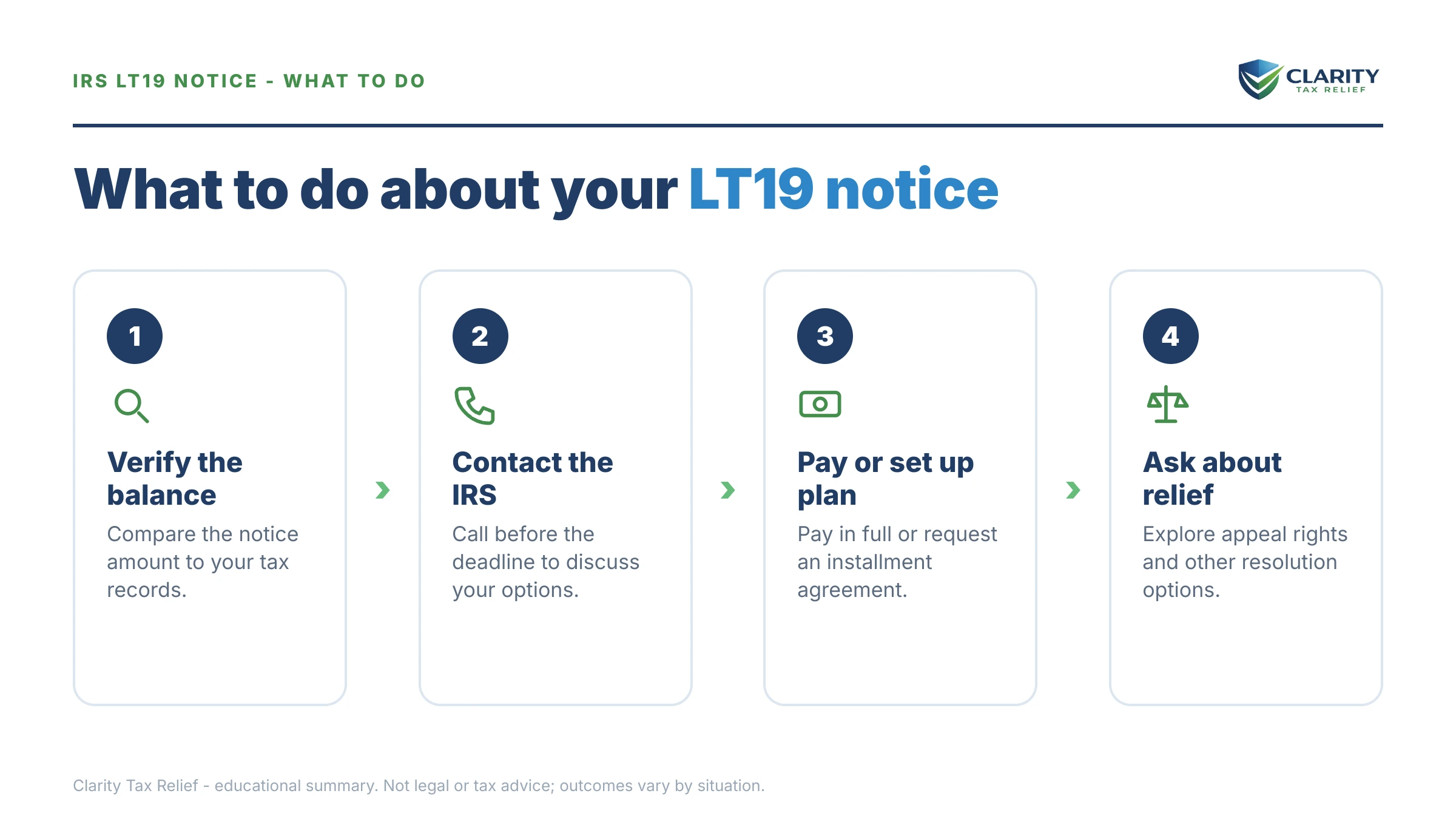
Holding an LT19 right now?
Your account is in the IRS's active collection system, and the balance grows every month it sits. Send us a photo of your LT19 — an experienced tax professional will verify what you actually owe, flag any unfiled years, and map your options before ACS sends the next letter. Free and confidential.
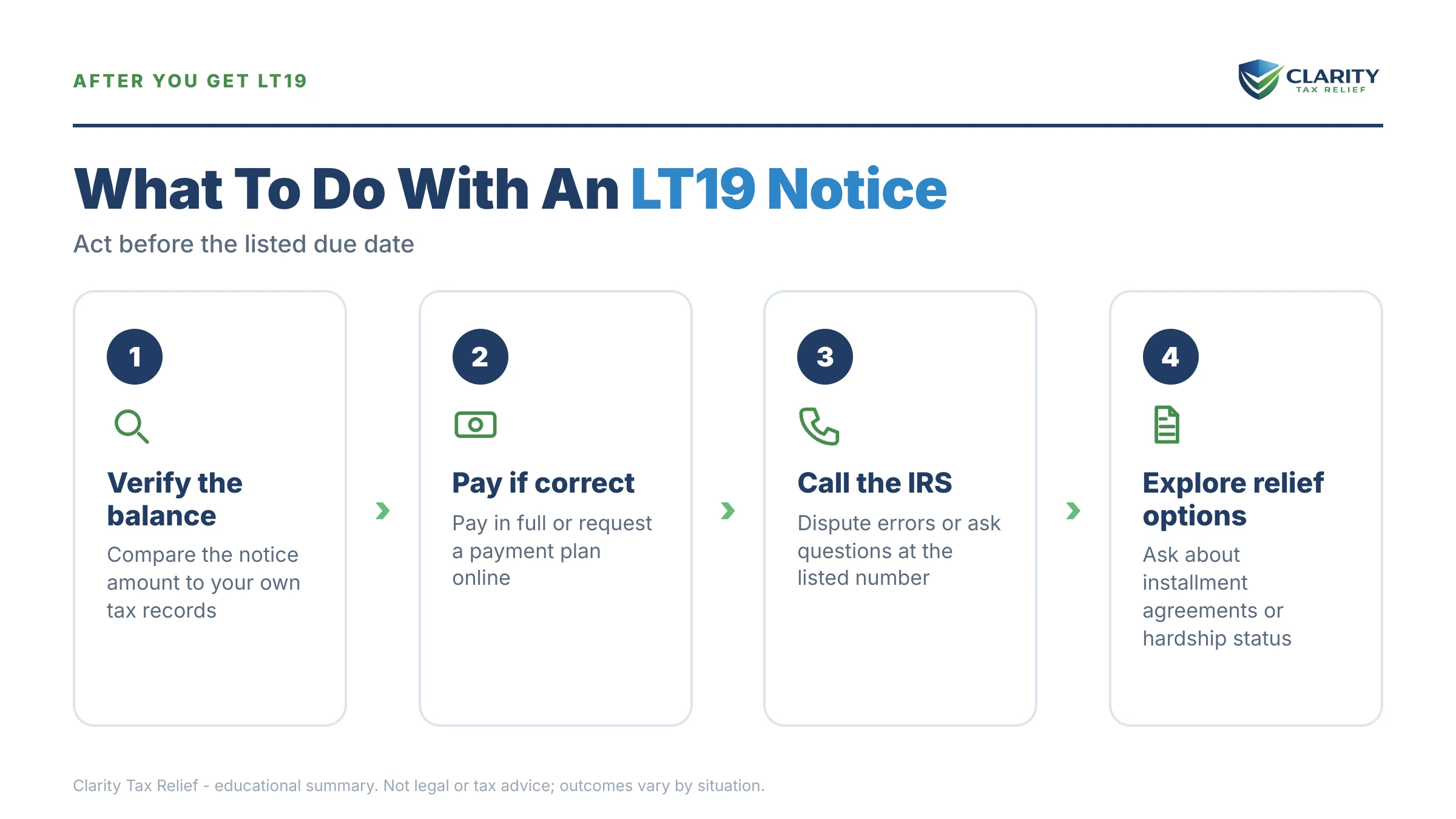
Your options for paying an LT19 balance
Any balance of $10,000 or less can qualify for a guaranteed installment agreement — if all your required returns are filed and you can pay it off within 3 years. The LT19 only offers pay-in-full, but the IRS runs a full menu of programs it doesn't print on the letter. Which one fits depends on the size of the balance and your real finances:
| Option | Who qualifies | Cost & the key catch |
|---|---|---|
| Pay in full | Anyone | Stops penalties and the notice sequence immediately |
| Short-term plan (up to 180 days) | Can pay everything within 180 days | $0 setup; interest + penalties keep accruing until paid |
| Guaranteed installment agreement | Owe ≤ $10,000, all returns filed, pay within 3 years | IRS must accept if criteria are met; setup fee applies |
| Streamlined installment agreement | Owe ≤ $50,000; set up online, up to 72 months | No detailed financials required; interest still accrues |
| Currently Not Collectible | Paying anything would create genuine hardship (Form 433-F) | Pauses collection; debt and interest remain, IRS reviews periodically |
| Offer in Compromise | Income + assets genuinely can't cover the debt; all returns filed | $205 fee, 20% down on lump-sum offers (both waived with low-income certification); ~1 in 5 accepted in FY2024 |
| Penalty relief (FTA / reasonable cause) | Clean compliance the prior 3 years, or circumstances beyond your control | Removes penalties, not tax; starting summer 2026, Automatic Exemption from Penalty (AEP) applies some relief with no request needed |
A worked example — say you owe $8,900. This is a hypothetical, but it's the math the LT19 is running against you. At $8,900 you're under the $10,000 line, so once your returns are filed, a guaranteed installment agreement paid over 36 months runs roughly $247 a month ($8,900 ÷ 36), plus the interest and 0.5% monthly failure-to-pay penalty that continue on the shrinking balance. Meanwhile, doing nothing costs about $44.50 a month in failure-to-pay penalty alone ($8,900 × 0.5%), before interest — and if any of that $8,900 sits on an unfiled year, the failure-to-file penalty runs 5% a month, about $445, until it caps at 25% ($2,225). You can rough out your own accrual with our Penalty & Interest Calculator — it estimates, it doesn't promise.
LT19 with unfiled returns: file first, then deal with the balance
The IRS will not approve a payment plan, hardship status, or an Offer in Compromise while you have unfiled required returns. If you're a gig worker with, say, three years unfiled, this is the trap hidden inside the LT19: you can't resolve the balance it demands until the missing returns are in. Our guide to haven't filed in 3 years walks the catch-up process end to end.
Filing first isn't just a hoop — it usually helps you three ways:
- It can shrink the LT19 balance. If the amount came from an SFR built on gross 1099s, filing your real return with mileage, phone, and supply deductions replaces the inflated assessment with your actual tax.
- It stops the worst penalty. The failure-to-file penalty is 5% per month — ten times the 0.5% failure-to-pay rate. Filing even with no payment attached switches you to the cheaper penalty. The math is in failure to file penalty vs failure to pay.
- It can recover money. Refunds expire 3 years after the return's due date. If withholding or credits sat in any recent unfiled year, filing now can capture that refund and apply it against the LT19 balance — wait too long and it's gone permanently.
Order matters: returns first, then penalty relief, then the payment arrangement. Set the plan up before filing and the new assessments from your late returns can default it.
How to respond to an LT19 notice, step by step
- Verify the balance — log into your IRS online account and compare it against the LT19: same tax year, same amount, recent payments posted.
- Check your filing status for every year — pull your account transcripts and list any unfiled years; nothing gets approved until required returns are in.
- File anything that's missing — prepare the unfiled returns with your real income and expenses, even if you can't pay, because filing stops the 5%-per-month failure-to-file penalty.
- Pick and set up your payment option — pay in full at IRS.gov/payments if you can; otherwise set up a short-term plan, an installment agreement, or request hardship status before ACS escalates. Here's how to set up an IRS payment plan online.
- Request penalty relief — ask about first time penalty abatement or reasonable-cause relief once you're compliant; removed penalties directly shrink the balance on future notices.
- Get a professional review if the pieces are tangled — multiple unfiled years, an SFR assessment, or income the IRS reconstructed wrong are exactly where sequencing changes what you end up paying.
What your transcript shows alongside an LT19
The transaction codes on your IRS account transcript tell you where the LT19 balance came from and what stage collection has reached. Before you commit to any plan, ten minutes with your transcript answers questions the notice doesn't:
| Code | What it means | What to do |
|---|---|---|
| 150 | Tax assessed — from your return, or from an SFR if you never filed that year | If you didn't file it, compare the figures; filing your real return can replace an inflated SFR |
| 971 | Notice issued — your LT19 (and prior letters) log here | Note the dates; they show how fast your account is moving through ACS |
| 276 | Failure-to-pay penalty assessed | Flag it for a First-Time Abatement or reasonable-cause request once compliant |
| 196 | Interest charged to the account | Interest rarely gets waived — the fix is stopping the accrual sooner |
| 599 | Return secured — the IRS received a late-filed return | Confirms your catch-up filings posted; keep copies until the balance updates |
| 530 | Account in Currently Not Collectible status | If it's already there, an LT19 may signal the IRS is re-reviewing your hardship status |
When you can handle an LT19 yourself
Plenty of LT19s never need professional help. If the balance is accurate, all your returns are filed, and you can either pay within 180 days or comfortably carry a streamlined monthly payment, set it up online yourself — the process takes under an hour and there's nothing a firm would add except a fee.
Experienced help changes outcomes in specific situations: multiple years unfiled (the returns must be built from wage-and-income transcripts and reconstructed expenses, and filing order affects penalties), an SFR assessment you want replaced, a balance you dispute, self-employment income the IRS overstated, or a hardship or Offer in Compromise case where the financial-disclosure math decides everything. If the LT11 has already arrived behind your LT19, the 30-day appeal window makes professional timing genuinely valuable.
Terms on your LT19, decoded
- ACS (Automated Collection System): the IRS's computerized collection unit — the sender of every LT-series letter and the issuer of most levies.
- Levy vs. lien: a levy takes property (wages, bank funds); a lien is a legal claim against what you own, filed to protect the government's position.
- CSED: the Collection Statute Expiration Date — the IRS generally has 10 years from assessment to collect, though appeals, offers, and bankruptcy pause the clock.
- Statutory additions: the penalties and interest the law tacks onto the tax — the reason the LT19 figure is bigger than the tax you skipped.
- SFR (Substitute for Return): a return the IRS files for you from 1099s and W-2s alone, with no deductions — often the source of a gig worker's LT19 balance.
- CDP rights: Collection Due Process — the formal appeal (Form 12153) that becomes available when the final levy notice, LT11, arrives.
LT19 questions, answered
Is an LT19 notice serious?
Yes — more serious than a CP-series bill, because it means your account is in the IRS Automated Collection System, the unit that actually issues levies. Nothing can be seized based on the LT19 itself, but you are typically only one or two letters away from LT11, the final notice that authorizes wage and bank levies after 30 days.
Is an LT19 an intent to levy?
No. An LT19 is a payment demand, not a levy notice, and it does not start the 30-day Collection Due Process clock. The final notice of intent to levy is the LT11 or Letter 1058 — that one gives the IRS legal authority to levy wages and bank accounts 30 days later. The LT19 is your warning that the LT11 is coming if you don't act.
Why did I get an LT19 instead of a CP501 or CP504?
The letter prefix tells you which IRS unit is handling your account. CP notices come from the service-center computers; LT notices come from the Automated Collection System (ACS), the enforcement arm. Some accounts route to ACS quickly — common with self-employment balances and accounts that also have unfiled returns — so an LT19 can arrive without your ever seeing a CP504.
Can I set up a payment plan after getting an LT19?
Yes — an LT19 does not block any payment option. If you owe $10,000 or less, meet basic compliance tests, and can pay within 3 years, you may qualify for a guaranteed installment agreement; balances up to $50,000 can usually be set up online for as long as 72 months. The one hard prerequisite is that all your required returns must be filed first.
What if I can't pay the amount on my LT19 at all?
The LT19 only offers pay-in-full, but the IRS has hardship options it doesn't print on the notice. Currently Not Collectible status pauses collection if paying would leave you unable to cover basic living expenses, and an Offer in Compromise can settle for less when your income and assets genuinely can't cover the debt — the IRS accepted roughly 1 in 5 offers in FY2024, so eligibility is real but means-tested. Both require filed returns and financial documentation.
Will the IRS levy my bank account after an LT19?
Not based on the LT19 alone. Before levying a bank account or paycheck, the IRS must first send a final notice of intent to levy — the LT11 or Letter 1058 — and then wait 30 days while you can request a Collection Due Process hearing. Ignoring the LT19 is what moves your account toward that final notice, and once a bank levy hits, the bank holds your funds for 21 days before sending them to the IRS.
Do I have to file my old returns before the IRS will accept a payment plan?
Yes. The IRS will not approve an installment agreement, Currently Not Collectible status, or an Offer in Compromise while required returns are unfiled — filing compliance is the entry ticket to every resolution program. There's a hidden upside: filing old self-employed returns with your real expenses often reduces the balance the IRS assessed, and any refund year within the 3-year claim window can offset what you owe.
How do I know my LT19 is real and not a scam?
A genuine LT19 arrives by postal mail with your name, the tax year, and a specific balance — the IRS never sends first contact by email, text, or social media. Verify the balance yourself by logging into your IRS online account at IRS.gov before paying anything. Real payments go only to the United States Treasury or through IRS.gov; anyone demanding gift cards, wire transfers, or payment apps is a criminal.
Your next 24 hours
- Find two things on your LT19: the total balance by tax year, and the response date printed near the top — that date, not a generic rule, is your working deadline.
- Gather your records: the notice, your last filed return, your 1099s and income records for any unfiled years, and a login (or new account) at your IRS online account to verify the balance.
- Get your LT19 reviewed free: call (888) 825-7779 or use the 2-minute form. Your account is in active ACS collection and penalties and interest accrue monthly — the earlier the plan is in place, the less the sequence behind this letter ever costs you.
For the IRS's own payment channels and plan terms, see IRS.gov/payments and the IRS payment plans page. If collection is causing hardship the IRS won't address, the independent Taxpayer Advocate Service can intervene.
This guide is general information, not tax or legal advice for your specific situation. Eligibility for IRS programs depends on individual facts and circumstances; no outcome is guaranteed.