
IRS Notices
IRS LT26 Notice: What It Means and How to File Your Overdue Returns (2026)
The short answer: an LT26 notice means the IRS still has no record of one or more tax returns it has already asked you to file. The letter lists the missing tax years and a file-by date. File your own returns by that date — or the IRS can build a substitute return that ignores your deductions and credits.
You're looking at a letter that isn't a bill at all — there may be no dollar amount on it — just a list of tax years and a demand to file. That's the strange part of an LT26: the IRS isn't telling you what you owe, because until a return exists, nobody knows. And this isn't the first ask. An LT26 only goes out after earlier requests went unanswered, which is exactly why this one deserves a real response.
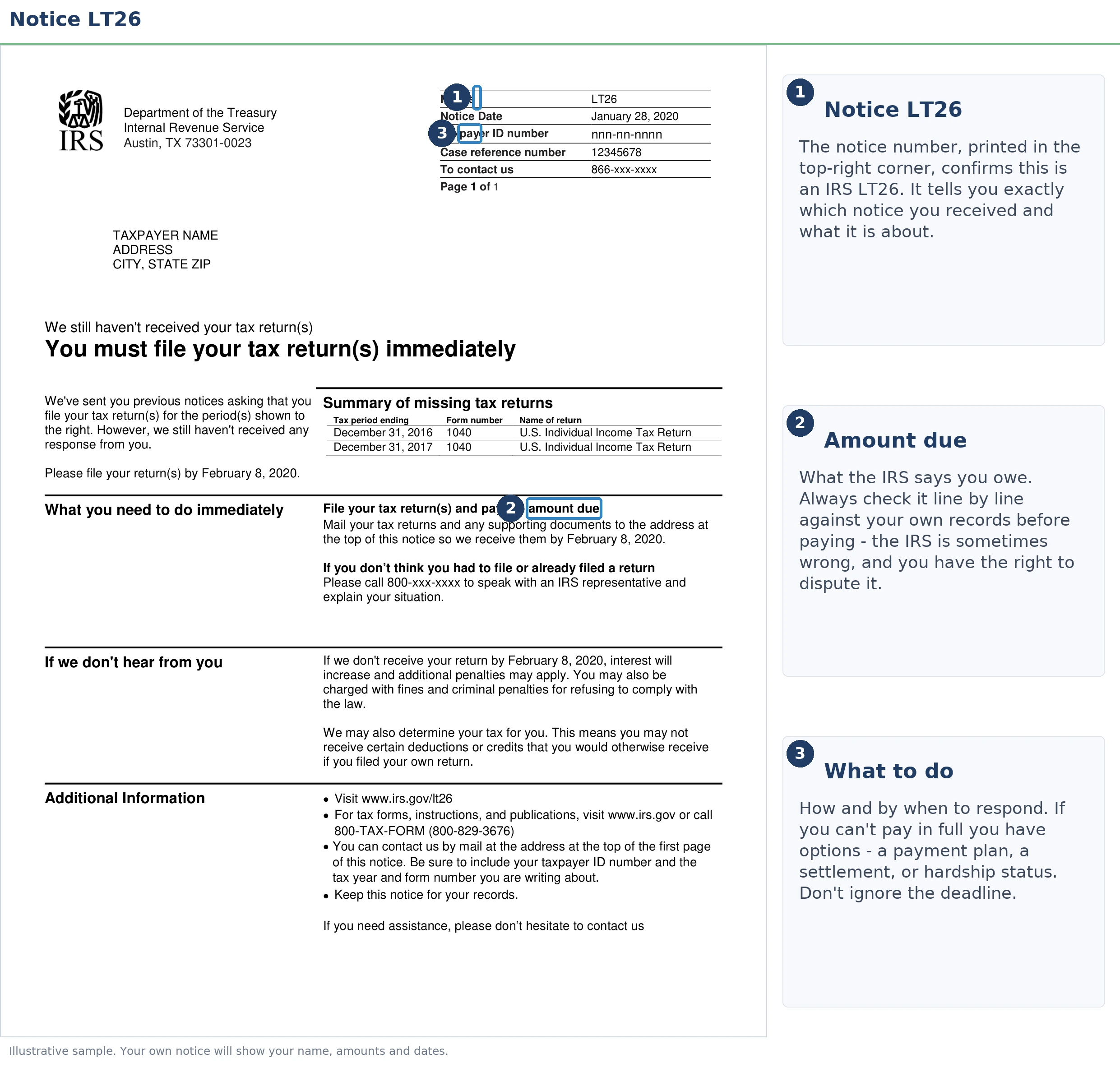
The image below shows exactly what an LT26 looks like and where to find the two details that control everything: the tax periods the IRS wants and the file-by date printed on your copy.
⏱ Your deadline: the file-by date printed on your LT26 — the letter sets a short response window, and the exact date on your copy controls. Once it passes, the IRS can prepare a substitute return under IRC §6020(b), and on any year with unpaid tax, the failure-to-file penalty keeps building at 5% per month, up to 25%.
Why you got an LT26 notice
An LT26 notice means the IRS has requested one or more overdue tax returns before — and still has no record of receiving them. It comes from the Automated Collection System (ACS), the enforcement side of the house, after earlier non-filer notices like the CP59 no-return-filed notice, the CP518 final unfiled notice, or an LT18 notice went unanswered. Think of it as the "we're done reminding you" letter.
The IRS knows the years are missing because your income was reported to it independently. Your employer filed your W-2; banks and brokers filed 1099s. When those documents exist under your SSN and no return shows up, the non-filer system opens a case automatically — no human decided to target you.
An LT26 lands for a few distinct reasons: you genuinely never filed; you mailed a paper return that was never processed; you weren't actually required to file that year; or a return was filed under a mismatched name or SSN. An LT26 is a follow-up demand — the IRS has already asked at least once and logged your silence. If you want the bigger picture of how IRS letters work in general, our guide to why you got a letter from the IRS covers the whole system; this page covers only the LT26.
What happens if you ignore an LT26
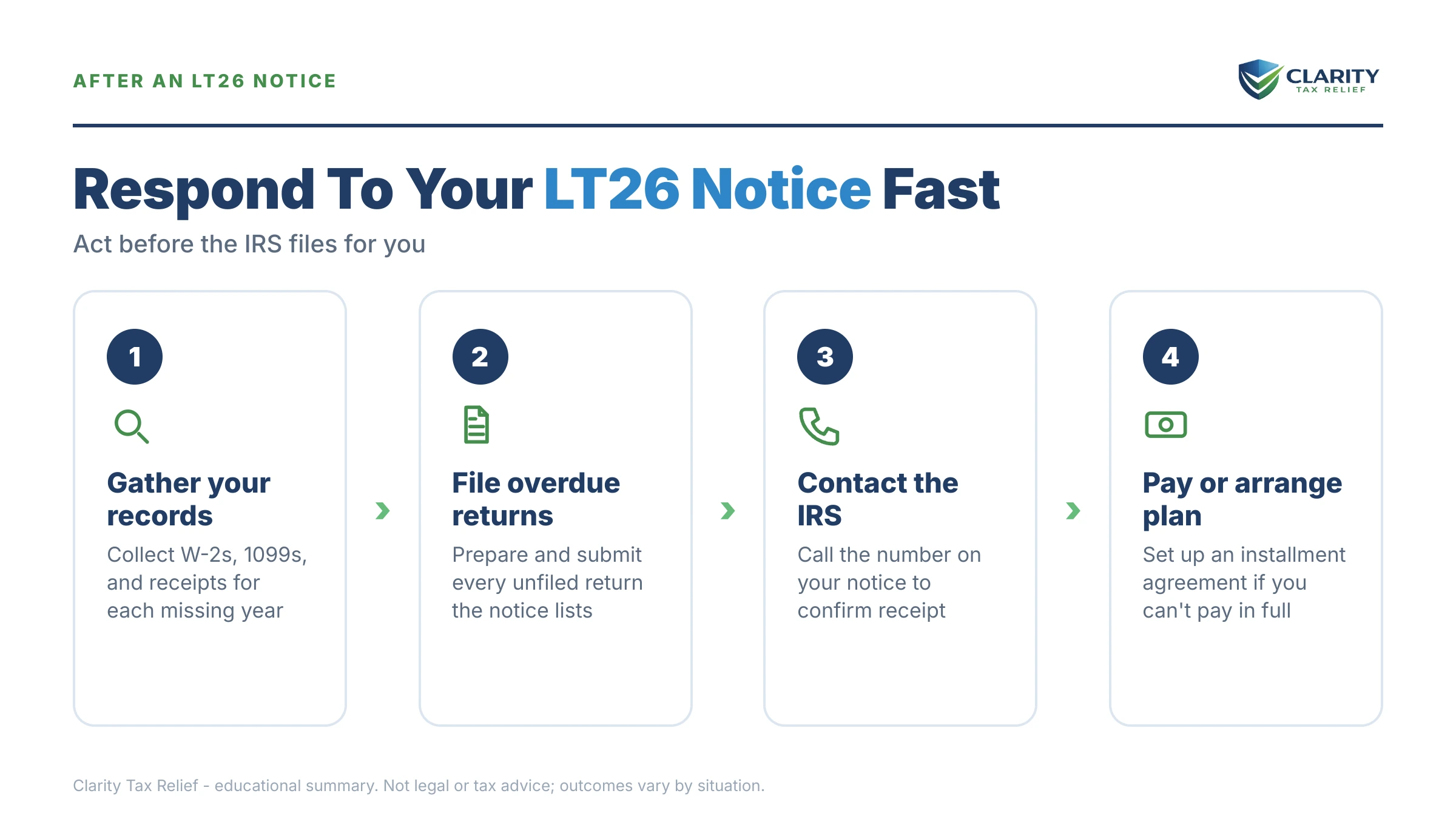
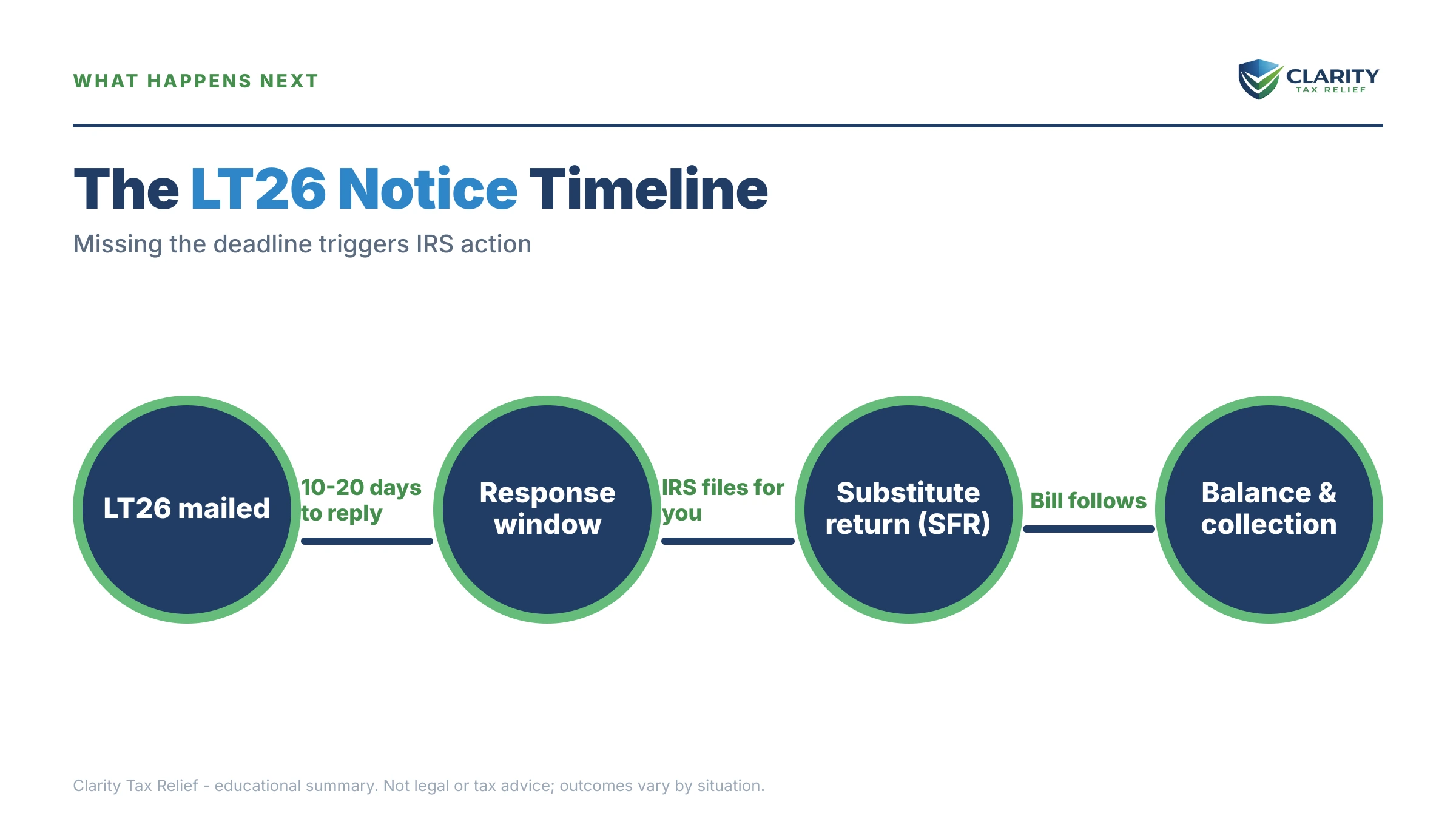
Ignoring an LT26 hands the IRS permission to file your return for you — a Substitute for Return under IRC §6020(b), built on worst-case math. The sequence that follows is automated, and each stage takes away something you still have today:
- The file-by date passes. Your case stays in ACS inventory. On any year where tax is unpaid, the failure-to-file penalty keeps accruing — it stops accruing after five months — a combined 25% cap with the failure-to-pay penalty, since in overlapping months the filing penalty is reduced to 4.5% (netting 22.5% filing plus 2.5% payment penalty), and interest compounds on top.
- The IRS builds a substitute return. Using only the W-2s and 1099s on file, it computes tax with single or married-filing-separately status, the standard deduction, and zero credits, then proposes the assessment — typically on a CP2566 notice. If the IRS filed a substitute return for you, the number is almost always higher than reality.
- CP3219N — the deficiency notice. The CP3219N for non-filers gives you 90 days to petition Tax Court before the substitute-return amount becomes a legal assessment. Silence here converts an estimate into a debt.
- Assessment and collection. Balance-due notices begin, escalating toward intent-to-levy letters and ultimately the LT11 notice — the final notice that opens the door to wage garnishment and bank levies 30 days later. Any current-year refunds can be held against the missing years along the way.
Two quieter losses run alongside that sequence. First, an unfiled year never closes — the normal statute of limitations on assessment doesn't start until a return is filed, so the year stays open indefinitely. Second, if the missing year would have produced a refund, the three-year window to claim it is ticking, and it expires whether or not the IRS ever escalates.
| Stage | What the IRS does | What it means for you |
|---|---|---|
| LT26 (you are here) | Demands the listed returns by the file-by date | No assessment yet — you still control the numbers |
| File-by date passes | Case queued for substitute-return processing | Failure-to-file penalty accrues at 5%/month on unpaid tax |
| Substitute return / CP2566 | Computes tax from W-2s and 1099s, no deductions or credits | Proposed balance is usually inflated versus a real return |
| CP3219N deficiency notice | Gives 90 days to petition Tax Court | Last stop before the estimate becomes a legal debt |
| Assessment → LT11 → levy | Bills the balance, then moves to final levy notice | Wages, bank accounts, and refunds become reachable |
Holding an LT26 for years you never filed?
Send us a photo of the letter before its file-by date passes. An experienced tax professional will confirm exactly which years the IRS wants, what its income records show for you, and the fastest way back to compliance — free, confidential, no pressure.
Your options after an LT26 notice
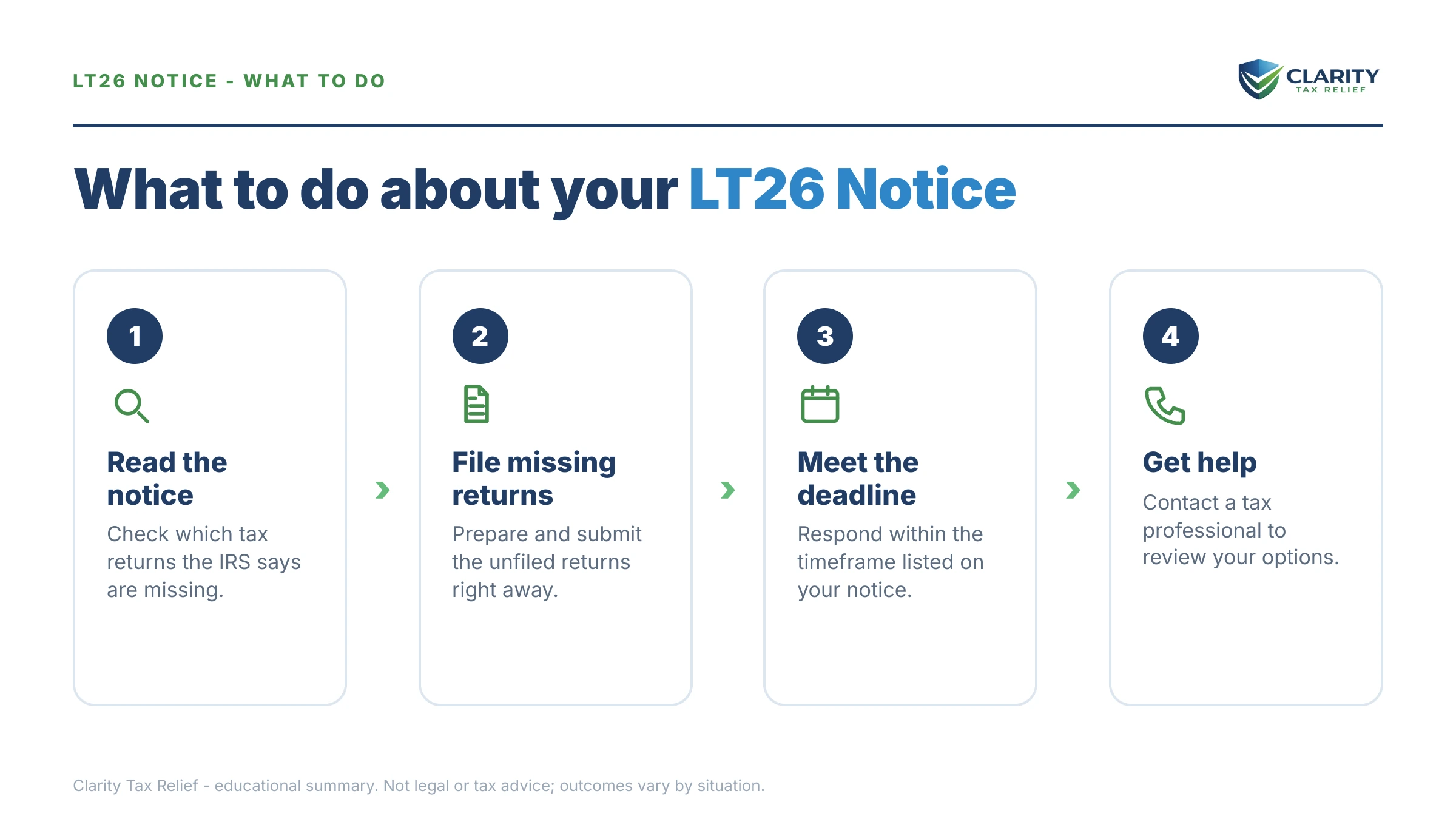
Every path out of an LT26 starts the same way: getting a signed return on file for each year the letter lists. The options differ only in what happens next.
- File the missing returns — with your numbers. This is the answer for almost everyone. Your own return captures your withholding, deductions, and credits; a substitute return captures none of them. If more years are missing than the letter lists, IRS policy generally treats the last six years of returns as the compliance standard — our guide to how many years of back taxes you have to file walks through it.
- File even if you can't pay a dime. The failure-to-file penalty is ten times the failure-to-pay penalty, so filing stops the expensive clock immediately — file even if you can't pay. Once the return posts, you can take up to 180 days to pay with no setup fee, set up a monthly installment agreement (balances under $50,000 usually qualify online for up to 72 months), or seek hardship status if paying anything is genuinely impossible.
- Ask about penalty relief. If your prior three years were clean, First-Time Abatement can remove the late-filing penalty on one year — and starting in summer 2026, the IRS's new Automatic Exemption from Penalty (AEP) begins applying qualifying relief without a request. Reasonable cause (illness, disaster, records destroyed) can cover years FTA can't.
- Already filed? Prove it. Respond by the file-by date with a signed copy of the return, your e-file acceptance, or the certified-mail receipt. Paper-return backlogs generate LT26s to people who did everything right.
- Not required to file? Say so in writing. If your income for a listed year was below the filing threshold, reply explaining why no return is due. Don't assume silence communicates that — silence reads as non-compliance.
LT26 deadlines and rights: what each date protects
Every deadline on the unfiled-return path protects a specific right, and each one disappears the day its date passes.
| Deadline | What it protects | If it passes |
|---|---|---|
| File-by date printed on your LT26 | Your right to set the numbers first — every deduction, credit, and dollar of withholding | The IRS can start a substitute return using worst-case math |
| 3 years from the return's original due date | Your refund for that year (the RSED) | The refund is forfeited permanently, even if the IRS agrees you overpaid |
| 90 days from a CP3219N | Your right to contest the substitute-return amount in Tax Court before paying | The tax is assessed; fixing it later means filing your own return and waiting through reconsideration |
| 30 days from an LT11 / Letter 1058 | Collection Due Process appeal rights before levy (requested on Form 12153) | The IRS can garnish wages and levy bank accounts |
What filing now saves you: a worked example at $83,100
Say you're a W-2 employee, single, and you never filed your 2023 return. Your wage and income transcript shows $83,100 in wages and $8,500 in federal withholding. This is hypothetical — but the math is how it actually runs.
Your real return: standard deduction, tax of roughly $10,500. Subtract the $8,500 withheld and about $2,000 went unpaid. The failure-to-file penalty is 5% of that per month — $100 a month — capped at 25%, or $500, after five months. Since the return is over a year late, the full $500 applies, plus the 0.5% monthly failure-to-pay penalty (about $10 a month; the two offset slightly in overlapping months so the combined rate never exceeds 5%) and compounding interest. Call it roughly $2,700–$2,800 total today — an amount a 180-day short-term plan with no setup fee handles cleanly. You can estimate your own penalty and interest with our IRS Penalty & Interest Calculator.
Now the substitute-return branch: the IRS's version of that same year skips whatever it can't see. Say you made a $2,800 deductible IRA contribution — the SFR ignores it, adding about $616 in tax at the 22% bracket, and every penalty percentage then compounds on the bigger number.
And the branch nobody expects: if your withholding had been $11,300 instead, your real return shows an $800 refund — meaning zero failure-to-file penalty, because the penalty is a percentage of unpaid tax and nothing is unpaid. But that refund dies three years after the return's due date — for a 2023 return, around April 2027. Plenty of W-2 non-filers who receive an LT26 are owed money and are quietly running out of time to claim it; see the 3-year refund deadline for old returns.
How to respond to an LT26 notice, step by step
- Confirm the years listed. Check the tax periods printed on your LT26 against your own filing records. The letter only covers the years it names — those are the ones with a substitute-return clock running.
- Pull your wage and income transcripts. Download them free from your IRS online account for each missing year. They show every W-2 and 1099 reported under your SSN — the same data the IRS would use to build a return against you.
- Prepare accurate returns for each missing year. Use the transcripts to rebuild your income even if your own records are gone, then add the deductions, credits, and withholding a substitute return would ignore. Prior-year returns must use that year's forms and rules.
- Send the returns exactly as the letter directs. The LT26 gives a specific address or fax number so your returns reach the collection unit holding your case — not the normal filing pipeline. Keep signed copies and proof of delivery for every year.
- Set up payment or relief if you owe. File first, then pick the arrangement that fits: a short-term plan of up to 180 days, a monthly installment agreement, or penalty relief. If you already filed, reply with proof of filing instead.
For the mechanics of step 2 and step 3, our walkthroughs of wage and income transcripts and filing back taxes with no records cover exactly how to rebuild a year from nothing.
When you can handle an LT26 yourself — and when help changes the outcome
A single missing year of straightforward W-2 income is a genuinely do-it-yourself LT26. If you have your W-2 (or can pull it from IRS Get Transcript), the return takes an evening, and any modest balance fits a payment plan you can set up online. The same goes if you already filed and just need to send proof.
Experienced help earns its cost when the situation compounds: multiple unfiled years, self-employment or 1099 income that needs expense reconstruction, a substitute return already assessed that has to be unwound, an amount you can't realistically pay even over 72 months, or levy notices from other years already arriving in parallel — the pattern behind an LT16 notice, which pairs overdue returns with an unpaid balance. In those cases, the order you fix things — returns first, then penalties, then the balance — changes what you ultimately pay, and getting it wrong locks in numbers you could have avoided.
Terms on your LT26, decoded
- Automated Collection System (ACS): the IRS's centralized collection unit that issues LT-series letters and, later in the sequence, levy notices — no local agent is assigned to your case.
- Substitute for Return (SFR): a return the IRS constructs for you from third-party income documents, with no deductions or credits beyond the standard deduction.
- IRC §6020(b): the law that authorizes the IRS to prepare and sign a return on your behalf when you don't file.
- Delinquent return: any required return filed after its due date — filing one, even years late, replaces the IRS's numbers with yours.
- Statutory notice of deficiency: the formal letter (CP3219N for non-filers) that starts your 90-day window to contest a proposed tax in Tax Court.
- Refund statute expiration date (RSED): the deadline — generally three years from the return's due date — after which an unclaimed refund is gone for good.
LT26 questions, answered
What is an IRS LT26 notice?
An LT26 is a follow-up letter from IRS collections telling you the agency still has no record of one or more tax returns it has already asked you to file. It lists the specific tax periods and sets a file-by date. It is not a bill and not an audit — but if you don't respond, the IRS can create a substitute return for each missing year and assess tax on its own numbers.
How serious is an LT26 notice?
Serious enough that it is usually the last request before the IRS starts building a return for you. Earlier notices like the CP59 were reminders; the LT26 comes from the Automated Collection System, the same unit that issues levy notices. Filing your own accurate returns by the letter's file-by date typically resolves it completely — the danger is entirely in continued silence.
Can the IRS levy my wages because of an LT26?
Not from the LT26 itself — it is a demand for returns, not a levy notice. A levy requires an assessed balance plus a final notice like the LT11 or Letter 1058, which starts a 30-day window with appeal rights. But an ignored LT26 leads to a substitute-return assessment, and that assessed balance is what eventually feeds the levy pipeline. If you also owe on other years, those collection notices may already be running in parallel.
What if I already filed the return my LT26 asks for?
Respond by the file-by date with proof instead of ignoring the letter: a signed copy of the return, your e-file acceptance confirmation, or the certified-mail receipt. Paper returns caught in processing backlogs trigger LT26 notices regularly. If you can't prove filing, sending a newly signed copy marked as a duplicate to the address on the letter is usually faster than arguing.
How many years of unfiled returns do I have to file?
IRS policy generally requires the last six years of returns to be considered back in filing compliance, though the LT26 only demands the specific periods printed on it. Start with the listed years — those are the ones with a substitute-return clock running — and then work backward if more years are missing. Years where a refund is due carry no failure-to-file penalty, so filing them costs you nothing but time.
Should I file the return if I can't pay what I owe?
Yes — always. The failure-to-file penalty runs 5% of the unpaid tax per month, ten times the 0.5% failure-to-pay penalty, so filing stops the most expensive clock even if you send no money with the return. Once the return is on file, you can get up to 180 days to pay with no setup fee, or a monthly installment agreement — balances under $50,000 can usually be set up online for up to 72 months.
What happens if the IRS files a substitute return for me?
The IRS assembles a return from the W-2s and 1099s on file, using single or married-filing-separately status, the standard deduction, and no credits — then proposes the tax on a CP2566 and, if you still don't respond, assesses it after a CP3219N. The resulting balance is almost always higher than an accurate return would show. You can still file your own return afterward to correct the numbers, but by then penalties, interest, and collection may already be in motion.
Can I still get a refund for the year listed on my LT26?
Yes, if you file in time — a refund must generally be claimed within three years of the return's original due date. Many W-2 employees who receive an LT26 actually overpaid through withholding and are owed money, not the other way around. But the deadline is unforgiving: once the three-year window closes, the refund is forfeited permanently, even if the IRS agrees you overpaid.
Your next 24 hours
- Find the tax periods and the file-by date on your LT26. They're printed near the top of the letter — write both down. Those two details define your entire to-do list.
- Gather your income records for each listed year. Log into your IRS online account, download the wage and income transcript for every missing year, and pull your last filed return for reference. If you'll owe, payment options live at IRS.gov/payments; if an IRS delay or hardship is blocking you, the Taxpayer Advocate Service exists for exactly that.
- Get a free case review before the file-by date on your letter passes. Use the 2-minute form or call (888) 825-7779 — we'll confirm what the IRS's records show for your missing years and map the fastest, cheapest route to compliant.
This guide is general information, not tax or legal advice for your specific situation. Eligibility for IRS programs depends on individual facts and circumstances; no outcome is guaranteed.