
IRS Notices
IRS LT24 Notice: What It Means, Your Form 433 Deadline, and What to Do (2026)
The short answer: an LT24 notice means the IRS received your payment proposal but won't approve it yet — it first needs a completed Collection Information Statement, usually Form 433-F, with proof of your income, expenses, and assets. Respond by the date printed on the notice, or the IRS can reject your proposed plan and resume collection.
You did the responsible thing. You contacted the IRS about the balance, offered a monthly payment you could actually live with, and figured the hard part was over. Then the LT24 landed: before anyone says yes, the IRS wants a signed financial statement and the paperwork to prove every line of it. That's not a rejection — it's a checkpoint, and how you handle it decides whether you get the plan you asked for.
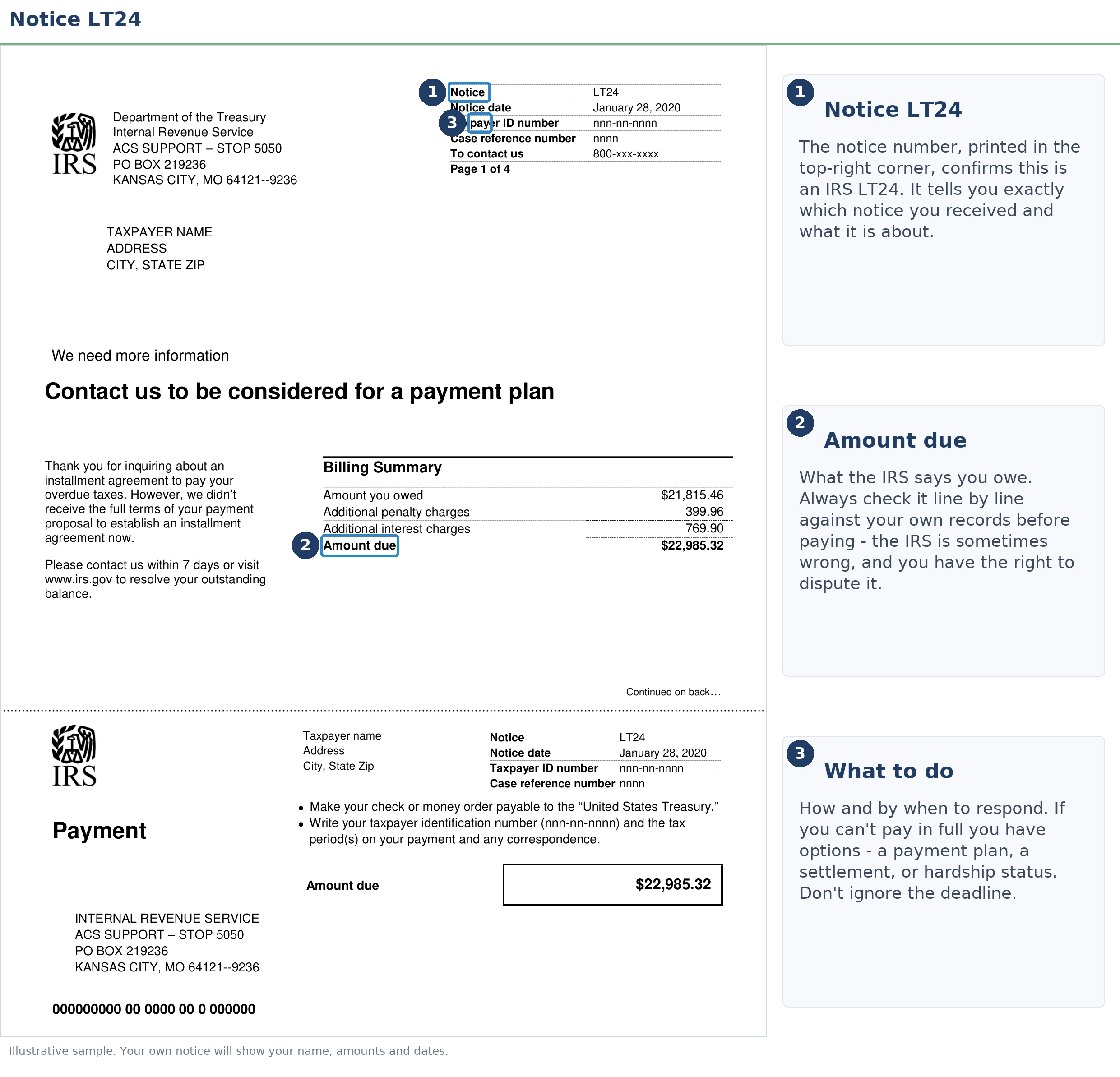
One page of the LT24 does most of the work. The image below shows exactly what the notice looks like and where to look — the response date and the specific Form 433 request are the two lines that control everything you do next.
⏱ Your deadline: the response date printed on your LT24. There is no standard nationwide window for this notice — the IRS sets the deadline on the letter itself, and it's typically short. Miss it and the IRS can reject your pending payment proposal and put your account back on the enforcement track, with interest and the monthly failure-to-pay penalty accruing the entire time.
Why you got an LT24 notice
The IRS sends an LT24 when it has your payment proposal in hand but can't approve it without a completed Form 433 financial statement. The letter comes from the Automated Collection System (ACS) — the computer-driven side of IRS collections — and it means your request fell outside the lanes where plans get approved automatically.
A proposal sails through without financials when the balance is small enough and the payment full-pays the debt within 72 months and before the collection statute runs out. Yours tripped at least one screen. The usual triggers:
- Your balance is above the streamlined limits. Owe more than $25,000 without direct debit — or more than $50,000 even with direct debit — and the IRS generally wants to see your finances before agreeing to terms.
- Your proposed payment is too low. If the monthly amount you offered won't pay the debt off within 72 months — or within the 10-year collection statute — the IRS needs Form 433-F to justify accepting less. You can estimate how much time remains on your debt with our CSED Calculator.
- You're self-employed. ACS scrutinizes 1099 and business income more closely because it varies month to month and has no withholding behind it. Contractors and gig workers see LT24s at balances where a W-2 employee might have been approved over the phone.
- You've defaulted a plan before. A prior broken installment agreement often means the IRS wants financial proof before saying yes a second time.
If you're not sure why the IRS is writing to you at all, our guide to why did I get a letter from the IRS maps every letter type. This page covers the LT24 specifically — a notice that, unlike most in the collection stack, exists because you already started fixing the problem.
What the LT24 asks for: Form 433 and the proof behind it
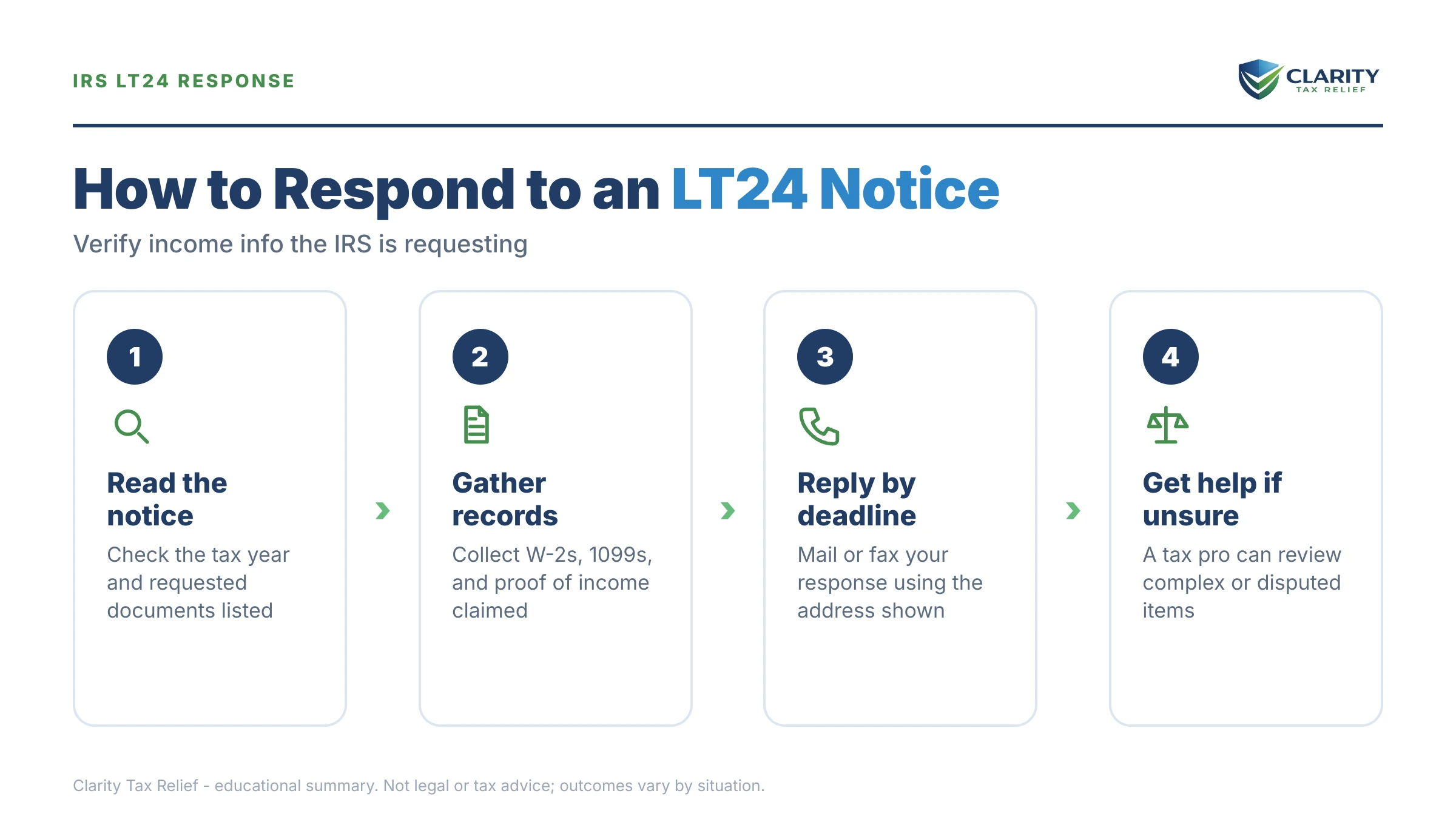
The LT24 asks for one thing: a completed Collection Information Statement — almost always Form 433-F for individuals — plus documents that back up every number on it. (Cases assigned to a revenue officer use the longer Form 433-A instead; your letter names the form it wants.)
Form 433-F is a two-page snapshot of your financial life: bank and investment accounts, real estate and vehicles, credit available to you, employment or self-employment income, and your monthly living expenses. You sign it under penalty of perjury. Our Form 433-F walkthrough covers it line by line.
Two things trip people up. First, the IRS doesn't accept your actual expenses at face value — it measures them against its published IRS allowable living expenses standards, national and local caps for food, housing, transportation, and health care. Claim $900 a month for food as a single filer and the IRS will substitute its standard, which raises the payment it thinks you can afford.
Second, the form cuts both ways. Everything you disclose — every bank account, every client who pays you — becomes a roadmap the IRS can use for levies if the plan falls apart later. That's a reason to be strategic and accurate, not a reason to hide anything: omissions on a perjury statement create far worse problems than a higher monthly payment.
What happens if you ignore an LT24
Ignoring an LT24 kills the payment plan you asked for and restarts the enforcement sequence you were trying to escape. Because your account is already inside ACS, there's less runway left than there was when the first bill arrived. The sequence runs like this:
- The printed deadline passes. Without a complete Form 433-F, the IRS treats your proposal as unsupported and can reject it. The "pending request" status that was restraining levy action ends.
- Your account returns to active collection. Expect renewed ACS demand letters — the LT16 notice and LT19 notice are the common ones — each arriving with a larger balance as interest and penalties compound.
- A final notice of intent to levy arrives. The LT11 notice (or Letter 1058) starts a 30-day clock and carries your Collection Due Process rights, requested on Form 12153. This is the last structured off-ramp.
- Levy. After the 30 days expire, the IRS can freeze a bank account (the bank holds funds 21 days before sending them), garnish wages continuously, and — critical for contractors — send levies directly to your clients. See can IRS garnish 1099 income for how those one-shot contractor levies work.
In 2026, the IRS workforce is roughly 27% smaller than it was — but this entire sequence is automated. No human needs to review your file for the next letter to go out, which is exactly why the LT24's short window matters more than its polite tone suggests.
| Notice | What it means | Enforcement power |
|---|---|---|
| CP14 / CP501 / CP503 | Bill and reminders for the balance due | None yet; interest and penalties accrue |
| CP504 | Intent to levy your state tax refund | IRS can seize a state refund |
| LT16 / LT19 | ACS demand letters: pay or make arrangements | None new; account is in active collection |
| LT24 (you are here) | Your payment proposal needs Form 433 financials | None new; your plan is on hold pending your response |
| LT11 / Letter 1058 | Final notice of intent to levy; CDP rights attach | 30 days, then wage and bank levies |
Holding an LT24 with the deadline approaching?
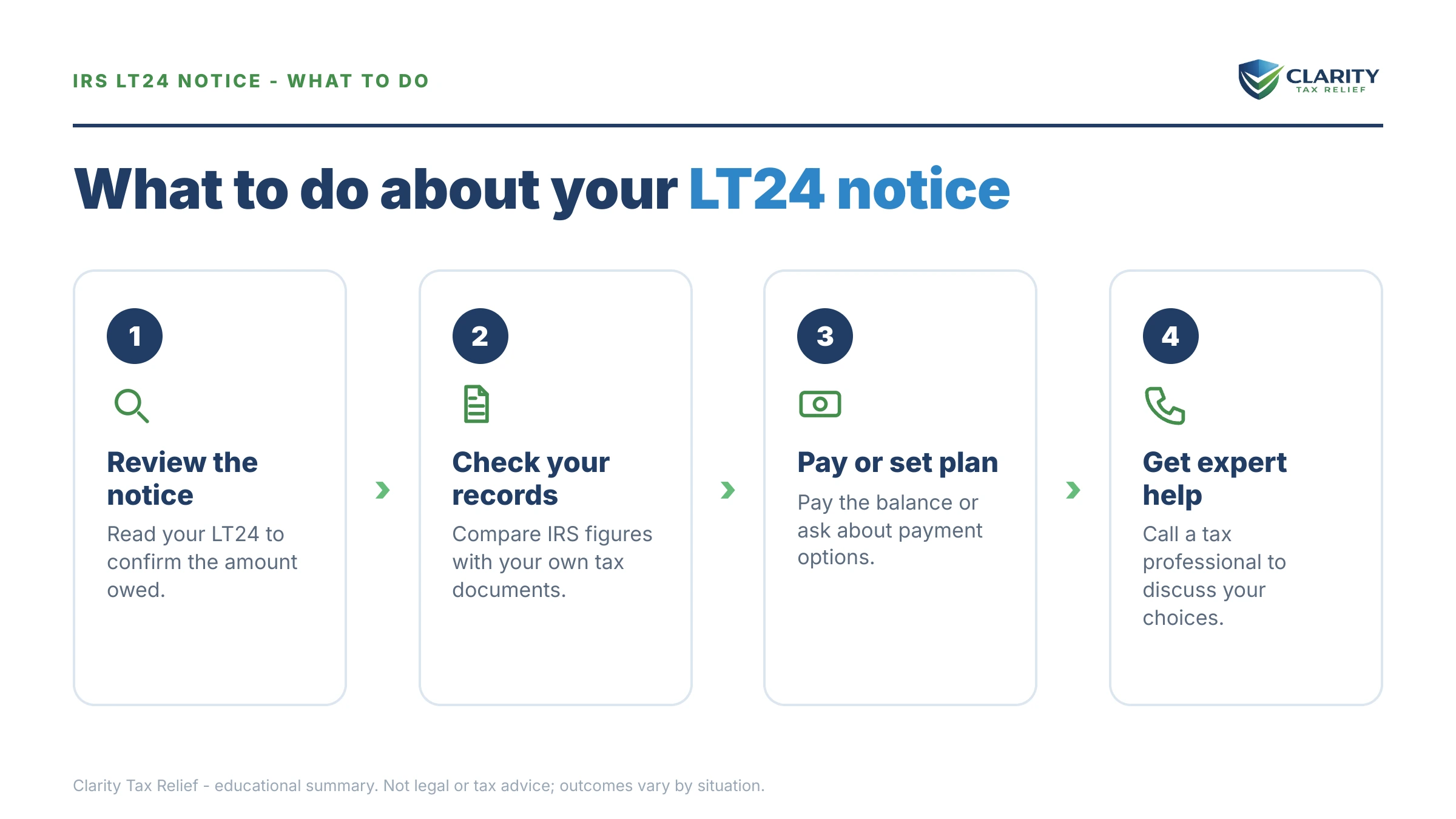
The Form 433-F you send determines the payment you'll live with for years. Get your LT24 and your numbers reviewed free before the response date on your notice passes — an experienced tax professional will tell you what the IRS's math will say before the IRS runs it.
Your options when the IRS wants financials
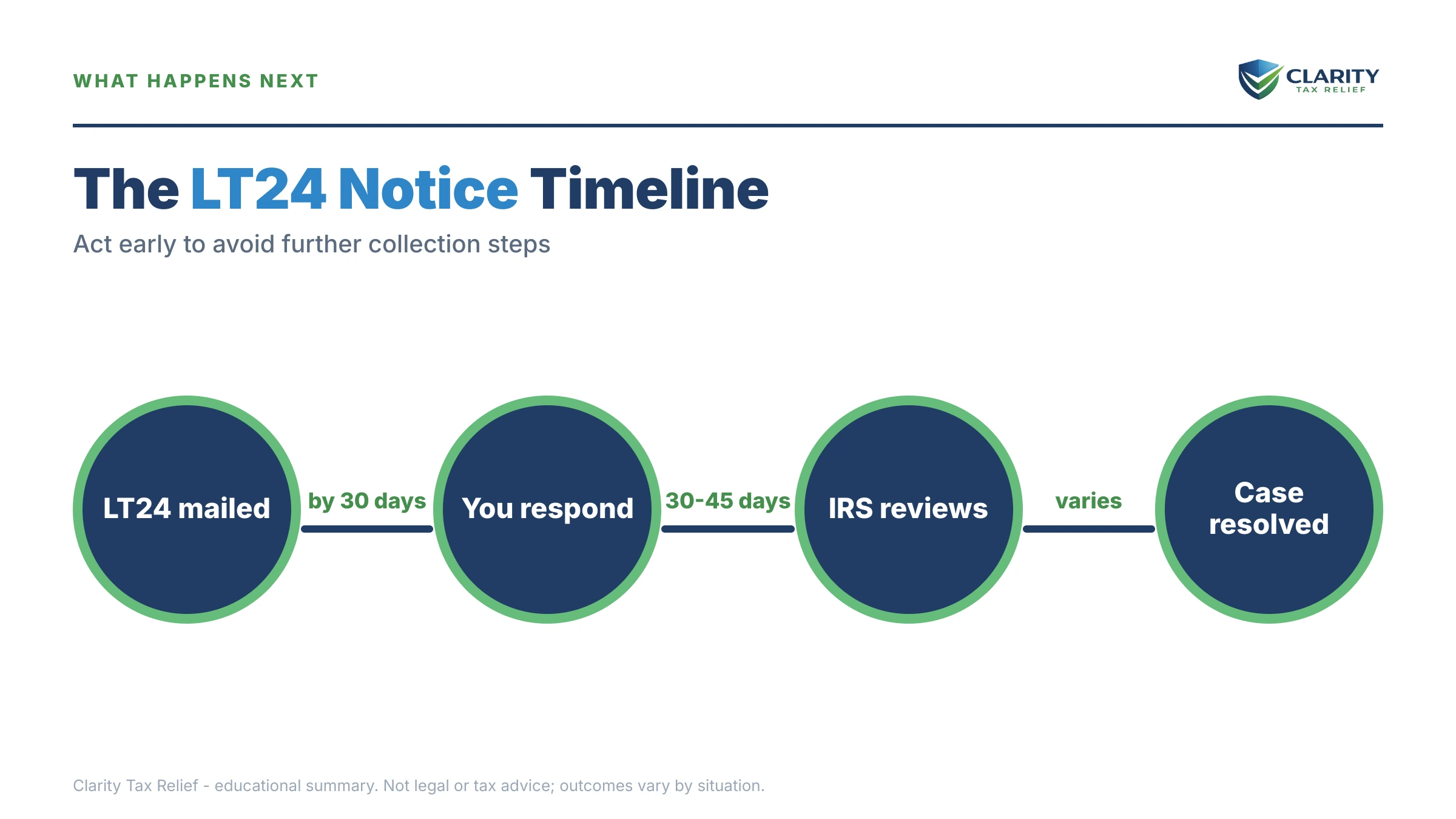
An LT24 doesn't lock you into the financial-statement route — it tells you which route your current proposal is on. There are four real paths, and two of them avoid Form 433-F entirely:
| You owe / your situation | Plan type | Form 433-F required? |
|---|---|---|
| $10,000 or less | Guaranteed installment agreement | No |
| $25,000 or less | Streamlined agreement, up to 72 months | No |
| $25,001–$50,000 with direct debit | Streamlined direct-debit agreement, up to 72 months | No |
| Over $50,000, or a payment that won't full-pay in 72 months / before the CSED | Non-streamlined agreement or partial-payment plan | Yes — this is the LT24 trigger |
| Nothing left after allowable expenses | Currently Not Collectible (hardship) | Yes |
- Complete the Form 433-F and support your proposal. If your income minus allowable expenses genuinely matches the payment you offered, the financials prove your case and the plan gets set at a number you can sustain.
- Restructure into a streamlined agreement instead. If you can raise your payment to full-pay within 72 months and set up direct debit (for balances up to $50,000), you may be able to convert to a streamlined installment agreement and skip the financial disclosure entirely. Paying the balance down below $25,000 accomplishes the same thing without direct debit.
- Ask for a partial-payment plan. When the 433-F shows you truly can't full-pay before the collection statute expires, a partial payment installment agreement sets the payment at your real disposable income — with the IRS re-reviewing your finances periodically.
- Request hardship status. If allowable expenses eat your entire income, the same Form 433-F can support Currently Not Collectible status, which pauses collection while your situation improves. The debt and the accruals remain, but levies stop.
A worked example: a 1099 contractor who owes $31,200
Say you're a self-employed contractor who owes $31,200 across two tax years. You called ACS and offered $275 a month — a number your cash flow can handle. At $275/month, $31,200 takes about 113 months to pay before counting interest ($31,200 ÷ $275 ≈ 113). That's far past the 72-month line, so the computer couldn't say yes, and the LT24 went out. Your realistic paths:
- Direct-debit streamlined: $31,200 ÷ 72 = about $434/month. Because the balance is under $50,000, agreeing to $434 by direct debit may qualify you for a streamlined plan — no Form 433-F, no financial disclosure.
- Pay-down streamlined: pay roughly $6,200 up front to bring the balance to $25,000, then $25,000 ÷ 72 ≈ $348/month — streamlined without direct debit.
- Prove the $275: suppose your Form 433-F shows $3,900 in monthly income against $3,650 of allowable expenses. That's $250 of disposable income — the financials would support a payment near what you offered, likely as a partial-payment agreement subject to periodic review.
Whichever path you take, interest and a reduced failure-to-pay penalty continue to accrue during the plan, so real payoff runs slightly longer than the flat division suggests. This is a hypothetical illustration — your allowable-expense math will differ — but it shows the decision the LT24 is actually putting in front of you: disclose, restructure, or pay down.
How to respond to an LT24, step by step
- Confirm which form the IRS wants. Read the first page of your LT24 and note which Collection Information Statement it demands — usually Form 433-F — and the exact response date printed on the notice.
- Gather your documentation first. Collect your last three months of bank statements, proof of income (1099s, invoices, or a year-to-date profit-and-loss if you're self-employed), and proof of major monthly expenses like rent, utilities, insurance, and secured loan payments.
- Complete Form 433-F accurately. Fill in every section, use the IRS allowable-expense standards as your benchmark for living costs, and remember you sign under penalty of perjury — guessing high on expenses or omitting an account can sink the plan.
- Send it by the printed deadline and keep proof. Return the form and attachments using the fax number or mailing address on the letter, and keep a dated copy of everything you send.
- Follow up on the decision. If you don't hear back within the timeframe the letter describes, call the number on the notice. If the monthly payment the IRS calculates from your financials is more than you can genuinely afford, ask about a partial-payment agreement or hardship status before you agree to anything.
One compliance note before any plan gets approved: the IRS requires all your returns to be filed. If you have unfiled years, expect the IRS to raise them — non-filers in collection often receive an LT26 notice demanding the missing returns. File first, or the plan stalls regardless of how good your 433-F looks.
| The clock | Where it comes from | What passes with it |
|---|---|---|
| Response date on your LT24 | Printed on the notice itself | Your pending proposal — the IRS can reject it and resume collection |
| 30 days from an LT11 | Final notice of intent to levy | Your right to a Collection Due Process hearing (Form 12153) |
| 21 days after a bank levy | The bank's required hold period | The last window to get frozen funds released before they go to the IRS |
| 10 years from assessment (CSED) | Federal collection statute | The IRS's legal ability to collect — plans are built to fit inside it |
When you can handle an LT24 yourself
Plenty of people answer an LT24 without help. You can likely handle it yourself if your income is steady and documented, your expenses fall inside the IRS standards, and the payment you proposed roughly matches your real disposable income — in that case the 433-F simply confirms what you already told the IRS. Same if you can restructure into a streamlined plan (raise the payment to ~72-month full-pay with direct debit, or pay the balance below $25,000) and skip the financials entirely; the IRS's own payment plans page covers the mechanics.
Experienced help changes the outcome in a narrower set of situations: self-employment income that swings month to month (how you present a 12-month average can move the payment by hundreds of dollars), expenses well above the IRS standards that need documented justification, unfiled years mixed into the balance, or numbers so tight that the honest answer is a partial-payment plan or hardship status — outcomes ACS rarely volunteers. A 433-F is a negotiation document as much as a disclosure; how it's assembled matters most when your case sits on a borderline.
Terms on your LT24, decoded
- ACS (Automated Collection System): the IRS's computer-and-call-center collection arm — LT-series letters like yours come from ACS, not from an assigned revenue officer.
- Collection Information Statement: the IRS's name for the Form 433 family — a sworn snapshot of your income, expenses, assets, and accounts.
- Allowable living expenses: the IRS's published caps for food, housing, transportation, and health care; your payment is calculated against these standards, not your actual spending.
- Streamlined installment agreement: a payment plan approved without a financial statement, available when the balance and payment fit inside set thresholds.
- Partial-payment installment agreement (PPIA): a plan whose payments won't fully pay the debt before the collection statute expires — allowed only when financials prove you can't pay more.
- CSED (Collection Statute Expiration Date): the date, generally 10 years after assessment, when the IRS's right to collect ends; certain events pause the clock.
LT24 questions, answered
What is an IRS LT24 notice?
An LT24 is a letter from the IRS Automated Collection System saying it received your payment proposal but needs a completed Collection Information Statement — usually Form 433-F — before it can approve a payment plan. It is not a levy notice and it doesn't add new penalties. It's sent when your balance or your proposed payment doesn't qualify for automatic approval, so the IRS wants proof of your income, expenses, and assets first.
Is an LT24 notice serious?
It's serious in the sense that your payment plan is on hold until you respond, but the LT24 itself doesn't authorize any seizure. The real risk is inaction: if the deadline printed on the notice passes without a complete Form 433-F, the IRS can reject your proposal and move your account back onto the enforcement track that leads to an LT11 final notice and, 30 days after that, wage and bank levies.
How long do I have to respond to an LT24?
Your deadline is the response date printed on the notice itself — the IRS sets it per account, so don't rely on a generic day count you read online. If you can't gather bank statements and expense proof in time, call the number on the letter before the date passes and ask for more time; ACS routinely works with taxpayers who are actively cooperating.
What is Form 433-F and what do I have to send with it?
Form 433-F is the IRS Collection Information Statement — a snapshot of your bank accounts, assets, employment or self-employment income, and monthly living expenses, signed under penalty of perjury. Your LT24 will list the documents to attach, typically recent bank statements, pay stubs or proof of 1099 income, and proof of major expenses. The IRS compares your claimed expenses to its national and local allowable-expense standards, not to what you actually spend.
What happens if I ignore an LT24?
Your pending payment proposal is rejected and your account goes back into active collection. From there the sequence escalates to a final notice of intent to levy (LT11 or Letter 1058), which starts a 30-day clock; after it expires the IRS can levy bank accounts and garnish income. For a 1099 contractor that can include levies sent directly to your clients. Interest and the monthly failure-to-pay penalty keep accruing the whole time.
What's the difference between an LT24 and an LT27?
Both letters ask you to complete and return Form 433-F. The LT24 is tied to a payment proposal you already made — the IRS is telling you it can't approve your plan without financials. An LT27 notice is a more general demand for a Collection Information Statement on a balance-due account. Either way, the response is the same: a complete, accurate, documented Form 433-F by the printed deadline.
Can the IRS levy me while my payment plan request is pending?
As a general rule, the IRS holds off on levy action while an installment agreement request is genuinely pending and for a period after a rejection — which is one reason responding to the LT24 matters so much. Letting the deadline pass ends the pending status that's protecting you. Note that if a CP504 arrived earlier, the IRS already has authority to take a state tax refund, so that narrower action can still happen.
Your next 24 hours
- Find the two controlling lines on your LT24: the response date and the specific Form 433 the letter demands. Write the date somewhere you'll see it daily — that printed deadline is the only clock that matters right now.
- Start the document pile: your last filed return, the LT24 itself, three months of bank statements, and your income records — 1099s, invoices, or a year-to-date profit-and-loss. These are the raw material for every option on this page.
- Get the numbers reviewed before you send them. Call (888) 825-7779 or use the 2-minute form for a free case review — an experienced tax professional can run the IRS's own expense math on your figures before the response date on your notice arrives, so the 433-F you submit supports the payment you can actually live with.
The official IRS resources are worth bookmarking too: About Form 433-F for the current form and instructions, and IRS.gov/payments if you decide to pay the balance down toward a streamlined threshold.
This guide is general information, not tax or legal advice for your specific situation. Eligibility for IRS programs depends on individual facts and circumstances; no outcome is guaranteed.