
IRS Notices
IRS LT27 Notice: Why the IRS Wants Your Form 433-F and How to Respond (2026)
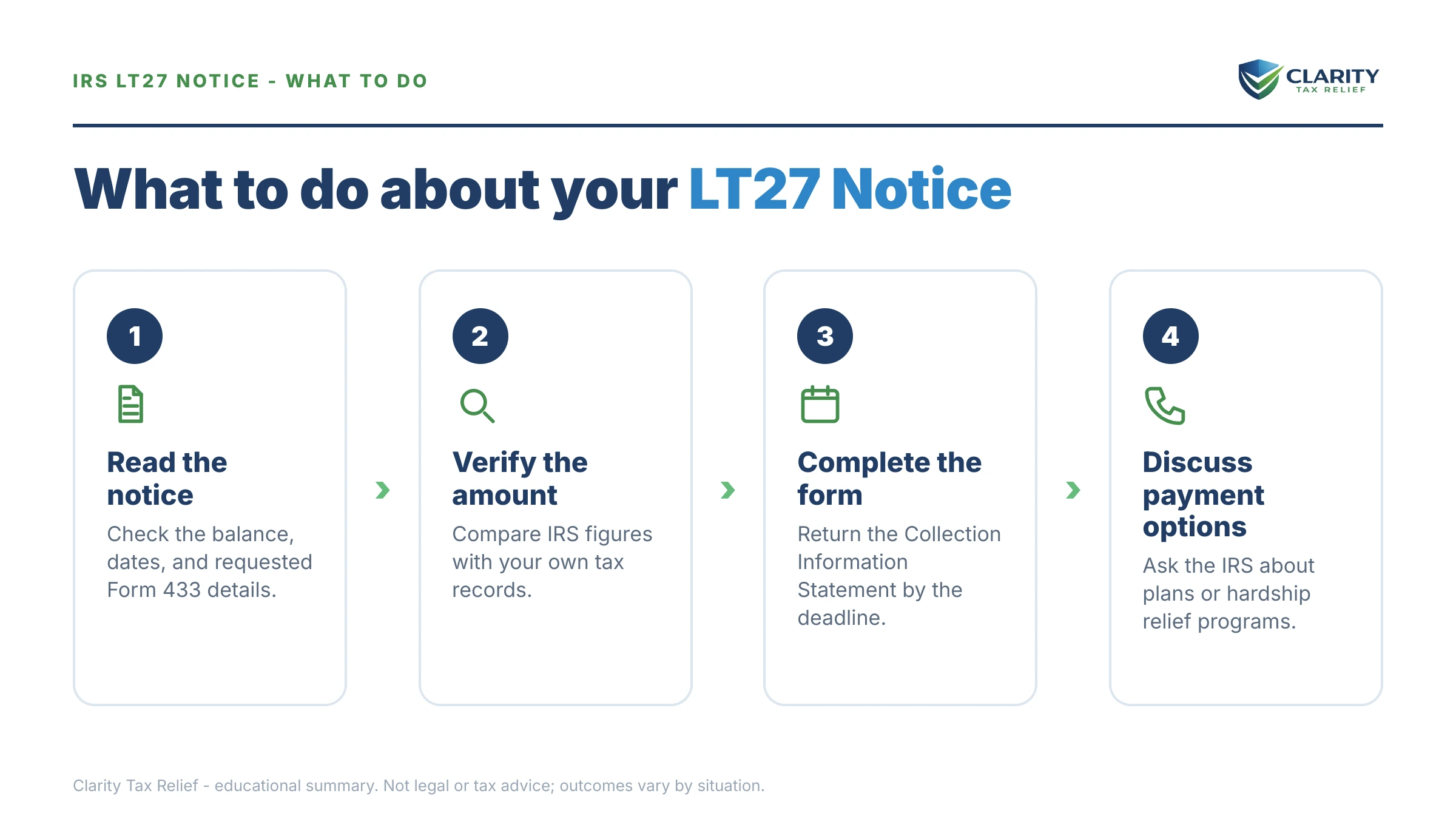
The short answer: an LT27 notice is the IRS asking you to complete Form 433-F, the Collection Information Statement, so it can decide how you'll pay your balance. It usually arrives after you've requested a payment plan or hardship status. Return the completed form — with documentation — by the response date printed on the letter.
You finally called the IRS about the balance you can't pay on a fixed income — and instead of an answer, an LT27 notice showed up asking you to lay out every account, every dollar of income, and every monthly bill on a government form. That feels invasive. It's actually your opening: Form 433-F is where you prove, in the IRS's own math, how little you can afford to pay.
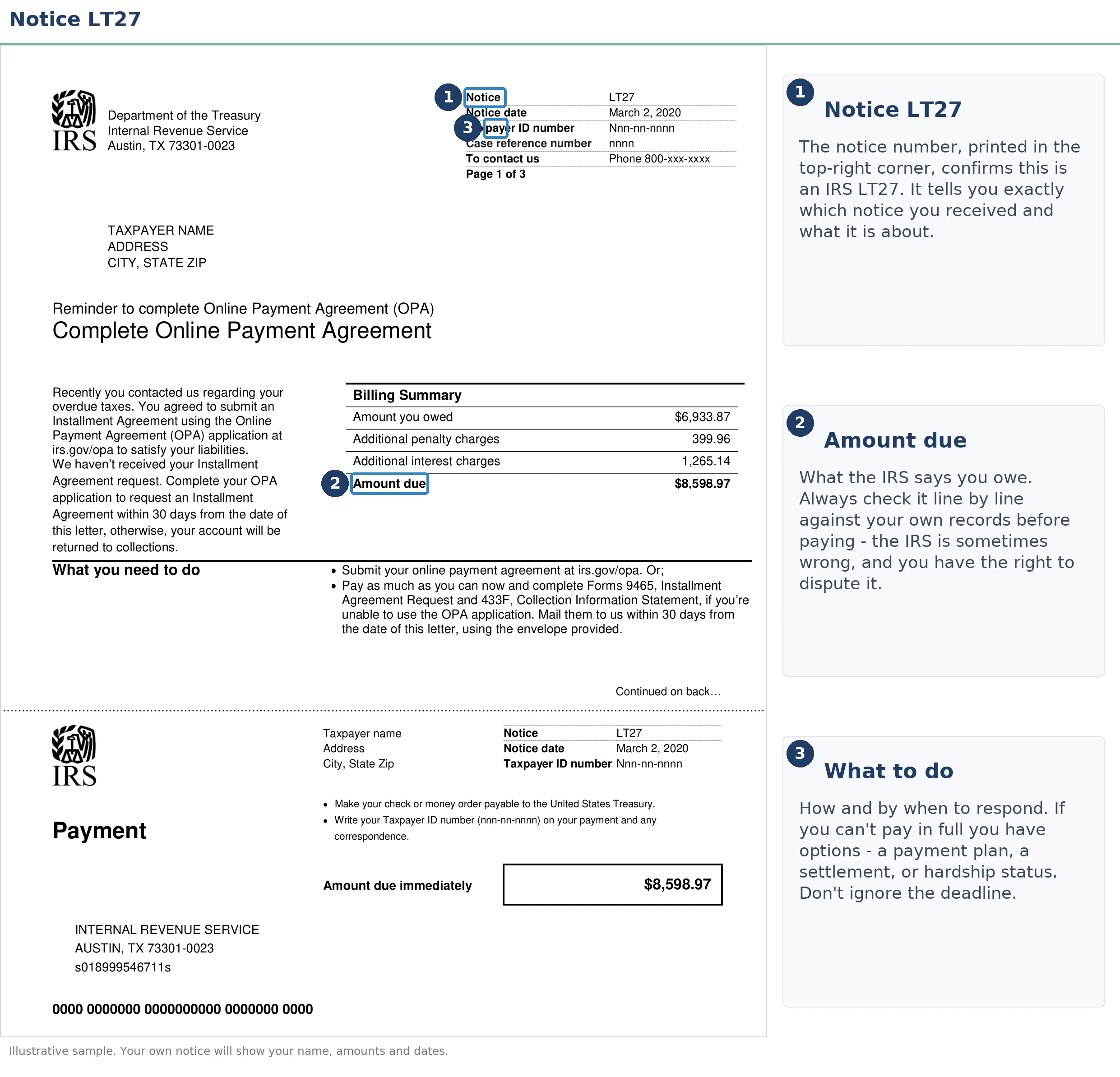
The stakes are real but manageable. Your answers on that one form decide whether the IRS demands a payment you can't make, accepts a small one you can, or pauses collection entirely. The image below shows exactly what an LT27 looks like and where to find the response date and the form it's asking for.
⏱ Your deadline: the response date printed on your LT27. This letter sets its own clock — there is no standard window that applies to everyone, so pull yours off the page. Miss it and the IRS decides your account without your financial information, while interest and the monthly late-payment penalty keep accruing.
Why you got an LT27 notice
The IRS sends an LT27 when it needs a completed Form 433-F before it can approve — or continue — a collection arrangement on your account. It comes from the Automated Collection System (ACS), the computer-driven side of IRS collections, not from a human assigned to your case. The most common triggers:
- You asked for a payment plan the computer can't rubber-stamp. Balances and proposed payments outside the streamlined limits require proof of what you can actually afford.
- You requested hardship or reduced payments. Currently not collectible status and partial-payment plans are granted only on documented financials — the 433-F is how you document them.
- An existing arrangement needs re-verification. The IRS periodically re-checks finances behind hardship status and low-dollar agreements, and the LT27 is how ACS asks.
If you're not sure why the IRS is writing you at all, our decoder on why did I get a letter from the IRS covers the whole notice system; this page stays on the LT27 specifically. The key distinction: unlike its cousins in the LT series, the LT27 isn't demanding money — it's demanding information. What you put on the form determines what happens to the money.
What Form 433-F actually asks for
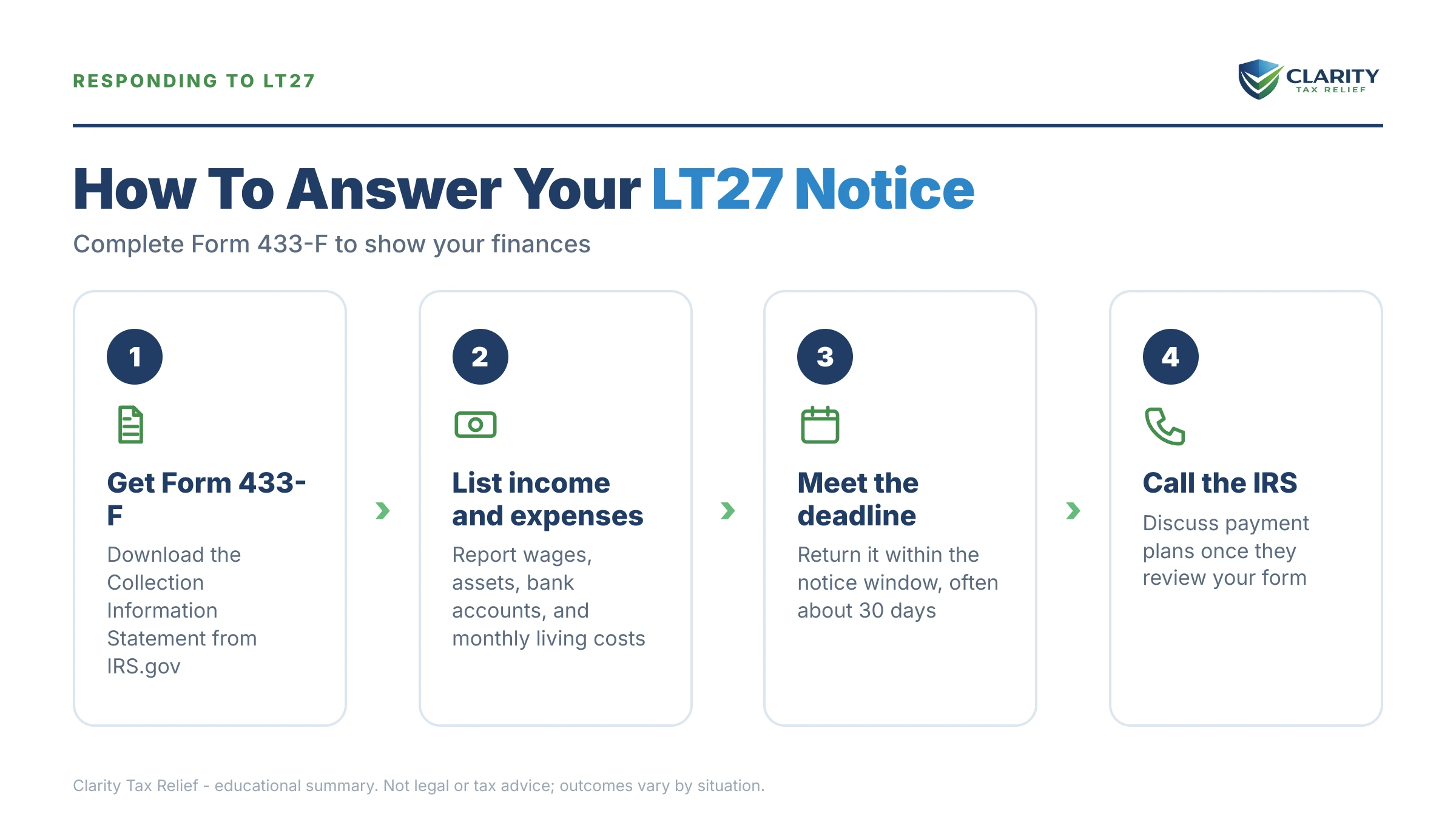
Form 433-F is a one-form financial snapshot: your accounts, assets, income, and monthly living expenses. The IRS uses it to compute one number — how much is left over each month after necessary expenses — and that number becomes your payment. The form covers:
- Accounts and lines of credit: checking, savings, investment and retirement accounts, with balances.
- Assets: real estate, vehicles, and other property, with what's owed against each.
- Income: everything — wages, self-employment, pensions, Social Security, rental income. Yes, benefits count as income on this form.
- Monthly expenses: housing, utilities, food, transportation, health insurance, out-of-pocket medical costs, court-ordered payments, and current-year tax withholding or estimates.
Here's the part most people miss: the IRS doesn't automatically accept your actual expenses. It measures them against national and local IRS allowable living expenses standards — preset caps for food, housing, transportation, and health care. Expenses within the standards are allowed; amounts above them often aren't, unless you can justify them. For retirees, out-of-pocket medical costs are frequently the most under-claimed category, and every legitimate dollar you claim lowers the payment the IRS calculates.
For a line-by-line guide to the form itself, see our Form 433-F walkthrough. This page focuses on the LT27 letter and the decisions your answers drive.
What happens if you ignore an LT27 notice
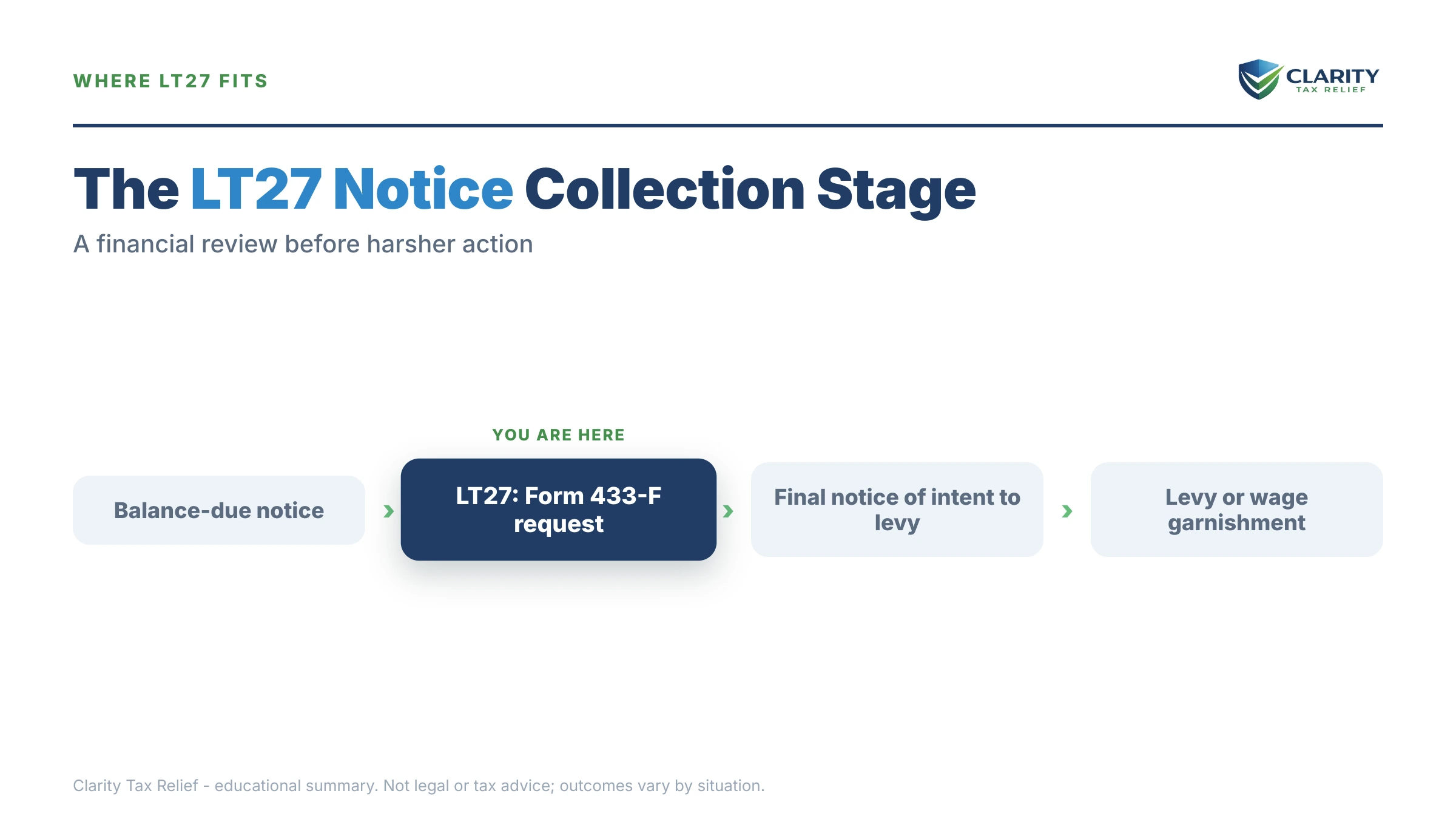
Ignoring an LT27 usually gets the arrangement you requested denied and puts your account back into active ACS collection. The LT27 itself carries no levy power — but it sits inside a letter sequence that does, and silence moves you down that sequence:
- LT27 unanswered — the IRS closes the request it was evaluating. No plan, no hardship status; your balance is simply "unresolved" again.
- Renewed demand letters — ACS resumes billing. Letters like the LT16 notice and LT19 push for payment or contact, with interest compounding the whole time.
- Final notice of intent to levy — the LT11 notice starts a 30-day clock and your Collection Due Process rights. This is the last exit before enforcement.
- Levy — after the LT11 window closes, the IRS can levy bank accounts (a 21-day hold before funds leave) and, for benefit recipients, take up to 15% of each Social Security check through the Federal Payment Levy Program.
The bitter irony of skipping the 433-F: the levy the IRS eventually imposes is almost always larger than the payment your real finances would have supported. In 2026, with IRS staffing down roughly 27%, it's genuinely hard to get a human back on the phone to undo an automated escalation — the systems that deny requests and issue levies kept running through the layoffs.
One more clock worth knowing: at $48,300 you're below the $66,000 threshold at which the IRS certifies seriously delinquent tax debt to the State Department for passport action in 2026 — but accruing penalties and interest push balances upward, and unresolved accounts drift toward that line.
Staring at an LT27 and a blank Form 433-F?
How you fill out that form decides your monthly payment — sometimes the difference between a levy on your Social Security and no payment at all. Get your LT27 and financials reviewed free before the response date on your letter passes: call (888) 825-7779 or use the 2-minute form.
Where the LT27 sits in the IRS letter sequence
The LT series comes from ACS, and each letter has a distinct job — the LT27 is the information-gathering step, not the enforcement step. Here's the map:
| Letter | What it says | Enforcement power |
|---|---|---|
| LT16 | Contact us about your unpaid taxes and/or unfiled returns | None yet — a demand for contact |
| LT19 | Pay the amount you owe | None yet — a bill with teeth coming |
| LT24 / LT27 | Send financial information (Form 433) so we can evaluate your account | None — but silence forfeits your say in the outcome |
| LT11 / Letter 1058 | Final Notice of Intent to Levy and your right to a hearing | Levy authorized 30 days after issuance; CDP appeal rights attach |
The LT24 notice is the LT27's closest sibling — it typically follows a payment proposal the IRS can't approve as submitted, while the LT27 is a direct request to complete Form 433-F. Both get the same answer: a complete, documented financial statement by the printed date.
Your options once the IRS has your numbers
Form 433-F is the gateway to every non-full-payment resolution the IRS offers. Which one fits depends on what the form shows:
| Option | Who it typically fits | Form 433-F needed / cost |
|---|---|---|
| Short-term plan (up to 180 days) | You can pay in full within about six months | Usually no 433-F; $0 setup fee |
| Streamlined installment agreement | Balance ≤ $50,000 and you can afford full payoff within up to 72 months | Often no 433-F required; setup fee applies (reduced for direct debit) |
| Regular (non-streamlined) installment agreement | Balance or payment terms outside streamlined limits | 433-F required; setup fee applies |
| Partial payment installment agreement | 433-F shows you can pay something, but not the full balance before collection expires | 433-F required; periodic financial reviews |
| Currently Not Collectible | Allowable expenses equal or exceed income — paying anything creates hardship | 433-F required; $0, but interest still accrues |
| Offer in Compromise | Assets plus future income genuinely can't cover the debt | Fuller financials (433-A(OIC)); $205 fee, waived with low-income certification — roughly 1 in 5 offers accepted in FY2024 |
Notice the escape hatch in row two: if your balance is $50,000 or under, you can often set up a streamlined plan without submitting a financial statement at all — but only if you can genuinely afford the payment it requires. That's exactly the trap a fixed income exposes, which the worked example below makes concrete.
Also worth knowing for anyone weighing a partial-payment plan or CNC: the IRS generally has 10 years from assessment to collect, and whatever isn't collected by the collection statute expiration date typically expires (appeals, offers, and bankruptcy pause the clock). You can estimate where your own clock stands with our CSED Calculator.
Say you owe $48,300 on Social Security: the Form 433-F math
Here's a hypothetical to make the stakes concrete. Say you're retired, you owe $48,300 from a couple of tax years around a retirement-account withdrawal, and your income is $2,380/month in Social Security plus an $890/month pension — $3,270 total.
A streamlined plan sounds tempting because it skips the 433-F. But $48,300 spread over the maximum 72 months is roughly $671/month before accruing interest and penalties ($48,300 ÷ 72 = $670.83). On $3,270 of fixed income, that payment likely fails the first month it's due — and a defaulted agreement puts you right back into the enforcement sequence.
Now run the 433-F instead. Suppose your documented monthly expenses, within the IRS's allowable standards, look like this (illustrative figures — the standards vary by county and household size):
- Housing and utilities: $1,480
- Food, clothing, and miscellaneous: $790
- Health insurance premiums plus out-of-pocket medical: $470
- Vehicle operating costs and insurance: $410
Total allowable expenses: $3,150. Income of $3,270 minus $3,150 leaves $120/month of ability to pay. On those numbers, the realistic outcomes are a partial-payment installment agreement near $120/month, or — if medical costs rise even modestly — currently not collectible status at $0. Compare that with what ignoring the LT27 risks: a Federal Payment Levy Program levy of 15% of the $2,380 Social Security check is about $357 every month, taken without regard to your budget. The form is how you replace the $357 the computer would take with the $120 your finances actually support. More on the retiree-specific path in IRS hardship on Social Security and can the IRS garnish Social Security.
Three Form 433-F mistakes that inflate your payment
The most expensive errors on Form 433-F are usually omissions on the expense side, not the income side.
Under-claiming expenses. People leave off out-of-pocket medical costs, dental, prescriptions, health insurance premiums deducted from benefits, and term life insurance. Every allowable dollar you skip is a dollar added to your monthly payment.
Guessing instead of documenting. Round numbers with no backup invite ACS to substitute the standard amounts — which may be lower than your reality. Pull actual statements and bills for the last three months.
Understating income or hiding accounts. The IRS already sees your reported income and can summon bank records. An agreement built on an inaccurate 433-F can be voided later, and the signature line is under penalty of perjury. Report everything; win on the expense math, not on omissions.
How to respond to an LT27, step by step
- Find the response date printed on your LT27 and put it on your calendar — that date, not a standard window, is your deadline.
- Gather your documents: three months of bank statements, your Social Security or pension benefit letters, and proof of rent, utilities, insurance, and out-of-pocket medical costs.
- Complete every section of Form 433-F — report all income, list all accounts and assets, and claim every allowable expense, including health costs the IRS's standards permit.
- Decide what to request before you send it: a streamlined plan, a partial-payment installment agreement, or currently not collectible status — whichever the numbers support.
- Send it by the printed date and keep a copy — mail it to the address on the letter or call the ACS number printed on it, and keep a complete copy of everything you submit.
When you can handle the LT27 yourself
Plenty of LT27 responses don't need professional help. If your finances are simple — one or two income sources, no business, no unfiled returns — and the numbers clearly support the arrangement you want, you can complete Form 433-F, attach your statements, and send it in yourself. Likewise, if your balance is $50,000 or under and you can comfortably afford the 72-month payment, setting up a streamlined agreement online may sidestep the financial statement entirely.
Experienced help changes outcomes in specific situations: when your income barely covers expenses and the CNC-versus-payment-plan call is close; when the IRS's expense standards would disallow costs you actually pay (high medical bills are the classic case); when there are unfiled years the IRS will demand before approving anything; when a levy is already in motion; or when the 433-F math suggests the debt may never be fully collectible before the 10-year statute runs — which reshapes the whole strategy. Our guide for readers in exactly this position: retired and owe back taxes.
Terms on your notice, decoded
- Form 433-F (Collection Information Statement): the IRS's short financial disclosure form — income, expenses, accounts, and assets — used to set collection terms.
- ACS (Automated Collection System): the computer-and-call-center side of IRS collections that issues LT-series letters; no individual officer is assigned to your case.
- Allowable living expense standards: preset national and local caps the IRS applies to your claimed expenses when computing what you can pay.
- Currently not collectible (CNC): a status that pauses collection when paying would leave you unable to meet basic living expenses; interest still accrues.
- CSED (collection statute expiration date): the end of the IRS's 10-year window to collect an assessed tax, pausable by appeals, offers, and bankruptcy.
- FPLP (Federal Payment Levy Program): the automated program that can take up to 15% of federal payments — including Social Security — for unpaid tax debt after final notice.
Primary sources if you want them: the IRS's About Form 433-F page, its overview of payment plans and installment agreements, and the independent Taxpayer Advocate Service if the IRS mishandles your response.
LT27 questions, answered
Is an LT27 notice serious?
It's not a levy threat by itself — it's a request for financial information (Form 433-F) so the IRS can decide how you'll resolve your balance. The seriousness lies in what happens if you ignore it: the arrangement or hardship status you asked for is typically denied, and your account moves back toward enforcement letters like the LT11. Respond by the date printed on the letter.
What is Form 433-F and why does the IRS want it?
Form 433-F is the Collection Information Statement — a snapshot of your income, expenses, bank accounts, and assets. The IRS's Automated Collection System uses it to calculate how much you can realistically pay each month. Your answers determine whether you get a payment plan, a reduced partial-payment plan, or currently not collectible status, so accuracy — especially claiming every allowable expense — directly changes the outcome.
What happens if I don't respond to the LT27?
The IRS decides without your numbers. That usually means the arrangement you requested is denied and your account returns to active collection — reminder and enforcement letters, and eventually a final notice of intent to levy (LT11) that opens the door to bank levies and a 15% Social Security levy through the Federal Payment Levy Program. Interest and the late-payment penalty keep accruing the entire time.
Do I have to report Social Security on Form 433-F?
Yes. Form 433-F asks for all income sources, and Social Security counts. Reporting it doesn't mean the IRS takes it — the form also captures your living expenses, and for many retirees the expense side shows there's little or nothing left to pay. Leaving income off the form can void any agreement based on it, so report everything and claim every allowable expense.
What's the difference between an LT27 and an LT24?
Both come from the IRS Automated Collection System and both ask for financial information. The LT24 typically follows a payment proposal the IRS can't approve as submitted and asks for a completed Form 433, while the LT27 is a direct request to complete Form 433-F so the IRS can evaluate your account. In practice, respond to both the same way: a complete, documented Form 433-F by the printed date.
Do I need to send proof with my Form 433-F?
Be prepared to. The instructions ask for documentation supporting your entries — recent pay stubs or benefit statements, bank statements (usually the last three months), and proof of expenses like rent, utilities, and out-of-pocket medical costs. ACS may accept some financial reviews by phone, but having the documents assembled speeds up approval and protects you if the IRS questions a number later.
Can Form 433-F get me currently not collectible status?
It's the main path to it. If the 433-F shows your allowable living expenses equal or exceed your income, the IRS can mark the account currently not collectible, which pauses levies and payment demands. The debt doesn't disappear — interest keeps accruing and the IRS reviews your finances periodically — but the 10-year collection statute keeps running while you're in CNC.
Your next 24 hours
- Find the response date on your LT27 — it's printed on the letter, along with the ACS phone number and mailing address. Write the date somewhere you'll see it.
- Gather your financial file: last three months of bank statements, your Social Security and pension award letters, your most recent tax return, and bills for rent, utilities, insurance, and medical costs.
- Get the form reviewed before you send it. An experienced tax professional can check that your 433-F claims every allowable expense and requests the right outcome — free, at (888) 825-7779 or through the 2-minute form — so the IRS's math works for your budget instead of against it.
This guide is general information, not tax or legal advice for your specific situation. Eligibility for IRS programs depends on individual facts and circumstances; no outcome is guaranteed.