
Innocent Spouse & Family Tax Debt
Spouse Gambling Tax Debt: Are You Liable for Their Winnings? (2026)
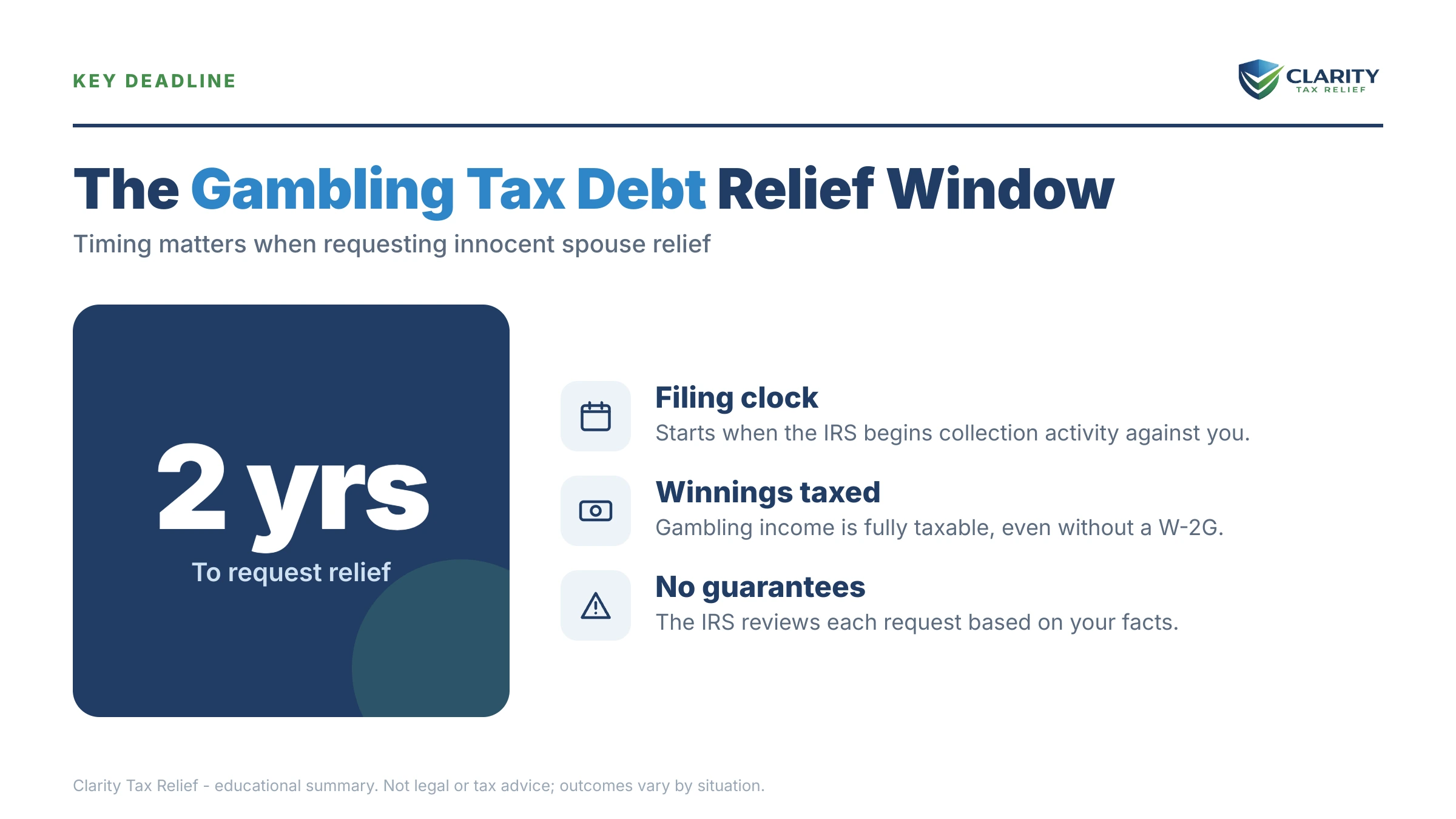
The short answer: if you signed a joint tax return, a spouse gambling tax debt is legally yours too — the IRS can collect 100% of it from either of you. Innocent spouse relief through Form 8857 can remove your liability, but the two strongest paths generally close two years after IRS collection starts.
You didn't place a single bet. But the balance on the notice traces back to your spouse's casino and sportsbook winnings, both of your names are on it, and you're supposed to be locking in a refinance rate this year. The good news is precise: the law that put this debt in your name has three built-in exits, and each one has its own clock and its own test.
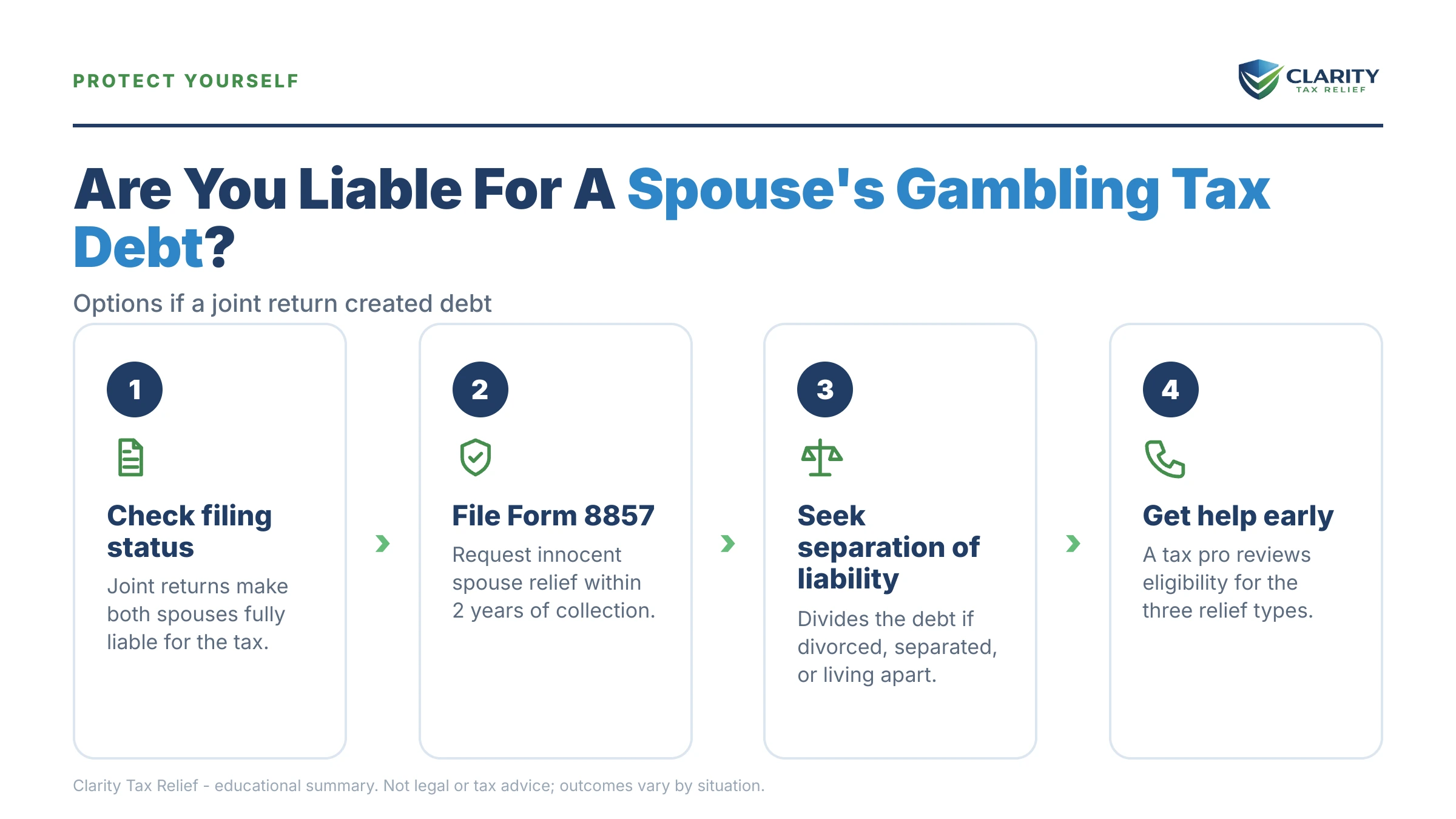
Every exit runs through one document — Form 8857 — and the visual guide below maps the deadlines and options that decide your case, so nothing in the process surprises you later.
⏱ The controlling deadline: you generally have 2 years from the IRS's first collection activity against you to request innocent spouse relief under §6015(b) or separation of liability under §6015(c) on Form 8857. Equitable relief under §6015(f) stays open longer — as long as the IRS can still collect — but the two strongest paths close first.
Why you're facing a spouse gambling tax debt
The IRS matches every Form W-2G a casino or sportsbook issues against the tax return it should appear on — and when winnings are missing from a joint return, it bills both signers. Your spouse's payer sent copies of those W-2Gs straight to the IRS. The Automated Underreporter system compared them to your return, found a gap, and generated a CP2000 notice or a straight balance-due bill.
The legal engine is joint and several liability: by signing a joint return, each spouse becomes responsible for 100% of the tax on everything on it — and everything that should have been on it. The IRS doesn't split the bill by who earned what. It collects from whoever is easiest to reach, which is often the spouse with the steady W-2 paycheck, not the one at the tables.
Gambling debt has a cruel wrinkle its non-gambling cousins don't: the tax is on gross winnings, not net results. A spouse who won $88,000 and lost $90,000 still generated taxable income of $88,000, because losses only offset winnings as an itemized deduction on that year's return, capped at the winnings. If the return never itemized losses that could have been claimed, amending the return to reduce the tax debt may shrink the number before you fight about who owes it. The mechanics of how the winnings themselves get taxed are covered in our guides to casino winnings tax debt and FanDuel winnings taxes — this page is about the spouse who never gambled but got the bill.
One more distinction controls everything that follows. If the winnings were left off the return, you have an understatement — and all three relief provisions are potentially open. If the winnings were reported but the tax was simply never paid (your spouse promised to handle it and didn't), you have an underpayment — and only equitable relief under §6015(f) can help. Check the notice: a CP2000 or audit adjustment means understatement; a plain balance due on the return as filed means underpayment.
What happens if you ignore your spouse's gambling tax bill
On a joint liability, the IRS can collect the entire balance from either spouse, in whatever order its systems find money — and those systems are fully automated. Both of you receive the notice stream, and ignoring it moves the account through the same escalation sequence every unpaid balance follows:
- Assessment — the CP2000 proposal or audit change becomes a legal debt against both signers.
- CP14 — the first bill, with roughly 21 days to pay or arrange something before the reminders start (10 business days if the balance is $100,000 or more).
- CP501 / CP503 — reminder notices while penalties and interest compound monthly.
- CP504 — intent to levy your state tax refund. A Notice of Federal Tax Lien becomes a live risk here — the single worst development for a homeowner heading into a refinance, because the lien attaches to the house.
- LT11 / Letter 1058 — final notice of intent to levy. A 30-day clock starts on your Collection Due Process rights (requested on Form 12153). After it runs, the IRS can levy bank accounts (a 21-day hold before funds leave) and garnish wages — including your wages, even though the winnings were never yours.
Two more pressure points are specific to this situation. First, if the balance grows past $66,000 (the 2026 threshold), the IRS can certify the debt to the State Department and block passport renewal for both of you. Second, waiting burns your best remedy: the two-year window for §6015(b) and (c) relief starts at the IRS's first collection activity against you — often earlier than people realize — and it does not pause while you hope your spouse handles it.
Holding a joint tax bill for winnings you never saw?
If the IRS has started collecting, your two-year innocent spouse window is already running. Send us the notice — an experienced tax professional will tell you which relief path fits your facts and what it means for your refinance. Free, confidential, no pressure.
Your options: removing your liability vs. managing the balance
Three different provisions of Section 6015 can take some or all of a spouse's gambling tax out of your name — and if none fits, the standard collection alternatives still keep levies off your paycheck. The general playbook for any IRS balance is in our guide to how to settle tax debt yourself; here is what's specific to a gambling-spouse case:
| Option | Best fit | Key eligibility & limits |
|---|---|---|
| Innocent spouse relief — §6015(b) | Winnings hidden from a joint return; you're still married or divorced | You didn't know and had no reason to know about the winnings when you signed; generally file within 2 years of first collection activity |
| Separation of liability — §6015(c) | Divorced, widowed, legally separated, or living apart 12+ months | Allocates the gambling tax to the gambler; actual knowledge of the winnings disqualifies you — and the IRS must prove you had it |
| Equitable relief — §6015(f) | Winnings were reported but never paid, or you missed the 2-year window | Fairness factors: hardship, abuse, who benefited, compliance since; open as long as the IRS can still collect |
| Injured spouse — Form 8379 | Your joint refund was seized for your spouse's separate pre-marriage debt | Different remedy entirely — recovers your share of a refund; does not touch joint liability |
| Installment agreement | The debt stands (or partly stands) and you need levies off the table | Balances ≤ $50,000 qualify for a streamlined plan up to 72 months online; interest and penalties keep accruing |
| Offer in Compromise | The joint finances genuinely can't cover the debt before the statute runs | $205 application fee; the IRS accepted roughly 1 in 5 offers in FY2024 — means-tested, never automatic |
| Currently Not Collectible | Any payment would leave the household unable to cover basic living costs | Financial disclosure required; collection pauses but the balance keeps growing |
Order matters. Relief under §6015 removes liability; payment plans merely manage it. If your facts support Form 8857, file it before you lock yourself into paying a debt that may not be yours — though a plan on any undisputed portion can run in parallel to keep enforcement quiet.
The knowledge test: what the IRS actually asks about gambling
The IRS tests whether you knew about the winnings, not whether you knew your spouse gambled. Living with a gambler doesn't disqualify you — plenty of spouses know about the habit and have no idea a jackpot or a winning sports run ever happened, precisely because the money went back across the table before it reached home.
Expect the IRS to look at: whether large deposits or casino credits ran through accounts you used; whether the household suddenly benefited (a paid-off car, a lavish trip) from money you never questioned; your involvement in the family finances and the tax return; and your education and financial experience. Separate accounts, concealed statements, and winnings that were gambled away before you could see them are the fact pattern that wins these cases. Under §6015(c), the standard is even more favorable — only actual knowledge of the specific winnings disqualifies you, and the burden of proving it sits on the IRS.
If concealment crossed into abuse or financial control, say so on the form. Documented abuse can neutralize the knowledge factor entirely, and the IRS handles those claims with specific safety protections.
A worked example: a $41,800 gambling tax bill before a refinance
Say your spouse won $88,000 across sportsbooks and a casino in 2023 and reported none of it on your joint return — and you're planning to refinance the house this year. This is a hypothetical, but the math is real:
- The CP2000 assessment: $32,900 in additional tax, a 20% accuracy-related penalty of $6,580, and about $2,320 in interest to date — $41,800 total, growing monthly. You can estimate how fast a balance like this compounds with our IRS Penalty & Interest Calculator.
- If separation of liability is granted: the entire understatement traces to your spouse's W-2G income, so 100% of the $41,800 allocates to them. Your assessed share of this item: $0. This path requires that you're divorced, legally separated, widowed, or have lived apart 12 months — and no actual knowledge of the winnings.
- If relief is denied and the debt stands: $41,800 is under the $50,000 streamlined ceiling, so a 72-month plan runs about $581/month ($41,800 ÷ 72) before ongoing interest — the real payoff is higher because accrual continues until the balance hits zero.
- The refinance: most lenders will work around an IRS balance that's inside an installment agreement with a few on-time payments; a filed tax lien usually stops the loan until it's paid or subordinated. Getting the account stabilized before the application is the whole game.
How to respond to spouse gambling tax debt, step by step
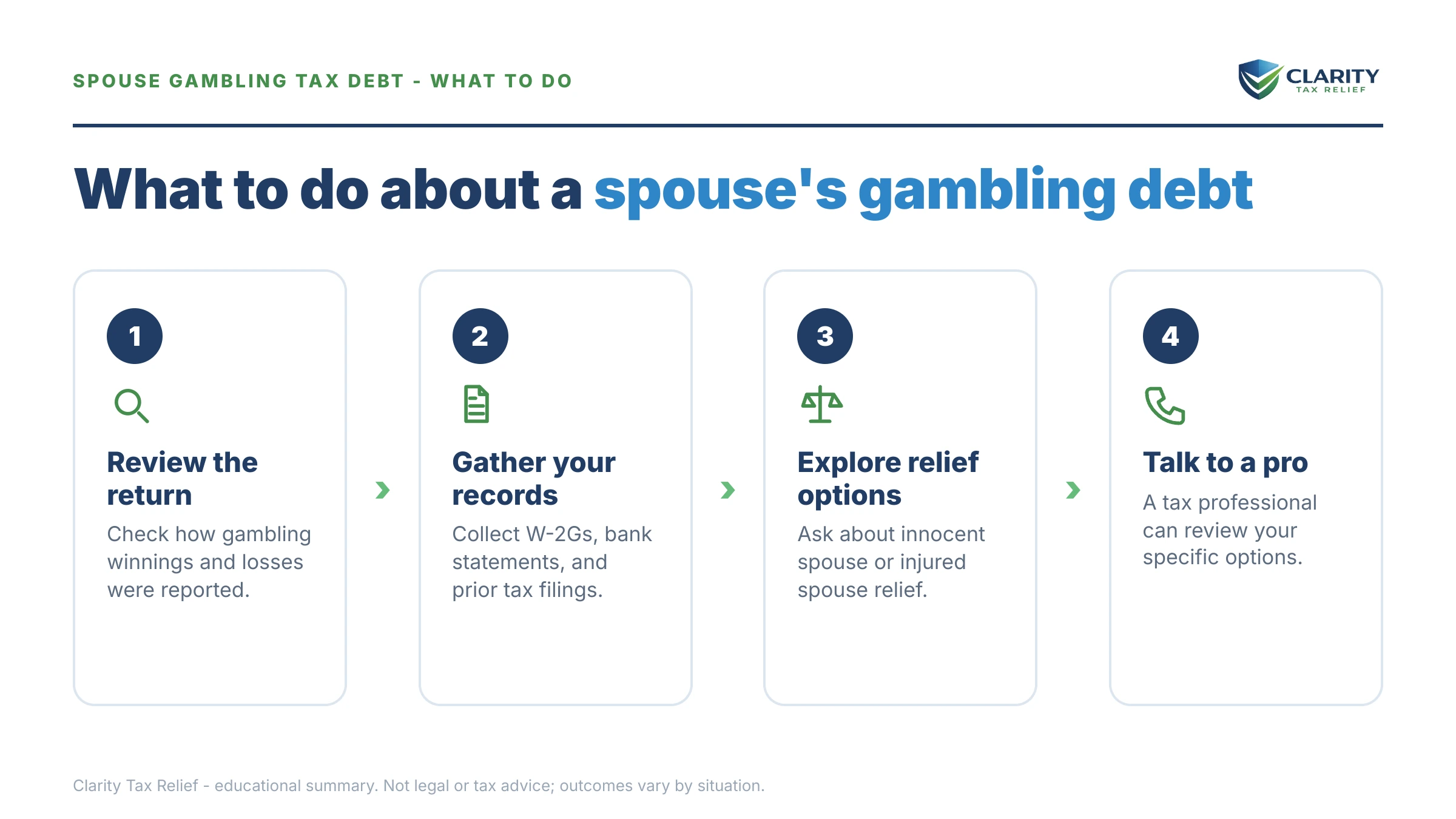
- Pull the numbers — Get the notice, the joint return for that year, and your IRS wage and income transcript showing every W-2G — confirm whose name and Social Security number the winnings were reported under.
- Classify the debt — Determine whether this is an understatement (winnings left off the return) or an underpayment (winnings reported but the tax never paid) — that single fact decides which relief provisions are open to you.
- Answer any open notice by its printed date — A CP2000 or Notice of Deficiency has a response date printed on it; missing that date converts a proposed change into an assessed debt with far fewer ways to dispute it.
- File Form 8857 if you qualify — One form requests innocent spouse relief, separation of liability, and equitable relief at the same time — and the §6015(b) and (c) paths generally close 2 years after the IRS's first collection activity against you.
- Bridge the balance while relief is pending — Put a payment plan or hardship status on any portion you may still owe so liens and levies don't land in the middle of your refinance.
Our Form 8857 walkthrough covers the form line by line, including the questions about finances, knowledge, and abuse that decide these cases.
The deadlines that decide your rights
Form 8857 relief under §6015(b) and (c) generally closes 2 years after the IRS's first collection activity against you — and it's only one of several clocks running on a gambling-spouse case:
| Trigger | Window | Right at stake if it passes |
|---|---|---|
| CP2000 proposed change | Response date printed on the notice | Disputing the winnings, or itemizing losses, before assessment |
| Notice of Deficiency (90-day letter) | 90 days | Petitioning Tax Court before paying anything |
| IRS's first collection activity against you | Generally 2 years | Innocent spouse relief §6015(b) and separation of liability §6015(c) |
| Ongoing (no fixed trigger) | While the IRS can still collect (10-year CSED) | Equitable relief under §6015(f) |
| LT11 / Letter 1058 final notice | 30 days | Collection Due Process hearing (Form 12153) before levy |
| Innocent spouse final determination (denial) | 90 days | Tax Court review of the denial |
Refinancing your home while the debt is open
An unpaid joint tax assessment can put a federal tax lien on a jointly owned home — and a filed lien sits ahead of a new mortgage unless the IRS agrees to subordinate it. That's why the refinance timeline should drive your sequencing, not the other way around.
Before a lien is filed, your leverage is highest: an installment agreement or a pending Form 8857 keeps the account out of aggressive enforcement, and most underwriters will lend around an agreed IRS payment. After a lien is filed, you're negotiating a payoff at closing or a subordination — slower, and at the lender's discretion. The full underwriting picture is in can I refinance with an IRS lien. If innocent spouse relief ultimately removes your liability, the IRS's claim against you for that debt goes with it — one more reason to file the 8857 before, not after, the loan application.
When you can handle this yourself
You don't need professional help for every version of this problem. If the balance is one you agree with and can pay within 180 days, a short-term payment plan at IRS.gov/payments costs nothing to set up. If the debt is under $50,000 and you just need time, the streamlined online agreement is genuinely a self-serve product. And if your only issue is a seized refund from a spouse's old separate debt, Form 8379 is a straightforward filing.
Experienced help changes outcomes in the harder versions: a knowledge-test case that turns on assembling bank records and casino statements your spouse controlled; a divorced allocation under §6015(c) with the ex contesting it; a lien or levy already in motion while a refinance hangs in the balance; or a denied claim heading to appeal or Tax Court, where the 90-day windows are unforgiving. If cost is the barrier, a Low Income Taxpayer Clinic or the Taxpayer Advocate Service may be able to help at no charge.
Terms on your notice, decoded
- Joint and several liability — each signer of a joint return owes 100% of the tax; the IRS can collect the whole amount from either spouse.
- Erroneous item — income omitted or a deduction wrongly claimed by one spouse; unreported gambling winnings are the textbook example.
- Understatement vs. underpayment — tax missing because the return was wrong, versus tax reported correctly but never paid; only understatements qualify for §6015(b) and (c).
- Form W-2G — the information return casinos and sportsbooks file with the IRS reporting a gambler's qualifying winnings.
- Actual knowledge vs. reason to know — knowing of the specific winnings versus facts that should have prompted questions; §6015(c) only fails on the first, and the IRS carries that burden.
- CSED — the collection statute expiration date, 10 years from assessment; a pending innocent spouse claim pauses (tolls) it.
Spouse gambling tax debt questions, answered
Am I responsible for my spouse's gambling tax debt?
If you signed a joint return for the year of the winnings, yes — joint filers are each liable for 100% of the balance, and the IRS can collect the entire amount from either of you. If you filed separately, the debt is generally your spouse's alone, though community property states can allocate half of each spouse's income to the other. Innocent spouse relief exists to remove liability you signed for unknowingly.
Does innocent spouse relief work for gambling winnings?
Yes — hidden gambling winnings are a classic "erroneous item" under Section 6015. To qualify under §6015(b) you must show you didn't know and had no reason to know about the winnings when you signed, and the request generally must be filed within 2 years of the IRS's first collection activity against you. If you're divorced or separated, separation of liability under §6015(c) is often the easier path.
What if my spouse lost more than they won — do the losses cancel the tax?
Not automatically. Gambling losses only offset winnings when they're claimed as an itemized deduction on the return for that same year, and only up to the amount of winnings — losing it all back does not erase the tax on what was won. If the return could have itemized losses and didn't, an amended return may shrink the balance; see our guide to deducting gambling losses against back taxes.
My divorce decree says my ex pays this tax debt. Am I off the hook?
No — the IRS is not a party to your divorce and is not bound by the decree. Both signers of the joint return remain liable to the IRS, and it collects from whoever has reachable wages or assets. The decree gives you a claim against your ex in state court, but the IRS-side fix is separation of liability or innocent spouse relief requested on Form 8857.
Will the IRS tell my spouse that I filed Form 8857?
Yes. The law requires the IRS to notify the other spouse and let them participate, because relief for you shifts liability toward them. The IRS will not disclose your current address or employer, and Form 8857 asks about domestic abuse specifically because it changes both the safety handling and the fairness analysis. Don't let fear of the notification stop you from filing — but plan for it.
Can we still refinance our house with this tax debt open?
Often yes, but the debt has to be managed first. Most underwriters will accept an IRS balance with an installment agreement in place and a short history of on-time payments. A filed Notice of Federal Tax Lien is a bigger obstacle and usually requires a payoff or an IRS lien subordination before closing. Start the resolution before the loan application, not during it.
What if we live in a community property state?
Community property rules can make half of your spouse's gambling winnings your income even on a separate return in states like California, Texas, and Arizona. Section 66 provides its own relief when you didn't know about the income and it would be unfair to tax you on it. The tests differ from Form 8857 relief, so the state you live in changes the strategy — see community property tax relief.
Does filing Form 8857 stop IRS collection against me?
Generally, yes — the IRS suspends most collection against the requesting spouse while an innocent spouse claim is pending, though it can still offset your tax refunds. Be aware the pause also tolls the 10-year collection statute, so a denied claim gives the IRS extra time on the back end. Collection against the gambling spouse continues normally.
Your next 24 hours
- Find three things on the notice: the tax year, the total balance, and any response date printed on it — then check whether the notice describes added income (understatement) or an unpaid return balance (underpayment).
- Gather your file: the joint return for that year, the notice itself, and — if you can get them — bank statements and your IRS wage and income transcript showing the W-2Gs, which prove whose winnings created the debt. The official form and instructions are at the IRS's About Form 8857 page.
- Get the case reviewed free: call (888) 825-7779 or use the 2-minute form. If the IRS has already started collecting, your two-year innocent spouse window is running — and the balance grows with interest every month it sits.
This guide is general information, not tax or legal advice for your specific situation. Eligibility for IRS programs depends on individual facts and circumstances; no outcome is guaranteed.