
Back Taxes
Can You Deduct Gambling Losses on Back Taxes? The 2026 Rules
The short answer: you can deduct gambling losses on back taxes only against gambling winnings from the same tax year, only by itemizing on Schedule A, and only with documentation. For 2025 and earlier years, 100% of losses count (up to winnings); starting in 2026, only 90% do. The fix is amending — or answering the CP2000 — for the debt year itself.
The IRS says you owe for a year you mostly lost. Its letter counts every W-2G jackpot as pure profit — the $120,000 in slot hits, none of the $110,000 you fed back into the machines the same weekends. That gap between what the casino reported and what you actually kept is exactly what this guide fixes, and there is a legal path to fix it for a year that's already closed.
The catch nobody tells you: losses live and die inside a single tax year. You cannot take this year's losing streak and apply it against last year's bill — but you can reopen the year the bill came from and put that year's own losses where they belonged all along. The image below shows exactly what the W-2G paper trail the IRS matched against your return looks like and where the figures driving your balance appear.
⏱ Your real clock: you generally have 3 years from the date you filed the debt-year return (or 2 years from the date you paid the tax, whichever is later) to claim losses and get money back. If a CP2000 is open, the controlling date is the response deadline printed on your notice — typically 30 days from the notice date. Interest and penalties keep accruing monthly on any unpaid balance while you decide.
Why the IRS billed you for your winnings and ignored your losses
The IRS sees 100% of your reportable gambling winnings and 0% of your losses, because casinos report wins on Form W-2G but nobody reports losses. Every slot jackpot of $1,200 or more, keno win of $1,500 or more, poker tournament cash of more than $5,000, and most other wins of $600-plus (when at least 300 times the wager) generates a W-2G with a copy sent straight to the IRS.
The IRS's Automated Underreporter program then matches those W-2Gs against your filed return. If the winnings aren't on it, the computer proposes tax on the gross amount — no losses, no offsets — and mails you a CP2000 notice. The same matching drives the huge balances we cover in casino winnings tax debt and sports betting tax debt cases: apps and sportsbooks feed the same reporting pipeline.
If you never filed at all, it gets worse. The IRS may file a substitute return using your gross winnings with no itemized deductions whatsoever — see the IRS filed a substitute return for me — which produces the most inflated version of the bill possible.
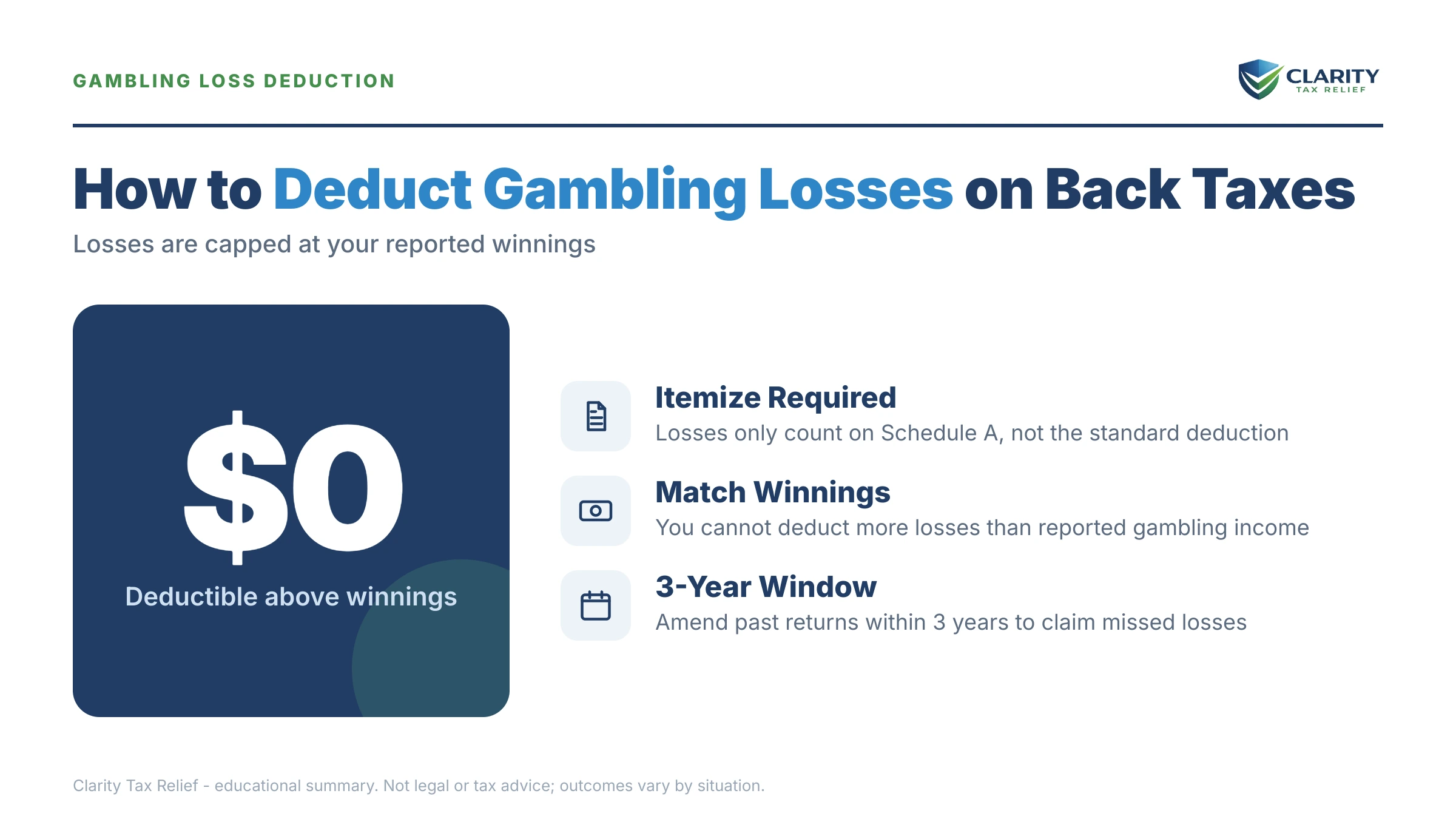
How to deduct gambling losses on back taxes: the three rules
Three rules decide whether your losses can legally shrink a back-tax bill — same year, itemized, and documented. Miss any one of them and the deduction fails, no matter how real the losses were.
Rule 1 — same year only. Losses offset winnings from the identical tax year, period. A casual gambler gets no carryback and no carryforward — a brutal 2025 at the tables cannot touch a 2022 tax debt. The only way losses help a back-tax year is if they happened in that year and you go back and claim them.
Rule 2 — you must itemize. Casual gamblers deduct losses on Schedule A, which means giving up the standard deduction for that year. If your losses plus other itemized deductions don't beat the standard deduction, claiming them changes nothing. This is why the amendment math has to be run before anything gets filed.
Rule 3 — capped and documented. The deduction can never exceed your winnings for that year, and the IRS can demand proof: session records, win/loss statements, bank activity. Filing a joint return helps here — on a joint return, one spouse's losses can offset the other spouse's winnings, since the couple's gambling activity is combined. (If the gambling was your spouse's and the debt landed on you, that's a different problem — see spouse gambling tax debt.)
One more distinction that changes everything: these rules describe casual gamblers. If gambling was genuinely your trade — full-time, systematic, profit-motivated — you may report on Schedule C instead, where the math works differently. That path has its own traps, including self-employment tax; see professional gambler taxes.
The 2026 law change: only 90% of losses count going forward
For tax years beginning in 2026, the One Big Beautiful Bill Act cuts the gambling-loss deduction to 90% of losses, still capped at winnings. That means a player who wins $100,000 and loses $100,000 in 2026 — a true break-even year — is taxed on $10,000 of income that never existed in their pocket.
For back taxes, this cuts in your favor: debt years from 2025 and earlier keep the old 100% rule. If you're amending 2022, 2023, or 2024, every documented dollar of loss (up to winnings) still counts. But it raises the stakes on current-year habits — if you're gambling in 2026 while owing for old years, the phantom-income effect will make each new balance harder to avoid. The broader picture of what the law changed for people in tax debt is in our guide to one big beautiful bill tax changes.
What happens if you ignore a gambling-income tax bill
An unanswered CP2000 about gambling winnings becomes a legally final assessment — and your loss deduction gets harder to claim at every stage after that. The sequence is automated and runs on its own schedule:
- CP2000 unanswered — the IRS treats its gross-winnings math as unchallenged. This is the cheapest, easiest stage to present your losses.
- CP3219A, the Notice of Deficiency — a statutory 90-day window to petition Tax Court. After it closes, the proposed tax is assessed as legally owed.
- The billing cycle begins — a CP14 bill (typically 21 days to pay, or 10 business days if the balance is $100,000 or more), then CP501/CP503 reminders, each adding interest and a monthly failure-to-pay penalty.
- CP504 — the IRS can seize your state tax refund, and a federal tax lien becomes a live possibility.
- LT11 / Letter 1058 — the final notice. After 30 days the IRS can levy bank accounts and, for a 1099 contractor, levy payments your clients owe you. Your Collection Due Process rights start — and expire — here.
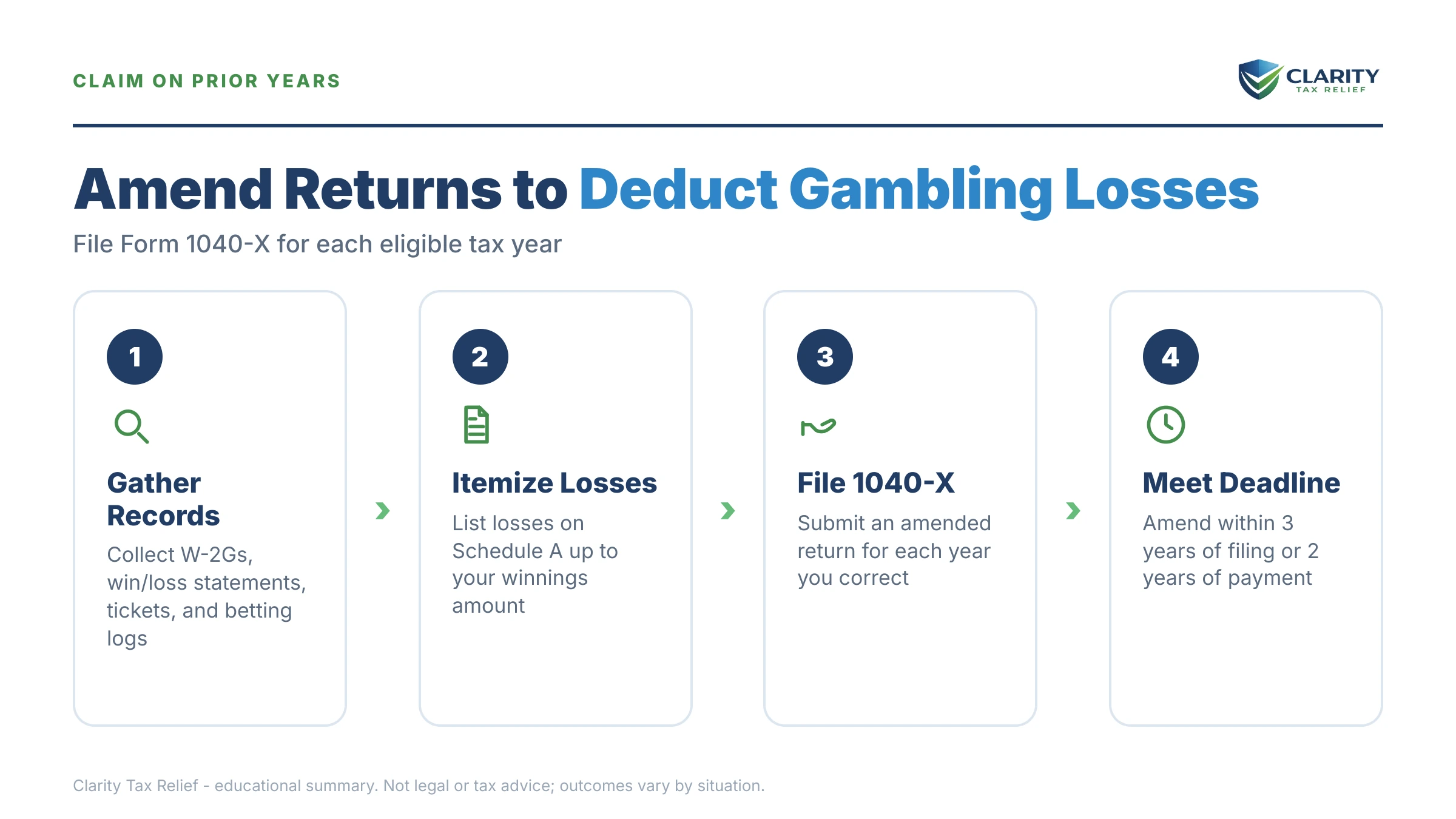
- The quiet deadline underneath it all — the 3-year refund statute on the debt year keeps running. Wait long enough and the losses become unclaimable for any amount you've paid, even though they were always real. See the 3-year refund deadline.
In 2026, don't count on slow enforcement to save you. IRS staffing is down sharply, but the matching, assessment, and levy systems are automated — the machine escalates whether or not a human ever reads your file.
Billed for winnings you didn't keep?
Send us the CP2000 or transcript. An experienced tax professional will check whether your losses can legally cut the bill — and whether your response window or 3-year amendment clock is still open. Free, confidential, no pressure.
Your options: four ways to apply losses to a back-tax year
Which filing path fixes your bill depends on one question: has the tax been formally assessed yet? The earlier in the sequence you are, the simpler — and cheaper — the fix.
| Your situation | The fix | The window |
|---|---|---|
| CP2000 proposing tax on unreported winnings (not yet assessed) | Respond to the CP2000 with your Schedule A loss figures and documentation — don't file an amended return on top of an open CP2000 | The response date printed on the notice (typically 30 days) |
| You filed and reported winnings, but never claimed losses | File Form 1040-X for that year with Schedule A — see amending a return to lower a tax debt | Generally 3 years from filing, or 2 years from payment |
| The IRS filed a substitute return (SFR) using gross winnings | File your own original return for that year claiming itemized losses; the IRS generally adjusts the assessment | No fixed cutoff — but every month adds penalties and interest |
| Balance already assessed after a missed CP2000 or an audit | Request audit reconsideration with your loss documentation | No fixed deadline for unpaid balances — but refunds of amounts already paid are limited by the 3-year/2-year statute, and collection continues while you wait |
Whichever path fits, the substance is the same: show the IRS that the debt year's winnings were legally offset by that year's itemized, documented losses — and that the balance should be recalculated.
A worked example: turning a $36,900 bill into roughly $6,800
Say you're a single 1099 contractor who cleared $85,000 from contracting in 2023 — and hit $120,000 in slot jackpots that year, every one generating a W-2G, while feeding roughly $110,000 back into the machines. You filed on time, reported the $85,000, took the standard deduction, and never mentioned the gambling. Eighteen months later a CP2000 arrives.
The IRS's math, using gross winnings only:
- Extra tax on $120,000 of added income (spanning the 22%–32% brackets): roughly $28,400
- 20% accuracy-related penalty: roughly $5,680
- Interest accrued since the return's due date: roughly $2,820
- Total proposed: about $36,900
Now the fix. 2023 is a pre-2026 year, so 100% of documented losses count, capped at the $120,000 in winnings. You gather win/loss statements and bank records showing $110,000 in losses. Itemizing means giving up 2023's $13,850 standard deduction, so the net new deduction is $110,000 − $13,850 = $96,150. Your added taxable income drops from $120,000 to $23,850:
- Extra tax on $23,850 at roughly 22%: about $5,250
- Accuracy penalty recalculated on the smaller amount: about $1,050 (and potentially removable)
- Interest, recalculated proportionally: about $520
- New total: roughly $6,800 — about $30,100 less than the notice proposed.
This is a hypothetical with rounded numbers, not a promise — your brackets, deductions, and documentation will move every figure. Two things generalize, though. First, the deduction only works because the losses came from the same year as the winnings. Second, timing matters: had these been 2026 winnings, only 90% of the $110,000 ($99,000) would count, adding roughly $11,000 back to taxable income. To see how much of your own balance is penalty and interest rather than tax, you can estimate it with our Penalty & Interest Calculator.
If losses can't erase the whole balance: resolution options
Even a successful loss claim usually leaves some real tax owed — in the example above, about $6,800. The IRS has standard programs for whatever remains, each with its own eligibility line. (The full playbook for working these yourself is in how to settle tax debt yourself.)
| Option | Who qualifies | Cost and key terms |
|---|---|---|
| Short-term payment plan | You can pay in full within 180 days | $0 setup; penalties and interest keep accruing until paid |
| Guaranteed installment agreement | Balance of $10,000 or less, all returns filed | Automatic approval; must pay off within 3 years |
| Streamlined installment agreement | Balance of $50,000 or less | Up to 72 months, set up online without full financial disclosure; interest continues |
| Offer in Compromise | Assets plus future income genuinely below the balance — means-tested, not automatic | $205 fee and 20% down for lump-sum offers (both waived if AGI ≤ 250% of the poverty line); the IRS accepted roughly 1 in 5 offers in FY2024 |
| Currently Not Collectible | Paying would prevent basic living expenses | Collection pauses; the debt and interest remain and the IRS re-reviews later |
| First-time penalty abatement / AEP | Clean compliance history in the prior 3 years | Removes penalties, not tax; starting summer 2026, the new Automatic Exemption from Penalty applies without a request |
Sequence matters: fix the balance first, then resolve what's left. Setting up a payment plan on the inflated gross-winnings number means paying — with interest — tax you may never have owed.
Proving gambling losses: what the IRS actually accepts
The IRS's own guidance calls for a session-level record of your gambling — not a shoebox of losing tickets. A credible reconstruction for a back-tax year layers three kinds of evidence:
- A session log (or a good-faith reconstruction of one): dates, locations, games or wager types, and amounts in and out per session. Casual gamblers report by session — you net each sitting, not each spin — which is also why the log is the backbone of the claim.
- Win/loss statements from every casino, sportsbook, and app, requested from their player's-club or account records. Useful corroboration, but the IRS treats them as estimates because they only capture carded play.
- Money-trail records: bank statements, ATM withdrawals at or near casinos, credit-card cash advances, and app deposit histories. These are often the most persuasive piece, because they're third-party records you can't backdate.
One warning: reconstructing losses is legitimate; inflating them is not. A loss claim that exceeds what your money trail can plausibly support invites an examination that costs more than the deduction saves.
How to claim gambling losses for a back-tax year, step by step
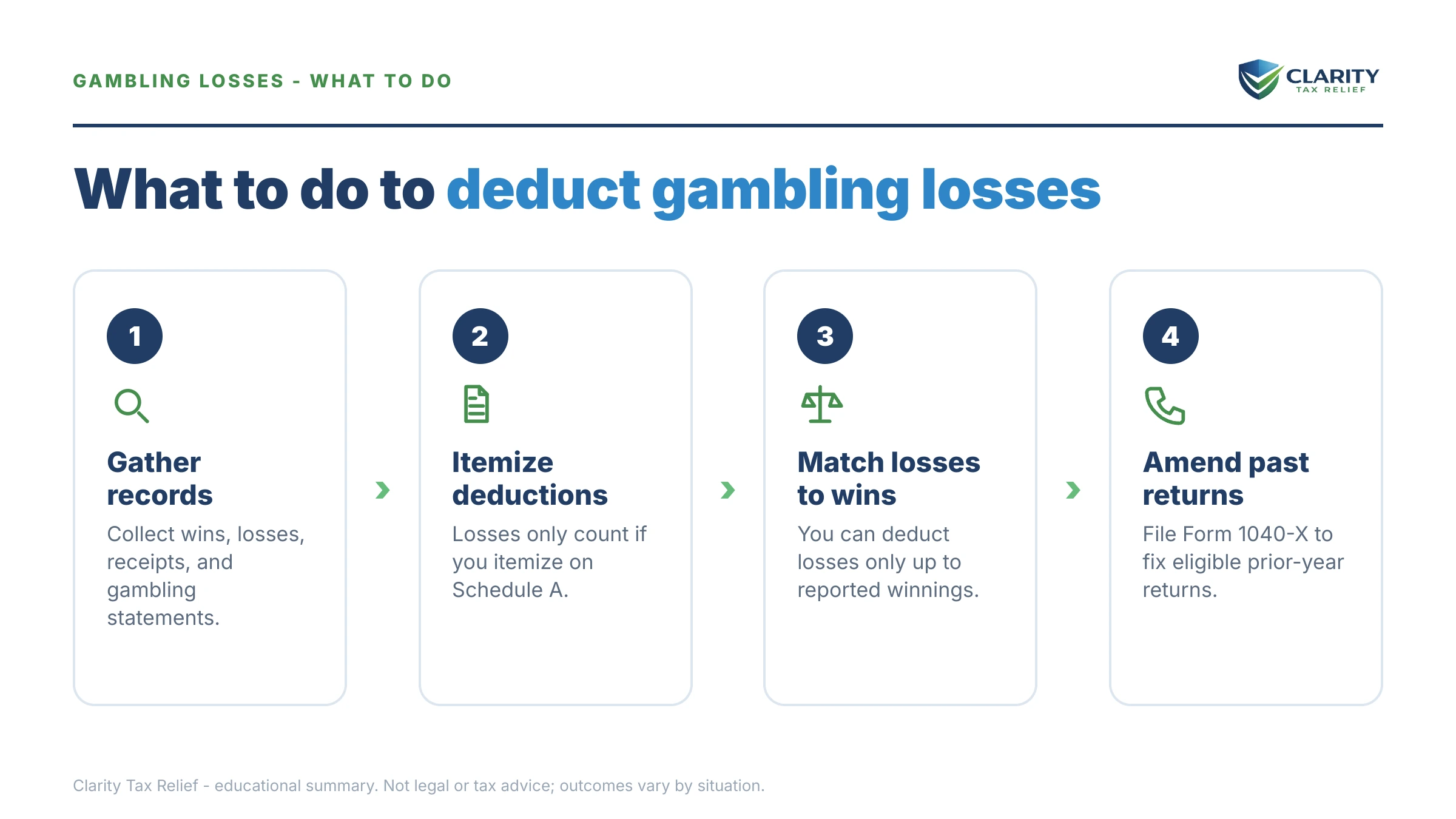
- Pull your IRS transcripts. Get your wage and income transcript for the debt year to see every W-2G the IRS matched, and your account transcript to see what has actually been assessed.
- Reconstruct your losses. Request win/loss statements from every casino, sportsbook, and betting app you used that year, then back them with bank statements, ATM withdrawals, and any session notes or tickets.
- Run the itemizing math. Total your losses (capped at that year's winnings) plus your other itemized deductions and confirm they beat that year's standard deduction before you file anything.
- File the right fix. Respond to the CP2000 if the window is still open, file Form 1040-X if you already filed, file an original return if the IRS filed an SFR, or request audit reconsideration if the assessment is final.
- Resolve any remaining balance. Set up a payment plan, or pursue an offer or hardship status for what the losses could not erase, before the collection notices escalate.
- Get a professional review for large numbers. Assessments over roughly $10,000, multiple open years, or a professional-gambler question are where experienced representation changes the outcome.
Reading your transcript: the codes behind a gambling-income bill
Your account transcript tells you exactly where the W-2G mismatch sits in the pipeline — and which fix from the table above still applies. These are the codes that show up most in gambling-income cases:
| Code | What it means | What to do |
|---|---|---|
| 922 | Underreporter review — the W-2G mismatch has been flagged | Expect (or answer) a CP2000; this is the best stage to present losses |
| 290 | Additional tax assessed — the proposed amount became final | The CP2000 window closed; use audit reconsideration or an amended return |
| 276 | Failure-to-pay penalty posted to the balance | Check penalty-relief eligibility once the tax itself is corrected |
| 196 | Interest charged to the account | Interest recalculates automatically if the underlying tax is reduced |
| 971 | A notice was issued | Match the date to the letter in your mail pile — it tells you which stage you're at |
When you can handle this yourself — and when help changes the outcome
Plenty of gambling-loss fixes are genuinely DIY. You likely don't need professional help if all of these are true: it's one tax year, the CP2000 window is still open, you agree with the winnings figure the IRS matched, your losses are documented by a single casino's win/loss statement plus bank records, and the itemizing math clearly beats the standard deduction. That case is a well-organized CP2000 response, and you can write it yourself.
Experienced help changes outcomes in the harder patterns: the assessment is already final and you're into audit-reconsideration territory; the IRS filed substitute returns across multiple unfiled years; the winnings span many casinos, apps, and states and the reconstruction is genuinely contested; a levy notice (CP504 or LT11) has already arrived and the collection clock is running alongside the correction; or the professional-vs-casual classification question is live, which swings both the deduction rules and self-employment tax. In those cases, the order of operations — correct the balance, protect against levy, then resolve the remainder — is where representation earns its fee.
If your debt year is closing in on the three-year mark, don't let the classification debate run out the clock — have an experienced tax professional review your transcripts and loss records free before the refund statute decides for you.
Terms on your notice, decoded
- Form W-2G — the information return casinos and sportsbooks file when a win crosses the reporting thresholds; the IRS's copy is what triggered your bill.
- AUR (Automated Underreporter) — the IRS matching program that compares W-2Gs and 1099s against your return and generates CP2000s.
- Session method — the rule that casual gamblers measure wins and losses per gambling session, not per individual bet.
- Substitute for return (SFR) — a return the IRS files for a non-filer using gross reported income and no itemized deductions.
- Audit reconsideration — the process for reopening an already-assessed balance with evidence the IRS never saw, like loss documentation.
- RSED (refund statute expiration date) — the deadline (generally 3 years from filing or 2 years from payment) after which money you've already paid can't come back, even if the deduction was valid.
Gambling losses and back taxes: your questions, answered
Can I deduct gambling losses from back taxes I already owe?
Not directly — gambling losses only offset gambling winnings from the same tax year. If the year you owe for included unreported winnings, you can amend that year (or respond to the CP2000) with documented, itemized losses and shrink the assessment. Losses from this year never reduce a prior year's balance, because casual gamblers get no carryback or carryforward.
Can gambling losses offset my 1099 or wage income?
No. For a casual gambler, losses are deductible only up to the amount of gambling winnings — never against contracting income, wages, or investment income. If you won $40,000 and lost $60,000 in the same year, you can deduct at most $40,000 for 2025 and earlier years; the extra $20,000 simply disappears for tax purposes.
Does a casino win/loss statement count as proof for the IRS?
It helps, but the IRS treats win/loss statements as estimates rather than conclusive proof, because they only capture play tracked on your player's card. The strongest evidence is a session-by-session log — dates, locations, games, amounts — backed by ATM withdrawals, bank records, and tickets. For a back-tax fix, submit the win/loss statement plus every corroborating record you can reconstruct.
Can I deduct gambling losses if I took the standard deduction?
Not without switching. Gambling losses are an itemized deduction on Schedule A, so claiming them means giving up the standard deduction for that year. The switch only pays off when your losses plus your other itemized deductions exceed that year's standard deduction. Run both calculations before amending — sometimes the losses are real but the math saves nothing.
What changed for gambling losses in 2026?
Starting with tax years beginning in 2026, the One Big Beautiful Bill Act limits the deduction to 90% of your losses, still capped at your winnings. A break-even player with $50,000 in wins and $50,000 in losses now pays tax on $5,000 of phantom income. Back-tax years from 2025 and earlier keep the old rule: 100% of losses, up to winnings.
How far back can I amend a return to claim gambling losses?
Generally three years from the date you filed the original return, or two years from the date you paid the tax, whichever is later, to get money back. If the balance is assessed but still unpaid, audit reconsideration can reopen the year even after that window — but you cannot recover amounts already paid once the refund statute closes.
The IRS filed a return for me with all my W-2G winnings. Can I still claim losses?
Yes. A substitute for return (SFR) counts your gross winnings with no itemized deductions, which is why SFR balances run so high. File your own original return for that year claiming documented, itemized losses, and the IRS will generally adjust the assessment to match. This is often the single biggest balance reduction available to a non-filer with casino or sportsbook income.
Are the rules different for professional gamblers?
Yes. A professional gambler reports on Schedule C, where losses and business expenses offset winnings before the income ever reaches the front of the return — no itemizing required — but the total deduction still cannot exceed winnings, and any net profit triggers self-employment tax. The IRS applies a strict facts-and-circumstances test; heavy recreational play does not make you a professional.
Will my state let me deduct gambling losses too?
Not always. Several states tax gross gambling winnings and allow no deduction for losses at all, so fixing your IRS balance may leave a matching state bill untouched. Before assuming the federal fix carries over, check your state revenue agency's rules for the specific back-tax year — state amendment windows and loss rules are set by state law, not the IRS.
Your next 24 hours
- Find the two numbers driving your bill. On a CP2000, it's the "reported to IRS by others" winnings figure and the response date; on a transcript, it's the tax year and the code 290 or 922 line. Those two facts decide which fix applies.
- Start the records requests today. Email or call every casino, sportsbook, and betting app you used in the debt year for win/loss statements, and pull that year's bank statements and your filed return. Statements can take weeks — the request is the step that can't wait.
- Get the math checked free. Use the form or call (888) 825-7779 and an experienced tax professional will confirm whether your losses legally cut the balance and whether your CP2000 response date or 3-year amendment window is still open — every month of waiting adds interest to a number that may already be wrong.
For the primary sources on everything above, see the IRS's own pages on gambling income and losses (Topic 419) and Form W-2G, and its payment options at IRS.gov/payments.
This guide is general information, not tax or legal advice for your specific situation. Eligibility for IRS programs depends on individual facts and circumstances; no outcome is guaranteed.