
Owe the IRS
Sports Betting Tax Debt: Why You Owe the IRS and How to Fix It (2026)
The short answer: sports betting tax debt exists because the IRS taxes every winning bet at its gross amount; losing bets count only if you itemize. Sportsbooks report wins on Form W-2G and rarely withhold, so the bill lands after you file. It's resolvable through a payment plan, hardship status, or in limited cases a settlement.
You placed bets from your phone through a season or two of retirement, cashed some wins, ate some losses — and now the IRS says you owe tens of thousands on money you never felt you kept. That gap isn't a mistake. It's how gambling tax math works, and it's fixable in a specific order.
Most of these bills trace back to a stack of Forms W-2G you may never have paid attention to. The image below shows exactly what these forms look like and where the winnings figure the IRS matched against your return appears — that number is the whole fight.
⏱ The clock that's actually running: there's no single deadline on sports betting tax debt, but the meter runs monthly. The failure-to-pay penalty adds 0.5% of the balance every month, and interest compounds daily on top. On a $54,600 balance, that's roughly $273 in penalty alone for each month you wait.
Why sports betting tax debt happens — even when you lost money overall
The IRS taxes every winning sports bet at its gross amount, and losing bets offset nothing unless you itemize deductions. That single asymmetry is why people who broke even — or finished down — end up with five-figure tax bills.
Here's the mechanic. Every winning wager is income the moment it settles. Your losing wagers don't reduce that income on the same line; they can only be claimed as an itemized deduction on Schedule A, capped at the amount you won. If you take the standard deduction, your losses count for exactly zero.
Say your apps show $140,000 in winning bets and $145,000 in losing bets across a year. In your pocket, you lost $5,000. On a return with the standard deduction, you have $140,000 of taxable gambling income and no offset. That's the whole trap in one sentence.
Two more mechanics make it worse for online bettors specifically:
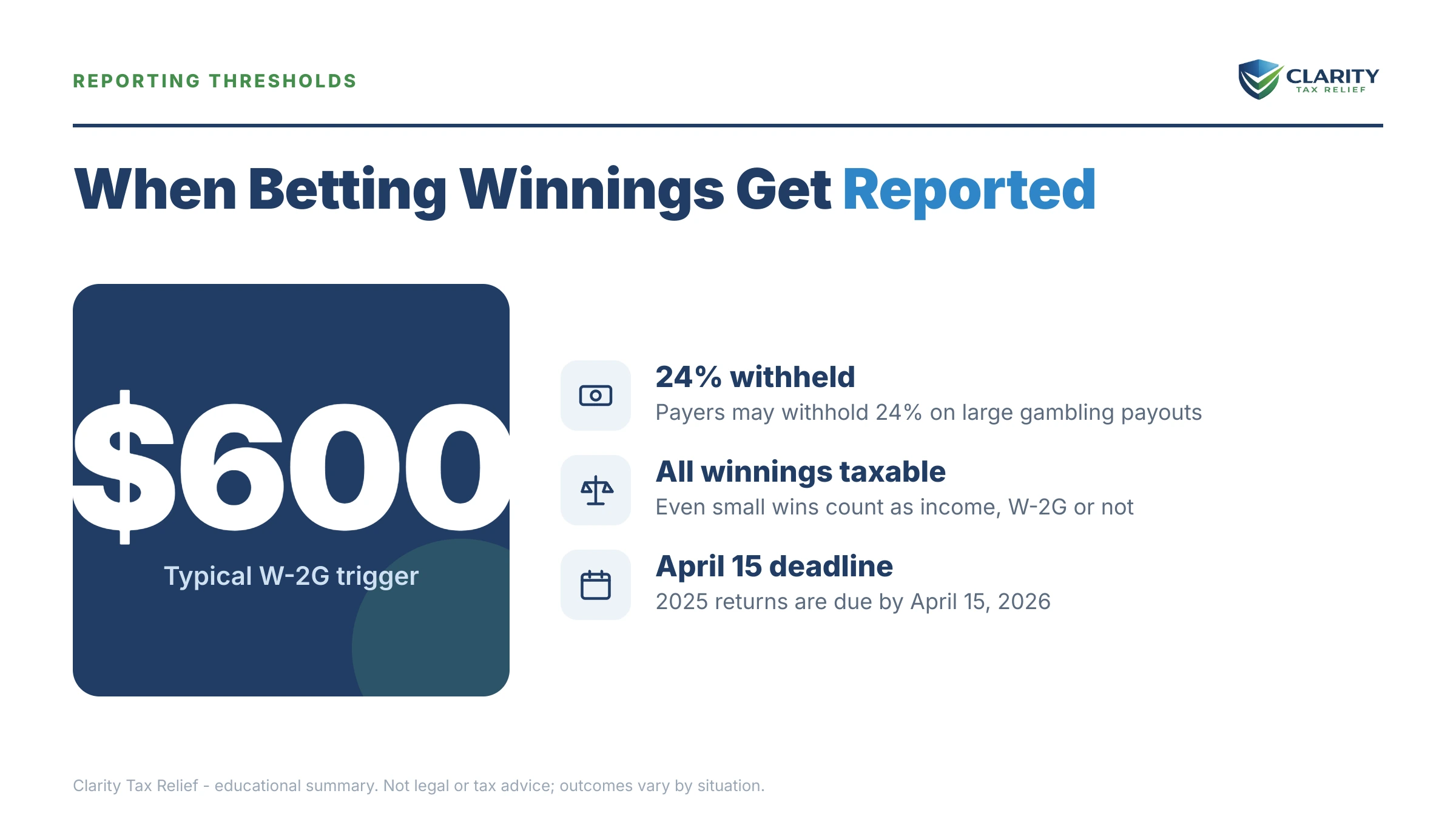
- Sportsbooks rarely withhold. Federal withholding generally kicks in only on payouts over $5,000 at very long odds — a threshold most sports bets never approach. Casinos at least withhold on jackpots; betting apps mostly pay you gross. Nothing was ever set aside for the tax.
- The IRS sees the wins anyway. Books file Form W-2G for qualifying wins (generally $600 or more at 300 times the wager or better), and some issue 1099s for promos, bonuses, and fantasy profits. The IRS matches those forms against your return by Social Security number. Winnings that never appear on a return typically surface later as a CP2000 notice — often built from gross W-2G figures with no losses considered at all.
If you're retired, there's a third layer most articles skip. Gross winnings inflate your adjusted gross income even when losses cancel them in real life. A higher AGI can make up to 85% of your Social Security benefits taxable and can raise your Medicare premiums two years later. The same wins can effectively get taxed three ways — which is how a break-even betting year produces a bill like $54,600. This compounding is exactly what we cover for fixed-income taxpayers in retired and owe back taxes.
One 2026-specific change to know: under the new tax law, starting with the 2026 tax year only 90% of gambling losses are deductible, even for itemizers. Our guide to the one big beautiful bill tax changes covers what that means if you're still betting this year. For app-specific reporting quirks, see owe taxes on DraftKings winnings.
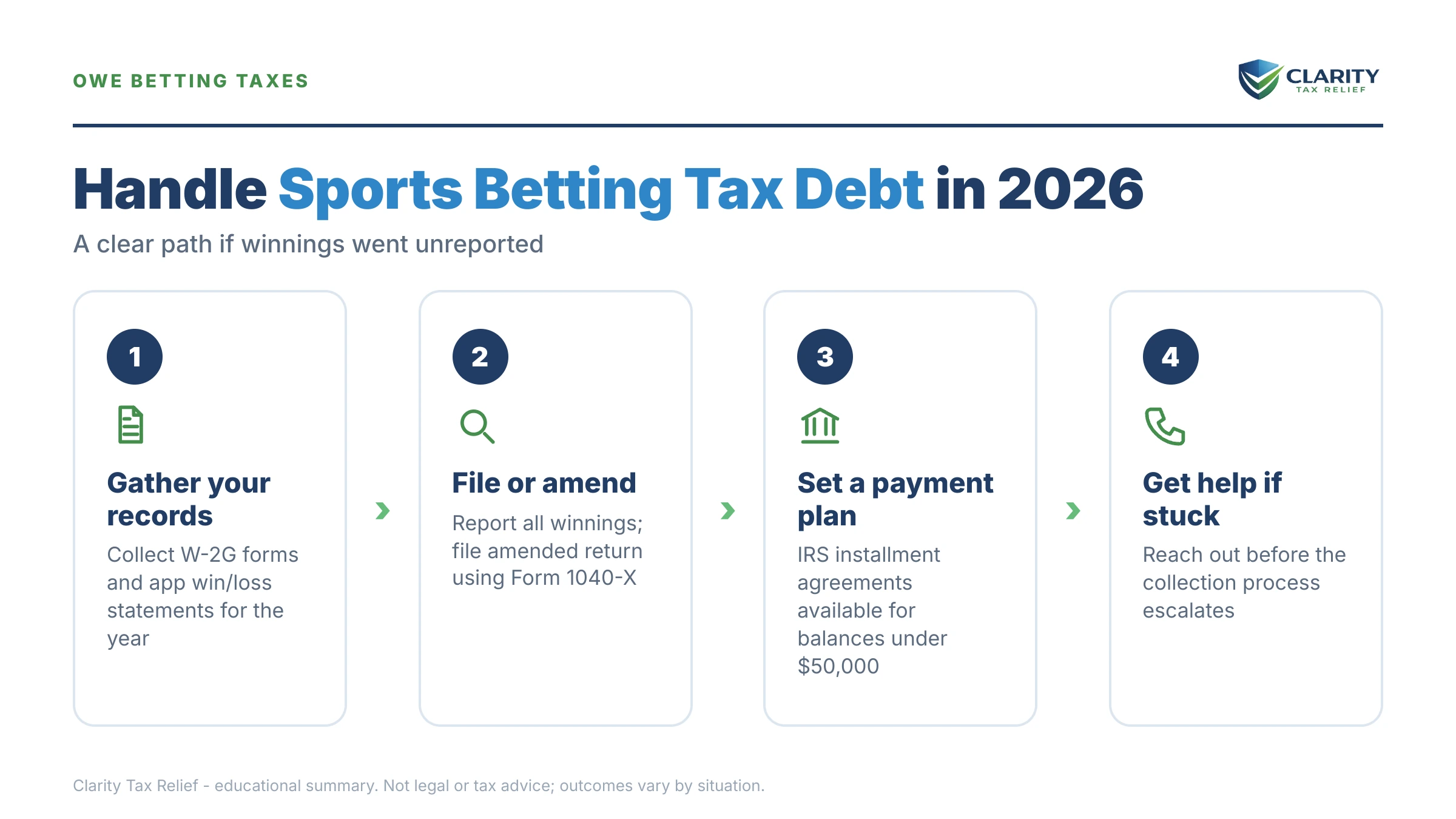
What happens if you ignore sports betting tax debt
Ignored sports betting tax debt moves through the same automated IRS collection sequence as any balance — and for a retiree, it ends at your bank account and your Social Security check. The sequence runs on computers, not case workers, so 2026's IRS staffing cuts don't slow it down.
- The balance posts. Either you filed and couldn't pay (a CP14 bill arrives), or the IRS caught unreported W-2Gs and sent a CP2000, then a CP3219A deficiency notice, then assessed the tax. Interest and the monthly failure-to-pay penalty start immediately.
- Reminder notices (CP501/CP503). Still just bills — but the balance grows every month, and each notice you ignore removes negotiating room.
- CP504 — intent to levy. The IRS can now seize your state tax refund under IRC §6331(d), and a federal tax lien becomes a live risk.
- LT11 / Letter 1058 — final notice. This starts a 30-day clock and your Collection Due Process rights (requested on Form 12153). After it runs, the IRS can levy without further warning.
- Levies. A bank levy freezes funds for 21 days before they're sent to the Treasury. Under the Federal Payment Levy Program, the IRS can take up to 15% of your Social Security — continuously, every month. And once the total debt reaches $66,000 (the 2026 threshold), the IRS can certify it to the State Department and block your passport — see passport revoked for tax debt.
A $54,600 balance accruing penalties and interest is closer to that $66,000 passport line than it looks. The order of stages above is fixed; the only variable is how far you let it run.
Staring at a betting tax bill that doesn't match reality?
Before you agree to pay a number built from gross W-2Gs, get it reviewed free. An experienced tax professional will check whether the IRS's winnings figure is even right, whether your losses can still be claimed, and which resolution fits a fixed income — while the balance is still in the notice stage.
Your options when you owe the IRS for sports betting
A $54,600 sports betting tax debt sits just above the $50,000 cutoff for the IRS's streamlined online payment plan — and that cutoff shapes your whole strategy. But before you negotiate payment on any number, make sure the number itself is right.
First, shrink the number
IRS assessments built from W-2Gs alone routinely overstate what you truly owe, because they count every reported win and zero losses. If you can document losing wagers — annual win/loss statements from each app, account histories, a wagering log — amending the return to itemize losses on Schedule A may cut the bill substantially. Whether that beats your standard deduction depends on your other deductions; the math is worked through in deducting gambling losses against back taxes.
Penalty relief is a second lever. If the prior three years were clean, First-Time Penalty Abatement can remove the failure-to-file or failure-to-pay penalty for one year — and starting summer 2026, the IRS's new Automatic Exemption from Penalty applies similar relief automatically, no request needed. You can estimate how much of your balance is penalties and interest with our Penalty & Interest Calculator before deciding what to fight.
Then pick a resolution
| Option | Who it fits | Cost and key terms |
|---|---|---|
| Short-term payment plan | You can pay in full within 180 days | $0 setup; interest and penalties continue but enforcement stops |
| Streamlined installment agreement | Balance $50,000 or less — set up online, up to 72 months | Setup fee applies (reduced with direct debit); no financial disclosure required |
| Non-streamlined installment agreement | Balance over $50,000 | Form 9465 plus financial disclosure (Form 433-F); IRS reviews income and assets |
| Currently Not Collectible | Any payment would prevent covering basic living expenses — common on Social Security-only income | Free to request via Form 433-F; collection pauses, debt and interest remain, IRS reviews periodically |
| Offer in Compromise | Income and assets genuinely can't cover the debt before the collection statute runs | $205 fee and 20% down on lump-sum offers — both waived with low-income certification (AGI ≤ 250% of poverty); roughly 1 in 5 offers accepted in FY2024 |
| Penalty abatement (FTA / AEP) | Clean compliance for the prior 3 years, or reasonable cause (illness, disaster) | Free; removes penalties, not tax or interest |
How those options line up by balance:
| Balance | Realistic path | Watch out for |
|---|---|---|
| Under $10,000 | Guaranteed installment agreement — the IRS must accept a qualifying plan | Interest keeps accruing; pay it off faster than the minimum if you can |
| $10,000–$25,000 | Streamlined plan online in minutes | A missed year of quarterly filings can void the streamlined path |
| $25,000–$50,000 | Streamlined plan; direct debit typically required near the top of the band | Refunds will be offset to the debt every year until it's paid |
| $50,000–$66,000 | Pay down below $50,000 for online setup, or file Form 9465 with financials; CNC/OIC if unaffordable | You're approaching the $66,000 passport-certification line |
| Over $66,000 | Financial-disclosure agreement, CNC, or OIC — usually with professional help | Passport certification; possible revenue officer assignment |
If your balance is over the streamlined line, the disclosure process is covered step by step in IRS payment plan over $50,000.
A worked example: $54,600 on a fixed income
Say you owe $54,600 from two seasons of app betting, and your income is $2,600/month in Social Security plus a $900/month pension — $3,500 total. This is hypothetical, but the arithmetic is real:
- Pay down $4,601 first. That drops the balance to $49,999, under the online streamlined cap. Spread over 72 months, that's about $695/month ($49,999 ÷ 72), with interest continuing to accrue on the shrinking balance.
- Or file Form 9465 on the full $54,600. Roughly $758/month over 72 months ($54,600 ÷ 72) — but above $50,000 the IRS will want Form 433-F financials first, and it may push for more based on what those financials show.
- Or face the math honestly. After housing, utilities, food, and medical costs on $3,500/month, the IRS's own allowable-expense standards may show you can't afford $695. That's not a dead end — it's the fact pattern where Currently Not Collectible status, a partial-pay agreement, or an Offer in Compromise becomes the right answer instead of a plan you'll default on.
- The cost of doing nothing: about $273/month in failure-to-pay penalty plus daily-compounding interest — and eventually a 15% Social Security levy of about $390/month, taken without your consent.
Notice the comparison: a levy takes $390/month indefinitely and the balance still grows. A resolution you choose costs about the same or less and actually ends. Hardship rules for benefit-only households are detailed in IRS hardship on Social Security.
How to respond to sports betting tax debt, step by step
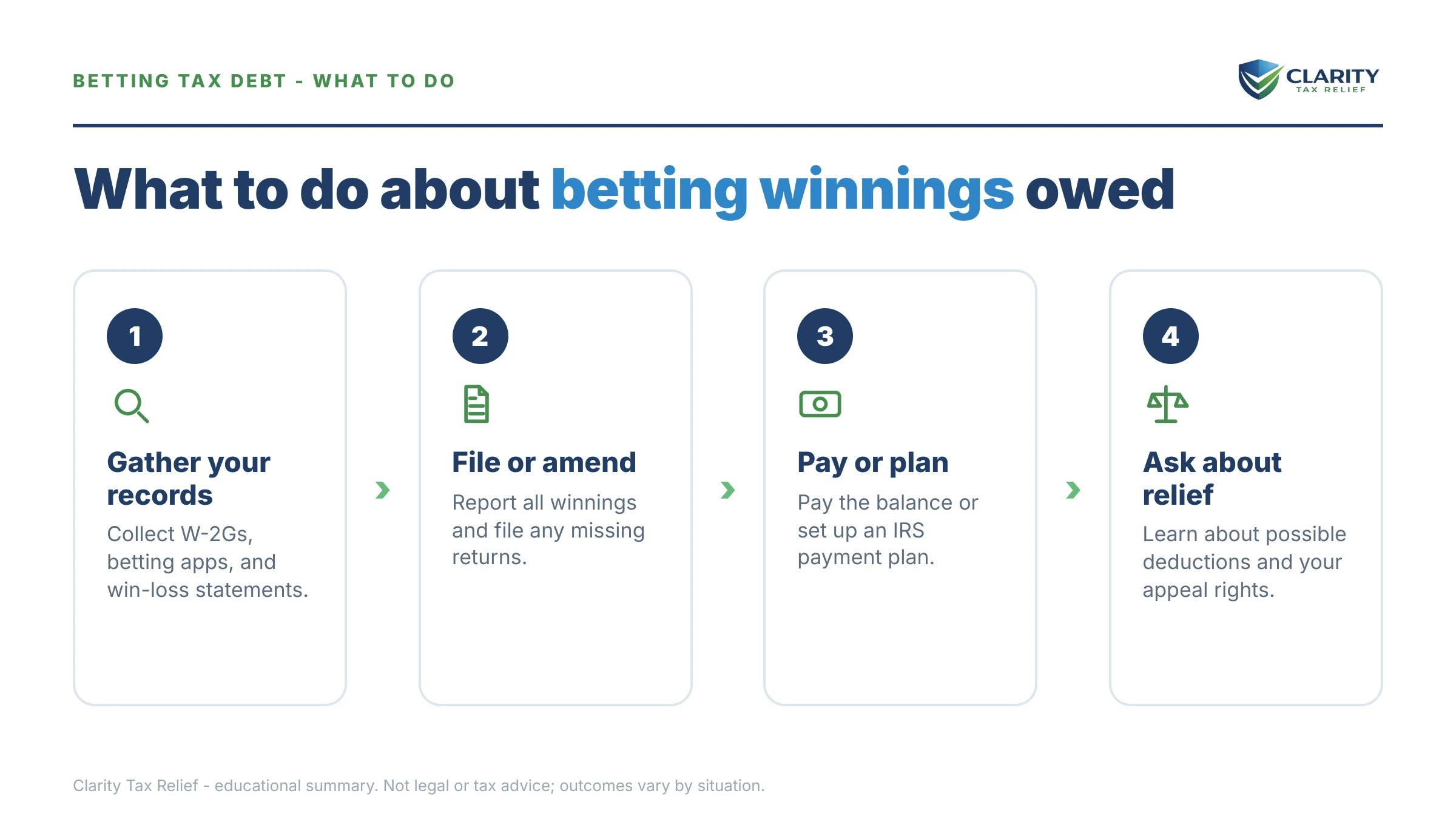
- Pull your IRS wage and income transcript. Download it free from your IRS online account. It lists every W-2G and 1099 sportsbooks filed under your Social Security number, so you can see exactly what the IRS is matching against.
- Recalculate what you actually owe. Request annual win/loss statements from every app you used and compare the gross winnings on the transcript with your own records. IRS figures built from W-2Gs alone often overstate the real liability.
- Amend the return if losses change the math. If itemizing documented losses on Schedule A beats your standard deduction, file Form 1040-X to shrink the assessment before you negotiate payment on it.
- Set up a resolution before enforcement starts. Pick the option that fits your balance and income — a payment plan, currently-not-collectible status, or an Offer in Compromise — and get it in place while you are still in the notice stage.
- Protect your Social Security if you cannot pay. If any monthly payment would squeeze basic living expenses, submit Form 433-F and ask for hardship status before a 15% benefit levy ever starts.
When you can handle this yourself — and when help changes the outcome
Plenty of sports betting tax debts are genuinely a do-it-yourself fix. If you agree with the IRS's number, the balance is under $50,000, and a streamlined payment fits your budget, you can set the plan up online in an afternoon — our how to settle tax debt yourself guide walks through every program without a middleman. Same if you can pay in full within 180 days: the short-term plan costs nothing to set up.
Experienced help earns its cost in a few specific situations:
- The IRS built your bill from gross W-2Gs and ignored your losses. Reconstructing wagering records across multiple apps and amending correctly is where most self-filers give up — and where the biggest dollar reductions live.
- Multiple years are involved — some unfiled, some underreported. The order you fix them in changes the total.
- A levy notice on your Social Security has already arrived. The 30-day appeal window and hardship-release process have exact procedural requirements.
- You may be an OIC candidate on a fixed income. The offer math turns on how the IRS values your home equity, retirement accounts, and future income — get it wrong and you've disclosed your entire financial life for a rejection.
And if betting is still ongoing at meaningful volume, the session-method and self-employment questions in professional gambler taxes may apply to you.
Terms on your notice, decoded
- Form W-2G — the form a sportsbook files with the IRS (and sends you) reporting a qualifying gambling win; details at the IRS's About Form W-2G page.
- Gross winnings — the full amount of every winning bet, before any losing bets are considered; this is the number the IRS taxes.
- CP2000 — the automated underreporter notice sent when forms filed under your SSN don't match your return.
- Standard deduction vs. itemizing — gambling losses are deductible only if you itemize on Schedule A; taking the standard deduction forfeits them entirely.
- FPLP — the Federal Payment Levy Program, which lets the IRS take up to 15% of federal payments like Social Security, continuously.
- CSED — the collection statute expiration date; the IRS generally has 10 years from assessment to collect, though appeals, offers, and bankruptcy pause the clock.
Sports betting tax debt questions, answered
Do I owe taxes on sports betting if I lost money overall for the year?
Yes, often. The IRS taxes each winning wager as gross income, while losing wagers only count if you itemize deductions on Schedule A. If you take the standard deduction — as most retirees do — your losses provide no offset at all, so you can owe real tax in a year you finished down. Starting with the 2026 tax year, even itemizers can deduct only 90% of gambling losses.
How does the IRS know about my sports betting winnings?
Sportsbooks report qualifying wins to the IRS on Form W-2G, and some issue 1099s for bonuses, promotions, and fantasy profits. The IRS computer-matches those forms against your return, and a mismatch typically triggers a CP2000 underreporter notice a year or more after you file. Even wins that never generated a form are still taxable income, and the IRS can obtain account records if it examines you.
Can the IRS take my Social Security check for sports betting tax debt?
Yes. Through the Federal Payment Levy Program, the IRS can take up to 15% of your Social Security retirement benefits, and the levy continues every month until the debt is resolved or you prove hardship. You will receive warning notices first, including a final notice with 30 days of appeal rights. If the levy would leave you unable to cover basic living expenses, you can request a hardship release.
Can I deduct my gambling losses after the IRS already billed me?
Sometimes. If you can document your losing bets — app statements, account histories, a wagering log — you may be able to amend the return with Form 1040-X, itemize the losses on Schedule A, and shrink the assessment. Losses only offset winnings up to the amount you won, never more, and starting with the 2026 tax year only 90% of losses are deductible. Whether amending beats the standard deduction depends on the size of your other deductions.
Do DraftKings, FanDuel, and other sportsbooks withhold taxes on winnings?
Rarely. Federal withholding generally applies only to very large payouts at long odds — typically over $5,000 at 300-to-1 or better — which most sports bets never hit. That means the tax on a year of winning wagers usually arrives as a lump-sum bill after you file, or as a CP2000 notice if the winnings never made it onto your return.
What are my options if I owe the IRS more than $50,000 from sports betting?
Above $50,000 you lose the streamlined online payment plan, so the IRS will typically want Form 9465 and financial disclosure before approving monthly payments. Many people just over the line pay the balance down below $50,000 to regain online eligibility. If payments genuinely are not affordable on your income, currently-not-collectible status or an Offer in Compromise may fit — both are means-tested against your actual finances.
Can sports betting tax debt be settled for less through an Offer in Compromise?
Only if your finances qualify. An OIC is accepted when the offer equals or exceeds what the IRS calculates it could realistically collect from your income and assets — the IRS accepted roughly 1 in 5 offers in FY2024. Retirees on fixed incomes with modest assets are sometimes genuine candidates, but home equity and retirement accounts count against you. The application fee is $205, waived with low-income certification.
Will unpaid sports betting taxes affect my passport?
They can. Once your total tax debt, penalties, and interest reach $66,000 (the 2026 threshold), the IRS can certify the debt to the State Department, which can deny a passport renewal or new application. Getting into a payment plan, hardship status, or a pending Offer in Compromise generally blocks or reverses certification. A $54,600 balance left to accrue can cross that line within a few years.
Your next 24 hours
- Find the IRS's winnings number. On your notice, locate the tax year and the income figure the IRS is using — or log into your IRS online account and pull your wage and income transcript to see every W-2G filed under your SSN.
- Gather your side of the math. Request annual win/loss statements from every betting app you used, and pull last year's return and a simple list of your monthly income and expenses.
- Get the free case review. Call (888) 825-7779 or use the 2-minute form. Every month this balance sits unresolved adds roughly half a percent in penalty plus daily interest — and moves a fixed-income household one notice closer to a Social Security levy. Payment options are laid out at the IRS payment plans page, and free representation for qualifying low-income taxpayers exists through the Taxpayer Advocate Service.
This guide is general information, not tax or legal advice for your specific situation. Eligibility for IRS programs depends on individual facts and circumstances; no outcome is guaranteed.